
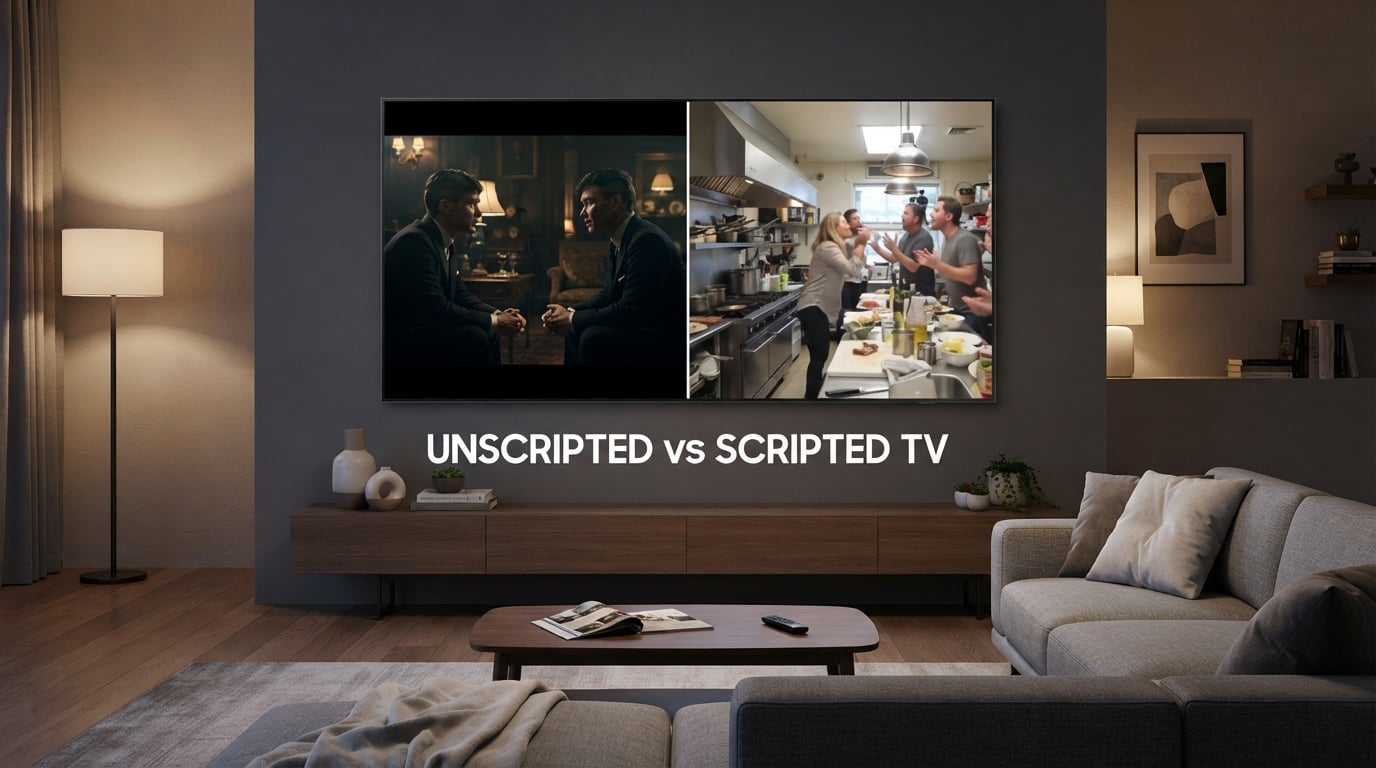
If you’ve ever wondered whether the dramatic fight on reality TV was real or whether your favorite drama series was shot scene by scene in a writers room, you’re asking exactly the right questions. The unscripted vs scripted TV debate shapes how we watch, what we binge, and even how the industry builds shows for streaming platforms in 2026.
I spent the last few months talking to producers, writers, and editors on both sides of the camera. What I found surprised me: the line between unscripted and scripted TV is blurrier than most viewers realize. This guide breaks down what each format actually means, how it gets made, and why the difference matters for your next binge session.
By the end of this article, you’ll know exactly what makes a show scripted or unscripted, why “unscripted” is a misleading label, and how hybrid formats are reshaping what we consider television.
Table of Contents
What Is Scripted TV?
Scripted television is content produced with a written script. Every line of dialogue, every plot point, and every character beat comes from a team of writers working in a writers room before cameras roll.
The process typically starts with a showrunner pitching a concept to a network or streaming platform. From there, writers develop episodes beat by beat, dialogue by dialogue. Scripts go through multiple drafts, table reads, and revisions before production begins. Once filming starts, actors perform the exact words on the page, sometimes with room for small improvisations.
Examples of scripted TV include:
Drama series like Breaking Bad, Game of Thrones, and Succession
Comedy series like The Bear, Ted Lasso, and Abbott Elementary
Sci-fi and fantasy like Stranger Things and The Mandalorian
Limited series like Chernobyl and The Queen’s Gambit
The strength of scripted TV is control. Writers control the narrative arcs, the pacing, and the emotional payoff. That control is why prestige dramas often feel like 10-hour novels with budgets to match.
Scripted shows also tend to be the ones critics reward. The Emmys, Golden Globes, and SAG Awards all have dedicated categories for scripted drama and comedy. That recognition fuels the perception that scripted work is somehow more legitimate than unscripted, though that perception is shifting fast.
What Is Unscripted TV?
Unscripted television is content produced without a written script. The term covers reality TV, documentary series, talk shows, game shows, and live events. Real people, not actors, drive the action on screen.
Instead of a script, unscripted TV relies on a format. Producers design situations, cast participants, and build story arcs through editing rather than writing. A reality competition like Survivor has a structure, but no one hands Jeff Probst a script before tribal council. The drama unfolds from the people, the circumstances, and how producers shape the footage afterward.
Examples of unscripted TV include:
Reality competition shows like Survivor, The Amazing Race, and Love Island
Documentary series like Making a Murderer, Tiger King, and The Last Dance
Talk shows like The Tonight Show and The Daily Show
Game shows like Jeopardy and The Price is Right
Lifestyle shows like The Real Housewives franchise and Queer Eye
The strength of unscripted TV is spontaneity. Viewers tune in for authentic reactions, real stakes, and the possibility that anything could happen. That unpredictability is what keeps audiences coming back week after week.
Unscripted shows also tend to generate viral moments faster than scripted ones. A dramatic rose ceremony elimination or an unexpected documentary twist can light up social media within minutes, something scripted shows rarely achieve at the same speed.
Key Production Differences Between Scripted and Unscripted TV
The production pipelines for scripted and unscripted TV look nothing alike. Understanding these differences makes it easier to see why one format costs more, takes longer, or feels more polished than the other.
Development Timeline
Scripted TV takes years from concept to screen. A drama series can spend 12 to 18 months in development, then another 6 to 12 months in production and post. Unscripted TV moves faster. A reality show can go from greenlight to air in 3 to 6 months, especially when producers reuse established formats.
Budget and Crew Size
Scripted shows typically carry bigger budgets per episode because they need writers, actors, set construction, costume design, and visual effects. A single episode of a streaming drama can cost more than an entire season of a reality competition. Unscripted TV runs lean by comparison, with smaller crews, fewer locations, and minimal post-production visual work.
The Writers Room vs the Production Team
In scripted TV, the writers room is the engine. Multiple writers break stories together, then hand scripts to directors and actors. In unscripted TV, there is no writers room. Producers, story editors, and showrunners shape narratives during filming and especially in the edit bay, where hundreds of hours of footage get cut into 42-minute episodes.
Editing as Storytelling
Editing is more important in unscripted TV than most viewers realize. Story editors craft character arcs out of raw footage, choosing which moments to feature and which to leave on the cutting room floor. This is one reason the unscripted vs scripted TV comparison gets complicated: both formats rely on editors to build narrative, even if only one starts with a script.
Production Schedule
Scripted shows shoot in blocks, often out of order, and depend on lighting, weather, and actor availability. Unscripted shows run on continuous schedules, sometimes filming 12 to 16 hours a day to capture enough footage for an entire season.
Union Work vs Non-Union Work
One detail often overlooked in the unscripted vs scripted TV conversation is labor. TV crew members on Reddit frequently point out that scripted work is predominantly union, covered by agreements with the Writers Guild of America and other guilds. Unscripted production, by contrast, is estimated to be 80 to 90 percent non-union. That gap affects pay, benefits, and working conditions across the industry.
Is Unscripted TV Actually Unscripted?
This is one of the most common questions I get, and it’s a fair one. The short answer: no, not really. The label “unscripted” describes what the viewer sees on screen, not how the show gets made behind the camera.
Producers in unscripted TV use several techniques that look a lot like scripting:
Story outlines that guide which cast members to focus on each episode
Prompted conversations and suggested talking points during interviews
Cast selection designed to maximize conflict and emotional range
Recasting or reshoots when storylines fall flat
Music, sound design, and pacing in editing that shape viewer perception
The reality TV industry calls this “format-driven” production. Think of it as a loose script written by producers rather than writers. The viewer sees spontaneity; the production team sees months of careful planning.
Reality TV participants themselves often come forward after a season airs claiming their words were taken out of context or that producers engineered conflicts behind the scenes. This happens frequently enough that the term “unscripted” has become something of an inside joke among industry insiders.
This is why the unscripted vs scripted TV distinction is more about the final product than the process. Scripted shows perform scripted dialogue. Unscripted shows perform unscripted reactions, but both formats use the same toolkit of production, casting, and editing to tell a story.
The Blurring Line Between Scripted and Unscripted Formats
Hybrid formats are where the unscripted vs scripted TV comparison gets really interesting. More and more shows borrow elements from both sides, creating new categories that don’t fit the traditional labels.
Docu-Dramas and Docuseries
Shows like Wild Wild Country and The Jinx mix archival footage, interviews, and dramatic reenactments. The result feels like a documentary but uses narrative techniques borrowed from scripted drama, including cliffhangers, character arcs, and music cues designed to guide emotion.
Scripted Reality Parodies
The Office, Parks and Recreation, and Modern Family are scripted shows filmed in a mockumentary style. They use talking-head interviews and handheld cameras from reality TV while delivering every line from a script. Viewers rarely notice the seam.
Hybrid Streaming Releases
Streaming platforms like Netflix and HBO Max increasingly mix scripted prestige dramas with documentary series in the same launch slates. The line between the two has become a marketing tool rather than a clear dividing line.
This blending matters because it changes how the industry thinks about TV production. Writers work on docuseries. Producers storyboard reality shows. Creators switching from scripted to unscripted report stronger audience connection and more room for authenticity. The unscripted vs scripted TV divide that defined the medium 20 years ago is fading fast.
Why the Unscripted vs Scripted TV Distinction Still Matters?
Even as the formats blur, knowing the difference still helps you as a viewer. It sets expectations for what you’re about to watch, how it was made, and what kind of payoff to expect.
Scripted TV rewards patience. You invest in characters over multiple seasons, trust that writers have a plan, and accept that some storylines take dozens of episodes to pay off. Unscripted TV rewards attention in the moment. The drama peaks fast, the conversation happens live on social media, and you don’t need to remember plot threads from three seasons ago.
For aspiring content creators, the distinction matters even more. Working in scripted TV usually means writers rooms, union protections, and long development cycles. Working in unscripted TV often means faster turnarounds, smaller budgets, and more flexibility on the job. Neither path is better, but they suit different creative personalities.
For the industry itself, the formats serve different business goals. Scripted prestige drives subscriptions and awards buzz. Unscripted content fills the schedule cheaply, keeps viewers engaged between big releases, and generates clips that travel well on social platforms.
FAQs
Is Unscripted TV actually unscripted?
Not in the strict sense. Unscripted TV is unscripted on screen, meaning participants speak and act without written dialogue. But producers shape storylines, suggest topics, and heavily edit footage to create the final product. The term refers to the on-camera experience, not the entire production process.
What is the difference between scripted and unscripted shows?
Scripted shows use written dialogue developed in a writers room before filming. Actors perform lines from a script, and every scene is planned in advance. Unscripted shows feature real people in unscripted situations, with no written dialogue. Producers shape the final story through casting, prompting, and editing.
What are examples of unscripted TV?
Common examples include reality competition shows like Survivor and The Amazing Race, documentary series like Making a Murderer and Tiger King, talk shows like The Tonight Show, game shows like Jeopardy, and lifestyle shows like The Real Housewives franchise.
What is the difference between scripted and unscripted?
Scripted content is written before filming and uses planned dialogue, while unscripted content captures real people in real situations without a written script. Both formats rely on editing and storytelling techniques, but scripted TV starts with words on a page and unscripted TV starts with cameras rolling.
Final Thoughts on Unscripted vs Scripted TV
The unscripted vs scripted TV distinction matters less than it used to. Both formats use the same fundamental tools: casting, production, editing, and storytelling. The difference is where the story starts. Scripted TV begins with writers. Unscripted TV begins with people in real situations, and producers turn that footage into stories.
What hasn’t changed is the appetite for both. Scripted dramas still drive prestige awards and cultural conversation. Unscripted reality TV still dominates streaming charts and social media clips. The shows winning right now are the ones that borrow freely from both sides.
Next time you turn on the TV, pay attention to how the show feels. Does the dialogue sound polished and planned, or spontaneous and real? Either way, you’re watching a production team that made a thousand small decisions to get you to feel something. That’s true whether the show is scripted, unscripted, or somewhere in between.