
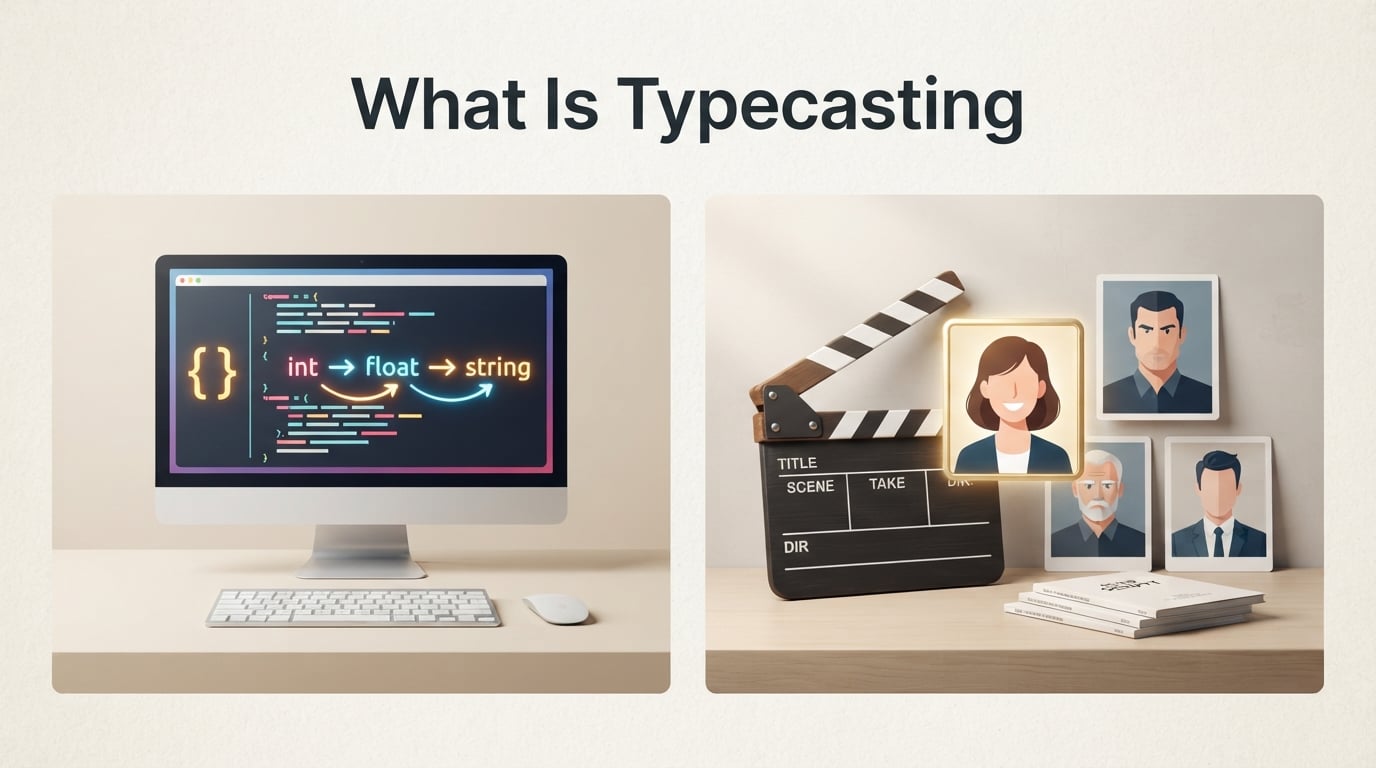
Typecasting is a word that shows up in two very different worlds: software development and the entertainment industry. If you have ever typed int(x) in Python or wondered why a certain actor keeps playing the same kind of role, you have already met typecasting in action.
In this guide, I walk you through both definitions side by side. You will see real code examples in Python, JavaScript, and C++, learn the difference between implicit and explicit type casting, and pick up practical tips for actors who want to avoid being typecast. By the end, the word “typecasting” will feel simple no matter which context you find it in.
Table of Contents
What Is Typecasting? Two Definitions You Should Know
Typecasting has two main definitions, and most confusion comes from mixing them up:
- In programming: Typecasting (also called type conversion) is the process of changing a value from one data type into another, such as turning an integer into a float, or a string into a number.
- In acting and film: Typecasting is when an actor becomes strongly identified with a specific character type and keeps getting cast in similar roles, like the wise mentor, the sarcastic best friend, or the action hero.
Both definitions share a simple idea: a thing (a value or an actor) is being squeezed into a specific shape. Once you see that core pattern, the rest of the details fall into place.
What Is Typecasting in Programming?
In programming, typecasting refers to converting one data type into another. Every value in code belongs to a type, such as integer, float, string, or boolean. Sometimes the type you have is not the type you need, and typecasting is how you bridge the gap.
Here is a quick scenario. Imagine you read user input from a form. The result comes in as a string, even if the user typed 42. Before you can do math with it, you need to convert it to a number. That conversion is typecasting.
Most programming languages split typecasting into two flavors:
- Implicit type casting (coercion): The language does it for you, automatically, usually to prevent data loss when combining smaller and larger numeric types.
- Explicit type casting: You write the conversion yourself using a function or cast operator, telling the compiler or interpreter exactly what you want.
Implicit vs Explicit Type Casting: Key Differences
Implicit and explicit type casting solve similar problems, but they trade control for convenience in different ways. Here is how they compare at a glance.
| Aspect | Implicit Type Casting | Explicit Type Casting |
|---|---|---|
| Who performs it | The language or compiler | The programmer |
| Direction | Usually widening (smaller to larger type) | Can be widening or narrowing |
| Risk of data loss | Very low | Possible with narrowing |
| Readability | Can hide what is happening | Makes intent obvious |
| Error checking | Often caught at compile time | May fail at runtime if incompatible |
| Typical syntax | Just assign or combine values | Use int(), (int)x, Number() |
If you remember only one rule, remember this: implicit casting is automatic and safe most of the time, while explicit casting is manual and gives you full control, including the ability to lose precision on purpose.
Widening and Narrowing Conversion
Widening conversion moves a value into a type that can hold more information, like converting an int to a double. Narrowing conversion does the opposite, such as turning a double into an int, which can drop the decimal part. Most languages only allow implicit casting on widening paths because narrowing can quietly destroy data.
Code Examples: Type Casting in Python, JavaScript, and C++
Seeing the same idea in three languages makes the concept stick. Below are quick examples I run when teaching beginners.
Python Type Casting
Python wraps explicit conversion in friendly built-in functions.
# String to integer
age_str = "30"
age = int(age_str)      # explicit cast

# Integer division result forced to float
result = float(10) / 3  # 3.3333...
print(result)

# Float to integer (narrowing, drops decimals)
price = int(19.99)      # 19
JavaScript Type Casting
JavaScript mixes implicit coercion with explicit functions, which surprises a lot of newcomers.
// Implicit coercion (string + number becomes string)
let result = "5" + 2;       // "52"

// Explicit conversion using Number()
let total = Number("42") + 8;  // 50

// ParseInt for integer strings
let userAge = parseInt("25");   // 25
That "5" + 2 line is famous for catching people off guard. The + operator concatenates strings, so JavaScript quietly coerces the number into a string instead of doing math.
C++ Type Casting
C++ leans on cast operators and is strict about types.
// C-style cast (common but less safe)
double pi = 3.14159;
int approx = (int)pi;            // 3

// C++ static_cast (recommended)
int whole = static_cast<int>(pi); // 3

// Implicit widening
int small = 100;
double bigger = small;           // 100.0 automatic
If you are writing C++ in 2026, reach for static_cast over the old C-style syntax. Modern compilers warn about C-style casts for good reason.
What Is Typecasting in Acting and Film?
In acting, typecasting describes what happens when an actor becomes so closely associated with one kind of role that casting directors keep putting them in similar parts. The word itself is older than television and was used in stage casting for decades.
Typecasting often starts as a compliment. An actor performs a character so convincingly that audiences and directors immediately think of them when a similar role comes up. The problem shows up when the actor wants to play something different and the industry still sees them as the same character.
Common typecast buckets include:
- The comedic sidekick
- The brooding action hero
- The wise older mentor
- The romantic lead
- The villain with a soft side
Reddit threads in r/acting and r/movies are full of performers sharing both sides of this. Some say being typecast at least keeps the work coming, even if the roles feel predictable. Others feel trapped, watching less talented peers land the parts they want.
Typecasting vs Stereotyping: Where Is the Line?
Typecasting and stereotyping are often mentioned together, but they are not identical. Typecasting describes casting patterns based on an actor’s established image. Stereotyping, by contrast, is casting based on broad assumptions about a group of people, such as gender, ethnicity, or age.
Many of the criticisms directed at typecasting are really criticisms of stereotyping in disguise. Critics argue that typecasting can reinforce stereotypes when casting directors repeatedly choose actors from narrow groups for narrow roles. Studios in 2026 are under more pressure than ever to widen their casting calls, partly because audiences have called this out online.
How Actors Can Avoid Being Typecast
If you are an actor worried about being locked into one type, the good news is that performers break out of typecasting all the time. Here are strategies that come up again and again in forums and casting guides.
- Take classes that stretch your range. Improv, period drama, and method acting all push you into unfamiliar territory.
- Self-produce short films or theater. When you create the role, casting directors cannot typecast you into it.
- Pick contrasting indie projects. A small dramatic role next to a big comedy hit signals range to casting teams.
- Work with new directors. Fresh collaborators often see you differently than people you have worked with before.
- Update your materials often. Headshots, reels, and bios should reflect where you want to go, not just where you have been.
Talented actors who can transform themselves physically and vocally tend to escape typecasting more easily, but even small, deliberate choices add up. Each unusual role you take chips away at the box the industry has put you in.
Frequently Asked Questions About Typecasting
Is typecasting good or bad?
In programming, implicit typecasting is generally helpful because it prevents data loss and keeps code shorter. Explicit typecasting is also useful when you need precision, but it can introduce bugs if you cast to the wrong type. In acting, typecasting can be good early in a career because it means casting directors think of you for specific parts. It becomes a problem when you want to stretch into new roles and the industry keeps seeing you as the same character.
What is an example of typecasting?
In programming, an example of typecasting is converting the string u002242u0022 into the integer 42 so you can add it to another number. In C++, writing (int)3.14 converts the double 3.14 into the integer 3, dropping the decimal. In acting, an example of typecasting is an actor who plays a sarcastic best friend in one comedy and then gets cast as the sarcastic best friend in every comedy after that, even when they want to try drama.
What does it mean to typecast someone?
To typecast someone means to assign them a role based on the type of character they are known for playing, rather than on the full range of what they can do. In film and theater, typecasting happens when casting directors reuse the same associations, such as always picking the same actor to play doctors, villains, or romantic leads. In programming, typecasting a value means converting it from one data type to another so it can be used in a context that expects a different type.
How do actors avoid typecasting?
Actors avoid typecasting by deliberately choosing roles that contrast with their established image, training in new performance styles, self-producing projects where they control the casting, working with directors who see them differently, and updating their reels and headshots to reflect their desired range. Even small choices, like a dramatic cameo between two comedies, can slowly reshape how the industry sees you.
Final Thoughts on Typecasting
Typecasting is one of those rare words that means something technical to a developer and something deeply human to an actor. In code, it is a tool that lets you convert between data types safely and predictably. On a film set, it is a pattern that can either launch a career or slowly box one in.
If you take one thing from this guide, let it be this: typecasting is about fitting a value, or a person, into a specific shape. Once you see that shared idea, every definition, code sample, and casting decision makes a lot more sense.