
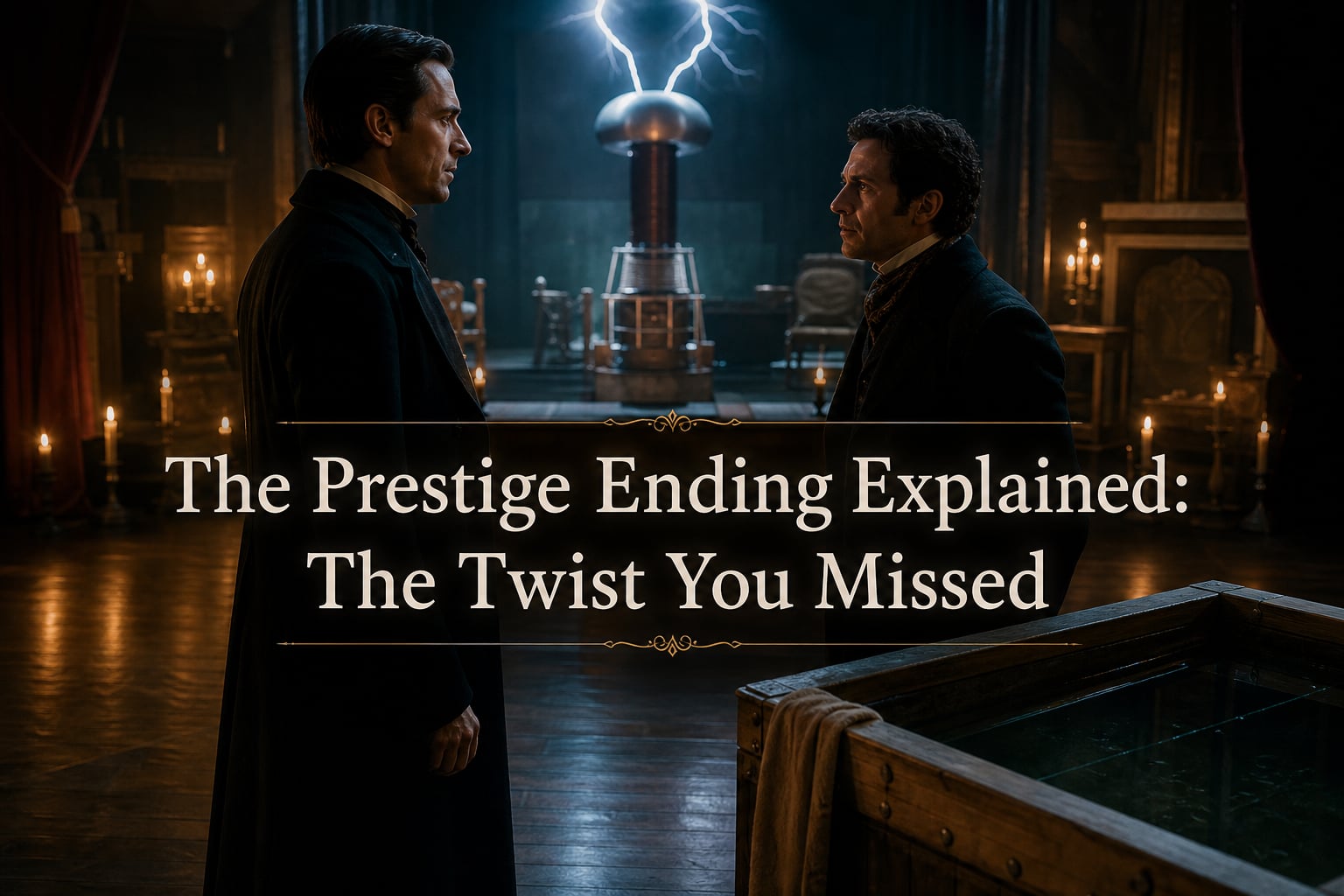
The Prestige ending explained in one line: Alfred Borden had an identical twin brother who shared his life, while Robert Angier used a Tesla-built cloning machine and killed himself every night in a water tank. Both men performed The Transported Man, but only one trick was real magic, and only one man survived to walk away.
I’ve watched Christopher Nolan’s 2006 film four times now, and each viewing peels back another layer. The Prestige ending isn’t just one twist. It’s two interlocking reveals that reframe everything you thought you saw. Below, I’ll break down exactly what happens, why the timeline feels so disorienting, and the small details Nolan buried in plain sight.
Table of Contents
The Prestige Ending Explained: The Quick Answer
The Prestige ending reveals two secrets running in parallel. First, Alfred Borden (Christian Bale) is actually two people: identical twins Alfred and Bernard Borden who take turns living as “Alfred,” sharing a wife (Sarah), and alternating as the magician’s assistant Fallon. Second, Robert Angier (Hugh Jackman) didn’t find a teleportation device. He found a cloning machine built by Nikola Tesla, and every performance of The Transported Man ends with the original Angier drowning in a tank beneath the stage while a duplicate steps into the spotlight.
That means the man Borden shoots in the final warehouse scene isn’t the original Angier. It’s one of the clones. The original Angier drowned before the gun was ever fired. Borden is sentenced to death for killing a man who was already dead.
The Final Scene: Step-by-Step Breakdown
The Prestige’s final act takes place across three key locations: Tesla’s Colorado Springs laboratory, a London warehouse, and the gallows at Newgate Prison. Here’s what happens, in order, even though the film shows it out of sequence.
Step 1: Angier tracks down Tesla and convinces him to build a machine that can replicate an object or person from a distance. Tesla warns him it’s not teleportation. It’s duplication. The original stays behind.
Step 2: Angier returns to London with the device and performs the trick hundreds of times. Each night, the man who steps into the machine dies. Each night, a clone walks out, takes a bow, and inherits the original’s memories.
Step 3: Borden discovers the secret, breaks into the warehouse, and finds a row of water tanks, each containing a preserved Angier clone. He shoots one of them in a moment of rage and grief.
Step 4: The film flashes back to the beginning. Cutter (Michael Caine) finishes telling the story to a young boy named Jess. The Prestige, we now understand, isn’t just the third act of a magic trick. It’s the entire story we’ve just watched.
How Borden Performed The Transported Man (The Twin Secret)
Borden’s version of The Transported Man relies on something no one in the film suspects: he isn’t one man, he’s two. Alfred and Bernard Borden are identical twins who have shared a single identity since childhood. They don’t just work together. They share a wife, a daughter, a career, and a life.
Every time the audience sees “Borden” on stage, half the time it’s actually his brother. One twin walks through a door on the left side of the stage. The other twin, who started the trick backstage, walks through a door on the right. The trick isn’t an illusion. It’s two people pretending to be one.
Fallon, the disfigured assistant who works for Borden, is the brother who isn’t performing that night. He covers his face with bandages to hide the fact that he’s identical to Borden. When Olivia (Scarlett Johansson) sees Fallon without his disguise and recognizes him as Borden, she tries to blackmail “Borden.” She thinks she’s figured out that Borden has a secret life. She has no idea how deep the secret goes.
The tragedy is that Sarah, Borden’s wife, never knew. When she confronted “Borden” about his secrets, she was talking to one twin while the other was gone. She thought her husband was living a double life with another woman. In reality, she was sharing a man with his brother. Her despair led her to hang herself, believing she could never be enough. The Borden weeps over her body in the morgue is the twin who didn’t live with her. He blames his brother for her death, and their relationship fractures permanently.
How Angier Performed The Transported Man (The Tesla Machine)
Angier starts the film trying to figure out Borden’s trick, and when he can’t crack it through observation, he turns to the one person who might build something impossible: Nikola Tesla. Tesla agrees to construct a machine that can move matter across distance, but when it’s finished, the machine doesn’t transport. It duplicates.
The Prestige never uses the word “clone,” but that’s what the device creates. Every performance of Angier’s trick involves two Angiers at the moment of the flash. One stays beneath the stage in a locked water tank and drowns. The other appears on the balcony across the theater, soaking wet, gasping for air, and walks out to applause.
Why does each clone accept this? Because each clone wakes up with all the memories, the ego, the pride, and the rage of the man who stepped into the machine. The original Angier wanted to be the man in the spotlight. The clone wants the same thing. Both versions are willing to die for the prestige.
The man Borden shoots in the warehouse is one of these clones. He’d been watching the original’s tanks for days, horrified by what the trick really was. When he confronts his own copies, he calls them “the pile of bodies in the basement.” Borden, in turn, realizes that the man he hated wasn’t a man at all, but a sequence of copies each living one night before drowning.
The Prestige Timeline Explained (Why It Feels Confusing)
One of the biggest frustrations first-time viewers report is that the timeline of The Prestige feels scrambled. Nolan’s film jumps between three distinct timelines without warning, and unless you know the order, the ending makes no sense.
The earliest timeline shows Borden and Angier as young magicians. Borden accidentally causes the death of Julia, Angier’s wife, during a failed water-tank escape trick. This tragedy seeds their lifelong rivalry.
The middle timeline is the bulk of the film. Borden and Angier sabotage each other’s performances, steal secrets, and try to expose each other. Borden is eventually sentenced to death for the murder of Angier, although Angier is actually alive and on the run in America.
The latest timeline shows Angier in Colorado Springs, meeting Tesla and commissioning the cloning machine. When he returns to London and performs the trick, this is the moment Borden “kills” him at the warehouse.
The reveal only clicks when you realize the film opens with the ending. Borden shooting the Angier clone is one of the last events chronologically. Everything you see after the warehouse scene (the trial, the gallows, the Cutter-Jess framing) fills in what led to that moment.
Hidden Clues and Hints You Missed on First Watch
The Prestige is famous for rewarding rewatches because Nolan litters the film with subtle signals that the twin and clone secrets are coming. Here are the ones that stand out most.
The opening trick, where a bird appears and then disappears, isn’t really a bird. It’s a visual metaphor for the entire film. Something vanishes, something else appears in its place, and the audience never gets to see what happened in between.
Borden’s knot trick is the first major clue. He’s asked which knot he tied, the sailor knot or the slip knot, and he doesn’t know. He can’t know, because each twin tied a different knot and the man on stage isn’t the one who tied it.
When Borden is shot by Angier’s bullet and survives, the wound appears in a different place on his body in the next scene. That’s because a different twin stepped in. The bullet hit one brother, and the other carried on the performance.
Fallon’s bandages are explained as burns from a magic trick gone wrong. But they’re really there to hide his face. Cutter, who designed the original Transported Man trick for Angier, recognizes Fallon’s voice as Borden’s. He doesn’t say so until the final scene, but he knows.
The “prestige” itself, the third act of a magic trick where the impossible happens, is never shown clearly. Nolan keeps cutting away at the exact moment the duplication should appear on stage, mirroring how magicians never reveal the secret. The audience, like the audience at Angier’s show, never gets to see the trick. We just see the result.
What The Ending Means: Themes of Obsession and Sacrifice
On the surface, The Prestige is a story about rival magicians trying to outdo each other. Underneath, it’s about the cost of obsession and what people will sacrifice to be remembered.
Borden sacrifices his marriage, his freedom, and eventually his life, but he keeps his art honest. His trick is real magic in the sense that two people perform it, not one. He cheats the audience, but he doesn’t clone himself. His sacrifice is personal.
Angier sacrifices his soul. Each performance requires his death, and each clone carries the memory of every previous performance. By the end, there is no “original” Angier. There’s just a long line of men who each believe they’re the real Robert Angier and who each step into a machine knowing they’ll drown.
Nolan’s deeper point is that art and obsession are inseparable. The two men are mirror images. Borden destroys himself for the trick. Angier destroys his copies. Neither truly wins, because neither can stop.
The Three Acts of a Magic Trick: Pledge, Turn, Prestige
The title comes from a line in the film: “Every great magic trick consists of three parts. The pledge, where the magician shows you something ordinary. The turn, where he takes that ordinary thing and makes it do something extraordinary. And the prestige, where the extraordinary thing returns to ordinary, and you don’t know how it happened.”
The Prestige, the film itself, follows this structure perfectly. The pledge is the rivalry setup: two magicians trying to sabotage each other. The turn is the Tesla machine, which turns the story from sabotage into sci-fi. The prestige is the reveal: the twin and clone secrets that reframe everything you thought you saw.
What makes Nolan’s structure brilliant is that you, the viewer, are the audience in the magic trick. The pledge makes you think you’re watching a rivalry drama. The turn makes you think it’s about science. The prestige makes you realize it’s about identity, obsession, and the cost of being seen.
Why The Prestige Starts and Ends With Cutter and Jess
The film opens and closes with Cutter narrating to a young boy named Jess. This framing device isn’t decorative. It’s the moral compass of the entire story.
Cutter is the engineer behind Angier’s original Transported Man trick. He knows magic from the inside, which is why he recognizes Borden’s voice in Fallon long before the reveal. He’s also the one who tells Borden, “You never understood why we did this. The audience knows the truth. The world is simple, and it’s terrible.”
By ending with Cutter and Jess, Nolan tells us the lesson of the film. Magicians don’t lie to trick people. They lie to teach people that the world contains more than what appears on the surface. Cutter passing the story to a new generation, the next magician, is the ultimate prestige. The trick continues.
How Critics and Audiences Reacted to The Prestige Ending
Roger Ebert famously criticized The Prestige for what he called a “cheat.” He argued that the Tesla machine turns the film from a clever mystery into a science-fiction deus ex machina, and that Angier’s trick wouldn’t work with the technology shown. Other critics, including David Bordwell, defended Nolan’s structural ambition. Audiences, meanwhile, made the film a cult favorite precisely because the ending demands rewatches.
On Reddit and Nolan fan forums, debates still rage over whether Borden or Angier “won.” The most popular answer is that neither did. Both paid the ultimate price for the prestige, and the audience walks away wondering whether the applause was worth the cost.
FAQs
Was Angier alive at the end of The Prestige?
No. The man Angier Borden shoots in the warehouse is a clone. The original Angier drowned in the water tank under the stage before Borden ever arrived. Every performance of the trick killed the man who stepped into the machine.
Did Sarah figure out Borden’s secret?
No. Sarah never understood that Borden was two people. When she confronted her husband about his double life, she was talking to one twin while the other was gone. Her despair led her to take her own life, believing she could never be enough for Borden.
Did Cutter know Borden was a twin?
Yes. Cutter recognized Borden’s voice in Fallon long before the reveal. As a magician and engineer himself, he understood the twin trick intuitively but kept the secret because exposing it would destroy the illusion he believed protected the audience.
How did Borden perform The Transported Man?
Borden and his identical twin brother Bernard shared a single identity. One twin walked through a door on the left side of the stage while the other walked through a door on the right. They alternated performances and shared a life, including a wife, without anyone knowing they were two people.
Why did Angier kill himself every night?
Each clone of Angier woke up with all the memories of the original, including the obsession with the trick and the rivalry with Borden. The original willingly stepped into the machine knowing he would drown, because the clone would inherit his legacy. Every Angier that lived for applause required another Angier to die for it.
Final Thoughts on The Prestige Ending
The Prestige ending explained isn’t about a single twist. It’s about two men who used different methods to perform the same impossible trick and paid for it in different ways. Borden lost his wife, his freedom, and his life, but kept his humanity intact. Angier lost his self, piece by piece, in a row of water tanks.
If you’re still puzzled by The Prestige ending, watch it again. Nolan designed the film to be decoded, and the prestige only hits when you realize you’ve been the audience in the trick all along.