
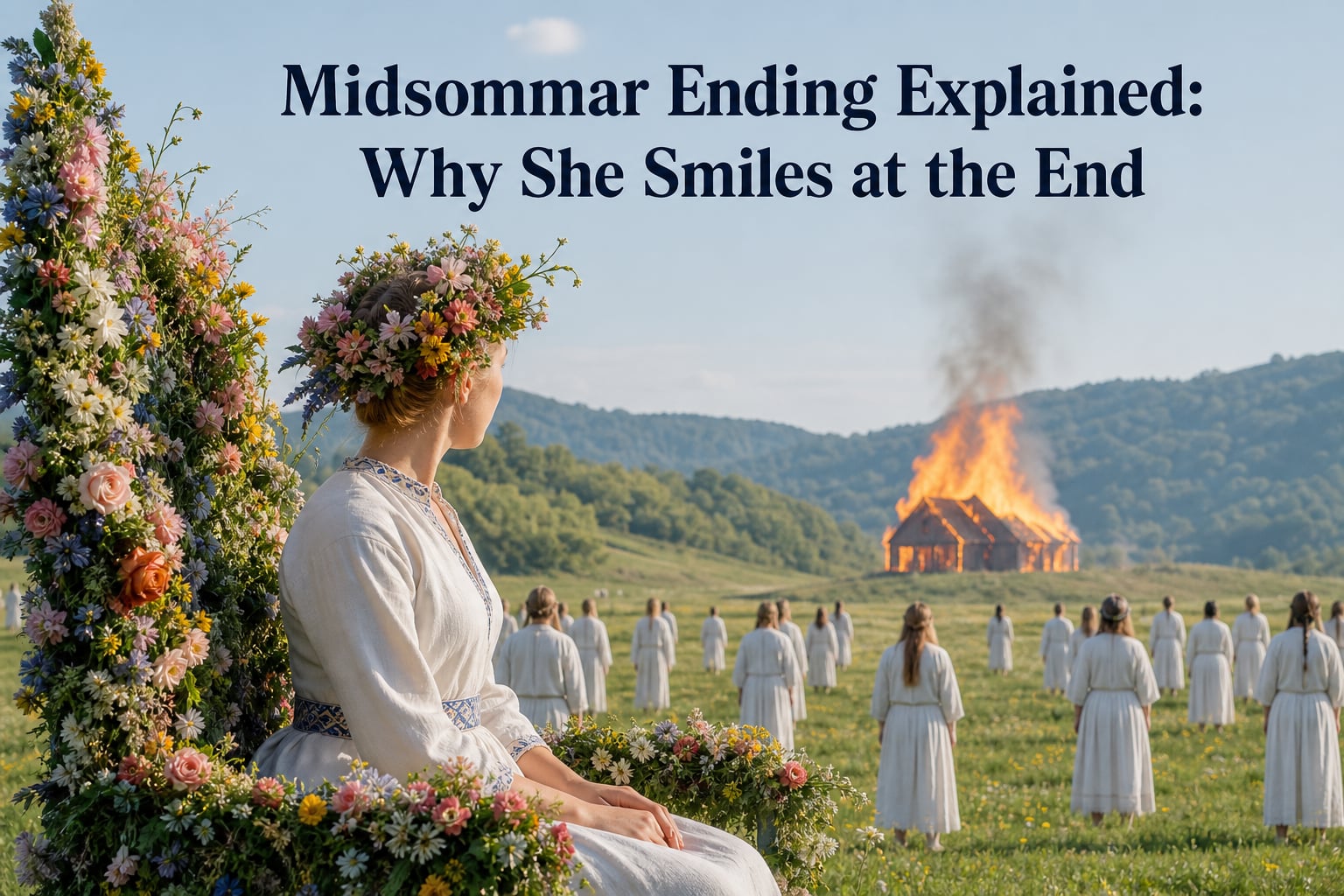
Ari Aster’s Midsommar ends with one of the most debated final shots in modern horror. Dani, crowned May Queen, watches her boyfriend Christian burn inside a bear carcass. She cries. Then she smiles. That single expression has split audiences since the film premiered in 2019. Some see liberation, others see madness, and a growing number see both at once.
In this deep dive, we break down the Midsommar ending explained from every angle. We cover the plot events leading to the finale, the May Queen ceremony, Christian’s gruesome fate, and the layers behind that haunting smile. Whether you view the ending as a feminist revenge story or a tragedy about cult manipulation, the evidence on screen supports a rich, uncomfortable reading.
Table of Contents
What Is Midsommar? Film Context and Ari Aster’s Vision
Midsommar is a 2019 folk horror film written and directed by Ari Aster, produced by A24, and starring Florence Pugh as Dani Ardor. The film follows a group of American graduate students who travel to a remote Swedish village called Harga to attend a midsummer festival that occurs only once every 90 years. What begins as a pastoral retreat descends into ritualistic violence.
Aster has described the film as a “breakup opera.” He has said in interviews that he wrote it while processing the collapse of his own relationship. That personal wound pulses through every frame. The film is not primarily about a cult in the traditional horror sense. It is about a woman navigating grief, emotional neglect, and the seductive pull of a community that actually sees her pain.
The folk horror genre matters here. Unlike conventional horror that hides monsters in the dark, folk horror places terror in broad daylight. The Wicker Man (1973) established this tradition, and Midsommar carries it forward with devastating effect. The sun never sets on the horror. There is nowhere to hide.
Florence Pugh delivers a career-defining performance, communicating volumes through her face alone. Her work grounds the film’s most outlandish ritual scenes in raw emotional truth. Without her, the ending would not land with anywhere near the same force.
Midsommar Plot Recap: How We Get to the Ending
To understand the finale, you need to trace Dani’s emotional journey from the opening frames. The film begins with devastating loss. Dani’s sister Terri kills herself and their parents by piping car exhaust into their home. Dani receives the news in a gut-wrenching phone call that establishes her as someone drowning in grief.
Her boyfriend Christian, played by Jack Reynor, responds to her trauma with emotional distance. He forgets her birthday. He tries to schedule a breakup conversation but never follows through. He invites Dani on the Sweden trip only as an afterthought, clearly hoping she will decline. She does not.
Once at Harga, the commune slowly separates Dani from Christian and the rest of the group. The village elders feed the visiting men psychedelic tea and subject them to increasingly disturbing rituals. Two elder members of the community perform an Attestupa, a ritual suicide by jumping from a cliff. When the Americans recoil, the Harga members explain that death at an advanced age is a cause for celebration, not mourning.
Meanwhile, a young woman named Maja sets her sights on Christian as a mating partner. The community orchestrates situations to push Christian toward Maja and further from Dani. Christian’s friends die one by one. Mark is killed after disrespecting ancestral traditions. Josh is buried in a garden plot after photographing sacred texts. The Harga are methodical in removing every obstacle between Dani and full integration.
Then comes the communal crying scene, often called the most important moment in the film. Dani suffers a panic attack after discovering Christian having sex with Maja in a ritual ceremony. She runs outside gasping, sobbing, completely unraveling. The women of Harga surround her and mirror her anguish perfectly. They wail with her. They scream with her. They hold her.
This moment is the emotional turning point. For the first time in the entire film, someone actually meets Dani where she is. Christian never held her after her family died. He never validated her pain. These strangers do. Whether this represents genuine empathy or calculated manipulation is the question the ending forces you to sit with.
Midsommar Ending Explained: Why She Smiles at the End
The final act centers on the Midsommar finale ceremony. After the communal wailing, the village holds a dance competition among its young women. Dani, now fully embraced by the community, participates in a maypole dance. She outlasts every other competitor and is crowned May Queen. Flowers cover her body. Women carry her on a throne. She is the center of attention for perhaps the first time in her life.
But the May Queen title comes with a responsibility. The Harga festival requires nine human sacrifices to cleanse the community for the next 90 years. Seven of the nine are already selected: the two Attestupa elders, Mark, Josh, and two community volunteers. The eighth and ninth slots remain. The ninth will be a final offering chosen by the May Queen herself.
The elders present Dani with a choice. She must select one final sacrifice from a lineup of victims. Among them is Christian, paralyzed and silent. In one of the film’s most debated moments, Dani points at Christian. Her expression is not vengeful or triumphant. It is resigned, exhausted, almost blank. She chooses him.
Christian is then placed inside a gutted bear carcass, sewn in, and laid in a specially constructed yellow temple alongside the other sacrifices. The temple is set ablaze. The Harga members watch the flames and scream in simulated agony, mirroring the pain of the burning offerings. This screaming echoes the communal wailing they shared with Dani earlier.
Now we reach the final shot. Dani sits on her May Queen throne, watching the burning temple. She sees Christian in flames. She begins to cry, her face contorting with anguish. Then something shifts. The screenplay describes it plainly: “She sees her family burning. She sees Christian burning. She watches, and her crying gives way. She smiles.”
That smile grows slowly, spreading across her face until it is wide and unmistakable. The camera lingers. The film cuts to black. Here is where the Midsommar ending explained becomes a question of interpretation.
One reading sees catharsis. Dani has finally released the weight of a toxic relationship. Christian was emotionally absent when she needed him most. He gaslit her, dismissed her grief, and was ready to abandon her. Watching him burn represents the destruction of everything that caused her pain. The smile is relief. Freedom. Release.
Another reading, the one Florence Pugh herself supports, sees a psychotic break. In a 2024 interview reflecting on the role five years later, Pugh said she believes Dani has completely lost her grip on reality by that final shot. The smile is not happiness. It is a mind fracturing under cumulative trauma, drugging, and psychological manipulation.
The most compelling reading holds both truths simultaneously. Dani experiences a genuine sense of belonging for the first time. She also has been systematically broken down by a cult that weaponized her vulnerability. The smile is real emotion emerging from a profoundly broken mind. It is catharsis and collapse fused into one expression.
The Murals: Visual Foreshadowing You Probably Missed
One detail that separates casual viewers from serious fans is the mural visible in Dani’s apartment during the opening scenes. The artwork above her bed depicts a girl kissing a bear. The same image appears woven into tapestries throughout Harga. Ari Aster planted the ending in the first five minutes.
The murals in the Harga commune tell the entire story before it happens. One tapestry shows a woman being crowned with flowers. Another depicts a bear being led into a building. A third shows figures dancing around flames. Every major plot point is illustrated on the walls if you know where to look.
This visual storytelling deepens the film’s themes of inevitability and fate. Dani was always meant to become May Queen. Christian was always the bear. The commune did not improvise. They read their own history on the walls and followed it step by step, grooming Dani from the moment she arrived.
Psychotic Break or Liberation? The Central Debate
The debate between liberation and psychotic break defines most Midsommar discussions. Ari Aster has said he intended the ending to feel triumphant, at least on the surface. He wanted the audience to feel a strange sense of relief when Dani smiles. He wanted you to question why you felt that relief.
Florence Pugh’s 2024 interpretation shifted the conversation. She said she played the final moment as a woman whose mind had completely snapped. The drugs, the grief, the manipulation, and the spectacle of watching someone burn alive broke something fundamental inside Dani. The smile, in Pugh’s reading, is the expression of a person who has lost contact with reality entirely.
Reddit communities have latched onto a detail that supports Pugh’s reading. Dani’s smile only appears after she looks around and sees the other Harga women smiling at her. She mirrors their expressions. This suggests conformity rather than spontaneous joy. She smiles because they smile, not because she feels happiness.
But the liberation camp has strong textual evidence too. Christian was a genuinely terrible partner. He planned to break up with her during one of the worst moments of her life. He lied about the Sweden trip. He cheated on her in a ritual he was too drugged to resist but not unwilling to participate in. The commune gave Dani something Christian never could: undivided attention to her emotional state.
The truth the film refuses to resolve is that both things can coexist. A cult can manipulate you and still provide something real that you were missing. Liberation achieved through manipulation is still a form of captivity. The smile lives in that impossible contradiction.
Thematic Analysis: Grief, Manipulation, and Found Family
Midsommar is ultimately about what happens when a person in profound grief encounters a community that claims to offer total emotional support. The Harga do not just tolerate Dani’s pain. They amplify it, mirror it, and use it as a doorway to integration. The communal wailing scene is simultaneously the most empathetic and most manipulative moment in the film.
The film also functions as a relationship horror story. Christian is not a monster in the traditional sense. He is something more relatable and therefore more disturbing: a man who is simply too emotionally immature to show up for his partner. His failure to hold space for Dani’s grief is what creates the vacuum the Harga fill.
Codependency runs through every thread of the narrative. Dani depends on Christian for stability he cannot provide. The Harga depend on outsiders for their sacrifices. Christian depends on his friends to validate his worst instincts. Each form of dependency leads to destruction.
Found family is the seductive promise the film offers and then complicates. Dani finds a community that holds her, celebrates her, and makes her their queen. She also finds a community that murdered her boyfriend and burned him alive. The found family is real and it is a death cult. Both facts are true at once.
Frequently Asked Questions
Why did Dani smile at the end of Midsommar?
Dani smiles because she experiences a moment of cathartic release as she watches the temple burn. She sees the destruction of her painful past and the boyfriend who failed her. Florence Pugh has stated she played the moment as a psychotic break, while Ari Aster intended it to feel ambiguously triumphant. The smile can be read as liberation, madness, or both at once.
What does the ending of Midsommar mean?
The ending of Midsommar represents Dani’s full absorption into the Harga cult. She is crowned May Queen, chooses Christian as the final sacrifice, and watches him burn. The finale asks whether finding community after grief is worth the cost of losing yourself to manipulation.
Did Dani intentionally choose Christian as the sacrifice?
Yes, Dani deliberately points at Christian when asked to select the final sacrifice. Her expression is not angry or vengeful. She appears resigned and exhausted. The choice reflects the culmination of Christian’s emotional abandonment throughout the film rather than a desire for revenge.
Why was Dani crying before she smiled?
Dani cries because she is watching Christian burn alive, which triggers memories of her family’s death. The screenplay explicitly notes that she sees her family burning in the flames. The crying gives way to a smile as her grief transforms into something the film leaves deliberately ambiguous.
Is Midsommar’s ending happy or disturbing?
Midsommar’s ending is intentionally both. Ari Aster described the film as a breakup opera and wanted the audience to feel a strange relief at Dani’s smile. At the same time, the ending depicts a traumatized woman joining a murder cult. The film forces you to sit with the discomfort of feeling happy for someone in a horrifying situation.
Conclusion
The Midsommar ending explained comes down to a single paradox. Dani’s smile is simultaneously the most honest and the most terrifying moment in the film. She found what she was looking for: a community that holds her pain. She also lost her mind, her boyfriend, and her freedom to a cult that planned everything from the start. That contradiction is why we are still talking about this ending in 2026, years after the film’s release.
If you want to go deeper, watch the film again and pay attention to the murals. Every answer Ari Aster gives you is already painted on the walls.