
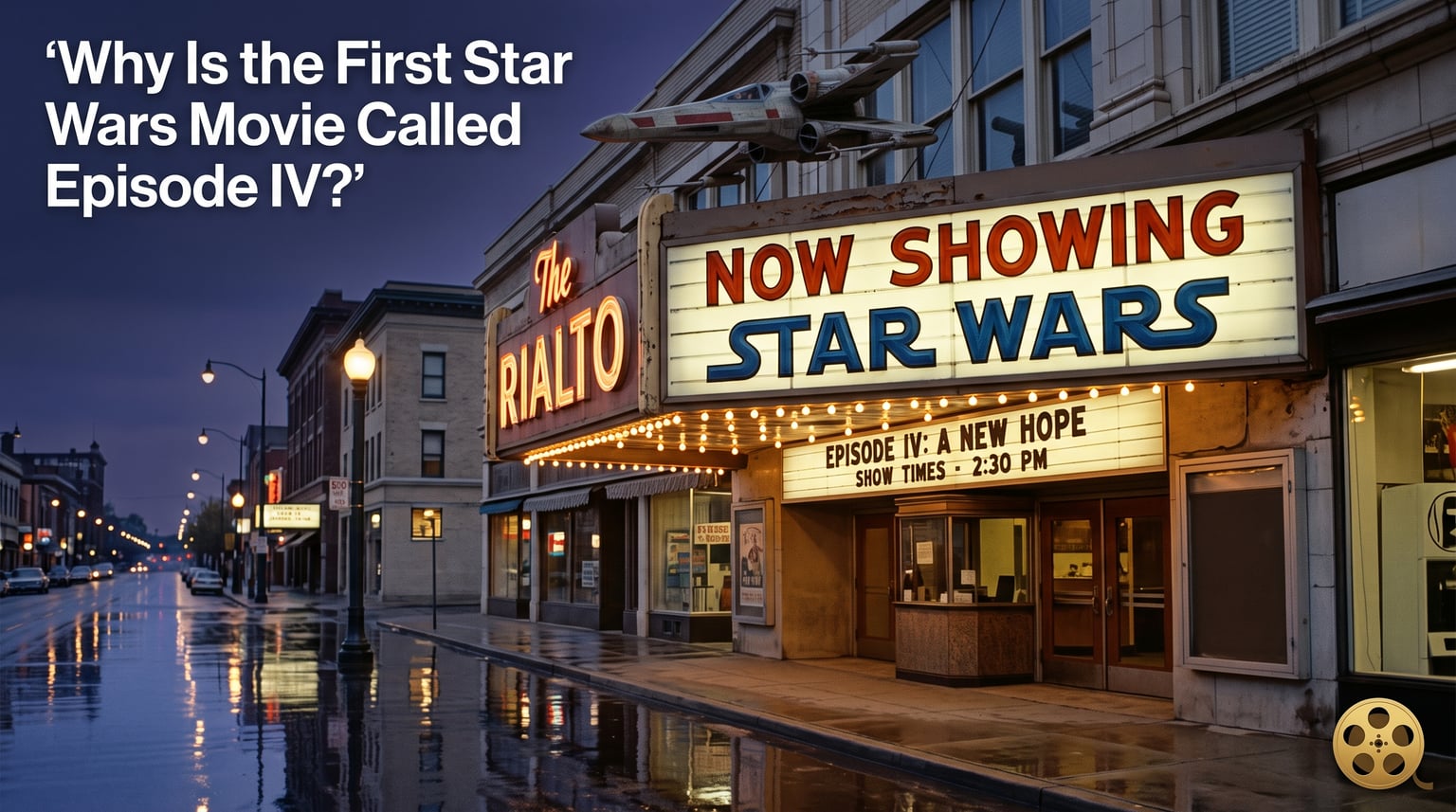
If you’ve ever wondered why the first Star Wars movie is called Episode IV, the short answer is this: George Lucas designed the 1977 film as the fourth chapter in his planned nine-episode saga, not as the beginning of the story. He chose to start with the middle of his narrative because the original script was too long for a single film and because he wanted viewers to feel dropped into an ongoing universe, just like watching a 1930s Flash Gordon serial halfway through.
The original 1977 release was simply titled “Star Wars,” with no episode number at all. The “Episode IV” and “A New Hope” subtitle were added in 1981 when the film was re-released after the success of The Empire Strikes Back. This single naming decision has shaped nearly fifty years of Star Wars storytelling, marketing, and the way fans experience the saga.
In this guide, I’ll walk you through Lucas’s original vision, the Flash Gordon inspiration, why the story starts in the middle, the 1977 vs 1981 title change, and how the episode numbering shaped what we now call the Skywalker Saga.
Table of Contents
George Lucas’s Original Vision for a Multi-Film Saga
George Lucas did not stumble into Star Wars hoping to make one film. By the early 1970s, he had already drafted extensive notes outlining a nine-episode saga spanning thousands of years. He wanted to tell a complete mythological story about the rise, fall, and redemption of a family across generations.
Lucas drew on his college studies of mythologist Joseph Campbell, whose work on the “hero’s journey” heavily influenced Star Wars. The nine-episode structure mirrored the sweeping scope he wanted, with each trilogy exploring a distinct era. The middle trilogy (Episodes IV, V, and VI) followed Luke Skywalker’s adventure, while the earlier trilogy would eventually show Anakin Skywalker’s fall to the dark side.
Several practical factors made this ambitious plan possible. Lucas’s 1973 film American Graffiti was a major commercial and critical success. That gave him enough leverage with 20th Century Fox to ask for the rights to sequels and merchandising in exchange for directing fees he forfeited. Without that deal, the multi-film saga might never have happened.
Lucas has said in multiple interviews that he always knew Star Wars was Episode IV. The opening crawl of the 1977 film famously begins with “Episode IV” before “A New Hope,” and this was no accident. It was a deliberate signal that what viewers were about to watch was a fragment of a much larger story.
Flash Gordon and the 1930s Serial Inspiration
The structure of starting a story in the middle didn’t come from nowhere. Lucas has repeatedly cited the Flash Gordon serials of the 1930s as a direct inspiration. Those Saturday matinee chapter-play films presented audiences with adventures already in progress. Viewers joined the story mid-stream and picked up the world as they went.
Lucas tried for years to secure the rights to make a Flash Gordon film. When that fell through, he created Star Wars as an original homage to that serial style. He wanted viewers to feel the same sense of discovery, like walking into a movie theater partway through an ongoing adventure.
Producer Gary Kurtz later confirmed in interviews that Lucas and the team considered whether to label the first film Episode III, IV, or V. Each number was tested for the effect of dropping viewers into a story that felt already underway. Episode IV won out, partly because it left the most room for both prequels and sequels.
This is also why the original film contains mysterious references that are never explained. Mentions of the Clone Wars, the Republic, the Jedi, and the Imperial Senate all assume a universe with deep history. The episodic format wasn’t just a numbering choice. It was a storytelling philosophy about creating a world that felt real and lived-in.
Why the Story Starts in the Middle
The technical reason behind starting with Episode IV was simple: Lucas’s original script was too long. His first draft, written in 1974, included material that would eventually become Episodes I through VI. No studio would greenlight a single film that long, and the technology to make it didn’t exist.
Lucas made a creative decision that shaped everything. He picked the most cinematically exciting portion of his story, the part where the rebellion was already in motion and a young hero was being drawn into conflict, and developed that into the first film. The backstory would come later.
When pressed in interviews about why he didn’t start with Episode I, Lucas famously said the choice was made for “technical and storytelling reasons.” Many fans and historians have interpreted this as a combination of factors: the visual effects needed to depict earlier eras (like the Clone Wars) weren’t possible with 1970s technology, and starting in media res created more dramatic momentum.
There’s also a storytelling argument. Beginning with Episode I would have required viewers to sit through political setup and character introductions before reaching the action. By starting with Episode IV, Lucas dropped audiences straight into a rescue mission, a chase across the galaxy, and a desperate attack on a space station. It was the most efficient way to hook viewers immediately.
From “Star Wars” to “Episode IV – A New Hope”: The 1981 Title Change
Here’s a piece of Star Wars history that surprises even longtime fans: the 1977 release was titled simply Star Wars. There was no “Episode IV” and no “A New Hope” subtitle on the original poster, the original opening crawl, or the original press materials.
The episode numbering and subtitle were added in 1981, when the film was re-released after The Empire Strikes Back became a massive hit in 1980. By that point, Lucas and Fox were confident the saga would continue. Adding “Episode IV” to the original film made the connection explicit and prepared audiences for the larger story.
The subtitle “A New Hope” was reportedly suggested by Lucas to give the original film a more complete identity, distinct from the sequels being developed. It also mirrored the subtitles given to The Empire Strikes Back and Return of the Jedi during the same re-release period.
For older fans who saw the film in 1977, the sudden appearance of “Episode IV – A New Hope” in 1981 was a strange moment. It retroactively changed the identity of a film they already loved. But the change stuck, and since then, the official title has been Star Wars: Episode IV – A New Hope.
Clone Wars and the Living Universe Lucas Created
One of the most famous lines in the original 1977 film is the throwaway reference to the Clone Wars. Luke and Obi-Wan discuss it briefly, but no explanation is given. Viewers in 1977 had no idea what the Clone Wars were, and that mystery was intentional.
By labeling the film Episode IV and hinting at events from a distant past, Lucas created the impression of a galaxy with thousands of years of unrecorded history. The Clone Wars reference was a tiny worldbuilding detail, but it told the audience: this universe existed before the movie started, and there’s more to the story than what you’re seeing.
For 22 years, fans speculated about what the Clone Wars actually were. Lucas finally answered the question with Star Wars: Episode II – Attack of the Clones in 2002, and then with the animated film and TV series The Clone Wars. The throwaway line had become a cornerstone of the prequel trilogy.
This approach, leaving breadcrumbs and trusting the audience to fill in the gaps, became a Lucas trademark. It also explains why the episode numbering mattered so much. Without “Episode IV,” those references would have felt strange. With it, they felt like echoes of a deeper history.
From 1977 to 2005: How the Skywalker Saga Took Shape
Lucas’s nine-episode vision moved from dream to reality across nearly three decades. The original trilogy (Episodes IV, V, and VI) was released between 1977 and 1983. After a long break, Lucas returned with the prequel trilogy (Episodes I, II, and III) between 1999 and 2005.
The prequel trilogy filled in the story of Anakin Skywalker’s fall from Jedi Knight to Sith Lord, the corruption of the Republic, and the events leading directly up to A New Hope. Lucas used new CGI technology that didn’t exist in 1977 to bring those earlier eras to life.
After Disney acquired Lucasfilm in 2012, the sequel trilogy (Episodes VII, VIII, and IX) was released between 2015 and 2019. These films continued the saga into a new generation of characters. Together, all nine episodes now form what Lucasfilm officially calls the Skywalker Saga.
It’s worth pausing to appreciate how unusual this is. Few filmmakers get to plan a nine-film saga, see it released across 42 years, and watch each chapter become a defining cultural moment. Lucas’s choice to start with Episode IV made all of that possible.
Where Should New Viewers Start Watching Star Wars?
This is probably the most common question newcomers ask, and the answer depends on what kind of experience you want. The two main approaches are release order and chronological order.
Release order means watching Episodes IV, V, VI, I, II, III, then VII, VIII, IX. This is the order the films were made and the order most original fans first experienced them. It preserves the surprises and reveals that the prequels set up for longtime viewers.
Chronological order means watching I, II, III, IV, V, VI, VII, VIII, IX. This follows the in-universe timeline from Anakin’s childhood through the final defeat of the Sith. It tells the story in sequence but spoils some classic moments.
There’s also a hybrid approach called “Machete order,” which places Episode IV first, then V, then II and III as flashback material, before finishing with VI and the sequels. This preserves the original trilogy’s biggest twist while still giving the prequel backstory. Any of these work. There’s no wrong way to watch Star Wars as long as you eventually get through all nine episodes.
Frequently Asked Questions
Why did episodes 4, 5, and 6 come out before episodes 1, 2, and 3?
George Lucas designed the original Star Wars film as Episode IV of a planned nine-episode saga. He chose to produce the middle portion of his story first because the original script was too long for a single film and because 1970s visual effects technology couldn’t yet depict the earlier eras. Episodes 1, 2, and 3 were made later, between 1999 and 2005, after CGI made those time periods possible to film.
Why didn’t George Lucas start with Episode 1?
Lucas started with Episode IV because the original script covered too much story for one film. He selected the most dramatic and visually exciting middle section to develop into the first movie. The earlier portions of his saga required visual effects that were not possible in the 1970s. Lucas also wanted viewers to feel dropped into an ongoing universe, similar to the Flash Gordon serials he grew up watching.
Was the original 1977 Star Wars called Episode IV?
No. The 1977 release was titled simply Star Wars with no episode number or subtitle. The Episode IV designation and the A New Hope subtitle were added in 1981 when the film was re-released after the success of The Empire Strikes Back. Since that re-release, the official title has been Star Wars: Episode IV – A New Hope.
Should I start watching Star Wars from Episode 1 or Episode 4?
Both options work. Release order (4, 5, 6, 1, 2, 3, 7, 8, 9) preserves the original trilogy’s surprises and is the order most longtime fans recommend. Chronological order (1 through 9) tells the story in timeline sequence but reveals some classic plot twists early. New viewers who want the most authentic 1977 experience should start with Episode IV.
Final Thoughts
So why is the first Star Wars movie called Episode IV? Because George Lucas always intended it to be the fourth chapter. The 1977 release was simply the first film he could actually produce, not the start of his story.
Lucas’s choice to begin in the middle, inspired by Flash Gordon serials and shaped by 1970s production limits, gave Star Wars something most franchises never achieve: a sense of depth and history. The Clone Wars reference, the Empire’s rise, the Jedi’s fall, all of it felt real because it implied a galaxy that existed before viewers tuned in.
Nearly 50 years after the original release, the episode numbering still shapes how fans discover and discuss Star Wars. Whether you start with Episode IV or Episode I, you’re walking into a saga that was decades in the making.