
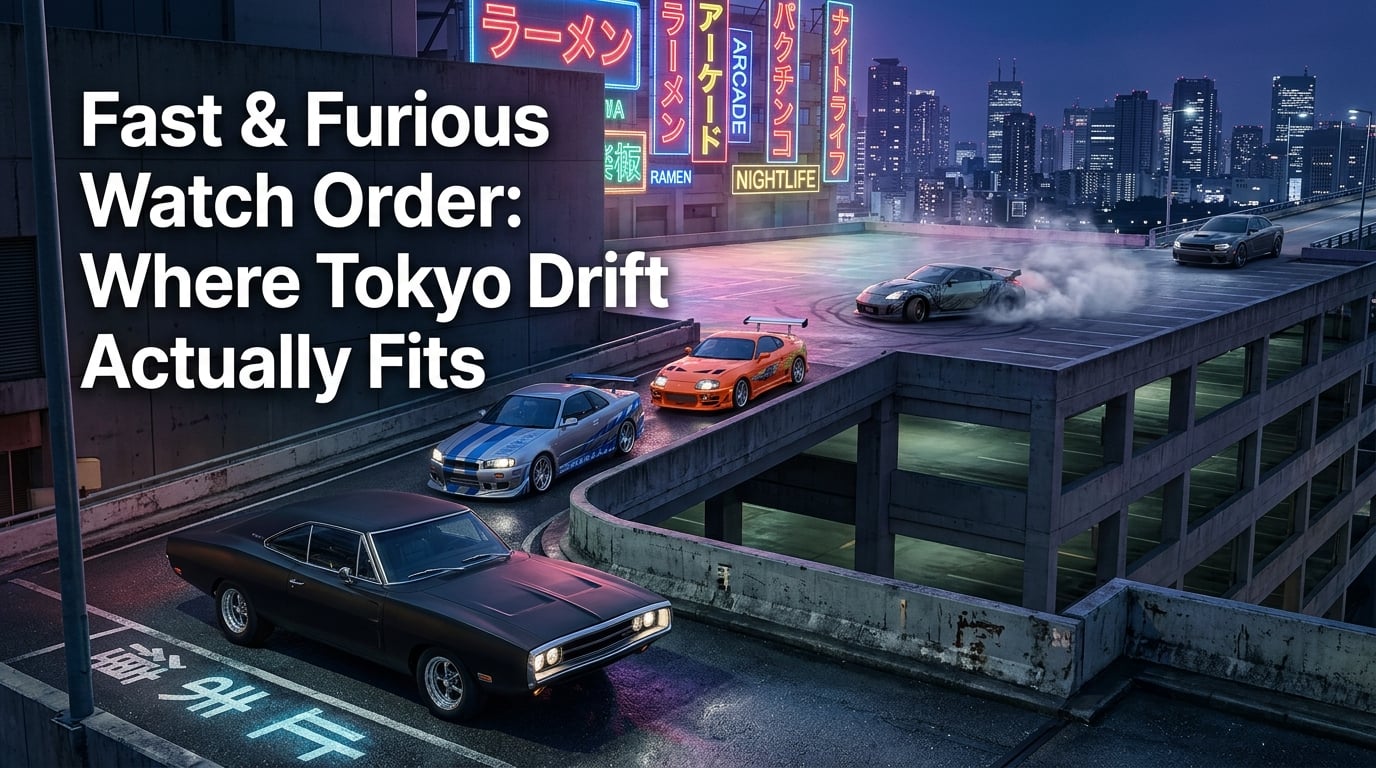
If you want the short answer: Tokyo Drift is the third movie released, but it sits sixth in the Fast and Furious chronological order, slotting in between Fast & Furious 6 and Furious 7. That single line is the source of nearly all the confusion fans hit when starting the franchise for the first time.
I have worked through this franchise order a few times now (once for myself, once with my niece, and once while writing up that Fast X post-credits deep dive), and the cleanest framing is this: the studio released Tokyo Drift in 2006 as a soft spinoff, then spent a decade quietly retconning it into the main story. By the time F9 rolled around in 2021, what looked like a disconnected side story had become essential canon.
In this guide I will give you both lists (release order and chronological order), explain the timeline math that places Tokyo Drift in 2014, walk through how Han survived his apparent death, and share the binge plan I would use for anyone watching the Fast and Furious watch order for the very first time in 2026.
Table of Contents
Fast and Furious Watch Order at a Glance
Here is the entire franchise on one page. Print this out if you want, because it is the only reference you really need.
Fast and Furious Movies in Release Order (2001-2026)
The Fast and the Furious (2001)
2 Fast 2 Furious (2003)
The Fast and the Furious: Tokyo Drift (2006)
Fast & Furious (2009)
Fast Five (2011)
Fast & Furious 6 (2013)
Furious 7 (2015)
The Fate of the Furious (2017)
Hobbs & Shaw (2019)
F9 (2021)
Fast X (2023)
Fast and Furious Chronological Order
The Fast and the Furious (2001)
2 Fast 2 Furious (2003)
Fast & Furious (2009)
Fast Five (2011)
Fast & Furious 6 (2013)
The Fast and the Furious: Tokyo Drift (2006, set in 2014)
Furious 7 (2015)
The Fate of the Furious (2017)
Hobbs & Shaw (2019)
F9 (2021)
Fast X (2023)
The only difference between the two lists is step 6 in chronological order, which is where Tokyo Drift slides in. Everything else stays put. If you remember that single swap, the franchise timeline stops feeling chaotic.
Fast and Furious Movies in Release Order
The release order is the list Universal used to market the films, and it is also the order most viewers saw them the first time. For a lot of fans, this order still feels the most natural, because Tokyo Drift plays like a spinoff when you watch it third.
Here is a quick rundown of every entry as it hit theaters, plus a one-line plot reminder.
1. The Fast and the Furious (2001)
Brian O’Conner (Paul Walker) goes undercover in Dominic Toretto’s (Vin Diesel) illegal street racing crew in Los Angeles. The franchise’s first heist sequence, the first family dynamic, and the first T-bone scene.
2. 2 Fast 2 Furious (2003)
Brian teams up with Roman Pearce (Tyrese Gibson) in Miami to bring down a drug lord. Diesel is absent, but the movie sets up Roman as a series regular.
3. The Fast and the Furious: Tokyo Drift (2006)
High schooler Sean Boswell (Lucas Black) is sent to Tokyo, where he gets pulled into the world of drift racing. Han (Sung Kang) and Twinkie (Bow Wow) become his mentors. This is the film whose placement confuses everyone.
4. Fast & Furious (2009)
Dom and Brian reunite in the Dominican Republic to take down a drug cartel. This entry officially starts the heist-era tone the franchise still uses today.
5. Fast Five (2011)
The crew pulls off the legendary vault-heist drag through the streets of Rio. This film added Dwayne Johnson as Hobbs and lifted the series into blockbuster territory.
6. Fast & Furious 6 (2013)
Dom, Brian, and the crew tangle with Deckard Shaw’s (Jason Statham) revenge plot in London. Han dies in this film’s ending, which now sets up Tokyo Drift chronologically.
7. Furious 7 (2015)
The infamous tank and parachute sequences. The film is dedicated to Paul Walker and was completed after his death in 2013.
8. The Fate of the Furious (2017)
Dom is blackmailed into betraying his family by the cyberterrorist Cipher (Charlize Theron). The team vs. team dynamics begin here.
9. Hobbs & Shaw (2019)
A spinoff featuring Luke Hobbs (Dwayne Johnson) and Deckard Shaw (Jason Statham) facing off against the cyborg villain Brixton (Idris Elba). Optional viewing, but it slots in here chronologically.
10. F9 (2021)
Dom faces Jakob (John Cena), his long-lost brother. F9 is also where Han’s return is explained, retroactively tying Tokyo Drift back into the main timeline.
11. Fast X (2023)
Dom’s crew battles Dante Reyes (Jason Momoa), the son of the drug lord from Fast Five. The film ends on a cliffhanger, leading directly into Fast & Furious 11.
That release-order list is the simplest way to start watching, and it is the order most of us grew up with.
The Fast and Furious Chronological Order
Switching to the in-universe Fast and Furious chronological order solves a lot of the plot holes, especially Han’s death and Deckard Shaw’s revenge arc. The change you need to know is that Tokyo Drift moves from position 3 to position 6.
This is the order I now recommend to anyone new to the franchise.
Chronological Fast and Furious Watch Order (Step by Step)
1. The Fast and the Furious (2001)
Brian is an LAPD officer, Dom is a street racer, Letty (Michelle Rodriguez) is the love interest. The opening weekend numbers and the opening chase through LA both still hold up.
2. 2 Fast 2 Furious (2003)
Brian and Roman are hired by the feds to take down Carter Verone (Cole Hauser) in Miami. This is the only movie in the franchise without Vin Diesel.
3. Fast & Furious (2009)
Set four years after the original, Dom and Brian investigate a heroin pipeline. The racing is back, and so is the family.
4. Fast Five (2011)
The franchise pivot point. Dom and Brian assemble a team in Rio, drag a vault through the streets, and Hobbs enters the picture.
5. Fast & Furious 6 (2013)
The team hunts down Shaw, who crippled one of their own in the post-credits scene of Fast Five. Letty returns with no memory of her past life. Han dies in a fiery crash driven by Deckard Shaw.
6. The Fast and the Furious: Tokyo Drift (2006, set in 2014)
Still set after Fast & Furious 6, which is exactly when Han arrives in Tokyo. He is running from his past, working as a mechanic, and preparing for the drift showdown that ends with his iconic death.
7. Furious 7 (2015)
Shaw seeks revenge for his brother Owen’s death. The team defends themselves across the Balkans and the UAE, while Brian and Dom settle their differences.
8. The Fate of the Furious (2017)
Cipher turns Dom against his team, leading to a globetrotting chase. The submarine scene, the zombie cars in New York, the New York-to-Cuba convoy.
9. Hobbs & Shaw (2019)
Hobbs and Shaw become reluctant partners against Brixton, a former MI6 agent turned super-soldier. The Samoa finale is the emotional set-piece.
10. F9 (2021)
Jakob Toretto resurfaces, and the crew discovers that he has been working with Cipher. Most importantly for the timeline: we learn how Han faked his death.
11. Fast X (2023)
Dante Reyes takes his revenge across Rome, Portugal, and Rio. Fast X ends on a cliffhanger, and Fast & Furious 11 picks up immediately.
This chronological order turns a confusing franchise into a coherent 20-year saga. Once you have it down, plot threads that felt random start to feel intentional.
Where Does Tokyo Drift Actually Fit in the Timeline?
Tokyo Drift is sixth in the Fast and Furious chronological order, even though it is the third movie released. It picks up after Han leaves the team at the end of Fast & Furious 6, which means everything you see in Tokyo Drift happens after the London showdown and before Furious 7.
Wait, how does a film released in 2006 follow events from 2013? The retcon explains it this way: Tokyo Drift was always set after the rest of the series, but the original script needed Han to be in Tokyo for unrelated personal reasons. Fast & Furious 6 introduced the idea that Han was running from the fallout of a previous mission. That throwaway line gave the studio the cover to slide Tokyo Drift into the canon timeline, and F9 later explained exactly why Han was in Tokyo.
The 2014 Timeline Math
Here is the math Universal is treating as canon. Tokyo Drift’s events are stamped to roughly spring 2014, based on three on-screen clues.
First, Han’s flip phone and dated tech match 2014 rather than 2006, signaling the studio wants you to read this as a present-day setting. Second, a calendar visible during Sean’s family dinner scene appears to show April 2014. Third, Fast & Furious 6 is set in 2013, and Furious 7 opens during the same 2014 calendar year, with Tokyo Drift filling the off-screen gap.
For first-time viewers, none of this math really matters as long as you watch Tokyo Drift right after Fast & Furious 6. That is the cleanest way to experience the franchise.
How Han Returns After His Death: The Retcon Explained
Han’s death in Tokyo Drift is one of the most iconic moments in the franchise, and his return in F9 is the moment that retroactively makes Tokyo Drift essential. The official story is that Han faked his death with the help of Mr. Nobody (Kurt Russell), the off-books CIA agent who runs the team during Fast & Furious 6.
According to F9, Mr. Nobody staged Han’s crash and pulled him into a covert program in Tokyo. Han spent years working with Deckard Shaw (without Shaw knowing his real identity), gathering intelligence. Shaw’s earlier threat to kill Han was therefore redirected toward Mr. Nobody, which is why Shaw’s revenge arc targets Dom’s family rather than Han in later films.
For first-time viewers, the takeaway is simple: watch Tokyo Drift after Fast & Furious 6, treat the iconic crash as a fake, and let F9 confirm the setup. The whole retcon is more elegant than it sounds, especially once you know what to look for.
This retcon is also why I now recommend chronological order over release order. Release order makes Han’s death look like a permanent cast change, and it makes F9 feel like a plot hole. Chronological order makes both films land cleanly.
How to Watch Fast and Furious for the First Time: Binge Guide
Here is the plan I would give a friend who has never seen a single film. It is built around chronological order with two smart exceptions.
The Two-Binge Plan
Binge one covers films 1 through 6 (The Fast and the Furious through Fast & Furious 6). This is the street-racing era, and it is roughly 12 hours of total runtime, easily done over a long weekend.
Binge two starts with Tokyo Drift, continues through Furious 7, and runs all the way through Fast X. This is the heist and super-spy era, and it is roughly 16 hours. Plan a full day, or break it across a Saturday-Sunday.
Should You Watch Hobbs & Shaw?
Hobbs & Shaw is optional. The spinoff does not move any major plotline forward, but it does give Dwayne Johnson and Jason Statham room to breathe after their chemistry exploded in Furious 7. New fans can skip it without confusion, although I personally enjoy the Samoa finale.
Streaming Availability
As of 2026, the Fast & Furious films rotate between Netflix, Peacock, and Amazon Prime Video on a deal-by-deal basis. Universal also dropped the franchise on a streaming tier at various points over the past few years, so the lineup changes every quarter. Before you start your binge, check JustWatch or Reelgood for current streaming windows. Many of the films are also available for digital rental on Prime Video and Apple TV.
What About Fast & Furious 11?
Fast & Furious 11 is the direct continuation of Fast X and is expected to wrap up the Dante Reyes storyline. It was confirmed in 2026 that the script is in active development, with Vin Diesel, Michelle Rodriguez, and Jason Momoa returning. For anyone starting the franchise now, you can finish on Fast X and have a clear picture of where the next chapter is heading without waiting for a release date.
FAQs
Where does Tokyo Drift fit in the timeline of Fast and Furious?
Tokyo Drift fits sixth in the franchise timeline, even though it was the third movie released. The film is set between Fast u0026amp; Furious 6 and Furious 7, which is why Han shows up after appearing to die in the previous film.
In what order do you watch Tokyo Drift?
Watch Tokyo Drift immediately after Fast u0026amp; Furious 6. That is the chronological slot that makes sense of Han’s storyline and sets up the events of Furious 7.
Why is Tokyo Drift out of order?
Tokyo Drift was originally released as a side story in 2006, before the main franchise took off. After Fast u0026amp; Furious 6, the studio decided to retcon Tokyo Drift into the main timeline by positioning Han’s trip to Tokyo after his involvement with Dom’s crew. F9 later confirmed that Han’s death was staged.
Is it okay to skip Tokyo Drift?
You can skip Tokyo Drift and still follow the main plot, but you will miss Han’s full character arc and his iconic final race. If you want the complete experience, including F9 and Fast X, watching Tokyo Drift in chronological order is the better call.
Where do Hobbs and Shaw fit in the timeline?
Hobbs u0026amp; Shaw takes place between The Fate of the Furious and F9. The film is a spinoff focused on Luke Hobbs and Deckard Shaw, but the main storyline of the Fast Saga continues without it. Chronologically, watch it after The Fate of the Furious and before F9.
Cionclusion
The whole Fast and Furious watch order comes down to one swap. Move Tokyo Drift from slot 3 to slot 6 in the release order, slide it in after Fast & Furious 6, and the franchise timeline clicks into place. That single adjustment explains Han’s death, his return in F9, and why Deckard Shaw’s revenge spans multiple films.
If you only have time for one session, start with Tokyo Drift in its chronological slot and let the rest of the films line up behind it. Then check back here closer to the Fast & Furious 11 release, and I will update the list with the new entry in the Fast Saga watch guide.