
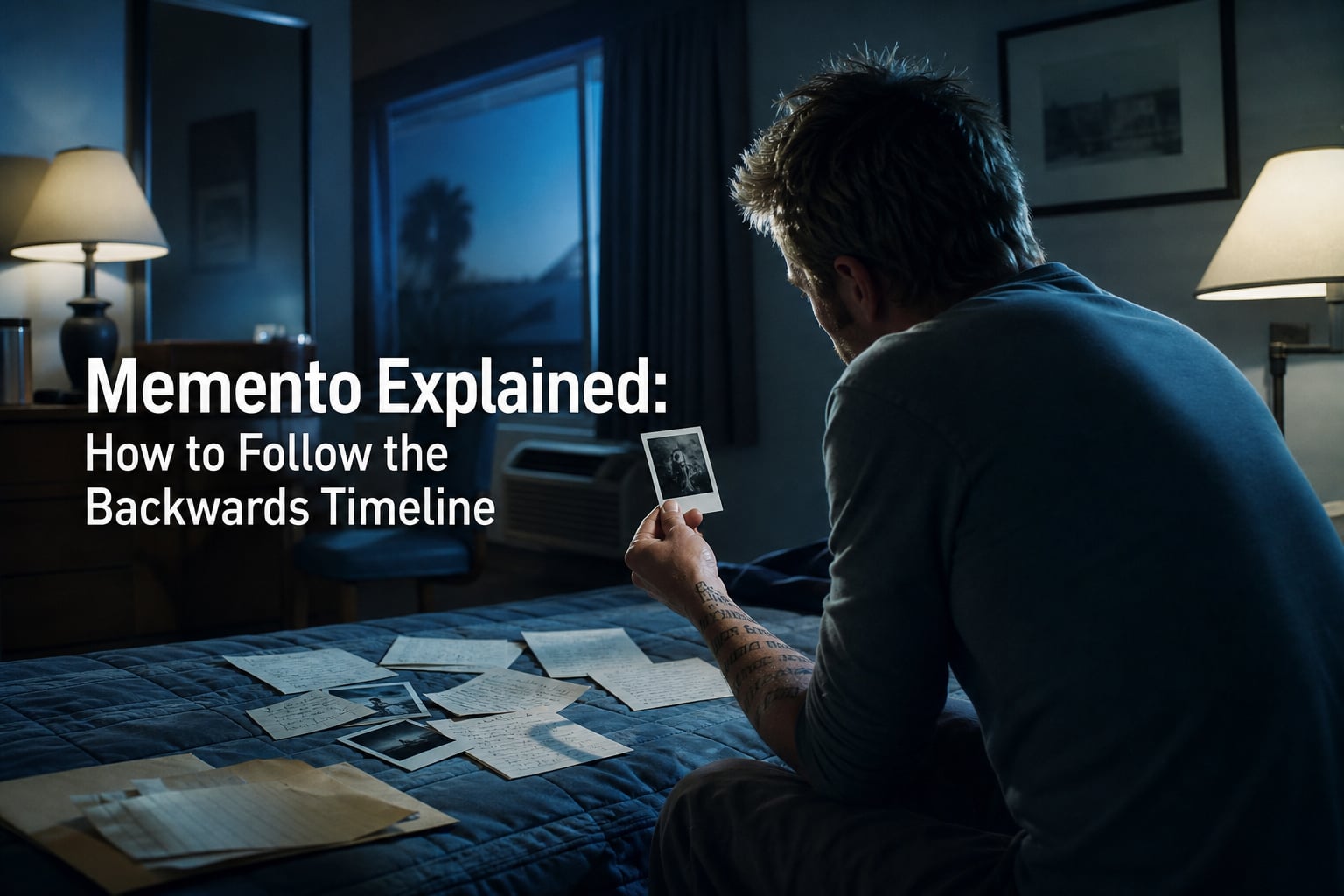
Spoilers for Memento follow. Memento explained: how to follow the backwards timeline comes down to one rule: the color scenes move backward through time, while the black-and-white scenes move forward. They meet at one central moment, and that meeting point turns the apparent ending into the cause of nearly everything we have just watched.
Christopher Nolan’s 2000 film follows Leonard Shelby, a man who cannot reliably make new long-term memories after a head injury. He is hunting the man he calls John G., whom he believes assaulted him and killed his wife, but he has to rebuild his purpose after every lapse by reading tattoos, Polaroids, and handwritten notes.
The first viewing is supposed to feel unstable. Forum discussions repeatedly describe viewers asking which scenes come first, whether Teddy is lying, and whether Sammy Jankis is really Leonard; the film gives us Leonard’s limited footing rather than a safe all-knowing view.
This guide separates what the movie shows from what characters claim. It explains the Memento dual timeline structure, gives the Memento chronological order, and then returns to the ending, where the question is less “Who is telling the truth?” than “What kind of truth can Leonard live with?”
Table of Contents
Memento uses two timelines that move in opposite directions.
The color storyline runs in reverse chronology. Every new color scene occurs before the color scene that preceded it on screen, so the film begins near the end of Leonard’s search and backs toward the event that set this particular cycle in motion.
The black-and-white storyline runs forward. It begins with Leonard alone in a motel room, speaking on the phone and describing Sammy Jankis, then advances in ordinary chronological order toward the same point where the color story begins.
The fast answer: follow color scenes by asking, “What happened immediately before this?” Follow black-and-white scenes by asking, “What happens next?” When black-and-white turns to color, the two tracks have reached the same moment.
The color scenes show effects before causes.
At the start, Leonard kills Teddy. Because the film is moving backward, the next color segment shows Teddy alive and Leonard farther from the shooting; each cut supplies the missing cause for information we have already seen.
This order makes small objects feel suspicious. A photograph may show a smiling Leonard beside a dead man, a note may label someone “Don’t believe his lies,” and a tattoo may announce a fact before we know who wrote it or why.
The black-and-white scenes show Leonard building a story.
In the monochrome track, Leonard explains his routines and tells the Sammy Jankis case in detail. He also speaks to an unseen caller, and the scene supplies background that feels dependable because it moves normally, even though the film eventually asks us to question that confidence.
The black-and-white material is not simply a flashback separate from the main plot. It advances toward the same motel and the same Leonard seen in color, then crosses over when Leonard leaves his room and the image shifts into color.
The meeting point is the key to Memento’s plot explained.
The two timelines meet after Leonard has killed Jimmy Grantz in an abandoned building. Teddy arrives, tells Leonard that Jimmy was a drug dealer connected to a sting, and offers his account of Leonard’s past before persuading Leonard to take Jimmy’s car and clothes.
From there, the color scenes run backward through Leonard’s dealings with Natalie, Dodd, and Teddy until they arrive at this point. Chronologically, however, this is where the long chain of manipulation, revenge, and self-authored clues begins.
Memento explained: how to follow the backwards timeline step by step.
You do not need to memorize every cut to understand the movie. Keep the two tracks separate, treat Leonard’s records as evidence rather than facts, and track only the changes that a new scene explains.
Step 1: Identify the image style. Color means the story has moved one step earlier than the last color scene. Black and white means the story has moved one step later than the last black-and-white scene.
Step 2: Start each color scene with its outcome. Ask what Leonard already knows, what object he possesses, and what problem he is reacting to. The following color scene on screen will usually reveal why.
Step 3: Watch the records change. Polaroid captions, notes, and tattoos act as Leonard’s external memory. Notice when a label has been crossed out, when a photo was taken, or when a fact appears without a source.
Step 4: Treat black-and-white as the spine. This forward-moving track supplies the route to the convergence. It explains where Leonard is, why he is waiting, and how he comes to meet Teddy.
Step 5: Mark the crossover. When Leonard leaves the motel room and the black-and-white image becomes color, both timelines occupy the same present moment. Everything afterward in real time is what the color track has been working backward from.
Step 6: Reframe the opening. The first killing is not the beginning of a solved case. It is the latest result of Leonard acting on a clue he chose to create for his future self.
Viewing tip: Do not pause to place every scene on a giant calendar during a first rewatch. A simpler method is to write “color: earlier” and “B&W: later,” then note only three anchors: Jimmy’s death, Teddy’s confession, and Teddy’s death.
The chronological order begins with Leonard’s past and ends with Teddy’s death.
The following outline gives the causal order, not the order in which the movie presents events. A few details remain intentionally uncertain because the film filters them through Leonard and through Teddy, but the sequence makes the Memento timeline explained much easier to hold.
Leonard works as an insurance investigator and examines Sammy Jankis’s claim that he cannot form new memories.
Leonard and his wife are attacked in their home. Leonard kills one assailant, suffers a head injury, and believes another attacker escaped; his wife later dies, though the film keeps the exact circumstances unstable.
Leonard develops his system of tattoos, Polaroids, and notes while pursuing the remaining John G.
Teddy, a police officer whose real name is John Edward Gammell, claims he helps Leonard locate the attacker. Teddy says Leonard kills that man and takes a celebratory photograph, but Leonard cannot retain the resolution.
Teddy keeps using Leonard’s need for a target, directing him toward men such as Jimmy Grantz. Whether every part of Teddy’s narration is accurate is not provable, but the film shows that Teddy profits from the arrangement.
Leonard meets Jimmy at the abandoned building and kills him, believing he has found John G. He photographs the body and is photographed with it.
Teddy arrives, explains his version of Leonard’s past, and pushes Leonard to take Jimmy’s belongings. Leonard secretly writes a clue that points to Teddy’s license plate and resolves to make Teddy his next John G.
Leonard meets Natalie, who recognizes Jimmy’s car and uses Leonard’s condition to remove Dodd, a man threatening her. Natalie writes and alters information Leonard will later treat as reliable.
Leonard follows the license-plate clue, confronts Teddy, and kills him. That is the chronological endpoint and the film’s opening scene.
This order answers a common misconception: the movie is not literally played backward from start to finish. Its color scenes are reverse chronological, its black-and-white scenes are chronological, and the two strands are intercut to put the audience in the same informational disadvantage as Leonard.
Leonard’s memory condition is anterograde amnesia, not a magic reset button.
Anterograde amnesia means difficulty forming new lasting memories after the injury or illness begins. Leonard can recall parts of his earlier life, reason in the moment, follow habits, and learn enough to create a record, but he loses the recent context that tells him why he is doing something.
The film uses the condition with unusual care in some respects: Leonard recognizes that his handwriting can mislead him, relies on routines, and knows that emotional conviction is not the same as proof. Still, Memento is a fictional thriller, not a medical case study, so viewers should not treat its exact timing or behavior as a universal portrait of real people with anterograde amnesia.
Leonard’s memory system gives authority to marks that have no built-in truth.
The tattoos are Leonard’s highest-level facts because they are permanent and difficult to ignore. Yet their permanence makes them dangerous: once he turns an interpretation into ink, future Leonard receives it as a command without remembering the doubt that came before it.
Polaroids give faces and places a practical label. Their captions look objective, but Natalie can write “He is not a liar” on her own photo, Teddy can be labeled “Don’t believe his lies,” and Leonard can mistake a useful warning for a settled conclusion.
Handwritten notes are the most flexible layer and therefore the most exposed to interference. Natalie exploits that weakness after provoking Leonard into violence, then writes instructions that steer his next self away from her role in what happened.
Important distinction: Leonard does not have no memory at all. His problem is that the recent past will not stay available, which leaves him dependent on a system that other people can edit and that he can weaponize against himself.
The ending shows Leonard choosing a future target before he forgets why.
Memento’s ending explained in chronological terms starts at Jimmy’s death. Teddy tells Leonard that he had already helped him find and kill the man responsible for the home attack, and that Leonard’s search has continued because he cannot keep the satisfaction of finishing it.
Teddy also says Leonard has created a repeating pattern: once one target is gone, a new John G. can be found. Teddy may have incentives to distort details, especially because he benefits from using Leonard, but the scene is built to make his core revelation hard to dismiss rather than easy to accept.
Leonard does not simply forget Teddy’s confession; he acts against it.
After hearing Teddy, Leonard considers whether he needs another puzzle to live for. He deliberately records Teddy’s license plate, burns a message that could complicate the choice, and decides that future Leonard will find the clue without remembering that present Leonard planted it.
That act changes the moral weight of the final killing. Leonard is not merely a passive victim of missing memory; he knowingly creates evidence that will persuade his later self to hunt Teddy, even while admitting that he may be wrong.
The actual killer is not confirmed with courtroom certainty.
If “the actual killer” means the attacker who killed Leonard’s wife, Teddy says Leonard already found and killed him. The movie gives supporting images, including the photograph of Leonard after that apparent victory, but it withholds independent proof and makes Teddy an interested witness.
If the question means who dies at the end of the movie’s story, the answer is Teddy. Leonard kills him because the license-plate clue he made for himself turns Teddy into the next John G.; the tragedy is that Leonard designed the certainty he then obeys.
Teddy, Natalie, and Sammy reveal different ways Leonard can be used.
Leonard is an unreliable narrator, but not because he consciously lies in every scene. His memories are interrupted, his records can be altered, and his intense need for a coherent mission makes the explanation that feels most useful stronger than the explanation best supported by evidence.
Teddy tells important truths but remains unsafe to trust.
Teddy knows more about Leonard’s history than Leonard can check. He appears to give Leonard information about the earlier John G., and he understands that Leonard will lose the emotional force of a solved case, but he also taunts Leonard and appears to exploit him for his own purposes.
The right response is not to accept or reject every sentence Teddy says. His confession can contain the movie’s central truth while his conduct shows that he is not a neutral rescuer; that tension is why audiences often resist him even when the evidence points toward parts of his story.
Natalie wants Dodd gone because Dodd threatens her and Jimmy’s operation.
Natalie sees Leonard driving Jimmy’s car after Jimmy disappears. She understands that Leonard’s condition can be directed, so she feeds him selected facts and manufactures a confrontation that will make him pursue Dodd.
Her cruelty is plain in the scene where she provokes Leonard, leaves while he cannot retain the exchange, and returns to shape his response. Yet she is not presented as a simple villain: she has lost Jimmy, faces pressure from Dodd, and finds a way to survive by making Leonard’s need serve her immediate problem.
Sammy Jankis may be a displaced version of Leonard’s guilt.
The Sammy story begins as Leonard’s insurance-case example of someone who could perform routines without truly remembering. In Leonard’s account, Sammy’s wife tests him by repeatedly asking for insulin injections, and Sammy gives them until she dies.
The film later flashes a disturbing image in which Leonard appears in Sammy’s place. That image does not provide a signed factual report, but it invites the interpretation that Leonard has transferred some part of his own history, grief, or responsibility onto Sammy in order to preserve the story he needs about himself.
So, was Leonard actually Sammy? No literal identity swap occurs. The stronger reading is that Sammy is a separate person whose story has been mixed with Leonard’s memories, making him a screen for material Leonard cannot bear to own.
Reverse chronology makes the audience feel Leonard’s need for certainty.
In an ordinary mystery, viewers receive causes, weigh them, and wait for the result. Memento gives us consequences first: a body, a car, a wound, a furious reaction, and a note. We are pushed to form a judgment before we know the context that might undo it.
That design produces a small version of Leonard’s condition. We cannot carry forward enough immediate context to assess each person cleanly, so we rely on captions, confident voices, and the emotional pull of revenge just as he does.
Memory in Memento is a tool for identity, not a neutral archive.
Leonard insists that memory can be distorted while facts cannot. The film challenges that belief by showing that facts arrive through people, labels, and decisions; a tattoo can be physically stable while the meaning behind it is mistaken or deliberately planted.
The result is a bleak Memento film analysis of identity. If a person depends on records to know what matters, then choosing which records survive becomes a choice about who that person will be next.
Control in Memento is real only for a moment.
Leonard builds procedures to regain control: he photographs, labels, writes, and tattoos. Those procedures help him act independently, yet they also create a set of handles that Teddy and Natalie can pull when Leonard is not present to defend the original context.
His final decision is therefore both an assertion of agency and a surrender of it. Present Leonard controls future Leonard by giving him a clue, but future Leonard cannot consent to the purpose behind the clue because the deciding moment has been erased.
Self-deception is the film’s most lasting twist.
The line between deliberate invention and honest error matters. Leonard knows enough at the end to suspect that Teddy’s account may be true, then chooses a version of events that gives his life direction; he turns doubt into a permanent instruction.
This is why a chronological cut can feel less mysterious but not less sad. It clarifies who acts first, but it cannot remove the painful pattern: Leonard needs a story powerful enough to survive the next gap in memory, even if that story costs another person’s life.
The best way to rewatch Memento is to follow evidence, not confidence.
On a rewatch, look for the source of every “fact.” Ask who wrote it, what they knew, what they gained, and whether Leonard saw the event himself or inherited it from a note.
Track when Teddy’s photograph and license plate become meaningful.
Notice that Natalie’s note-writing gives her access to Leonard’s next decisions.
Compare Leonard’s certainty about the wife, Sammy, and John G. with the evidence actually shown.
Watch the final chronological scene as a choice to create a mystery, not simply as a twist revealing one.
Viewers online often recommend a chronological version after the original cut. That can clarify plot mechanics, but the theatrical structure remains the better first experience because its confusion is the point: it makes certainty feel attractive before showing how dangerous it can be.
FAQs
What is the chronological order of Memento?
Chronologically, Leonard investigates Sammy Jankis, is injured during the attack on his home, builds his note-and-tattoo system, and—according to Teddy—kills the original attacker. Teddy then directs him to Jimmy Grantz; Leonard kills Jimmy, records Teddy’s license plate as a future clue, meets Natalie and removes Dodd, and finally kills Teddy. The color scenes show this sequence in reverse, while black-and-white scenes move forward to Jimmy’s death.
Who was the actual killer in Memento?
The film never gives a fully independent, certain identification of Leonard’s wife’s killer. Teddy says Leonard already killed the responsible attacker before the main color-story events, and a photograph supports that claim, but Teddy also exploits Leonard and has reasons to lie. The film’s confirmed final victim is Teddy, whom Leonard kills after planting Teddy’s license plate as a clue for himself.
Why did Natalie want Dodd dead?
Natalie wanted Dodd removed because he was threatening her over Jimmy Grantz’s drug operation. After seeing Leonard with Jimmy’s car, she recognized an opportunity: she manipulated Leonard’s memory system and anger so he would pursue Dodd. Her plan protects her from an immediate threat, although it also puts Leonard in danger and turns his condition into a weapon.
Was Leonard actually Sammy?
Leonard was not literally Sammy Jankis. The movie presents Sammy as a former insurance case, then briefly shows Leonard in Sammy’s place during the insulin-memory sequence. That image suggests Leonard may have blended Sammy’s story with his own trauma and guilt, possibly transferring unbearable details into another man’s narrative. It is evidence of unreliable memory, not a literal identity reveal.
Conclusion
Memento explained: how to follow the backwards timeline is simple at the structural level: color moves backward, black and white moves forward, and the tracks meet at Jimmy’s death. What stays difficult is the human level, because every record and recollection can be mistaken, manipulated, or chosen for emotional survival.
Watch the color scenes as a chain of causes being uncovered in reverse, then replay the chronological outline above. On a second viewing, the film stops being a puzzle about the order of events and becomes a sharper question about memory, revenge, and whether a person can live without a story that explains who they are.