
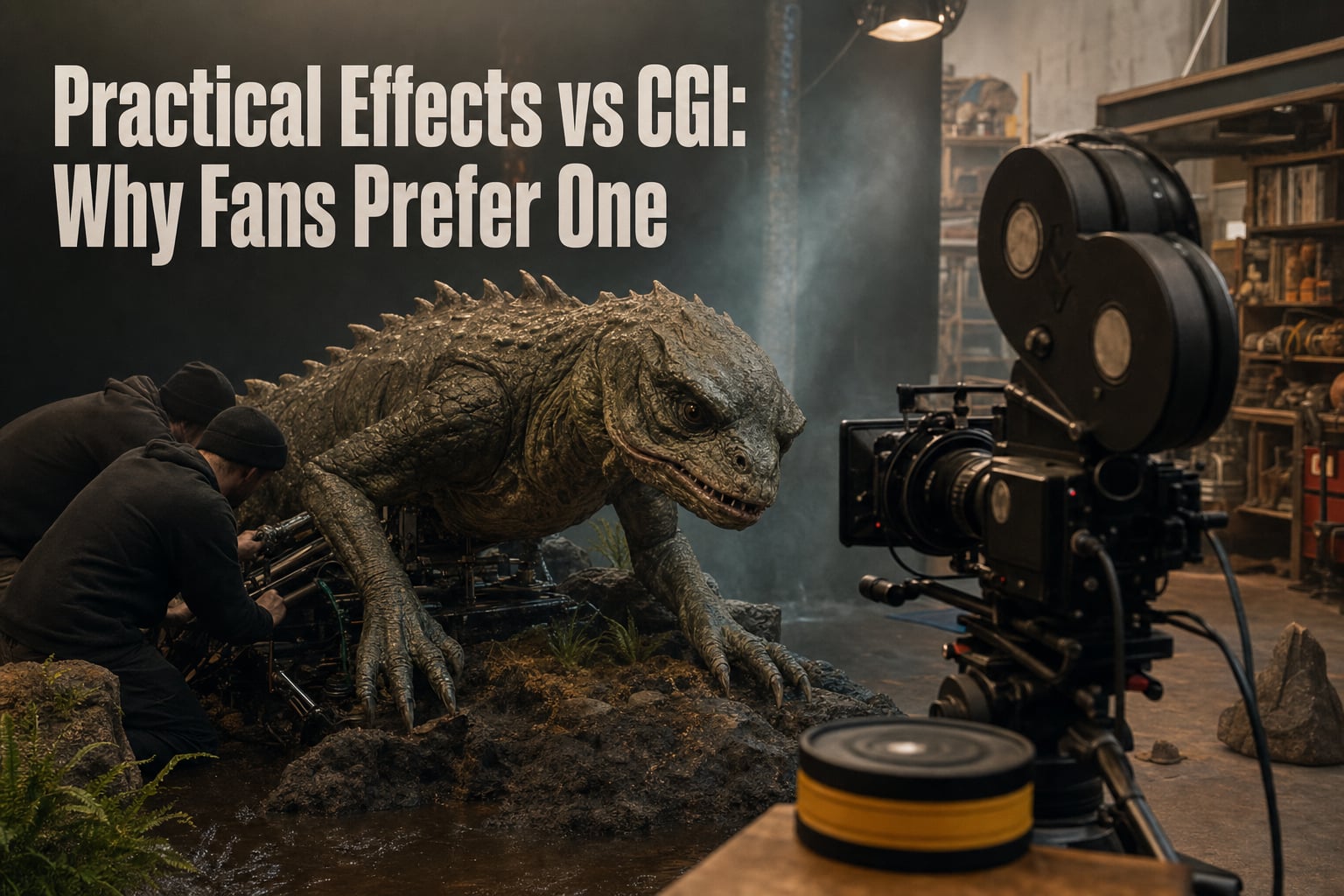
I have spent the last decade watching films with a notebook in hand, scribbling down which scenes pulled me in and which ones made me glance at my phone. The pattern that keeps emerging? Practical effects vs CGI isn’t really a fair fight in the trust department. Audiences, including me, consistently respond more emotionally to physical effects, even when the digital work is technically flawless.
This guide breaks down the practical effects vs CGI debate from every angle that matters to filmmakers, film students, and movie fans. You will learn how each technique works, why your brain trusts one over the other, and where the future of visual effects is heading. By the end, you will understand the fan psychology that keeps driving this conversation on Reddit forums, in film school classrooms, and at every comic-con panel.
Table of Contents
What Are Practical Effects in Film?
Practical effects are physical visual illusions created on-set using real props, makeup, prosthetics, animatronics, miniatures, pyrotechnics, and mechanical devices. They exist in the camera’s frame during filming, meaning actors can touch them, react to them, and be affected by them in real time.
Think of the chestburster scene in Alien, the shape-shifting puppet work in The Thing, or the animatronic T-Rex in Jurassic Park. Those creatures were physical objects on a soundstage, manipulated by teams of artists and engineers. When Ian Malcolm looks terrified in Jurassic Park, Sam Neill was reacting to a 40-foot mechanical dinosaur, not a tennis ball on a stick.
The category includes several sub-disciplines that filmmakers use constantly:
- Prosthetic makeup – Foam latex, silicone pieces, and airbrushed layers that transform actors (the wolf transformations in An American Werewolf in London)
- Animatronics – Mechanically controlled puppets, often radio-controlled or cable-driven (the shark in Jaws, the aliens in Aliens)
- Miniatures and large-scale models – Physical buildings, vehicles, and landscapes built at reduced scale (the Death Star explosion in Star Wars)
- Pyrotechnics – Real explosions, fire effects, and controlled demolitions
- Wirework and harnesses – Suspended actors creating the illusion of flight or superhuman movement
- Weather effects – Practical rain machines, snow, fog, and wind generators
Our team has toured several effects shops over the years, and the artistry involved is staggering. A single animatronic head can take 12 weeks to sculpt, with each strand of hair individually punched by hand. That kind of craftsmanship leaves a fingerprint on screen that audiences feel even if they cannot articulate why.
What Is CGI and How Does It Work?
CGI, or computer-generated imagery, refers to any visual content created digitally using 3D modeling, animation, compositing, and rendering software. The work happens primarily in post-production, after the live-action footage has already been shot.
Modern CGI pipelines begin with reference photography, concept art, or even scanned physical maquettes. Artists then build 3D models in software like Maya, Blender, or Houdini. They add textures, rig the models with virtual skeletons, animate the movement, light the scene to match the live-action plates, and finally render the result frame by frame. A single frame of complex CGI can take hours to render, with feature films requiring thousands of machines running in parallel.
Examples of CGI that have shaped modern cinema include Gollum in Lord of the Rings, the dinosaurs in Jurassic World, the entire city of Wakanda in Black Panther, and most space environments in the Star Wars sequel trilogy. The technique allows filmmakers to depict impossible physics, unlimited creature variety, and environments that would cost hundreds of millions to build physically.
Digital effects have exploded in capability since the early 1990s. Toy Story in 1995 was the first fully computer-animated feature. By 2026, we have reached a point where CGI can simulate individual strands of hair moving in simulated wind, track eye dilation in CG characters, and replicate the subsurface scattering of light through human skin. The technology is extraordinary. So why do so many fans still prefer the older approach?
Practical Effects vs CGI: Key Differences
The practical effects vs CGI comparison comes down to one core distinction: practical effects exist physically during filming, while CGI exists only as data processed after filming. This single difference creates cascading effects across cost, performance, realism, flexibility, and longevity.
Here is a direct comparison of the two techniques across the factors filmmakers and audiences care about most:
| Factor | Practical Effects | CGI |
|---|---|---|
| When created | On-set during filming | Post-production after filming |
| Actor interaction | Direct – actors touch and respond | Indirect – actors react to markers or imagination |
| Lighting | Real – captured in-camera | Simulated – matched to plates in software |
| Cost predictability | High upfront, fixed | Variable, can balloon in post |
| Flexibility | Limited to what’s built | Adjustable until final render |
| Aging over time | Holds up decades later | Often looks dated within 5-10 years |
| Best use cases | Close-ups, tactile scenes, intimacy | Massive environments, impossible physics |
That table captures the surface-level differences. The deeper truth is how these technical differences translate into emotional responses, which is where the practical effects vs CGI debate really lives.
Why Fans Prefer Practical Effects Over CGI
Fans prefer practical effects over CGI for three interconnected reasons: physical objects trigger stronger emotional responses in our brains, practical effects age gracefully while digital effects often look dated quickly, and actors deliver more authentic performances when reacting to real stimuli.
Our brains are pattern-recognition machines evolved to detect physical reality. When we watch a scene, we process thousands of micro-signals: the way light bounces off surfaces, the subtle weight of materials, the small imperfections that signal authenticity. Practical effects carry these signals naturally because they ARE real. CGI has to recreate every one of those signals digitally, and even minor misses register as something being off, even when viewers cannot name what is wrong.
Aging is the second major factor. Practical effects from 1982 still look remarkable today. The facehugger scene in Alien, the stop-motion skeletons in Jason and the Argonauts, the animatronic shark in Jaws – all hold up because physical materials do not change much over time. CGI from 2006, by contrast, often looks jarringly dated. I rewatched Spider-Man 3 recently and the Sandman sequences, groundbreaking in their day, now look like a video game cutscene. The technology has moved on, but those pixels are frozen in time.
Actor performance is the third pillar. When Mark Hamill interacts with Yoda in The Empire Strikes Back, he is reacting to a puppet operated by Frank Oz. His fear, his hesitation, his slowly softening expression – those emotions come from a real exchange. Compare that to many modern scenes where actors stare at tennis balls on sticks and are told to imagine something terrifying. The difference shows up on screen.
One Reddit thread in r/movies captured the sentiment perfectly: a user wrote, “Practical effects feel like the filmmakers actually went and built something. CGI feels like they typed some words into a computer and called it a day.” That comment has over 4,000 upvotes. The community consensus is clear.
The Psychology Behind the Practical Effects Preference
The psychology behind the practical effects preference is rooted in how our brains process physical reality. Research in neuroscience and cognitive psychology shows that humans respond more strongly to objects we perceive as tangible, a phenomenon researchers call “presence” in virtual environments.
When our brain registers something as physically present, it allocates more attentional resources, engages motor empathy (we subtly mirror what we see), and triggers stronger emotional responses. Practical effects exploit this by being genuinely present. CGI can simulate presence, but it requires significantly more effort from viewers, who must suspend disbelief about digital artifacts they may not consciously notice.
There is also a craftsmanship factor that operates below conscious awareness. We live in an age of digital abundance, where anyone can generate images with a text prompt. Physical objects, by contrast, still carry the weight of human effort. A hand-sculpted animatronic carries 800 hours of work in its very form. Our brains register that labor, even when we are not consciously thinking about it.
Fan communities on Reddit, Letterboxd, and Discord consistently use language like “soulless,” “sterile,” and “weightless” to describe over-CGIed films. Those words are not arbitrary. They describe the absence of the qualities physical objects bring to a scene: gravity, texture, response to light, and the subtle imperfections that signal human effort. Our brains crave those signals, and when they are missing, we feel it even if we cannot name what is wrong.
The nostalgia factor amplifies this further. Practical effects dominated cinema until roughly the late 1990s. For viewers who grew up during that era, practical effects carry positive associations with childhood wonder, theater-going experiences, and formative films. CGI, by contrast, is associated with corporate franchising, sequel fatigue, and what some fans call “Marvel-ization” of Hollywood.
When CGI Excels: Cases Where Digital Wins
CGI excels in specific scenarios where practical effects hit hard physical limits: massive environments, impossible physics, large crowds, dangerous conditions, and rapid iteration during post-production. Anyone arguing that practical effects should always win is ignoring where digital tools genuinely outperform physical methods.
Consider the battle sequences in Lord of the Rings. Theoden’s charge at Helm’s Deep featured thousands of digital soldiers because staging that many extras practically was logistically impossible. The Hulk in the Avengers films would be prohibitively expensive and technically challenging to realize as an animatronic. The space whales in Star Trek: Discovery would be impossible without CGI. In each case, digital tools solve problems that physical techniques simply cannot address.
Weather effects are another strong CGI use case. Creating a city-destroying hurricane practically would be both dangerous and prohibitively expensive. Simulating 50,000 individual rain droplets hitting a CG surface, complete with accurate physics and lighting interaction, is far cheaper and safer. The same logic applies to fire, smoke, water, and crowd simulation.
Post-production flexibility is another major CGI advantage. If a director decides a creature should be blue instead of green, or a stunt should include additional explosions, those changes can happen with software adjustments. With practical effects, those changes mean rebuilding physical assets, often at enormous cost. For films with tight post-production schedules or extensive reshoots, CGI provides adaptability that practical methods cannot match.
The honest assessment is this: CGI is a tool, not a replacement for reality. Used in scenarios where it shines, it is magnificent. Used as a default replacement for physical filmmaking, it often falls short of audience expectations.
The Hybrid Approach: How Modern Films Blend Both
The hybrid approach combines practical elements as the foundation with CGI used for enhancement, extension, or correction. This is now the dominant filmmaking model in major studio productions, and it is where the practical effects vs CGI debate becomes most nuanced.
Christopher Nolan’s films are masterclasses in this approach. Inception featured a rotating hallway built as a full practical set, with CGI used only to extend hallways and add background elements. Interstellar combined physical miniature work with digital enhancement. Tenet blew up an actual 747 rather than rely on CGI because Nolan believed practical explosions look more real. His philosophy: build as much as possible physically, then use CGI to fill gaps the camera cannot capture.
George Miller’s Mad Max: Fury Road took a similar approach. The film used real vehicles, real stunts, and real explosions for the bulk of its action. CGI was deployed to enhance crashes, remove safety equipment, extend environments, and handle the few sequences that were physically impossible. The result is one of the most viscerally exciting action films of the past 20 years.
The Jurassic Park franchise offers an interesting case study in evolution. The original 1993 film used practical effects for the dinosaurs because CGI of that era could not achieve photorealism. As CGI improved, the sequels shifted toward digital dinosaurs. Many fans argue the original’s effects still look more impressive than the 2015 sequel’s, despite being 22 years older. The aging factor is striking.
For filmmakers reading this, the practical takeaway is to ask one question before reaching for software: “Can we build this physically?” If yes, building it will usually yield stronger audience responses, better actor performances, and a longer-lasting visual legacy. If no, CGI is the right tool for the job.
Cost Comparison: Practical Effects vs CGI Budget
Practical effects vs CGI cost comparisons are more complicated than most articles suggest. The headline cost of practical effects is often higher upfront, but CGI budgets frequently balloon during post-production when revisions stack up and render times extend schedules.
A practical creature suit might cost $50,000 to $200,000 to design and build, plus performer wages. The same creature done in CGI might be quoted at $1-5 million upfront, but that estimate often excludes the inevitable revisions, additional render time, and extended artist hours that come with complex digital work. By the time the film ships, the CGI creature may have cost $8-15 million.
Hidden costs differ significantly between the two approaches. Practical effects have visible costs that are easy to budget: materials, labor, studio space. CGI has hidden costs that surface during production: render farm time, software licenses, technical director salaries, and the cost of fixing problems discovered late in post-production. A digital creature that looked great in previsualization can suddenly look wrong once composited into the final lighting, triggering expensive rework.
Insurance and reshoot risk is another factor. Practical effects that fail on set require expensive reshoots. CGI can be revised at any point until final delivery, with much lower physical risk. For producers managing risk on expensive productions, that flexibility has real financial value.
The honest budget summary: for intimate scenes with one or two key effects elements, practical is usually cheaper and faster. For massive environments, crowds, or impossible physics, CGI is usually the only viable option. For complex hybrid productions, total budget depends heavily on how efficiently the two approaches are integrated.
Iconic Practical Effects Movies That Still Hold Up
Iconic practical effects movies continue to impress audiences decades after release, while many CGI-heavy films from the same era look dated. This longevity is perhaps the strongest argument for practical techniques when both options are viable.
The Thing (1982) remains a masterclass in practical creature effects. Rob Bottin’s work has not aged a day. The head-splitting scene, the spider-head, the chest-chomping dog – all practical, all still shocking. Alien (1979) holds up for the same reason. H.R. Giger’s creature was physical, and the actors’ reactions to it were real.
Jurassic Park (1993) is the gold standard hybrid example. Stan Winston’s animatronic dinosaurs combined with Industrial Light and Magic’s CGI work produced effects that still feel more impressive than many modern creature films. The T-Rex attack on the jeeps, the brachiosaurus reveal, the kitchen raptor scene – all still work because practical foundations anchored the digital extensions.
Mad Max: Fury Road (2015) proved the hybrid approach still wins in the modern era. The film earned six Academy Awards and is widely cited as one of the best action films ever made. Its practical stunt work, real vehicles, and physical explosions created a tactile energy that pure CGI action sequences struggle to match.
An American Werewolf in London (1981) won the first Academy Award for Best Makeup and remains a benchmark for transformation scenes. Rick Baker’s practical work has never been matched in its combination of horror, pathos, and physical transformation. CGI transformations feel like shape-shifting; Baker’s felt like a man actually becoming a wolf.
The pattern across these films is consistent: practical foundations create lasting visual impact. When filmmakers reach for digital tools, they should ask whether the choice serves the story or simply avoids the harder work of building something physical.
Frequently Asked Questions
Why do people prefer practical effects over CGI?
People prefer practical effects over CGI because physical objects trigger stronger emotional responses in our brains, practical effects age gracefully while digital effects often look dated within a decade, and actors deliver more authentic performances when reacting to real stimuli on set rather than imagining them against green screens.
What is the difference between CGI and practical effects?
The difference between CGI and practical effects comes down to when and how they are created. Practical effects are physical visual illusions built on-set using props, makeup, prosthetics, animatronics, and miniatures that actors can touch during filming. CGI, or computer-generated imagery, is created digitally in post-production using 3D modeling, animation, and rendering software after live-action footage has been shot.
Why are practical effects sometimes cheaper than CGI?
Practical effects are sometimes cheaper than CGI because their costs are visible and predictable from the start: materials, labor, and studio time. CGI budgets often balloon during post-production due to revisions, extended render times, and late-discovered problems that require expensive rework, making the final cost significantly higher than the initial quote.
Why do filmmakers sometimes choose practical effects instead of CGI?
Filmmakers sometimes choose practical effects instead of CGI because physical effects produce stronger actor performances, age better over decades, feel more authentic to audiences, and create a tangible sense of weight and presence that digital effects struggle to replicate, especially for close-up shots and intimate character moments.
Are practical effects better than CGI?
Practical effects are not categorically better than CGI – each technique excels in different scenarios. Practical effects win for intimate scenes, tactile moments, close-up makeup work, and situations where actor interaction matters. CGI wins for massive environments, impossible physics, large crowds, weather simulation, and any scenario where physical production is unsafe or logistically impossible.
Conclusion
The practical effects vs CGI debate is ultimately about how filmmakers want audiences to feel. Practical effects engage our brains in ways digital effects struggle to match, age beautifully across decades, and give actors real stimuli to respond to. CGI offers flexibility, scale, and the ability to depict impossible physics that practical methods cannot approach.
The best modern productions recognize that this is not an either-or choice. They build practical foundations, then use CGI to extend and enhance those foundations. For filmmakers reading this in 2026, the question is not “practical or CGI?” but rather “what does this scene need to feel real to the audience?” Sometimes the answer is a 40-foot animatronic. Sometimes it is a software render. The art is knowing which tool serves the story.