
If you have played a free-to-play game in the last few years, you have almost certainly seen the term “battle pass” thrown around. But what is a battle pass, really? It sounds simple until you start digging into tiers, seasons, XP, V-Bucks, premium tracks, and everything else attached to it.
When I first encountered a battle pass in Fortnite years ago, I was honestly confused. Was it a subscription? A one-time purchase? Did I lose everything when the season ended? Those are the exact same questions I see popping up on Reddit threads and gaming forums every single day.
In this guide, I am going to break down exactly what a battle pass is, how the progression system works, what you actually get for your money, and whether it is worth buying in 2026. I will keep the gaming jargon to a minimum so whether you are a seasoned player or a parent trying to understand what your kid is asking you to buy, this will make sense.
Table of Contents
What Is a Battle Pass?
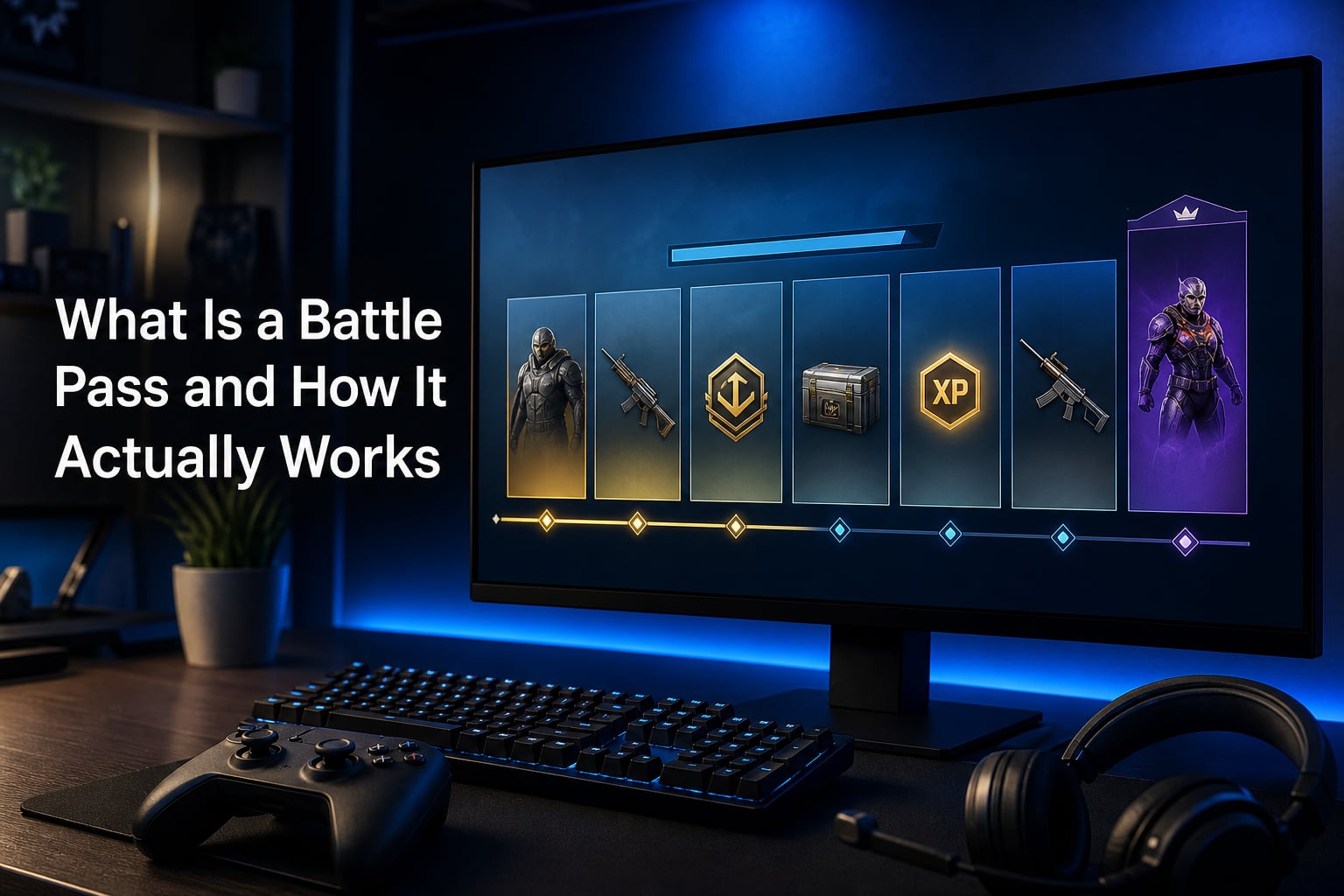
A battle pass is a seasonal in-game progression system that rewards players with cosmetic items, in-game currency, and other unlockables as they play and complete challenges. Think of it like a rewards card at a coffee shop, except instead of earning a free latte after ten visits, you earn character skins, weapon wraps, emotes, and digital currency over the course of a gaming season.
The concept is simple at its core. You play the game, you earn experience points (XP), and those XP fill up a tiered rewards track. Each tier you unlock gives you something new. The more you play, the more tiers you clear, and the more rewards you collect.
Here is what a typical battle pass includes:
Rewards track: A tiered system where each level unlocks a specific item, usually spanning 50 to 100 tiers per season.
Season duration: Most passes run for 8 to 12 weeks before resetting with a new season.
Free and premium tiers: A limited free track available to all players and a paid premium track with significantly more rewards.
Cosmetic rewards: Character skins, outfits, emotes, loading screens, weapon wraps, and similar items that change appearance but do not affect gameplay.
In-game currency: Some passes include premium currency (like V-Bucks in Fortnite) that you can spend in the item shop or save for the next season’s pass.
The battle pass model has become the dominant monetization approach for free-to-play games because it keeps players engaged over time rather than relying on one-time purchases. Instead of selling a game for $60, developers give the game away for free and monetize through these seasonal passes, optional cosmetics, and occasional microtransactions.
How a Battle Pass Actually Works
Understanding how a battle pass works means understanding three connected systems: XP accumulation, tier progression, and seasonal resets. Let me walk through each one step by step.
Step 1: Earning XP Through Gameplay
Every battle pass runs on an experience points system. You earn XP by simply playing the game. In Fortnite, that means surviving matches, getting eliminations, and completing quests. In Call of Duty, it means playing multiplayer matches and finishing daily challenges. In Apex Legends, it means surviving and scoring kills in the battle royale.
Most games also offer bonus XP through specific activities:
Daily and weekly quests: Targeted challenges like “deal 500 damage with shotguns” or “play 5 matches in squads.”
Special events: Limited-time events that offer double or triple XP multipliers.
XP boost items: Some passes include or sell boosters that temporarily increase how much XP you earn per match.
Performance bonuses: Earning more XP for better match placement or higher kill counts.
The key thing to understand is that XP is the fuel. Without earning XP, your battle pass does not move forward.
Step 2: Leveling Up Tiers
As you accumulate XP, you fill up an experience bar. When that bar fills completely, you gain a battle pass level (sometimes called a tier or a star). Each level typically unlocks one reward from the pass.
In Fortnite’s current system, you earn Battle Stars for each level. You then spend those stars on the reward page to unlock specific items you want, giving you some choice in what you unlock first. Other games like Call of Duty and Apex Legends use a linear track where rewards unlock automatically in a set order as you level up.
Most battle passes have somewhere between 50 and 100 tiers. The early tiers tend to offer smaller rewards like loading screens and emotes, while the later tiers feature the most desirable items like legendary character skins and exclusive outfits.
Step 3: Seasonal Resets and New Content
Here is where things trip people up. A battle pass is seasonal, meaning it has a start date and an end date. Most seasons last 8 to 12 weeks. When the season ends, the current battle pass disappears entirely and a brand new one takes its place.
This seasonal reset is the core of the battle pass model. It creates urgency to play regularly and complete the pass before time runs out. If you do not finish the pass before the season ends, you lose access to any rewards you did not unlock. There is no way to go back and earn rewards from a previous season’s pass.
However, any items you did unlock from a battle pass are yours to keep permanently. The Optimus Prime skin you unlocked in Chapter 4 Season 4? That is yours forever. The emote you earned at tier 20? Never goes away. Only the ability to earn those items disappears when the season ends.
Step 4: Completing Bonus and Super Styles
Many modern battle passes include additional reward layers beyond the main track. Once you reach the maximum tier, you often unlock “bonus rewards” or “super styles” that let you earn variant versions of items you already unlocked. These might be gold or chrome versions of character skins, additional emote styles, or exclusive pickaxes.
Fortnite calls these Super Level Styles. If you finish the main pass and keep playing, you can unlock alternate color schemes for the season’s skins. It is a way to reward the most dedicated players who max out the pass well before the season ends.
Free vs Premium Battle Pass: What Is the Difference?
Nearly every game with a battle pass offers two versions: a free track and a premium track. The difference is significant, and understanding it helps you decide whether buying the pass is worth it.
The free track is available to everyone who plays the game. You do not need to spend any money. However, the free version offers far fewer rewards. Typically, the free track includes maybe 10 to 15 items spread across the season, compared to 100 or more items on the premium track.
Free track rewards usually include:
A few basic cosmetic items like loading screens or emotes
Small amounts of in-game currency (sometimes enough to eventually save up for a premium pass)
Occasionally a single character skin at a high tier
The premium track is what most players are talking about when they say “battle pass.” It requires an upfront purchase, usually around $9 to $12 in real money or the equivalent in premium currency. In Fortnite, the premium pass costs 1,000 V-Bucks, which translates to roughly $8 to $10 depending on how you buy the currency.
The premium track includes everything the free track offers plus dozens of additional exclusive items:
Multiple character skins and outfits, often featuring licensed crossover characters
Weapon wraps, pickaxes, gliders, and back blings
Dances and emotes
Significant amounts of premium currency (Fortnite’s pass includes 300 V-Bucks spread across the track)
Super styles and bonus rewards after maxing out the pass
One important detail: in many games, buying the premium pass mid-season instantly unlocks all premium rewards for every tier you have already reached on the free track. So if you have been playing for free and reached level 50, buying the premium pass at that point immediately gives you all 50 tiers of premium rewards you missed.
Here is a quick comparison to make the difference crystal clear:
Free track: 10 to 15 items, basic cosmetics, small currency rewards, no exclusive skins.
Premium track: 100+ items, exclusive skins, full currency rewards, bonus styles, crossover content.
Cost difference: Free track costs nothing. Premium track costs roughly $10 or equivalent in-game currency per season.
Time investment: Both tracks require the same XP and playtime. The premium track simply gives you more rewards for your effort.
Types of Battle Pass Rewards
Battle pass rewards are almost entirely cosmetic. This is a crucial point that many new players misunderstand. A battle pass does not give you better weapons, stronger characters, or any gameplay advantage over players who do not buy it. Everything is about appearance and self-expression.
The most common reward types include:
Character skins and outfits: New looks for your character. These are the headline rewards that draw most players to buy the pass.
Weapon wraps: Custom skins for your weapons that change their appearance.
Emotes and dances: Short animation sequences your character can perform.
Back blings: Backpack-style accessories worn on your character’s back.
Pickaxes and harvesting tools: Customized tools used for gathering resources or as melee weapons.
Gliders: The parachutes or wingsuits you use when dropping into a match.
Loading screens: Custom artwork displayed while matches load.
In-game currency: Premium currency you can save or spend in the item shop.
Music tracks: Background music for menus and lobby screens.
Some games also include seasonal exclusives, items that will never be available again after the pass ends. These exclusives create a sense of rarity and prestige for players who earned them during the original season.
The Psychology Behind Battle Passes
I want to be transparent about something that most articles skip. Battle passes are designed using well-documented psychological principles that encourage spending and continued play. Understanding these mechanics helps you make informed decisions about whether to participate.
Fear of missing out (FOMO): Battle passes are time-limited. If you do not complete the pass before the season ends, those rewards are gone forever. This creates genuine anxiety about missing exclusive items, which drives both purchases and extended play sessions.
The sunk cost fallacy: Once you buy a premium pass, you feel pressured to play enough to “get your money’s worth.” Players who paid $10 for a pass will grind through dozens of hours of gameplay to unlock everything, even when they are no longer enjoying the game. The initial purchase becomes a hook that keeps you playing.
Artificial scarcity: By making items exclusive to a specific season, developers create artificial rarity. That skin from Season 3 becomes a status symbol because no new player can ever obtain it. This scarcity drives engagement and purchases.
The progression treadmill: XP bars, tier unlocks, and reward tracks are all forms of variable reward scheduling. The same psychological mechanism that makes slot machines compelling is at work here, just applied to cosmetic unlocks instead of money.
None of this means battle passes are inherently bad. But it does mean you should be aware of why they feel so compelling and make conscious decisions about your time and money rather than being pulled along automatically.
Battle Pass vs Other Monetization Models
Battle passes did not appear out of nowhere. They evolved from earlier monetization models, and understanding that history helps explain why they became so popular.
Loot boxes were the dominant model before battle passes. You paid real money for a randomized chance at items. Spend $5, open a box, and maybe get the skin you want or maybe get something useless. Loot boxes faced intense criticism and regulatory scrutiny because they functioned similarly to gambling, especially for younger players.
Battle passes solved the loot box problem by offering guaranteed rewards for a fixed price. You know exactly what you are getting and what you need to do to earn it. No randomness, no gambling mechanics. This transparency is why players generally prefer battle passes over loot boxes and why regulators have been more accepting of the model.
Direct purchases from item shops still exist alongside battle passes. In Fortnite, you can buy individual skins directly from the shop without buying the pass. The trade-off is that individual skins typically cost $8 to $20 each, while a battle pass gives you 100+ items for around $10. The pass offers significantly better value, which is the entire point.
Subscriptions are the newest evolution. Some games are experimenting with monthly subscription models that include battle pass access plus additional perks. Whether this replaces the seasonal pass model remains to be seen.
A Brief History of the Battle Pass
The battle pass concept traces back to Dota 2 in 2013. Valve introduced something called the Compendium for The International tournament. Players could buy the Compendium to unlock cosmetic items and contribute to the tournament prize pool. It was a massive success and laid the groundwork for what would become the modern battle pass.
Fortnite popularized the model in 2017 when it launched its Battle Royale mode with a seasonal Battle Pass. Epic Games charged about $10 for the pass and offered over 70 tiers of rewards. The pass was so successful that it generated hundreds of millions of dollars in revenue within months, proving that free-to-play games could be enormously profitable through cosmetic monetization alone.
After Fortnite’s success, nearly every major free-to-play game adopted the model. Call of Duty, Apex Legends, Overwatch 2, Halo Infinite, Valorant, Destiny 2, and dozens of others all launched their own versions. By 2026, the battle pass is the standard monetization approach for live-service games across PC, console, and mobile platforms.
Some games have experimented with variations on the model. Halo Infinite introduced a non-expiring battle pass that lets players progress through old seasons at their own pace without time pressure. This player-friendly approach addresses one of the most common criticisms of the traditional model, though it remains the exception rather than the rule.
Is a Battle Pass Worth It?
Whether a battle pass is worth buying depends on how much you play and what you value. Let me break it down honestly.
It is probably worth it if:
You play the game regularly, at least a few hours per week.
You enjoy cosmetic customization and want exclusive items.
You want to support a free-to-play game you love.
The pass includes enough in-game currency to partially or fully fund the next season’s pass (Fortnite’s pass includes 300 V-Bucks, for example).
It might not be worth it if:
You only play occasionally and will not earn enough XP to unlock most rewards.
You do not care about cosmetic items or character appearance.
You feel pressured to play when you are not enjoying it just to complete the pass.
You are on a tight budget and the purchase would cause financial stress.
My advice is to play the free track first. If you find yourself wanting the premium rewards after a week or two of play, then buy the premium pass. You can buy it at any point during the season and still unlock everything you missed up to your current level. There is no penalty for waiting.
FAQs
How much do battle passes usually cost?
Most premium battle passes cost between $9 and $12 in real money or the equivalent in premium currency. Fortnite’s Battle Pass costs 1,000 V-Bucks, which translates to roughly $8 to $10. Call of Duty and Apex Legends charge around $10 for their premium tracks. Prices vary slightly by game and region.
When you buy the Battle Pass, do you keep it forever?
You keep all rewards you unlock from a battle pass permanently. However, the pass itself is seasonal and expires when the season ends. Any items you earned before the season ended are yours to keep forever, but any rewards you did not unlock in time are gone and cannot be earned again.
Is it worth getting a Battle Pass?
A battle pass is worth it if you play the game regularly and enjoy cosmetic customization. The premium track offers significant value compared to buying individual items from the in-game shop. If you play at least a few hours per week and want exclusive skins and items, the pass pays for itself in content and entertainment value.
Is every Battle Pass 1000 V-Bucks?
Fortnite’s premium Battle Pass has consistently cost 1,000 V-Bucks for several seasons. However, not every game uses the same pricing. Call of Duty charges 1,100 CP, Apex Legends charges 950 Apex Coins, and other games have their own pricing structures. The cost is roughly equivalent across games at about $10.
Wrapping Up
So what is a battle pass? At its simplest, it is a seasonal rewards system that gives you cosmetic items for playing a game you already enjoy. You earn XP through gameplay, level up through tiers, and unlock exclusive items along the way. The free track costs nothing, while the premium track offers significantly more rewards for around $10.
The model works because it is transparent and rewarding rather than relying on random chance. You know what you are getting, you know what you need to do to earn it, and the rewards you unlock are yours permanently. Just be aware of the psychological mechanics at play, especially FOMO and the sunk cost fallacy, and make decisions that fit your budget and play habits.
If you play a game regularly and love customizing your character, a battle pass is one of the best values in gaming. If you are a casual player or feel pressured to grind, skip it and enjoy the free track. Either way, now you know exactly how it works.