
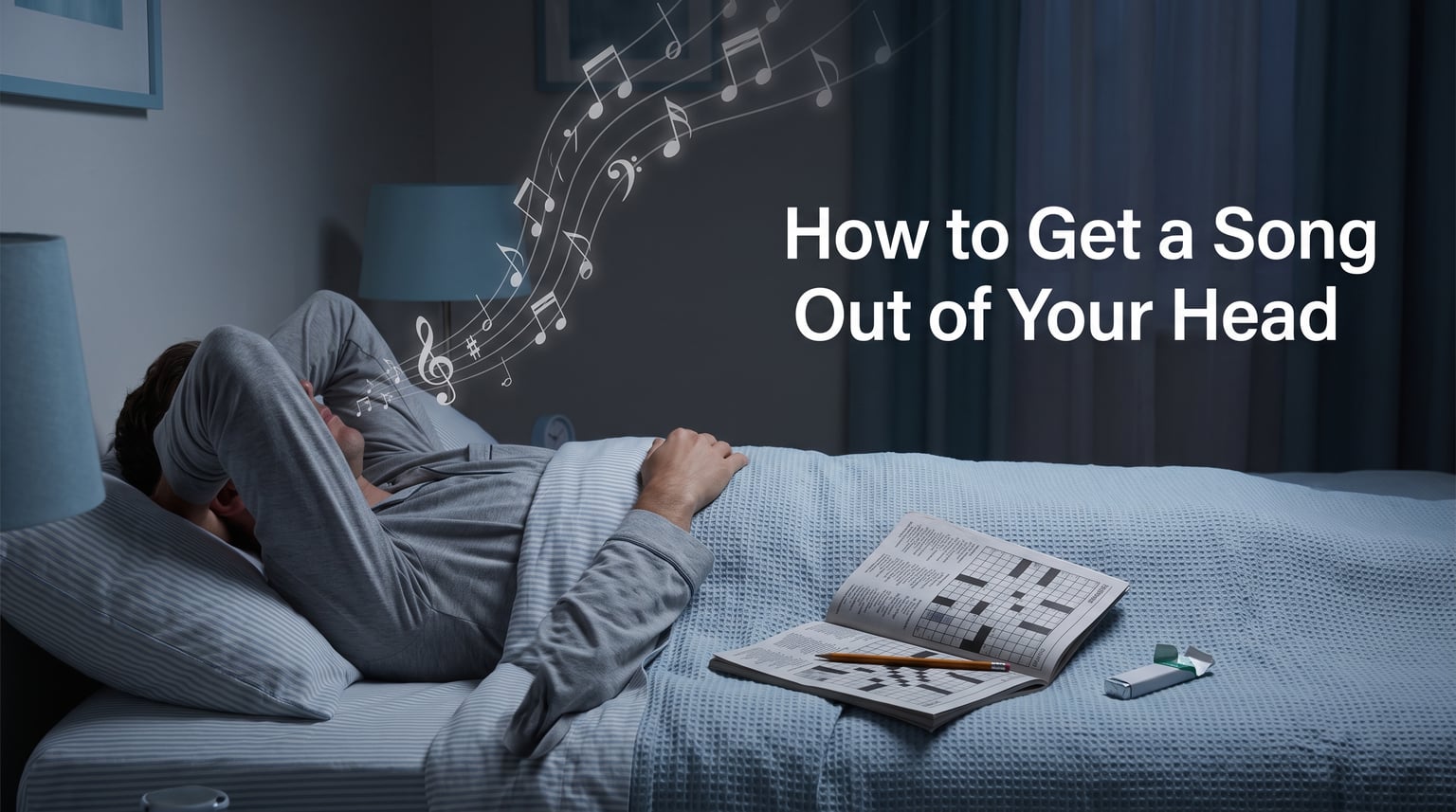
If you want to know how to get a song out of your head, start by doing one task that fully occupies your verbal attention: finish a word puzzle, read a short passage aloud, or work through a few mental sums. If the loop began with only one hook, listening to the complete track once can also give your brain a sense of ending.
A song stuck in your head is irritating at the best of times. When it turns up while you are trying to sleep, study, or focus on work, fighting it can make the replay feel louder.
There is no single earworm cure that works for every person, so I suggest choosing one method, trying it for a few minutes, and then moving on rather than cycling through ten ideas in a panic. The basics are still useful in 2026: give the loop an ending, redirect attention, and lower the stress that may be keeping it active.
Quick answer: To break an earworm, listen to the whole song once if you can do so calmly, then switch to a word-based or number-based activity. Chewing gum, a conversation, a puzzle, or a routine task with your full attention may interrupt the mental replay; trying to force the song away may have the opposite effect.
Table of Contents
An earworm is an involuntary loop of music in your mind
An earworm is the everyday name for involuntary musical imagery, often shortened to INMI. It means a fragment of music appears in your mind without you choosing it and repeats, usually as a short chorus, lyric, or melodic hook.
The phrase sounds unpleasant, but the experience itself is very common. Research discussed by major health sources reports that up to 98% of people experience these loops, and many pass on their own after a short time.
An earworm is not the same as hearing music as though it comes from the room around you. With ordinary INMI, you recognize that the music is internal, even if the stuck song is vivid and hard to ignore.
People also call them tune wedgies, stuck songs, or cognitive loops. Those labels capture the feeling well: the brain keeps returning to one small section instead of moving through the song or leaving music behind.
Most earworms last briefly, but attention can extend the experience
There is no fixed clock for how long an earworm lasts. A hook may disappear in minutes, return a few times during the day, or hang around longer when you keep checking whether it has gone.
That checking matters because attention gives the loop more room. If you notice the chorus, judge it as unbearable, and monitor it for a response, the song can become the main event instead of background mental noise.
Songs stick because memory, attention, and emotion keep a short loop active
Earworm science points to a meeting point between hearing, memory, attention, and feeling. A song you have just heard, a familiar tune linked with nostalgia, or music playing during a stressful moment can leave a small piece ready to replay.
The auditory cortex helps process sound, while memory and emotion systems can make a particular musical fragment easy to retrieve. Researchers often discuss the phonological loop, a short-term system that holds sounds and words in mind, when explaining why lyrics and melodies can recur.
Catchy patterns give the brain an easy fragment to replay
A catchy song often has a repetitive melody, a simple rhythm, a distinctive rise and fall in pitch, or an unusual musical interval. A chorus is designed to be remembered, so it makes sense that the brain can pull out a tiny, unfinished-looking part.
Hearing a song only in passing may leave that part without its musical resolution. This is one reason some people find that hearing the complete track helps: it may close the musical sequence rather than leaving the hook dangling.
Trying not to think about the song can keep it front of mind
Psychologists use ironic process theory to describe a familiar trap: when you tell yourself not to think of something, part of your mind has to keep scanning for it. That scan can bring the song back.
This does not mean you should enjoy an unwanted loop. It means a neutral response, followed by a concrete activity, can work better than repeatedly ordering your brain to stop.
Stress can make a normal loop feel much more intrusive
Forum discussions repeatedly connect songs stuck in the head with stressful periods, sleeplessness, and trouble concentrating. Stress does not prove the song has a serious cause, but it can reduce the spare attention you have for ignoring a repetitive mental sound.
Think of the song as one more item competing for a tired brain’s bandwidth. A small reset such as food, water, a walk, slower breathing, or a change of task may reduce the conditions that let the loop dominate.
How to Get a Song Out of Your Head: Break the loop with focused attention
The fastest practical approach is to give the song a clear ending or replace its mental slot with a task that needs language, numbers, or movement. Use these nine steps one at a time; switching methods every few seconds can keep the song at the center of your attention.
Listen to the whole song once when an unfinished hook is looping
Play the complete version from beginning to end if doing so will not upset you or disturb someone nearby. Many people who deal with chronic earworms report that the full song gives their mind the closure that a fifteen-second chorus lacks.
After it ends, do not immediately replay it to check whether the cure worked. Put on no music for a few minutes and begin another activity.
Chew gum to occupy the mouth and interrupt subvocalization
Chewing gum is a frequently suggested earworm removal tactic and has a reasonable practical logic. Mental music often involves a faint internal rehearsal of words or rhythm, called subvocalization, and chewing may compete with that rehearsal.
It is a low-effort option for a commute, a queue, or a work break. If gum is not for you, try sipping water or eating a small snack slowly while attending to taste and texture.
Do a word puzzle that needs active verbal attention
Try a crossword clue, word-search, spelling game, anagram, or a few minutes of reading aloud. These activities ask your phonological loop to process new language rather than silently replaying the same lyric.
The task should be challenging enough to hold you but not so difficult that it raises frustration. I would start with three to five minutes, then reassess only after finishing the task.
Work through simple math to replace rhythm with a mental sequence
Count backward by sevens, total a few figures from a receipt, or do a basic multiplication problem in your head. A number task gives the mind an ordered sequence that competes with the song’s rhythm.
Keep it simple when you are tired. The goal is not to perform perfectly; it is to move attention onto a different pattern.
Speak to someone or narrate a practical task out loud
A genuine conversation can be more absorbing than silent distraction because you must listen, plan, and respond. If you are alone, quietly narrate a routine job such as packing a bag, cooking, or tidying one shelf.
Use normal language rather than reciting the stuck lyric backward. Repeating a lyric in a new form can still keep the song active.
Move your body and give your senses new information
Take a brief walk, stretch, wash dishes, fold laundry, or step outside and name five things you can see. Movement is not a guaranteed earworm cure, but it changes your posture, sensory input, and focus at the same time.
This works especially well after a long spell of sitting with the loop. Choose a safe activity that does not need headphones or more music.
Use a neutral replacement only when silence feels impossible
Some people choose a familiar, less catchy piece of music as a temporary replacement. This can work, but it comes with an obvious risk: the new tune may become the next earworm.
If you try it, pick something calm and listen once rather than building a new loop. Spoken-word audio, a podcast with a steady voice, or ambient environmental sound may be less likely to create another repeating chorus.
Let the song be present briefly instead of wrestling with it
Notice the tune, label it as an earworm, and return to what you were doing without testing whether it remains. This is an acceptance-based response, not giving up; you are declining to feed the cognitive loop with fear and checking.
For some people, the song loses force once it stops being treated as an emergency. Pair this with a puzzle or routine task if passive acceptance alone feels too hard.
Change the trigger when the same song returns in one setting
Think back to what happens just before the stuck song arrives. It may be a social-media clip, a shop playlist, a morning alarm, a particular route, or an ad that uses the same hook.
Reducing that trigger for a few days can help break the association. Replace the cue with a different routine, such as silence during a commute or a nonmusical alarm sound.
Tip: Give each technique a fair trial. A short, absorbing task followed by no checking is usually more helpful than hunting for a perfect cure song every minute.
Sleep and study earworms respond best to a lower-stimulation reset
A song at bedtime feels louder because there are fewer outside sounds and fewer demands on your attention. Do not turn the bed into a place for battling a chorus; use a quiet routine that shifts focus away from music.
At bedtime, use words or body sensations instead of more songs
Read a few pages of low-stakes prose, try a gentle body scan, or count slow breaths without forcing a result. If you remain awake and frustrated, get up briefly for a calm, dim, nonmusical activity, then return when sleepy.
Avoid scrolling through short videos to find a distraction. The next clip may supply a fresh catchy song, and bright, fast content can make sleep harder for a separate reason.
While studying, give the brain a small verbal job before deep work
Write a short list of the next three tasks, summarize the last paragraph you read in your own words, or solve two simple problems on paper. Then start a focused work interval with the phone and music sources out of reach.
If lyrics keep intruding, silent instrumental music is not always neutral; musicians and music-focused listeners can get instrumental earworms too. A quiet room, earplugs if safe and comfortable, or unobtrusive nonmusical background sound may be a better choice.
At work, choose a task that needs interaction rather than passive busywork
Answer a message that needs thought, organize a short list, or speak with a colleague about a concrete next step. Passive tasks leave more room for the stuck song to continue in the background.
When concentration is the problem, do not judge yourself for having an earworm. Treat it as a cue to change the task or reset attention for a few minutes.
Stress and music exposure can make earworms feel more frequent
Some people seem to get earworms more often, but frequency alone does not identify a condition or personality type. People who listen to a lot of music, pay close attention to melodies, or spend time performing music may simply have more musical material available for recall.
ADHD does not follow automatically from a song stuck in your head
Having a song stuck in your head is common and is not, by itself, a sign of ADHD. People with ADHD may describe attention as harder to direct, but only a qualified clinician can assess a pattern of symptoms and its effect on daily life.
The useful question is practical: does the loop fade when you change tasks, sleep, or lower stress, or is it one part of a broader and persistent attention concern? If the latter is affecting school, work, relationships, or wellbeing, discuss it with a healthcare professional.
Anxiety can amplify an earworm without being its sole cause
Anxiety may make a stuck song more noticeable because the mind is already scanning for problems and the body is more activated. The loop can then become one more target for worry, which keeps attention fixed on it.
That is why a combined response helps: use a redirecting task and address the stressor where you can. A song in your head is not enough information to diagnose anxiety, OCD, or any other mental-health condition.
Children can have earworms too and usually need simple reassurance
Children may repeat a favourite chorus after school, a film, or a party because repetition is part of how they enjoy and remember music. A calm explanation that the brain is replaying a tune, followed by play, reading, or conversation, is often more useful than treating it as strange.
Ask for professional advice if a child is very distressed, cannot sleep over a sustained period, reports hearing sounds others cannot hear, or has other sudden changes in mood or behavior. Describe what happens and when it happens rather than trying to label it yourself.
Musical loops can sometimes support memory or creativity
Not every earworm is a nuisance. A melody can cue a memory, spark an idea, or supply a pleasant mental soundtrack when it is brief and welcome.
The difference is control and impact. When the loop interrupts sleep or concentration, use one of the reset methods; when it is harmless, there may be no need to turn a normal mental event into a problem.
Seek professional advice when the experience changes or disrupts daily life
Most stuck songs are ordinary involuntary musical imagery. Still, it is sensible to speak with a doctor or mental-health professional if music-like experiences are new, markedly different from your usual earworms, or are causing serious distress.
Warning: Seek prompt medical help for sudden neurological symptoms such as weakness, facial droop, confusion, severe headache, trouble speaking, or a new change in vision. Do not assume those symptoms are caused by an earworm.
Get support when the loop is persistent, distressing, or paired with other symptoms
Make an appointment if the experience repeatedly prevents sleep, makes work or school difficult, leads you to avoid normal activities, or arrives alongside intrusive thoughts, major mood changes, or hearing music as external sound. Bring notes on how long it has been happening, likely triggers, sleep, medicines, and other symptoms.
A clinician can help sort out whether stress management, sleep support, hearing assessment, or mental-health care makes sense. This is not a failure of willpower, and you do not need to wait until the problem feels unbearable to ask.
FAQs
Common questions have practical, short answers
How to get a stuck song out of your head?
Listen to the complete song once if an unfinished hook is looping, then switch to a task that needs words or numbers, such as a puzzle, reading aloud, or simple mental math. Chewing gum, conversation, and a short walk may also interrupt the replay. Avoid repeatedly checking whether the song is gone, because suppression can keep it in focus.
Is having a song stuck in your head ADHD?
No. Earworms are common and a song stuck in your head alone does not indicate ADHD. If attention difficulties are persistent across settings and affect daily life, a qualified clinician can assess the wider pattern rather than relying on one symptom.
How do you remove a song from your head?
Give the song a full ending by listening to it once, or redirect your attention with a word puzzle, math problem, conversation, gum, or movement. Try one method for several minutes, then move on without testing whether the tune remains.
Are earworms caused by anxiety?
Anxiety can make earworms feel stronger because stress makes attention more likely to lock onto a repeated thought or sound. It is not the only cause, and an earworm alone cannot diagnose anxiety. Pair a focused task with calming routines if stress seems to be a trigger.
How to get an earworm song out of your head?
Start with completion or replacement: hear the whole track once, then do a verbal or number-based task. People also report success with chewing gum and a brief walk. If trying to push the song away makes it louder, label it as an earworm and return attention to the next task.
How long can earworms stay in your head?
Many earworms fade quickly, but the same fragment can return over hours or longer when it is repeatedly triggered or monitored. There is no universal duration. Seek professional advice if a persistent music loop seriously disrupts sleep, concentration, or daily life.
How to get a song to stop being stuck in your head?
Stop feeding the loop with constant checks. Do one absorbing activity such as a crossword, a short conversation, a mental-math task, or a walk, and reduce the trigger if a clip, alarm, or playlist keeps restarting the song.
Final Thoughts
Knowing how to get a song out of your head starts with treating it as a temporary earworm rather than a contest you must win. Complete the song once if that feels right, redirect your attention with words, numbers, or movement, and stop checking for silence.
If the song is interfering with sleep or concentration, begin with one small reset today: a short puzzle, a calm walk, or a nonmusical bedtime routine. If the experience is persistent, distressing, or unlike your usual inner music, professional advice is the right next step.