
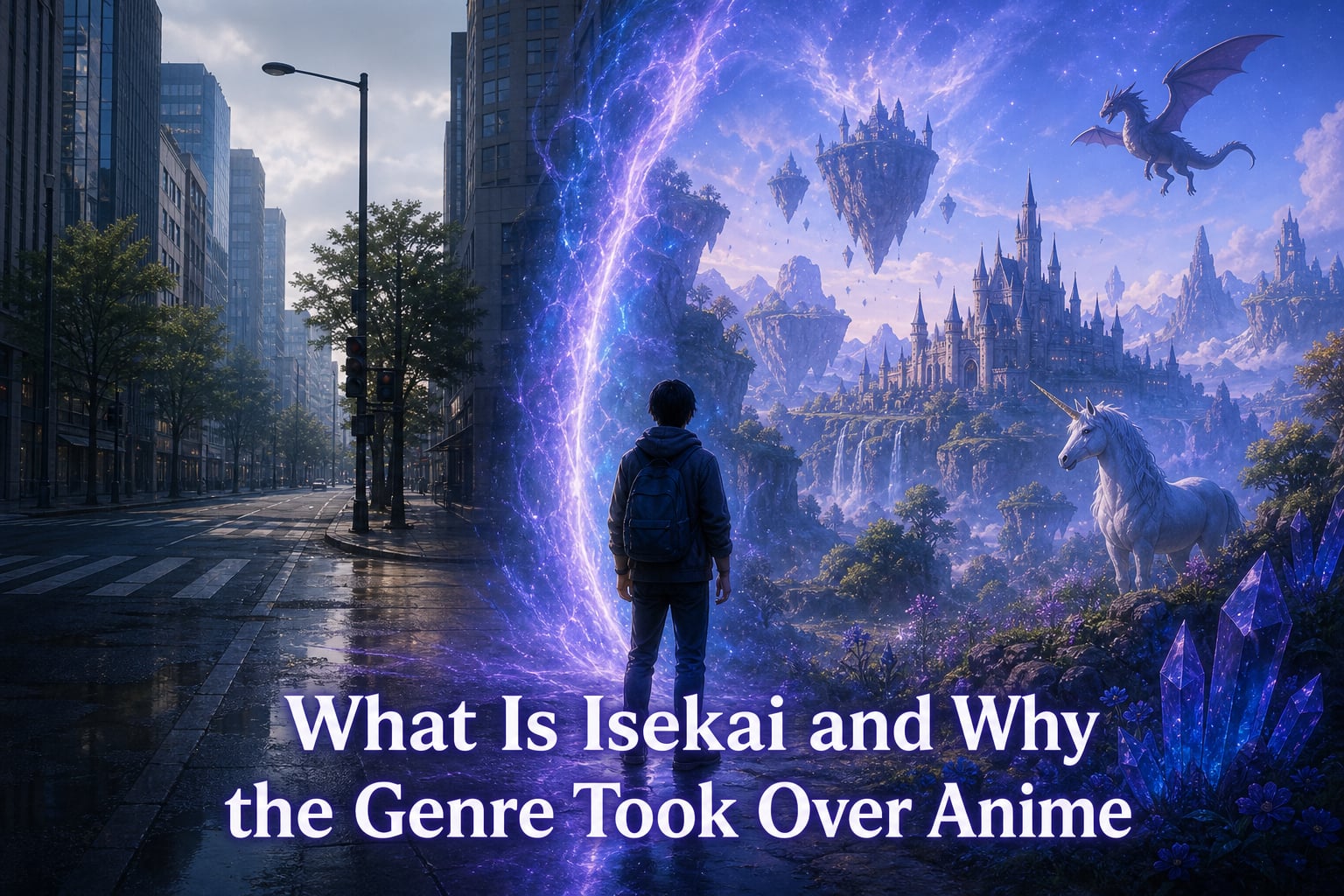
Walk into any anime discussion in 2026 and one word keeps coming up: isekai. It has dominated seasonal lineups, filled streaming platforms, and turned unknown light novel authors into household names. But what is isekai and why the genre took over anime deserves a real explanation, not just a surface-level definition.
If you have ever wondered why every season seems to bring five new shows about an ordinary person getting hit by a truck and waking up in a fantasy world, you are in the right place. This guide breaks down the meaning, history, tropes, and cultural forces behind the biggest genre in modern anime.
Whether you are a newcomer trying to understand the hype or a long-time fan looking to put words to what you already feel, we will cover everything. From ancient Japanese folklore to the web novel platforms that birthed today’s biggest hits, here is the full story of how isekai anime conquered the medium.
Table of Contents
What Is Isekai?
Isekai is a Japanese term meaning “different world” or “another world.” It refers to a subgenre of Japanese fantasy and science fiction where a protagonist is transported to, summoned into, or reincarnated in another world and must survive there. That is the definition in a single sentence, and it is the one most encyclopedias use.
But the genre goes deeper than just “person goes to fantasy land.” The protagonist almost always comes from our modern world, usually contemporary Japan. They bring their memories, their knowledge, and sometimes their devices with them. That gap between modern Earth thinking and medieval-style fantasy worlds is where much of the drama and humor comes from.
The transportation itself happens in several distinct ways. A character might die in a traffic accident and be reincarnated in a new body. They might be magically summoned by a kingdom in crisis. They could get trapped inside a video game. Some are even sent to the wrong world by a careless deity who feels bad about the mistake and offers a bonus ability as an apology.
Once in the new world, the protagonist typically discovers they have powers far beyond the locals. In isekai anime, this “cheat ability” is practically a genre requirement. A salaryman might reincarnate as a noble with access to all elemental magic. A high school student might have game-like stats that dwarf everyone around them. This power gap lets stories explore themes of reinvention and consequence.
What makes isekai different from general portal fantasy is its Japanese cultural lens. The protagonist is often reacting to Japanese social norms in a world that operates differently. Concepts like customer service, school hierarchies, and corporate loyalty get transplanted into fantasy settings, creating moments that feel simultaneously alien and familiar to Japanese viewers. Western audiences get the fantasy adventure, while Japanese audiences get layered cultural commentary underneath.
Etymology and Meaning: Where the Word Comes From
The word isekai is written in Japanese as 異世界. Breaking that down, 異 (i) means “different” or “strange,” 世 (se) means “world” or “generation,” and 界 (kai) means “boundary” or “realm.” Put together, the compound literally translates to “different world,” “another world,” or “other world.”
The term has existed in Japanese for a long time, but it was not always a genre label. In older usage, isekai simply described the concept of another world or a foreign realm in general storytelling. It could appear in folklore, mythology, or casual conversation without carrying any specific genre connotation.
That changed in the late 2000s and early 2010s. As web novel platforms like Shosetsuka ni Naro exploded with stories about characters being transported to fantasy worlds, Japanese fans and critics needed a shorthand term. Isekai stuck. By the time publishers started adapting these web novels into light novels and then anime, the word had become a recognized genre category.
Interestingly, the Japanese entertainment industry sometimes uses related terms that overlap with isekai. “Isekai tensei” specifically refers to reincarnation into another world, meaning the protagonist dies first and is born again in a new body. “Isekai ten’i” means transfer or transportation to another world, where the character arrives in their original body. The distinction matters to hardcore fans, though most people use isekai as the umbrella term.
The History of Isekai: From Ancient Folklore to Modern Anime
The roots of isekai stretch back centuries before anime existed. The Japanese tale of Urashima Taro, a fisherman who visits the dragon god’s palace under the sea and returns to find centuries have passed, shares the genre’s DNA. Similar stories exist in Western folklore too, from Alice in Wonderland to The Wizard of Oz. The idea of traveling to another world and struggling to return is one of humanity’s oldest narrative impulses.
In modern anime, the first clear isekai titles appeared in the 1980s. Yoshiyuki Tomino’s Aura Battler Dunbine (1983) transported a young man from Earth into the fantasy world of Byston Well. Hayao Miyazaki’s beloved film Spirited Away (2001) sent Chihiro into a spirit realm that operated by its own strange rules. Vision of Escaflowne (1996) brought a high school girl to a world of mecha and prophecy. These early titles established the template but did not trigger a genre explosion.
The modern isekai boom traces directly to web novel platforms. In 2007, a programmer named Tappei Nagatsuki began posting Re:Zero on Shosetsuka ni Naro, a free user-generated fiction site. Around the same time, Kugane Maruyama started publishing Overlord online. These stories attracted massive reader bases without going through traditional publishing channels.
The real turning point came with Sword Art Online in 2012. While technically about characters trapped in a VR game rather than transported to a literal fantasy world, SAO popularized the mechanics that define modern isekai anime. Game-like interfaces, skill progression, and high-stakes adventure in a fantasy setting all went mainstream. The series became a global phenomenon and proved that isekai-adjacent concepts had massive commercial potential.
After SAO, the floodgates opened. Re:Zero started airing in 2016 and became a critical darling by subverting expectations. Its protagonist suffered, made terrible decisions, and died repeatedly. KonoSuba turned the formula into comedy gold by making every party member hopelessly flawed. Mushoku Tensei, long considered the grandfather of modern “Narou-style” isekai web novels, finally got an anime adaptation in 2021 with production values that stunned viewers.
By 2026, isekai had become a dominant force. According to Anime News Network’s industry analysis, roughly 34 isekai anime titles aired in 2024 alone, representing about 15 percent of all new anime productions. Every season brings a fresh batch, and streaming platforms like Crunchyroll prioritize them because the data shows they perform exceptionally well with international audiences.
Why Is Isekai So Popular? The Genre’s Explosive Rise
Understanding what is isekai and why the genre took over anime means looking at several converging factors. No single reason explains the boom. Instead, a combination of cultural conditions, publishing infrastructure, audience psychology, and business incentives created the perfect environment.
Escapism and Power Fantasy
At its core, isekai offers something many viewers desperately want: a fresh start. The typical protagonist is an ordinary person, often unhappy or unfulfilled. A tired office worker. A lonely shut-in. A student who feels invisible. When they get transported to another world, they leave behind their old problems and become someone important.
This is power fantasy in its purest form. In the new world, the protagonist’s modern knowledge gives them an edge. Their cheat ability makes them special. They form relationships, gain respect, and build a life that matters. For viewers dealing with their own stress and dissatisfaction, watching that transformation is deeply satisfying on a psychological level.
Forum discussions on Reddit make this connection explicit. Many fans describe isekai anime as comfort food, a way to decompress after a long workday. They know the tropes are repetitive, but they do not watch for surprise. They watch for the feeling of watching someone succeed against the odds, and that feeling never gets old for the right audience.
The Web Novel Pipeline
The engine behind isekai’s dominance is the web novel platform Shosetsuka ni Naro, often shortened to Narou. This free site lets anyone publish serialized fiction, and it has become a massive talent farm for the anime industry. Authors post chapters daily, readers leave immediate feedback, and popular stories rise to the top organically.
The platform’s format shaped the genre itself. Daily serialization encourages cliffhanger endings and steady power progression. Reader feedback loops push authors toward proven formulas. Stories that perform well on Narou get picked up by publishers like Kadokawa and Media Factory, turned into light novels with illustrations, and then adapted into manga and anime. This pipeline produces a constant stream of isekai content that is already audience-tested before a single frame of animation is produced.
This system is incredibly efficient. By the time an anime studio adapts a Narou isekai, the story has years of reader validation. That reduces financial risk for production committees, which makes them more willing to fund isekai adaptations. The cycle feeds itself.
Streaming and Global Accessibility
Simulcast streaming changed everything for isekai specifically. Platforms like Crunchyroll, Funimation, and later Netflix made anime available worldwide almost immediately after Japanese broadcast. Isekai anime turned out to translate exceptionally well to international audiences because their premises are universally understandable. The fish-out-of-water setup works across cultural boundaries.
The data backs this up. Anime News Network reported that isekai titles consistently rank among the most-watched shows on major streaming platforms. For many Western viewers, isekai anime like Sword Art Online or Re:Zero served as their gateway into the medium. The genre’s combination of RPG mechanics, fantasy adventure, and serialization makes it ideal for binge-watching.
Wish Fulfillment for a Stressed Generation
Japanese cultural context matters here. The salaryman lifestyle, with its long hours and rigid hierarchy, creates real burnout. Isekai speaks directly to that experience by offering a fantasy where hard work actually pays off. In the new world, the protagonist’s effort directly translates into visible results. They level up. They gain allies. Their choices matter.
That contrast between real-world futility and fictional agency is powerful. Many isekai protagonists are explicitly overworked employees who died from exhaustion, only to be reborn in worlds where their competence is recognized. The wish fulfillment is obvious, and for a generation dealing with economic stagnation and workplace pressure, it resonates on a personal level that other genres cannot match.
Low Barrier to Entry for New Viewers
Isekai anime are remarkably accessible. The protagonist is almost always a newcomer to the fantasy world, which means the story explains everything alongside them. Viewers learn the magic system, the politics, and the geography at the same pace as the main character. There is no prerequisite knowledge needed.
This makes isekai the perfect entry point for anime beginners. You do not need to understand shonen tournament brackets, mecha physics, or slice-of-life cultural references. The premise is immediately clear from the first episode. Someone from our world goes to a fantasy world and has adventures. That simplicity is a feature, not a bug.
Common Isekai Tropes You Will See Everywhere
Once you have watched a few isekai anime, the patterns become impossible to miss. These recurring elements are so prevalent that they have become inside jokes within the community. Some are beloved, others criticized, but all of them define the genre’s current identity.
Truck-kun. The meme to end all memes. An astonishing number of isekai protagonists die by being hit by a truck on a modern road. Fans have given this recurring vehicle the nickname “truck-kun” and joke about its body count. The truck has become such a recognizable symbol that some anime now parody it openly, and there is even a satirical website tracking its victims. The trope is so established that avoiding it feels subversive.
Cheat abilities. The protagonist arrives in the new world with an unfairly powerful skill that no one else possesses. This “cheat” ability might be appraisal magic that lets them see stats, overwhelming combat power, or a unique talent for crafting. The cheat ability is the mechanism that lets an ordinary person become extraordinary overnight.
OP protagonists. Overpowered main characters are a staple. Within a few episodes, the hero can defeat threats that veteran adventurers have struggled with for decades. This creates tension problems in some series, but fans who enjoy power fantasy find it satisfying rather than boring.
Game-like mechanics. Status screens, skill trees, experience points, and level-up notifications appear constantly. The new world often operates like an RPG, with guilds, quests, and item drops. This gamification makes progression visible and measurable, which is inherently satisfying to watch.
Harem building. Many isekai anime feature a male protagonist who gradually accumulates a group of female companions, often with romantic undertones. The harem dynamic is one of the genre’s most criticized elements, but it remains commercially successful enough that it continues appearing in new titles each season.
Slime and mascot characters. Whether it is the actual Slime in That Time I Got Reincarnated as a Slime or cute companion creatures in other series, adorable mascot characters have become an isekai staple. They provide comic relief and merchandise opportunities.
The Adventurer’s Guild. Nearly every fantasy world in isekai anime has an adventurer’s guild where characters register, accept quests, and rank up. This institution gives the story a structure for progression and introduces a steady stream of minor characters and side quests.
Isekai Subgenres: More Than Just Another World
Not all isekai anime are created equal. The genre has splintered into several distinct subgenres, each with its own conventions and target audience. Understanding these categories helps explain how isekai maintains its dominance by appealing to different viewer segments simultaneously.
Reincarnation isekai is the most common form. The protagonist dies on Earth and is reborn in a new world, sometimes as a human baby, sometimes as something entirely different. That Time I Got Reincarnated as a Slime takes this to its logical extreme by making the protagonist a gelatinous blob. Overlord turns the hero into a skeleton mage. The freedom of starting from scratch in any form is part of the appeal.
Cheat isekai focuses on the protagonist’s overwhelming advantage. Mushoku Tensei, The Eminence in Shadow, and The Irregular at Magic High School all feature main characters whose abilities trivialize challenges that would stop anyone else. This subgenre is the purest expression of power fantasy and tends to draw the most criticism for lack of tension, but it also pulls massive viewership numbers.
Villainess isekai has exploded as a distinct category. A person, usually a young woman, is reincarnated as the villainess character from an otome game or romance novel they played in their previous life. They know the plot and the bad ending that awaits them, so they use that knowledge to avoid their fate. My Next Life as a Villainess and The Most Heretical Last Boss Queen are standout examples. This subgenre has attracted a significant female audience to isekai, broadening the genre’s demographic reach.
Reverse isekai flips the formula. Instead of an Earth person going to a fantasy world, a fantasy character arrives on modern Earth. The Devil Is a Part-Timer places a demon lord working at a fast-food restaurant. Holy Knight Yuki finds a fantasy hero navigating Japanese high school life. Reverse isekai is less common but offers fresh comedic potential by treating our mundane world as the strange one.
Trap or game-world isekai involves characters stuck inside a video game or VR environment. Sword Art Online, .hack//Sign, and Log Horizon all explore this space. The characters are not physically transported to another world but are locked into a virtual one where death has real consequences. This subgenre blurs the line between isekai proper and game-themed adventure.
FAQs
Why is isekai a genre?
Isekai is a genre because it taps into a universal desire for reinvention and escape. The premise of leaving behind an ordinary life for a world where your actions matter resonates deeply with audiences experiencing real-world stress or dissatisfaction. Combined with an efficient publishing pipeline through web novel platforms and low barriers to entry for new viewers, the genre has enough cultural and commercial momentum to sustain itself as a distinct category.
What is the big 4 of isekai?
The big 4 of isekai typically refers to Re:Zero, KonoSuba, Overlord, and The Rising of the Shield Hero. These four series are widely credited with popularizing modern isekai anime during the 2010s boom. Some fans swap titles depending on personal preference, but these four consistently appear in community discussions as the foundational pillars of the genre’s current era.
Which is the no. 1 isekai anime?
There is no single agreed-upon number one isekai anime, but Re:Zero consistently ranks at or near the top of community polls and critical lists. Its psychological depth, willingness to make the protagonist suffer, and strong character development set it apart from more formulaic entries. Mushoku Tensei and KonoSuba are also frequent contenders depending on whether fans prioritize production quality, storytelling, or comedy.
What do people find so appealing about isekai?
People find isekai appealing because it combines several powerful draws: escapism from daily life, power fantasy where an ordinary person becomes extraordinary, visible progression through game-like mechanics, and the emotional satisfaction of a fresh start. The genre is also highly accessible to new viewers since the protagonist learns about the world alongside the audience.
Why don’t people like isekai?
Critics of isekai point to several recurring issues: repetitive premises, overpowered protagonists that eliminate tension, excessive fan service, lazy worldbuilding, and genre oversaturation crowding out more diverse anime. Some long-time fans feel the sheer volume of mediocre isekai titles, sometimes called isekai slop, has displaced more original storytelling in seasonal lineups.
What was the first isekai anime?
While ancient Japanese folklore like Urashima Taro contains isekai-like elements, the first modern anime to clearly fit the genre is generally considered to be Aura Battler Dunbine from 1983, created by Yoshiyuki Tomino. Other early examples include Vision of Escaflowne (1996) and the .hack// franchise (2002), but the genre did not explode in popularity until Sword Art Online in 2012 sparked the modern isekai boom.
Conclusion: Isekai Is Here to Stay
Understanding what is isekai and why the genre took over anime comes down to recognizing a simple truth: it gives people what they want. Escapism, power fantasy, a fresh start in a world that rewards effort, and stories that are easy to jump into. The web novel pipeline ensures a constant supply of new material, streaming platforms guarantee global reach, and the formula works well enough that production committees keep investing.
Not every isekai anime is great. The genre produces its share of forgettable, formula-driven shows. But the best titles, like Re:Zero, KonoSuba, and Mushoku Tensei, transcend their tropes to deliver genuinely compelling storytelling. They prove that the premise still has room for creativity and emotional depth.
If you are new to isekai anime, start with one of the big four and see which subgenre speaks to you. If you are a veteran, keep an eye on each season for the titles that try something different. Either way, the genre is not slowing down in 2026, and understanding it means understanding one of the biggest forces shaping modern anime.