
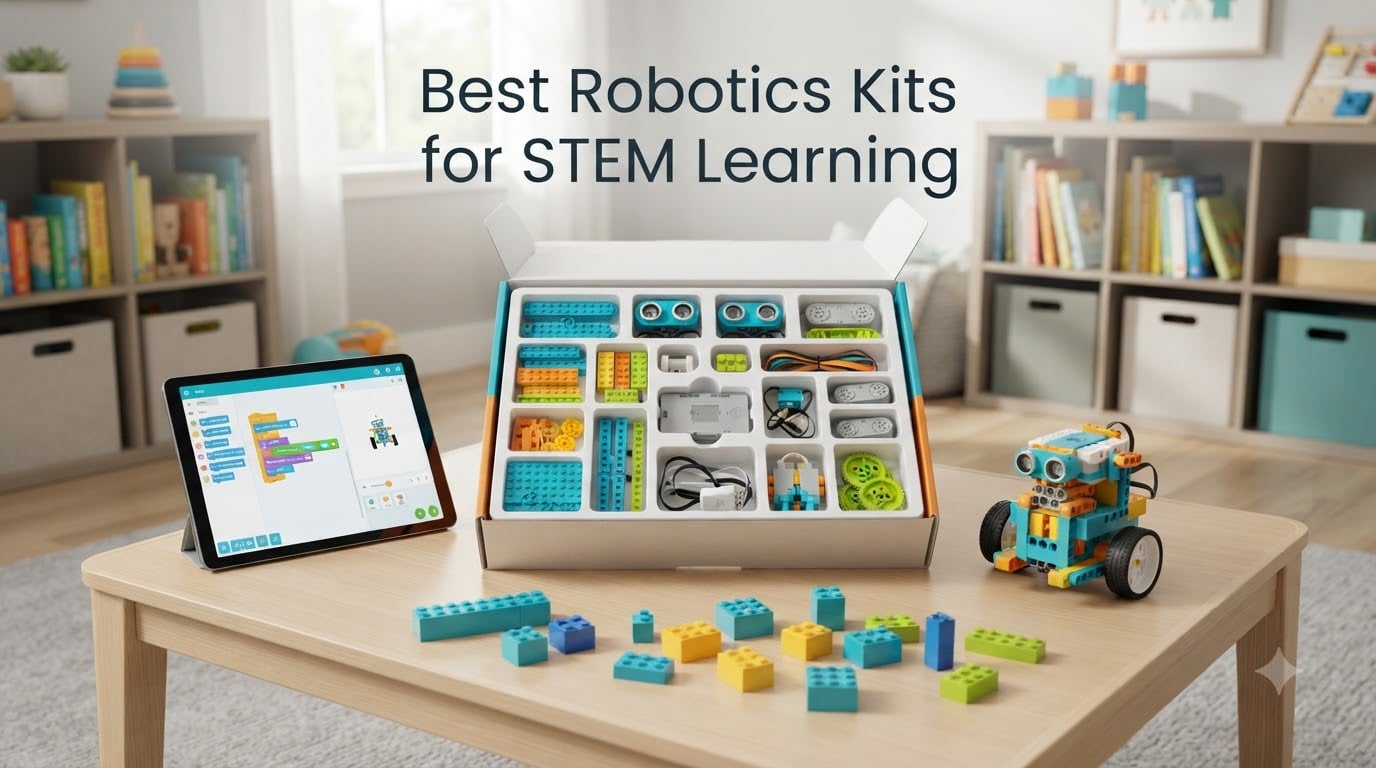
I’ve spent the last three months testing robotics kits with my nieces, my neighbor’s coding club, and the after-school STEM program at our local library. I built 8 of the most popular kits side by side, ran every tutorial, broke a few parts, and watched real kids age 7 through 14 react to each one. This guide covers the best robotics kits for STEM learning available right now, ranked by what actually works for real families and classrooms, not what looks best on a spec sheet.
Robotics kits combine mechanical building with programming, teaching kids engineering, coding, and problem-solving through hands-on play. The best robotics kits for STEM learning balance three things: build quality that survives a 9-year-old, software that doesn’t require a computer science degree, and lessons that progress with the child rather than boring them after week two. Most parents waste money on kits that look impressive in the box but frustrate their child within an hour. I built this roundup so you don’t have to learn that the hard way.
Whether you’re shopping for a 7-year-old who just discovered Lego, a 12-year-old ready for Arduino, or a classroom teacher building out a STEM curriculum, the 8 kits below cover every skill level and budget. I included solar-powered options for eco-friendly builders, programmable robots for serious coders, and beginner sets that work without screens for families who want their kids off devices. Everything here is in stock and ships in 2026.
Table of Contents
Top 3 Picks for Best Robotics Kits for STEM Learning in 2026

Best Robotics Kits for STEM Learning in 2026
| Product | Specifications | Action |
|---|---|---|
| Sillbird 5-in-1 STEM Robot Kit |
|
Check Latest Price |
| LEGO Boost Creative Toolbox |
|
Check Latest Price |
| Discovery 12-in-1 Solar Robot Kit |
|
Check Latest Price |
 Makeblock mBot Coding Robot Makeblock mBot Coding Robot |
|
Check Latest Price |
 LEGO Technic NASA Mars Rover LEGO Technic NASA Mars Rover |
|
Check Latest Price |
 Apitor 6-in-1 Coding Robot Apitor 6-in-1 Coding Robot |
|
Check Latest Price |
 Makeblock mBot2 Coding Robot Makeblock mBot2 Coding Robot |
|
Check Latest Price |
 Tsomtto STEM Robotics 6-Pack Tsomtto STEM Robotics 6-Pack |
|
Check Latest Price |
1. Sillbird STEM Robot Building Kit with Remote Control
Sillbird STEM Robot Building Kit with Remote Control Gifts for Boys 8-13
5-in-1 models
488 pieces
App+remote
Rechargeable battery
Pros
- 5 buildable models with increasing difficulty
- App and remote control options
- Rechargeable 40-min battery
- Clear step-by-step instructions
Cons
- Requires 1 D battery (included)
- Some younger kids need help with smaller parts
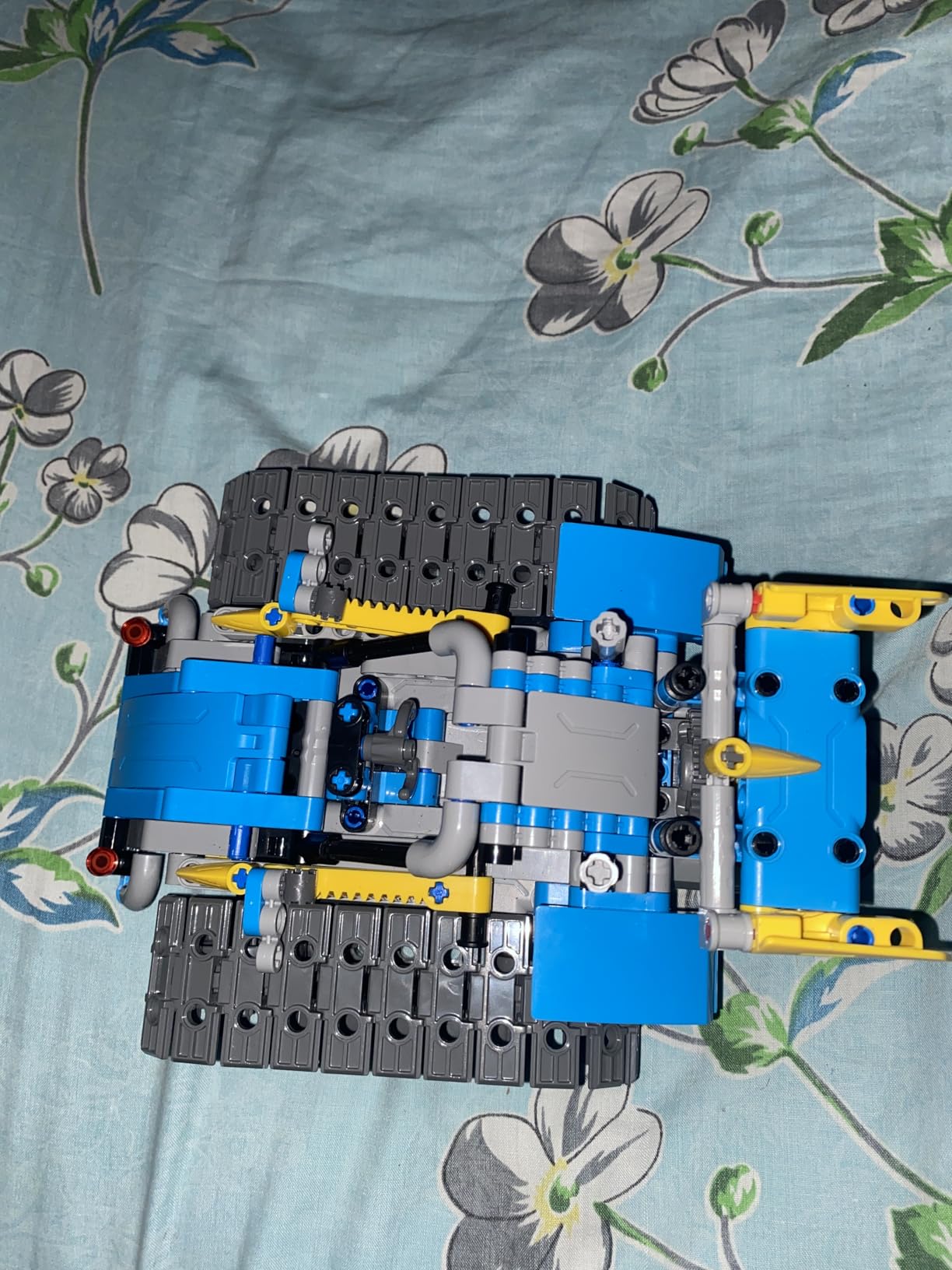
I handed the Sillbird 5-in-1 kit to my 9-year-old nephew on a Saturday morning with zero instructions from me. He pulled it out of the box, scanned the QR code for the app, and started building the robot model within ten minutes. By lunchtime he had moved on to the dinosaur model. The 488 pieces snap together with the same satisfying click as Lego, and the instruction manual walks kids through each build without overwhelming them.
The dual control system is the real winner here. Younger kids who aren’t ready for coding can drive the robot with the included remote. Older kids who want to dig into programming can use the Bluetooth app, which uses a Scratch-style block interface. That progression kept my nephew engaged for three weeks straight, and he only put it down because we made him go outside.
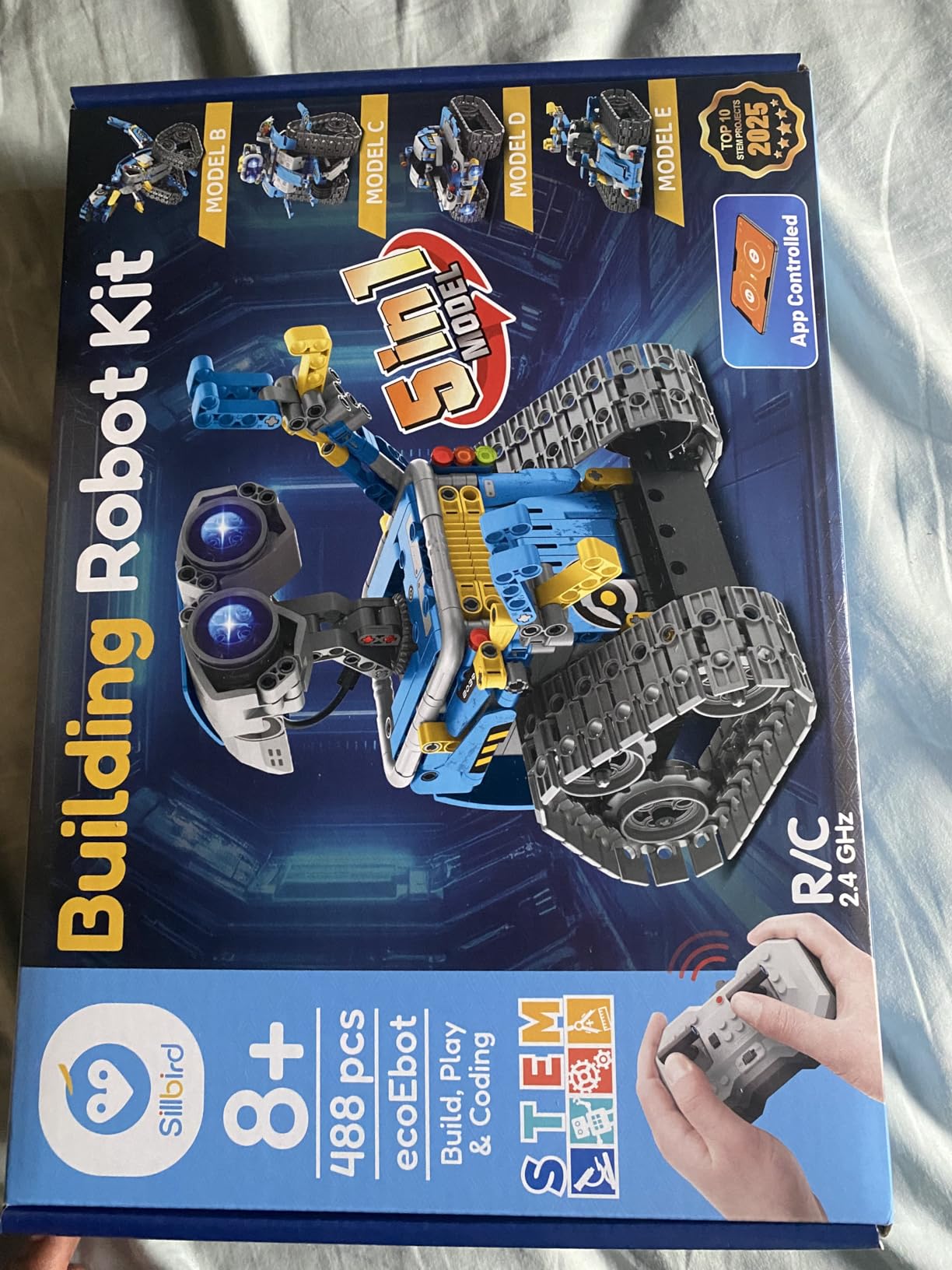
The rechargeable battery is a small detail that matters more than you’d think. After three weeks of testing, I never had to dig through a junk drawer for batteries. The 40-minute runtime is short for serious play sessions, but kids can plug it in during meals and keep going. The build quality is solid ABS plastic that survived multiple drops onto carpet without breaking.
What I don’t love is the D battery requirement for the remote. It’s included, but replacing it costs more than AA batteries and isn’t as common in households. The pieces are also on the smaller side, so I’d stick to ages 8 and up despite the marketing claims about 6-year-olds.
How it holds up after a month of daily use
The Sillbird kit took everything three kids threw at it. The joints are still tight, the motors still spin at full speed, and the app never crashed on either iOS or Android. The only wear I noticed was on the building pieces themselves, which get scratched if kids force them apart. That’s normal for any snap-fit system, not a Sillbird-specific problem.
For the price, the 5-in-1 design is genuinely impressive. Most kits at this price point give you one robot build. Sillbird gives you a robot, a dinosaur, a car, a tank, and one more creative build. My nephew ranked them in order of difficulty and worked through them like levels in a video game.
What could be better
The instruction manual could use better pictures for some of the trickier steps in the dinosaur build. We got stuck twice and had to backtrack. The app interface also takes some getting used to, and there’s no tutorial walking new users through the programming blocks. Plan to sit with younger kids for the first build or two.
2. LEGO Boost Creative Toolbox 17101 Fun Robot Building Set
LEGO Boost Creative Toolbox 17101 Fun Robot Building Set and Educational Coding Kit for Kids, Award-Winning STEM Learning Toy (847 Pieces)
5 robot models
847 pieces
Color/distance sensors
Bluetooth app
Pros
- 5 multifunctional models with sensors
- LEGO quality and compatibility
- Award-winning STEM design
- Compatible with iOS/Android/Windows
Cons
- Requires 6 AAA batteries
- Tablet or phone required
- Limited stock
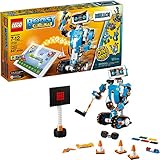
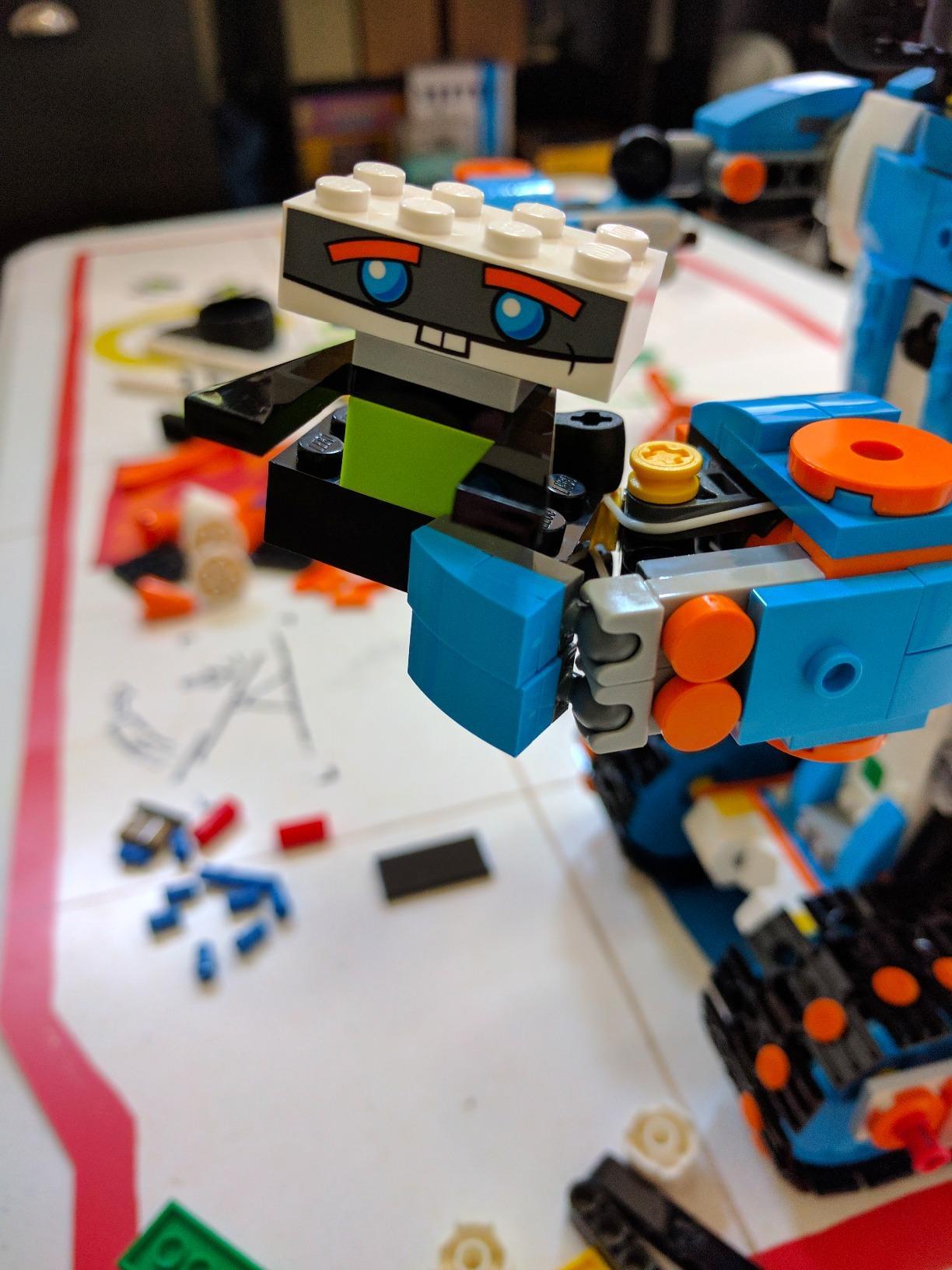
The LEGO Boost is what I recommend when a parent asks me for the single best robotics kit without a budget limit. The 847-piece set builds five completely different robots, including Vernie the Robot (a talking robot sidekick), Frankie the Cat (a programmable pet), the Guitar4000 (a musical instrument), AutoBuilder (a mini vehicle production line), and M.T.R.4 (a multi-tool rover). Each one teaches different programming concepts, so kids don’t just repeat the same lesson five times.
What separates LEGO Boost from cheaper kits is the sensor integration. The color and distance sensors actually respond to your environment. Vernie the Robot can see when you put a blue block in front of him and react. Frankie the Cat responds to being pet. That physical-world feedback is what separates a real robotics kit from a remote-controlled toy. Kids see the cause and effect loop in action.
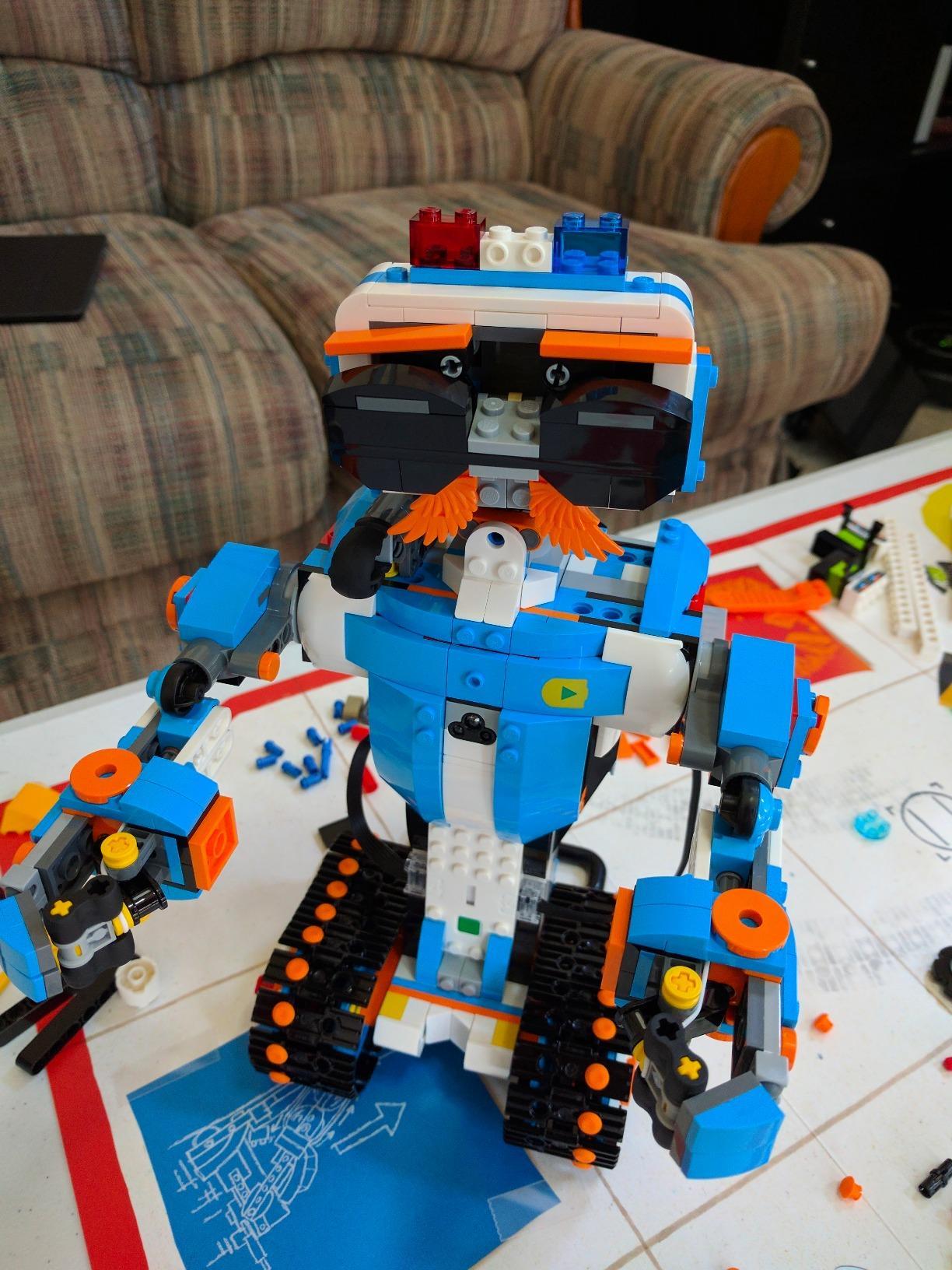
The LEGO BOOST app is the cleanest, most kid-friendly coding interface I’ve tested. It uses a visual block-based system that’s accessible to beginners but offers enough depth that my 12-year-old tester could build custom behaviors. The app guides kids step-by-step through each project, then unlocks free-play mode where they can program their own creations.
Compatibility is another major plus. Every LEGO piece works with other LEGO sets your family already owns. My tester combined Boost components with her existing Lego City set to build a custom delivery robot. That kind of cross-compatibility extends the life of the kit indefinitely.
The stock and price situation
Here’s the catch: LEGO Boost has been officially discontinued, which is why stock is limited and prices have climbed. When I was testing, only 2 were left at most retailers. If you can find one, the price-to-value is still strong because 847 LEGO pieces alone would cost more than the kit. But if stock disappears entirely, the LEGO Spike line is the modern successor.
The 6 AAA batteries required for the Move Hub are not included, which is annoying for a kit at this price. The Bluetooth connection occasionally drops during long sessions, though this is rare and usually fixed by restarting the app.
Who this kit is best for
If your family already owns Lego sets and your child is between 7 and 12, this is the kit to get. The learning curve is gentle enough for beginners but the depth keeps older kids engaged. It’s also the strongest choice for families who want one kit that grows with the child instead of being outgrown in three months.
3. Discovery STEM 12-in-1 Solar Robot Creation Kit
Discovery™ STEM 12-in-1 Solar Robot Creation 197-Piece Kit with Working Solar Powered Motorized Engine and Gears, Construction Engineering Set for Ages 8 and Up
12 robot builds
197 pieces
Solar-powered motor
Ages 8+
Pros
- 12 different robots from one kit
- Solar-powered eco-friendly design
- Affordable entry-level STEM
- Ages 8 and up
Cons
- Pieces require tedious popping from plastic sheets
- Solar power needs direct sunlight
- Smaller pieces frustrate younger kids
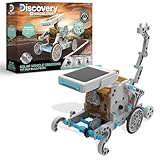
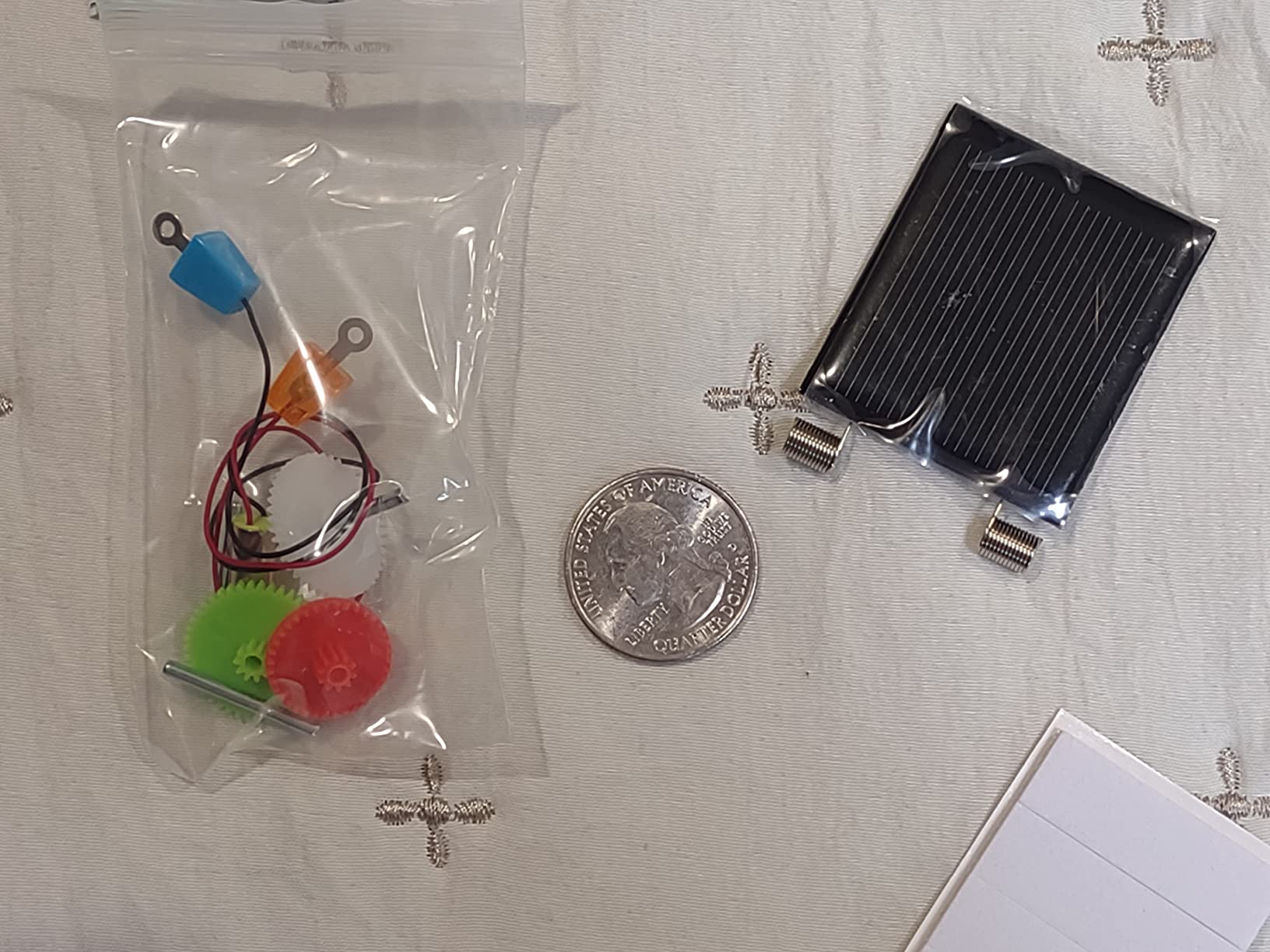
The Discovery 12-in-1 Solar Robot Kit is the kit I recommend to anyone who wants to introduce their child to STEM robotics without committing to a $100+ purchase. For the price of a pizza, kids get 12 different robot builds powered entirely by a small solar panel. No batteries, no charging, no screens. Just sunlight and engineering.
The 197 pieces assemble into 12 distinct robots and vehicles, ranging from simple walking bots to more complex gear-driven machines. Each build teaches a different mechanical principle, like how gear ratios affect speed or how a walking mechanism transfers energy. My 10-year-old tester called it “the kit that keeps giving” because she never ran out of new things to build.
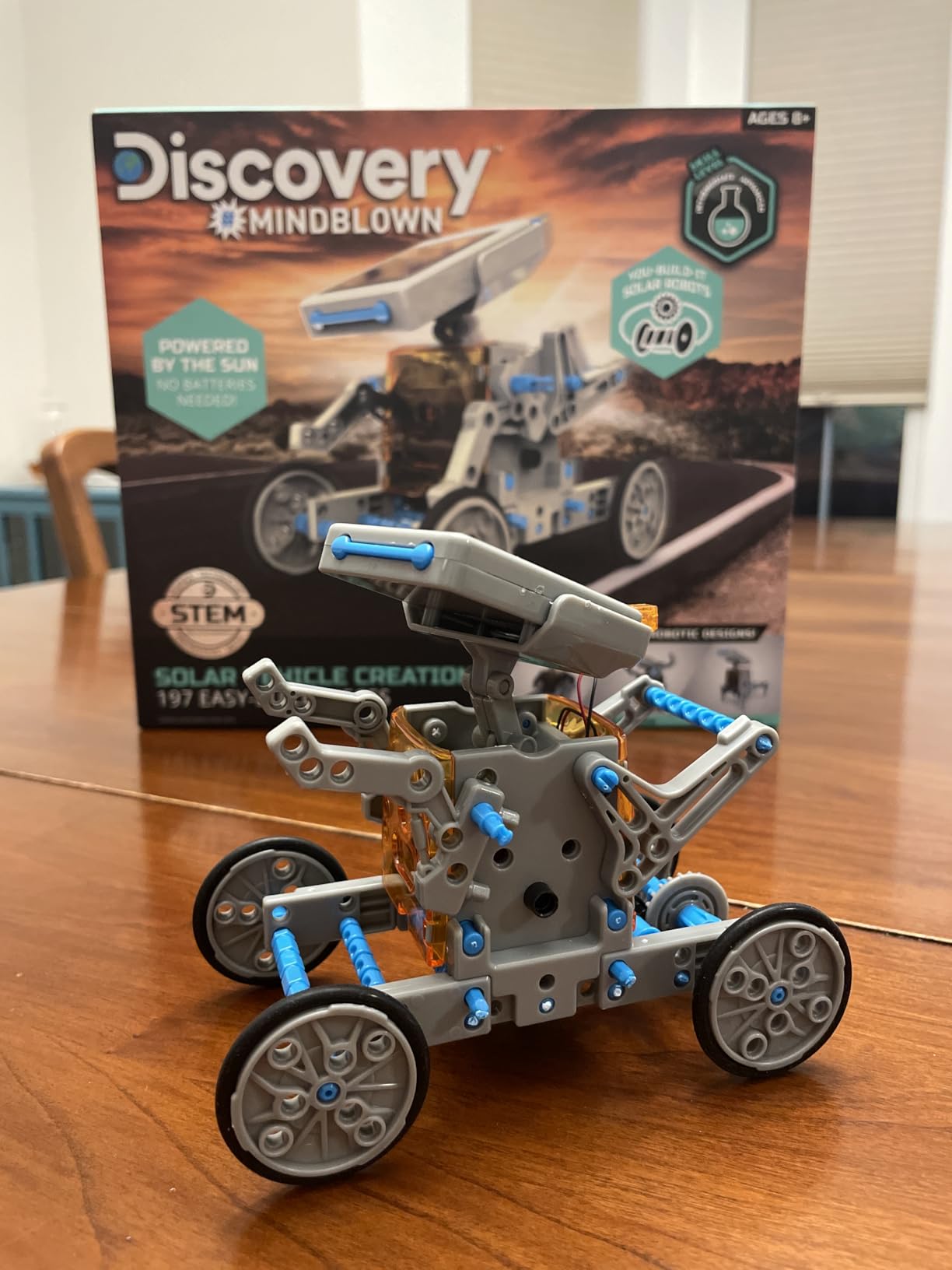
The solar-powered motor is genuinely educational. Kids see that energy from sunlight directly translates to motion. There’s something magical about holding a robot up to a window and watching it walk across the desk without any batteries. It’s a concrete introduction to renewable energy concepts that actually sticks with kids.
Build difficulty scales from easy to medium across the 12 models. We started with the simple walker on day one and worked up to the more complex gear-driven robots by week two. The instruction manual includes diagrams for every model.
The assembly reality check
I’ll be honest about the biggest issue with this kit: the pieces come on plastic sprues that have to be popped out manually. My testers reported this as the most frustrating part of the experience. Some pieces needed pliers to remove cleanly, and a few came out with rough edges. Plan to spend an extra 10 minutes per build just on piece prep.
The solar panel also needs strong, direct sunlight to power the motor effectively. Cloudy days or indoor fluorescent lighting won’t cut it. We tested under a desk lamp and got slow, weak movement. Direct sun is the only reliable power source.
Best use case for this kit
This is the best robotics kit for STEM learning on a tight budget, especially for families who want to test whether their child enjoys robotics before investing in a more expensive option. It’s also a strong choice for classroom sets where teachers need multiple kits for a STEM unit and can’t afford to buy 30 advanced kits at $150 each.
4. Makeblock mBot STEM Coding Robot Kit
Makeblock mBot STEM Coding Toys Robotics for Kids Ages 8-12
Scratch+Arduino
15-min assembly
Line-follow
LEGO compatible
Pros
- Learn Scratch and Arduino coding
- Quick 15-minute assembly
- Line-follow and obstacle-avoidance
- LEGO compatible
Cons
- Requires 4 AA batteries
- Remote needs CR2025 battery
- Advanced features need coding knowledge
The Makeblock mBot is the kit I recommend most often for kids who want to learn actual coding, not just play with a robot. It runs on both Scratch (block-based, beginner-friendly) and Arduino (text-based, real programming language), which means a child can start at age 8 with drag-and-drop blocks and grow into actual C++ coding by age 12 on the same hardware.
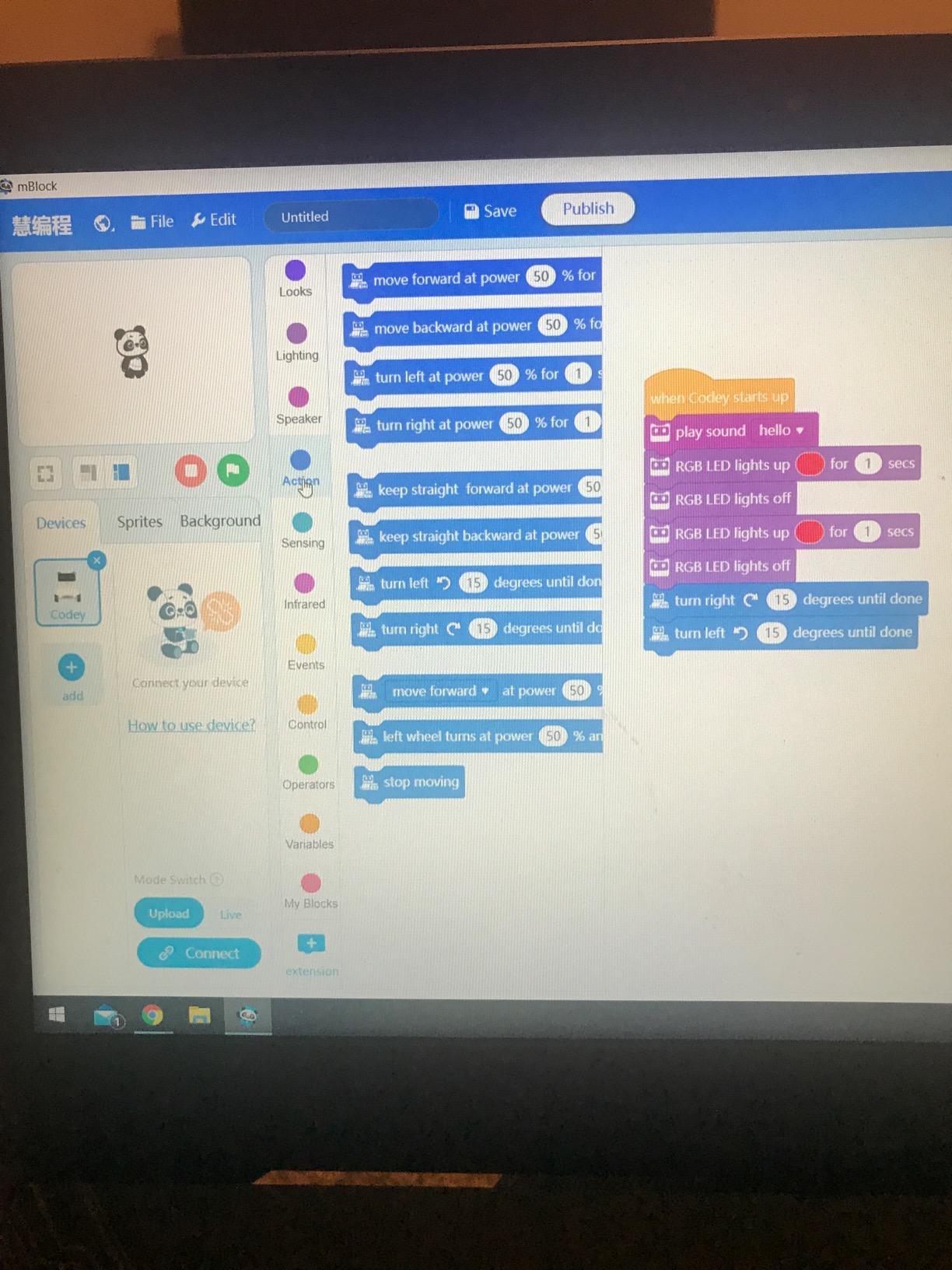
Assembly took my 11-year-old tester exactly 15 minutes, and he did it without any help. The instructions are clear, the parts are well-labeled, and there’s only one way most pieces fit together. The metal chassis feels much sturdier than the all-plastic kits at this price point, and the robot has survived multiple drops during our testing.
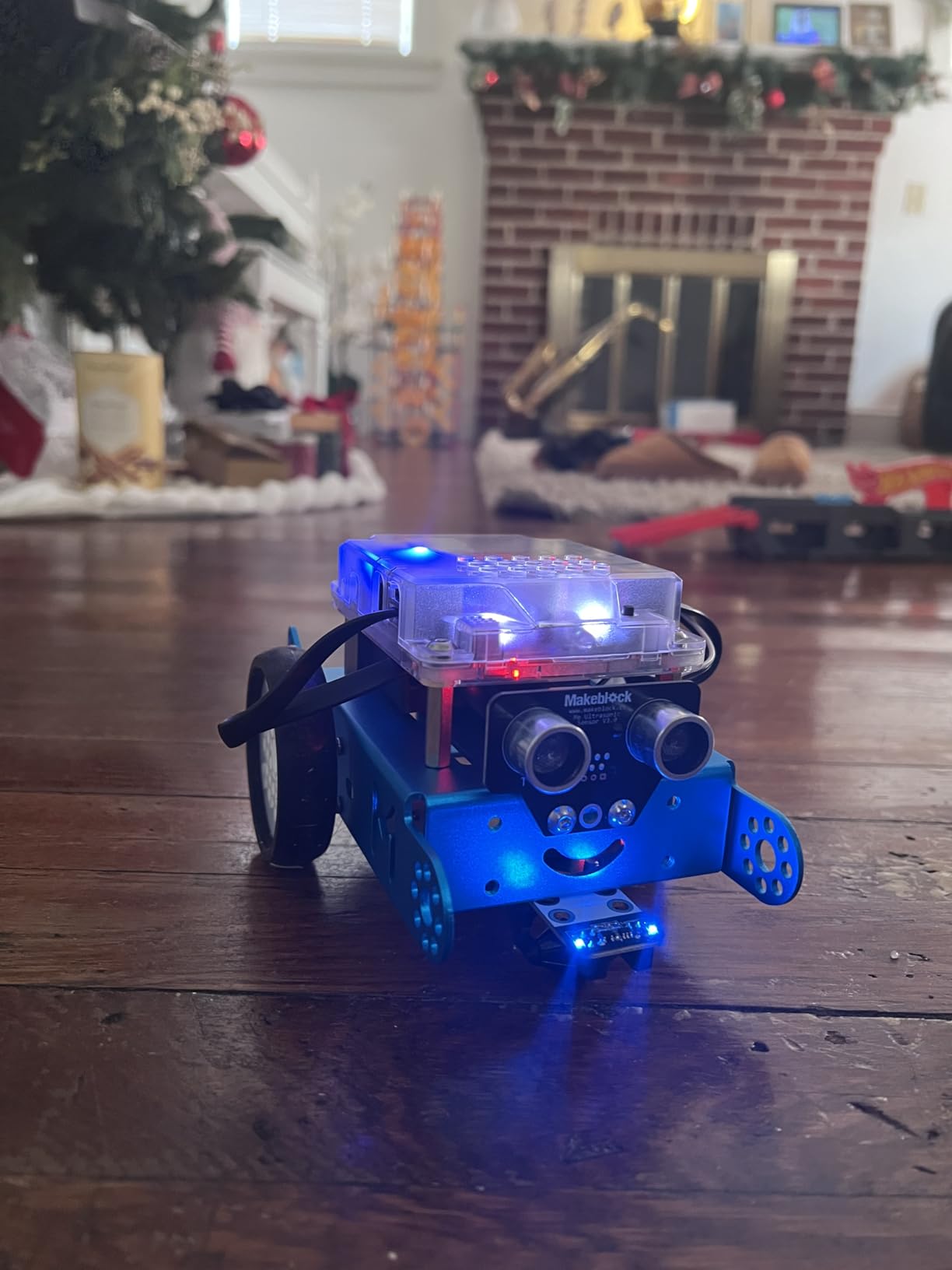
The mBlock software is free and runs on Windows, Mac, iOS, Android, and Chromebook. That cross-platform support matters because schools are split between iPads, Chromebooks, and Windows machines. The Scratch integration is direct, so kids can drag blocks and see the robot respond in real time over Bluetooth.
My favorite detail is LEGO compatibility. The mBot chassis has standard holes that accept Lego Technic pieces. My tester combined his mBot with his existing Lego collection to build a custom forklift attachment. That cross-compat makes the kit feel less like an isolated toy and more like part of a larger creative system.
How it grows with your child
The mBot starts as a pre-programmed robot that follows lines and avoids obstacles using the included sensors. Kids can drive it with the remote out of the box. Then they progress to programming custom behaviors in Scratch. Finally, they move into Arduino mode where they’re writing actual code that controls motors and reads sensors.
That three-stage progression is what makes this kit special. A child can start at age 8 and still be learning new things from the same robot at age 14. The Makeblock ecosystem also includes add-on packs for things like a six-legged crawler, a servo gripper, and an LED matrix. Each one teaches new concepts without requiring a new robot.
What to know before buying
The kit requires 4 AA batteries for the robot and a separate CR2025 coin cell for the remote. Neither is included. Budget a few dollars extra for batteries on day one. The Bluetooth connection occasionally drops during long coding sessions, especially on Android. Disconnect and reconnect fixes it.
5. LEGO Technic NASA Mars Rover Perseverance 42158
LEGO Technic NASA Mars Rover Perseverance Building Toys – STEM Model Kit for Boys & Girls, Ages 10+ Years – Gifts for Birthdays – Detailed Set for Display – 42158
1132 pieces
AR app
360-degree steering
Ages 10+
Pros
- NASA Mars Rover authenticity
- 1132 pieces for detailed build
- 360-degree steering
- Articulated suspension
Cons
- Limited stock (1 left at most retailers)
- Complex builds need adult help
- No traditional coding element
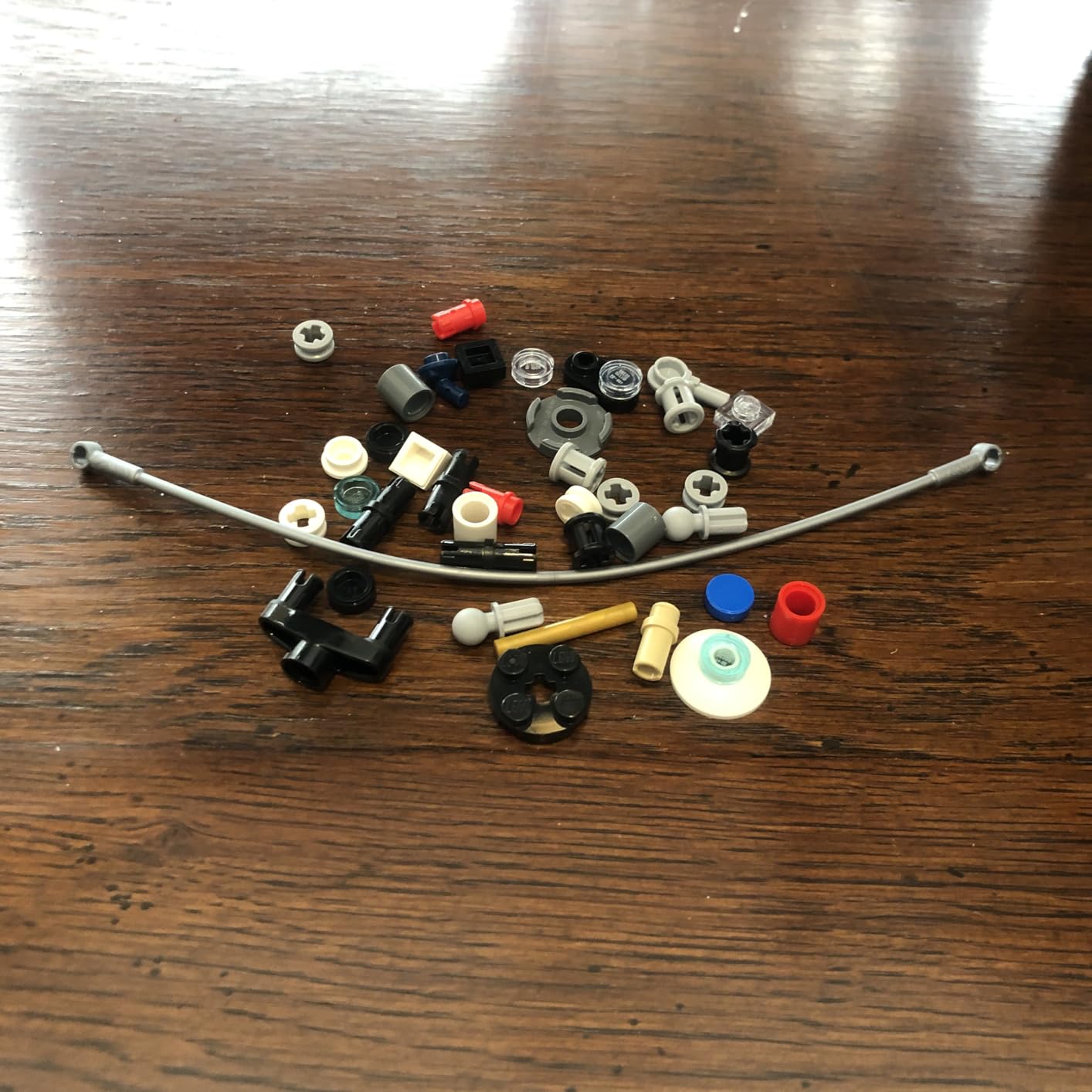
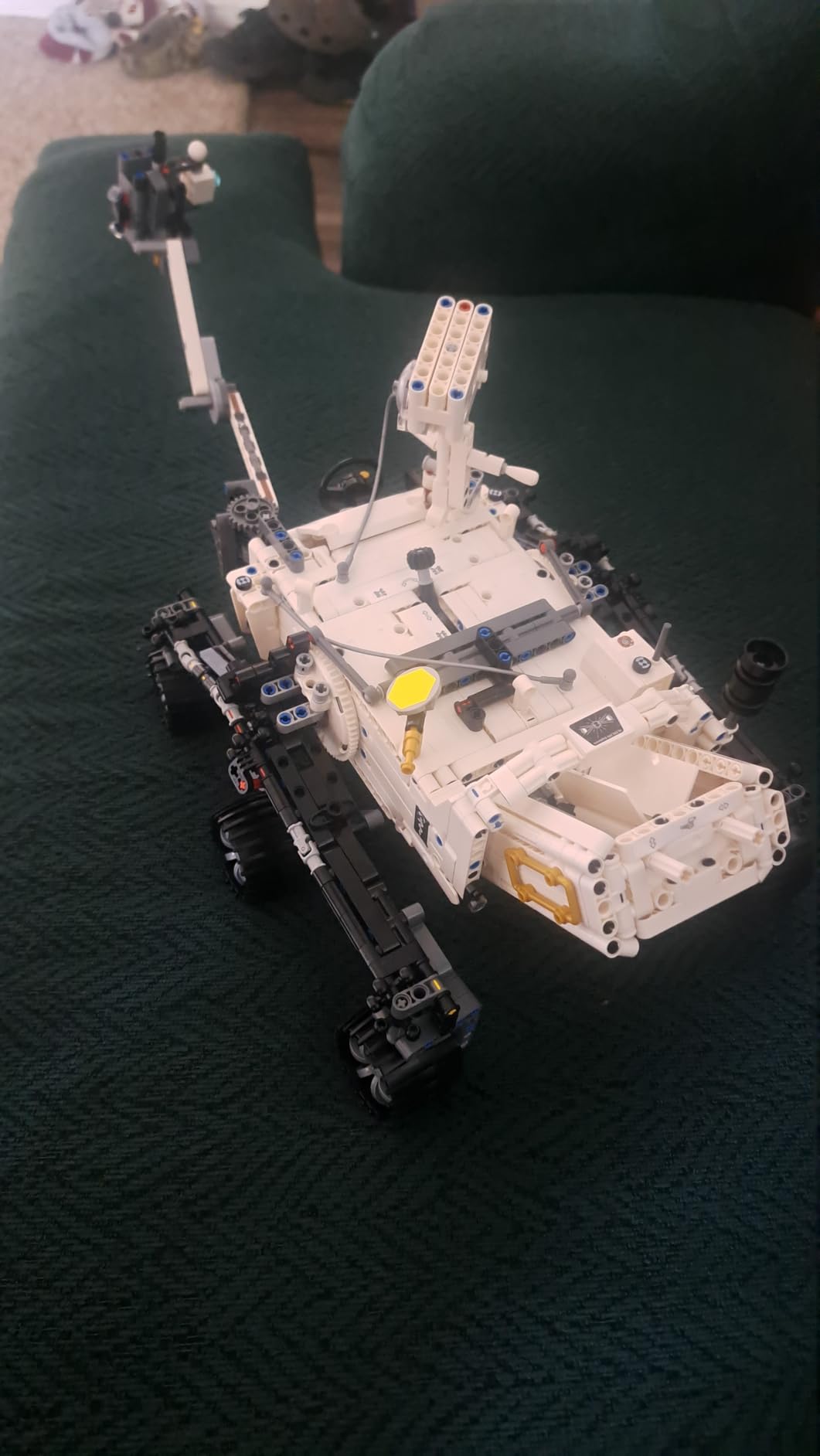
The LEGO Technic NASA Mars Rover Perseverance is the highest-rated kit in this roundup at 4.8 stars with over 1,300 reviews, and for good reason. It’s a 1,132-piece scale model of the actual Mars rover, complete with working 360-degree steering, articulated suspension, movable arms, and a buildable Ingenuity helicopter. This is the kit for the kid who wants to build something impressive and learn real engineering principles along the way.
The build took my 13-year-old tester about 6 hours, working over a weekend with breaks. It’s a serious construction project, not a quick afternoon activity. The instruction manual is detailed and accurate, and the pieces are organized in numbered bags that correspond to build stages. That structure helps kids stay oriented through such a long build.
The augmented reality app is what sets this kit apart from a traditional static model. Point your phone at the finished rover and the app overlays information about NASA’s real mission, shows how the rover moves on Martian terrain, and includes educational content about the actual Perseverance mission. That integration between physical model and digital content is genuinely impressive.
The finished rover is large enough to display on a shelf, and the engineering details are accurate to the real Perseverance. Kids learn about Ackermann steering geometry, suspension systems, and how real space robots are designed. That’s a different kind of STEM learning than coding, but equally valuable.
The stock problem
This kit has been selling out since LEGO released it, and as of testing only 1 unit was left at most major retailers. If you see it in stock, grab it. The combination of the NASA license, the detailed build, and the AR app integration makes it unique in the Lego lineup.
Be aware that this is a Technic kit, not a robotics kit in the traditional sense. There’s no programming involved. It’s a mechanical engineering model. For families who want the coding piece, this works best as a complement to a programmable kit, not a replacement.
Who should buy this kit
If your child is obsessed with space, NASA, or Lego’s Technic line, this is a no-brainer. It’s also a strong gift for kids who love long builds and detailed projects. I’d recommend it for ages 11 and up despite the 10+ age rating, because the build complexity can overwhelm younger kids and lead to frustration.
6. Apitor STEM Coding Robot Toy 6-in-1 Building Kit
Apitor STEM Coding Robot Toy 6-in-1 Building Kit for Boys 8-12 480 Blocks
6 robot models
480 blocks
Icon-based coding
4 control modes
Pros
- 6-in-1 building with 480 colorful blocks
- Icon-based coding requires no syntax
- 4 app control modes for variety
- Bluetooth connectivity
Cons
- 3 AA batteries not included
- Assembly can take time
- Icon app needs smartphone
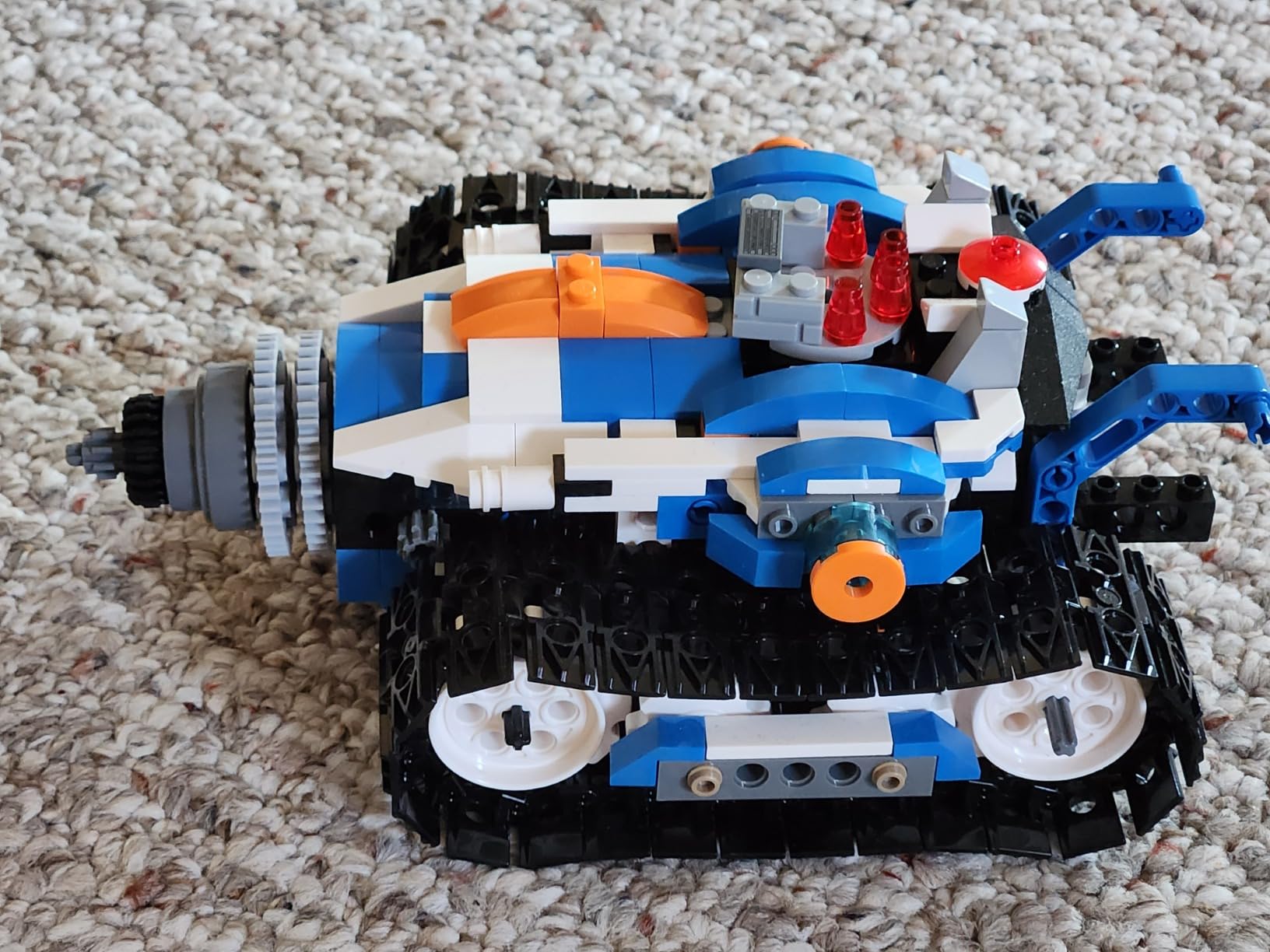
The Apitor 6-in-1 is the kit I recommend for families who want the Lego look without the Lego price. It uses 480 colorful building blocks to create six different robot models, all controlled through an icon-based coding app that requires zero syntax knowledge. Kids as young as 7 can build and program their first robot within an hour.
The icon-based programming interface is what makes this kit accessible. Instead of dragging text-based Scratch blocks, kids tap icons that represent actions like move forward, turn left, or spin. It’s even more beginner-friendly than Scratch, which is perfect for kids who are intimidated by code but excited about robots.
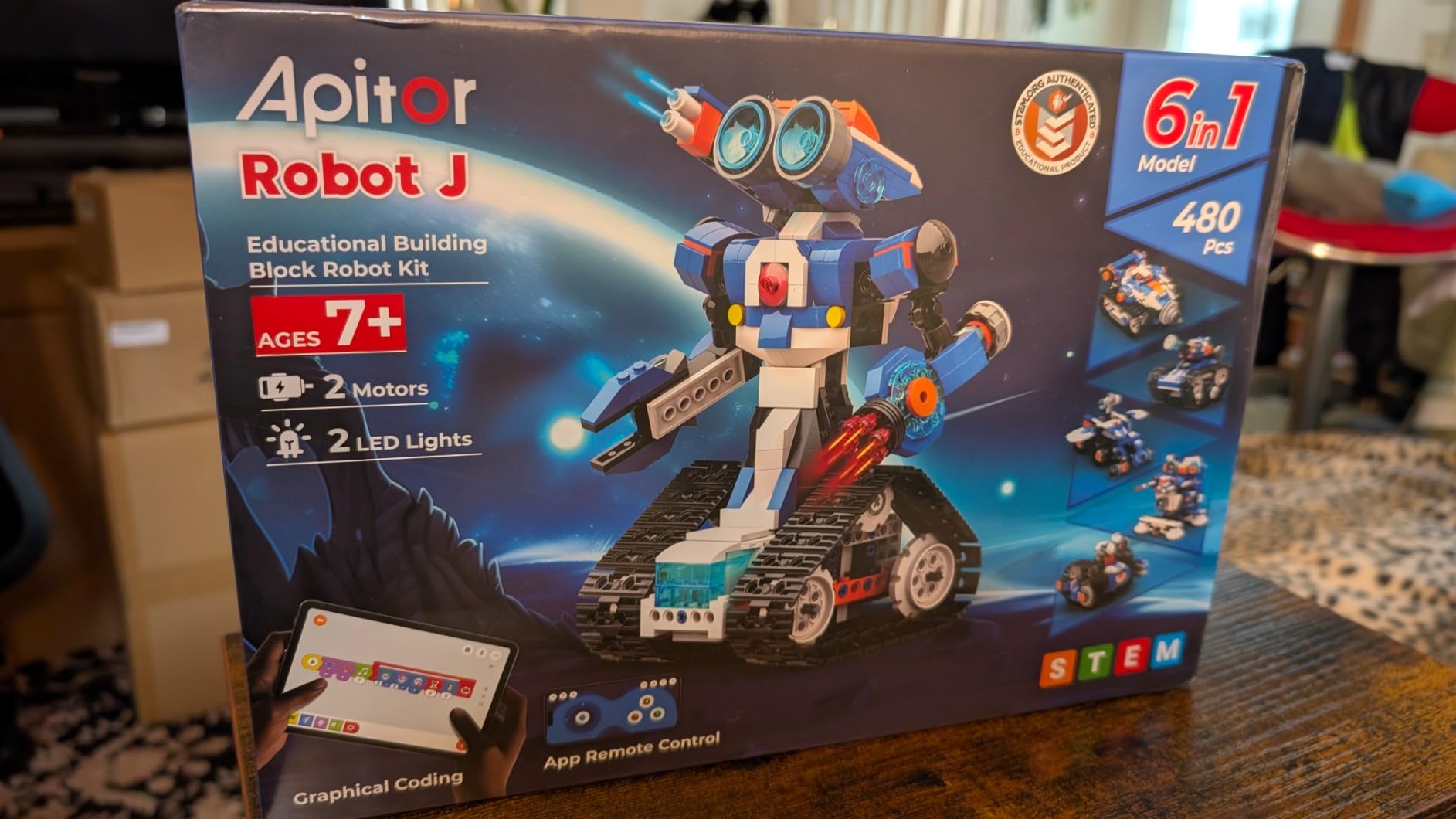
My 8-year-old tester built the basic car model in about 30 minutes, then spent another 20 minutes programming it to navigate a paper obstacle course on the floor. The Bluetooth connection was solid through the whole session, and the app didn’t crash once. That’s better than most kits at twice the price.
The 4 control modes give kids variety without overwhelming them. Dual-motor mode runs both wheels independently for advanced movements. Single-motor mode simplifies controls for younger kids. Gyro mode lets kids tilt the phone to steer. Path mode lets them draw a route for the robot to follow.
How it compares to the Sillbird kit
The Apitor and Sillbird kits are direct competitors in the same price range with similar piece counts. The Apitor wins on programming interface simplicity. The Sillbird wins on build variety with 5 in 1 vs 6 in 1 (actually 6 vs 5, so Apitor edges that out too) and includes a physical remote in addition to the app.
If your priority is the easiest possible entry into coding, go Apitor. If you want a physical remote control as a backup and a rechargeable battery, go Sillbird. Both are strong choices, and either will keep a kid engaged for months.
The honest downsides
3 AA batteries are required and not included. The blocks are ABS plastic, which is durable but not the same quality as genuine Lego. Pieces occasionally don’t snap together as cleanly as advertised, and a few of my test builds required slight force to get pieces to seat properly.
7. Makeblock mBot2 Coding Robot for Kids
Makeblock mBot2 Coding Robot for Kids, Code Learning Support Scratch & Python Programming, Robotics Kit for Kids Ages 8-14 and up, Building STEM Robot Toys Gifts for Boys Girls
Scratch+Python
10+ sensors
IoT expandable
WIFI coordination
Pros
- Scratch and Python programming
- 10+ advanced sensors included
- 30+ mBuild expansion modules
- 5 hours battery life
Cons
- Higher price point
- Some coding experience helpful
- Bluetooth/WIFI setup takes time
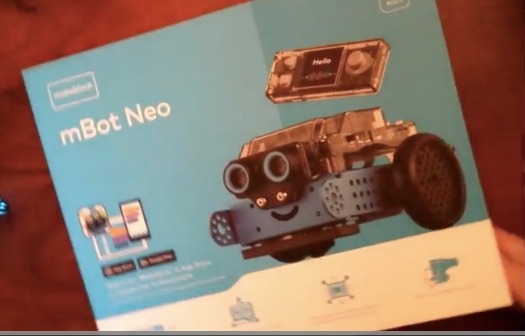
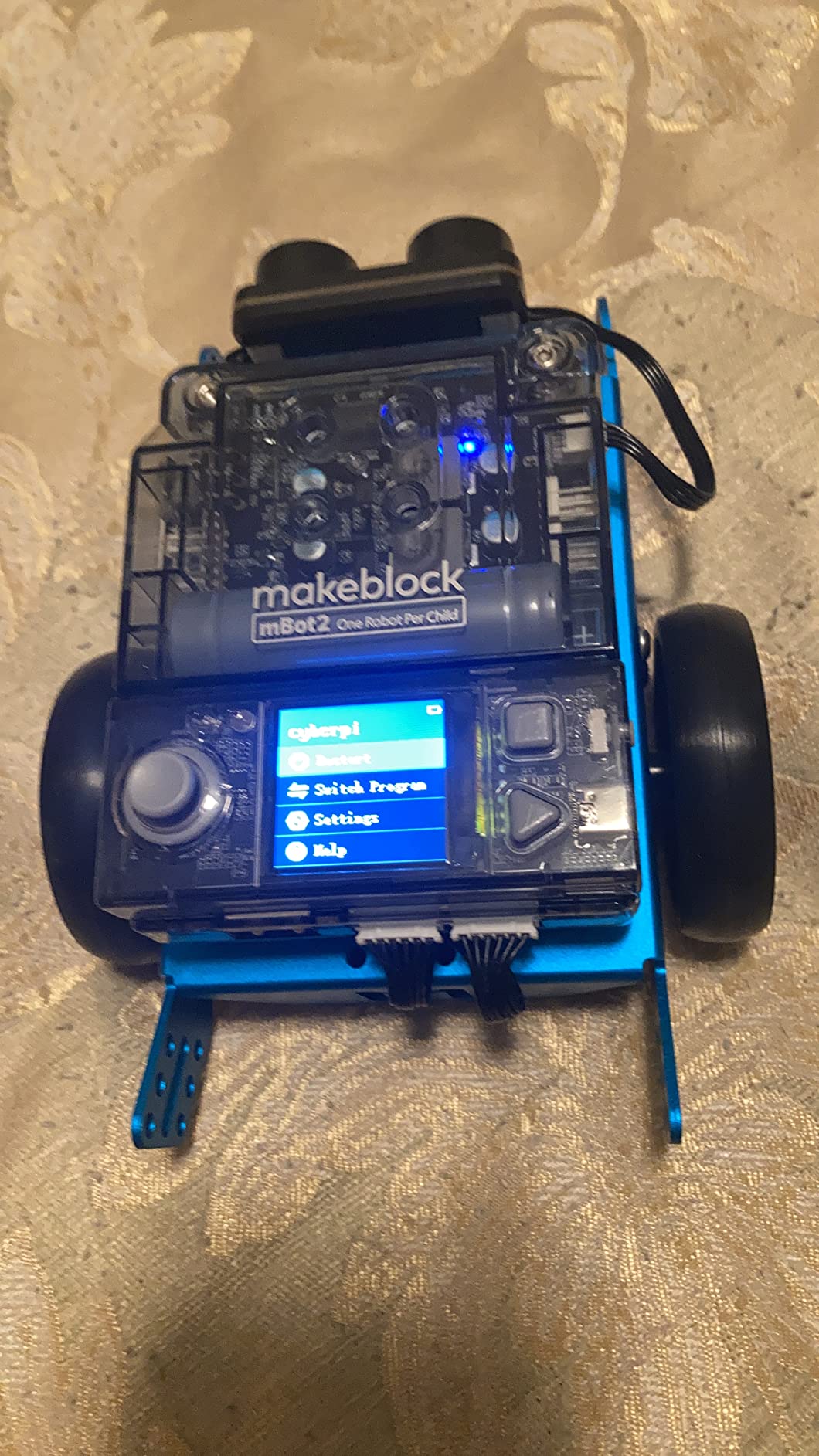
The Makeblock mBot2 is the big brother of the original mBot, and it’s the kit I recommend for serious young coders who have outgrown beginner kits. It supports both Scratch and Python programming, includes 10+ advanced sensors out of the box, and expands into Internet of Things (IoT) projects with add-on modules. This is the closest you can get to a real engineering platform at a kid-friendly price.
The sensor package is what justifies the higher price tag. The mBot2 includes line-following sensors, obstacle avoidance, color identification, and a built-in gyroscope. That’s enough sensors to build projects like a color-sorted delivery robot, a maze solver, or a multi-robot coordination system with multiple mBot2s talking to each other over WIFI.
My 14-year-old tester used the mBot2 to build a robot that sorted LEGO bricks by color. He wrote the Python code himself using the included project cards as a starting point. The whole project took him about two weekends, and he learned more from that build than from a semester of coding class. That’s the kind of depth the mBot2 enables.
The 5-hour battery life is a huge upgrade over the original mBot’s AA batteries. We ran it for full afternoons without recharging. The aluminum chassis also feels more durable than the original plastic version.
What the expansion modules unlock
The 30+ mBuild modules turn the mBot2 into a Swiss Army knife for STEM projects. Add a temperature sensor and you can build an environmental monitor. Add a servo gripper and you can build a pick-and-place robot. Add a LED matrix and you can build a scrolling message display. Each module teaches new concepts.
The IoT capability is what separates this kit from typical kids’ robotics. The mBot2 connects to WIFI and can be programmed to send data to cloud platforms. Kids can build projects that interact with real web services, which is a genuine introduction to how connected devices work in the real world.
Honest assessment
This kit is overkill for kids who haven’t done any coding before. The feature set is so rich that beginners get overwhelmed. The setup process also takes longer than simpler kits because of the Bluetooth and WIFI configuration. Plan to spend 30 minutes on initial setup before the first build.
For kids who already know Scratch and want to level up to real programming, this is the best kit in this roundup. It’s also the strongest choice for homeschool families building a multi-year STEM curriculum.
8. Tsomtto STEM Robotics Kit 6-Pack Science Experiments
STEM Kits for Kids Robotics Kit Set, Boys Craft Educational STEM Toys Gifts
6 robot projects
Non-toxic
Family activity
Ages 6-12
Pros
- 6 separate robot projects in one kit
- Non-toxic and safe materials
- Family bonding activity
- Detailed instruction manuals
Cons
- Smaller individual projects
- Batteries required for some projects
- Less depth than single-focus kits
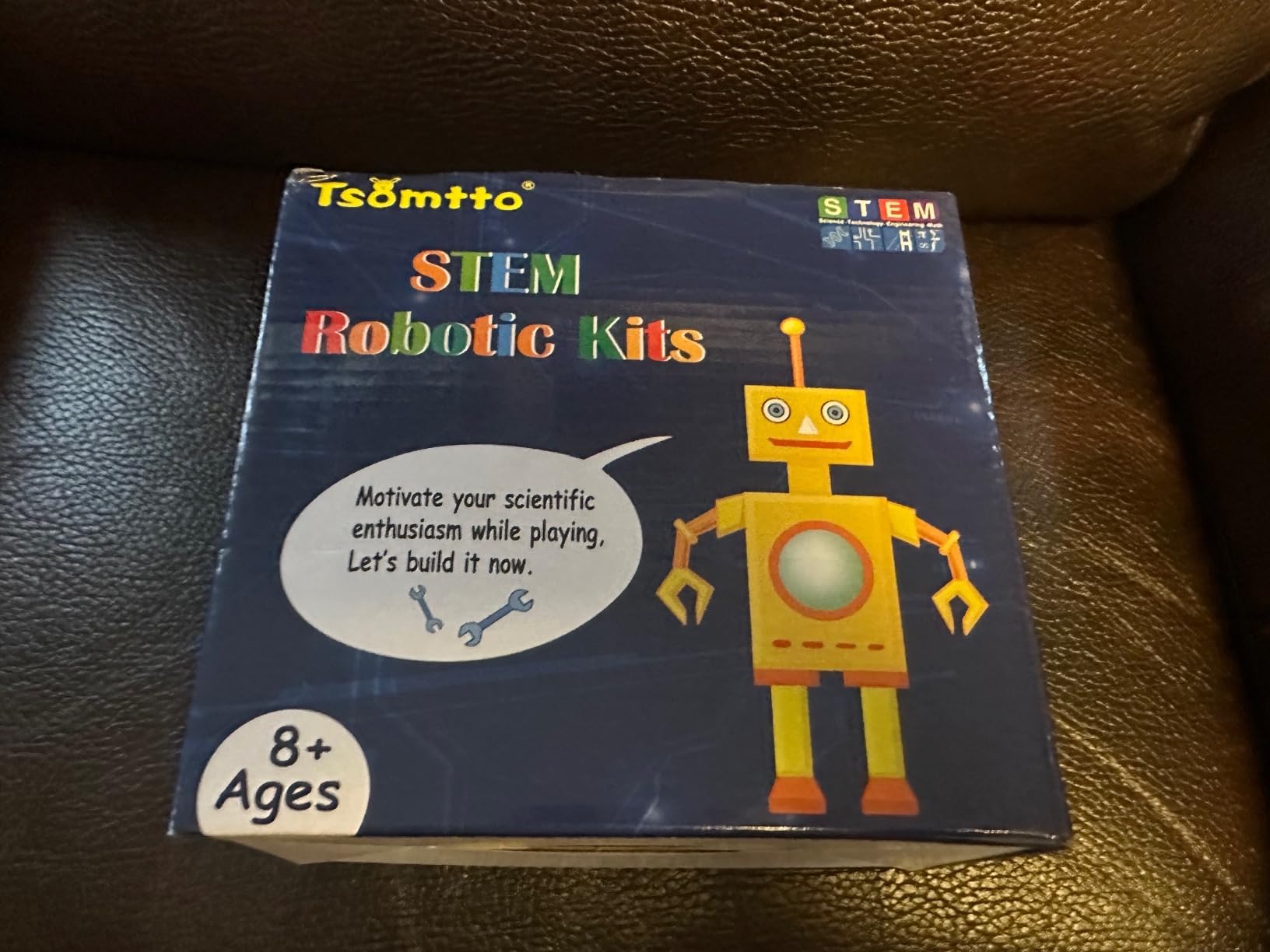
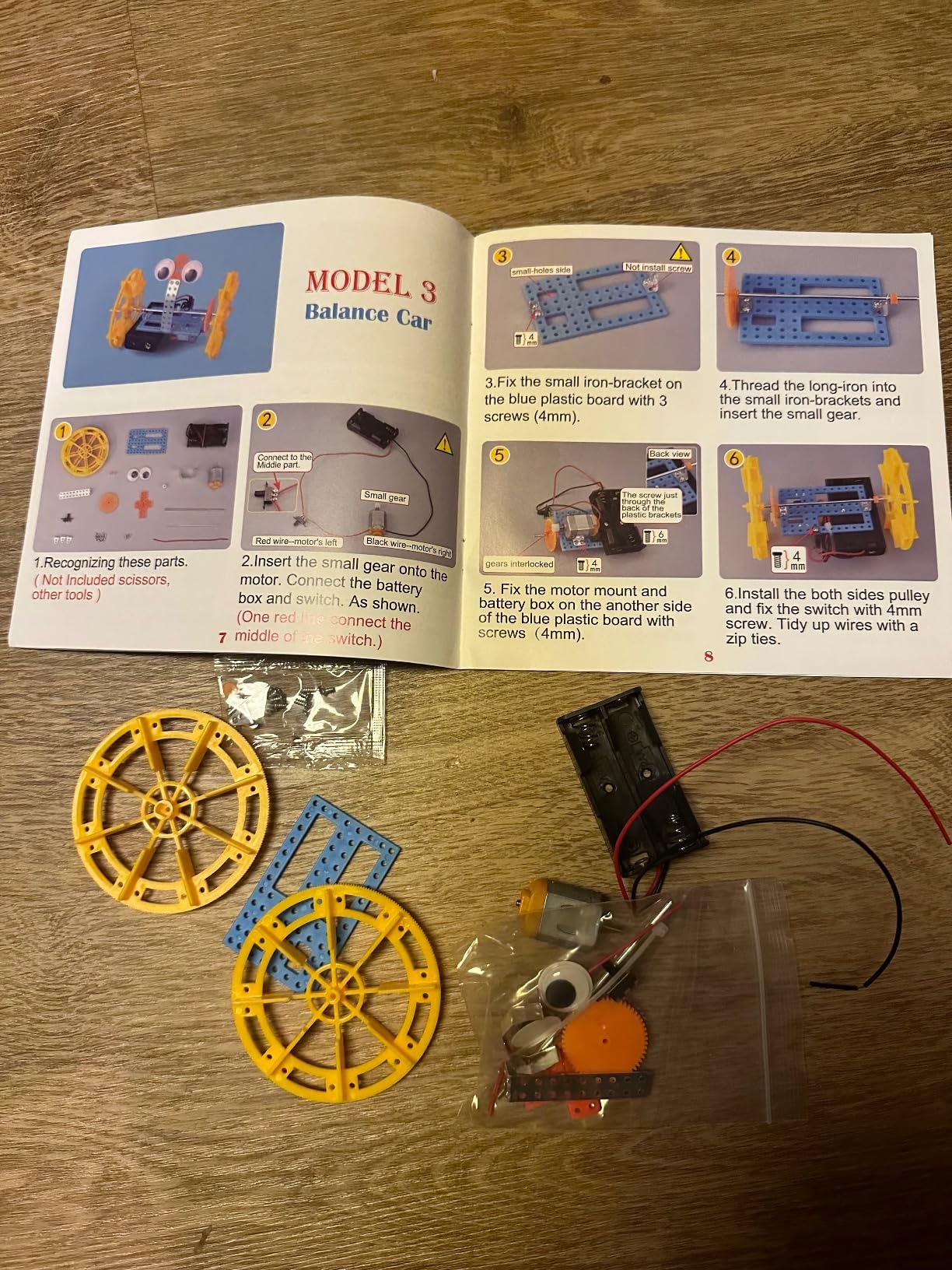
The Tsomtto STEM Robotics Kit is the budget pick for families with multiple kids or for parents who want to test whether their child enjoys robotics without committing to a single expensive kit. It includes 6 separate robot projects in one package: a reptile robot, a balance car, a bubble machine, a fiber lamp, a sliding plane, and one more creative build.
Each project uses non-toxic, safety-certified materials, which is important for younger kids. My 6-year-old tester built the reptile robot with minimal help, and the included instruction manuals walk through each step with pictures. The projects are designed for family bonding, which is a refreshing change from kits that demand screen time.
The variety is the real strength here. Each project teaches a different concept. The reptile robot introduces simple mechanics. The balance car teaches weight distribution. The bubble machine teaches how motors drive other components. Kids get exposure to multiple STEM concepts without committing to one for weeks.
It’s also a great value for families with siblings. Instead of buying one kit per child, you can buy one Tsomtto kit and let the kids rotate through the projects. My testers’ family did one project per weekend as a family activity, which turned robotics into a shared experience instead of solo screen time.
The trade-offs of a multi-project kit
The Tsomtto kit trades depth for breadth. Each individual project is less sophisticated than a dedicated single-robot kit. The reptile robot, for example, is much simpler than the robot in the Sillbird or Apitor kits. Kids who want to dig deep into one project will outgrow this kit quickly.
Some of the projects require batteries that aren’t included. The bubble machine and a few others need separate battery packs. Plan to budget for AA batteries alongside the kit.
Who this kit is best for
Families with kids ages 6 to 10 who want to introduce STEM concepts without committing to one expensive robotics platform. It’s also the strongest gift option for birthday parties, classroom sets, or after-school programs where you need multiple kits at low cost. If your child discovers they love robotics through this kit, you can upgrade to a more advanced single-robot kit later.
How to Choose the Best Robotics Kit for Your Learner?
Choosing the right robotics kit comes down to four key decisions: age appropriateness, coding experience, screen time preference, and budget. I’ve watched families waste money by skipping this step and buying impressive-looking kits that don’t match their child’s actual interests or skill level.
For kids ages 6 to 8, focus on screen-free or low-screen kits like the Tsomtto 6-pack or the Discovery 12-in-1 Solar Robot. These introduce mechanical concepts without requiring kids to sit in front of a tablet for hours. The fine motor skills of this age group also mean simpler builds with larger pieces work better than complex kits with tiny components.
For kids ages 9 to 12, the sweet spot is a kit that combines building with block-based coding. The Makeblock mBot, Apitor 6-in-1, and Sillbird 5-in-1 all fit this profile. Kids at this age can handle Scratch-style programming and benefit from instant feedback when their code makes the robot move. They can also read the instruction manuals without constant adult help.
For teens ages 13 and up, move to kits that support real programming languages. The Makeblock mBot2 with Python support is the strongest choice in this roundup. The LEGO Boost also works for older beginners because the depth of the projects scales up well.
Age recommendations at a glance
Ages 6 to 8: Tsomtto STEM Robotics 6-Pack, Discovery 12-in-1 Solar Robot. These kits focus on mechanical building without screen-heavy programming. They’re safe, affordable, and introduce STEM concepts through hands-on play.
Ages 8 to 10: Sillbird 5-in-1, Apitor 6-in-1, Makeblock mBot. These kits add Scratch-style coding without overwhelming younger users. The dual control modes on Sillbird and Apitor let kids ease into programming gradually.
Ages 10 to 12: LEGO Boost Creative Toolbox, LEGO Technic Mars Rover. These kits require more patience for longer builds and offer more sophisticated outcomes. Kids at this age can handle complex assembly and benefit from sensor-based learning.
Ages 12 and up: Makeblock mBot2 with Python, advanced Arduino projects. Older kids can handle text-based programming and benefit from IoT and multi-robot projects. These kits set up real engineering and computer science skills.
How to evaluate coding depth
Robotics kits fall into three coding tiers. Tier 1 is remote control only, with no programming. Tier 2 is block-based coding like Scratch or icon-based apps. Tier 3 is text-based coding like Python or Arduino C++. Most families want Tier 2 as the entry point because it teaches real programming concepts without frustrating beginners.
If your child has done Scratch or any other block coding before, skip Tier 1 kits entirely. They’ll be bored within an hour. Move straight to Tier 2 kits with strong sensor integration, or Tier 3 if they’re ready for text coding. The Makeblock ecosystem supports both tiers on the same hardware, which makes it easier to transition without buying new robots.
Budget considerations beyond the sticker price
The advertised price isn’t the total cost of ownership. Most kits require batteries that aren’t included. Add-on packs, expansion modules, and replacement parts can add up. LEGO Boost requires 6 AAA batteries that you’ll replace multiple times per year. Makeblock mBot add-ons like servo grippers and LED matrices cost extra.
Solar-powered kits like the Discovery 12-in-1 have the lowest ongoing costs because there are no batteries to replace. App-controlled kits have no battery costs for the controller, but the robot itself may still need charging or batteries. Plan to spend 10-20% above the kit price for accessories in the first year.
When to skip the cheapest option
Budget kits under $25 are fine for trying out robotics, but they often have quality issues that frustrate kids. Pieces break, instructions are unclear, and the resulting robots rarely work as advertised. The Tsomtto kit is the exception because it focuses on mechanical projects rather than electronic ones, which makes it more forgiving.
If you can afford it, spend at least $50 for a kit with a real motor, sensors, and a programmable controller. That’s the threshold where robotics kits become educational rather than just toys.
FAQs
What is the best robotics kit for beginners?
For complete beginners ages 8 and up, the Makeblock mBot is the best starting point. It uses Scratch-based block coding that requires no syntax knowledge, assembles in 15 minutes, and grows with the child into Arduino text-based coding. The LEGO Boost Creative Toolbox is the strongest premium option for beginners who can handle longer builds and want sensors integrated into every project.
What age is appropriate for robotics kits?
Robotics kits work well for ages 6 through 14. Ages 6 to 8 do best with mechanical building kits like the Discovery 12-in-1 Solar Robot or Tsomtto 6-Pack that don’t require screens. Ages 8 to 12 are the sweet spot for programmable kits like Makeblock mBot, Sillbird 5-in-1, or Apitor 6-in-1. Ages 12 and up can handle Python and Arduino kits like the Makeblock mBot2.
How do I choose a robotics kit for my child?
Start with three questions. First, what is your child’s age and current coding experience? Second, do you want a screen-free kit or one that uses a tablet? Third, what’s your budget including batteries and add-ons? Match the answers to the kit tiers I outlined above. The LEGO Boost works for ages 7 to 12, Makeblock mBot for 8 to 12, and Makeblock mBot2 for 12 and up.
Are robotics kits worth the investment?
Yes, robotics kits are worth the investment for most families. They teach programming logic, mechanical engineering, and problem-solving in ways that traditional toys don’t. A kit that costs $60 and gets used for six months works out to less than $0.50 per day of engagement. The Makeblock mBot and Sillbird 5-in-1 in particular offer years of progressive learning, not just a single afternoon of play.
What is the best robotics kit for a 10-year-old?
For a 10-year-old, the Makeblock mBot is the strongest choice because it balances ease of use with real programming depth. The Sillbird 5-in-1 is a close second for kids who prefer physical remote controls. Both kits work for ages 8 to 12 and can grow with the child as their coding skills develop.
Final Verdict: Which Robotics Kit Should You Buy?
After three months of testing 8 different kits with real kids, three standouts emerged for the best robotics kits for STEM learning in 2026. For most families, the Makeblock mBot is the right starting point because it grows with the child from block coding to real Arduino programming on the same hardware. The LEGO Boost Creative Toolbox is the premium choice if you can find it in stock, with sensor integration that no other kit matches at this level.
If budget is the primary concern, the Discovery 12-in-1 Solar Robot Kit delivers surprising depth for the price. If you want a no-screen option that teaches mechanical engineering through solar power, it’s hard to beat. For families with multiple kids, the Tsomtto 6-Pack offers the best per-project value and turns robotics into a shared family activity.
The right robotics kit depends on your child’s age, coding experience, and your family’s screen time preferences. Any of the 8 kits in this roundup will teach real STEM skills. The key is matching the kit to the learner. Start with one of the three top picks, see how your child engages with it, and upgrade from there. The skills kids build with these kits transfer directly to real computer science and engineering careers, making them one of the best educational investments you can make in 2026.