
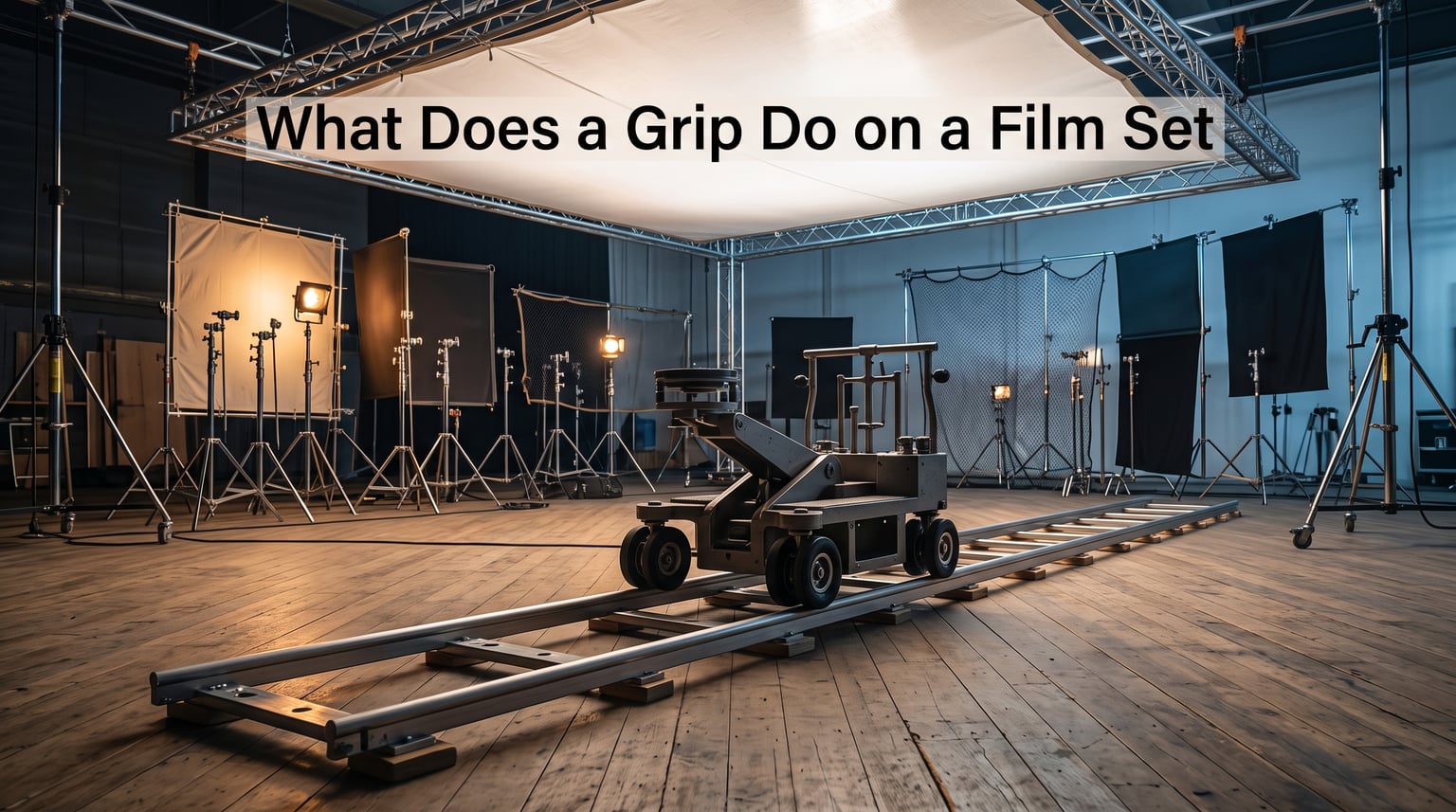
When someone asks what does a grip do on a film set, the simplest answer is this: a grip handles every piece of non-electrical equipment that holds the camera, shapes the light, and keeps the production moving safely. I have worked alongside grip crews on indie features and commercial shoots for years, and I have seen firsthand how much the entire production depends on these crew members. In this guide, I will walk you through the full role, the tools, the hierarchy, and the career path so you can decide whether this job is right for you.
By the end, you will understand the difference between a key grip and a dolly grip, what separates a gaffer from a grip, and how a typical 12-hour shoot day actually unfolds behind the lens.
Table of Contents
What Is a Grip on a Film Set?
A grip is a camera support and lighting modification technician who works under the Director of Photography (DoP) and the key grip. They set up, rig, operate, and strike every piece of non-electrical equipment used on a film set, including dollies, cranes, C-stands, flags, and silks. The job is part rigger, part problem-solver, and part athlete.
The word “grip” comes from an old stagehand term for the bag a stage worker used to carry their tools. Over time, it stuck and became the universal name for the department that physically shapes how a shot looks and moves.
When people search for what does a grip do on a film set, they often picture someone just moving a light stand. In reality, the grip department makes the camera move the way the director envisions. Without grips, you cannot dolly through a doorway, fly a camera over a staircase, or block sunlight spilling into a window.
The Core of the Grip Department
The grip department runs parallel to the electric department, but the two never overlap in equipment ownership. Grips do not touch anything that runs electricity. If it lights up or has a plug, that belongs to the gaffer’s team. If it holds, supports, blocks, or shapes, that belongs to the grips.
I learned this distinction the hard way on my first commercial shoot, when I tried to help the electric team plug in a light. The gaffer politely told me to step back, and the key grip laughed and said, “Touch a cable today, regret it for the whole shoot.” The line is sacred on every professional set.
Core Responsibilities of a Grip
A grip’s responsibilities break into three main buckets: camera support, light shaping, and safety rigging. Each task happens before, during, and after every single shot, often with no downtime between takes.
1. Camera Support and Movement
Grips build and operate every rig that moves the camera. This includes laying dolly track, balancing cranes, mounting cameras to vehicles, and setting up jib arms. When the DoP says, “I want a slow push-in from the doorway,” that push-in only exists because a dolly grip built the track and pushed the cart.
Modern grip crews also work with Steadicams, gimbal systems, and stabilized remote heads. Even in the age of digital effects, physical camera movement still rules the visual language of cinema. Grips are the people who deliver it.
2. Light Shaping and Modification
Most of what grips do on a day-to-day basis involves shaping light rather than moving cameras. They set up flags to block light, silks and diffusion frames to soften it, and nets to reduce intensity. They build overhead rigs with butterflies and overhead frames so the electric department can bounce or diffuse light from above.
Light shaping is a quiet art. A 12×12 frame of silk placed just above an actor’s face can change the entire mood of a scene. Grips do this work without ever plugging in a single light.
3. Rigging and Safety
Whenever equipment gets mounted overhead, on a wall, or on a vehicle, a grip rigs it. They work with safety cables, sandbags, and clamps to make sure nothing falls on a crew member or an actor. Safety rigging is unglamorous, but it is the reason no one gets hurt when a 20×20 silk frame is hanging 12 feet above the set.
On bigger productions, grips also operate scissor lifts, condors, and even helicopter-mounted camera rigs. Each of these roles requires additional certification and a serious respect for safety protocols.
Types of Grips in the Department
The grip department follows a clear hierarchy, and each position has a specific job on set. Here are the main types of grips you will find on a professional shoot.
Key Grip
The key grip is the head of the grip department and reports directly to the Director of Photography. They design the rigging approach for each shot, lead the crew, and manage equipment inventory. The key grip is in every production meeting and is the decision-maker for how every camera move and lighting rig will be physically executed.
Best Boy Grip
The best boy grip is the key grip’s second-in-command. They handle logistics, scheduling, timecards, and the daily equipment order. On set, they coordinate the other grips and make sure gear shows up where it needs to be, when it needs to be there. It is often the first management role a grip takes on the path toward becoming a key grip.
Dolly Grip
The dolly grip pushes the camera on a dolly during tracking shots. This is one of the most skilled positions because the dolly grip has to match the actors’ movements exactly while keeping the camera frame steady. A great dolly grip can make a complex shot feel effortless; a poor one will ruin takes all day.
Company Grip / Swing Grip
Company grips and swing grips are the workhorses of the department. They set up flags, move C-stands, lay sandbags, build rigs, and assist wherever they are needed. Most grips start in this role before moving up.
Specialty Grips
On larger productions you may also see crane grips, jib grips, vehicle rig grips, and underwater grips. Each has specialized training. These positions usually pay higher day rates and require years of experience to land.
Gaffer vs Grip: What’s the Difference?
The gaffer runs the electrical department, while the key grip runs the grip department. The gaffer owns every light, cable, dimmer, and generator. The key grip owns every stand, frame, flag, dolly, and piece of rigging. They work together constantly but their equipment and responsibilities never overlap.
Think of it this way: the gaffer decides how much light hits the set, and the grip decides where that light goes and how it looks. The gaffer turns on a 10K; the grip decides whether that 10K needs a silk in front of it, a flag beside it, or a net to cut its intensity.
Their chains of command run parallel. The gaffer reports to the Director of Photography. The key grip also reports to the DoP, but acts as a peer to the gaffer rather than a subordinate. On smaller shoots these two roles may sometimes cross over, but on professional sets the rule is strict: lights and plugs belong to the gaffer, stands and frames belong to the grip.
Side-by-Side Comparison
Gaffer responsibilities include powering lights, running cable, managing dimmer boards, and operating generators. Grip responsibilities include setting up camera support, building dollies and tracks, rigging overhead frames, and shaping light with flags and diffusion.
Their tools differ too. A gaffer’s bag is full of lamps, gel, edison adapters, and electrical tape. A grip’s bag is full of C-47s (wooden clothespins), tape measures, multitools, gloves, and sharpies. Both crews carry gaffer tape, but the grip tape is usually black, while the electric crew often works with colored spikes for marking cable runs.
Essential Equipment a Grip Uses
Every grip on set learns to handle the same core kit. Here is the equipment you will find in a working grip truck on any given day.
C-Stands
A C-stand is the grip’s bread and butter. It is a heavy-duty steel stand with a curved arm that lets you mount flags, silks, and nets in awkward positions without tipping over. A typical shoot may use 30 to 50 C-stands in a single scene.
Flags and Cutters
Flags are solid black frames that block light. Cutters are smaller flags used to control specific edges of light. Grips spend most of their day hanging flags to keep light off unwanted surfaces like windows, walls, and reflective objects.
Silks, Diffusion, and Nets
Silks and diffusion frames soften harsh light. Nets reduce light intensity without changing color temperature. Grips build frames from 6×6 inches all the way up to 20×20 feet and rig them overhead or on stands as needed.
Apple Boxes
Apple boxes are wooden boxes in four sizes (full, half, quarter, and pancake) used for leveling, propping up cameras, or giving actors extra height. They are the grip’s answer to nearly every small height-related problem on set.
Dollies and Track
From a Fisher dolly for tight interior shots to a Chapman Hybrid for larger moves, dollies are the centerpiece of any grip truck. Track comes in straight sections and curves and is laid down before the camera rolls.
Sandbags
Every overhead rig and every C-stand gets a sandbag. Sandbags keep stands from tipping when a heavy frame is mounted on them. Running out of sandbags on set is a cardinal sin.
C-47s and Gaffer Tape
C-47s (wooden clothespins) clip silks and nets to frames. Gaffer tape fixes everything else. A good grip can fix 90% of set problems with a roll of black gaffer tape and a fistful of C-47s.
A Day in the Life of a Grip
A grip day usually starts before sunrise. Our team typically arrives on set at 6:30 AM for a 7:00 AM call. The first hour is spent unloading the truck, setting up the gear cage, and reviewing the day’s shooting schedule with the key grip.
By the time the DoP and director arrive, the grips have already laid down dolly track and built the first set of overhead rigs. Once shooting starts, grips stay close to camera for every take, ready to adjust a flag, reposition a stand, or move the dolly the moment the director yells cut.
The physical demands are real. Most grip call sheets run 12 hours minimum, often stretching to 14 or 16 on bigger days. You spend that time on your feet, lifting, climbing, and problem-solving in real time. Veterans emphasize two things: stay hydrated, and invest in good boots. Both have saved my back more than once.
Between takes, grips reset the frame, swap out equipment, and anticipate the next shot. The best grips do not wait to be told what to do. They watch the rehearsal, predict what the camera will need, and have it ready before the director calls action.
How to Become a Film Grip
Most grips start as production assistants or trainees and learn on the job. There is no single required degree, but a background in technical theater, mechanical work, or sports helps. What matters most is showing up on time, listening, and being willing to carry heavy things in uncomfortable positions.
The typical career path is trainee, company grip, dolly grip, best boy grip, and finally key grip. Reaching key grip usually takes 8 to 15 years of steady work, though fast learners can move faster by networking aggressively and showing reliability on every gig.
Training and Certification
In the United States, grips typically join the International Alliance of Theatrical Stage Employees (IATSE) Local 80 in Hollywood or other regional IATSE locals. Union membership gives you access to bigger productions, better pay, and health benefits.
In the United Kingdom, grips join the BECTU Grips Branch or work through ScreenSkills-recognized training programs. Many grips also pursue Level 2 and Level 3 Diplomas in Film and Television Production to formalize their skills.
How Much Do Film Grips Get Paid?
Entry-level grips in the US earn around $200 to $300 per day on union productions. Experienced company grips make $400 to $600 per day, while dolly grips and crane grips can earn $700 to $1,200 per day. Key grips on studio features regularly clear $1,500 per day. Pay scales in the UK run lower but follow a similar ladder based on experience and union status.
Building a Network
Like most film careers, grip work depends on who you know. Start by working on local indie films, student projects, and music videos for free or low pay to build your reel and your contacts. Every grip I know got their first real gig because someone on a previous set recommended them.
Frequently Asked Questions
How much do film grips get paid?
Entry-level grips in the US earn around $200 to $300 per day on union productions. Experienced company grips make $400 to $600 per day, while dolly grips and crane grips can earn $700 to $1,200 per day. Key grips on studio features regularly clear $1,500 per day. Pay scales in the UK and other regions run lower but follow a similar experience-based ladder.
What is the difference between a gaffer and a grip?
The gaffer runs the electrical department and owns every light, cable, dimmer, and generator on set. The key grip runs the grip department and owns every stand, frame, flag, dolly, and piece of rigging. They work together but their equipment and responsibilities never overlap: lights and plugs belong to the gaffer, stands and frames belong to the grip.
What does a grip person do on a film set?
A grip person sets up, operates, and strikes every piece of non-electrical equipment on a film set. This includes building dolly track, operating cranes and jib arms, hanging flags and silks to shape light, rigging overhead frames for diffusion, and supporting the camera for every shot. The role combines rigging, light shaping, and physical problem-solving.
How to get a job as a grip in film?
Start by working as a production assistant or trainee on local indie films, student projects, and music videos to build contacts and on-set experience. Then apply to your regional IATSE local in the US or the BECTU Grips Branch in the UK to access union productions. Most grips move from trainee to company grip to dolly grip to best boy grip and finally to key grip over 8 to 15 years of steady work.
Final Thoughts
So, what does a grip do on a film set in 2026? They make every camera move possible and shape every beam of light the audience sees. The role is physically demanding, technically complex, and endlessly rewarding for people who love hands-on problem-solving.
If you are curious about film production, shadowing a grip for a single day will teach you more about how movies are made than any textbook. Reach out to a local production company, offer to carry sandbags for free, and you will quickly see whether this career fits you.