
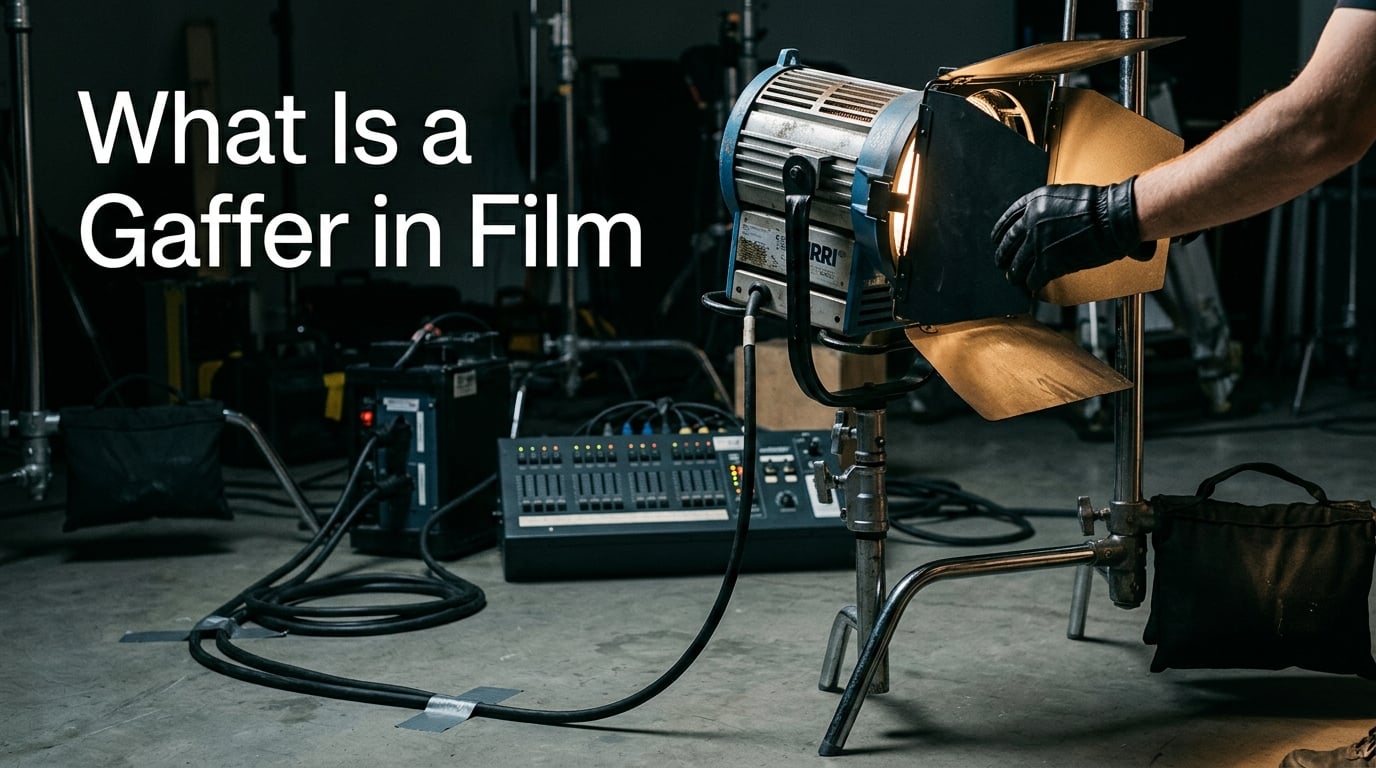
When people ask what is a gaffer in film, the short answer is simple. A gaffer is the chief lighting technician on a movie, TV, or commercial set, and they run the entire electrical department under the director of photography.
I have spent years working alongside gaffers on indie sets and studio shoots. The role is often misunderstood, even by people working in the industry. Most casual viewers have no idea who controls the lighting shaping their favorite scenes.
In this guide, our team breaks down exactly what a gaffer does, where the term comes from, how the role compares to a key grip, and how you can build a career as one in 2026. I will also walk through the daily responsibilities, the tools you will carry, and the slang meanings that pop up outside the film world.
Table of Contents
What Is a Gaffer in Film and TV?
A gaffer is the head of the lighting and electrical department on a film, television, or commercial production. They are formally known as the chief lighting technician, and they answer directly to the director of photography (DP) or cinematographer.
Think of the gaffer as the lighting department’s version of a foreman. They take the DP’s creative vision and translate it into a working lighting plan, then lead a team of electricians (called sparks) to make it happen on set.
Our team has watched gaffers on small indie shoots manage a two-person crew, and on big studio productions lead teams of 12 or more. The core job never changes: control the light, control the power, keep the crew safe.
Key responsibilities at a glance:
- Plan and execute the lighting setup for every scene
- Manage power distribution from generators to individual fixtures
- Lead and schedule the electrical crew
- Coordinate with the grip department on placement
- Maintain safety standards around electricity and heat
- Adjust lighting in real time as conditions change
The role is part artist, part electrician, part logistics manager. A good gaffer can read a scene the way a musician reads a chord chart.
Why Is It Called a Gaffer? The Etymology Explained
The word “gaffer” has been in the English language for centuries, but it landed on film sets in the early 20th century. Two main theories explain how.
The first theory traces the term back to the hooked pole used by early lamp lighters. Street lamplighters carried a long pole with a hook on the end, called a “gaff,” to lower and service gas lamps. When film lighting crews started using similar hooks to hang and adjust early studio lights, the term stuck with the people doing the work.
The second theory points to British slang for “godfather” or “old man.” On early sets, the gaffer was the senior authority figure managing the lighting crew, much like a patriarch. The British term “gaffer” for a boss or grandfather migrated naturally into crew hierarchies that borrowed heavily from British theater tradition.
Most film historians land somewhere in the middle. The lighting crew kept the term alive because of the gaff hook, but the sense of seniority in the word gave it authority on set.
Whatever the origin, the name has been standard in American and British film production since the silent era. Walk onto any major set today and the lighting department is still led by the gaffer.
Gaffer vs Grip: What’s the Difference?
The gaffer and the key grip lead two related but distinct departments. Confusion between them is one of the most common questions new crew members have.
The short version: the gaffer handles everything that produces light, and the key grip handles everything that shapes, modifies, or controls light once it exists.
| Role | Department | Main Gear | Reports To |
|---|---|---|---|
| Gaffer | Electrical / Lighting | HMI, LED, tungsten fixtures, dimmer boards, distro boxes | Director of Photography |
| Key Grip | Grip / Rigging | C-stands, flags, silks, scrims, dollies, rigging | Director of Photography |
Our team put it this way on a recent commercial shoot: the gaffer decides what lights go where, and the key grip decides how to mount, flag, and shape them once they are there.
On a practical level, the gaffer’s crew runs cables, sets up lights, and manages power. The grip’s crew builds scaffolding, mounts flags to block unwanted light, and rigs overhead frames for diffusion.
Both departments must work in tight coordination. If the gaffer places a 12K HMI in a doorway, the grip crew is right behind them figuring out how to fly it safely and control the spill. I have seen great scenes fall apart when these two departments stop communicating.
One more distinction worth noting: the gaffer is sometimes confused with the cinematographer or DP. They are not the same. The DP designs the visual look. The gaffer executes the lighting that achieves it.
Where Does the Gaffer Sit in the Film Crew Hierarchy?
The gaffer reports to the director of photography and is one of the most senior department heads on set. Below the gaffer sit the best boy electric and the lighting technicians (sparks).
Here is how the lighting department chain typically flows on a mid-size production:
- Director of Photography (DP) / Cinematographer – sets the visual tone
- Gaffer (Chief Lighting Technician) – executes the DP’s vision
- Best Boy Electric – manages logistics, equipment, and crew schedules
- Sparks / Set Lighting Technicians – set up and operate individual lights
- Generator Operator – handles power generation and distribution
The gaffer’s voice carries serious weight during production meetings. When the gaffer says a setup will take 90 minutes, the DP and director plan around that reality.
On a recent feature I worked on, the gaffer had the authority to call safety holds whenever a cable ran through a wet location. The 1st Assistant Director respected that call every single time. Power is not something you negotiate with.
Working relationships matter as much as technical skill. A gaffer who has built trust with the DP gets hired again. A gaffer who delivers consistent safety and reliability builds a career that lasts decades.
What Does a Gaffer Do on Set? Key Responsibilities
The gaffer’s work starts long before the cameras roll. Their responsibilities break into three phases: pre-production, production, and wrap.
Pre-Production Responsibilities
During pre-production, the gaffer joins the DP for tech scouts and location walks. They evaluate available power, ambient light conditions, ceiling height for rigging, and any physical limitations of the space.
Our team has been on scouts where the gaffer spotted a 200-amp service drop that the location manager had completely missed. That single observation saved the production from renting a tow generator.
The gaffer also reads the script with the DP to flag lighting-heavy scenes. A bar scene with practical neon, a campfire in the woods, or a daylight car chase each require different gear and crew sizes.
By the end of pre-production, the gaffer builds the lighting plan, orders equipment, hires the electrical crew, and coordinates with the key grip on combined grip-and-electric needs.
Production Day Duties
On shoot days, the gaffer arrives before the crew call to confirm power, walk the set, and brief the sparks. Once cameras roll, the gaffer is rarely standing still.
Typical production responsibilities include:
- Briefing the best boy on the day’s setup priorities
- Supervising light placement and focus
- Adjusting dimmer levels between takes
- Flagging light spill using grip equipment
- Monitoring power loads to prevent overloads
- Communicating with the DP about any lighting limitations
- Managing cable runs to keep walkways clear
Speed matters. Productions lose thousands of dollars for every hour of camera downtime. A skilled gaffer can re-light a scene in minutes because they pre-planned every alternative.
Wrap and Post-Production Duties
At the end of each shoot day, the gaffer oversees equipment strike, cable coiling, and truck loading. They also report equipment losses or damage to the production manager.
On multi-day shoots, the gaffer maintains the lighting kit between locations. Bulbs burn out, gels tear, and scrims need replacing. The gaffer keeps the kit camera-ready every morning.
Gaffer Tape, C-47s, and Other Essential Tools
The term “gaffer” has bled into film gear culture, most famously with gaffer tape. Gaffer tape is a strong, cloth-backed, pressure-sensitive tape that tears easily by hand and removes without leaving residue. It is the gaffer’s duct tape.
Every gaffer carries a tool belt loaded with essentials. Here is what our team usually sees on set:
- Gaffer tape in black, white, and gray
- C-47s (wooden clothespins used to clip gels and diffusion)
- Sharpie markers and labeling tape
- Multimeter for checking voltage
- Leatherman or multi-tool
- Cable ties in multiple sizes
- Work gloves for hot fixtures
- Light meter for exposure checks
- Spare bulbs and gels
C-47s deserve a special mention. They are cheap wooden clothespins, but no gaffer works without them. They hold gels, secure cables, and clip diffusion frames faster than any clamp. Studios buy them by the case.
The light meter is the gaffer’s measuring tool. It tells them how much light is hitting the subject and helps them balance fixtures to match the DP’s exposure goals. I have seen gaffers carry meters worth over $1,000 just for daily readings.
How to Become a Gaffer: Career Path and Skills
Becoming a gaffer usually takes years of hands-on experience. There is no standard degree requirement, but on-set training is non-negotiable.
Here is the path our team has seen most often:
- Start as a production assistant (PA) on set to learn set culture and etiquette.
- Move into the electrical department as a lamp operator or intern.
- Work as a spark (set lighting technician) for several years to learn fixtures, power, and crew dynamics.
- Promote to best boy electric, where you handle logistics and learn to manage people.
- Build relationships with directors of photography who will hire you as their gaffer.
- Join IATSE (International Alliance of Theatrical Stage Employees) for access to major studio productions.
Skills that matter most:
- Deep knowledge of electrical systems and power distribution
- Ability to read a script and visualize lighting needs
- Strong communication and crew leadership
- Calm under pressure during tight schedule days
- Physical stamina for 12-hour days on your feet
- Creative problem solving when gear fails or weather changes
Many gaffers never stop being gaffers. The role is a respected terminal position, not just a stepping stone to cinematography. I have met gaffers with 25-year careers who turned down DP offers because they love the craft.
For women entering the trade, the path is real but harder. Lighting departments remain male-dominated, and mentorship matters. Organizations like the International Cinematographers Guild run programs that connect aspiring gaffers with established professionals.
Gaffer Slang Beyond Film: Football and Glassmaking
The word “gaffer” leaks out of film sets into other corners of English. In British football (soccer), the gaffer is the team’s manager. Fans shout “the gaffer’s got it wrong” when tactics fail. That meaning predates film usage and traces back to the “old man” or “boss” sense of the word.
In the glassmaking trade, a gaffer is the master glassblower who oversees the furnace and shapes the molten glass. This is the oldest technical use of the term, and it shares the same root idea: the senior person in charge of the hot, dangerous work.
Film borrowed the term because early lighting crews were themselves working with hot glass and bright lights. The connection is fitting, even if the modern gaffer tape has nothing to do with either profession.
Frequently Asked Questions
What is a gaffer in film?
A gaffer is the chief lighting technician on a film, TV, or commercial set. They lead the electrical department, manage power distribution, and execute the director of photography’s lighting plan.
What’s the difference between a grip and a gaffer?
The gaffer runs the electrical department and handles light-producing fixtures like HMIs, LEDs, and tungsten units. The key grip runs the grip department and handles equipment that shapes or modifies light, such as flags, scrims, and rigging.
Why are they called a gaffer?
The term most likely traces to the hooked pole (called a gaff) used to service early gas street lamps, combined with British slang meaning boss or godfather. The combination stuck with film lighting crews in the early 20th century.
Who does a gaffer report to on a film set?
The gaffer reports directly to the director of photography (DP) or cinematographer. The gaffer then manages the best boy electric and the sparks (set lighting technicians) below them.
How hard is it to become a gaffer?
Becoming a gaffer typically takes 7 to 10 years of on-set experience. Most people start as a production assistant, work up through the electrical department as a spark and best boy, and then build relationships with DPs who hire them.
Is a gaffer the same as a director of photography?
No. The director of photography designs the visual look of the film and makes creative lighting decisions. The gaffer executes that vision by leading the electrical crew and managing the actual lights on set.
What tools does a gaffer carry?
A gaffer typically carries gaffer tape, C-47s (wooden clothespins), a multimeter, a light meter, spare bulbs, gels, cable ties, work gloves, and a multi-tool. Gaffer tape and C-47s are the two most iconic items.
Final Thoughts on What a Gaffer Does in Film
So what is a gaffer in film, in the simplest terms? They are the chief lighting technician who turns the director of photography’s creative vision into actual light on the set.
The role sits at the intersection of art and electrical work, and it carries real responsibility. Every well-lit frame you have ever watched on screen owes something to a gaffer who planned it, rigged it, and kept it running safely for 12 hours at a stretch.
If you are considering this as a career, get on set as soon as you can. Volunteer on a local production, learn the gear, and treat every cable run as a chance to prove you can be trusted with more. The path to gaffer is long, but the work is honest, creative, and never boring.