
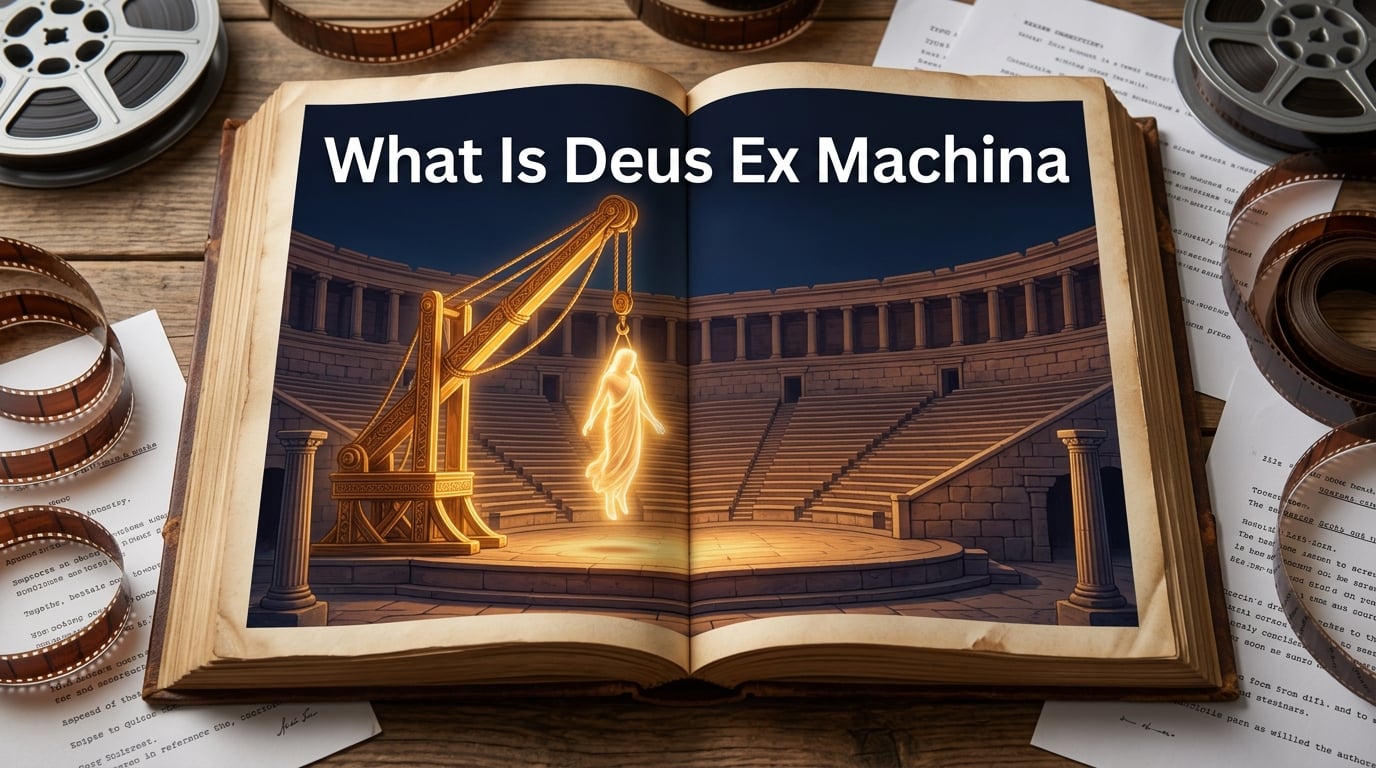
A deus ex machina is a plot device where a seemingly unsolvable problem in a story is suddenly resolved by an unexpected intervention of an outside force, often something godlike or improbable. The phrase literally means “god from the machine” in Latin, and it has shaped storytelling for over 2,500 years.
I have spent years studying narrative structure across film, novels, and games, and I keep coming back to this single device because it sits at the center of the lazy writing debate. In this guide, I will walk you through what deus ex machina means, where it came from, how it works, and the surprisingly nuanced answer to when it actually works.
Table of Contents
What Does Deus Ex Machina Mean? Etymology and Pronunciation
Deus ex machina literally translates from Latin as “god from the machine.” It is pronounced DAY-əs ex MAH-kee-nə, with the stress falling on the first syllable of each word.
The phrase comes from ancient Greek theater, where “machine” referred to the crane (mechanē) used to lower actors playing gods onto the stage. When the original Greek phrase, ἀπὸ μηχανῆς θεός (apò mēchanês theós), was translated into Latin, it became deus ex machina.
Understanding this etymology matters because it shows that the term was never meant to insult writers. It started as a neutral description of a stage technique, and the negative connotation only developed over centuries as audiences grew tired of unearned resolutions.
Breaking Down the Latin
The three-word phrase breaks down simply:
- Deus = god
- Ex = from or out of
- Machina = machine or contrivance
Together it describes a god emerging from a machine, which is exactly what the crane-and-actor setup looked like in a 5th-century BCE theater.
The Origin of Deus Ex Machina in Ancient Greek Theater
Deus ex machina originates from the staging conventions of ancient Greek drama, particularly the tragedies of the 5th century BCE. Playwrights used a crane called the mechanē to lift actors playing gods above the stage and lower them into the action.
The character would appear at the climax to settle an otherwise unresolvable conflict. Euripides, the most famous practitioner of this technique, used it in plays like Medea, Hippolytus, and Orestes. In Medea, the title character escapes in a dragon-drawn chariot provided by the sun god Helios, an early and frequently cited example.
Greek audiences accepted this convention because their religious framework made divine intervention plausible. The gods were active characters in their worldview, so a literal god appearing to fix things matched their sense of how the world worked.
When we use the term today, we have largely dropped the religious context. The “machine” can now be anything from a previously unmentioned character to a natural disaster to a piece of technology that conveniently appears at the right moment.
How Deus Ex Machina Works as a Plot Device
The mechanics of deus ex machina follow a reliable three-part pattern. First, the story builds toward an impossible problem. Second, the protagonist runs out of conventional options. Third, an external force suddenly solves everything.
This third element is what makes it a deus ex machina. The intervention must come from outside the established rules of the story, and it must arrive without sufficient setup. A character using skills they developed earlier in the story is not deus ex machina. A random alien spaceship appearing to beam up the hero definitely is.
Modern usage has expanded the definition beyond literal gods. Any improbable, last-minute, externally sourced solution can qualify. A long-lost uncle leaving a fortune, a sudden illness curing itself, a hidden room the protagonist never noticed before, all of these can function as deus ex machina when they bypass the established logic of the narrative.
Famous Deus Ex Machina Examples in Movies, Books, and TV
The best way to understand this device is to see it in action. These examples appear frequently in discussions because they capture the technique at its clearest.
Jurassic Park (1993)
The T-Rex arrives at the visitor center at exactly the moment the raptors are about to eat the children. This is one of the most discussed examples in modern film, partly because the filmmakers did plant a loose hint (the goat on the fence), but mostly because the T-Rex was not introduced as a possible solution during the main action.
The Lord of the Rings (1954–1955)
The Great Eagles arrive at the Battle of the Black Gate and carry Frodo and Sam off Mount Doom. J.R.R. Tolkien’s defenders point out that the Eagles appear earlier in the story, but the debate continues because the rescue at the climax feels sudden. This example is often used to show how context shapes whether an audience accepts the device.
War of the Worlds (H.G. Wells, 1898)
Earth bacteria kill the alien invaders at the very end. Wells used this to make a point about evolution and natural immunity, which is why many readers forgive the abrupt resolution. It is also frequently cited as an example of the technique failing, because readers feel cheated by the lack of human agency.
Monty Python and the Holy Grail (1975)
Police officers arrest Arthur and his knights just as God appears to resolve the plot. This is a self-aware, comedic use that audiences love precisely because it mocks the convention. We will come back to this example in the section on when deus ex machina works.
Video Games: Mass Effect 2 (2010)
The ending of the Collector base mission involves a deus ex machina moment depending on player choices, though BioWare’s use of the device is more contested. It shows how the technique appears across interactive media, not just passive storytelling.
Why Critics Call Deus Ex Machina Lazy Writing
The criticism of deus ex machina comes down to one word: earned. Readers and viewers want resolutions that feel earned by the choices characters have made throughout the story.
When an outside force solves everything at the last second, it robs the protagonist of agency. The hero did not win. The plot was simply stopped by an external event. This breaks the implicit contract between story and audience, which is that character actions matter.
The Reddit writing communities I have followed spend a lot of time on this. The recurring complaint is not that problems get solved, but that solutions arrive from nowhere. The setup was missing, the payoff was unearned, and the audience feels cheated.
There is also a structural problem. Deus ex machina shortcuts the resolution, which means the story skips the most interesting part. Conflict resolution is where theme crystallizes, where characters grow, and where readers feel satisfaction. An external fix denies all of that.
Deus Ex Machina vs. Convenient Plot Device: Key Differences
Not every convenient plot point is deus ex machina. The difference comes down to setup and internal logic.
A convenient plot device that the story prepared for is simply good plotting. Foreshadowing, character skills established earlier, and Chekhov’s gun all fall into this category. Chekhov’s gun is the principle that if you mention a gun in act one, it must fire by act three. That is the opposite of deus ex machina, because the resolution is earned through earlier setup.
Deus ex machina requires that the solution not be prepared for. If the audience can look back and trace the setup, you are writing good foreshadowing. If the audience has no way to predict the solution and no reason to think it was hinted at, you have written a deus ex machina.
Coincidence also walks a fine line. A coincidence that fits the story’s tone and characters can feel realistic. A coincidence that contradicts the story’s logic feels like a cheat. The difference is whether the story earned the audience’s trust.
When Deus Ex Machina Actually Works: Acceptable Uses
Here is where the conversation gets interesting. Deus ex machina is not automatically bad. There are situations where it works.
Self-Aware or Ironic Usage
When a story acknowledges the trope and uses it deliberately, audiences tend to forgive it. Monty Python and the Holy Grail is the classic example. The Hitchhiker’s Guide to the Galaxy also gets away with it because the absurdity is the point.
Comedy and Satire
In comedy, sudden absurd interventions are often the joke. They do not need to feel earned because the genre already promises the unexpected.
Proper Foreshadowing
If the “machine” appears earlier in the story, even briefly, the resolution is no longer a deus ex machina. The Lord of the Rings Eagles work for many readers precisely because the Eagles appear earlier. The setup was there.
Genre-Specific Considerations
Fantasy, mythology, and religious fiction often allow for divine intervention as part of their world-building rules. In those genres, gods showing up is not a cheat. It is the established logic of the setting.
The rule of thumb is this: if your audience can look back and find the setup, it works. If they cannot, it feels lazy.
How to Avoid Deus Ex Machina in Your Own Writing
Writing a story without falling back on this device takes practice. Here are the techniques I use and recommend.
Plant the Setup Early
If you know your climax requires a specific solution, plant clues at least a third of the way through the story. The audience does not need to predict the solution, only to recognize it as something they saw before.
Make Characters Solve Their Own Problems
Every major resolution should be possible because of decisions the protagonist made earlier. This is the heart of character agency. The hero’s choices should be the engine of the ending.
Check the Internal Logic
Before you finalize your ending, ask whether the solution could have happened on page one. If yes, the story has not earned its ending. If the solution is only possible because of events in chapters two through ten, you are on solid ground.
Test the LitCharts Rule
LitCharts puts it well: a reader should be surprised but should not say “I don’t believe it.” Surprise is good. Disbelief is the failure mode of deus ex machina.
Use Multiple Smaller Resolutions
Instead of one big external fix, distribute smaller earned solutions throughout the climax. Each one draws on earlier setup. The audience feels the weight of accumulated choices rather than the surprise of one miracle.
Writing without deus ex machina is harder in the short term, but it produces the kind of endings readers remember. Earned resolutions are what people talk about years later.
Frequently Asked Questions
What does deus ex machina literally mean?
Deus ex machina literally means u0022god from the machineu0022 in Latin. The phrase comes from ancient Greek theater, where a crane called the mechanē lowered actors playing gods onto the stage to resolve the plot.
What is a famous example of deus ex machina?
One of the most famous examples is the T-Rex rescue at the end of Jurassic Park (1993). The dinosaur arrives suddenly to save the protagonists from the raptors, resolving the climax with an external force the audience did not see coming.
Is deus ex machina considered lazy writing?
It is often considered lazy writing because the resolution is not earned by the protagonist’s earlier choices. The intervention comes from outside the story’s established logic, which can rob characters of agency and leave readers feeling cheated.
Is deus ex machina still used today?
Yes. Deus ex machina appears in modern films, novels, television, and video games. The technique has expanded beyond literal gods to include any improbable, last-minute external solution, though writers today often use it with self-awareness or proper foreshadowing.
How do you pronounce deus ex machina?
It is pronounced DAY-əs ex MAH-kee-nə, with the primary stress on the first syllable of each word. The Latin pronunciation is also accepted: DEH-oos ex MACK-ee-nah.
Why is it called deus ex machina?
It is called deus ex machina because ancient Greek playwrights used a crane called the mechanē to lower actors playing gods onto the stage. The Latin translation u0022god from the machineu0022 became the standard term for this kind of plot device.
Final Thoughts on Deus Ex Machina
So what is deus ex machina? At its core, it is the sudden appearance of an external force that resolves an impossible problem, a device that goes back to ancient Greek theater and remains one of the most debated tools in storytelling today.
The trick is to recognize the difference between earned and unearned resolutions. Plant your setup, let your characters do the work, and only reach for the machine when you have earned the right to use it. Your readers will feel the difference.