
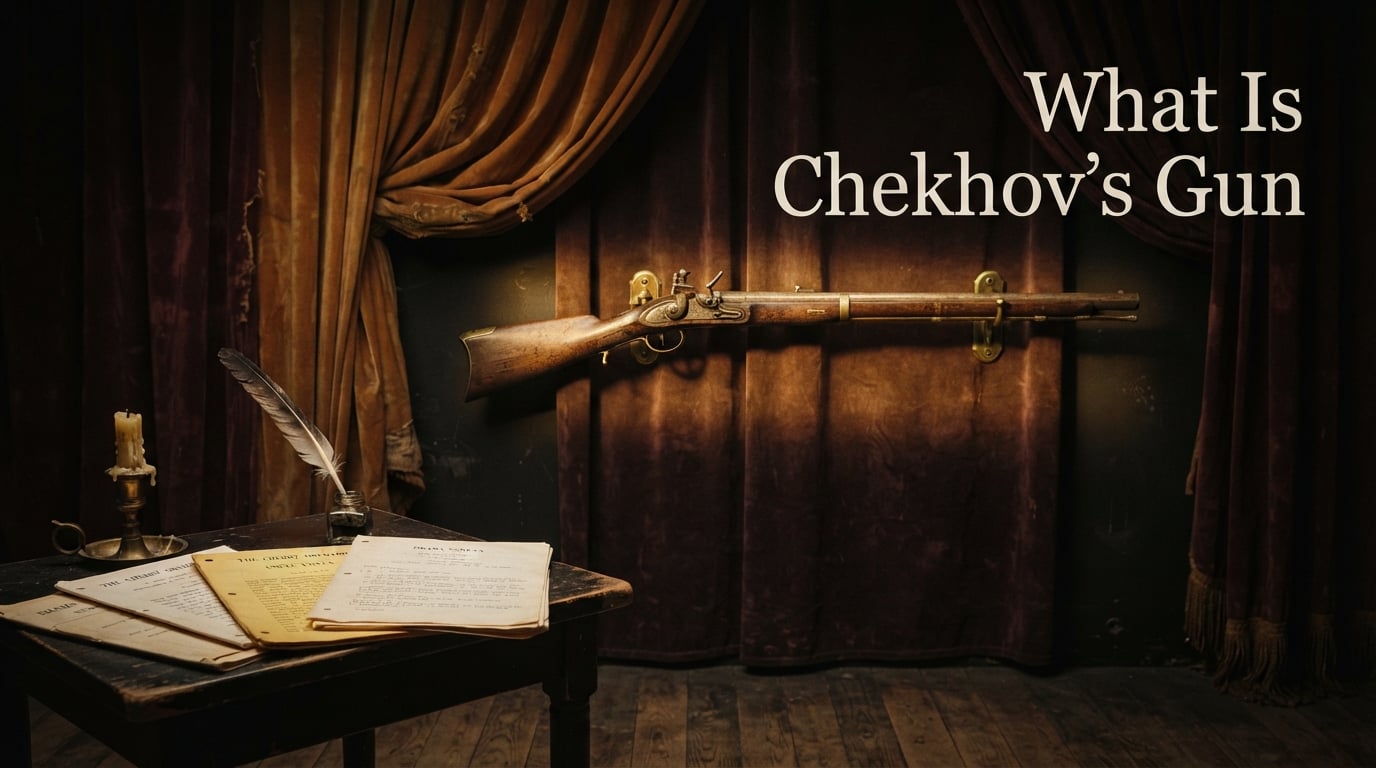
Chekhov’s Gun is a storytelling principle stating that every element introduced in a narrative must become relevant later. If a writer draws attention to something in Act 1, the audience expects it to matter by Act 3.
I first bumped into the phrase while studying screenwriting, and it clicked instantly. It explained why loose props and forgotten side characters feel like a betrayal. Below, I’ll walk you through what Chekhov’s Gun is, where it came from, and how to use it without strangling your story.
Table of Contents
What Is Chekhov’s Gun? Definition and Core Principle
Chekhov’s Gun is a dramatic principle that says every element in a story should be necessary, and any element that is not necessary should be removed. Coined in reference to Russian playwright Anton Chekhov, the rule pushes writers toward tight, purposeful storytelling.
The principle rests on a simple bargain between storyteller and audience. When you show me a gun hanging on the wall in Act 1, you are making a promise. The audience files it away, expecting payoff. Forget the gun, and you break trust.
The exact wording is often quoted this way: “If in the first act you have hung a pistol on the wall, then in the following one it should be fired. Otherwise don’t put it there.” That single line has shaped modern drama, film, and television for over a century.
The Origin: Anton Chekhov and His Letters
The phrase traces back to a letter Anton Chekhov wrote on November 21, 1889, to his friend and fellow writer Alexander Pleshcheyev. Chekhov was responding to criticism of his play The Seagull, and he used the gun metaphor to defend the importance of every detail on stage.
Here is the full context. Chekhov argued that productions should be true to life, and that props introduced on stage must serve a function. A rifle hanging in Act 1 should fire by Act 4. His advice came from years of writing short stories where every line carried weight.
Few competitors dig into the letter itself. Most cite the quote and move on. But the origin matters because it shows Chekhov was not inventing a gimmick. He was describing a discipline he had practiced for decades across hundreds of short stories and several major plays, including The Seagull, Uncle Vanya, and The Cherry Orchard.
His original note was about realism. He believed that if an object existed on stage, it must have a reason for being there. Modern writers have expanded his principle to cover plot devices, side characters, and even lines of dialogue. Anything you point the camera at becomes a promise.
How Chekhov’s Gun Works: The Setup and Payoff
The mechanism is straightforward. You introduce something early, and you pay it off later. The audience may not even notice the setup consciously, but they will feel the payoff when it arrives. That is the magic of dramatic economy.
Think of it like planting a seed. You drop a detail in Chapter 1. The reader may forget about it. Then Chapter 20 arrives, and suddenly the detail matters. The reader experiences a small thrill of recognition.
Three forces power this. First, audience expectation, because viewers are trained to look for meaning. Second, narrative promise, since the writer has flagged the element as important by including it. Third, dramatic tension, because setups create anticipation for resolution.
Chekhov’s Gun Examples in Film and Literature
Classic examples help the principle click. Here are some of the most cited cases across film, TV, and literature.
Ghostbusters and the Proton Pack
The Ghostbusters show their proton packs in early scenes. Viewers see the equipment, but its full power becomes clear during the climactic battle. The packs were set up as ordinary gear, then revealed as essential weapons.
Harry Potter and the Vanishing Cabinet
J.K. Rowling mentions the Vanishing Cabinet in Chamber of Secrets. It does almost nothing in that book. By Order of the Phoenix, the cabinet becomes the passage used by Death Eaters to attack Hogwarts. A small mention became a major plot device.
James Bond Gadgets
Q Branch always shows Bond new gadgets early in the film. Each gadget gets a quiet demonstration. By the climax, every gadget earns its moment, often saving Bond’s life.
Toy Story and Buzz’s Wings
In Toy Story, Buzz Lightyear’s wings are shown but unused for most of the film. At the climax, Buzz uses those exact wings to launch himself and Woody to safety.
The Seagull by Anton Chekhov
Chekhov’s own The Seagull is the literal origin point. A prop rifle introduced in early scenes eventually goes off in the tragic final act, fulfilling the principle he later articulated in his letters.
Chekhov’s Gun in Modern Digital Media
The principle has expanded well beyond stage plays. Streaming series, video games, and web storytelling all depend on the same setup-and-payoff economy, sometimes at scale.
Consider long-form TV. Shows like Lost, Severance, and Westworld reward viewers who track every detail. A throwaway prop in Season 1 may turn into a Season 3 twist. Writers today treat Chekhov’s Gun as a contract with binge audiences.
Video games use the rule even more strictly. A weapon shown in the tutorial section often returns for the final boss. An NPC met briefly early on might offer the key clue late game. Players notice when developers break the rule, and review sites call it out fast.
Web series and serialized podcasts lean on the same discipline. A line of dialogue in episode 2 can become the central mystery of episode 20. The audience remembers, even when they don’t realize they’re remembering.
Chekhov’s Gun vs MacGuffin vs Red Herring vs Foreshadowing
Writers often confuse Chekhov’s Gun with related storytelling concepts. Here is how they differ and overlap.
Chekhov’s Gun vs MacGuffin
A MacGuffin is a plot device that drives the story but whose specific nature does not matter. Think of the briefcase in Pulp Fiction. A Chekhov’s Gun, by contrast, is a specific object that will fire, be used, or matter in a specific scene. MacGuffins can be swapped out. Chekhov’s Guns cannot.
Chekhov’s Gun vs Red Herring
A Red Herring is a deliberate misdirection. It is an element introduced to look important, then discarded. Chekhov’s Gun is the opposite. It is introduced and then paid off. Many writers break Chekhov’s rule on purpose to plant Red Herrings, which is one of the few times the principle is intentionally violated.
Chekhov’s Gun vs Foreshadowing
Foreshadowing is a hint about future events. Chekhov’s Gun is sometimes a form of foreshadowing, but not all foreshadowing is a Chekhov’s Gun. A Gun must be a physical, concrete element the audience sees. Foreshadowing can be mood, atmosphere, or dialogue tone.
| Concept | What It Does | Paid Off? |
|---|---|---|
| Chekhov’s Gun | Introduces a concrete element that becomes critical later | Yes, always |
| MacGuffin | Drives the plot but is interchangeable | Not required |
| Red Herring | Misleads the audience on purpose | Never (and that is the point) |
| Foreshadowing | Hints at future events, often subtly | Yes, but not always via a concrete object |
When You Should Break the Rule
Chekhov’s Gun is a guideline, not a law. Breaking it intentionally can produce powerful effects when done with skill.
First, breaking it on purpose can create a sense of realism. Real life is full of unused objects, abandoned plans, and forgotten details. Sticking rigidly to the rule can sometimes make fiction feel overly mechanical.
Second, some works thrive on Red Herrings. Mystery novels and detective stories plant false clues constantly. Audiences expect to be misled on the way to the real reveal.
Third, breaking the rule can signal a subversion. A writer who has trained the audience to expect payoff can deliver surprise by withholding it. Quentin Tarantino and Charlie Kaufman do this regularly. The risk is breaking trust. Done well, it builds a new kind of anticipation.
Practical Tips for Writers Using Chekhov’s Gun
If you are writing a story, here are some habits that will help you apply the principle without overdoing it.
- Audit every named element. List every prop, character, and place mentioned by name in your opening chapter. Each one must earn its place later.
- Cut what does not serve the story. If a prop has no role, remove it. Decorative clutter dilutes the signal.
- Use the rule to plant subtext. A character who is introduced as a minor neighbor can return as the twist. The audience will love the callback.
- Be honest about coincidence. If a setup pays off too neatly, it can feel artificial. Earn the payoff with believable cause and effect.
- Reserve the right to break the rule. Track deliberate misdirections. Make sure they serve the plot, not laziness.
I keep a simple checklist when revising. Anything I described in detail must either pay off later or be cut. That one rule has saved me from dozens of messy drafts over the years.
Frequently Asked Questions
What is Chekhov’s gun in simple terms?
Chekhov’s Gun is a storytelling rule that says any element you introduce in a story must become important later. If you show a pistol on the wall in Act 1, you must fire it before the story ends. If it does not matter, leave it out. The principle keeps plots tight and audiences satisfied.
What is an example of a Chekhov’s gun?
A classic example is the proton pack in Ghostbusters. The Ghostbusters show off their proton packs early in the film, demonstrating their power. By the final battle, those same packs become the only way to defeat the villain. The gadget was set up in Act 1 and paid off in Act 3. Other famous cases include the Vanishing Cabinet in Harry Potter, James Bond’s gadgets, and Buzz Lightyear’s wings in Toy Story.
What is the difference between Chekhov’s gun and a MacGuffin?
A Chekhov’s Gun is a specific element that must be used later in the story in a concrete way. A MacGuffin is a plot driver whose exact nature does not actually matter. The MacGuffin in Pulp Fiction, the case, could be anything. A Chekhov’s Gun cannot be swapped out, because the audience expects the specific object to reappear and matter. MacGuffins drive the chase. Chekhov’s Guns deliver the payoff.
What is the opposite of a Chekhov’s gun?
The opposite of a Chekhov’s Gun is a Red Herring. A Red Herring is an element introduced to look important but then abandoned as a deliberate misdirection. Mystery novels use Red Herrings to throw readers off the real clue. While Chekhov’s Gun promises payoff, a Red Herring promises nothing and is meant to mislead the audience on purpose.
Conclusion
Chekhov’s Gun is one of the simplest and most powerful tools in a storyteller’s kit. It says: every detail matters, every detail has a job, and if it has no job, it should not be there.
From Anton Chekhov’s 1889 letter to today’s streaming series, the principle has stayed relevant because it serves the audience. When writers honor it, stories feel tight and rewarding. When they break it on purpose, they earn surprise.
If you are a writer working on a draft this year, try auditing every element you have introduced. Cut what does not serve, and make sure what stays delivers. That single pass will sharpen your story more than almost any other revision trick I know.