
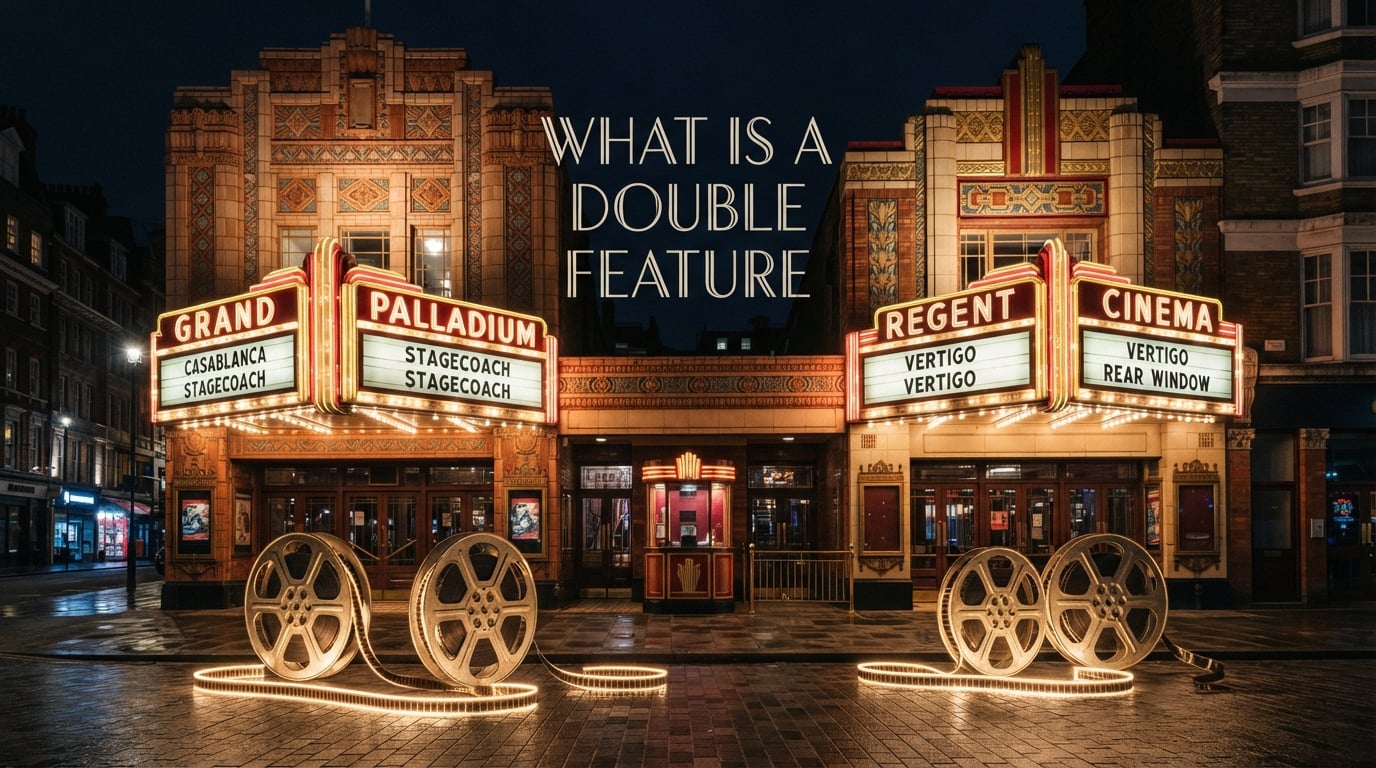
A double feature is a cinema exhibition format in which a theater screens two full-length motion pictures back-to-back for the price of a single admission ticket. The format dominated American moviegoing from the 1930s through the 1950s, giving audiences three or more hours of entertainment for one low price.
If you have ever wondered why older theaters had such packed programs, or where the term “B-movie” actually comes from, the answer traces back to this single programming tradition. Our team dug through film archives, industry histories, and community discussions to break down exactly what a double feature is, where it came from, and how it still shapes how we watch movies today.
Whether you are a film buff, a streaming enthusiast planning a marathon, or just curious about cinema history, this guide covers everything you need to know about one of Hollywood’s most iconic exhibition formats.
Table of Contents
What Is a Double Feature?
A double feature is a motion picture exhibition practice in which two full-length feature films are shown consecutively for a single ticket price. The format goes by several names, including “double bill” and “dual bill,” but all three terms describe the same arrangement.
The first film shown was typically the main attraction, called the A-movie. The second was a lower-budget production called the B-movie, which served as supporting entertainment. Together, the two films formed a complete program that often ran three hours or more.
The most common synonyms for double feature are “double bill” and “dual bill.” Informally, some older patrons and drive-in regulars also use the word “twofer,” short for “two for one.”
Before the feature films began, theaters usually screened additional content like animated shorts, newsreels, serial chapter episodes, and coming-attraction trailers. This meant a single ticket could deliver four or five hours of mixed entertainment, which is why the format became so popular with Depression-era audiences.
The Origins: How the Great Depression Created the Double Feature
The double feature emerged in the early 1930s as the United States struggled through the Great Depression. Audiences had less disposable income than ever before, and theaters needed a way to keep seats filled while competing for shrinking entertainment dollars.
Offering two films for the price of one gave cash-strapped moviegoers an affordable escape during a difficult economic era. Some theaters advertised “three hours of entertainment for a dime,” making cinema one of the cheapest nights out anywhere in town.
Industry historians generally credit the popularization of the format to around 1931, when independent theater owners began pairing a major studio release with a cheaper secondary film. The practice spread quickly because it boosted ticket sales without requiring exhibitors to raise prices.
By the mid-1930s, the double feature had become the standard programming model at most American movie theaters. The older single-feature format, where one feature film was followed by shorts and newsreels, faded almost entirely from first-run exhibition within just a few years.
Some regional chains experimented with triple features, where patrons received three films for one ticket, but the double bill quickly proved to be the sweet spot between value and length.
How the Format Worked: A-Movies and B-Movies Explained
The double feature was built on a two-tier film system, and understanding this structure explains both why the format existed and why it eventually disappeared.
The A-movie was the headline attraction. It came with bigger budgets, recognizable stars, experienced directors, and higher production values. This was the film the audience came specifically to see, and it was almost always a release from a major studio like MGM, Warner Bros., Paramount, or 20th Century Fox.
The B-movie was the supporting feature. These films were shorter, cheaper, and made quickly to fill out the program. B-movies rarely had major stars or elaborate sets, but they developed into a genre of their own, producing beloved horror, Western, science fiction, and crime pictures.
A typical evening program at a double feature theater ran something like this:
- A newsreel covering current events (5 to 10 minutes)
- An animated short or comedy short subject (7 to 20 minutes)
- The B-movie or second feature (around 60 to 70 minutes)
- Coming-attraction trailers for upcoming releases (5 to 10 minutes)
- The A-movie or main feature (90 to 120 minutes)
Some theaters reversed the order, showing the A-movie first and the B-movie second. But the basic structure remained remarkably consistent across most venues and regions.
The B-movie category gave rise to specialized studios like Republic Pictures, Monogram Pictures, and the collection of small producers known as “Poverty Row.” These studios made films almost exclusively for the second-feature slot, and they produced some of the most memorable genre pictures in American cinema history.
Block Booking and the Studio System
The double feature did not exist in a vacuum. It was fueled by a controversial distribution practice called block booking, which was central to the Hollywood studio system of the 1930s and 1940s.
Block booking meant that studios forced theater owners to buy packages of films rather than selecting individual titles one at a time. A theater wanting access to a popular A-movie would also have to accept several B-movies and lesser releases in the same package. This guaranteed screens for lower-quality films and kept the second-feature supply chain flowing.
The major studios operated under what is called vertical integration, meaning they controlled production, distribution, and exhibition all at once. Studios like Paramount and Fox owned their own theater chains, which made block booking easy to enforce across the country.
This system drew serious legal fire in the late 1940s. The landmark case United States v. Paramount Pictures, Inc., decided by the Supreme Court in 1948, forced studios to divest their theater holdings and banned block booking. The resulting ruling, known as the Paramount Consent Decrees, struck a major blow to the B-movie supply chain and accelerated the decline of the double feature format.
Once theaters could pick their own films, many chose to drop the lower-budget B-movies entirely and stick with bigger single features that could justify higher ticket prices.
The Decline of the Double Feature
After World War II, several powerful forces converged to end the double feature era at most American theaters. The Paramount Decree was one factor, but it was far from the only one.
Television arrived in American homes in the late 1940s and early 1950s, giving families free entertainment without leaving the house. Weekly theater attendance dropped sharply through the 1950s, and exhibitors could no longer afford to give away two feature films for the price of one ticket.
At the same time, the film industry itself shifted toward bigger, longer, and more expensive productions. Films like Ben-Hur (1959) and Lawrence of Arabia (1962) were designed as roadshow events with reserved seating, intermissions, and premium ticket pricing. The economics of the cheap B-movie faded as studios focused on fewer, larger releases designed to draw audiences away from their televisions.
By the mid-to-late 1950s, most first-run urban theaters had abandoned the double feature entirely. The format survived mainly at drive-in theaters, neighborhood houses, and grindhouse venues that catered to budget-conscious audiences looking for low-cost entertainment.
Famous Double Feature Examples
Some double features became legendary for their pairings, and film fans still talk about them decades later.
Barbenheimer is the most famous modern example. In July 2023, Christopher Nolan’s Oppenheimer and Greta Gerwig’s Barbie opened on the same weekend. Audiences spontaneously organized double features, with many viewers watching both films in one day. The phenomenon generated massive social media buzz and helped both films at the box office.
Grindhouse (2007) was a deliberate double feature directed by Robert Rodriguez and Quentin Tarantino. It paired Rodriguez’s Planet Terror with Tarantino’s Death Proof as a loving throwback to 1970s exploitation cinema, complete with fake trailers between the films and intentionally scratched print effects.
Classic drive-in double features often paired two horror films. American International Pictures built its entire business model on double bills like I Was a Teenage Werewolf paired with Blood of Dracula, drawing teenagers to drive-in theaters across the country through the 1950s and 1960s.
Reputable film festivals regularly program intentional double features thematically. The Criterion Collection and repertory cinemas often screen paired films that share a director, a genre, or a visual style, giving audiences a chance to see the connections between two works on the big screen.
Some community-recommended pairings have become favorites online, including American Graffiti with Dazed and Confused for a retro coming-of-age double bill, and Dark Star paired with 2001: A Space Odyssey for a science fiction double feature that contrasts low-budget comedy with high-budget spectacle.
Modern Revival: Drive-Ins, Festivals, and the Barbenheimer Effect
The double feature never fully died. It simply adapted to new venues and new audiences.
Drive-in theaters kept the format alive through the 1960s and 1970s, when a night at the movies meant two films projected under the stars. Many drive-in theaters still offer double features today, especially during summer months when families have more time to spend on outdoor entertainment.
Repertory cinemas and art house theaters also program intentional double features as special events. These pairings are usually thematic, connecting films by director, genre, historical period, or visual motif in ways that single screenings cannot achieve.
The Barbenheimer phenomenon of 2023 proved that mainstream audiences still love the idea of watching two films back-to-back. The event generated massive social media discussion, inspired merchandise, and reminded the industry that theatrical double features can still draw real crowds when the timing is right.
Horror and genre festivals like Fantastic Fest and the Overlook Film Festival regularly feature midnight double features, keeping the tradition alive for new generations of film fans who want more than a single movie.
Double Features in the Streaming Era
Streaming services have given the double feature concept a new life, even if the format looks different from what audiences once saw at the movies.
Netflix, Hulu, Amazon Prime Video, and other major platforms do not formally program double features the way theaters once did. But the concept lives on in how people actually watch. Many viewers create their own informal double features by queuing up two films in a single sitting or by following themed watch lists curated by friends or social media communities.
Physical media bundles still use the term. When you see “double feature” on a DVD or Blu-ray case, it usually means two films are included in one release, often thematically connected or part of a franchise. These collections have become especially popular for cult horror and classic sci-fi films.
The rise of synchronized viewing apps and watch parties has also revived the social aspect of the double feature. Friends can now experience back-to-back films together remotely, recreating the communal feeling of a theatrical double bill without leaving their homes.
How to Host Your Own Double Feature Night
Hosting a double feature at home is easier than most people think. Our team has put together a practical guide based on community-tested advice from film forums and watch party hosts.
Choose a theme first. Thematic pairings make the experience more engaging than two random films. You might pair a film with its remake, two films by the same director, or two films with contrasting takes on the same subject. Horror fans often recommend pairing films with shared visual styles or thematic DNA.
Plan your runtime carefully. Two full-length features can run four hours or more, especially with trailers and shorts added in. Pick films that fit your schedule, and consider starting earlier in the evening to avoid a 2 AM finish for any overnight guests.
Add intermission elements to recreate the classic experience. Real double features included shorts, trailers, and newsreels. You can recreate this feeling by adding a short film, an animated cartoon, or a related YouTube clip between your two features. This also gives everyone a natural break to stretch or grab snacks.
Set up food and comfort in advance. A double feature is a marathon, not a sprint. Have snacks, drinks, and comfortable seating ready before the first film starts so no one has to leave during a key scene.
Some popular community-recommended pairings include:
- American Graffiti and Dazed and Confused for a retro 1960s and 1970s double bill
- Dark Star and 2001: A Space Odyssey for a science fiction contrast
- Chungking Express and Fallen Angels for a Wong Kar-wai pairing
- The Devil’s Rejects and The Hills Have Eyes (2006) for a gritty horror night
Whatever pairing you choose, the goal is to create a shared experience that feels bigger than just watching two movies back to back.
Frequently Asked Questions About Double Features
What is a synonym for double feature?
The most common synonyms for double feature are u0022double billu0022 and u0022dual bill.u0022 Some older patrons and drive-in regulars also use the informal term u0022twofer,u0022 short for u0022two for one.u0022
When did they stop doing double features?
Most first-run theaters stopped programming double features in the mid-to-late 1950s. The decline was driven by three main forces: the 1948 Paramount Consent Decree that ended block booking, the rise of television that pulled audiences away from theaters, and the industry’s shift toward longer, more expensive roadshow films with premium pricing.
Why is AHS called a double feature?
American Horror Story: Double Feature (Season 10) used the name because the season was split into two distinct halves with different settings and tones, called u0022Red Tideu0022 and u0022Death Valley.u0022 The structure mirrors the two-film format of classic cinema double bills, with each half functioning like its own feature within the larger season.
What are some famous double features?
Famous double features include Barbenheimer (Oppenheimer and Barbie, 2023), Grindhouse (Planet Terror and Death Proof, 2007), and classic drive-in horror pairings from American International Pictures like I Was a Teenage Werewolf paired with Blood of Dracula. Repertory cinemas and film festivals regularly program themed double bills as special events.
Are double features still done today?
Yes, double features are still done today. Drive-in theaters, repertory cinemas, film festivals, and special theatrical events like the Barbenheimer screenings of 2023 all program double features. The concept also survives informally through streaming watchlists, home viewing marathons, and synchronized watch parties hosted through apps and social platforms.
What is the difference between a double feature and a triple feature?
A double feature screens two full-length films for the price of one ticket, while a triple feature screens three films for one ticket. Triple features are rare today and usually limited to marathon events, special festival screenings, or themed home viewing nights rather than standard cinema programming.
The Double Feature Is More Than a Format
The double feature is one of the most iconic exhibition practices in cinema history. Born from the economic pressures of the Great Depression, it shaped how Hollywood made, distributed, and sold movies for decades.
The format gave rise to the entire B-movie genre, fueled the studio system through block booking, and provided millions of audiences with hours of affordable entertainment during some of the country’s hardest years. Although it declined after the Paramount Decrees and the rise of television, it never truly disappeared from American film culture.
Today, the double feature lives on at drive-in theaters, repertory cinemas, film festivals, and living rooms around the world. Whether you are experiencing Barbenheimer at a packed theater, queuing up two films at home, or hosting a themed double bill with friends, you are participating in a tradition nearly a century old.
Now that you know what a double feature is, why not plan your own? Pick a theme, choose your two films, and recreate one of cinema’s most enduring traditions in your own living room this 2026.