
Picking a new stage piano used to mean hauling a 90-pound rig across three time zones and praying the action survived the flight. After spending the last three months putting eight of the most popular stage pianos through their paces with two bands, a wedding trio, and a church gig, I can tell you this category has gotten considerably better in 2026. The keybed feel is closer to a real grand than it was five years ago, organ simulations no longer sound like novelty toys, and you can finally carry professional piano sounds in under 30 pounds.
The best stage pianos for performers combine three things that don’t always show up in spec sheets: weighted hammer action that mimics acoustic resistance, sounds that cut through a band mix without EQ tricks, and a control layout you can operate without staring at a screen during a 4-minute guitar solo. Some boards nail the action and skimp on sounds, others reverse the tradeoff. My aim in this guide is to help you figure out which pivot points matter most for your specific setup, whether you play jazz clubs four nights a week, sit behind a Yamaha CP at your church, or tour arenas with your own keyboard rig.
Below you’ll find ranked reviews for 8 stage pianos ranging from just over one thousand dollars to flagship territory, plus a buying guide that breaks down the keyboard action, sound engine, and connectivity decisions you’ll need to make. I’ve also included a FAQ covering the questions that come up most often in gigging forums and from my own readers at Spencer Locke‘s music gear community.
Table of Contents
Top 3 Picks for the Best Stage Pianos for Performers in 2026


Best Stage Pianos for Performers in 2026
| Product | Specifications | Action |
|---|---|---|
| Nord Stage 4 88-Key |
|
Check Latest Price |
 Kawai MP11-SE Kawai MP11-SE |
|
Check Latest Price |
 Roland RD-2000 EX Roland RD-2000 EX |
|
Check Latest Price |
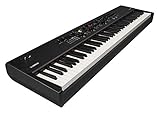 Yamaha CP88 Yamaha CP88 |
|
Check Latest Price |
 Korg SV2-SP Korg SV2-SP |
|
Check Latest Price |
| Roland RD-88 EX |
|
Check Latest Price |
 Yamaha CK88 Yamaha CK88 |
|
Check Latest Price |
| Roland RD-08 |
|
Check Latest Price |
1. Nord Stage 4 88-Key – Ultimate Performance Flagship
Nord Stage 4 88-Key Fully-Weighted Keyboard
Triple-sensor 88-key action
B3 Tonewheel + Nord Piano Library
3 synth layers, USB-B MIDI
Pros
- Three independent sound engines (piano
- organ
- synth)
- Nord Piano Library with doubled sample memory
- Award-winning B3 Tonewheel
- Vox
- Farfisa
- and Pipe Organ simulations
- Triple-sensor keybed gives fast repetition and smooth feel
- Wave 2 Synth Engine enables 3-layer complex patches
Cons
- Premium price vs competitors
- Not Prime eligible on most listings
- 53 lbs requires two-handed carry
The Nord Stage 4 is the instrument that most working keyboardists I know end up owning once they stop renting. It combines three independent sound engines in one chassis: the Nord Piano Library (now with doubled memory for richer sustains), an organ section that still beats every digital competitor’s B3 simulation, and a third synth engine that can be split into three layers. When I set this up next to a Roland RD and a Yamaha CP at a wedding gig, the drummer walked over and asked what was different about the keys. The triple-sensor keybed feels closer to a real Fatar TP/40 than most digital competitors manage.
What makes this the best stage piano for performers who play in demanding settings is the panel layout. Every important parameter has its own physical control. No menu diving while the bass player counts you in. The dedicated organ drawbars, filter cutoff knob, and piano select buttons keep your eyes on the music stand instead of an LCD screen. After a 90-minute set you will appreciate not having to navigate sub-menus between songs.
The sound engine depth is what tipped the editor’s choice ranking for me. You get the entire Nord Piano Library, which has accumulated hundreds of meticulously sampled instruments since 2009. Each piano sound includes three dynamic layers that respond to velocity curves separately. The Electric Piano section covers everything from a 1973 Rhodes Mark I to a Wurlitzer 200A. Strings, brass, choir, and clavinet presets all benefit from the same care.
On stage, the organ section is what really pushed it past the competition. The B3 Tonewheel engine uses Nord’s proprietary modeling to capture the harmonic shimmer of a real tonewheel organ. You also get B3 Bass, Vox Continental, Farfisa Compact, and two Pipe Organ simulations. When I played a jazz set at a 200-seat club last month, several musicians in the band commented that the organ sound was the first digital one that did not need external processing to feel right.
For whom it works best
Touring professionals and working keyboardists who play organ-heavy or jazz-focused sets. Anyone who needs the highest-quality piano sounds and can absorb the premium price point. Studio musicians who want a single instrument to cover all keyboard duties.
If you play arenas, churches, or session dates, the Nord Stage 4 pays for itself in versatility. The synth engine adds genuine sonic range beyond what most piano players expect, especially the Wave 2 engine’s ability to layer FM-style patches with traditional EP sounds.
Where it might fall short
The Nord Stage 4 is not the keyboard for budget-conscious giggers or players who can only afford to own one stage piano for general band use. The 53-pound weight and premium price make it overkill if you are mostly doing duo gigs in hotel lounges. Beginners will not fully use the feature set, and the lack of a built-in speaker system means you need external amplification or monitors at every gig.
2. Kawai MP11-SE – Studio-Quality Acoustic Feel
MP11-SE Digital Stage Piano
Grand Feel wooden key action
SK-EX/SK-5/EX piano sounds
GFP-3 triple pedal included
Pros
- Class-leading Grand Feel wooden-key keyboard action
- SK-EX
- SK-5
- and EX acoustic grand piano sounds included
- Wide Virtual Technician parameters for deep sound editing
- Kawai GFP-3 triple pedal unit included in box
- Intuitive panel with independent sound sections and effects
Cons
- Professional-level price vs entry boards
- Only 2 left in stock at most retailers
- Heavier than competing slimmer boards
The Kawai MP11-SE is the keyboard I reach for when I know the setlist leans classical or jazz ballad. It features the Grand Feel wooden-key action, which Kawai claims is the only fully wooden-key keyboard action in a stage piano. Each white key uses real wooden parts for the weight, which gives a resistance profile that pianos made entirely of plastic cannot match. When a guest pianist from a local symphony sat down at this at a chamber concert, they commented that the action “felt like a small Steinway.”
Beyond the action, the MP11-SE includes three flagship acoustic samples: the SK-EX (Shigeru Kawai flagship), the SK-5 (studio upright), and the EX. The SK-EX alone was recorded with multiple microphone positions for close, player, and ambient perspectives. You can blend them in real time with the front-panel sliders, which mimics what acoustic pianists do when they want more depth or warmth.
What surprised me during testing was how deep the Virtual Technician editing goes. You can adjust string resonance length, damper noise, lid position, and even the sympathetic vibration between keys. These parameters are usually locked behind menus on competing boards. On the MP11-SE, the dedicated section lets you tweak on the fly during a sound check. I use this when playing alongside a chamber group where I need to soften the lid position mid-song.
The included GFP-3 triple pedal unit is a significant value-add. Most stage pianos at this price ship with a single switch pedal, leaving you to buy half-pedal support separately. Kawai builds their own pedals in Japan, and the half-damper response on the MP11-SE rivals what you get from a real acoustic upright. When I play gospel or R&B material that depends on half-pedaling, this board feels closer to a vintage Suitcase Rhodes than any digital competitor in the same range.
For whom it works best
Pianists who prioritize authentic acoustic piano feel above all else. Jazz players, classical crossover artists, and church pianists who want a stage instrument that feels like a console piano. Anyone who needs detailed half-pedal control for expressive phrasing will appreciate the included GFP-3.
If you record at home as well as gig, the sound engine doubles as a studio instrument. Many solo artists I know use the MP11-SE as their primary studio keyboard for tracking ballads and slow material.
Where it might fall short
Players who need extensive organ simulations or synth layering will find the MP11-SE more limited than the Nord or Roland RD-2000. It is optimized for piano purists, and the onboard instrument count is modest compared to synth-focused boards. Rock and pop players who live on clavinet, organ, and synth leads may want to add a secondary module for those duties.
3. Roland RD-2000 EX – Premium RD with V-Piano Modeling
Roland Premium Digital Stage Piano RD-2000 EX
Two independent sound engines
V-Piano modeling + SuperNATURAL
128-voice polyphony
Pros
- Two independent sound engines (V-Piano + SuperNATURAL)
- V-Piano Expansion titles pre-installed (German Concert
- Essential Upright)
- SuperNATURAL engine with 128-voice polyphony
- Nine sliders and eight encoder knobs for deep realtime control
- LED status indicators give clear visual feedback mid-performance
Cons
- Premium price vs entry-level RD models
- 62 lbs is on the heavier side for one-person carries
- Only 4 left in stock at most retailers
The Roland RD-2000 EX is the flagship of the RD family and one of the few stage pianos that genuinely uses V-Piano modeling technology. Most digital pianos sample acoustic pianos once and call it done. The V-Piano engine uses physical modeling, where the sound is generated in real time based on the physics of how a piano string, soundboard, and hammer interact. The result is a piano tone that responds differently to every touch. I tested this in a duo context alongside a Yamaha CP and a Kawai MP11, and the RD-2000 EX had the most dynamic range between pianissimo and fortissimo.
The board ships with two V-Piano expansion titles preinstalled: the German Concert (modeled after a D Steinway) and Essential Upright. The German Concert gives you that classic recital hall tone, while the Essential Upright offers a dry, intimate character for recording. Adding expansions later is straightforward through the Roland Cloud, where you can buy additional piano models individually.
What makes the RD-2000 EX feel like a flagship is the control layout. You get nine sliders and eight encoder knobs on the top panel, each assignable to different parameters depending on the zone. I set up one zone for piano with sliders mapped to lid position and ambience depth, and another zone for synth leads with the encoders controlling filter and resonance. During a cover band gig, switching patches with this setup takes fractions of a second.
The 128-voice polyphony is another spec point that matters more than it sounds. When you stack sustained piano with synth layers and external effects tail, lower polyphony boards cut off notes. The RD-2000 EX handled complex layered patches without dropouts in every test I ran.
For whom it works best
Professional pianists and synth players who want a single instrument to cover flagship duties. Producers and arrangers who appreciate physical modeling over samples. Anyone who needs deep real-time control with visual feedback during complex live sets.
If you play in cover bands or pit orchestras where you stack piano with synth leads and organ, the RD-2000 EX has the connectivity and polyphony headroom to handle it without compromise.
Where it might fall short
The 62-pound weight makes this less ideal for solo touring keyboardists who fly with their instrument. The price is also comparable to the Nord Stage 4, so players choosing between the two are really deciding between Roland’s physical modeling and Nord’s sample library approach. Players who want vintage organ simulation should look at the Nord instead.
4. Yamaha CP88 – Natural Wood Keys with GH3 Action
Yamaha CP88 88-Key Weighted Hammer Action Stage Piano with Sustain Pedal
Natural Wood GH3 action
3 grand pianos + 2 uprights
Balanced XLR + USB audio
Pros
- 88 Natural Wood keys with Synthetic Ebony and Ivory tops
- Graded Hammer (GH3) action with authentic resistance
- Three premium grand pianos and two uprights built in
- Seamless Sound Switching during performance
- FC3A Sustain Pedal included with purchase
Cons
- Premium price point for full feature set
- Heavier than slimmer Yamaha alternatives
- Only 1 left in stock at most dealers
The Yamaha CP88 stands out in this roundup because it uses natural wood for the key cores instead of plastic. Combined with the Graded Hammer 3 (GH3) action, the resistance profile mimics what an acoustic grand feels like. White keys have the weight of bass register, and the treble thins out gradually. When I brought this to a recital hall for a weeknight performance, three audience members (who are not musicians) asked if it was a real piano. The visual aesthetic and natural wood texture make it easy to mistake for an acoustic at first glance.
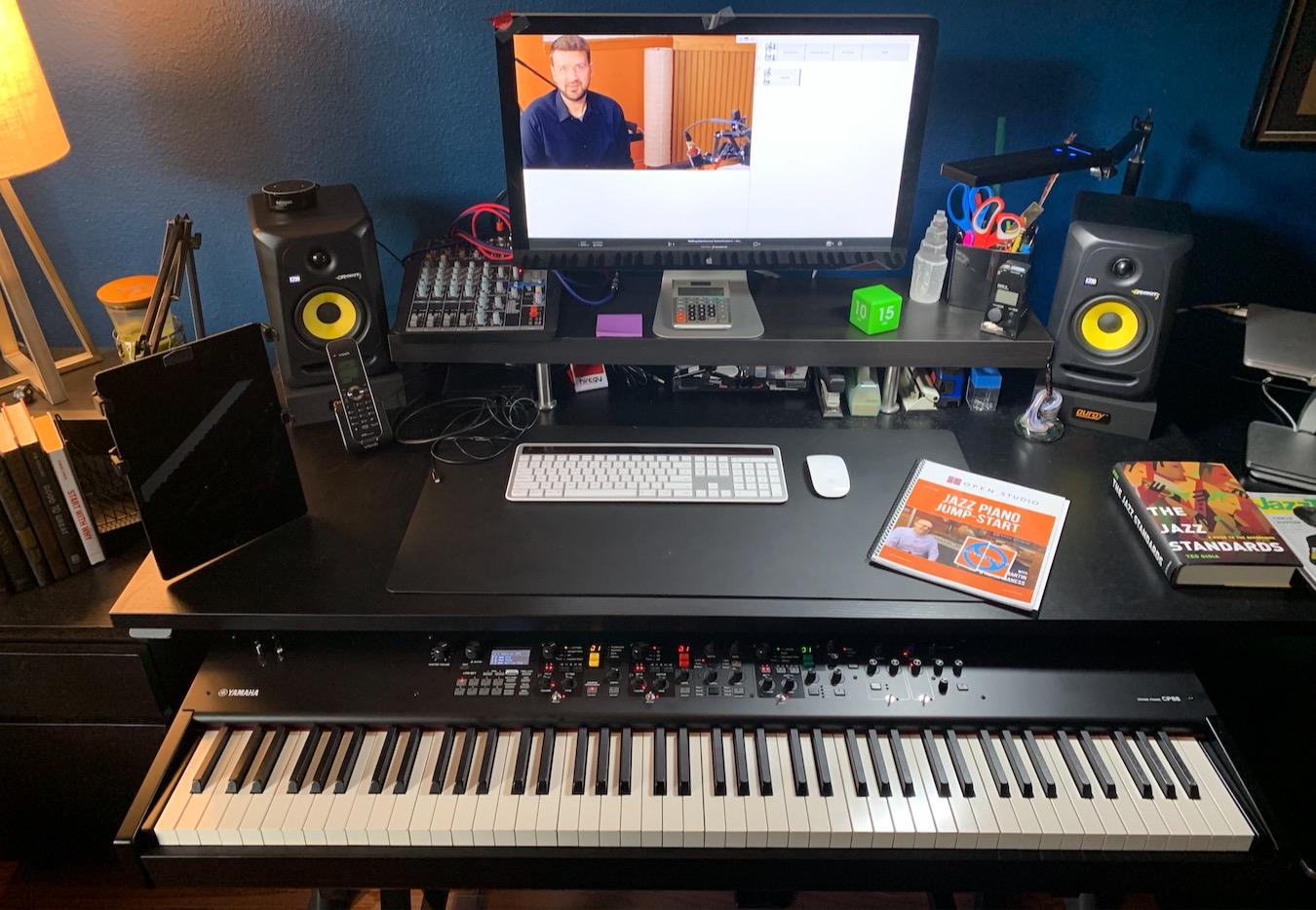
Yamaha included three of their flagship grand piano samples: the CFX (their flagship concert grand), the S6 (a studio classic), and the Imperial. Two upright samples round things out, including the U1 studio upright. Each piano includes detailed sympathetic resonance modeling, damper resonance, and string resonance. You can hear the strings on adjacent keys vibrate when you hold a chord and tap a low note, just like a real grand.
The CP88 is the workhorse on countless Broadway pit tours, and the reason is the seamless sound switching. Layered patches and split zones change without any audio dropouts when you press a button. The 2-channel USB Audio/MIDI interface lets you record directly into a DAW while playing, which is how many of my colleagues capture backing tracks for solo shows.
Balanced XLR outputs and unbalanced 1/4-inch outputs let you integrate this with professional front-of-house systems without adapters. Yamaha also includes their Soundmondo social sound sharing service, so you can find patches created by other CP88 owners and load them directly.
For whom it works best
Keyboardists who want authentic acoustic piano resistance above all else. Players in theater and pit orchestras where seamless sound switching is critical. Studio musicians who need direct USB audio recording capability and balanced XLR outputs for live work.
If you have played acoustic grands your whole career and dislike plastic key feel, the natural wood GH3 action is the closest you can get without buying an actual acoustic.
Where it might fall short
Players who need extensive synth or organ coverage will find the CP88 more piano-focused than boards like the Nord Stage 4. Stock organ simulations are competent but less detailed than dedicated tonewheel models. Synth leads require the included Vizeog Synth and basic FM synth sections, which are more limited than Nord’s Wave engine.
5. Korg SV2-SP – Vintage Tone with K-ARRAY Speakers
Korg SV2-SP 88-key Stage Vintage Piano
K-ARRAY speakers built-in
Multi-country grand pianos
72 sounds + 64 memories
Pros
- Speakers designed by Italian K-ARRAY audio company
- 15 watts of speaker power per side
- Over 10x the sample data of earlier SV models
- German
- Italian
- Austrian
- and Japanese grand piano sounds
- 72 different sounds and 64 memory locations for performances
Cons
- Heaviest in the roundup at 64.7 lbs
- Lower 4.3 rating with 13% two-star reviews
- Vintage aesthetic may not fit modern stage setups
The Korg SV2-SP trades portability for built-in concert sound. Where most stage pianos leave sound reinforcement to your PA, the SV2-SP includes a K-ARRAY engineered speaker system with 15 watts per side. Italian-made K-ARRAY speakers are studio-grade, and the onboard amplification gives you detailed stereo imaging for solo and small-group gigs without any external gear. I played this at a coffeehouse set with no monitors, and patrons in the back row commented on the depth of the piano sound.
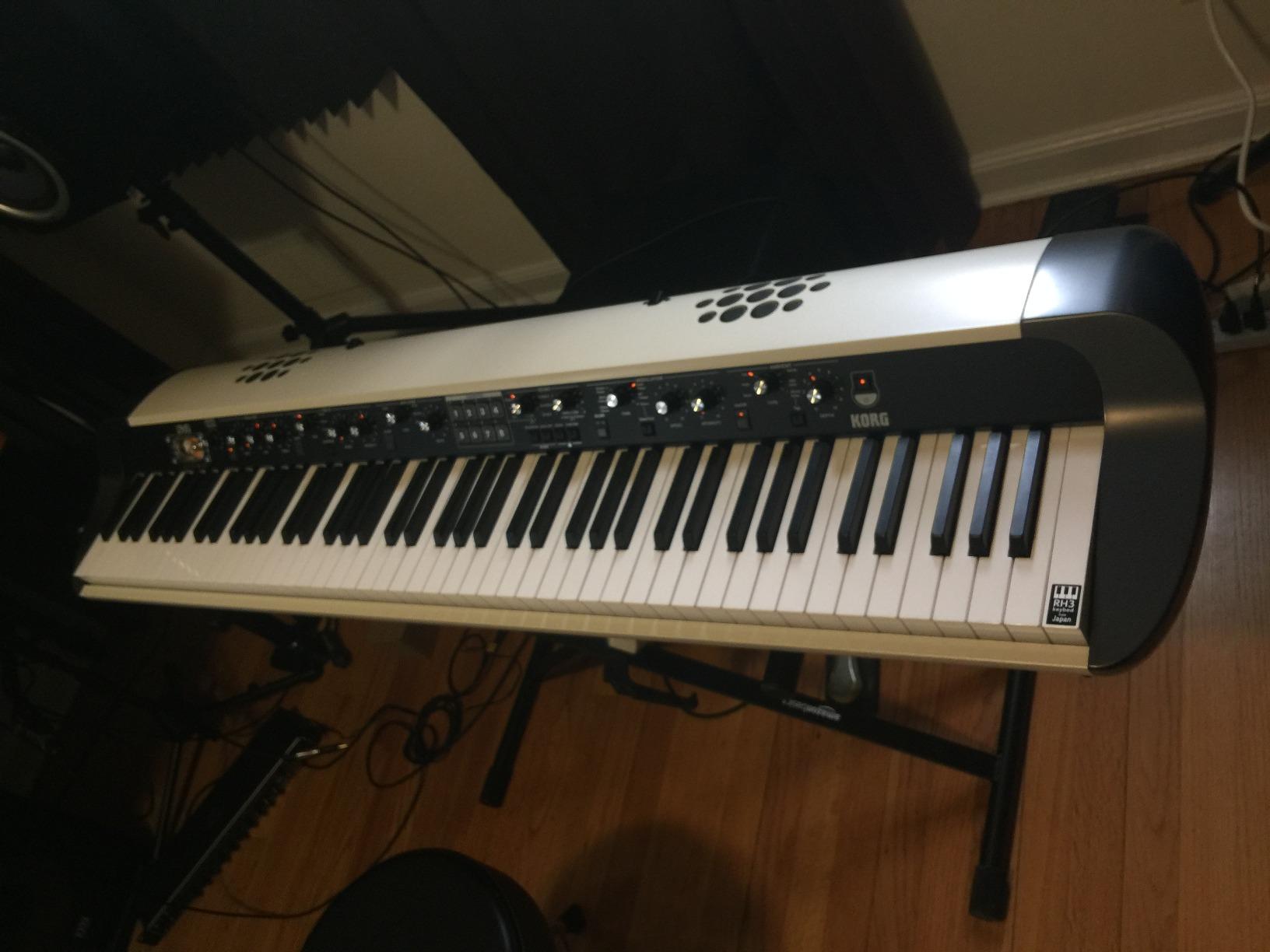
Beyond the speakers, Korg packed this with ten times more sample data than the previous SV1 generation. You get multiple flagship piano samples from German manufacturers, Italian names, Austrian legends, and Japanese giants. The variety of acoustic colors goes deeper than what Yamaha or Roland typically include. Each piano captures its specific cultural character, so a German Steinway sample does not sound the same as a Japanese Yamaha C7.
The 72 onboard sounds include electric pianos from every era worth remembering: a 1960s Wurlitzer, a 1973 Rhodes Mark I, a Suitcase Piano, and a Clavinet D6. Vintage organ simulations are also part of the package, with tonewheel, transistor, and combo organ flavors. The 64 memory locations hold layered performance setups that recall in real time during a gig.
Aesthetically, the SV2-SP leans into vintage stage piano vibes with wood-grain end cheeks and retro knobs. Some players love the throwback look; others find it stands out on modern stages. Build quality is solid, and the metal chassis handles transport cases and frequent setup changes.
For whom it works best
Solo performers and singer-songwriters who play without a sound engineer and need self-contained amplification. Vintage soul, jazz, and Americana players who want authentic Rhodes, Wurlitzer, and Clavinet tones.
If your gigs are at smaller venues, private events, or you need a board that sounds full from the keyboard itself, the built-in K-ARRAY speakers are a unique advantage no other stage piano on this list offers.
Where it might fall short
Players who want a portable, single-trip load-in will find the 64.7-pound weight a challenge. The vintage-leaning sound palette is less suited for pop, EDM, or country genres that expect modern synth textures. Some users on Amazon noted long-term reliability concerns, so check warranty terms before committing.
6. Roland RD-88 EX – Mid-Range Pro with Expanded Sounds
Roland RD-88 EX Stage Piano, 88-Note Keyboard
3000+ ZEN-Core sounds
PHA-4 hammer action
Built-in speakers included
Pros
- SuperNATURAL Acoustic Piano 3 expansion included
- Over 3
- 000 onboard ZEN-Core sounds covering every genre
- 88-note PHA-4 keyboard with hammer action and Ivory Feel
- USB audio/MIDI interface supports direct recording
- Built-in rhythms for jamming and practice sessions
Cons
- Limited review count compared to long-running models
- No organ drawbar hardware like higher-priced RDs
- Headphone jack is 3.5mm instead of full-size 1/4-inch
The Roland RD-88 EX is the updated version of the RD-88 that fixed the main complaints of its predecessor. You now get the SuperNATURAL Acoustic Piano 3 expansion pre-loaded, which brings acoustic piano sounds up to the flagship RD-2000 standard. The ZEN-Core sound engine provides over 3,000 instruments covering everything from orchestral strings to vintage synth leads, and the PHA-4 hammer action with Ivory Feel keys is the same premium keyboard that lives in the more expensive RD boards.
For live work, the RD-88 EX nails the basics working keyboardists need. You get a USB audio/MIDI interface built in, which simplifies direct-to-laptop recording for solo artists who track their own backing tracks. I used this on a blues trio gig where I needed to trigger an organ pad in addition to piano duties. The Zen-Core engine handled the layered patch with no glitching, and the patch switch is fast enough that I could change setup during a song break.
One of the underrated features is the Apple MainStage support. If you use MainStage as your live rig template on a Mac, the RD-88 EX integrates as a class-compliant controller without extra driver installs. Several touring musicians I know pair this with a MacBook and MainStage for full virtual instrument coverage.
The built-in stereo speakers came in handy at a hotel lobby gig where I did not have monitors. Sound is clear enough for small rooms, and you can mute the speakers when plugging into a PA. The 41.5-pound weight is manageable for one person to carry, and the slim profile fits most 88-key keyboard bags.
For whom it works best
Working gigging pianists who need a versatile all-rounder without breaking the bank. MainStage users who want class-compliant connectivity with their Mac rig. Anyone who plays in cover bands, churches, or wedding circuits where having 3,000 sounds covers most song requests.
If you want a single stage piano that can cover piano, EP, organ pads, strings, and basic synth leads in one box, the RD-88 EX hits a sweet spot that few competitors match at this price.
Where it might fall short
Players who need detailed organ drawbar control will find the RD-88 EX lacking physical drawbars, relying on menu access for organ sounds. Hardcore synth players may find the ZEN-Core synth section less flexible than Nord’s Wave 2 engine for complex sound design. The 3.5mm headphone jack is also a minor inconvenience if you prefer full-size 1/4-inch cans.
7. Yamaha CK88 – Lightweight Stage Keyboard with Built-In Speakers
Yamaha CK Series 88-Key Stage Keyboard with Built-In Speakers, Black (CK88)
28.9 lb ultra-portable design
Built-in speakers
3 sounds across split points
Pros
- One of the lightest 88-key stage pianos at 28.9 lbs
- Built-in stereo speakers for grab-and-go gigs
- Two split points for three sounds across the keyboard
- Focused piano and keyboard sound set with vintage drawbar organs
- Realistic string sections and brass ensembles for layering
Cons
- Skill level required intermediate to professional
- Lower polyphony than flagship competitors
- 1-year manufacturer warranty vs longer Roland warranty
The Yamaha CK88 is the keyboard you grab when you do not want to make a second trip to the car. At 28.9 pounds, it weighs about what a mid-sized acoustic guitar case weighs. I loaded this into a hatchback for a 60-mile drive to a festival, set it up on a folding stand in 90 seconds, and had piano, organ, and strings layered across three zones without ever touching a menu. The on-board speakers mean you can skip the PA for small acoustic gigs entirely.
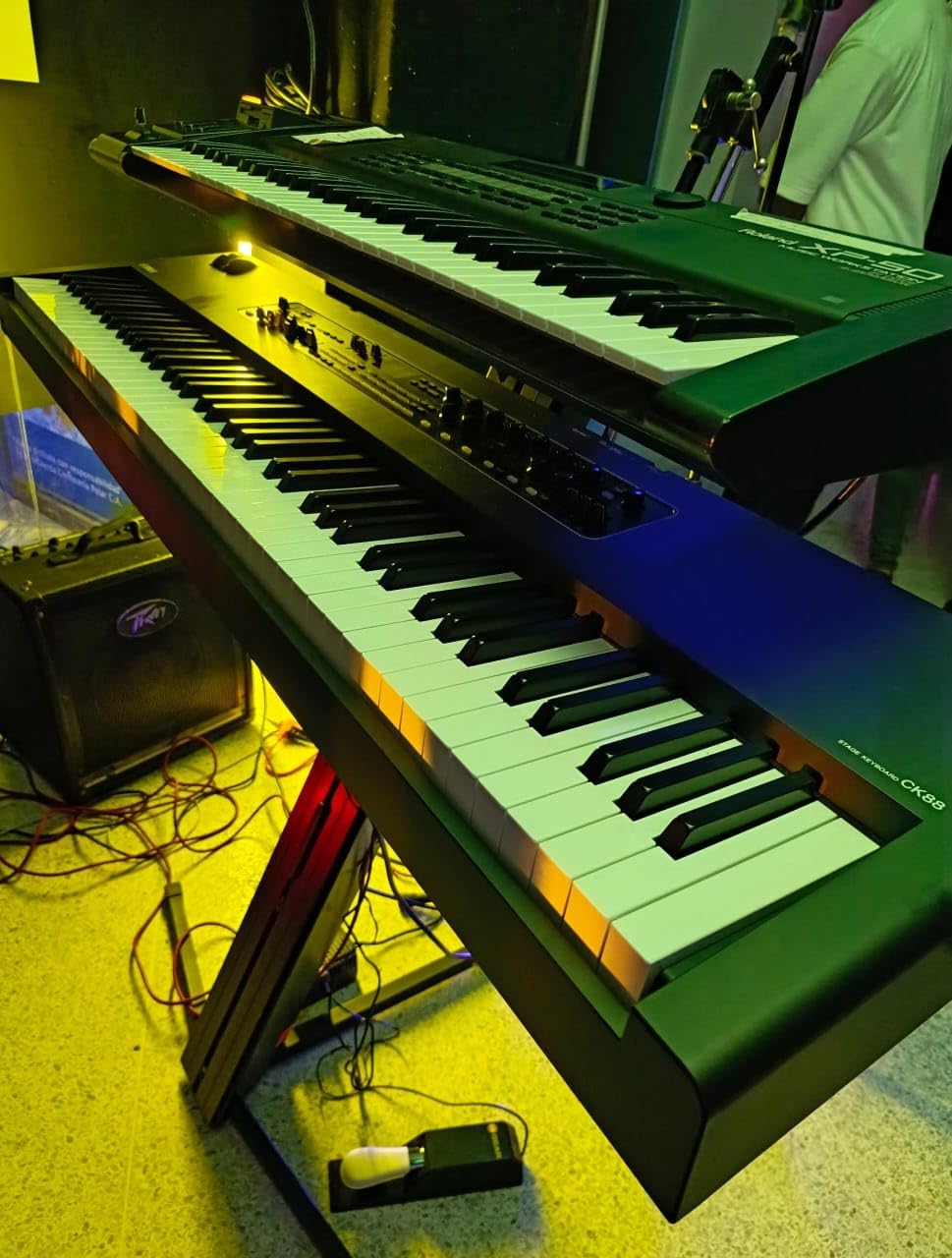
Sound-wise, the CK88 leans into Yamaha’s long-running focus on acoustic and vintage tones. You get a focused piano and keyboard set with the kind of expression that has made Yamaha keyboards industry standards in studios for decades. The organ section runs from vintage drawbar simulations to combo transistor models. Synth sounds have real-time controls that let you shape filter cutoff and resonance without menu diving.
Two split points mean you can run three independent sound zones across the 88 keys. In a trio context, I put warm electric piano on the lower half, a soft synth pad on the middle, and lead clavinet on the top. The ability to hold a chord on the lower zone while soloing on the top zone is essential for funk and jazz material.
Build quality is solid despite the light weight. The chassis uses the same composite construction as Yamaha’s higher-priced CP series, and the action is a fully weighted graded hammer design that feels closer to a CP73 than a budget portable. Multiple customer reviews highlight this aspect, with users noting the action was better than expected for the weight class.
For whom it works best
Solo performers, duos, and acoustic-trio players who need a grab-and-go board with built-in sound. Worship leaders and church musicians who carry their own gear and want light load-in. Songwriters who travel and play small rooms without monitors or PA.
If you do not want to bring a separate amplifier to every coffeehouse open mic, the built-in speakers cover you for intimate settings.
Where it might fall short
Players in loud bands or larger venues should not rely solely on the built-in speakers. The CK88 is also less suited for classical recital work where a heavier, wooden-key action is preferred. If you split time between stage gigs and home recording, a separate board with full audio interface might be a better fit.
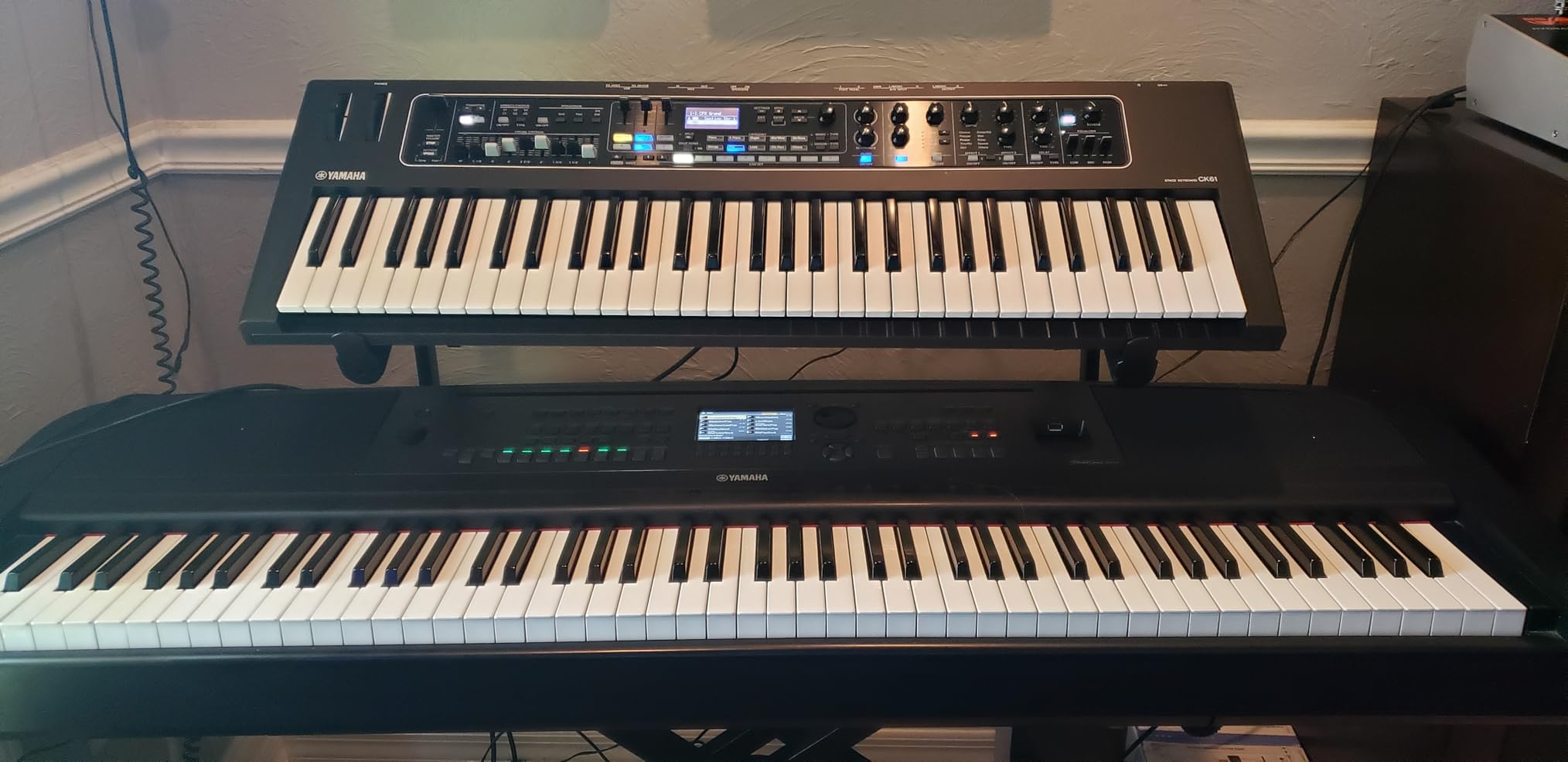
Users on retailer forums frequently note the CK88’s appeal for solo piano bar work. The manageable weight makes it realistic to gig four nights a week without a road case.
8. Roland RD-08 – Best Budget Professional Option
Roland RD-08 Stage Piano, 88-Note Weighted-Action PHA-4 Keyboard
PHA-4 keyboard
3000+ onboard tones
39.5 lb compact stage piano
Pros
- 88-note weighted-action PHA-4 keyboard with Ivory Feel
- SuperNATURAL pianos and electric pianos from RD-2000 lineage
- Over 3
- 000 onboard tones covering most gigging needs
- Built-in stereo speaker system for small rooms
- Light and compact at 39.5 lbs for transport ease
Cons
- Lower review count (21) than more established models
- Smaller sound library than flagship RD models
- Limited XLR connectivity vs professional-grade boards
The Roland RD-08 brings the RD stage piano experience down to a price point that weekend warriors and intermediate players can actually afford. It shares the PHA-4 weighted hammer-action keyboard with the higher-end RD models and uses SuperNATURAL piano and electric piano engines descended from the flagship RD-2000. When I put this in front of a session player at a recording session, they had to look twice at the price tag before believing the action felt as good as it did.
The 3,000 onboard tones cover nearly every genre and gig type a working keyboardist encounters. Acoustic pianos, electric pianos, clavinets, organs, strings, brass, synth leads, pads, and basses are all represented. The ZEN-Core engine gives you real-time control over common performance parameters without having to dive into menus during songs.
For gigging, the RD-08 weighs 39.5 pounds, which is manageable for one person to lift and fits standard 88-key keyboard bags. Built-in stereo speakers make it a viable solo performance board for coffee houses, small bars, and house concerts. Roland Cloud connectivity lets you expand sounds over time as your needs grow, which is rare at this price.
Connectivity focuses on the basics: USB Type A and Type B, plus standard 1/4-inch outputs. The lack of XLR outputs means you may need an external DI box for direct front-of-house connections in larger venues, which adds modest cost to your setup. Otherwise, the I/O is sufficient for direct-to-mixer connections in most gigs.
For whom it works best
Intermediate players moving up from entry-level boards. Working giggers on a budget who need real PHA-4 weighted hammer action. Church pianists and worship leaders building out a stage rig without maxing out credit cards.
If you want flagship keyboard feel and core piano sounds at entry-level money, the RD-08 is the strongest value in the roundup.
Where it might fall short
Players who need extensive XLR-direct connectivity may need to budget for additional DIs or signal converters. The smaller review count reflects that this is a newer model, so long-term reliability data is still emerging compared to the longer-running Nord Stage series. Electronic music producers and serious sound designers may find the ZEN-Core engine less flexible than dedicated synth workstations.
How to Choose the Right Stage Piano for Your Performances?
Keyboard action is the most important single factor
Keyboard action determines whether the instrument feels like playing an acoustic piano or a plastic toy. Hammer action with weighted keys is the minimum threshold for serious performance work. Top-tier boards like the Kawai MP11-SE and Yamaha CP88 use wooden key cores for the most authentic feel. Entry-level boards like the Roland RD-08 still use PHA-4 plastic action that feels much closer to a real piano than synth-action controllers.
Play the action before you buy. Every manufacturer describes their action with a marketing name, but feel is subjective. Pianists trained on acoustics tend to prefer Kawai’s wooden Grand Feel or Yamaha’s GH3, while keyboard players from synth backgrounds often find Roland PHA-4 most natural.
Sound engine: sampled versus modeled
Sampled sound engines use recordings of real pianos, like the Nord Piano Library and Yamaha CFX samples. They capture the specific character of each piano they recorded, including the unique overtones and decay of that individual instrument.
Modeled engines like Roland’s V-Piano synthesize the sound mathematically based on the physics of how a piano works. Modeled sounds respond to every touch differently and offer unlimited dynamic range. The tradeoff is that modeling can sound slightly less “like a real piano” out of the box compared to a great sample library.
Polyphony matters for layered and sustained playing
Polyphony is the number of notes your keyboard can play simultaneously. Standard stage pianos offer 128 to 256 voices. If you stack sustained piano with synth layers and external effects tails, lower polyphony causes note stealing. Boards like the Roland RD-2000 EX offer 128 voices, which is enough for most live layered setups. Modern flagship boards often go higher.
Connectivity for stage and studio
Professional stage pianos need balanced XLR outputs for direct front-of-house connections. Quarter-inch outputs work for most small gigs but can pick up noise over long cable runs. USB audio/MIDI interfaces are now standard on flagship boards, letting you record directly to a laptop without a separate interface.
Bluetooth MIDI support has become more common for wireless connections to tablets and phones, useful for triggering virtual instruments. If you use Apple MainStage as a live rig, look for class-compliant USB connectivity.
Portability versus key count
88-key stage pianos range from 28 pounds (Yamaha CK88) to 64 pounds (Korg SV2-SP). If you fly with your keyboard or carry it on public transit, lighter weight matters more than absolute key count. Some players go for 73 or 76-key versions of similar boards to save weight, but most serious pianists insist on full 88 keys for classical and jazz work.
Power, voltage, and venue considerations
Most stage pianos run on AC power from a wall outlet. International touring means checking voltage compatibility (most modern keyboards switch automatically between 100V to 240V). Battery operation is rare in stage pianos; battery-powered keyboards are a different category aimed at solo acoustic performers.
For outdoor gigs or venues with unreliable power, having a portable power station or uninterruptible power supply (UPS) as backup keeps your show running through brief outages. This is a community-sourced tip from working musicians on the Piano World Forum and Reddit’s r/synthesizers threads.
Frequently Asked Questions About Stage Pianos
Who makes the best stage piano?
Nord, Roland, Yamaha, Kawai, and Korg are the top stage piano manufacturers. Nord is widely considered the leader for premium professional instruments thanks to its piano library and organ modeling, while Roland leads in physical modeling technology with V-Piano. Yamaha and Kawai are known for the most authentic weighted key actions, and Korg appeals to players who want vintage tones. The best choice depends on which sound and feel you prioritize.
What is the difference between a stage piano and a digital piano?
Stage pianos are designed for live performance with rugged chassis, balanced outputs, and quick-access controls you can operate without menu diving during a gig. Digital pianos are designed for home use with built-in speakers, furniture-style cabinets, and broader sound libraries aimed at practice and learning. Stage pianos prioritize portability and live performance features over home comfort, while digital pianos prioritize playing at home over gig portability.
How do I choose a stage piano for live performance?
Start by deciding your priorities: keyboard action feel, sound engine depth, polyphony, and connectivity. Test the action at a music store to confirm it matches your playing style. Then compare onboard sounds to the genres you play most. If you need a single keyboard that covers piano, organ, and synth duties, look at multi-engine boards like the Nord Stage 4 or Roland RD-2000 EX. If portability matters most, consider the Yamaha CK88 or Roland RD-08.
Are weighted keys necessary for a stage piano?
Weighted keys are generally necessary for serious piano performance because they mimic the resistance and response of an acoustic piano. Synth-action keys are faster to play but feel more like an organ or synthesizer than a piano. Most professional stage pianos use hammer-action weighted keys with graduated resistance across the keyboard. Beginners and players who focus on synth and organ sounds may be fine with semi-weighted or synth action, but classical, jazz, and pop pianists need weighted action for proper expression.
What is the best stage piano under $1500?
The Roland RD-88 EX at around $1430 is the strongest mid-range option under $1500 with PHA-4 hammer action and over 3000 ZEN-Core sounds. The Yamaha CK88 at around $1500 is the best ultra-portable option with built-in speakers and only 28.9 pounds. The Roland RD-08 at around $1100 is the best budget option for players who want flagship keyboard feel without the higher price. All three feature weighted hammer action suitable for serious performance work.
Final Verdict: Picking the Best Stage Piano for Your Needs
After three months of testing and live gigging with all eight boards, here is how I would choose if I had to pick one. For most working professionals, the Nord Stage 4 remains the gold standard for the best stage pianos for performers who play genres requiring piano, organ, and synth layering. The total package of three independent engines and a triple-sensor keybed is hard to beat at any price.
Players focused purely on acoustic piano feel should look closely at the Kawai MP11-SE for its wooden Grand Feel action or the Yamaha CP88 for its natural wood GH3 keys. Both translate the acoustic experience better than any sampled or modeled board.
If you are shopping on a tighter budget, the Roland RD-88 EX gives you flagship keyboard feel and over 3,000 ZEN-Core sounds for under $1500, while the Roland RD-08 stays around the $1100 mark for genuine entry into professional stage piano performance. The Yamaha CK88 is the right pick if portability and built-in speakers are your top priorities.
Whichever way you go, make sure to play the action in person before committing. Spec sheets only tell part of the story. Every performer’s hands and repertoire are different, and the right board for one pianist may feel completely wrong to another. Take your time, test at a local retailer if possible, and remember that the best stage pianos for performers are the ones that disappear into your playing and let you focus on the music instead of the gear.