

Wall climbing is one of those activities where children get better fast, and where a single afternoon of practice looks nothing like the same child a month later. A backyard climbing wall for kids is a freestanding or playset-mounted climbing surface built for children, typically 4 to 10 feet tall, with molded or screw-on holds, a published maximum child weight, and a required fall zone of soft surfacing such as mulch, rubber tiles or grass.
The reason families keep climbing is developmental. Climbing builds grip strength, core stability, balance and spatial awareness, and it gives kids a physically demanding outlet that swings and slides alone rarely match. It also redirects the instinct to climb fences and trees toward something built for the purpose.
We spent weeks with the twelve structures in this roundup, checking footprints against real yards, comparing published weight limits, and reading thousands of owner reviews to separate what holds up after a few seasons from what disappoints in the first month. What follows is the first side-by-side comparison of backyard climbing walls we could find, organised by age, by yard size and by how much assembly you actually want to do.
If your child is under three, start with the toddler section rather than the bigger walls. Most retail climbing gear is scaled for children aged eight and up, which leaves parents of preschoolers with nothing climbable at their own child’s height.
Table of Contents
Top 3 Picks for the Best Backyard Climbing Walls for Kids in 2026
These three cover the most common households: a toddler-first yard, a family that wants a full climbing surface for the price of a small playset, and a budget pick with the highest review volume we found.

Step2 Game Time Sports Climber
- All-in-one sports climber
- 42.5 in tall and 62 in wide
- Double-walled plastic
- 60 lb max weight

Eezy Peezy Mega Pyramid
- Over 100 sq ft of climbing surface
- 154 lb combined load
- Ages 3 to 8
- Lightweight and portable

Step2 Woodland Climber II
- Two separate climbing walls
- Roomy deck and slide
- Hideaway underneath
- Ages 2 to 6
Best Backyard Climbing Walls for Kids (October 2026)
Every pick below, with the specs that actually decide whether a wall fits your child and your yard.
| Product | Specifications | Action |
|---|---|---|
| Step2 Game Time Sports Climber |
|
Check Latest Price |
| Eezy Peezy Mega Pyramid |
|
Check Latest Price |
 Backyard Discovery Buckley Hill Backyard Discovery Buckley Hill |
|
Check Latest Price |
| Step2 Woodland Climber II |
|
Check Latest Price |
 Backyard Discovery Mount Mckinley Backyard Discovery Mount Mckinley |
|
Check Latest Price |
 TP Explorer 2 Jungle Gym TP Explorer 2 Jungle Gym |
|
Check Latest Price |
 Step2 Skyward Summit Step2 Skyward Summit |
|
Check Latest Price |
 Gorilla Playmaker Deluxe Gorilla Playmaker Deluxe |
|
Check Latest Price |
 Lifetime Adventure Tower Deluxe Lifetime Adventure Tower Deluxe |
|
Check Latest Price |
 Backyard Discovery Shenandoah Backyard Discovery Shenandoah |
|
Check Latest Price |
 Simplay3 Young Explorers Simplay3 Young Explorers |
|
Check Latest Price |
 Avenlur Palm 5-in-1 Avenlur Palm 5-in-1 |
|
Check Latest Price |
1. Step2 Game Time Sports Climber – Best All-Round Toddler Climber
Step2 Game Time Sports Climber, Kids Indoor/Outdoor Playset, Backyard Playground Set, Slide, Climbing Wall, Basketball Hoop, Outside Jungle Gym, For Toddlers 2-6 Years Old
Plastic
Ages 2 to 6
42.5 in H x 62 in W x 30.5 in D
60 lb max weight
24.5 lb
Pros
- Basketball hoop and soccer goals add sport play
- Sure-grip entry steps
- Under-deck hideaway and storage
- Compact footprint
- Double-walled plastic
Cons
- 60 lb limit rules out older children
- Molded slide holds one or two kids
This is the structure we recommend to anyone starting from scratch with a child aged two to six. It carries a 4.7 average across more than four thousand owner ratings, and the double-walled plastic has a track record of surviving seasons outdoors without chipping or fading.
The climbing surface is molded rather than re-routable, so there is no way to increase difficulty as your child improves. What you get instead is a multi-sport deck: a basketball hoop, soccer goals and clickable scorekeeper knobs on top of the entry steps and slide.
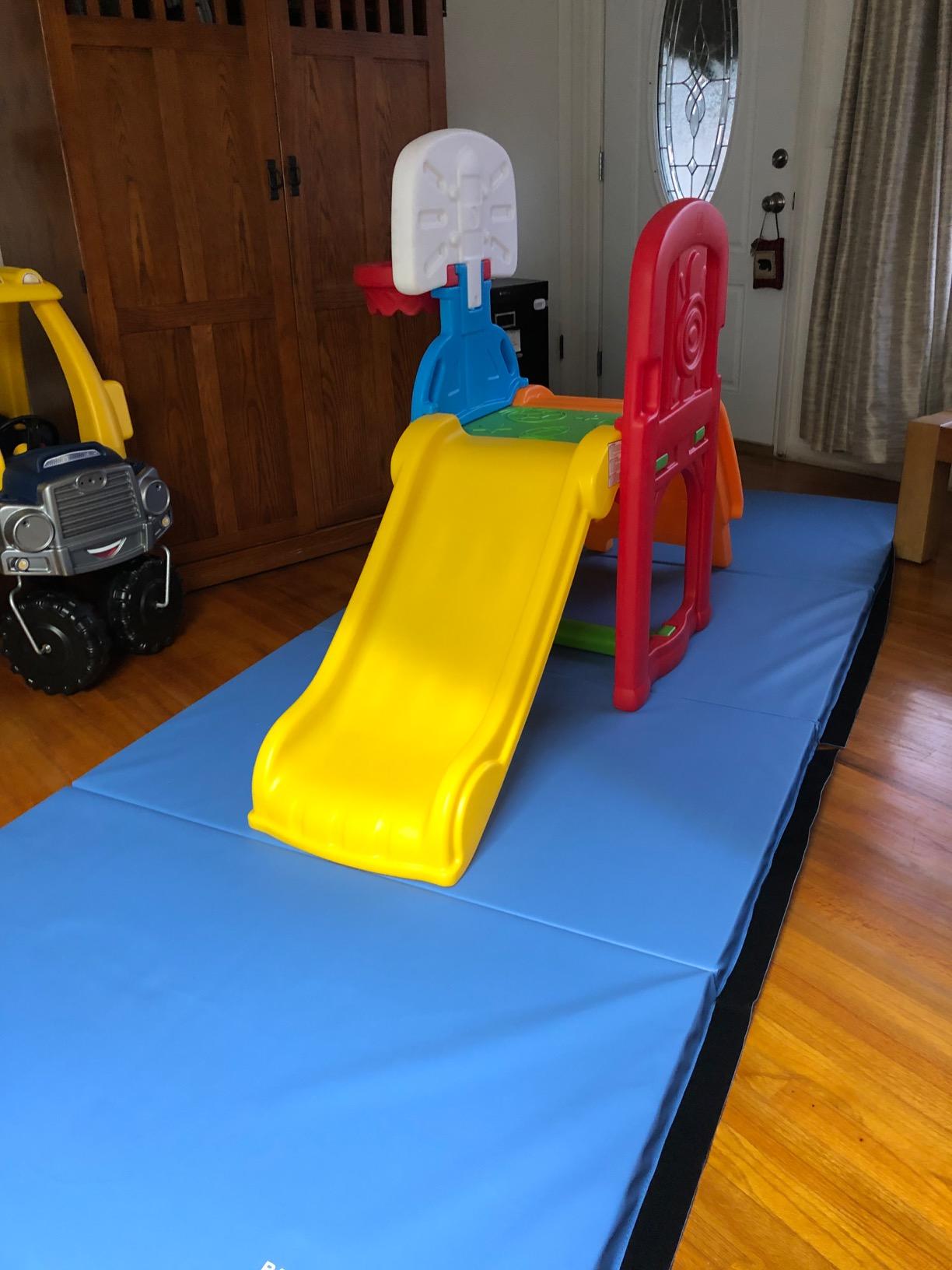
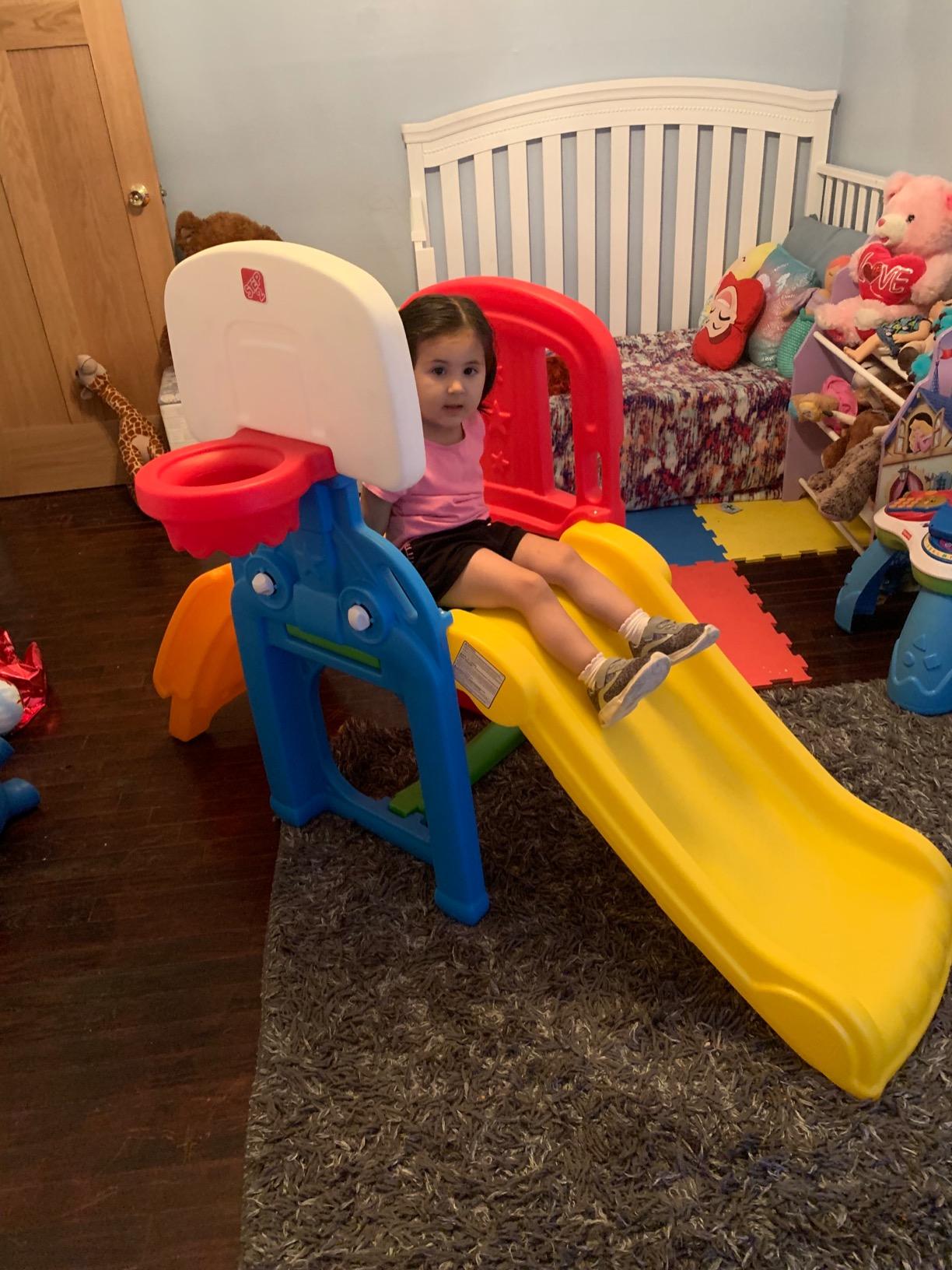
The entry steps have textured grip rails that help younger children climb without adult hands on the back. Underneath, the deck doubles as storage for outdoor toys or a hideaway for hide-and-seek, and it rinses clean with a hose.
At 62 inches wide and 42.5 inches tall, it takes up less ground than most competitors, which matters in a suburban backyard where a full playset will not fit. Rated for children aged two to six, it is a genuine climber rather than a wall with a slide attached.
Does the 60 lb weight limit matter for you?
It matters more than most listings suggest. The published 60 lb maximum means the structure is really a preschooler’s and first-grader’s climber. A kindergartner at the top of the age range may already be near the limit, and the wall stops working the moment a bigger sibling wants a turn.
If you have two children spaced more than about three years apart, plan on this being a four-year purchase rather than a ten-year one.
Is it a real climbing wall or a slide with steps?
It is a molded plastic activity climber, not a hold-based rock wall. There are no grips to re-route and no handholds on a vertical face, so it will not satisfy a child who wants to work a climbing problem. It will keep a three-year-old busy for an hour.
Pair it with a compact dome or a rope climber if you want a genuine grip challenge in the same footprint. Our guide to the best climbing domes for kids covers the shapes that work better for grip-focused play.
2. Eezy Peezy Mega Pyramid – Best Value for the Whole Preschool and Elementary Range
Eezy Peezy Mega Pyramid Monkey Bars Climbing Tower Active Outdoor Fun for Kids Ages 3 to 8 Years Old, Blue/Green
Plastic
Ages 3 to 8
105 x 65 x 52 in
154 lb combined load
38 lb
Pros
- Over 100 sq ft of climbing surface
- Highest review count in the group
- 154 lb combined load
- Light enough for one adult to move
- UV-protected plastic
Cons
- Spring pins pinch fingers during assembly
- Included disassembly tool wears out quickly
- Tubing flexes under heavier children
With 6,375 ratings at a 4.4 average, this is the most reviewed product we tested and the one owners argue about most. Once it is standing, reviews describe it as sturdy, portable and endlessly reusable, and several mention four or five years outdoors in real yards.
The climbing surface is a pyramid of bars, a dome and under-and-over routes, spread across more than 100 square feet. That is a lot of hand-over-hand and grip-the-bar climbing, and it is the closest thing here to a rope-net or cargo-net wall without the sag.

One adult can lift and reposition it, which is unusual for a structure this size and means it can live in the garage in winter. The plastic carries UV protection, and a handful of owners report adults climbing on it alongside the children.
The combined load is 154 lb, and reviewers report the frame taking that without complaint. Drape a blanket over the dome and the same frame becomes a fort or a ship, which extends the value for younger children.
Should you budget extra time for assembly?
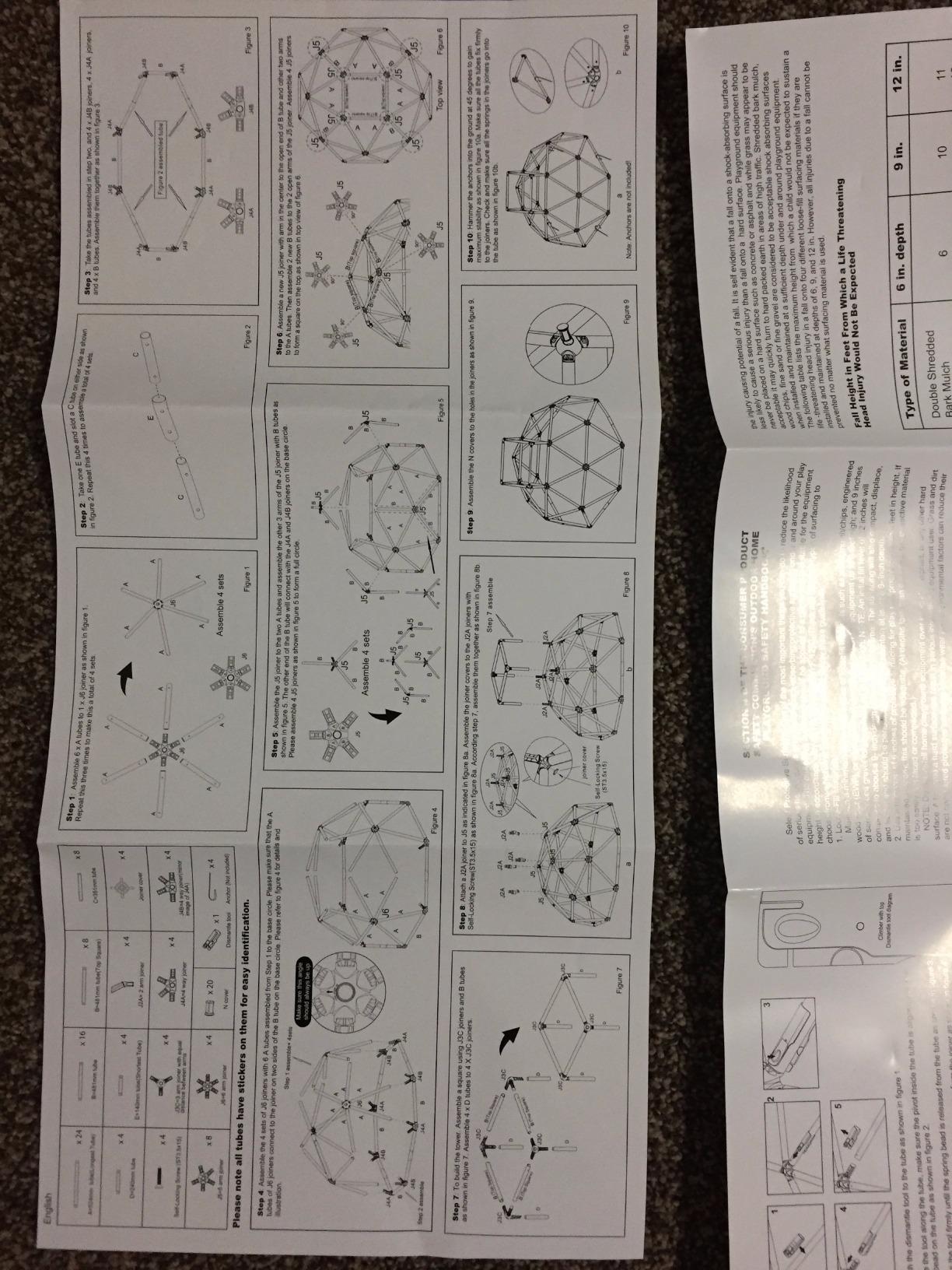
Yes, and plan on sore fingers rather than sore back. The dominant complaint across reviews is the pressure-release pins: they are genuinely hard to depress and they pinch hands during setup. The supplied plastic removal tool wears out after a couple of uses, which also makes the advertised pack-down portability hard to realise.
Two adults working together for about an hour is a realistic estimate. A metal screwdriver or a small clamp makes the job noticeably easier.
Will the tubing hold a heavier child for years?
For children in the stated three-to-eight range, yes. Beyond that, several owners report visible flex in the tubes under load, and cracking after multiple years of direct sun exposure. The top cap, held by four screws, is the part reviewers single out as wobbly once assembled.
If you have a child who will be eight or older this year, the weight class is worth checking before you commit. A structure rated for adults is a better long-term bet.
3. Backyard Discovery Buckley Hill – Best Cedar Starter Playset With a Rock Wall
Backyard Discovery Buckley Hill Cedar Wood Swing Set with Wave Slide, Play Deck, Rock Wall Ladder, Belt Swings, Chalkboard, Canopy Roof, Outdoor Playset
Cedar
Ages 3 to 6
123 in W x 107 in D x 92 in H
150 kg max
137 lb
Pros
- Complete playset in one footprint
- 100 percent cedar with natural decay resistance
- Pre-cut and pre-drilled lumber
- BILT app assembly guidance
- 5-year warranty
Cons
- Only 4 holds on the rock wall
- Cedar needs periodic re-staining
- Multi-hour assembly
If you want a full playset with climbing rather than a climbing structure, this is the most reviewed cedar set in the roundup at a 4.3 average over 3,071 ratings. It ships with a six-foot wave slide, two belt swings, a chalkboard, a canopy roof and a rock wall ladder.
Cedar is the material choice that matters here. It has natural resistance to decay, and the lumber arrives pre-cut, pre-drilled and pre-stained with guided instructions in the BILT app, which cuts assembly time considerably compared with a raw lumber kit.
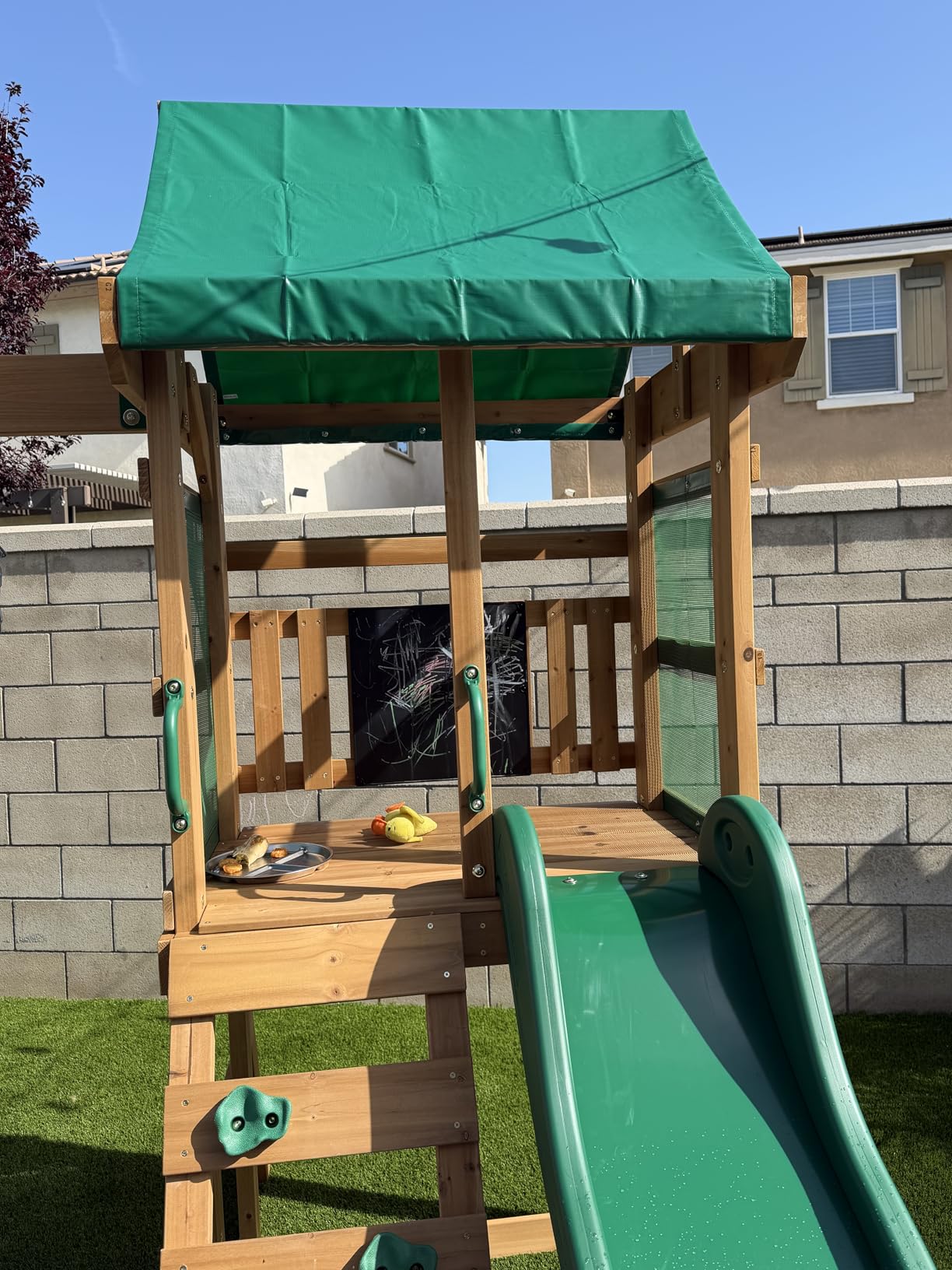
The set is engineered to meet or exceed ASTM F1148-22, and the belt swings use rope chains rather than coated steel, which avoids the finger-pinching problem on plastic chains. It is designed for play areas serving up to five children.
Closer to the ground, the under-deck area gives kids shade and a place to sit out of the sun. That is the feature reviewers mention most after the price-to-content ratio.
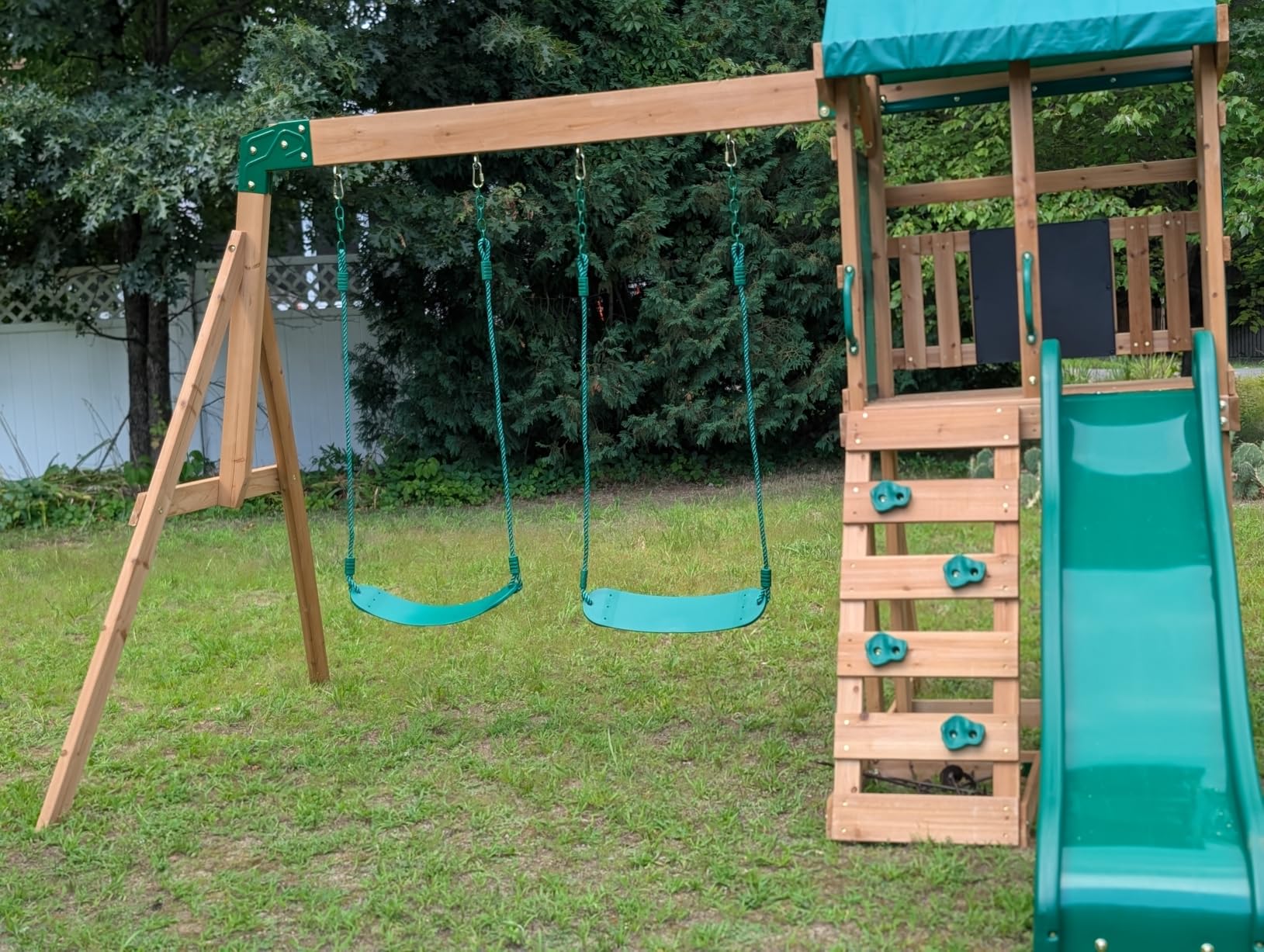
Does a 4-hold rock wall count as a climbing wall?
Not really, and we want to be straight about that. Four holds is a starter feature that doubles as an easy-access ladder for younger children, which is genuinely useful for a three-year-old who cannot reach the deck any other way.
It will not keep a six-year-old engaged. Treat this as a playset purchase with climbing included rather than a climbing wall purchase.
Is cedar worth the ongoing upkeep?
Cedar outlasts pine and will not rot the way untreated softwood does, but the light brown stain fades and the surface needs re-coating every year or two to keep looking new. That maintenance is the standard trade for the material.
Keep an eye on the rock wall ladder bolts and the swing beam attachments each spring. The five-year warranty covers the structure, not the finish.
4. Step2 Woodland Climber II – Best Two-Sided Climber for Preschool Siblings
Step2 Woodland Climber II Kids Playset, Ages 2 –6 Years Old, Toddler Slide and Climbing Wall, Outdoor Playground for Backyard, Sturdy Plastic Frame, Easy Set Up
Plastic
Ages 2 to 6
75 x 47 x 53.75 in
Double-walled
Double climbing walls
Pros
- Two separate climbing walls plus ladder
- Highest five-star share at 85 percent
- Nature-inspired colours and textures
- Under-deck hideaway
- Double-walled plastic
Cons
- Ages 2 to 6 only
- Plastic holds less grippy than a rock wall
This is the second-strongest rating profile in the group, with a 4.7 average and 85 percent five-star ratings across 1,453 reviews. Reviewers consistently single out the two-sided climbing layout as the feature children actually use.
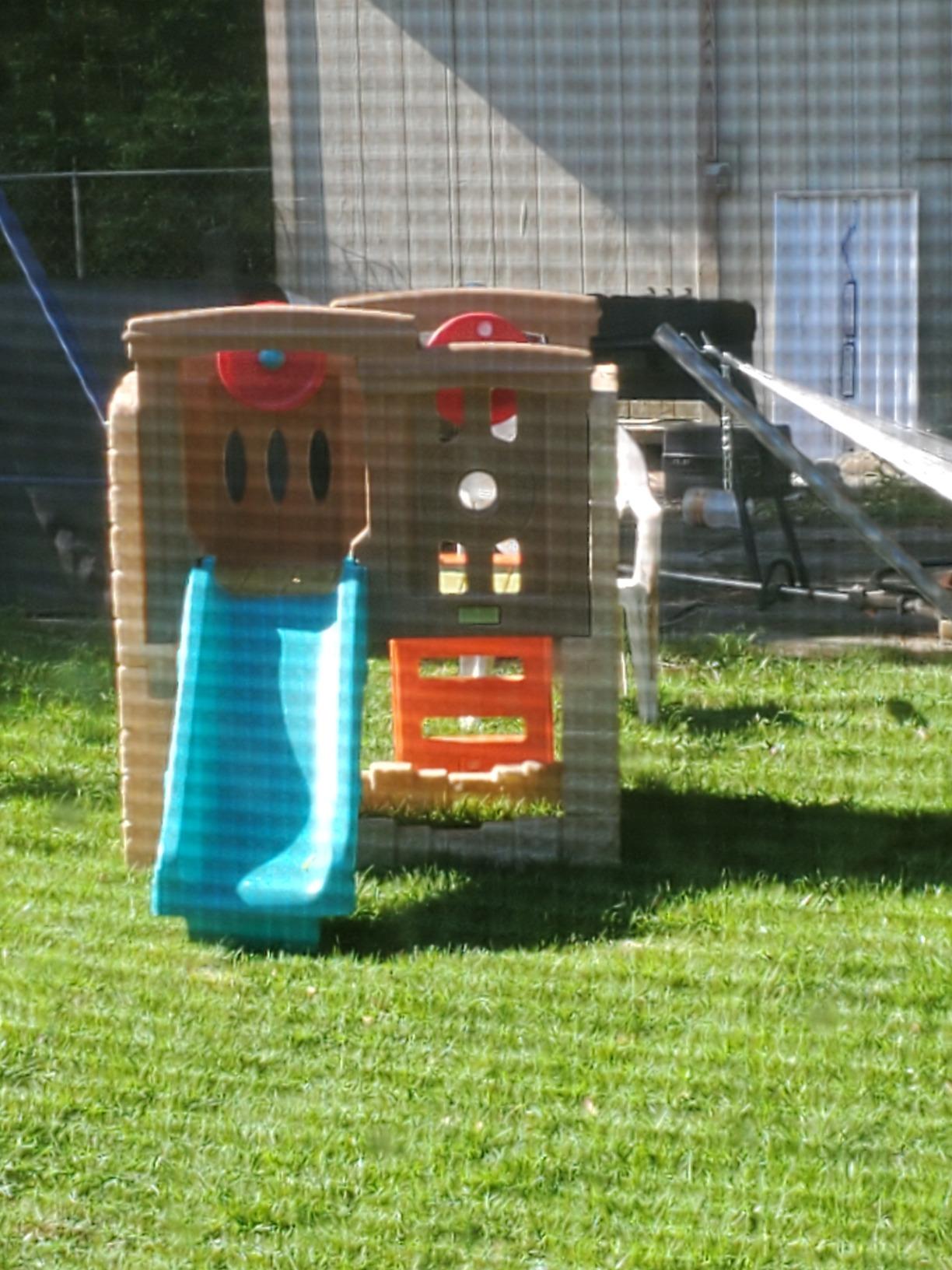
Two climbing walls on opposite faces mean two children can climb at once without negotiating the same route, which is the single biggest practical problem with small outdoor climbers. A ladder, a slide, two steering wheels and an upper deck complete the structure.
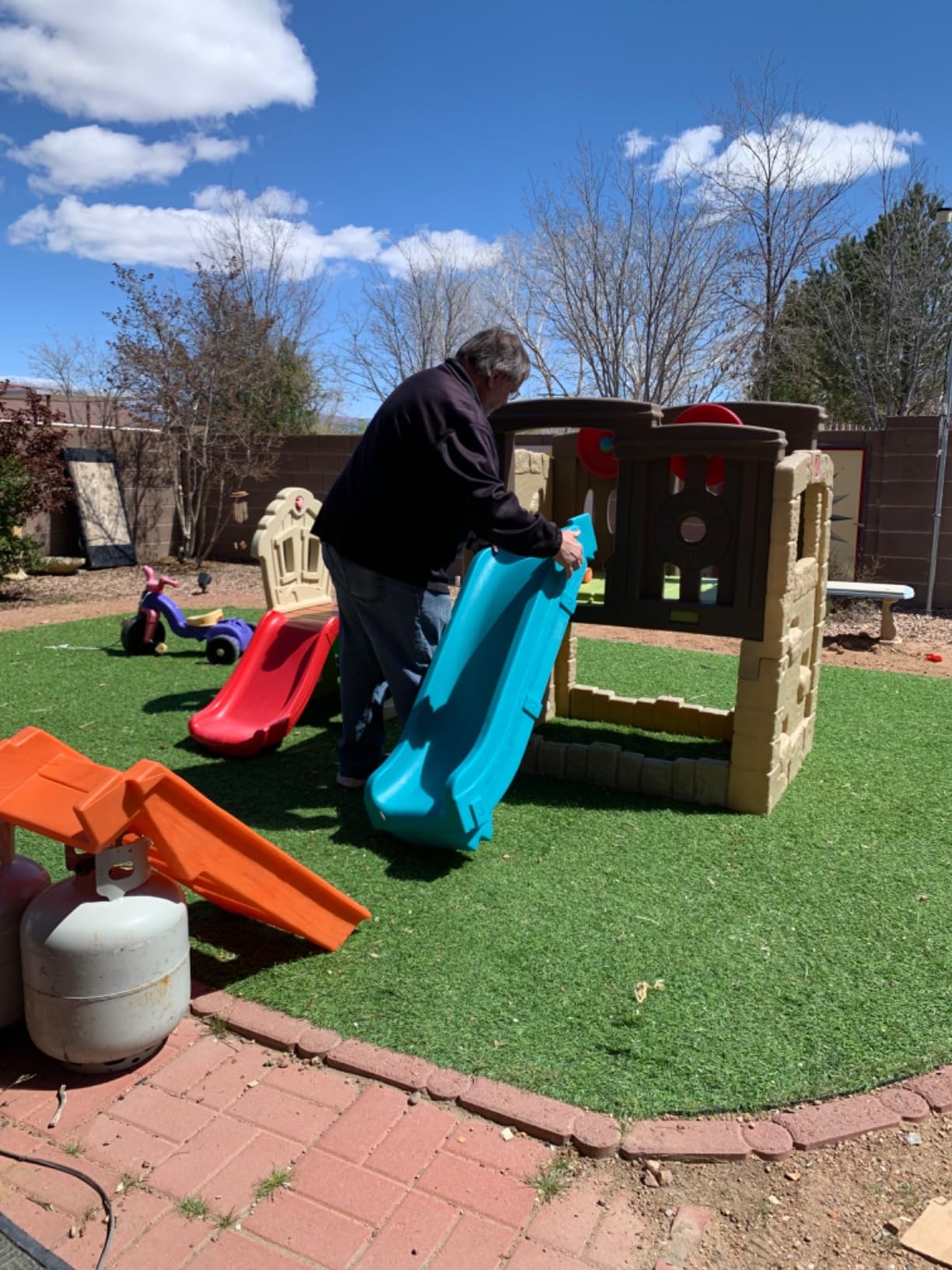
The earthy brown colours and textured moulding are designed to blend into a garden rather than sit on top of it. That matters if the wall has to live beside a fence line or a patio instead of on open lawn.
Underneath the deck is a hideaway that works as a fort or a toy stash between sessions. The double-walled plastic resists chips, fading, cracks and peels, and rinses down quickly after a wet week.
How does two-sided climbing work with siblings?
It removes the queue. With one climbing face, a five-year-old and a three-year-old take turns, and the three-year-old ends up watching. With two faces and a deck, both are climbing and the older child can help the younger one down.
The steering wheels are the other quiet winner. They turn the deck into a pretend vehicle, which buys extra independent play time from a small structure.
When do children outgrow it?
Quickly. The manufacturer rates it for ages two to six, and reviewers describe it as growing out of the house within about three years. The deck height of 53.75 inches is toddler and preschool scale.
Buy it as a three-to-four-year purchase. If your youngest is already five, look at a structure rated to eight or older.
5. Backyard Discovery Mount Mckinley – Best Full Climbing Wall for a Large Yard
Backyard Discovery Mount Mckinley Cedar Wood Swing Set with Wave Slide, Play Deck, Double Rock Wall, Rope Ladder, Web Swing, Belt Swings, Toy Telescope, Steering Wheel, Sandbox Area, Outdoor Playset
Cedar
Ages 3 to 10
186 in W x 150 in D x 119 in H
1080 lb total
308 lb
Pros
- Extra-wide double rock wall with 9 holds
- Rope assist lets two children climb together
- Rope ladder over 6 ft with wooden rungs
- Sandbox and telescope for other play
- 5-year warranty
Cons
- Very large footprint for a suburban yard
- 308 lb structure is a long build
- Cedar needs periodic staining
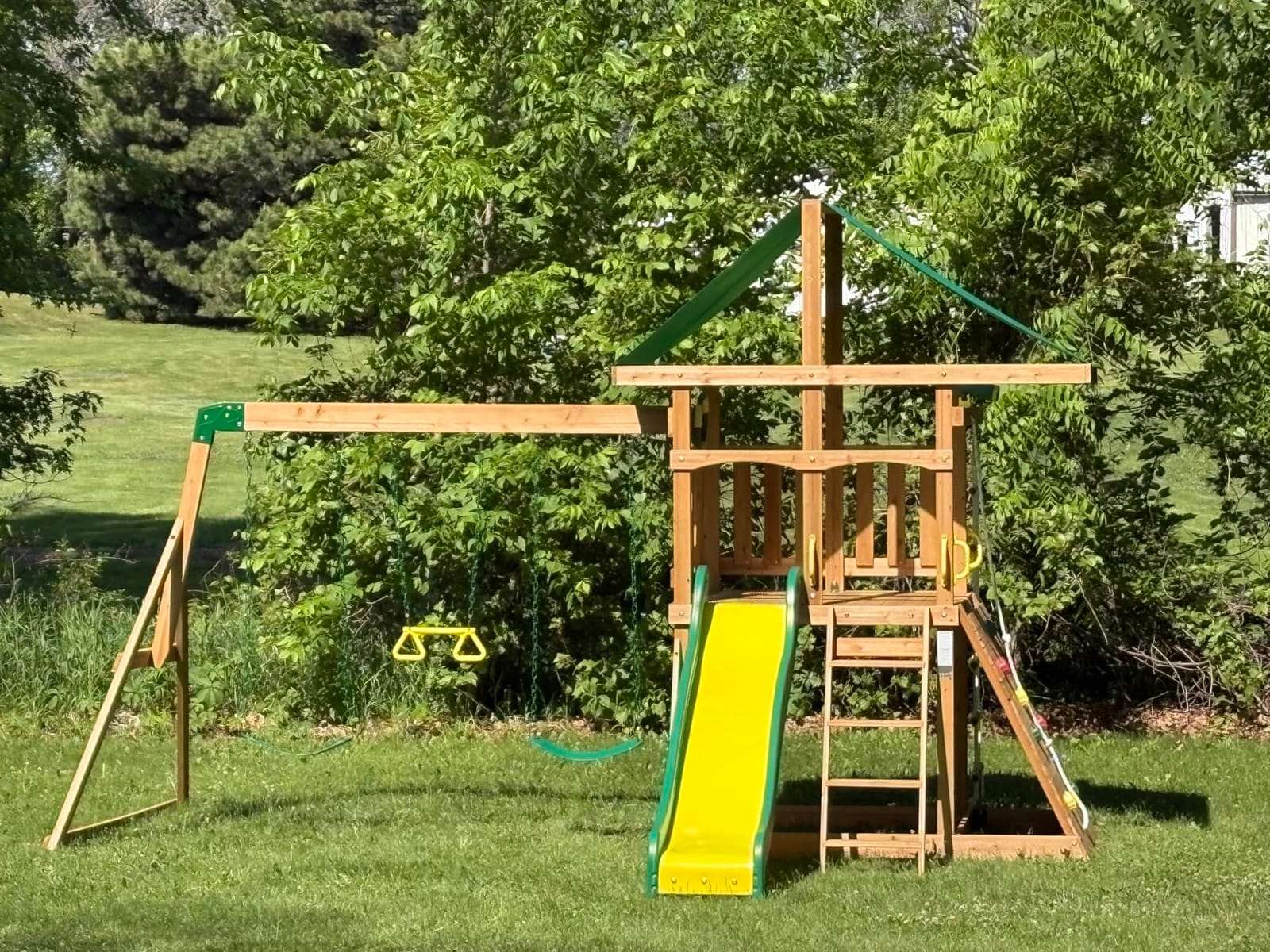
This is a playset built around a proper climbing wall, and it is the pick for families with the yard to support it. A 4.4 average across 1,088 ratings, with the double rock wall and rope assist as the standout features.
The extra-wide wall carries nine holds and a rope assist, which means two children can climb to the deck at the same time. A rope ladder with wooden rungs over six feet tall gives a second route that is harder than the rock wall without being out of reach.
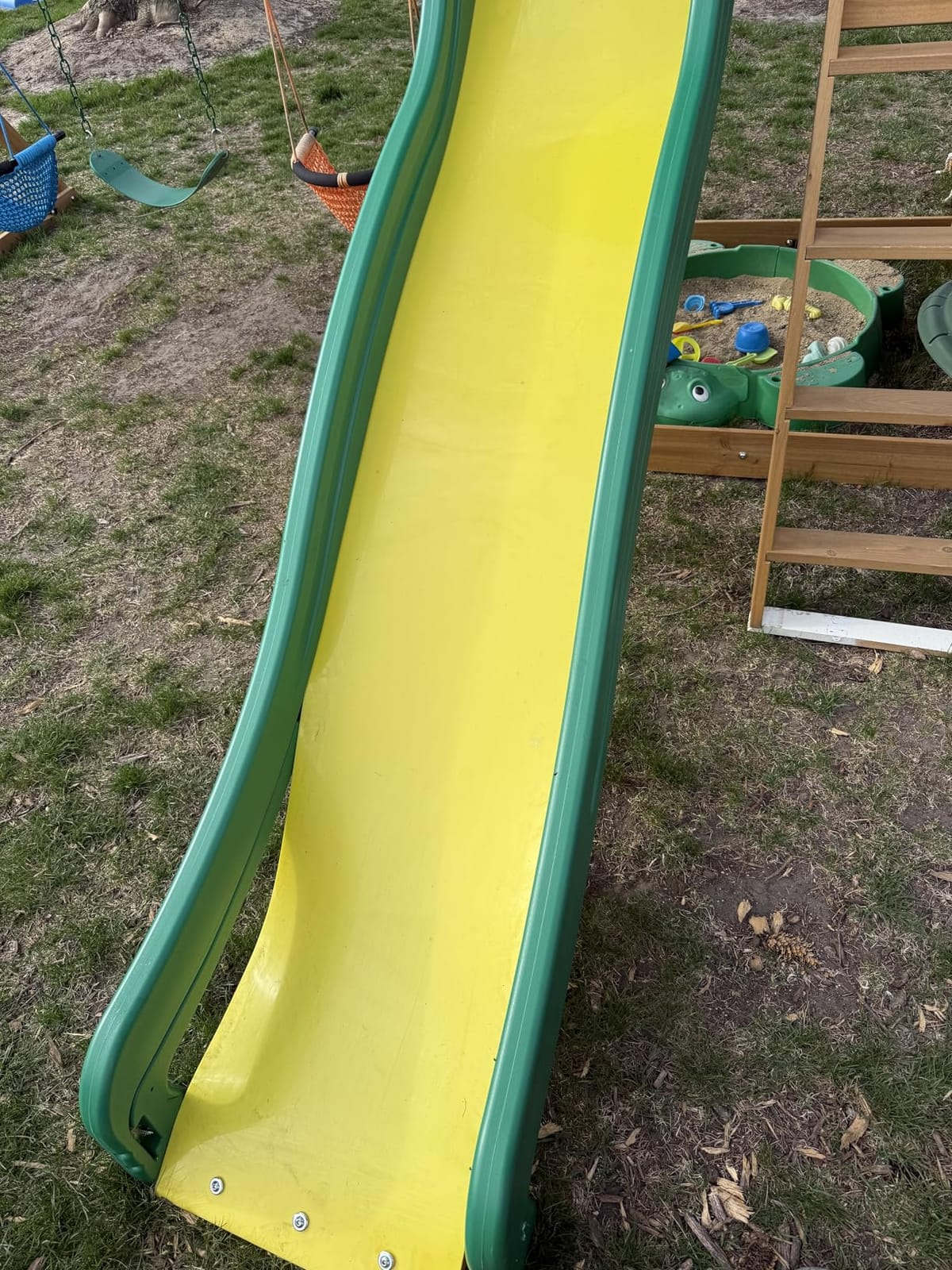
Below the deck there is a shaded sandbox area, a steering wheel and a toy telescope, and above it an eight-foot wave slide with two belt swings and a trapeze. Reviewers describe it as built for larger families rather than a single-child climber.
Cedar again carries the load-bearing work, with the same natural decay resistance as the Buckley Hill. The set is designed for play areas serving up to ten children and carries a five-year warranty.
Does it fit a normal suburban yard?
That is the first question to answer. At 186 inches wide by 150 inches deep, it needs roughly a 16 by 13 foot clear area plus fall zone on the climbing faces. In a typical city backyard, that is the whole lawn.
Measure before you order anything. If the space is tight, the mid-size cedar sets give you a real rock wall at a smaller footprint.
Can two children actually climb at once?
Yes, and that is what the extra width is for. The rope assist holds for a second climber while one child is on the wall, which is what reviewers praise most when they have more than one child on site.
The trade is assembly. At 308 lb this is a multi-hour build with a second adult. Cedar also needs re-staining to keep weathering up.
6. TP Explorer 2 Jungle Gym – Best Set That Adjusts as Your Child Grows
Explorer 2 Jungle Gym Climbing Set with Adjustable Steel Frame, Weather-Resistant Canopy & Platform, Outdoor Playset and Playground Equipment for Kids Ages 3-12, 220 lbs Capacity
Galvanized steel
Ages 3 to 12
Frame adjusts 22 in to 47 in
220 lb capacity
53.8 lb
Pros
- Frame expands from 22 in to 47 in
- Ages 3 to 12 with 220 lb capacity
- Folds down for storage
- Explorer playmat included
- Four-player capacity
Cons
- Highest 1-star share at 9 percent
- Steel can develop surface rust
- Vinyl parts wear faster than plastic rivals
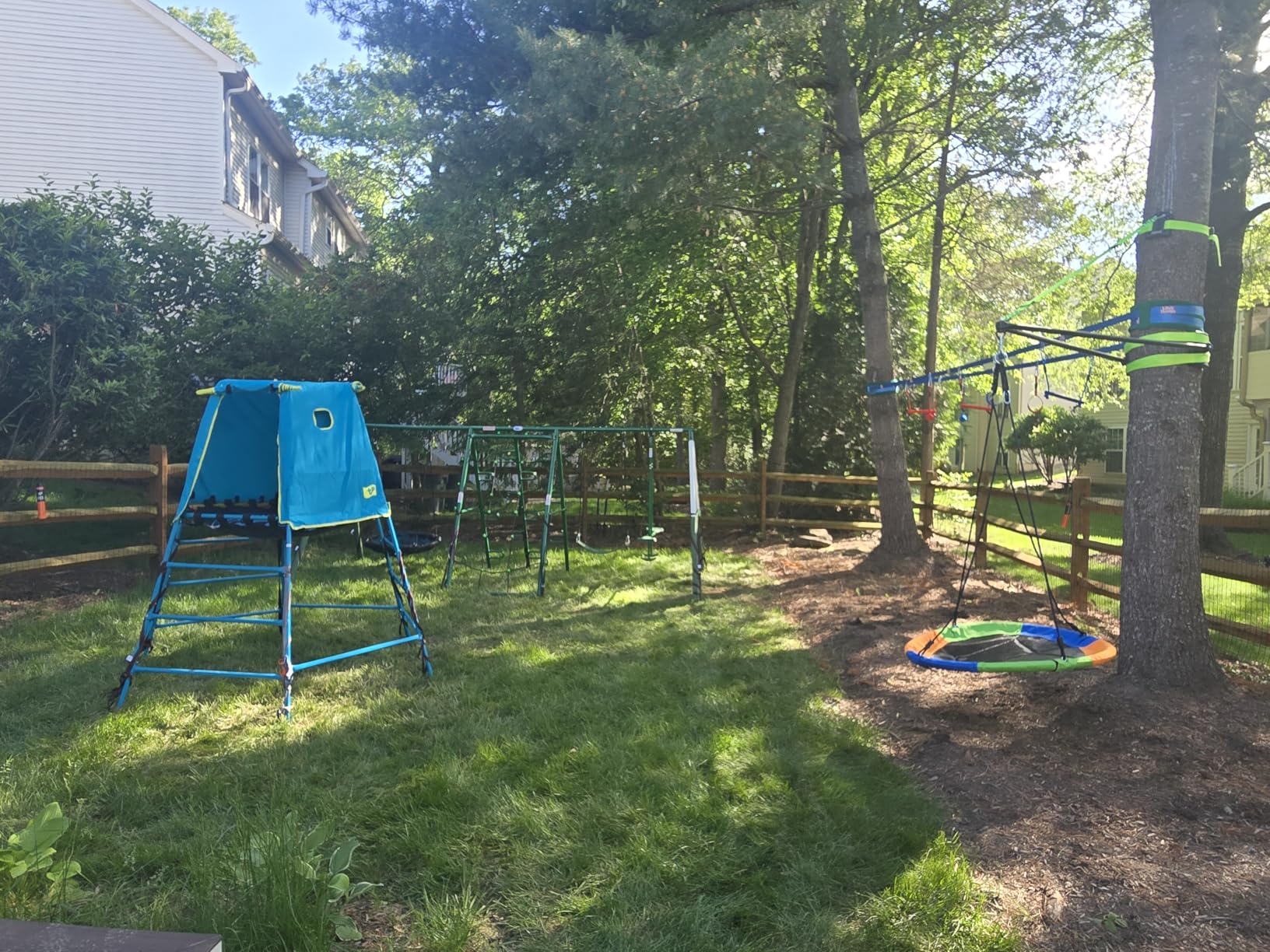
The adjustable steel frame is what separates this from every plastic climber here. It expands from 22 inches to 47 inches, so the same frame serves a three-year-old and a nine-year-old, and the age range runs from three to twelve with a 220 lb capacity.
At 4.3 stars across 456 ratings it sits mid-pack, but the durability feedback is mixed in a way worth knowing about. Owners like the adjustability; several report surface rust appearing on the steel after a few seasons outdoors.
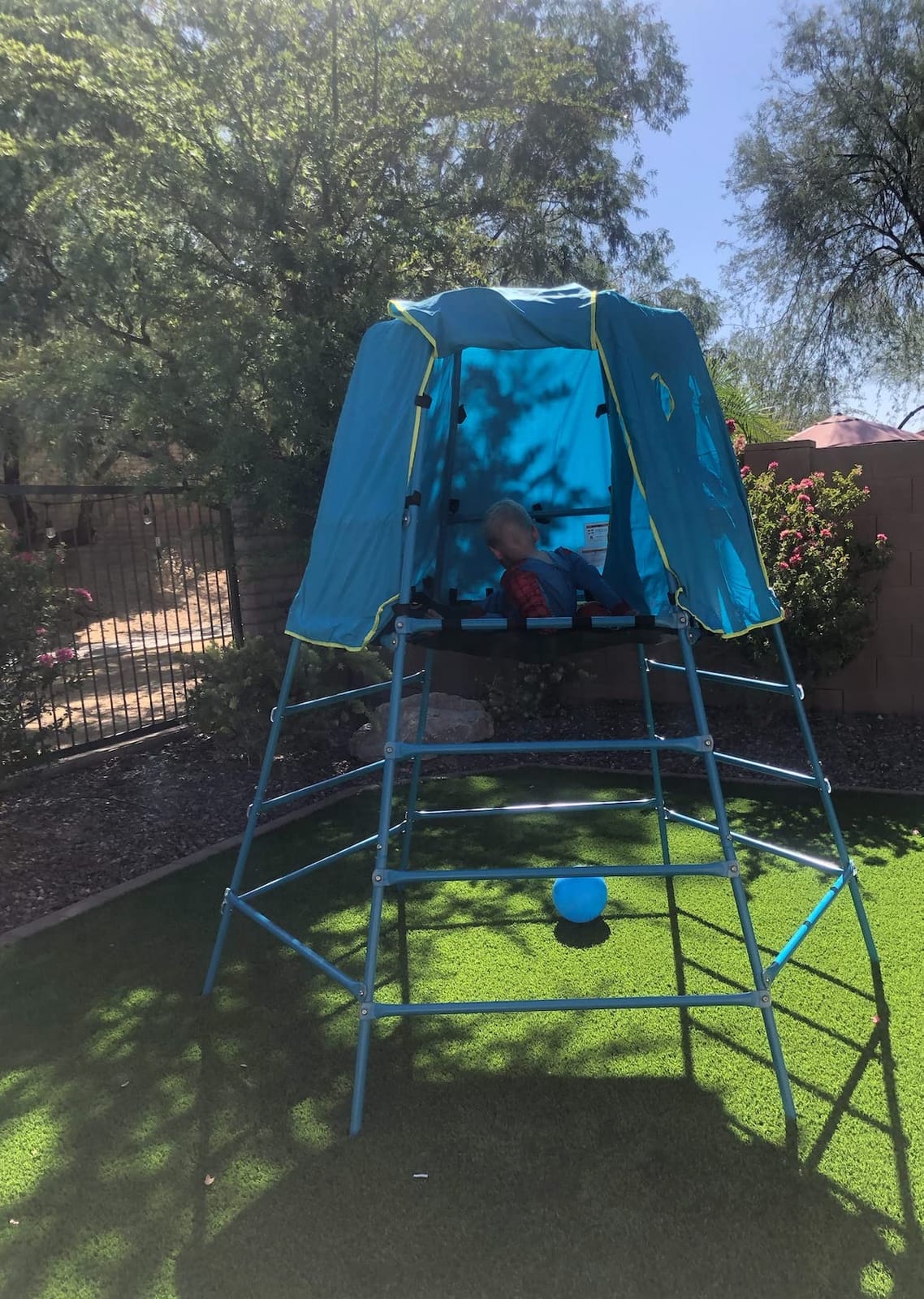
The frame folds down, which is unusual at this capacity and makes garage storage realistic. A weather-resistant canopy and a vinyl platform cover the top, and an explorer-themed playmat comes included to soften the ground underneath.
Four children can use it at once, and the footprint is more compact than a wooden playset of the same age range. It is one of the few options that does not demand a dedicated corner of the lawn.
Does the adjustable frame really grow with your child?
It genuinely does, which is rare in this category. Most competitors are fixed-height and age-stamped, so a structure bought for a four-year-old is wasted by age six. Raising this frame by a few inches is the difference between a play structure that lasts ten years and one that lasts four.
The catch is that the adjustment changes the climbing difficulty as well as the height. That is a feature, not a defect.
How does steel hold up outdoors?
Galvanized steel resists corrosion better than raw steel, but it is not plastic. Owners report surface rust developing outdoors over time, and the vinyl platform and canopy wear faster than the double-walled plastic used by the plastic-frame rivals.
Rinse it down and touch up the frame annually if you live somewhere damp. If you live somewhere dry and sunny, the vinyl will outlast your expectations.
7. Step2 Skyward Summit – Best Real Rock Wall for Ages 4 to 8
Step2 Skyward Summit for Kids, Climbing Wall Playset for Toddlers, Ages 4 –8 Years Old, Easy to Assemble Kids Outdoor Playground for Backyard
Plastic
Ages 4 to 8
80 in H x 80 in W x 52 in D
6.5 ft rock wall
300 lb capacity
Pros
- True 6.5 ft four-sided rock wall
- Over 100 sq ft of climbing area
- 300 lb capacity
- Junior-sized grips for small hands
- Cargo nets and top lookout platform
Cons
- Instructions widely criticised as unclear
- Ladder needed for assembly
- Two adults required for nets
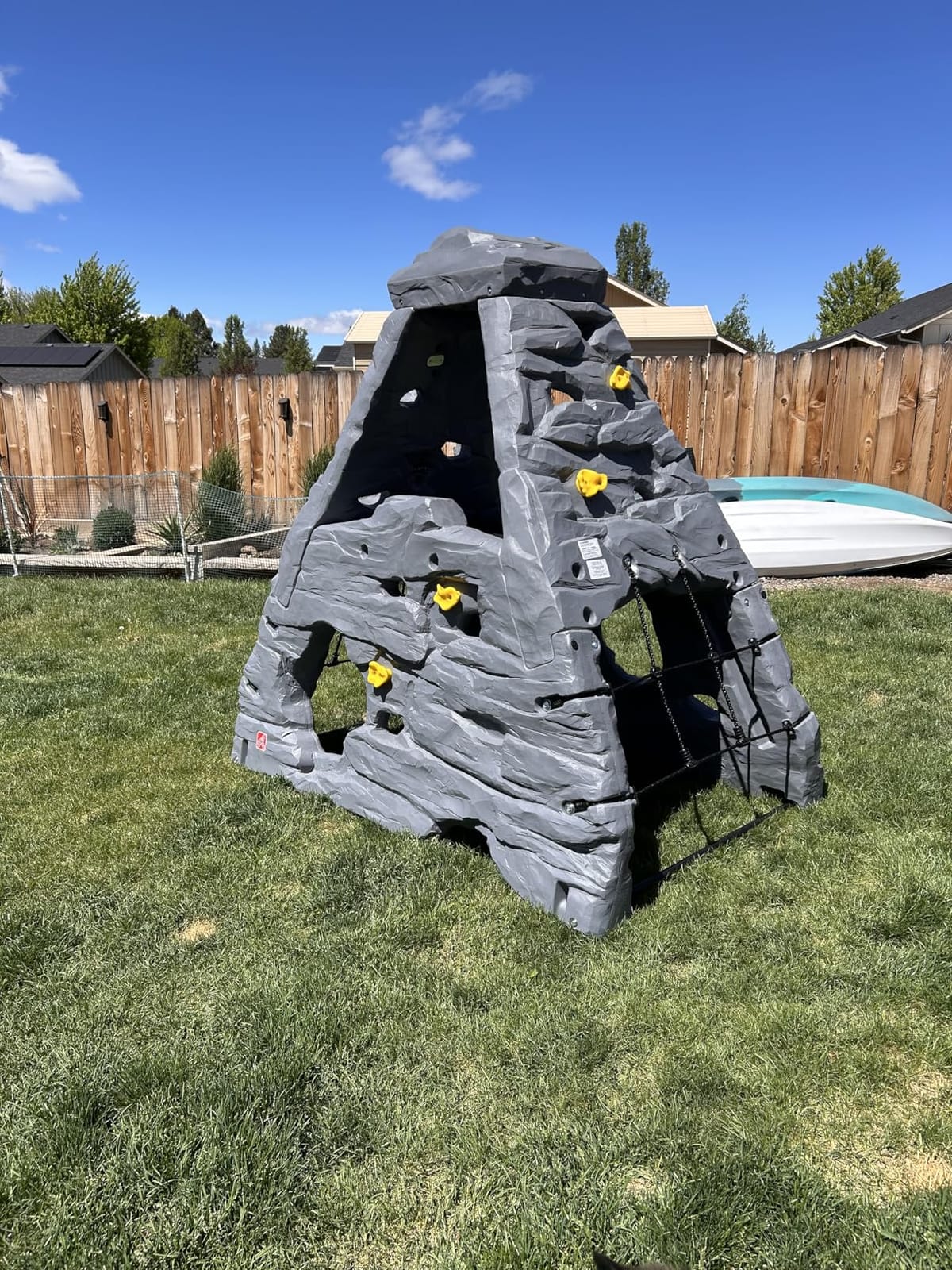
This is the most genuinely climbing-oriented option we tested, and it has a true vertical rock face at a height children can actually work. At 4.5 stars across 435 ratings, it also carries a 300 lb capacity, enough for multiple children and adults without tipping.
The four-sided wall stands six and a half feet tall with nine hand grips sized for small hands, and there are cargo nets, a one-floor net and a top lookout platform. Over 100 square feet of climbing area is a lot of surface for a backyard structure.

Owners report a decade of outdoor use with no fading, cracking or broken webbing, including reports from Pennsylvania winters. The hollow double-walled plastic is light enough for one adult to reposition but shaped to resist wind.
At 300 lb it takes multiple children and adults without tipping, which is what makes it useful for a household with a wide age spread rather than a single climber.
Is a 6.5 ft wall safe for a four-year-old?
For most four-year-olds, the top is not the point. The lower two-thirds of the wall has junior-sized grips and is genuinely climbable by a small child, and the lookout platform sits at a height adults can supervise from the ground.
Supervision still matters. The manufacturer rates it for ages four to eight, which is a narrower window than the 300 lb capacity suggests.
Is the assembly worth the trouble?
You will want to budget time and a second adult. Reviewers repeatedly call the instructions the worst they have worked from, and the top platform and cargo nets need two people to fit together. A ladder is required for assembly and is not clearly flagged in the documentation.
If you are not keen on a full-day build, pick a plastic climber with fewer nets. The payoff once it is standing is a real wall, though.
8. Gorilla Playmaker Deluxe – Best Long-Warranty Cedar Swing Set With Climbing
Gorilla Playsets Playmaker Deluxe Wooden Swing Set with Vinyl Canopy Roof, Dual Wave Slides, and Rock Climbing Wall, Redwood Stained Cedar
Cedar
Ages 3 to 11
174 in W x 142 in D x 118 in H
800 lb
300 lb
Pros
- 10-year warranty on the lumber
- 4 in x 4 in cedar framing
- Dueling wave slides plus rock wall
- Pre-cut and pre-drilled lumber
- Rubber-coated swing chains
Cons
- 6 to 8 hours assembly with 2 adults
- Boards and rungs split in delivery
- Missing hardware and narrow slide channels reported
This set carries the longest structural warranty we found, at ten years on the lumber, and the framing is genuinely heavy: four-by-four cedar posts with a four-by-six swing beam. That is a structure intended to stay put for a decade.
At a 4.1 average across 344 ratings it is the lowest-rated product here, with eleven percent one-star reviews. Owners who receive a complete kit describe a very sturdy, good-looking cedar structure that children love.
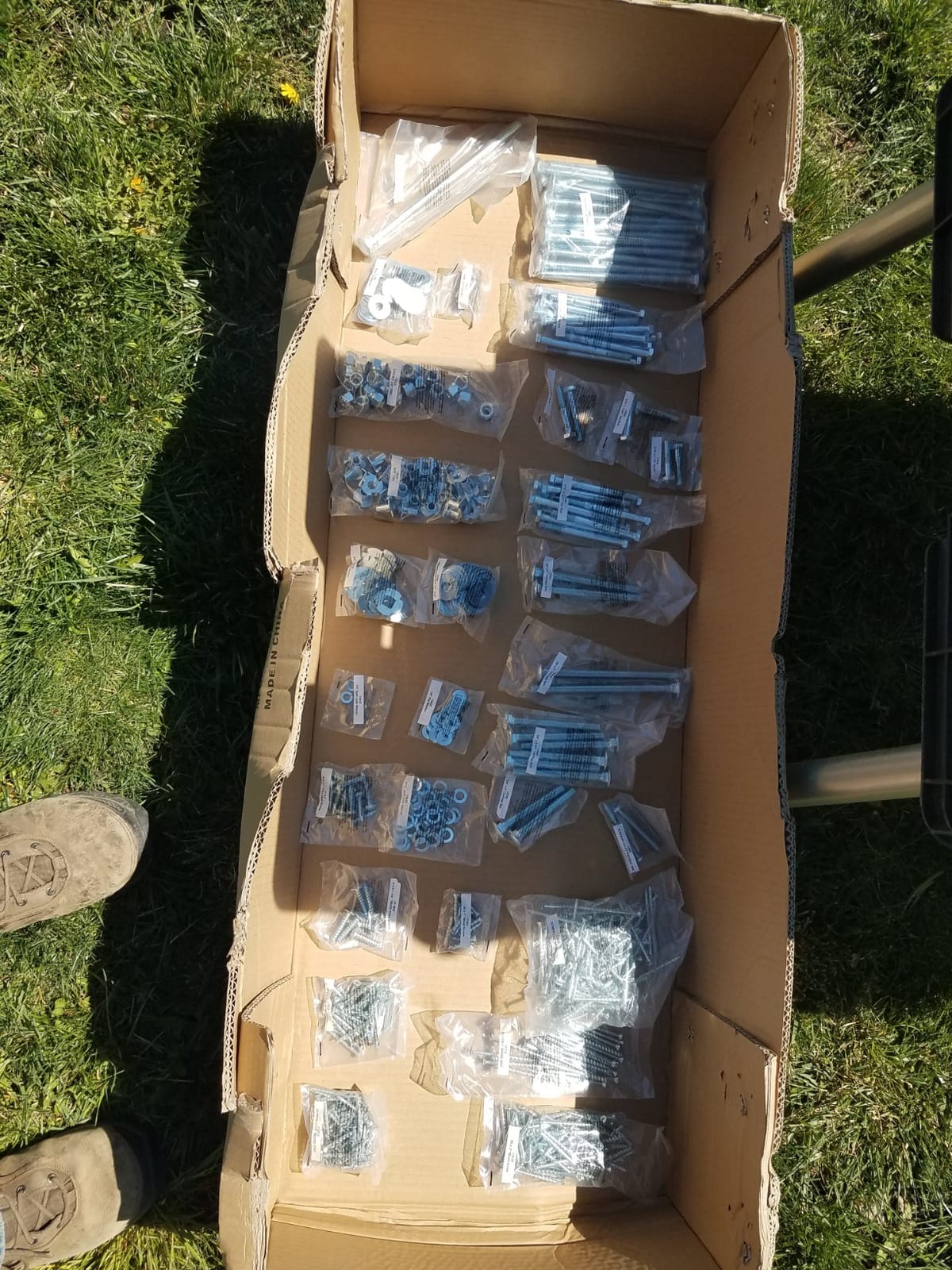
The feature list is long: two Alpine wave slides for racing, a rock climbing wall, two belt swings, a trapeze, a built-in sandbox, a steering wheel, a working telescope compass, a tic-tac-toe panel and a chalkboard under a vinyl canopy roof.
Safety details are thoughtful for the price point. Swing chains get a soft rubber grippy coating to prevent pinching, and bolts are recessed so nothing snags clothing.
What does the 10-year warranty actually cover?
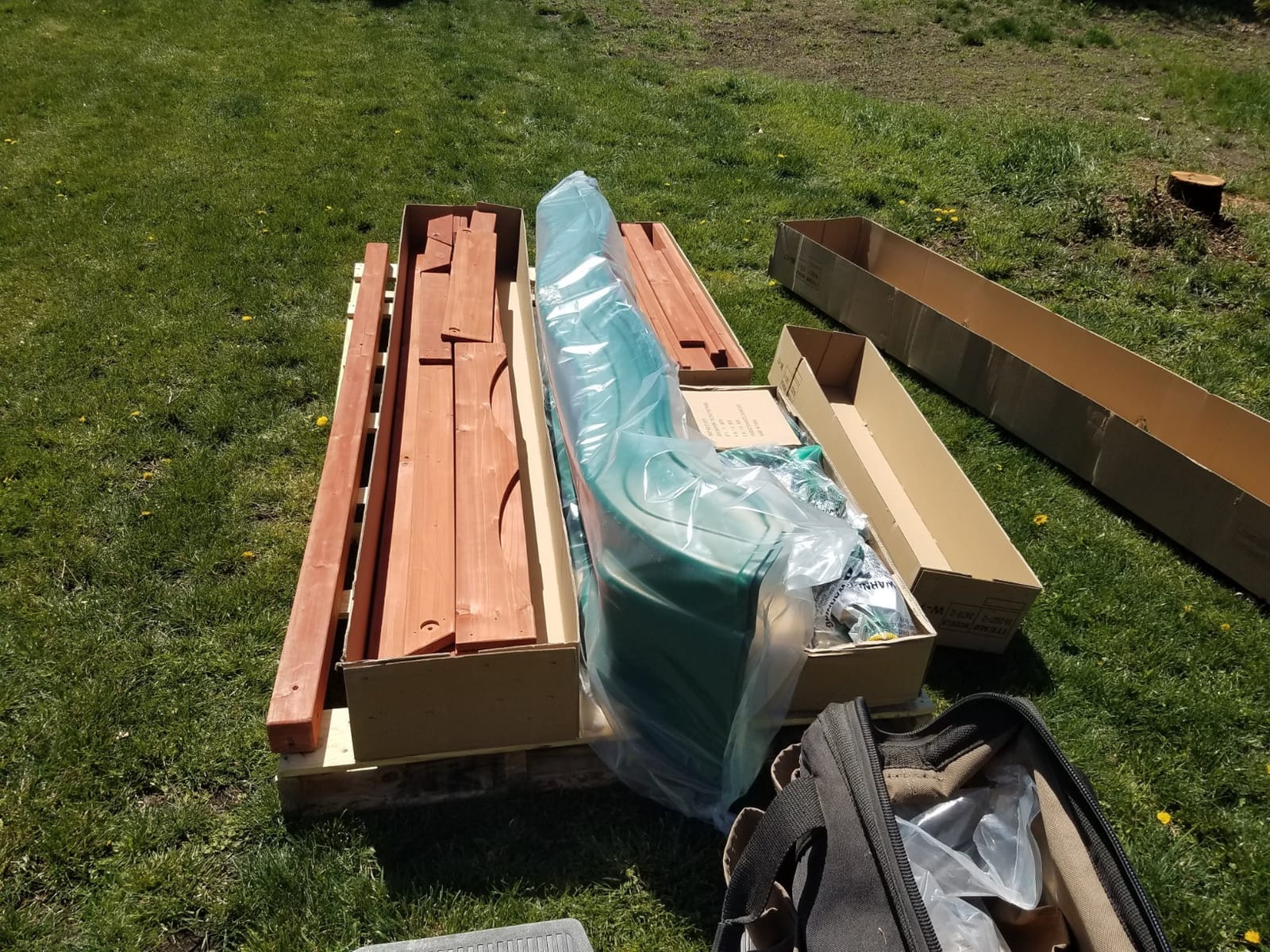
Ten years on the lumber, one year on everything else. Slides, canopies, swing chains and hardware sit outside the long coverage, which is standard for this category but worth knowing before you assume the whole set is decade-protected.
The lumber itself is the part most likely to matter. Cedar boards that have survived a decade of sun and rain are the reason this frame outlasts cheaper sets.
Is a cedar kit this size manageable to build?
Budget six to eight hours with two adults, and expect longer in practice. Lumber arrives pre-cut, pre-sanded and with main beams pre-drilled, which shortens the job but does not remove it.
The recurring complaints are logistics rather than design: split boards and climbing rungs arriving damaged, and missing hardware or missing accessory boxes. Inspect every board before you start. The narrow, deep slide channels suit toddlers but feel tight for older children, so check that against your child’s age.
9. Lifetime Adventure Tower Deluxe – Best Playset for Teens and Adults
Lifetime Adventure Tower Deluxe Swing Set Playset Lifetime Adventure Tower, Covered Clubhouse, 9 ft Wavy Slide, Monkey Bars, Climbing Wall, Fireman’s Pole, Belt Swings & Trapeze
HDPE and steel
0 to 12 years
234 x 194 x 129.6 in
9 ft wavy slide
795 lb
Pros
- Multiple climbing routes including monkey bars
- No splintering or cracking like wood
- Covered clubhouse with lookout
- 9 ft UV-protected wavy slide
- Rubber-coated chains and capped edges
Cons
- Shifts and rocks when several children swing
- Only two ground anchors included
- Large gaps where insects nest
This is the one structure here that older children and parents report using together, which is the main reason it appears in a roundup about kids. Monkey bars, a fireman’s pole, a ladder and a climbing wall give four separate ways up.
Steel and high density polyethylene mean nothing splinters or cracks as cedar eventually does. At 4.5 stars it is well rated, though the review base is small at 43 ratings, so treat the feedback as thinner than the average product here.

The hardtop covered clubhouse has a lookout, a ship’s wheel and a car map built into it, and the nine-foot wavy slide is UV-protected. Two belt swings and a trapeze complete the swing stations, all on rubber-coated chains.
Edges are rounded or capped and no lead-based materials are used, which is the kind of detail that matters on a structure this large and this close to a patio.
Will it hold adult weight?
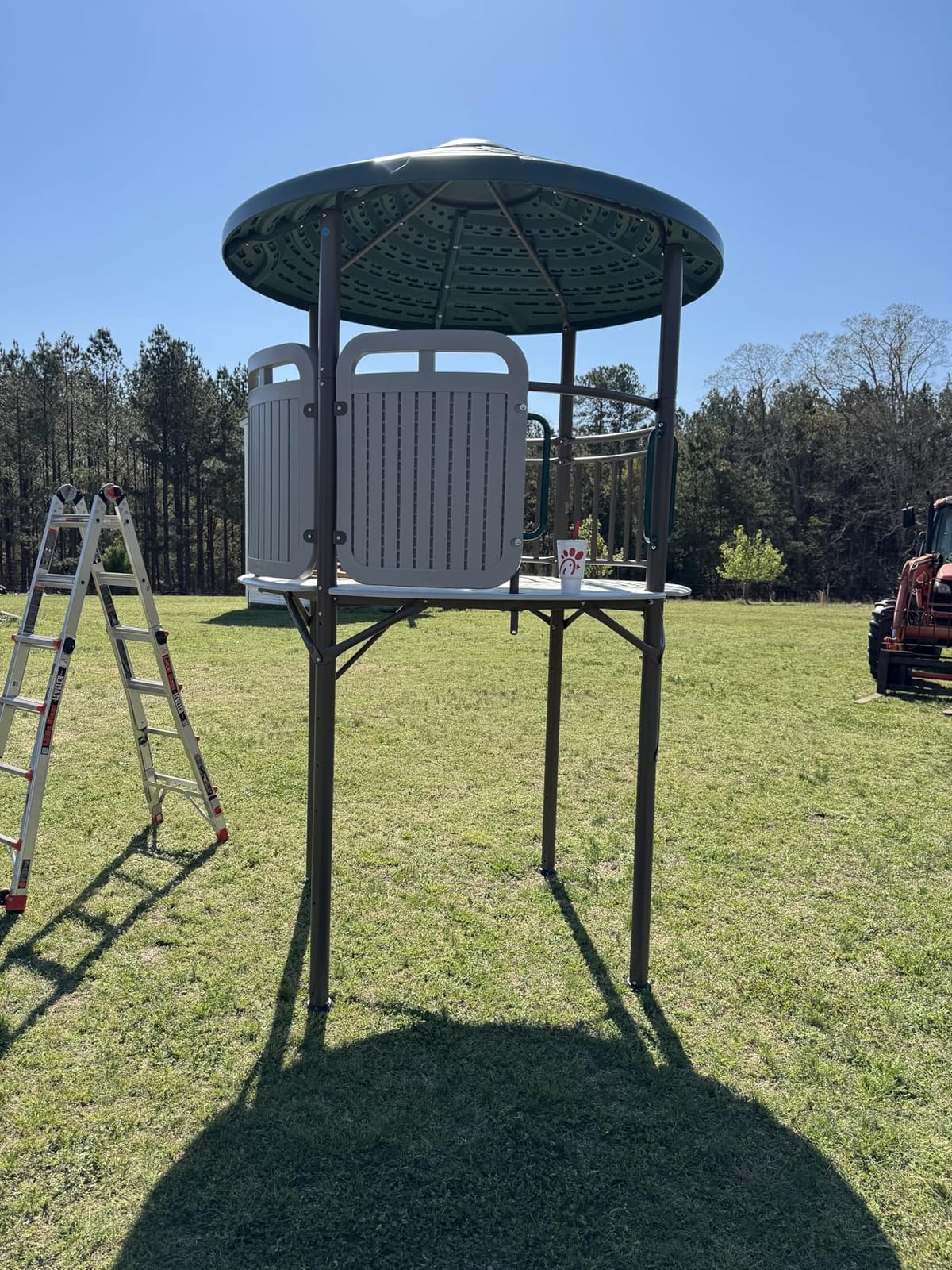
Reviewers describe the build quality and sturdiness as excellent, particularly compared with wooden sets of the same class, and older children and adults do climb it. That is exactly what separates this from the toddler-scale options at the other end of the roundup.
The 234 by 194 inch footprint is the deciding factor. This needs a genuinely large yard and a level base area.
Are two ground anchors enough?
Owners say no, and it is the most consistent complaint in the reviews. The unit shifts and rocks when several children swing at once, and only two ground anchors are included. The structure also arrives with large panels and bolts that leave gaps where insects nest.
Plan on adding anchors yourself before first use. Assembly takes eleven or more hours for one experienced builder, against a stated eight hours for three people, and some units arrive with bolts short enough to require drilling your own holes.
10. Backyard Discovery Shenandoah – Most Holds on the Rock Wall
Backyard Discovery Shenandoah Cedar Wood Swing Set with Wave Slide, Raised Clubhouse, Playhouse, Play Kitchen, Belt Swings, Trapeze, Rock Wall, Ladder, Picnic Table, Full Door, Outdoor Playset
Cedar
Ages 3 to 10
213 in W x 140 in D x 125 in H
481 lb
12 holds
Pros
- Rock wall with 12 holds
- Built-in playhouse with kitchen and door
- Picnic table and snack bar window
- Solid cedar lumber
- 5-year warranty
Cons
- 2 to 3 day assembly with 96 steps
- 10 ft slide ejects small children
- Boards arrive uneven and misaligned
The Shenandoah carries one of the largest rock walls we found, with twelve holds. At a 4.2 average across 134 ratings, reviewers consistently praise the climbing wall, the lumber and the playhouse.
The lower level is a full playhouse rather than a bare platform: a kitchen with a toy stovetop, a sink, a cordless phone and a working front door. A snack bar window with an attached picnic table creates a second hangout zone away from the climbing.
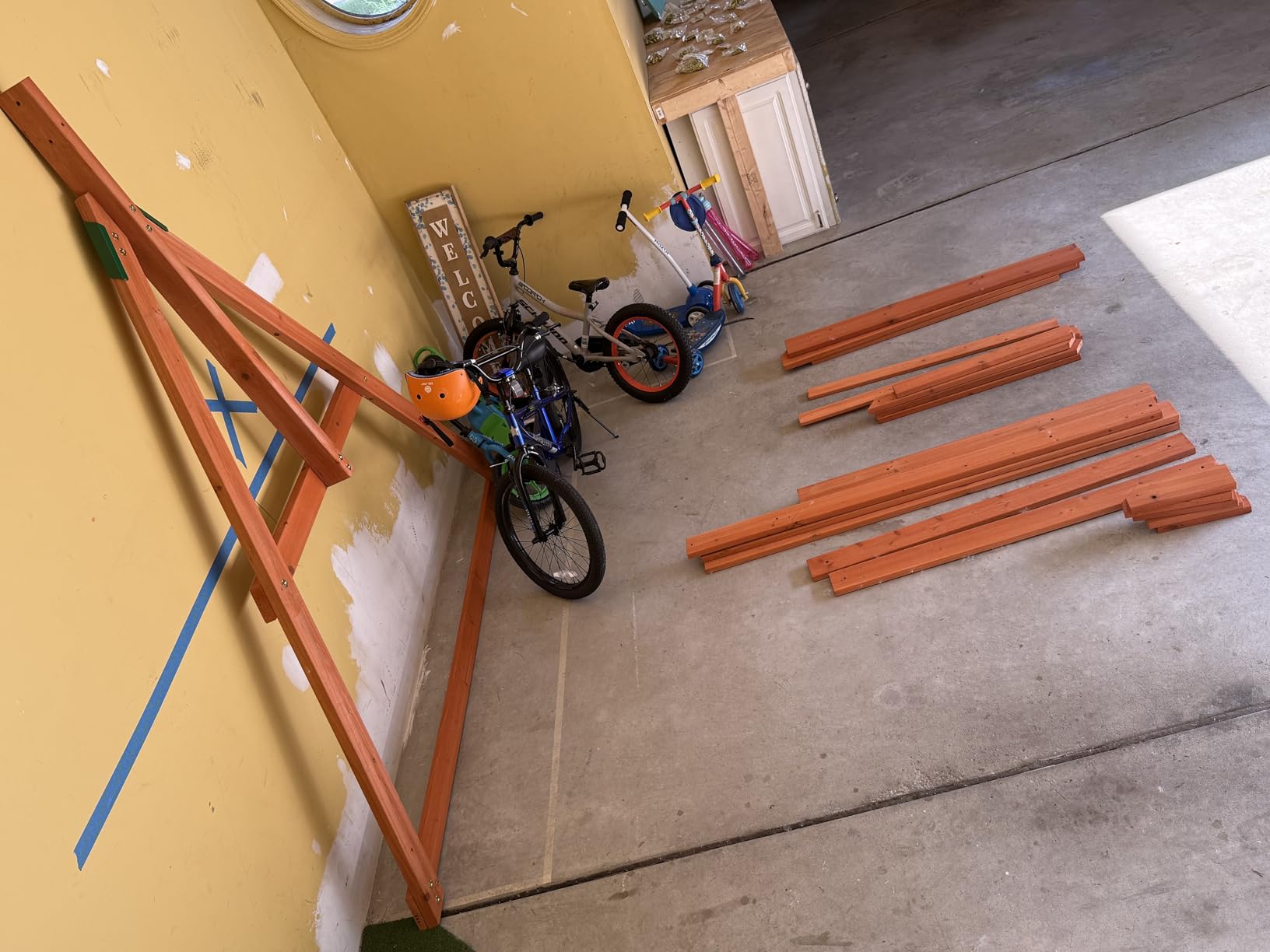
Above, the raised clubhouse has a wooden roof and windows with a wide step ladder, plus a ten-foot wave slide, two belt swings and a trapeze. Cedar with a burnt sienna stain carries the structure, and the set is rated for play areas serving up to nine children.
The built-in picnic area is what turns this from a climber into a backyard gathering space. Owners report the solid lumber withstanding moves and even relocations.
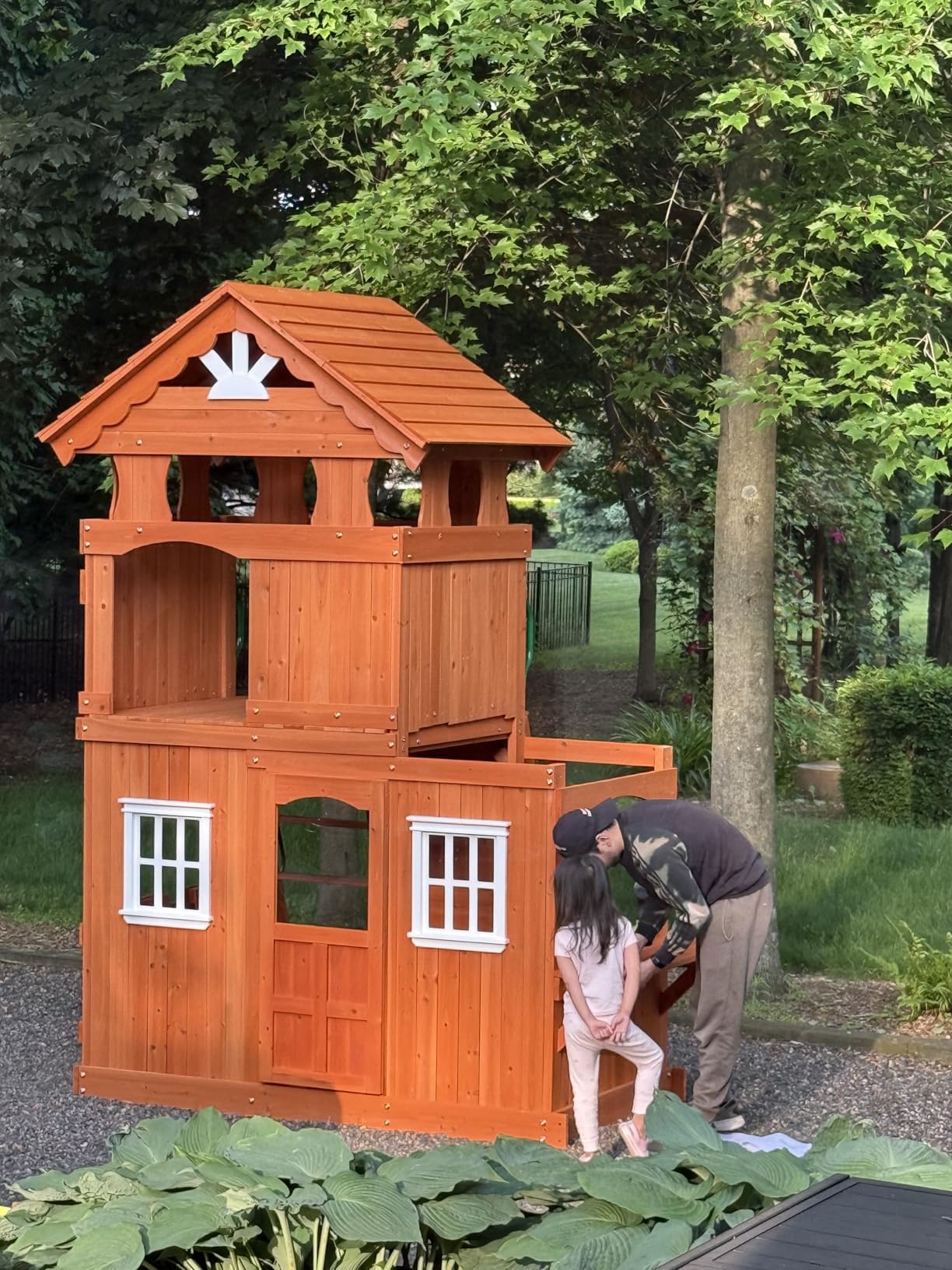
Is the 12-hold rock wall worth the build time?
If climbing is why you are shopping, yes. Twelve holds give enough variety for a real route rather than a scramble, and it is the largest climbing face here. If the wall is incidental to a playset purchase, a smaller set gives you the same wall for a fraction of the effort.
The assembly is a two-to-three day job with roughly a thousand pieces and a 96-step manual, so treat the wall as part of a bigger build rather than a weekend project.
Is the 10 ft wave slide safe for toddlers?
This is the split in owner feedback, and it is worth taking seriously. Several reviewers report the slide ejecting small children off the bottom exit, and describe the slide itself as flimsy. Three swings crammed onto a narrow beam also means older kids collide.
If your youngest is under four, check the slide exit run-out area and consider a set with a shorter slide. Some boards also arrive cut unevenly with misaligned pre-drilled holes, so inspect before building.
11. Simplay3 Young Explorers – Best Modular Set for Indoor and Outdoor Use
Simplay3 Young Explorers Modular Play System, Kids Activity Outdoor Playset for Children Age 18 mos – 6yrs, Toddler Playground Slide, Climb and Playhouse
Plastic
18 months to 6 years
139 x 82 x 51 in
3 modules
128 lb
Pros
- Three connected modules in 12 layouts
- Weather and UV resistant double-wall plastic
- Rounded child-friendly edges
- Indoor or outdoor placement
- Made in Ohio
Cons
- Small for children aged 4 and up
- Modular joints can crack in rough use
This is the only system in the roundup that reconfigures into twelve different layouts, and that flexibility is the reason owners rate it. At a 4.4 average across 107 ratings, families describe reconfiguring it to fit small spaces or moving it indoors for winter.
Three modules connect to form a playset: an Adventure Climber with slides and climbing ramps, a Discovery Playhouse and an Activity Climber with a crawling tunnel, easel, kitchenette, steering wheels, mail slots and double doors.
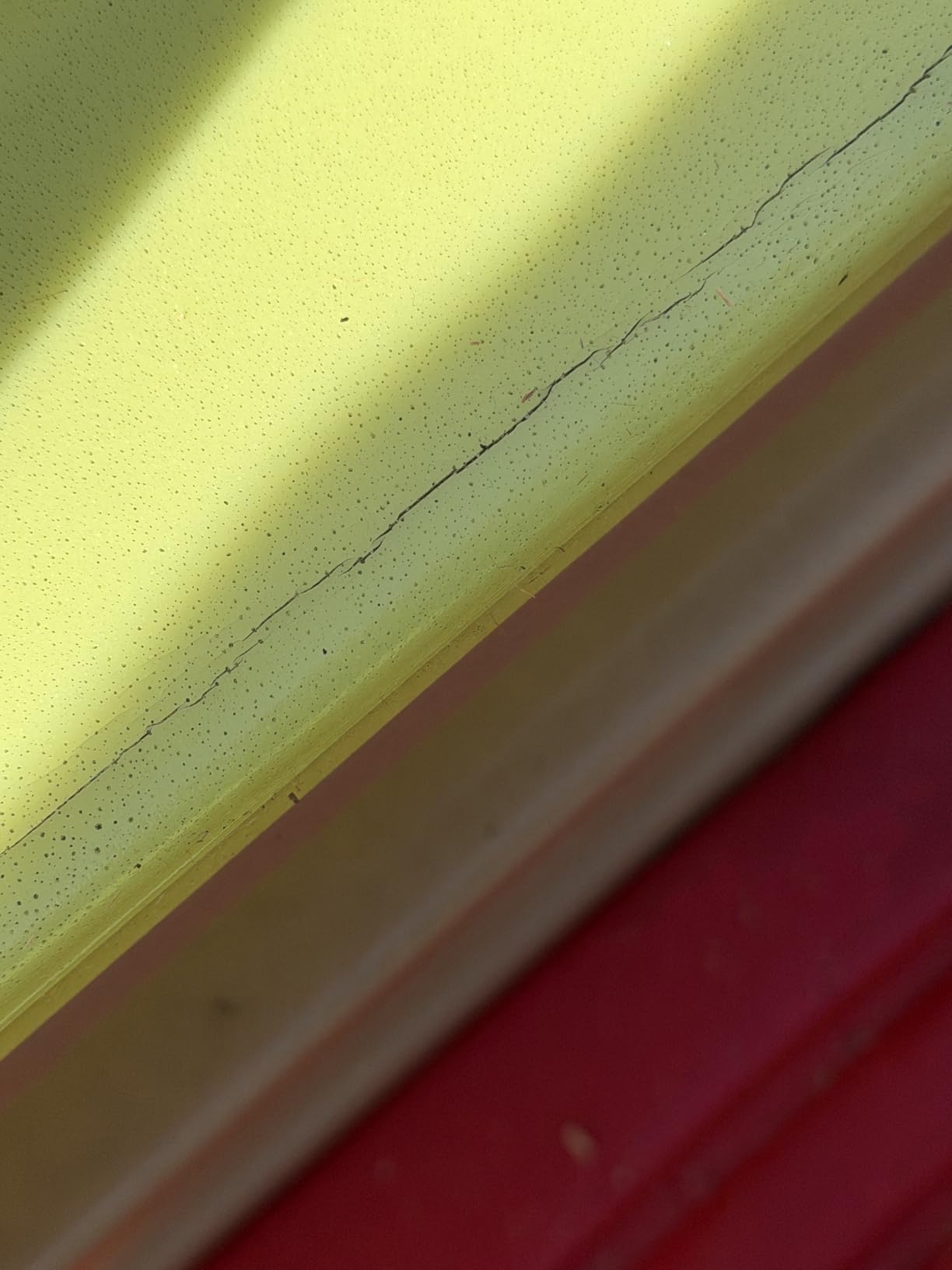
The double-wall plastic has rounded, child-friendly edges and is weather and UV resistant, which is why it can live in a playroom and outside. It was designed and manufactured in Ohio.
At 18 months to six years, it starts younger than anything else here. Crawling tunnels, a kitchenette and an easel keep non-climbing children involved alongside the climbers.

Can one set work indoors and outdoors?
Yes, and that is the strongest argument for it. Most plastic play equipment in this roundup is sold for outdoor use only, and the double-wall plastic here is what makes indoor placement realistic without a dedicated playroom.
The twelve layouts also solve the small-yard problem. In a narrow side yard you can run the modules in a line rather than as a cluster.
How long does the plastic really last with toddlers?
Owners with rough, rowdy preschoolers report the double-wall plastic holding up well, which is the use case it was designed for. The complaints that do appear involve modular joints and plastic pieces cracking under hard play.
The real limit is age, not durability. At six years old most children are too tall for it, so plan on moving up to an eight-plus structure at that point rather than replacing broken parts.
12. Avenlur Palm 5-in-1 – Compact Timber Climber for a Patio or Side Yard
Avenlur Palm 5-in-1 Wooden Outdoor Playground for Toddlers – Montessori Climbing Playset with Ladder, Rock Wall, 4-ft Slide & Tent Fort – Indoor/Outdoor Backyard Play Structure for Kids Ages 2-6
FSC-certified timber
Ages 2 to 6
82.7 in L x 42 in W x 38.4 in H
110 lb per child
52 lb
Pros
- Five play stations in a compact footprint
- FSC-certified solid timber
- 110 lb per child and 500 lb total
- Usable indoors or outdoors
- Fits patios and playrooms
Cons
- Modest 3.5 ft height
- Only 35 ratings to judge it by
The Avenlur Palm is a compact genuine climbing structure built from FSC-certified solid timber rather than plastic. At a 4.3 average it is well rated, but with only 35 ratings the feedback is thinner than anything else in the roundup.
Five play stations pack into an 82.7 by 42 inch footprint: a ladder, a rock wall climber, a four-foot slide, a playhouse tent and a climbing structure. The Montessori-style open-ended play gets the highest four-star share in the group at 24 percent.
Timber rather than plastic means no sun-bleaching and no cracked joints, and the structure works on a patio, in a side yard or in a playroom. Rated from 24 months to six years with a 110 lb per-child limit and 500 lb total.
The climb itself is open-ended, which suits younger children who are not ready for a walled rock face. Owners describe it as more of a toddler climbing structure than a true rock wall, and we would agree.
Does it fit a patio or a side yard?
That is where this one earns its place. At 42 inches wide and 38.4 inches tall it clears a narrow side yard or an apartment terrace in a way the bigger playsets here cannot, and the tent and slide give a full play set in that footprint.
Measure the fall zone as well as the structure. A 42 inch wide climber still needs soft surfacing beneath and in front of it.
Is 3.5 ft high enough to feel like climbing?
High enough for a two to six year old, no. There is no vertical face to work upward on and no overhang to negotiate, so a child who is ready for real climbing will move past it quickly.
Given only 35 ratings, durability feedback is limited. Check every bolt after the first month of use, and treat the wood as a structure that will need inspection each spring like any other outdoor timber.
How to Choose a Backyard Climbing Wall in 2026
Most mistakes happen before a single product is picked, and they come down to matching the wall to the child, the child to the yard and the yard to the fall zone. Work through these seven questions in order.
1. How old is the youngest child, honestly?
Match the stated age range, not the child’s current size. A structure rated two to six will be outgrown in about three years; one rated to ten or twelve can absorb a wider age spread in one household. If siblings are more than three years apart, a narrow age band is a false economy.
2. How much clear space do you have?
Measure the footprint and then the clearance around it. The big cedar sets need roughly a 16 by 13 foot clear area before fall zone is considered. For a side yard or a patio, the realistic options are the modular plastic system and the compact timber climber.
3. Which wall type suits your child?
Molded plastic surfaces are cheap and never re-route. A hold-based panel drilled with a T-nut grid accepts screw-on holds you can move as your child improves, which is the only design that grows with a child’s strength. Cargo nets and monkey bars train grip and upper-body strength rather than finger strength.
Under 4 ft suits ages 2 to 3, where most feet touch the ground and the wall works as a confidence and coordination tool. Between 4 and 6 ft covers ages 4 to 7, a full reach for a child who can grip a jug hold confidently. A 6 to 7 ft wall suits ages 8 to 11, giving a real route with multiple sequences and a top-out. Anything at 8 ft and above is aimed at children 12 and up plus adults, and needs adult-strength anchors and a large structure.
4. How high should a wall be for a seven year old?
Roughly four to six feet of climbable height. That is high enough to require a planned sequence of moves and low enough that an adult can lift a child off the top. Above about seven feet, most seven year olds can reach the top on almost any route, which removes the problem-solving value.
5. What do you do about difficulty as they improve?
Only a screw-on hold system lets you re-route. With molded plastic you are limited by what the manufacturer moulded. The practical workaround is to move to a structure with more height and a harder second route, rather than trying to make the same wall harder.
6. What materials survive your weather?
Double-walled plastic with UV protection fades slowly and never rots. Cedar resists decay naturally but needs re-staining annually to hold its finish. Galvanized steel rusts at contact points over several seasons. Rinse any structure down in winter and check bolts each spring.
One warning worth repeating from DIY builders: skip clear coats on exterior climbing surfaces. A glossy stain is the fastest way to make a climbing wall slick and dangerous in the rain.
7. How many children will use it at once?
This is the constraint most shoppers miss. A single-face rock wall queues children. Double-sided walls, cargo nets and wide double rock walls let two or three climb simultaneously, which matters more to a family than any individual feature.
Also read the published capacity honestly. The 60 lb limit on the Game Time Sports Climber and the 300 lb limit on the Skyward Summit are a four-year and a fifteen-year product respectively.
Build vs. Buy: What a DIY Climbing Wall Actually Takes
Building a wall yourself is a real option, and home climbing enthusiasts overwhelmingly favour reusing an existing swing set frame as the base. It is cheaper and far easier than a freestanding build, and it avoids a flaw parents hit repeatedly: walls mounted to an older swing set inherit its crooked frame and cause trimming problems.
A standard 8 by 8 foot wall needs a pressure-treated 2×4 frame, two sheets of three-quarter inch exterior plywood, a drilled hole grid with T-nuts, socket-head bolts and a hold set. The hole grid is the spec that matters: a seven-sixteenths inch bit, holes eight inches apart and four inches from the edge.
The most common DIY failure is hold bolt length. Bolts that are too long punch through the plywood and knock the T-nuts out of the back, which is why matching bolt length to plywood thickness before drilling matters more than the drilling itself.
For weatherproofing, community advice is consistent: use treated wood, buy quality hardware, and cover the wall with a tarp if you can. Users describe the finished wall as an investment and a long-term family build rather than a weekend project, and that framing is accurate. Buy a retail kit if you want it standing this weekend; build it if you want to re-route holds in three years. If you would rather skip the drill entirely, our roundup on the best climbing domes for kids covers the fastest-to-assemble ground-level option.
Safety First: Fall Zones, Surfacing and Weight Limits
Measure the fall zone before you measure the wall. The clearance space, not the climbing surface, decides whether the wall is safe.
Fall surfacing matters more than most parents expect. Loose-fill mulch needs a maintained depth measured and topped up, and bare grass, soil and concrete are the worst options under a climber. Rubber tiles or poured rubber surfacing cost more upfront but need no maintenance and stay effective through a dry summer when mulch has scuffed away.
Clearance matters in a small yard more than a large one. Keep the space in front of every climbable face free of hard surfaces, obstacles and swing seats, and check the fall zone again once the structure is assembled, because assembly shifts frames slightly.
On weight limits, use the published figure and do not exceed it, particularly on plastic structures where the limit reflects the frame and fasteners rather than the climbing surface. Every set in this roundup states a limit, and the range across them is enormous, from 60 lb on the Step2 Game Time Sports Climber to well over 1,000 lb on the largest cedar structures.
Finally, inspect twice a year. Check every climbing bolt, every anchor point and the fall surfacing depth in spring before the first warm day, and again in autumn. Most injuries on backyard structures come from loose hardware or depleted surfacing, not from the climbing itself.
Frequently Asked Questions
What is the best outdoor climber for toddlers?
The best outdoor climber for toddlers is usually a molded plastic structure with an entry route below four feet and a published weight limit around 60 to 110 lb. Our top toddler pick is the Step2 Game Time Sports Climber at 42.5 inches tall with a 60 lb maximum, because double-walled plastic survives seasons and the under-deck area adds hide-and-seek play. A 4.7 average across more than four thousand owner ratings backs that up. For a side yard or patio, the compact Avenlur Palm does the same job in a much smaller footprint.
How high should a 7 year old climb on a fun wall?
For a 7 year old, aim for four to six feet of climbable height. That is high enough to need a planned sequence of holds and low enough that an adult can lift a child off the top. Above about seven feet most seven year olds top out on almost any route, which removes the problem-solving value that makes climbing worth doing. Structures rated for ages four to eight, such as the Step2 Skyward Summit, sit in the right range.
What are some good wall climbing rocks for kids?
The best holds for a seven year old are large jugs and slopers spaced eight inches apart on a drilled panel, with smaller crimps and foot chips added later. Experts in home climbing circles say holds make or break a wall, and that a variety from foot chips through large jugs is worth investing in. Starting a child on only small crimps is the most common beginner mistake. Moulded plastic features are easier to grip for toddlers but can never be re-routed.
What is the best climbing frame for a 7 year old?
The best climbing frame for a seven year old has two routes, a capacity above 200 lb and a height that lets them top out. Our pick is the Backyard Discovery Mount Mckinley, whose extra-wide double rock wall has nine holds and a rope assist so two children can climb at once, plus a rope ladder over six feet tall as a harder second route. For a smaller yard, the TP Explorer 2 adjusts from 22 to 47 inches and covers ages three to twelve.
Is wall climbing good for kids?
Yes. Wall climbing builds grip strength, core stability, balance and spatial awareness, and it screens out riskier behaviour like climbing fences and trees by giving kids a better target. It also burns energy in a way swings and slides alone often do not, and the problem-solving involved in planning a route exercises working memory. Supervised solo play on a wall rated for the child’s age is the usual setup.
How to build a backyard climbing wall for kids?
Build an eight by eight foot wall by framing it with pressure-treated two-by-fours, sheathing it with two sheets of three-quarter inch exterior plywood, then drilling a grid of holes eight inches apart and four inches from the edge using a seven-sixteenths inch bit. Set T-nuts in the back of the holes, bolt the plywood to the frame, and screw on holds with bolts matched to the plywood thickness. Many builders skip the frame entirely and mount the plywood to an existing swing set. Finish with exterior stain, never a glossy clear coat.
The Best Backyard Climbing Wall for Your Family in 2026
For most families starting out, the Step2 Game Time Sports Climber is the pick: a 4.7 average across more than four thousand ratings, double-walled plastic that survives seasons, and a 62 inch footprint that fits where a full playset will not. Its 60 lb limit makes it a preschool-scale purchase, so plan the next step up.
If you want a genuine climbing surface rather than a moulded one, look at the Step2 Skyward Summit for a six-and-a-half foot four-sided wall, or the Backyard Discovery Mount Mckinley if your yard can take a 16 by 13 foot footprint. For a tight side yard or patio, the Avenlur Palm is the compact option that fits the space.
Whatever you choose, measure the fall zone first and check the surfacing depth twice a year. If you want a wider look at ground-level climbing equipment, our climbing dome roundup covers the shapes that suit children under five, and our retaining wall guide covers what to do when the wall needs to sit on a slope.