
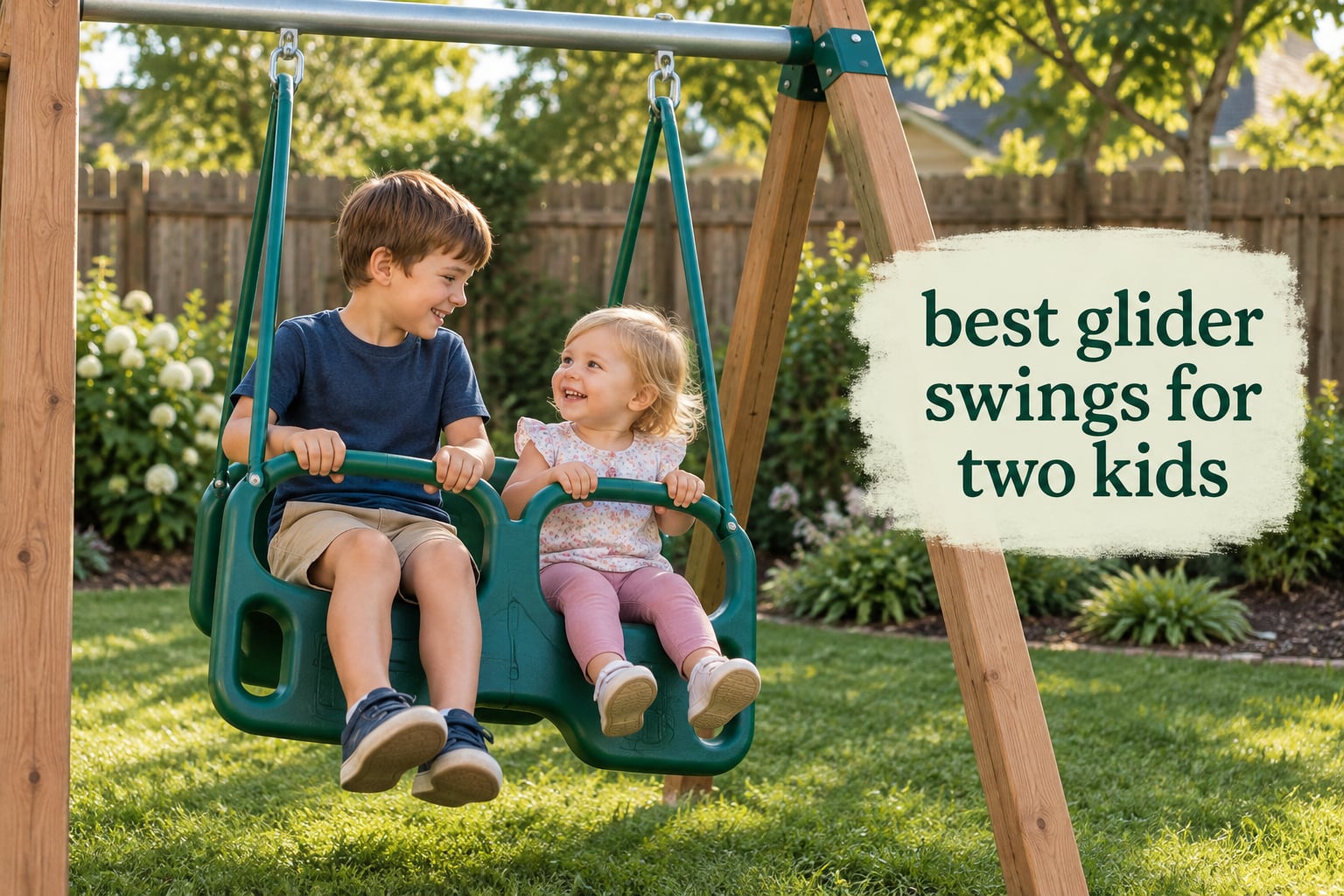
Most parents searching for the best glider swings for two kids are not looking for the wooden glider benches that dominate porch and patio furniture searches. They want a two-seat swing that hangs off a backyard swing set, holds two children at once, and keeps working after a full summer of rain and sun.
What is a glider swing for two kids? It is a single rigid swing seat built for two children that rocks and glides on one pivot point, like a porch swing, instead of swinging side to side like a belt swing. The riders sit face to face, back to back, or in tandem, and propel the seat by pumping their legs.
That one design choice is why gliders keep showing up in two-kid households. A younger child does not have to build a swing arc to enjoy it, and the enclosed molded seat feels more secure than a flat belt. For two children, it also settles the argument over who gets which swing: there is one seat, and they share it.
This roundup covers eight glider swings for swing sets, from plastic seat-only attachments you bolt to an existing wooden beam to complete metal A-frame playsets with a glider built in. Every pick below is a two-child seat, and every capacity figure we quote comes from the manufacturer listing rather than from a round number we invented.
Table of Contents
Top 3 Picks for the Best Glider Swings for Two Kids in 2026
Swing-N-Slide WS 3452 Dual Glider
- Back-to-back two-seat glider
- 60-inch plastisol coated chains
- 150 lb total capacity
- Attaches to most existing playsets
Gorilla Playsets Dual Ride Glider
- Molded plastic seat with double foot rests
- 150 lb capacity for two
- 50 in plastic coated chains
- Hardware and manual included

Step2 Rocket Swing for Two
- 50 lb per child
- 9 months to 3 years
- Weather resistant rope
- Back support and restraint system
Our first choice, the Swing-N-Slide WS 3452, has the deepest owner feedback in this group at more than a thousand reviews, and it is the one that installs on the widest range of existing sets. The Gorilla Playsets Dual Ride is the tougher molded-plastic option, and at 3 to 11 years it carries the widest stated age range of the three. The Step2 Rocket is the only one here built for children under three.
Best Glider Swings for Two Kids (October 2026)
| Product | Specifications | Action |
|---|---|---|
| Swing-N-Slide WS 3452 Dual Glider |
|
Check Latest Price |
| Gorilla Playsets Dual Ride Glider |
|
Check Latest Price |
| Step2 Rocket Swing for Two |
|
Check Latest Price |
 PLAYBERG Plastic Double Glider PLAYBERG Plastic Double Glider |
|
Check Latest Price |
 Sportspower Park Ridge Playset Sportspower Park Ridge Playset |
|
Check Latest Price |
 Outsunny Metal Set with Glider Outsunny Metal Set with Glider |
|
Check Latest Price |
 DECORLIFE A-Frame Playset DECORLIFE A-Frame Playset |
|
Check Latest Price |
 Safe Kidz Dual Glider Kit Safe Kidz Dual Glider Kit |
|
Check Latest Price |
How We Picked and What We Checked
We compared eight two-seat glider options across the full range of what parents actually buy: standalone seat attachments and complete playsets. For each one we pulled the manufacturer’s stated capacity, age range, chain coating, included hardware and dimensions, then weighted those against the volume and consistency of owner feedback.
Everything specific in this guide — capacity numbers, chain lengths, seat dimensions, included components — comes from the product listings. Where owners report assembly problems or missing parts, we say so plainly, because the recurring complaint across glider reviews is packaging rather than the product itself. We also cross-checked what parents ask on forums, where the three questions that come up most are where to buy the hardware, whether a toddler can ride alone, and how two children of different ages share one seat.
One quick note before the reviews: if you are shopping for an infant, you are in a different product category entirely. Our guide to the best baby swings for newborns covers that. A playset glider rated for children from three years up is not a baby seat, and no glider on this page is a substitute for a held or seated infant seat.
1. Swing-N-Slide WS 3452 Dual Glider – Most Owner Feedback
Swing-N-Slide WS 3452 Heavy Duty Two Person Dual Glider Swing, with Coated Chains to Prevent Pinching, 18″ W x 25 in H x 40″ L, Green
Back-to-back glider
150 lb total capacity
2 children
60 in coated chains
Ages 36 months-10 years
Pros
- Coated 60-inch plastisol chains reduce finger pinching
- Supports two children within a 150-pound combined limit
- Back-to-back layout builds teamwork
- Attaches to most existing playsets with basic hardware
- Meets or exceeds ASTM safety standards
Cons
- Glider bracket is not included and must be bought separately
- Not rated for commercial use
The WS 3452 is the attachment we keep coming back to, mostly because a thousand-plus owners have already worked out the install questions you are about to ask. It is a molded plastic two-seat glider with a back-to-back layout, 150 pounds of combined capacity, and a manufacturer age range from 36 months to 10 years. The whole unit weighs 15 pounds, so one adult can lift it into place.
Its 60-inch plastisol-coated chains are the practical headline. Coating is the single most effective anti-pinch measure on any glider, because fingers get caught where bare chain meets bare chain or chain meets bracket. If you have ever copped with a rusty chain on a cheap swing, the difference is obvious on the first swing.
The seat measures 18 inches deep and 40 inches wide at 25 inches high, which gives a 3-year-old and a 6-year-old room to sit without the bigger child pushing the smaller one off the edge. Because the 150-pound figure is shared, not per child, the practical pairing is two young children rather than a toddler and a 10-year-old. We explain that arithmetic in the weight section below.
Assembly is modest, and the box includes chains, the glider, hardware and illustrated instructions, all under a five-year limited warranty from the manufacturer. You will need one part that is not in the box: the glider bracket. Owners who forget this are the ones who end up with a swing that hangs like a flat seat and does not glide.
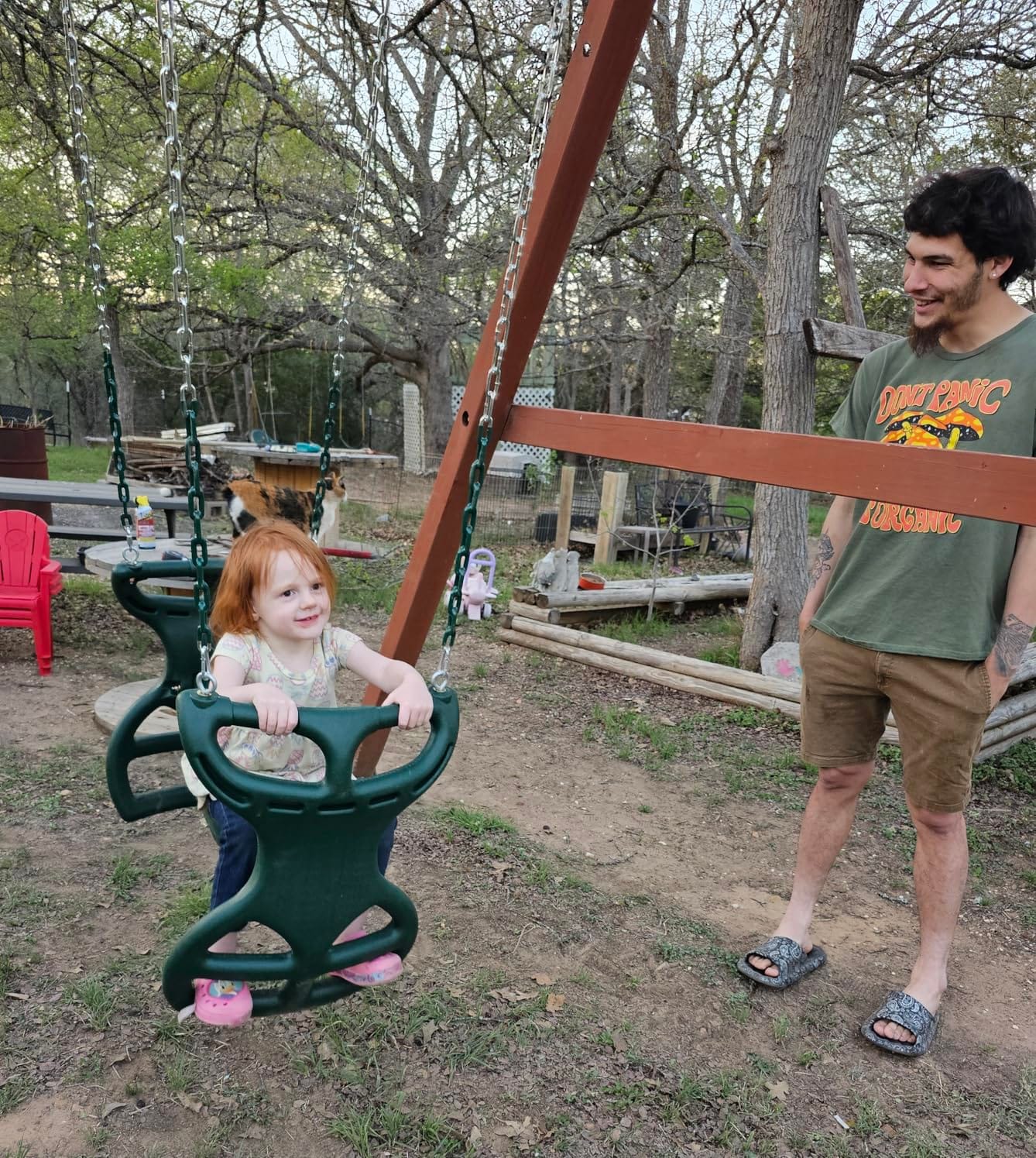
Check your beam width before you buy
Two things trip people up on this model. First, the bracket is separate, so budget for it as a distinct part of the purchase rather than an accessory you might add later. Second, the bracket has to match your swing beam, so measure the beam before ordering anything.
Also confirm your children fit inside 150 pounds together. If you are pairing a three-year-old with a first-grader you are comfortably inside the limit. If you are pairing a toddler with a nine-year-old, look at a higher-capacity option in this list instead.
Where it falls short
The obvious gap is the missing bracket, and it is a genuine friction point: a family who assumes the kit is complete will have a seat and no way to hang it properly. The second limitation is that this is a residential-use glider, so it is not appropriate for a day care, a school playground or a community park.
It is also a back-to-back seat rather than face-to-face, which means the two riders cannot see each other. For most sibling pairs that is a non-issue, but toddlers who like watching the person beside them may prefer a face-to-face geometry. The plastic seat is also less forgiving of hard drops than a tube glider, though owners generally report it holding up through repeated outdoor use.
2. Gorilla Playsets Dual Ride Glider – Rugged Molded Plastic
Gorilla Playsets 04-0037-G Dual Ride Glider Back-to-Back Tandem Swing, Green, Green Plastic Coated Chains, Multi-Child Swing
Molded plastic tandem glider
150 lb for two
Ages 3 to 11
50 in coated chains
All hardware included
Pros
- Thick molded plastic holds up through heat and rain
- Double foot rests and molded-in double handles
- Plastic coated chains help prevent pinches
- Mounts to Gorilla sets and most wooden playsets
- Hardware and illustrated manual included
Cons
- Some buyers report boxes arriving with missing hardware or seat
- Glider brackets are sold separately
- Assembly estimated at 1 to 2 hours
The Gorilla Playsets Dual Ride is the one we would put on a wooden playset in a wet climate. Its molded plastic construction is thick enough that owners consistently describe it as unaffected by summer heat and rain, and at 3 to 11 years its listed age range is the widest of any molded seat on our list. Like the WS 3452 it is rated for 150 pounds across two children.
Safety detailing is what separates it. The double foot rests and the double handles molded into the seat give a smaller child something to hold and something to brace against, which is exactly the moment of imbalance that causes a fall. The 50-inch plastic-coated chains are shorter than the Swing-N-Slide’s 60 inches, so check that the resulting seat height suits your children before you commit.
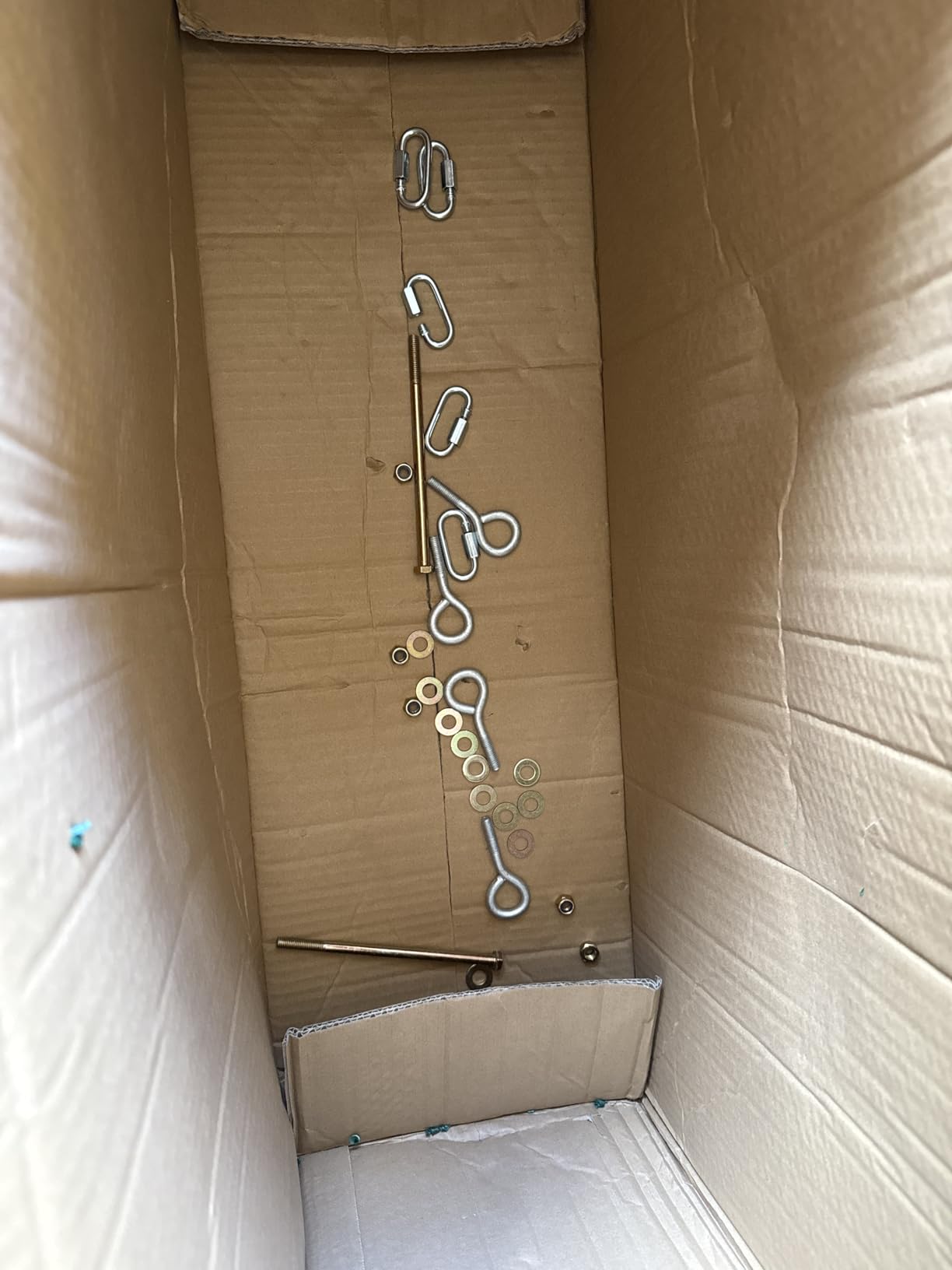
Assembled dimensions are 38 inches long, 16 inches wide and 24 inches high with the chains attached, and the unit weighs 12 pounds. It is a compact piece of hardware, which matters in a small yard because the glider’s swing arc, not the seat footprint, is what consumes space.
Owners most often praise the sturdiness, the simple fit onto an existing wooden set and how much children enjoy the tandem ride. The recurring complaint is packaging: a small number of reviews report arriving without chains, fasteners, or the seat itself, which is a shipping problem rather than a design flaw, but it is worth photographing the contents on arrival.
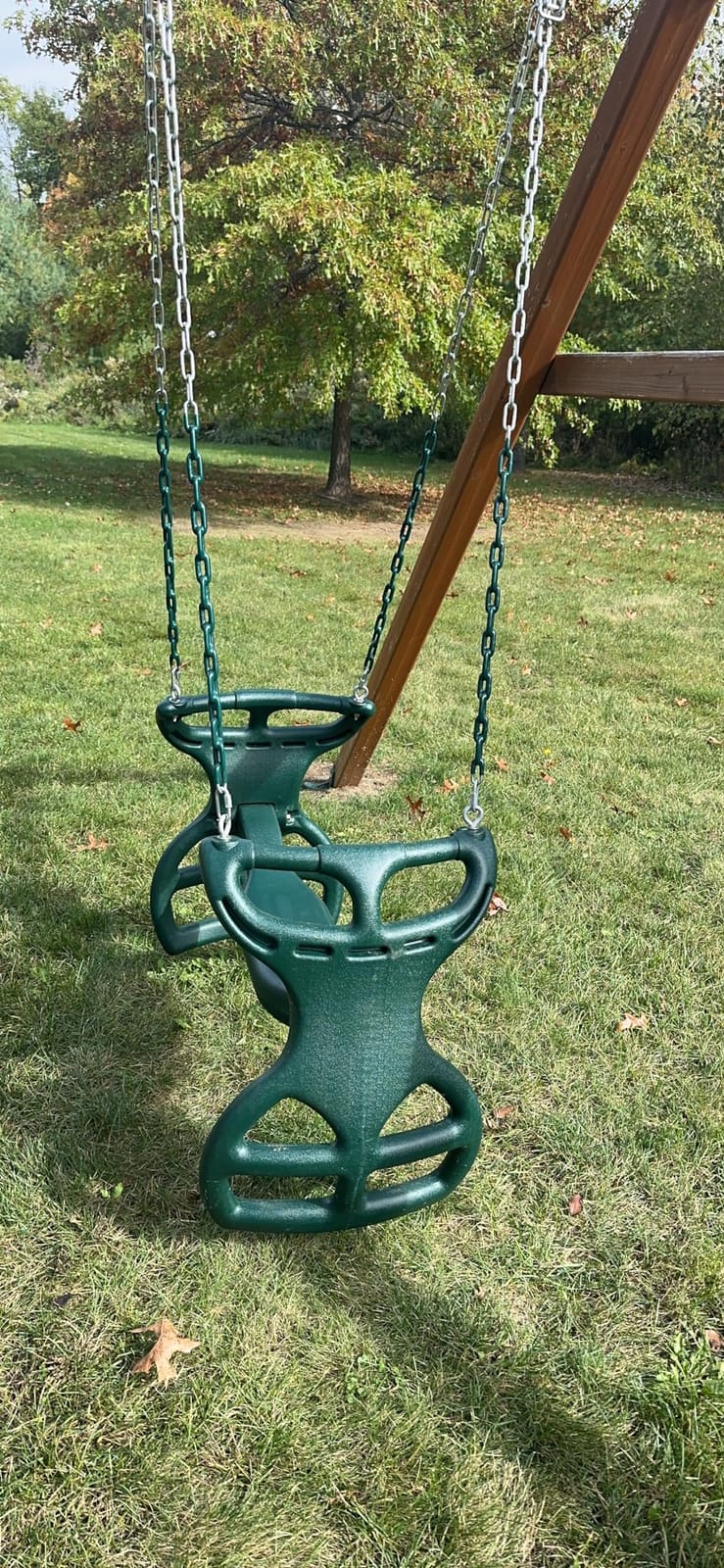
Why this suits a wooden playset
If you already own a Gorilla Playsets set or another wooden playset with a top beam, this is the simplest path. It mounts directly and pairs with the rest of the hardware style, and because everything needed for the seat itself arrives in the box, only the glider bracket is a separate purchase.
For families adding a swing to a set bought years ago, the beam width and the 50-inch chain length are the two numbers to check first. A five-year-old and a nine-year-old both fit the age range, but the older child is the one who decides whether the seat hangs low enough for real swinging.
Watch for the one-hour install and the extra bracket
Owners estimate one to two hours with basic tools, and tools are not included. That is longer than the Swing-N-Slide, so budget an afternoon rather than an evening, particularly if the bracket has to be fitted to a beam you cannot easily reach.
The second thing to plan for is the missing bracket. This is the single most common purchase blocker in glider forums, and the fix is simple: decide at checkout that you are buying a glider, not just a seat. The third limitation is a modest one, but it is shared with most molded plastic gliders, which is that the seat is rigid rather than flexing, so it is firmer underfoot than a tube or rope glider.
3. Step2 Rocket Swing for Two – Built for Toddlers
Step2 Rocket Swing for Two, Baby Outdoor Swing, Outside Weather-Resistant Rope, Attach to Playset, for Toddlers 9 Months – 3 Years Old
Two-child toddler swing
50 lb per child
9 months to 3 years
Weather resistant rope
Back support
Pros
- Highest average rating in this group at 4.9 stars
- Restraining system and back support keep toddlers secure
- Weather resistant rope holds up year-round
- Double-walled plastic resists chipping and fading
- Attaches to most existing swing sets
Cons
- Only rated to 50 lb per child
- Intended for toddlers under 3 years
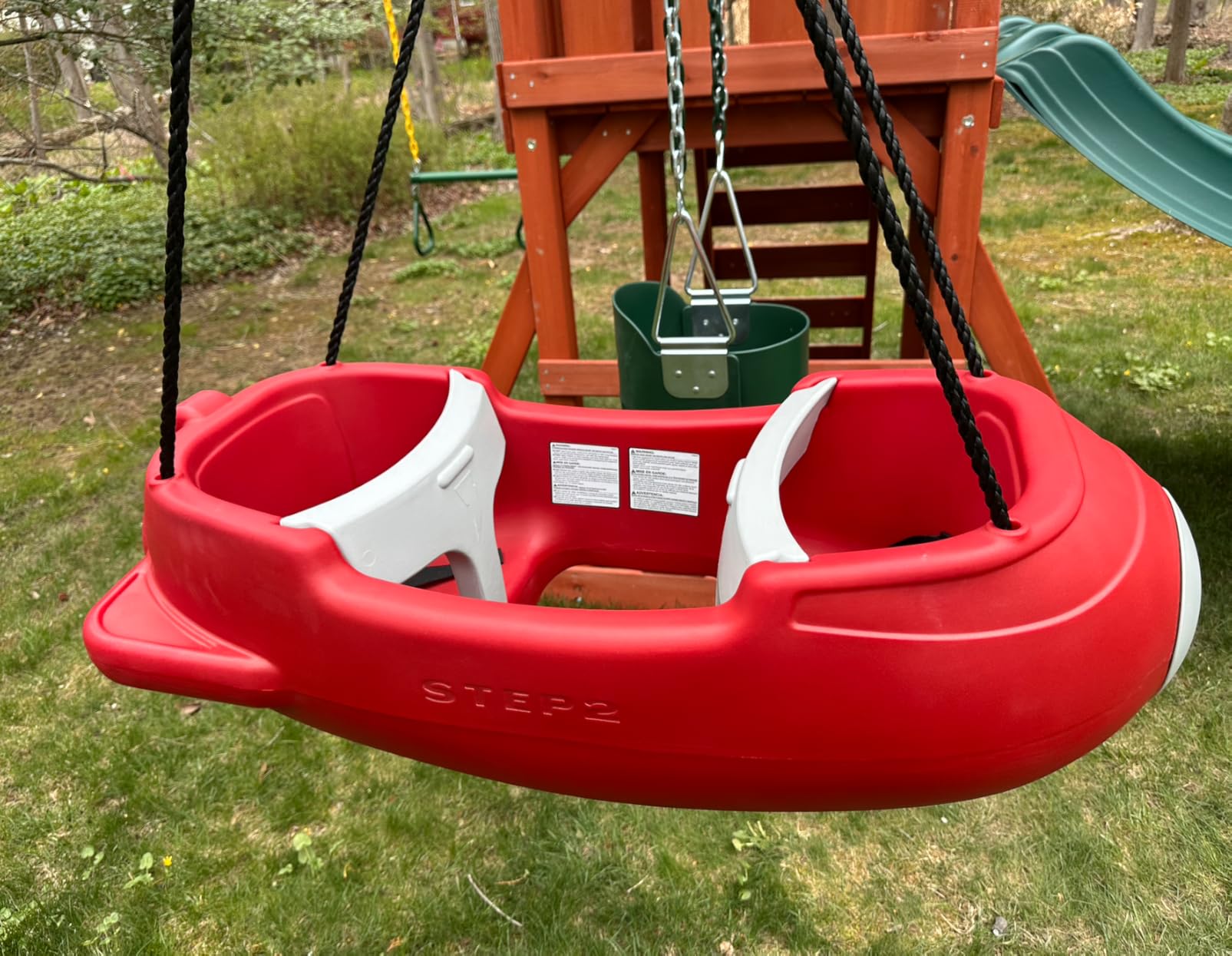
The Step2 Rocket Swing for Two is the only product in this roundup designed for children who are genuinely too young for a regular glider. It is rated at 50 pounds per child and for toddlers from 9 months to 3 years, and it has the highest average rating of the eight products we examined, with the great majority of its feedback at five stars.
What makes it different is the restraint system and the back support behind the seat. A three-year-old on a full-size glider is sitting in a seat designed for a much older child, with nothing holding them in. Here, the shell wraps the child’s body and the rope and seat geometry keep them in place, which is the whole reason this seat exists.
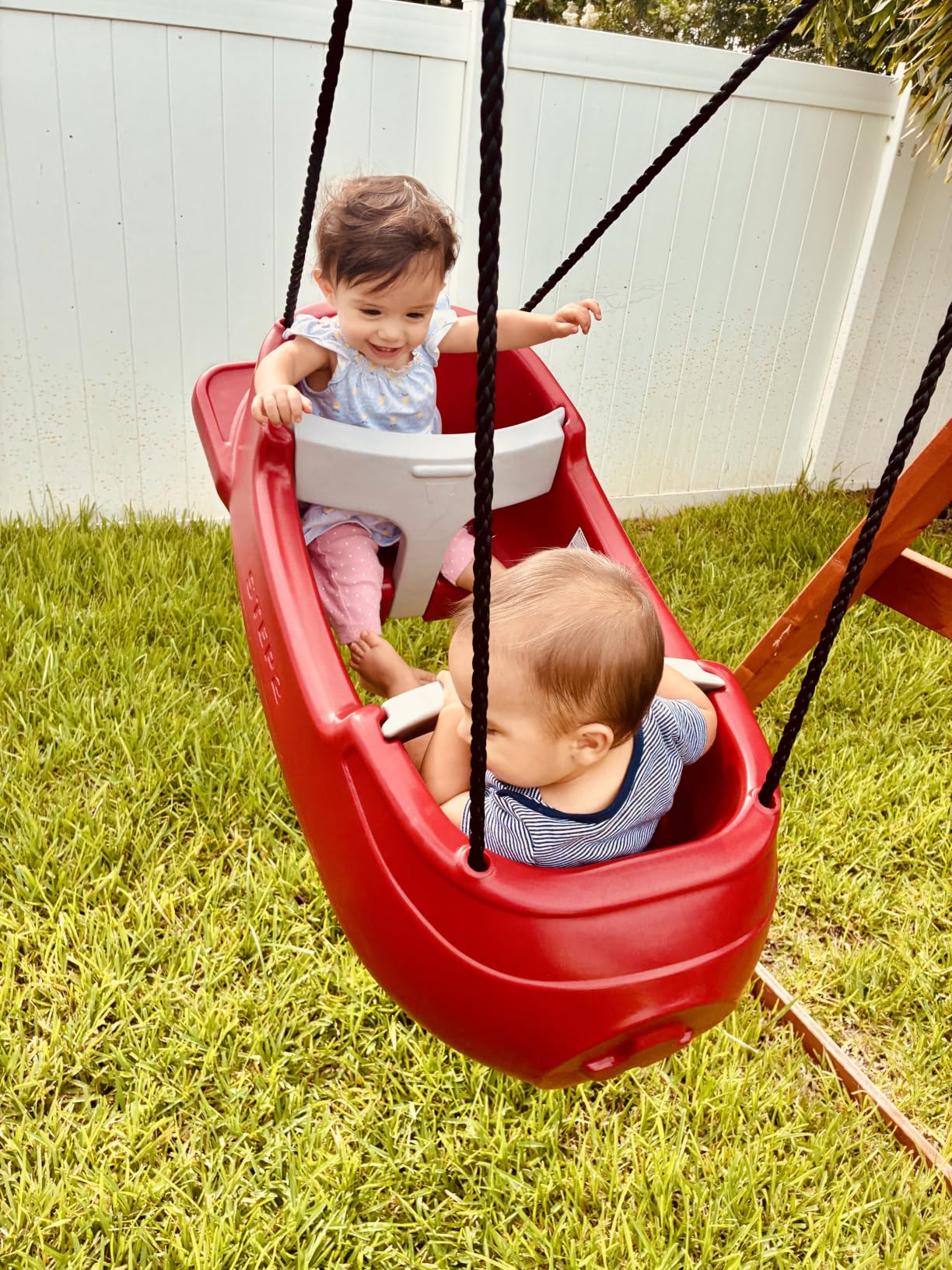
Construction is double-walled plastic with a weather-resistant rope, and the finish is described as resistant to chipping, fading, cracking and peeling. That matters in a category where plastic seats are exposed to ultraviolet light year after year. It fits two children and has a universal fit with most backyard and indoor play sets, so it can also serve as a second-ride seat indoors.
Owners highlight the secure restraint, the back support for young toddlers and the easy fit onto an existing playset. The limitation is stated plainly in the listing and repeated in reviews: at 50 pounds per child and an upper age of three, it does not suit older children at all.
The right seat for a two-toddler household
If both of your children are under three, this is the pick. The 50-pound-per-child limit is per child here rather than a shared total, so two toddlers well under that weight can ride together, and the per-child framing makes it far easier to judge than a shared 150-pound figure.
It also solves the pumping problem for the youngest riders. A glider this size needs almost no leg power to move, so a child who cannot yet pump a belt swing independently still gets a swinging experience on their own terms.
It is not a grow-with-us seat
The hard limit is age and weight. A four-year-old or a five-year-old is out of range, and there is no adjustment that extends it, so this is a seat you will replace rather than pass down. Plan on that if your younger child is close to three.
The other limitation is glider geometry: this is a facing toddler seat, not a cooperative two-rider glider built for pumping, so older siblings will quickly outgrow it and want a real dual glider alongside. Many families run one of each, with the toddler seat on one beam and a full glider on another, which also solves the problem of a third child needing a place to ride.
4. PLAYBERG Plastic Double Glider – Rope-Adjustable and Light
Outdoor Swingset Plastic Double Glider Playground 2 Person Kids, Green
Two-person wide glider
350 lb listed capacity
8 lb unit weight
Adjustable ropes
Handle bar and footrest
Pros
- Listed weight of only 8 pounds makes it easy to move
- Generous 350 pound listed capacity
- Handle bar and footrest add stability
- Thick adjustable ropes set the hanging height
- Very wide stated age range
Cons
- Hanging kit and carabiners are not included
- Basic plastic construction is lighter duty than metal-framed gliders
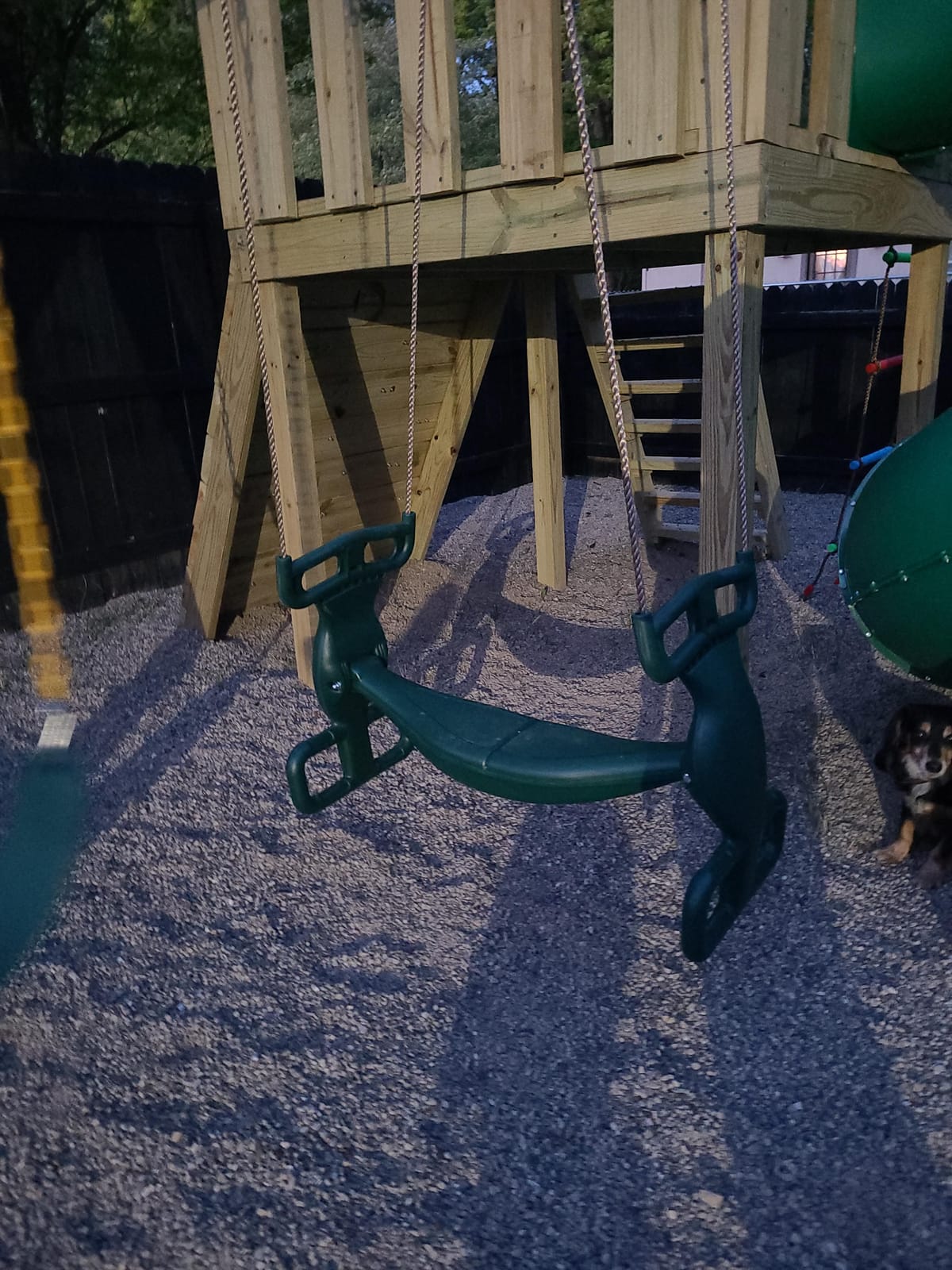
The PLAYBERG double glider is the one to consider when you want a roomy two-child seat that a single adult can reposition without a ladder. It weighs 8 pounds, which is remarkable for a full-width glider, and the thick adjustable ropes let you set the hanging height for whatever beam or stand you are using.
Its listed capacity of 350 pounds is the highest published number on any seat in this roundup, and the listed age range runs from 3 months to 12 years. Those two figures together are the reason it appeals to families with a wide age spread, though we would treat the age range with more caution than the capacity, since the seat geometry and the restraint design are what actually limit a young child.
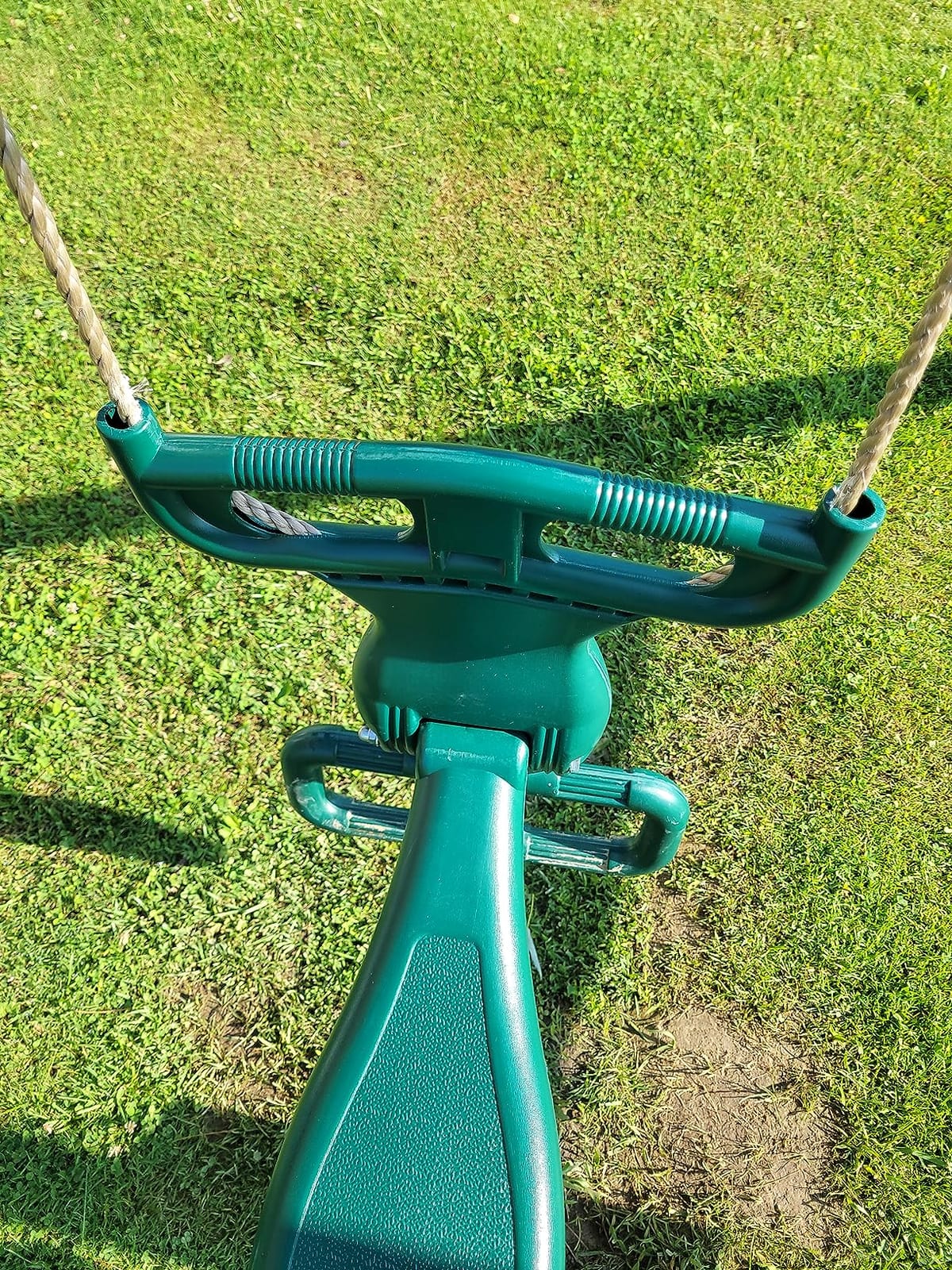
Dimensions are 48 inches wide, 15 inches deep and 23 inches high, with a total hanging length of 78.75 inches. The wide seat is the practical draw here: two children sit across the width rather than front to back, so a taller child has real leg room, and the handle bar and footrest add stability on the way in and out.
Owners treat it as an inexpensive add-on for an existing set and consistently praise the low weight, the adjustable ropes and the roomy two-child layout. The drawback they name most often is that the hanging kit and carabiners are sold separately, so you are sourcing part of the mounting hardware yourself.
When the wide seat is the deciding factor
This is the pick if your older child is tall enough that a narrow front-to-back glider is uncomfortable. Sitting side by side across 48 inches also means the two children are doing the same thing in the same direction, which suits a bigger child paired with a much smaller one who needs to be able to see where they are going.
Adjustable ropes also make it the easiest option to retrofit onto an unusual support. If your set has an angled beam, a tree branch or a simple A-frame, ropes that can be shortened on site are more forgiving than fixed-length chains.
Budget for the hardware and expect lighter construction
Two things to plan around. The hanging kit and carabiners are not included, so this is not a complete package in the way the Safe Kidz kit is, and you will need to source and confirm the load rating of that hardware. The second is build quality: the plastic is sturdy but basic, and it is the least substantial seat here for a child who swings hard.
A rating of 4.4 across a smaller pool of reviews tells the same story. It is a capable, portable, inexpensive addition that does its job well, and it is not the seat you would choose for a set that will be handed down through several children.
5. Sportspower Park Ridge Metal Set – Glider Plus Full Playset
Sportspower Park Ridge Metal Swing Set for Ages 3-8, 2 Swings, Standing Swing, Roman Glider, Teeter Totter, on 5ft Slide, 6.1ft Durable Steel Frame, Anchor Kit, 800lbs
2-person Roman glider
800 lb total capacity
Powder-coated steel
Ages 3-8
Anchor kit included
Pros
- Roman glider plus standing swing
- two belt swings
- teeter totter and 5 ft slide
- Powder-coated steel frame resists corrosion
- All chains PVC-covered against pinching
- Foam-padded frame legs
- Includes a 4-piece anchor kit
Cons
- Assembly is demanding with small labels
- Buyers report teeter totter and slide steps breaking
- Compact footprint feels small for older children
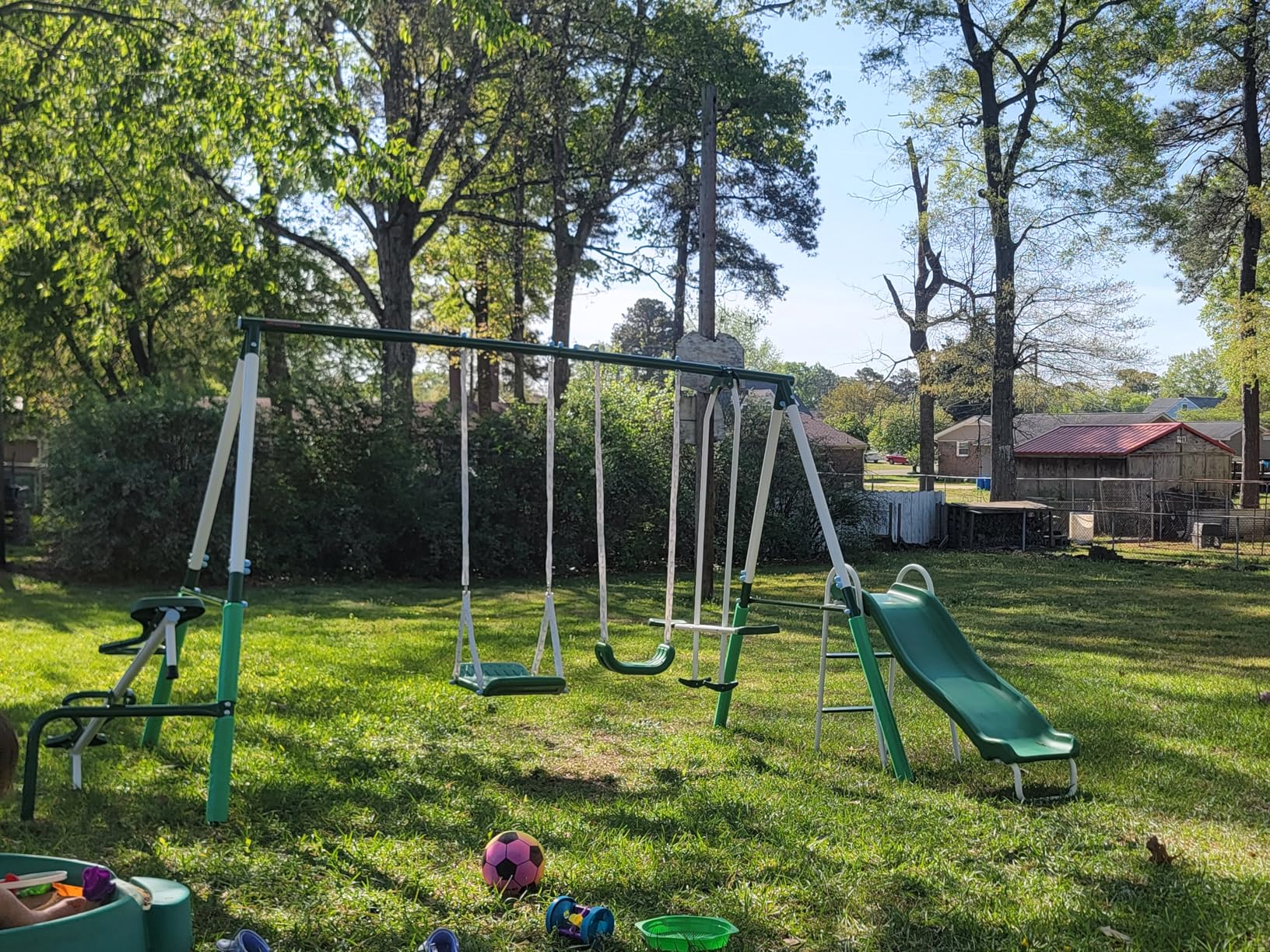
The Park Ridge is a different kind of pick, and the right one for a family starting from nothing rather than adding to a set. It is a metal A-frame playset whose glider is a two-person Roman glider, which is a footrest glider rather than a molded seat: riders sit on a sling or rail, lean back and pump with their legs.
Around that glider you get two belt swings, a standing or sitting swing, a teeter totter and a 5-foot wavy slide, on a powder-coated 6.1-foot steel frame rated for 800 pounds total, or up to eight children at 100 pounds each. It meets or exceeds ASTM and CPSIA standards, and a four-piece anchor kit is included, which is more than most competitors ship.
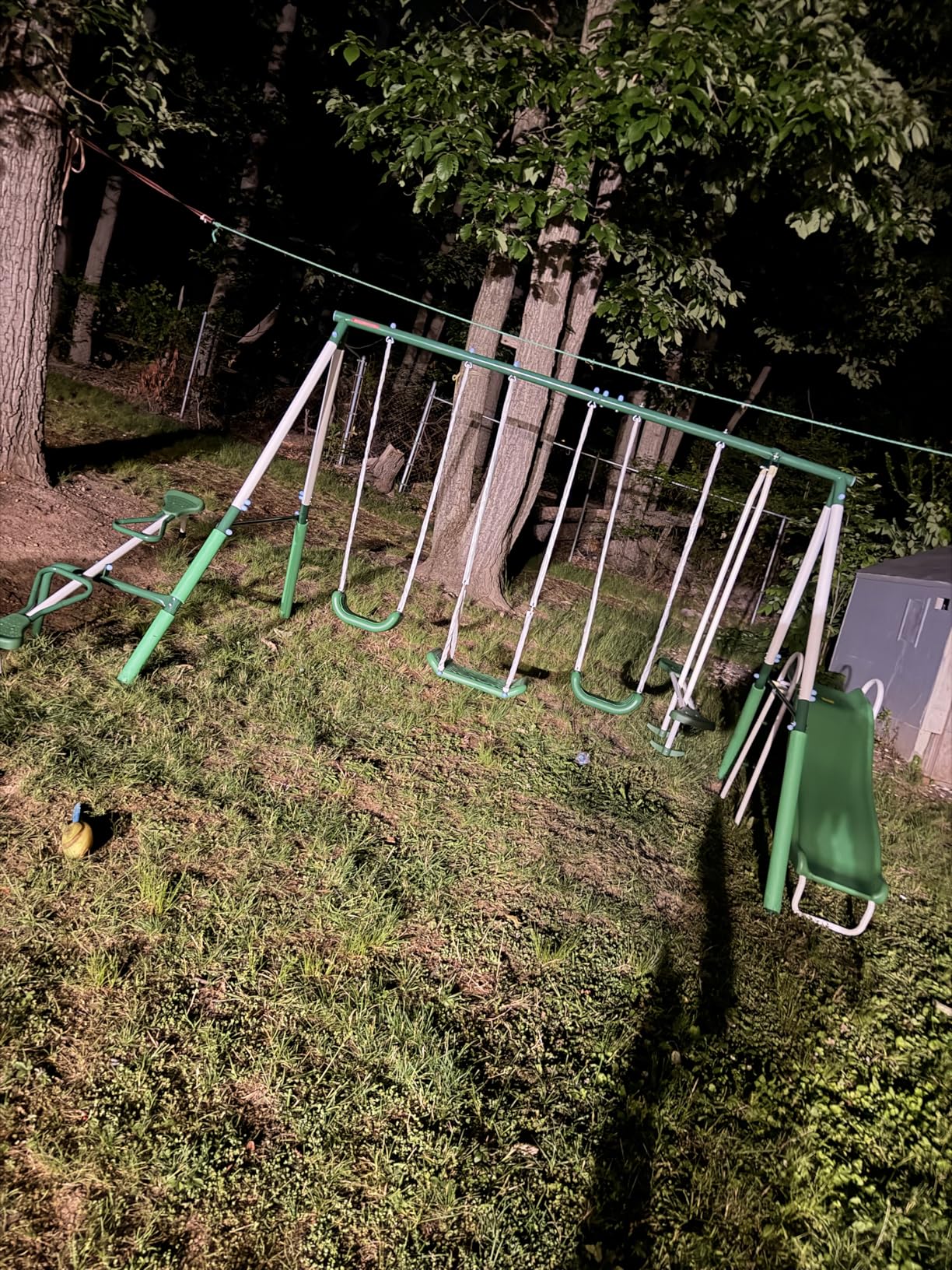
All chains are PVC-covered to protect small hands, and the frame legs are foam-padded. Those two details matter more than they sound on a set that packs four play stations into 90.55 by 159.45 by 72.83 inches, because the same compact geometry that makes it fit a suburban yard also puts children close to more moving parts.
It rates 4.1 stars, the lower end of our group, with a meaningful share of one-star reviews. Owners who finish the build praise the feature range, the padding and the coated chains. The complaints concentrate on assembly difficulty and durability in the teeter totter and slide steps, not on the glider itself.
When a full set beats a single attachment
Choose this if you have no swing set at all and you want more than a swing. A Roman glider, four other seats and a slide covers several children and a wider age range than a single glider attachment can, and the anchor kit and coated chains are the parts most owners end up buying separately.
It also makes sense if the frame is the priority. A powder-coated steel frame with a 6.1-foot beam height and a stated 800-pound capacity is a structure you can keep adding swings to, whereas every seat-only option in this roundup depends on a wooden or metal beam you already own.
Assembly is the real cost
This is the most demanding build in the roundup. Owners report small unreadable labels and unlabelled hardware, and that hardware and frame can show rust after assembly if they are not protected, so plan to coat the finished frame. Set aside a full day and get a second adult.
The other two limits are worth being straight about. The 5-foot slide and the teeter totter are the parts that break first according to owner reports, and the compact footprint feels small once two or more children are using it at the same time, which is especially noticeable with older children. If your priority is strictly a long-lasting two-kid glider rather than a full playground, the seat-only picks are the better value.
6. Outsunny Metal Set with Glider – Compact A-Frame
Outsunny Metal Swing Set with Glider Two S Seats Adjustable Height Green
Two belt seats plus glider
396 lb overall capacity
110 in wide
ASTM F963 and CPSIA
Adjustable ropes
Pros
- Combines two separate swing seats with a glider on one frame
- Adjustable hanging ropes set the swing height
- A-frame bracing between four metal poles adds stability
- Heavy overall capacity of 396 pounds
- Certified to ASTM F963 and CPSIA
Cons
- Small overall footprint limits multiple riders
- Compact 6.75 in wide seats suit younger children
- Rating spread is wide with 27 percent of reviews at three stars or below
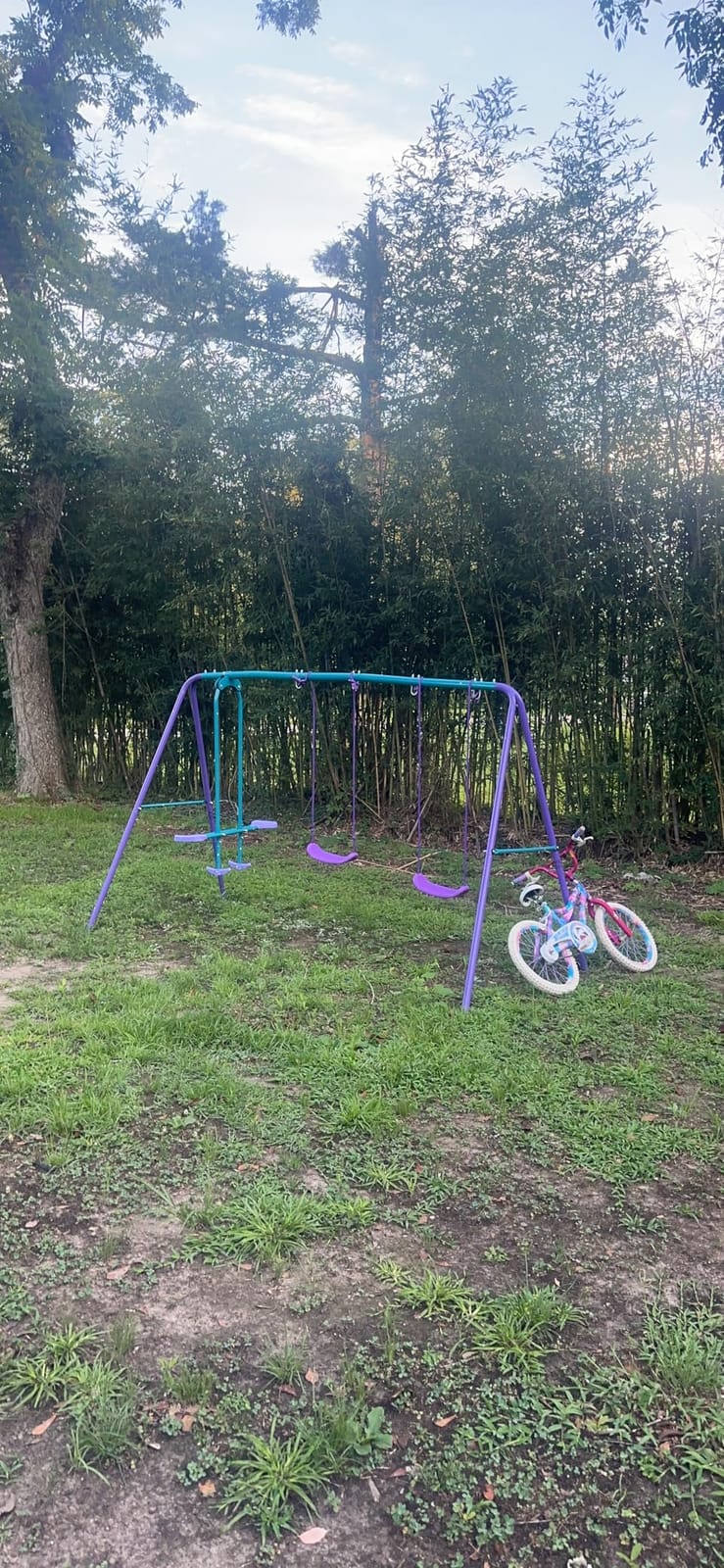
The Outsunny set answers a specific problem: a family that wants a glider and two more swings without a full playset taking up the yard. It puts two separate belt seats and a glider attachment on one metal A-frame, and the whole unit is 110.25 inches wide, 55 inches deep and 70 inches high, so it fits against a fence in a space most people would not use.
The frame is four metal poles with an A-shape bracing bar for stability, powder coated, with a stated overall capacity of 396 pounds. It is certified to ASTM F963 and CPSIA, and the swing seat hanging ropes are adjustable so you can set the height for whichever child is riding.
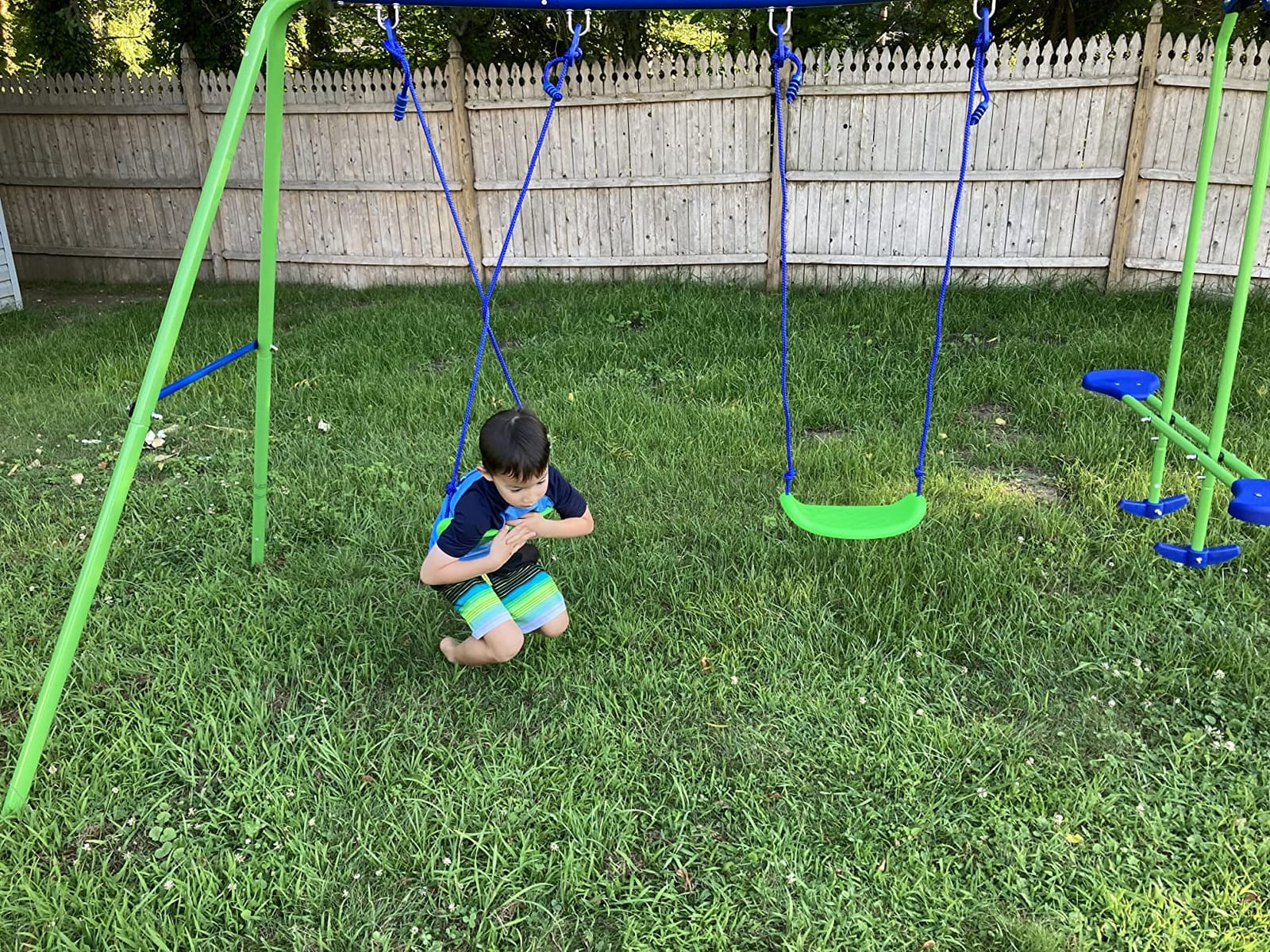
The swing seat itself measures 13.75 inches long by 6.75 inches wide. That is a small seat, and it is the detail that most affects the experience for an eight-year-old, who is effectively done with this set. The stated suitability is up to three children, and the age listing runs from 36 months.
Owners like the combination of two belts plus a glider at a 396-pound total capacity. The complaints concentrate on the same two points: the footprint feels cramped when several children are playing, and the small seats limit older riders. The 4.1 rating carries a wide spread, with 27 percent of feedback at three stars or below.
A sensible fit for a small yard
If your usable outdoor space is limited, this is the pick that gives you the most play per square foot. Two belts plus a glider on a 110-inch frame is a lot of swinging capability in a small footprint, and the adjustable ropes let you raise the seats when the younger child is riding and lower them when the older one is.
It is also a good second set for a family that already owns a larger playset but wants a separate toddler area, since the small seats and adjustable height suit the younger of two children well.
Plan around the seat size, not the capacity
The 396-pound figure is impressive and, for this product, less useful than it sounds, because it is an overall set capacity spread across up to four seat positions. A 6.75-inch-wide belt seat is built for a small child, so a larger child will be riding a seat they have outgrown even though the weight limit is nowhere near reached.
The rating spread is the other thing to weigh. With 27 percent of reviews at three stars or below, this is the least consistent product we included, and if you are deciding between it and the DECORLIFE set, which is similar in concept but rates higher, the evidence favours the DECORLIFE. Assembly is required, and you should budget the same kind of full-afternoon build you would give any metal set.
7. DECORLIFE A-Frame Playset – Glider Plus Room for Four
DECORLIFE Outdoor Swing Set for Backyard, 400 lb Heavy Duty Metal A-Frame Playset with 2 Belt Swings and 2-Person Glider, Weather-Resistant Outdoor Playset for Up to 4 Children Ages 3-8 – (Green)
2 belt swings plus 2-person glider
400 lb capacity
Ages 3-8
Pre-drilled parts
Compact footprint
Pros
- Two belt swings and a two-person glider on one frame
- Heavy-duty steel A-frame rated for 400 pounds
- Curved belt seats shaped for younger children
- Powder-coated frame and durable ropes resist rust
- Pre-drilled parts and included hardware simplify assembly
Cons
- Smaller review base than the top-rated picks
The DECORLIFE set is the strongest all-round value among the complete metal playsets here. It combines two belt swings and a two-person glider on a heavy-duty steel A-frame rated for 400 pounds, and it is the combination we would pick for a family with three or four children rather than two.
Unlike most metal sets in this price bracket, the parts come pre-drilled with the hardware included and clear instructions, which removes the single biggest source of frustration in metal playset assembly. The curved belt seats are shaped for younger children, and the powder-coated frame and durable ropes are described as resisting rust and wear season after season.
It is recommended for ages 3 to 8 and measures 119 by 74 by 73 inches assembled. The footprint is what owners mention most: a two-belt-plus-glider layout in roughly ten feet of width, which is narrower than the Sportspower set and a better fit for a suburban yard with a fence line.
At 4.7 stars across its rating base, the feedback is strong, with a high share of five-star ratings. The honest caveat is the size of the base itself. Ninety-plus ratings is a thin sample compared with the thousand-plus reviews behind our top pick, so you are trusting the build quality more than the track record.
Where this set fits your yard
Two belt swings plus a glider is the most versatile combination in this roundup because it separates the two kids. One child can ride the glider with a sibling or a friend while the other uses a belt, which resolves the biggest practical problem with a glider-only set: two children who refuse to share.
It also covers an age range rather than a moment. The belt swings take the younger child, the glider takes the two who can share, and the whole thing is rated for children up to eight, so it does not retire the way a single seat attachment does.
The review base is the caveat, not the design
There are no meaningful design complaints in the owner feedback, and the con worth naming is simply that the rating history is short. Long-term durability claims in this category take years to earn, and a 4.7 across a smaller pool of reviews says less about years of use than the same score across a thousand reviews would.
One practical check before you buy: confirm the assembled dimensions clear your intended spot, because 119 inches deep is deeper than the frame is wide and it is the depth that surprises people. Measure the swing arc in front of and behind the glider as well, not just the frame footprint, since a glider needs far more room to move than its footprint suggests.
8. Safe Kidz Dual Glider Kit – Brackets and Chains in the Box
Safe Kidz Back-to-Back Dual Glider Swing for Swing Sets, Heavy Duty Two Person Tandem Swing
Back-to-back dual glider
150 lb two-person
Adjustable 18 in hangers
Brackets and chains included
ASTM and CPSIA
Pros
- The only glider here that includes its own brackets
- chains and hardware
- Adjustable 18-inch steel hangers fit most wooden beams
- Heavy-duty molded seat with commercial-style coated chains
- Meets ASTM and CPSIA standards for residential playsets
- 1 year manufacturer warranty
Cons
- Some buyers arrive without chains and hardware
- Water can pool at the base of the handle after rain
- Intended for residential use only
Every other seat-only glider in this roundup requires a separate bracket purchase. The Safe Kidz kit includes the glider bracket, the coated chains, the mounting hardware and instructions in a single three-piece package, which makes it the least complicated attachment option if you want the job done in one order.
The hangers are adjustable 18-inch powder-coated steel, designed to fit most wooden swing set beams, and the seat is a heavy-duty molded plastic with a smooth back-to-back gliding motion. The chains are plastic-coated steel for grip and pinch protection, and the kit meets ASTM and CPSIA standards for residential playsets, with a one-year manufacturer warranty.
Capacity is 150 pounds for two children, and the seat measures 38 inches wide, 16 inches deep and 24 inches high with an 11-inch seat depth. The unit weighs 18.1 pounds. Because the hangers are adjustable rather than fixed-length chain, you control the seat height at install, which is useful on a beam that sits lower or higher than you expect.
Owners single this kit out as the most complete package, and they rate the build quality above similarly sized competitors. The reported drawbacks are a small number of boxes arriving without chains, fasteners or the seat itself, and plastic residue in the bolt holes that needs clearing before assembly.
Best choice if you want one order, not three
Bracket hardware is the most common reason a glider purchase stalls. Several manufacturers in this category sell the seat alone and list glider brackets as a separate accessory, so families end up with a seat in the garage and a set that will not glide until they find the right part. This kit removes that step entirely.
It is also the only one here with adjustable steel hangers instead of fixed chain length, which makes it the more forgiving option if your beam is at an unusual height. For a first-time glider buyer who does not already know their beam measurement, that is worth a lot.
Small drawbacks that are easy to live with
The shipping complaints are real but mechanical: inspect the box on arrival, and if chains or hardware are missing, request them from the seller immediately rather than partially assembling the kit. The plastic residue in the bolt holes takes a few minutes to clear with a cloth before the bolts will thread cleanly.
Water pooling at the base of the handle is a design characteristic rather than a fault, and it is a reminder to wipe the seat down after heavy rain and to check it before the kids get on. The 150-pound shared capacity and residential-only rating are the same constraints as the other 150-pound gliders here, and the 63-review base is the smallest in our group, so treat the quality assessment as strong but not yet proven over many seasons.
Face-to-Face vs Back-to-Back vs Tandem: Which Geometry to Buy
This is the decision that matters most in a two-kid household, and no competitor roundup we found explains it. Three geometries account for nearly every glider you will see sold, and they suit different pairs of children.
Back-to-back gliders put the riders facing opposite directions, one over the other’s shoulder. This is the most common type in this roundup, and it works well for siblings of similar size because neither child is looking into the other’s face. It is also the geometry that makes shared pumping feel cooperative, since the motion stays in one plane.
Tandem gliders line the riders up one behind the other, both facing the same direction. Tandem seats are longer and narrower, which suits an older child paired with a younger one who wants to watch where they are going. It also spreads the weight along the length of the seat rather than across its width.
Face-to-face gliders place the riders opposite each other, knees toward each other. Toddlers and young children generally love this because they can see the person beside them, and it is the geometry most associated with the enclosed, secure feeling that makes a glider easier for a small child to enjoy. It is also the hardest geometry to find as a playset attachment, which is the single most common request in glider forums.
Our advice for a two-kid household: face-to-face if both children are under six or one child is anxious about swinging, back-to-back if you are pairing similar ages and want the simplest install, tandem if one child is much older and you want them side by side rather than nose to tail.
How to Attach a Glider Swing to an Existing Swing Set
Most glider attachments mount to an existing top beam in one of two ways, and knowing which you have before you buy avoids a return trip. A glider bracket clamps or bolts onto the beam and gives the seat its pivot; spring clips attach a standard hanger directly to a chain. A glider needs a true pivot to rock and glide, so if your set has no bracket point, the bracket is the part that cannot be skipped.
1. Measure the beam. Record the width and height of your top beam and check it against the bracket’s stated fit before ordering anything. Most brackets are adjustable, but not across all widths.
2. Confirm you are buying a complete mount. The seat, the chains, the brackets and the fasteners are four separate things. Check what is in the box, because most seat-only gliders do not include the bracket.
3. Install the bracket level. Set the bracket so the seat hangs level and centred on the beam. A bracket mounted off-centre makes the glider track to one side, which feels unstable to riders and wears the pivot unevenly.
4. Attach the chains and check the level. With the seat empty, hang the glider and confirm it sits level. Adjust chain length or hanger position now, with no weight on it, rather than after a child is sitting in it.
5. Load test and inspect. Add a cautious adult load first, then check the pivot again. Over a few sessions, re-check the bracket bolts, which are the first thing to loosen under repeated motion.
If you have no suitable beam at all, a freestanding A-frame swing stand is the alternative route. It costs more in total and takes more yard space, but it avoids modifying an existing set, and it is the reason products like the Outsunny and DECORLIFE sets include a full frame rather than just a seat.
Weight Capacity Explained: What 150 Pounds Actually Means
The most misunderstood number in this category is capacity, and getting it wrong is how families end up disappointed. A two-seat glider’s rating is a total shared by both riders, not a per-child allowance. A 150-pound glider means 75 pounds each if the children are close in size, not 150 pounds each.
So a 150-pound glider suits a three-year-old and a six-year-old comfortably. It is a poor match for a toddler paired with a nine- or ten-year-old, where one child can be carrying 60 to 70 pounds on their own. This is the single most common misunderstanding we saw in parent discussions, and it is worth doing the addition before you buy rather than trusting the “two children” label.
Two products in this roundup break the shared model. The Step2 Rocket is rated at 50 pounds per child, which makes it far easier to judge for toddlers. The PLAYBERG glider carries a much higher listed total, and the three complete metal playsets quote a whole-set capacity that covers every seat rather than one glider, so treat those figures as set ratings, not glider ratings.
One more thing worth knowing: age ratings on gliders are frequently set by the child who needs help, not the child who is heaviest. A glider listed from 36 months is telling you the youngest rider cannot safely manage it alone before that, and the upper end of the range tells you when the seat becomes too small and stiff for an older child. Both ends matter, and a seat can be outgrown by size long before the weight limit is reached.
Safety, Clearance and a Pre-Use Inspection Checklist
Most glider injuries are not caused by the glider itself but by what is happening around it. A glider’s arc is far longer than its seat footprint, and it moves through that arc at speed, so the single most important safety decision is where the glider goes relative to everything else in the yard.
Clearance. Leave unobstructed space in front of and behind the glider equal to twice the height of the swing beam, and keep that zone free of other swings, fences, trees, patio furniture and hard surfaces. The glider travels in one plane, but a swinging glider plus a swinging belt swing on the same frame occupies overlapping volumes of space, which is exactly the collision risk parents describe.
The moving footprint. Measure the arc, not the frame. A seat 40 inches wide produces a swing path several feet long in each direction, and a child running underneath or alongside a moving glider can be struck at knee or head height. Keep the area under and beside the glider’s path clear of other children, and keep pets out of the yard while it is in use.
Surface. Use mulch, sand, wood chips or pea gravel under the entire use zone. Concrete and packed earth turn a short fall into a hard one, and this matters more for a glider than for a stationary play structure because the riders are moving.
Certification. Look for ASTM F381 or ASTM F963 and CPSIA compliance, which are the residential playground standards covering lead content, phthalates and structural safety. Products in this roundup state compliance, and for residential sets only.
Anchoring. Use ground anchors, not just placement. Motion and repeated loading loosen fasteners, and anchored sets are the fix for the wobble that families report developing a season or two after assembly.
Our pre-use inspection, run at the start of each season and after any impact:
1. Check the glider bracket bolts and the beam attachment points for tightness and rust.
2. Inspect every chain link and coated section, looking for thinning coating, kinks or stretched links.
3. Look at the seat and hangers for cracks, especially around the handle bases and bolt holes.
4. Confirm the glider still hangs level and that the pivot moves freely without sticking or grinding.
5. Confirm the children using it are still within the shared capacity and within the age range.
6. Re-check the clearance zone and remove anything that has moved into the swing arc.
7. Check the coating on the chain and seat joints, where moisture sits longest after rain.
If a used glider is what you are shopping for, add two checks: look for rust inside the chain links and inside the pivot hardware, where it is hidden and where it does the most damage, and confirm the bracket and chains are the same length and the same matched set. A glider with a mismatched chain and bracket tracks unevenly, and that uneven tracking is what wears the pivot out. We would avoid a used glider with any rust at the pivot, and would only consider one where the original chains and bracket are both present.
Frequently Asked Questions
What is the difference between a glider swing and a regular swing?
A regular belt swing hangs from two chains at each end and moves side to side on a single arc, so the rider has to build momentum by pumping. A glider is one rigid two-seat unit that rocks and glides on a pivot point like a porch swing, and the riders pump together as a team. That is why a glider is easier for a young child to enjoy solo and why two children share one seat rather than competing for two.
How much weight can a double glider swing hold?
It depends on how the rating is written. Most two-seat gliders list a shared total of 150 pounds for both riders combined, which suits children roughly 3 to 8 years old. Some toddler models rate per child instead, such as 50 pounds per child. Complete playsets quote a capacity for the whole frame rather than the glider. Always check whether the figure is shared or per child before you buy.
What age is a glider swing suitable for?
Most two-seat gliders are rated from 36 months to about 10 or 11 years, with the Gorilla Playsets Dual Ride covering the widest range at 3 to 11. Gliders built for toddlers go lower, from 9 months to 3 years at 50 pounds per child. Treat the age rating as the age at which a child needs help or has outgrown the seat, not as a weight limit.
Can a glider swing hold two children at once?
Yes, that is the design. Every two-seat glider in this roundup is built to carry two children simultaneously, with molded handles and footrests sized for a pair. The practical limit is the shared weight rating, and with a 150-pound model the right pairing is two young children rather than a toddler and a nine-year-old.
Do glider swings come with brackets and chains?
Most do not, and this is the most common purchase mistake. The Swing-N-Slide WS 3452 and the Gorilla Playsets Dual Ride both require glider brackets bought separately, and the PLAYBERG glider needs a hanging kit and carabiners. The Safe Kidz dual glider kit is the exception here, shipping with brackets, chains and hardware in one package.
How much clearance does a glider swing need?
Leave unobstructed space in front of and behind the glider equal to twice the height of the swing beam, and keep that zone free of other swings, fences, trees and hard surfaces. A glider moves through a much larger arc than its seat footprint suggests, and the area beside and under the arc should be kept clear of other children and pets.
Can a toddler ride a glider swing without help?
Often yes, which is one of the main reasons parents buy a glider. A toddler cannot build a swing arc on a belt swing, but a glider moves easily with a small push or a light pump from the legs. For children under three or under 50 pounds, a toddler-specific two-seat swing with a restraint system and back support is the safer choice.
Are glider swings safe for residential use?
Yes, when installed correctly. Look for ASTM F381 or ASTM F963 and CPSIA compliance, use ground anchors, check the clearance zone, and inspect the bracket, chains and seat before every season. A glider needs far more room around it than a belt swing because of its long moving arc, and most accidents come from collisions rather than from the glider itself.
Conclusion: Which Glider Swing Fits Your Two Kids
The best glider swings for two kids in 2026 come down to two questions: how old are your children, and do you already own a swing set. If you have a beam and two young children, the Swing-N-Slide WS 3452 is the pick, with the most owner feedback in the group and 60-inch coated chains that reduce pinching.
For two toddlers, the Step2 Rocket Swing for Two is the right seat because its 50-pound per-child rating and restraint system match their size. For a wider age gap or a child who has outgrown moulded plastic, look at a complete metal playset with a glider built in, and the DECORLIFE A-frame is the version we would choose for its pre-drilled assembly and compact footprint. If you want one order instead of three, the Safe Kidz kit is the only glider here that includes its own brackets, chains and hardware.
Whatever you choose, measure the swing arc before you buy rather than the seat, and add up your two children’s weights against the shared rating. Those two checks prevent almost every disappointment we saw in owner feedback. If you are also shopping for the rest of the yard, our picks for the best porch swings with stands cover the adult side of outdoor seating, and the sit and stand stroller guide covers getting two children out of the door in the first place.