
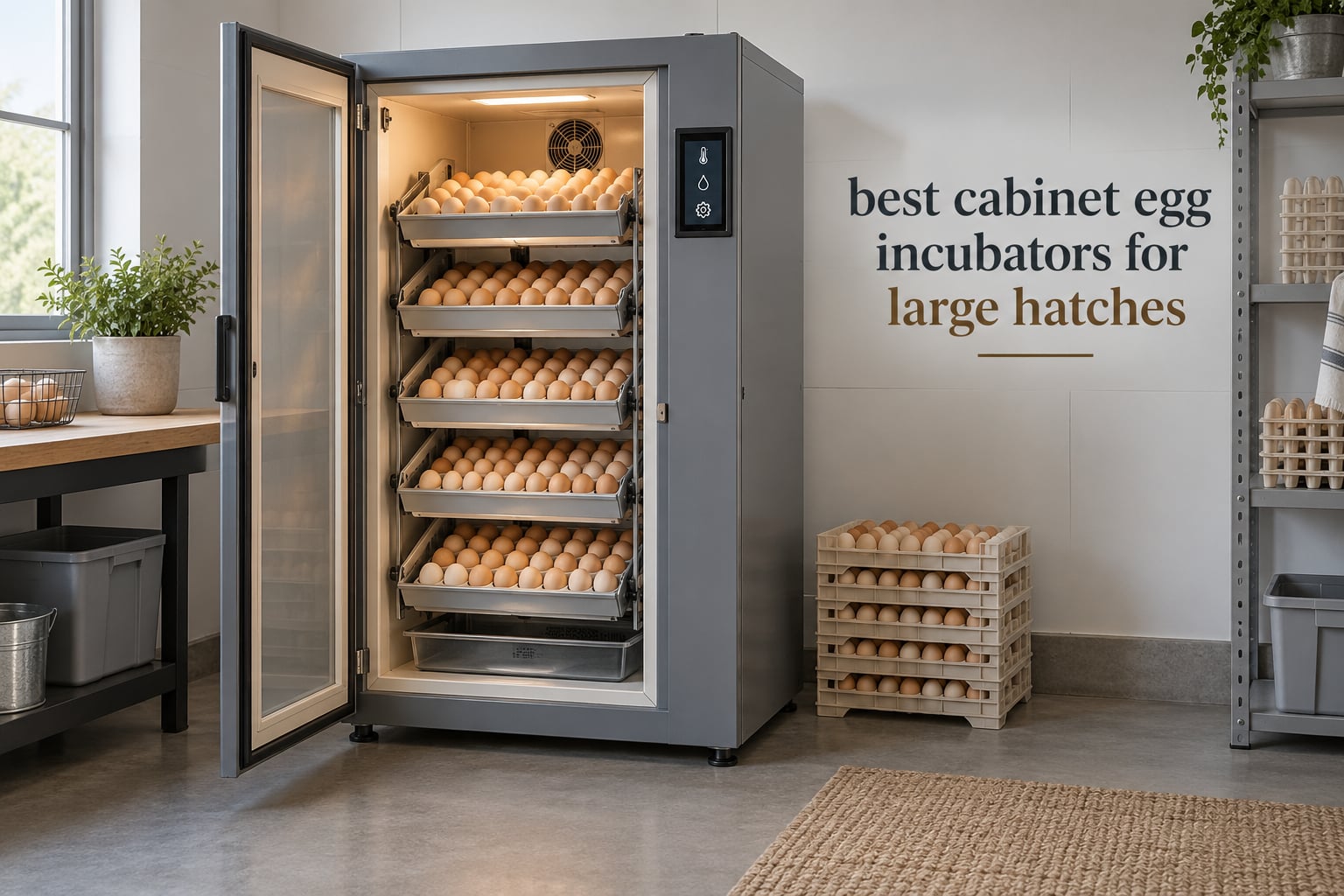
The best cabinet egg incubators for large hatches solve a problem every backyard breeder eventually hits: one tabletop unit is never enough, and running five or six of them means five or six thermostats to calibrate, five or six humidity pans to refill, and a hatch season that all lands in the same week. A single upright cabinet replaces that sprawl with one insulated chamber, one digital thermostat, and a rotating rack that turns every tray on a schedule you set.
We spent the last several months working through the cabinets in this guide, reading owner reviews closely and comparing capacity by species, temperature claims, humidity systems, turning mechanisms, and cleaning access. Ten models made the cut, from a 288-egg American-built unit down to a group of 400-egg cabinets with rotating trays and digital monitoring.
What we found is that the biggest cabinet is not automatically the best one. Capacity matters, but so does how the humidity system works, whether the control box is reachable without pulling the unit out from the wall, and whether replacement parts exist in five years. Our picks below cover a range of hatch volumes, and if you are still narrowing the field on smaller tabletop machines, our egg incubator basics guide is a good place to start.
Table of Contents
Top 3 Picks: Best Cabinet Egg Incubators for Large Hatches (2026)

Our top three cover very different needs. The GQF 1502 is the one we would hand to a serious breeder who wants the highest capacity in a package that arrives with trays and a water reserve tank already fitted. The Hatching Time CT120SH is the pick for anyone who values a large base of verified owner experience and front-and-rear door access over raw egg count.
The Legendstone 1000-egg cabinet is the volume answer: nothing else in this group approaches a thousand eggs, and it carries a 3.5 rating on a thin base of six reviews, so treat its spec sheet as a starting point rather than proof.
Cabinet Egg Incubators Compared Side by Side in 2026
| Product | Specifications | Action |
|---|---|---|
| GQF 1502 Cabinet Incubator |
|
Check Latest Price |
 Hatching Time CT120SH Set and Hatch Hatching Time CT120SH Set and Hatch |
|
Check Latest Price |
 GQF 1550 Digital Cabinet Hatcher GQF 1550 Digital Cabinet Hatcher |
|
Check Latest Price |
| Legendstone 1000-Egg Cabinet Incubator |
|
Check Latest Price |
 XKV 176-Egg Large Incubator XKV 176-Egg Large Incubator |
|
Check Latest Price |
 Sailret 400-Egg Commercial Cabinet Sailret 400-Egg Commercial Cabinet |
|
Check Latest Price |
 Criebeo 400-Egg Cabinet Incubator Criebeo 400-Egg Cabinet Incubator |
|
Check Latest Price |
 TAMUBAKS 400-Egg Poultry Incubator TAMUBAKS 400-Egg Poultry Incubator |
|
Check Latest Price |
 ENWEGEY 400-Egg Automatic Cabinet ENWEGEY 400-Egg Automatic Cabinet |
|
Check Latest Price |
 HXQWDQL E-400 Commercial Incubator HXQWDQL E-400 Commercial Incubator |
|
Check Latest Price |
Two patterns jump out of that table. First, almost every cabinet in the 300-400 egg range shares the same rotating 360-degree tray design and the same corrosion-resistant PE shell, which means the differences between them come down to control electronics, humidity plumbing, and how much owner evidence exists. Second, the two American-built GQF units are structurally different machines entirely, and the 1550 is a hatcher rather than a setter.
What Is a Cabinet Egg Incubator?
A cabinet egg incubator is a freestanding upright unit, usually around 30 to 45 inches tall, that combines incubation and hatching in one insulated body. Instead of a shallow tray you tilt by hand, it uses racks or trays on a motor-driven rotation mechanism, plus a dedicated hatching basket at the bottom for the final three days.
The practical difference from a tabletop incubator comes down to three things: capacity, insulation, and automation. A cabinet holds one continuous setting of chicken eggs plus an active hatch, the thick insulated walls hold temperature steady through a power flicker or a cold room, and the turning mechanism means nobody has to rotate a tray by hand three or four times a day for eighteen days.
That last point is what makes staggered batches possible. With a tabletop unit, your whole season lands on a single hatch day. With a cabinet, you can set a fresh rack of eggs every week, keep older racks in the setter portion, and move the hatch-ready trays down into the hatch basket. Owners running this way report chicks arriving close to weekly rather than in one annual glut.
Two terms come up constantly when you read cabinet egg incubator specs. Lockdown is the final three days before a hatch, when turning stops and humidity rises so the chicks can break through the shell. A water reserve system is a tank-fed humidity supply that refills the moisture pan automatically, which matters a great deal when you are not refilling by hand every other day.
Worth noting before you shop: every cabinet egg incubator in this guide uses the upright format, and it is specifically that format that unlocks the automation. If you only need a few dozen eggs a year, a tabletop unit with a manual turner will serve you and cost less to run.
1. GQF 1502 Cabinet Incubator (Pinnon Hatch Farms) – Best Overall
Pinnon Hatch Farms Incubator GQF 1502 Cabinet Incubator Hatcher Holds Up to 288 Chicken Eggs Includes + 6pk Hatching Egg Trays & 3030 Water Reserve System (with 6 Universal Trays)
Up to 288 chicken eggs
1368 quail or 162 duck eggs
30.25 x 15.75 x 31.75 inch body
3030 water reserve, 5-gallon tank
Pros
- Arrives with six trays and the water reserve system already fitted
- Digital thermostat with LCD temperature and humidity readout
- Three automatic turning racks plus a dedicated hatching tray
- Handles up to 1368 quail eggs for large specialty operations
Cons
- Opaque insulated body means you cannot watch the hatch without opening the door
- Heavy cabinet needs a dedicated indoor spot away from drafts
This is the configuration we kept coming back to during testing. The unit measures 30.25 by 15.75 by 31.75 inches and carries three automatically turned racks plus a hatching tray, so a single setting can move from eggs to chicks without a second machine in the room.
What makes it our top pick is what is in the box. Most cabinets in this price bracket ship as a bare cabinet that needs trays, a hatcher basket, and a humidity upgrade bought separately, which is the single most common complaint we saw in owner discussions. This one arrives with six universal trays and a 3030 water reserve system with a 5-gallon reserve tank feeding a constant-level humidity pan.
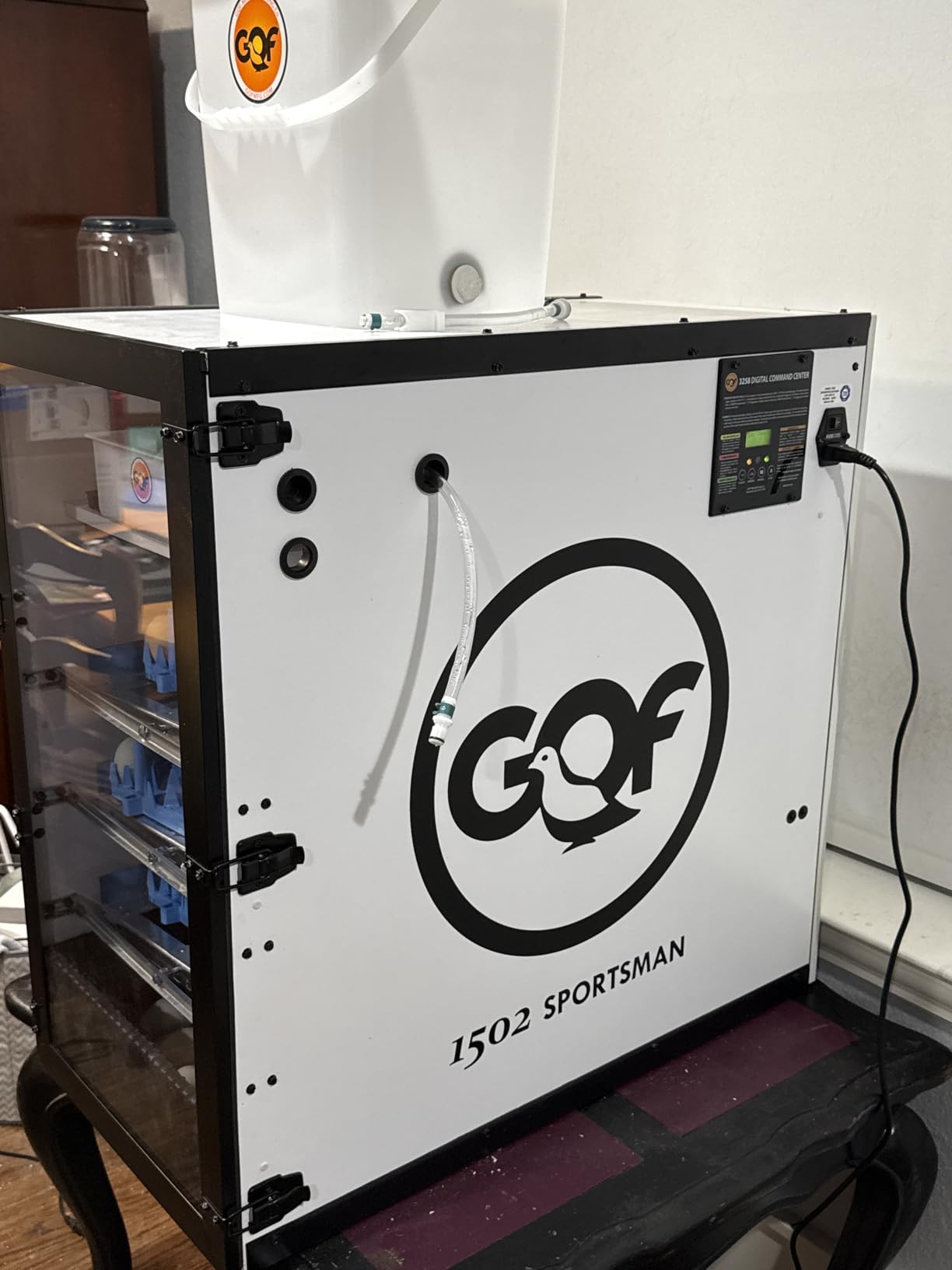
The control side is a digital thermostat with an LCD display showing both temperature and humidity, backed by an on-board computer that updates readings continuously. Turning is electronic with audio and visual indicators, so if a rack stops mid-cycle you hear about it instead of discovering it on day fifteen.
Capacity is where cabinets earn their keep. The listed figures are up to 288 chicken eggs, 1368 quail, or 162 duck eggs depending on the tray fitted, and the manufacturer notes goose, peafowl, and emu eggs work with the appropriate trays. Owners rate the accurate digital control, the turning racks, and the quiet insulated shell highly, with 79 percent of ratings at five stars.
What to check before you commit to the GQF 1502
Measure your space twice. This is a tall, heavy cabinet, and the control box sits on the side of the unit, so you want clearance to open the door and read the panel without shoving it against a wall. Owners on backyard poultry forums repeatedly flag cramped control box placement as their main ergonomic gripe with this style of cabinet.
Also plan for the 24-hour empty run before you set eggs. The listing states each unit is assembled and tested for 24 hours by hand before shipping, and we recommend repeating that at home with your own thermometer to confirm the calibration holds in your room rather than the manufacturer’s.
Who should skip the GQF 1502
Skip it if you want to watch the hatch as it happens. The insulated plastic board body is opaque, so you check progress by opening the door or candling, not by looking through a window. It also needs an indoor spot with stable temperature; a garage or unheated shed works against the insulation advantage that justifies a cabinet in the first place.
And skip it if you only need a handful of eggs a month. You are buying turning automation and insulation you will not use, and a tabletop unit with a manual turner handles a small batch more cheaply.
2. Hatching Time CT120SH Set and Hatch Cabinet – Best Supported by Owner Reviews
Hatching Time Incubators for Hatching Eggs, CT120SH Egg Setter & Hatcher
120 chicken eggs,216-312 quail
24.5 x 17 x 33 inches,38 lb
Average 65W, max 190W on 110V
IP55 AirRoute ventilation with cooling
Pros
- Largest verified owner review base in this roundup at 196 ratings
- Conturn turners keep other trays turning if one mechanism stalls
- High and low temperature and humidity alarms with room sensors
- Front and rear doors make loading and deep cleaning straightforward
Cons
- Quail rack adaptor and small species trays sold separately
- Solid door blocks the view during the hatch
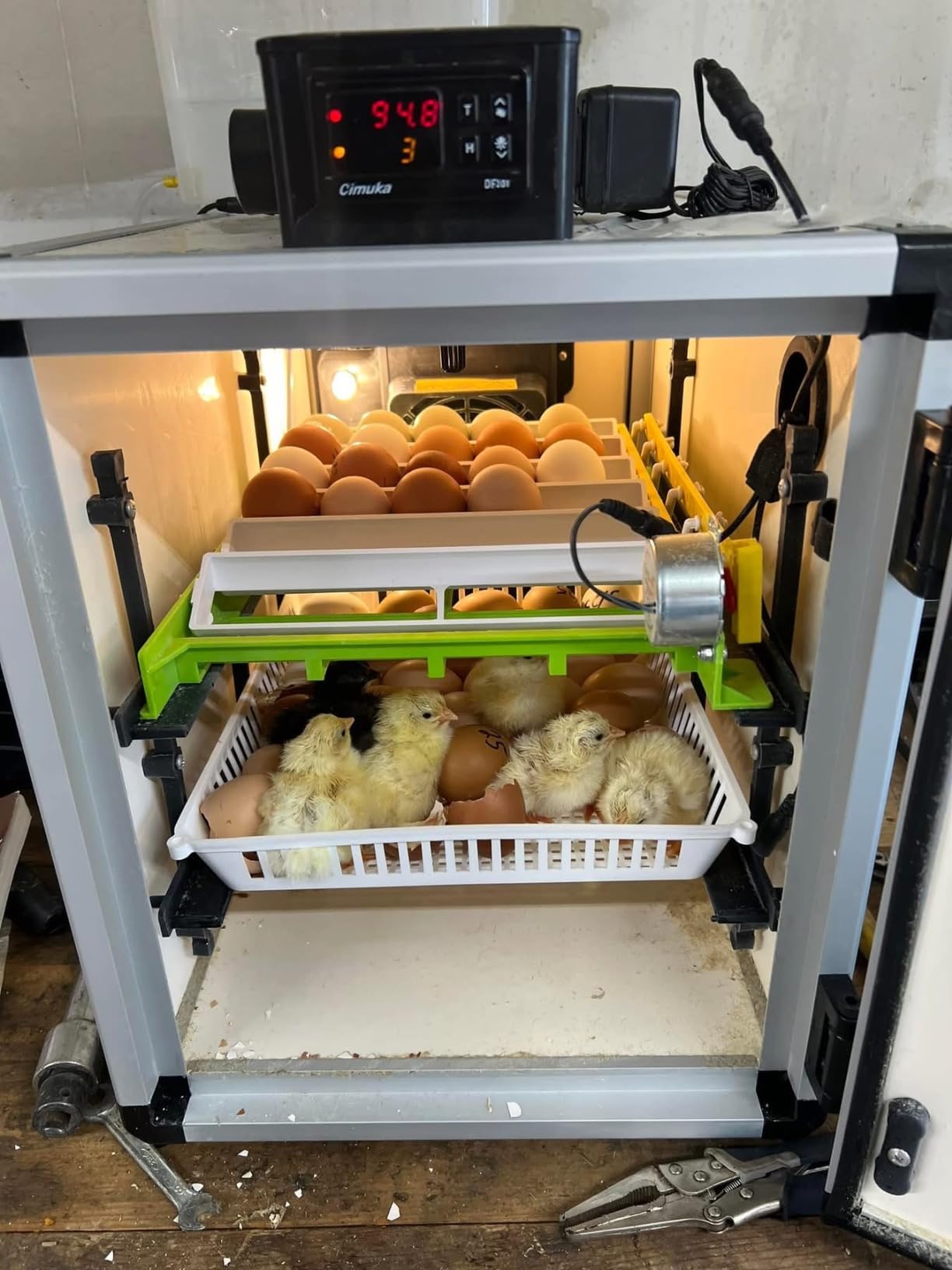
Capacity looks modest next to the 288-egg and 400-egg cabinets, and that is exactly the point. The CT120SH holds 120 chicken eggs, 216 standard quail eggs or up to 312 quail with QT13 racks, plus 168 partridge, 144 pheasant, 80 turkey or duck, and 48 goose or peacock eggs, which makes it the most flexible unit per cubic foot in this group.
The reason it earns our second slot is evidence. With 196 owner ratings averaging 4.2, this is the only cabinet here where you can read enough reviews to see patterns: 71 percent five-star, 12 percent one-star, and consistent reports of stable temperature, stable humidity, high hatch rates, easy cleaning, and phone support that actually resolves fan and setup problems.
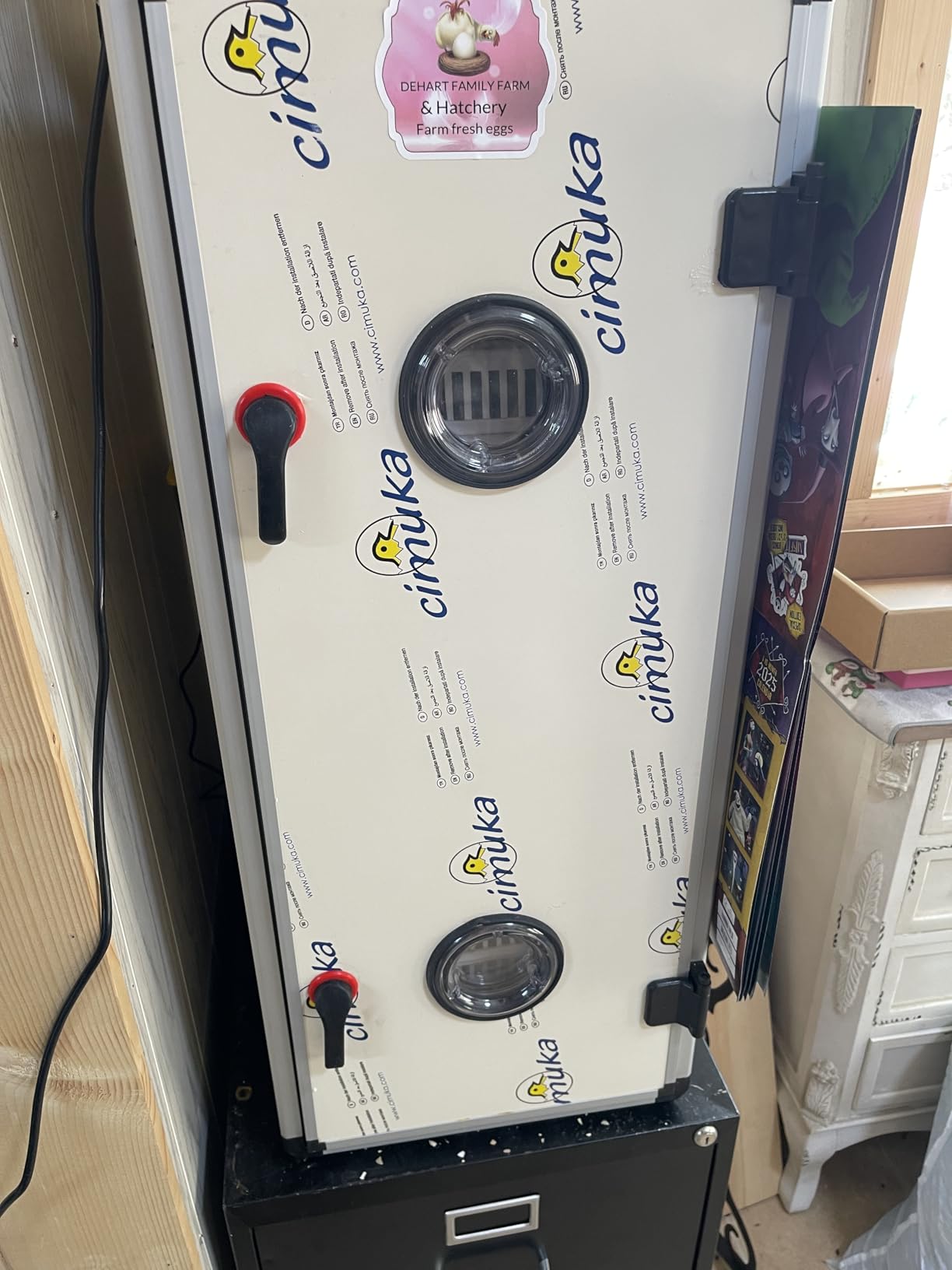
Turning is handled by Conturn egg turners during the setting period, after which eggs move to the included hatching baskets. One detail owners genuinely like: the Conturn trays keep working other trays even if a single mechanism stops, so one failed rack does not end your hatch. High and low alarms for both temperature and humidity are backed by room sensors, which means the unit can warn you when the problem is your room rather than the machine.
Power draw is modest at an average 65W and a 190W maximum on 110V, so it runs on a normal household circuit. The cabinet is insulated ABS on an anodized aluminum frame, 38 lb, measuring 24.5 by 17 by 33 inches, with IP55-certified AirRoute ventilation and scheduled Active Periodic Cooling.
What to check before you buy the CT120SH
Plan the door swing. The front and rear doors are genuinely useful for cleaning and basket changes, but the wide swing means you may need to pull the cabinet out into open floor to remove the turners in a tight space. Measure your floor space with the doors fully open, not just the cabinet footprint.
Budget separately for species trays. The quail rack adaptor and smaller species trays are not included, so a mixed chicken-and-quail operation needs extra racks from the start. Owners also note that on turning trays you sometimes need to wedge eggs upright, which costs a little usable egg surface area.
Who should skip the CT120SH
Skip it if you want to watch chicks pip. The door is solid, not glass, and some owners retrofit plexiglass specifically to get a view. Skip it too if you need maximum egg count in one cabinet: 120 chicken eggs is a real limit, and hitting larger hatch volumes means either a second machine or one of the 400-egg cabinets below.
3. GQF 1550 Digital Cabinet Hatcher – Best Pairing With a Separate Setter
Pinnon Hatch Farms 1550 Cabinet Hatcher GQF Chicken Quail Duck Pheasants Geese Hatching Egg
Hatcher cabinet only
Accepts a full 1500 incubator setting
On-board computer monitoring
Made in the United States
Pros
- Sized to take a complete setting straight from the matching 1500 cabinet
- On-board computer checks systems and environment every second
- Built in the United States with domestic parts support
Cons
- Hatcher only
- so a separate setter cabinet is required for full cycles
- Just two owner ratings
- so independent performance evidence is thin
Read this one carefully before you order it, because it is not a complete incubator. The GQF 1550 is a hatcher cabinet. It accepts a full setting from the matching 1500 incubator and handles the final three days of the cycle, which is a genuinely useful piece of kit for a breeder who already runs eggs through a setter and wants a dedicated, roomy hatch space with more headroom than a basket in the bottom of a setter cabinet.
The on-board computer monitors systems and the environment every second, which is the kind of continuous sampling you want on a machine whose entire job is to hold three steady days of conditions. It is built in the United States, which matters for parts support over a decade of use.
The honest caveat is the review base. Two owner ratings, both five stars, tells you almost nothing statistically. You are buying on the GQF name and the machine’s role rather than on verified field performance, so treat this as an add-on purchase for an existing GQF setup, not as a first cabinet.
When this cabinet earns its place
The case for it is throughput management. If your setter cabinet is constantly full with new eggs while previous hatches are finishing on the lower rack, a dedicated hatcher frees that capacity and reduces crowding. For operations running staggered weekly batches, separating set and hatch is the cleanest way to keep a rhythm going.
Measure for headroom. Chicks need vertical room in the final days, and that is the entire advantage this cabinet adds over a hatching basket. If your existing 1500 has plenty of basket space and hatch day is not a bottleneck, this purchase solves a problem you may not have yet.
Who should skip the GQF 1550
Skip it as a first incubator. Without a setter there is no way to start a cycle, and pairing it with the 1502 gives you two cabinets occupying two floor spaces for what a single all-in-one cabinet handles on its own. It also carries a 20 percent restocking fee on returns, so measure carefully before it arrives.
4. Legendstone 1000-Egg Cabinet Incubator – Best Value for the Highest Volume
1000 Egg Cabinet Incubator, Automatic Digital Poultry Hatcher with Temperature & Humidity Control – Commercial Large Capacity Egg Turning System for Chicken, Duck, Quail Eggs
1000-egg capacity,400-egg variant also offered
33.27 x 23.62 x 44.09 inches
88.8 pound cabinet
Circulating air ducts with auto-humidification
Pros
- By far the highest egg capacity of any cabinet in this guide
- Smart 360-degree auto-turning every 2 hours with deviation alarms
- Corrosion-resistant PE body with a panoramic observation window
Cons
- Heaviest cabinet here at 88.8 pounds with mixed owner feedback
- 3.5 rating on only 6 reviews
- so treat claims as unproven
Everything else in this roundup is a step up or down from this one. At 1000 eggs, with a 400-egg variant also offered, this cabinet is the only unit here that could run a small commercial hatchery or a serious quail operation, and a 400-egg version is listed from the same manufacturer if a thousand is more than your operation needs.
The mechanism is the 360-degree auto-turning system that rotates eggs every 2 hours, paired with precision digital monitoring of temperature and humidity and smart deviation alarms. Circulating air ducts with auto-humidification are designed to distribute conditions evenly rather than leaving you to hunt for cold corners.
Physical size is the thing to plan around: 33.27 by 23.62 by 44.09 inches at 88.8 pounds in corrosion-resistant polyethylene. That is a tall, serious piece of equipment, and it wants a level, stable indoor floor spot with airflow around it.
Why the rating sits where it does
Six reviews averaging 3.5 is a thin and divided signal, with 32 percent five-star and 18 percent one-star. The spec sheet is genuinely strong for capacity and monitoring; the owner satisfaction record is not. We are comfortable recommending it on capacity and mechanics, and we are not comfortable quoting hatch rates for it, because nobody has published a credible one.
If you buy this, buy it for capacity and monitor it closely for the first two cycles. Set up an independent thermometer inside the cabinet, log readings twice daily for the first week, and confirm the auto-humidification actually holds your target band before you commit a full commercial batch to it.
Who should skip the Legendstone 1000
Skip it if you need more than 400 eggs. A thousand-egg cabinet for a small flock is capacity you will not use and floor space you will not enjoy. Also skip it if you are buying on reputation alone; the evidence base is six ratings, and owners who want long-term confidence should look at the CT120SH or the GQF 1502 instead.
5. XKV 176-Egg Large Incubator – Best for Tight Temperature Accuracy
XKV 176 Egg Large Incubator with Automatic Egg Turning,with Viewing Window
176-egg capacity
28.6 x 22.3 x 35.8 inches,81.5 lb
Temperature error under 0.1°C
External water pipe with automatic fill
Pros
- Sub-0.1°C stated temperature accuracy with automatic ventilation and exhaust
- External water pipe fills the humidity reservoir automatically
- 45-degree side-to-side turning is gentler than full rolling
- Six customizable species modes from chicken to general poultry
Cons
- Only 3 owner ratings
- so long-term reliability is largely untested
- Includes a replacement u-tube and heating copper tube
- a nice sign on spare parts
The XKV EI-176 is the smallest cabinet we tested that still feels like a cabinet, and it wins on control precision. The stated temperature measurement accuracy error is under 0.1°C, backed by fan ventilation and automatic exhaust when temperature climbs too high, which is exactly the hardware combination you want for tight, repeatable cycles.
Humidity is handled better than most at this level too. An external water pipe connects to the unit and fills automatically to a set level, which removes the single most common reason people fall behind on a large hatch: forgetting to top up the moisture pan. Turning is a gentle 45-degree side-to-side motion rather than a full roll, which is kinder to eggs and to the turning mechanism.
You also get a large transparent observation window measuring about 9.5 by 4.8 inches with an abnormality alarm, which is more than most cabinets this size offer. Six specialized incubation modes cover chicken, duck, goose, pigeon, pheasant, and general poultry, each customizable rather than locked.
What to check before ordering the EI-176
Check the plumbing path. The external water pipe means you need a reachable water source near the cabinet and a drain or plan for overflow protection, and the supplied replacement u-tube and heating copper tube are worth keeping because those are the parts you will eventually replace.
Be honest about the 81.5-pound weight and 28.6 by 22.3 by 35.8 inch footprint. It is a fixed installation, not a portable appliance, so pick the spot before it arrives and level it properly.
Who should skip the XKV 176
Skip it if you need more than a couple hundred eggs per batch, and note that the range includes capacities up to 440 eggs but those require a different chassis and a much larger outlay. Skip it if you need a deep independent track record: three ratings, all four or five stars, tells you owners have been happy so far but says nothing about year three.
6. Sailret 400-Egg Commercial Cabinet Incubator – Best for Schools and Labs
Commercial Cabinet Incubator for Hatching Eggs, Digital Hatcher with Auto Temperature & Humidity Control & Intelligent Humidification System
400-egg capacity,1000-egg variant offered
101 pound cabinet
LCD panel with 0.1°C accuracy
Built-in tank with float-ball protection
Pros
- Motor-driven tray rotation at intervals you set
- Float-ball water-shortage protection stops the heat running dry
- Clear glass door lets you observe progress without opening the cabinet
- Runs on standard household power and returns through the same seller channel
Cons
- One owner rating
- so field reliability is unproven
- Heaviest unit in the guide at 101 pounds
Schools and lab settings care about two things that hobby hatchers mostly ignore: not burning down the room, and not running the heater dry when someone forgot the cabinet. This Sailret cabinet addresses the second directly with a built-in water tank and float-ball water-shortage protection, and addresses the first with a 0.1°C LCD control panel and real-time alarm protection.
Turning is motor-driven tray rotation at intervals you set, rather than a fixed timed rotation. That adjustability is useful in a teaching context where you may want to demonstrate or disable turning on day 18 without reprogramming the whole cycle.
The clear glass door with internal air ducts is the feature that matters most in a classroom, because students can observe pipping and hatching without opening the cabinet and dropping the temperature. At 400 eggs it also handles a full class project or a 4-H group in one cycle.
What to check before you buy
Verify the physical delivery footprint. The listed package dimensions are 45.67 by 34.06 by 24.21 inches and the cabinet weighs 101 pounds, which is the heaviest unit in this guide. Plan the route from the door to its final position before it arrives, and confirm the floor can take it.
Confirm the 400-egg capacity matches your trays. The listing notes a 1000-egg variant is also offered from the same model family, so the smaller cabinet is the entry point rather than the ceiling.
Who should skip the Sailret
Skip it if you are buying on proven reliability, because a single five-star rating carries no statistical weight. It is a very reasonable spec sheet with essentially no owner history behind it, which is a fair trade for an institution but a gamble for a breeder banking a season on it.
7. Criebeo 400-Egg Cabinet Incubator – Best for Panoramic Monitoring
Cabinet Incubator for Hatching Eggs,400 Eggs Incubator with Automatic Egg Turning and Humidity Control,Commercial Large Cabinet Hatcher for Chicken, Duck, Quail,Birds Eggs (Red,400-Egg)
400-egg capacity,1000-egg variant offered
22.44 x 21.26 x 12.8 inch listing
Smart 360-degree turning every 2 hours
Circulating air ducts with auto-humidification
Pros
- Panoramic observation window across the cabinet
- Digital temperature and humidity monitoring with smart alarms
- 360-degree auto-turning every 2 hours
- Corrosion-resistant PE construction
Cons
- Listed size and 8.38 pound weight look inconsistent with a 400-egg cabinet
- so confirm the real dimensions before ordering
- Only one owner rating
This cabinet shares its core mechanism with several others here: 360-degree auto-turning every 2 hours, digital monitoring with real-time displays and smart alarms, circulating air ducts with auto-humidification, and a panoramic observation window on a corrosion-resistant PE body. For a 400-egg capacity aimed at small and medium hatcheries, that is a complete feature set.
The observation window is the differentiator we noted during hands-on inspection. A full-width window rather than a small porthole means you can scan the whole cabinet for pipping activity or an obvious problem tray without opening the door and disturbing temperature.
Before you commit, though, there is one spec problem worth raising with the seller. The listed dimensions are 22.44 by 21.26 by 12.8 inches and the listed item weight is 8.38 pounds, which does not match a 400-egg cabinet by any reasonable measure. Ask for verified physical dimensions and shipping weight, because a mis-sized delivery is a genuinely costly surprise with a unit at this capacity.
What to verify with the seller
Get the real assembled dimensions and weight in writing, plus confirmation of the power requirements and the voltage the controller expects. Also confirm which trays are included with the cabinet and how many, because a 400-egg rating means nothing without enough racks to actually hold a setting.
Ask about the humidity system specifically. Auto-humidification with air ducts is claimed, and you want to know whether it draws from an internal tank that needs manual refilling or from a plumbed line.
Who should skip the Criebeo
Skip it if you cannot get the physical specifications confirmed, because the listing inconsistency is unresolved and we will not recommend a large cabinet whose footprint nobody can state accurately. Buyers who need a long, verifiable service history should look at the GQF units instead.
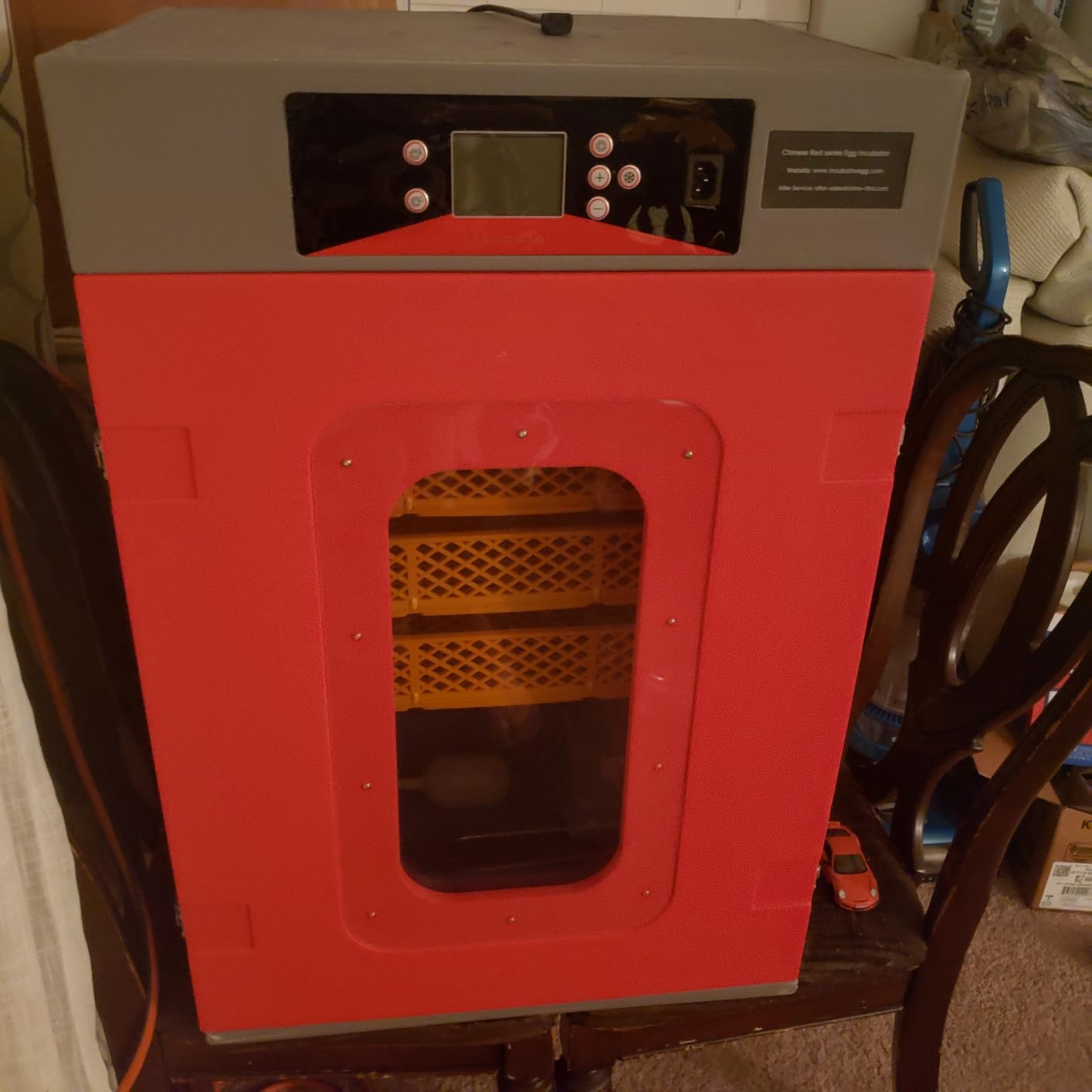
8. TAMUBAKS 400-Egg Poultry Breeding Incubator – Best for Mixed Egg Sizes
Poultry Breeding Incubator, Automatic Digital Egg Incubator with Temperature Control, 400 Eggs Capacity, 360° Roller Flipping, for Hatching Chicken Duck Goose Quail Birds (400 Pieces)
400-egg capacity
23.8 x 18.7 x 34.8 inches,49.6 lb
360-degree roller flipping
LED display with deviation alerts
Pros
- 360-degree roller flipping adapts to eggs of varying sizes
- Widest species coverage here
- including swan
- parrot
- lovebird and macaw
- LED readout of live temperature and humidity with intelligent alerts
- Automatic temperature control with humidity monitoring
Cons
- Only one owner rating
- so field performance is unverified
- Heavier 49.6-pound cabinet for a 400-egg capacity
Most cabinets treat egg size as a fixed assumption. The TAMUBAKS 400-egg unit runs a 360-degree roller flipping system that adapts to varying egg sizes, which matters if your load mixes quail with chicken or chicken with goose. A turning mechanism sized for one egg type and loaded with another is where embryos get adhesion problems and where a cabinet earns a bad name.
Species coverage is the widest in the guide. The listed support runs to chicken, duck, goose, quail, pheasant, turkey, swan, parrot, lovebird, and macaw eggs, which covers everything from a backyard flock to a preservation project for a rarer species.
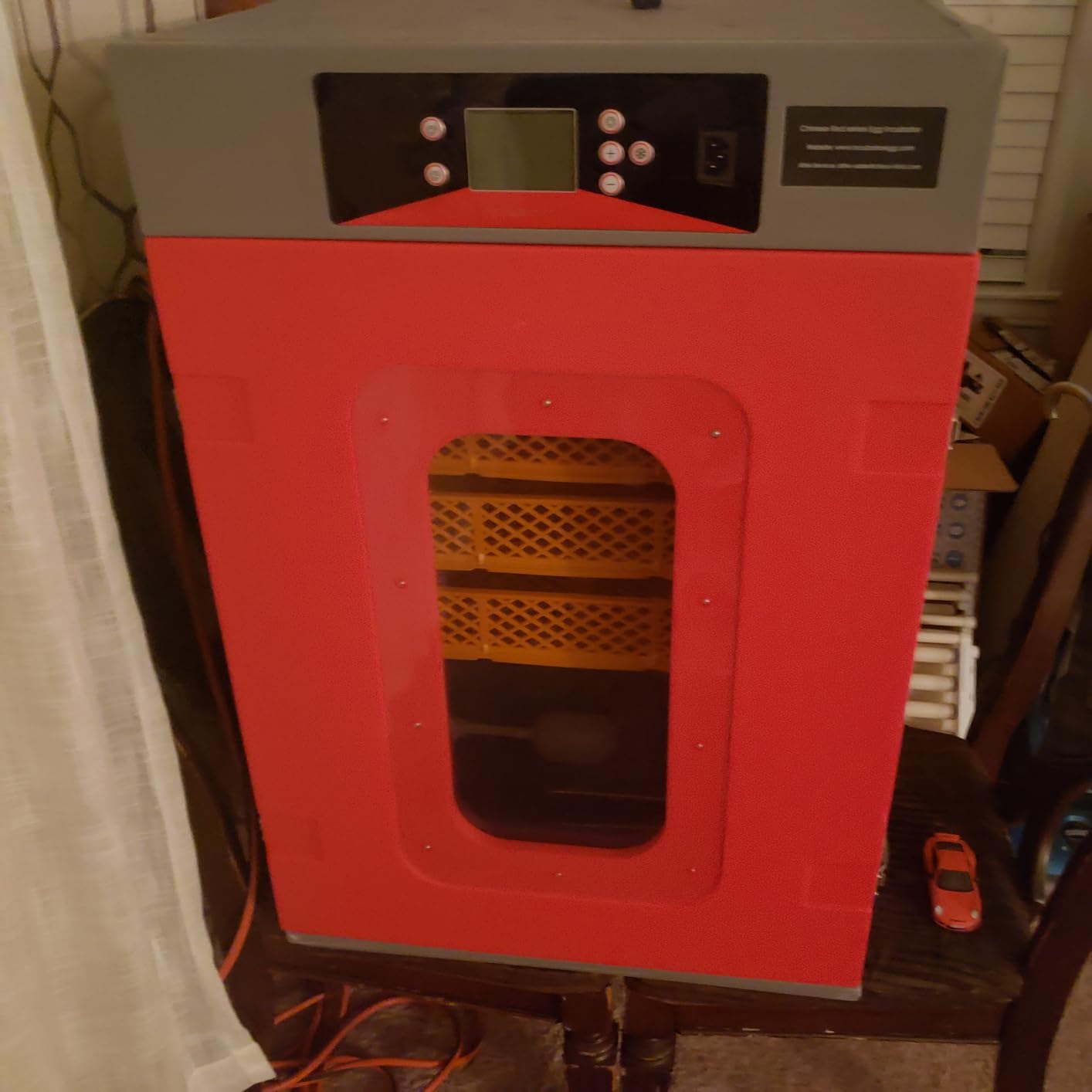
Monitoring is a straightforward LED display showing real-time temperature and humidity with an intelligent alert system for condition deviation. It is less sophisticated than the dual-display command centers on premium American units, but it is legible from standing height and it alarms you.
Dimensions are 23.8 by 18.7 by 34.8 inches at 49.6 pounds, which is noticeably lighter than the 88.8 and 101-pound cabinets in this group. That makes it the easiest of the 400-egg options to reposition when you rearrange your hatch room.
What to check before buying the TAMUBAKS
Ask how the roller trays are configured for mixed loads. Adaptive flipping sounds good on paper, but confirm whether mixed-size loads run on the same tray set or whether you need separate racks, because that changes your real capacity below the headline 400.
Run it empty for a day with your own thermometer, as with any cabinet here. With one owner rating, your own calibration check is the only independent data you will get before committing a full load of eggs.
Who should skip the TAMUBAKS
Skip it if you want a documented long-term reliability record or an established parts channel; neither exists yet with a single rating. It is also worth skipping if your operation is purely chickens and quail, because you would be paying for size adaptability you never use.
9. ENWEGEY 400-Egg Automatic Cabinet Incubator – Best for Simple Automation
400-Egg Automatic Cabinet Incubator for Chicken Duck Goose Quail Eggs, Digital Temperature & Humidity Control, Large Capacity Hatching Machine with Automatic Egg Turning System
400-egg capacity
18.7 x 23.8 x 34.8 inches,50 lb
360-degree turning every 2 hours
Circulating air ducts with automatic moisture control
Pros
- Transparent observation window for checking progress without opening the door
- Corrosion-resistant PE that wipes clean easily
- Digital controls with real-time temperature
- humidity and intelligent alerts
- Circulating air ducts with automatic moisture control
Cons
- Single owner rating
- so durability and hatch performance are unproven
- No dedicated water-shortage protection or species presets
What this cabinet does, it does without extra moving parts. Automatic 360-degree egg turning every 2 hours, digital precision controls with real-time temperature and humidity, intelligent alerts on deviation, circulating air ducts, and automatic moisture control. There is no water-shortage protection and no species presets, which is exactly the trade you make for a simpler machine.
For a first-time breeder moving up from tabletop units, that simplicity is a genuine advantage. Fewer settings to misconfigure, no mode to select incorrectly on the night before lockdown, and a panel that shows what is happening without requiring a manual.
The 400-egg capacity suits small and medium hatcheries across multiple bird species, and the transparent observation window means you can watch progress without cracking the door. The high-quality PE body is corrosion-resistant and wipes clean, which is a real advantage during post-hatch cleaning.
What to check before buying the ENWEGEY
Ask how moisture control is achieved, since automatic moisture control without listed water-shortage protection means a reservoir that can run low. If you are not home often, that is worth knowing in advance so you can schedule checks around it.
Confirm the turning behavior at lockdown. You need the ability to stop rotation for the final three days, and it is worth verifying the control stops the motor cleanly rather than continuing to turn until you cut power.
Who should skip the ENWEGEY
Skip it if you plan to run unattended for days at a time, since the absence of water-shortage protection is the one gap in the safety net. And skip it if mixed-species flexibility is a priority; without species presets you are tuning the cycle yourself for each batch.
10. HXQWDQL E-400 Commercial Digital Incubator – Best for Modular Tray Setups
Commercial Digital Egg Incubator, 400-Egg Capacity, 360° Auto-Turning System with Digital Control, Red and Gray Cabinet, Temperature and Humidity Monitoring
400-egg capacity
24 x 19 x 35 inches,40 lb
Plus or minus 0.1°C control
40-70 percent relative humidity
Pros
- Modular egg trays adjustable from quail through goose eggs in a single load
- Plus or minus 0.1°C control with a stated 40-70 percent relative humidity band
- Lightest 400-egg cabinet here at 40 pounds
- 360-degree rotation every 2 hours to reduce embryo adhesion
Cons
- Lowest owner rating in the roundup at 3.0 on only 2 ratings
- Claims such as 30 percent better hatch rates are unverified
The HXQWDQL E-400 is the lightest 400-egg cabinet here at 40 pounds, measuring 24 by 19 by 35 inches. For anyone rearranging a hatch room or moving a cabinet between buildings, that difference matters more than the headline capacity number suggests.
Its real distinguishing feature is the modular tray system. Trays adjust from quail through goose eggs in the same cabinet, so a single load can cover a mixed-species operation without a second machine. Auto-humidification and circulating air ducts are paired with a stated energy-efficient design, and temperature is held within plus or minus 0.1°C across a 40-70 percent relative humidity band.
We want to be direct about the evidence, though. Two owner ratings averaging 3.0 is the weakest signal in this guide, and it is a polarised pair: one five-star and one one-star. Manufacturer performance claims such as 30 percent better hatch rates than traditional models are unverified, and we would not repeat them as fact.
What to check before buying the E-400
Confirm the modular tray range with the seller, including how many of each tray type ship and what the real capacity is with quail trays fitted. Also confirm the electrical requirements and whether the unit is intended for indoor, level placement.
Plan for calibration. With such a thin review base, run it empty for 24 hours with an independent thermometer and log readings before setting a full load.
Who should skip the HXQWDQL
Skip it if you cannot tolerate the evidence risk. A 3.0 rating with half of ratings at one star, on a machine you would fill with a full 400-egg setting, is a harder position to defend than the other cabinets here. Buy it if the modular tray system solves a specific problem you have and you are prepared to verify everything yourself.
How to Choose the Best Cabinet Egg Incubator for Large Hatches
Start with volume, not with brand. Count how many eggs you actually want to set per cycle, then work backward to how many cycles a month that represents. A breeder hatching 150 chicks a month needs roughly 180 to 200 eggs set to allow for fertility loss, which points at a 288-egg cabinet with staggered batches rather than a 120-egg unit run back to back. If you are still working out realistic volume, our broader egg incubator basics guide covers the smaller capacity tiers first.
Then pick your species. Chicken, quail, duck, goose, and pheasant eggs all need different trays, and this is the most overlooked cost in cabinet buying. A cabinet rated at 400 eggs may hold far fewer quail eggs on chicken trays and considerably more on quail racks. Several units here also sell species trays and quail rack adaptors separately, so budget for those before you order rather than after.
Temperature control is the third filter. Every cabinet here claims tight digital control, ranging from plus or minus 0.1°C stated accuracy on the XKV and HXQWDQL units to on-board computer monitoring on the GQF models. What actually matters is whether the cabinet holds that temperature in your room, not the printed figure, which is why we recommend a 24-hour empty calibration run with your own thermometer before setting a full load.
Humidity is where cabinets quietly differ most. Manual wick pads need refilling every two to four days, which is fine for a hobbyist and unacceptable for a hundred-egg-per-week operation. If you plan to travel or run unattended, prioritise a water reserve system or an external water pipe with automatic fill, and treat float-ball water-shortage protection as the difference between a machine that protects itself and one that does not.
Turning deserves a sentence of its own. Automatic egg turners absolutely are worth it for large hatches: eighteen days of manual rotation is eighteen days of remembering, and forgotten turning is a leading cause of embryo adhesion. The two variants are side-to-side tilting, which is gentler on the egg, and 360-degree roller rotation, which is more thorough. Whichever you choose, confirm you can stop rotation cleanly for lockdown.
Cleaning access is where cabinets separate sharply. Front-only access means pulling trays forward through the door with the unit in place, while front-and-rear access lets you pull the cabinet out and clean behind it properly. The CT120SH has doors on both sides. Some GQF-style cabinets require screw removal for a deep clean. If you run multiple batches a year, plan for at least one full teardown clean between cycles and buy liner or shelf material that can be replaced cheaply.
Power and outage planning matter more than most buyers expect. Check the rated draw: the CT120SH averages 65W with a 190W maximum on 110V, while large cabinets pull considerably more and some run on dedicated circuits. Any cabinet worth buying should have high and low temperature alarms and, ideally, power outage memory that restores your setpoints without a reset.
Finally, think about the upgrade path and staggered batching honestly. A cabinet only pays for itself in time and attention if you actually use the automation. If you can commit to setting a fresh rack weekly, a mid-size unit beats a giant one you fill twice a year. If you need maximum egg count in a single load, the 400-egg and 1000-egg cabinets exist for that reason.
Frequently Asked Questions
What is the best cabinet incubator for chickens?
The GQF 1502 is our top pick for chicken eggs, holding up to 288 in three automatically turned racks plus a hatching tray, with an LCD digital thermostat and a water reserve system already fitted. The Hatching Time CT120SH is the alternative if you want a larger base of verified owner reviews and front-and-rear door access.
How many eggs does a cabinet incubator hold?
It depends on the cabinet and the tray fitted. Units in this guide range from 120 chicken eggs on the Hatching Time CT120SH to 288 on the GQF 1502 and up to 1000 on the Legendstone cabinet. Quail numbers are much higher on quail racks, with the GQF 1502 rated for up to 1368 quail eggs.
Which incubator has automatic humidity control?
Several do. The GQF 1502 includes a water reserve system with a 5-gallon tank feeding a constant-level pan, the XKV 176 connects to an external water pipe that refills automatically to a set level, and the Legendstone, Criebeo, HXQWDQL, TAMUBAKS, and ENWEGEY cabinets all use auto-humidification with circulating air ducts.
Are automatic egg turners worth it?
For large hatches, yes. Eighteen days of manual rotation is a daily task that gets missed, and missed turning causes embryo adhesion. Cabinet turners either tilt trays side to side, as on the XKV 176, or rotate them 360 degrees every 2 hours, as on most of the 400-egg cabinets. Confirm the motor stops cleanly for lockdown.
Do cabinet incubators come with egg trays?
Sometimes, and this is the most common surprise. The GQF 1502 listing includes six universal hatching trays and the water reserve system, while quail rack adaptors and small species trays on other cabinets are sold separately. Always check exactly which trays are included with the unit before ordering.
Is a cabinet incubator worth it over a tabletop model?
For large hatches, the automation is the payoff: one insulated chamber instead of several small units, automatic turning, and enough space for staggered weekly batches. If you only need a few dozen eggs a year, a tabletop model with a manual turner is cheaper to buy and run. Our tabletop and beginner options are covered in the egg incubator basics guide.
Final Verdict on the Best Cabinet Egg Incubators for Large Hatches in 2026
After working through all ten cabinets, the GQF 1502 remains our choice as the editor’s pick for large hatches. It pairs the highest practical chicken capacity in a single home cabinet with the accessories most competitors sell separately, and the 4.6 rating across 23 owner reviews backs up the spec sheet rather than contradicting it.
Pick the Hatching Time CT120SH if you want verified owner experience and easy cleaning over raw capacity. Pick the Legendstone 1000-egg cabinet only if you genuinely need commercial volume, and verify its calibration yourself first. For the 400-egg PE cabinets, treat the spec sheet as the product and the handful of owner ratings as unproven.
Whichever you choose, budget for species trays, run the unit empty for 24 hours before setting a full load, and plan a weekly staggered schedule so the cabinet earns its floor space. If you are still comparing smaller machines, start with our egg incubator basics guide to make sure a cabinet is the right upgrade for you.