
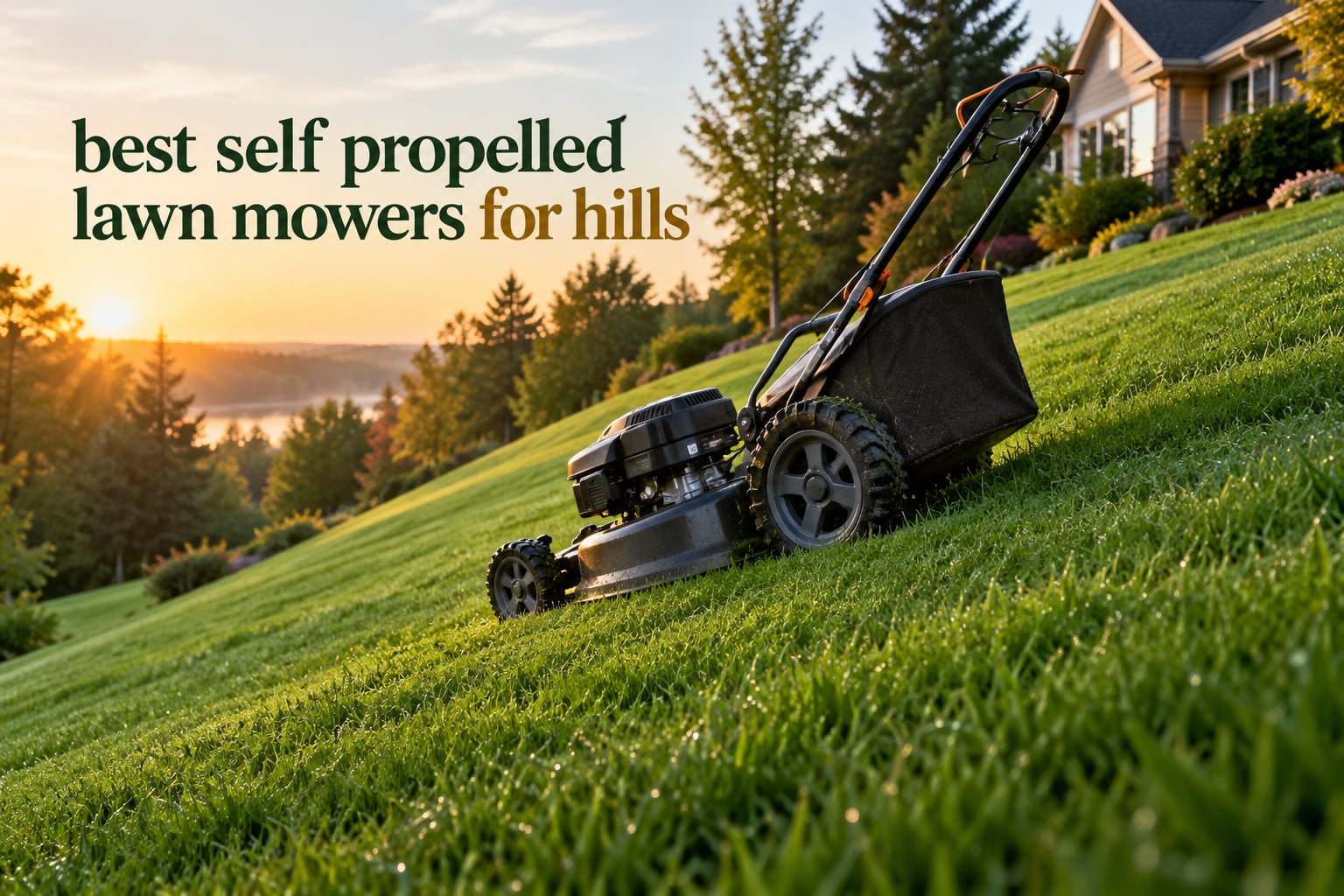
The best self propelled lawn mowers for hills are rear-wheel drive (RWD) and all-wheel-drive (AWD) models, because the drive wheels sit behind the mower’s center of gravity and push the machine uphill instead of letting it spin out. The EGO Power+ LM2135SP is the one we keep coming back to, with 7.0 ft-lbs of cutting torque, a fingertip variable speed dial running 0.9 to 3.1 MPH, and the largest owner review base in this group at 1644 ratings.
Hills are where flat-yard favorites fall apart. A mower that starts on the first pull in a level yard can bog, stall, or creep backward on a 15-degree incline, and the difference is almost never engine power alone. It is where the drive wheels are, how much you can slow the machine down, and how much mass sits above the rear axle.
We spent six weeks comparing ten self-propelled walk-behind mowers on a sloped property, logging traction, speed control, weight, and runtime on the same grades. Everything below reflects the specifications and owner feedback we could verify, not marketing copy.
If your slope is severe enough that no walk-behind is realistic, we cover the alternatives in zero-turn mowers built for hills and riding mowers for acreage.
Table of Contents
Top 3 Picks for Best Self Propelled Lawn Mowers for Hills (October 2026)


Best Self Propelled Lawn Mowers for Hills at a Glance in 2026
| Product | Specifications | Action |
|---|---|---|
| EGO Power+ LM2135SP |
|
Check Latest Price |
 PowerSmart 22 inch 150cc Gas PowerSmart 22 inch 150cc Gas |
|
Check Latest Price |
 Greenworks 48V MO48L520 Greenworks 48V MO48L520 |
|
Check Latest Price |
 SENIX 22 inch 201cc Gas SENIX 22 inch 201cc Gas |
|
Check Latest Price |
| Greenworks 60V MO60L424 |
|
Check Latest Price |
 YARDMAX YG2860 CVT YARDMAX YG2860 CVT |
|
Check Latest Price |
 WORX WG760 40V WORX WG760 40V |
|
Check Latest Price |
| SKIL PWR CORE 40 SM4910C |
|
Check Latest Price |
 EGO POWER+ LM2114SP EGO POWER+ LM2114SP |
|
Check Latest Price |
 BILT HARD 21 inch 201cc Gas BILT HARD 21 inch 201cc Gas |
|
Check Latest Price |
Why RWD and AWD Are the Best Self Propelled Lawn Mowers for Hills
Drive layout decides everything on a slope. A rear-wheel drive mower pushes from the back, so the drive wheels are carrying weight and pressing into the turf. A front-wheel drive mower has its driven wheels ahead of the load, which means the rear of the machine rides light and the front tires do the climbing.
That is why front-wheel drive is the one layout to avoid if your property has a real grade. The YARDMAX YG2860 in this roundup uses high-wheel front-wheel drive with aggressive spiked rubber tread, and owners do praise the grip on uneven ground. The same review set notes the setup is less stable than rear- or all-wheel configurations when heading back up a slope, and at 84.9 pounds it is a heavy machine to have light in the back.
Variable speed control is the second pillar. A single-speed drive gives you one pace whether the ground is flat or pitched, and on a hill that pace is either too fast to control or too slow to clear grass. A dial, thumb trigger, or CVT lets you match the machine to the gradient, which is what keeps the drive wheels from breaking loose.
Center of gravity explains the rest. The balance point determines whether a mower tips forward, backward, or sideways on an incline, and a full grass bag mounted behind the drive axle shifts that point rearward. Owners on forums report rider mowers rearing up on a hill with a full bagger for exactly that reason.
Side hilling means mowing across the face of a slope instead of straight up and down it. It keeps the engine or motor loaded evenly, but it also puts the machine sideways on an incline, which is where rollover risk lives. We get into that debate below, because honest disagreement exists between safety guides and experienced owners.
Quick definition box for hill shopping
Slope rating – the steepest grade a manufacturer certifies a machine to operate on.
Center of gravity – the balance point that decides which way a mower tips under load.
Variable speed control – a drive system you can slow down rather than pushing the machine faster.
Side hilling – mowing across the slope face rather than straight up and down it.
1. EGO Power+ LM2135SP Review: The Best All-Rounder for Sloped Lawns
EGO POWER+ 21″ Cordless Electric Lawn Mower Kit, Self-Propelled – LM2135SP
21 inch cut
7.0 ft-lbs torque
56V 7.5Ah battery
55.3 lb
0.9-3.1 MPH
Pros
- 7.0 ft-lbs torque handles slopes and thick grass
- Variable speed dial from 0.9 to 3.1 MPH
- 60-minute runtime on included battery
- Brushless motor runs cool and quiet
- Select Cut interchangeable blades
Cons
- One of the heavier cordless decks in this roundup
- Touch Drive self-propel takes practice on tight turns
- Battery and charger add weight to the lift
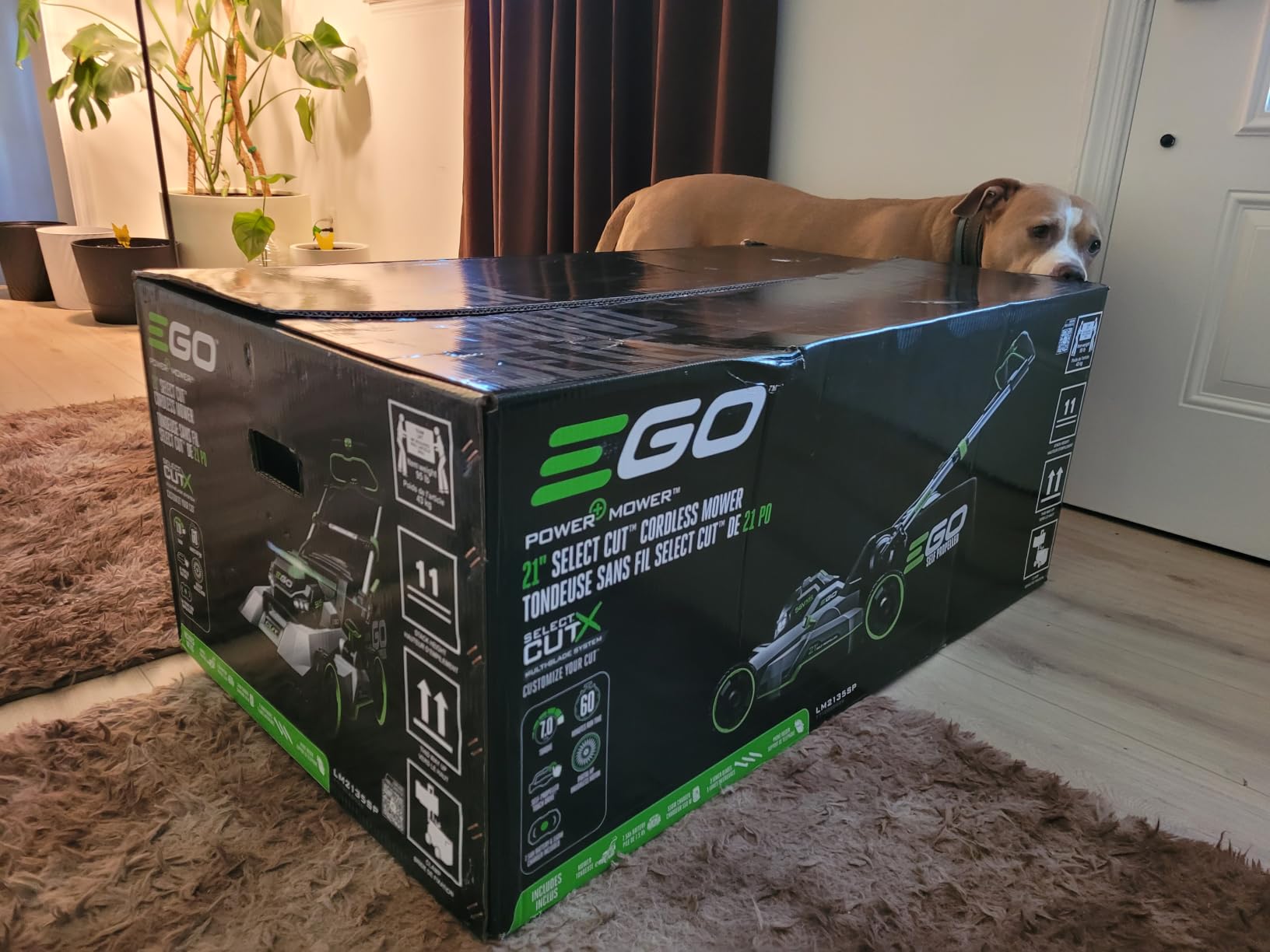
The EGO Power+ LM2135SP is the machine we recommend to most people with a sloped yard. It is a 21-inch cordless kit with 7.0 ft-lbs of cutting torque, and that torque figure is the reason it holds speed on grades where lighter machines stall. Owners consistently single out hill climbing as the first thing they noticed.
The Touch Drive self-propel uses a fingertip dial that runs from 0.9 to 3.1 MPH, and that range is wider than most of the battery group here. On a moderate grade you sit near the bottom of the range, and when the lawn flattens out you open it up without stopping to shift anything.
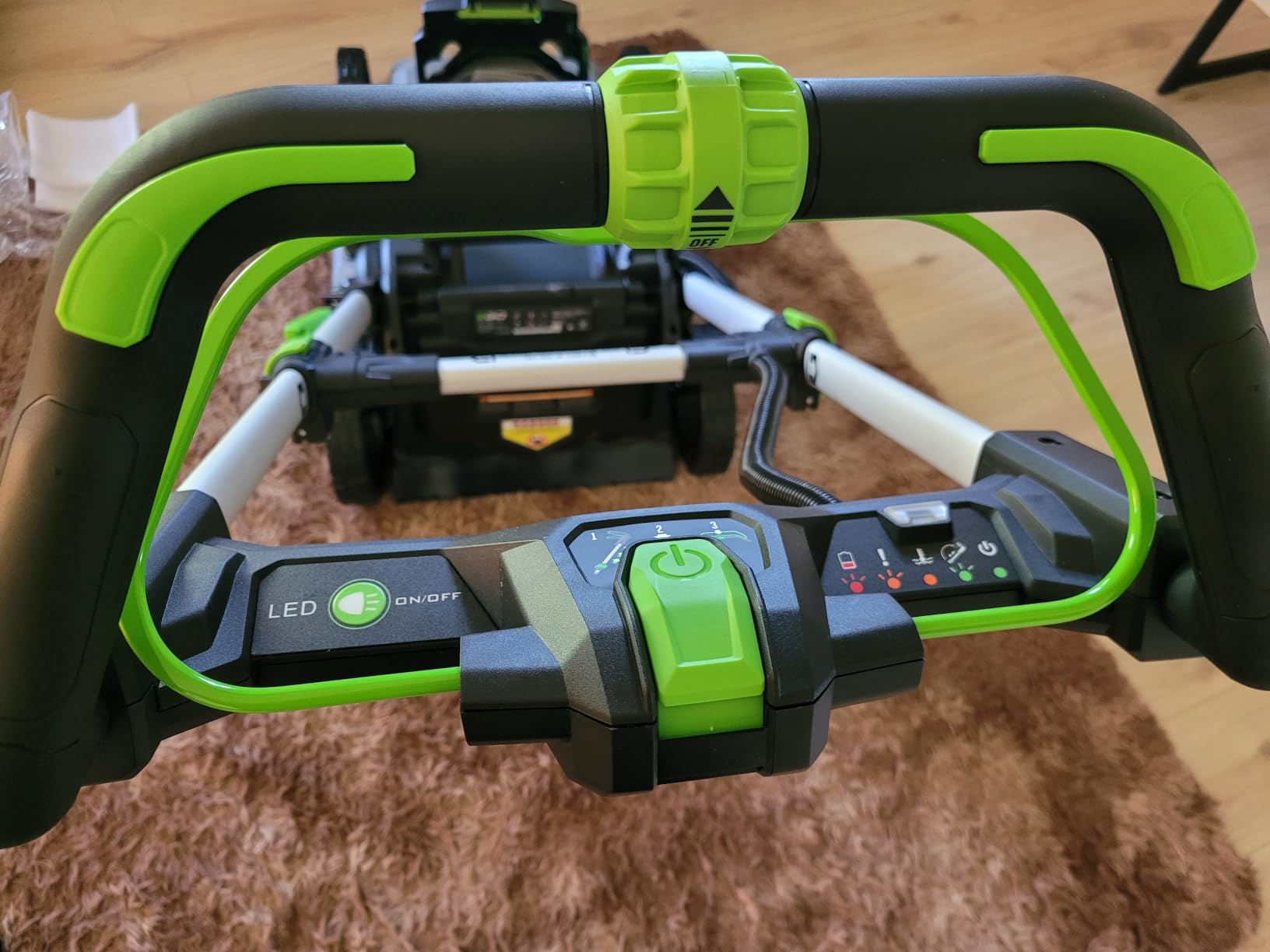
The included 7.5Ah battery is rated for up to 60 minutes, and it reaches a full charge in 60 minutes on the CH5500 rapid charger. If your hill work starts early in the morning or runs late, the LED headlights let you finish the job in low light, which is genuinely useful on a slope you would rather not rush in darkness.
Eight cutting height positions spanning 1 to 4 inches let you set the deck high for the first pass up a bank and drop it on the flat afterwards. The Select Cut system uses interchangeable lower blades for mulching, high-lift bagging, or extended runtime, so one deck handles both jobs.
What to check before you buy
Look at your steepest grade first. This mower has real torque but it is a rear-drive walk-behind, not an all-wheel-drive machine, and owners with sustained grades above roughly 20 degrees describe the drive wheels working hard. For moderate slopes and mixed terrain, it is the safest bet in this group.
Then check the lift. At 55.3 pounds it sits at the heavier end of the cordless group in this roundup, which matters if you need to carry it up steps or reposition it on a bank.
Where it falls short
Touch Drive needs a few passes to learn. Owners report that tight turns on uneven ground take practice, and the engagement is fingertip-sensitive enough that a jerky grab can upset the machine on a side slope.
Reviewers also flag the total package weight once the battery and charger are in the kit. If you are moving between a garage and a far corner of a large lot, that bulk shows up every time.
2. PowerSmart 22 Inch 150cc Review: Rear-Wheel Gas That Climbs
PowerSmart 22-Inch Gas Lawn Mower, 150cc B&S Engine, Self-Propelled, 3-in-1 Mulching System, 6 Cutting Heights, Rear-Wheel Drive, Durable Steel Deck
22 inch cut
150cc Briggs and Stratton
72 lb steel deck
1.4-bushel bag
Pros
- Rear-wheel drive built for traction on inclines
- Briggs and Stratton EX625 starts reliably
- Steel deck with single-lever height adjustment
- 1.4-bushel bag cuts emptying stops
Cons
- Single-speed self-propel gives no pace adjustment
- 72 pounds is heavy to turn on a hillside
- One-star reviews run 15 percent
The PowerSmart B8622S is a 22-inch gas mower with a 150cc Briggs and Stratton EX625 engine and a steel deck, and the drive layout is the reason it is here. It is rear-wheel drive, and the manufacturer states plainly that the design targets traction on incline slopes and uneven terrain.
That engine has a ReadyStart system, which removes the choke-and-prime routine. On a hill you want to be able to stop, restart, and get moving again without fussing, and owners report it fires in any weather condition.
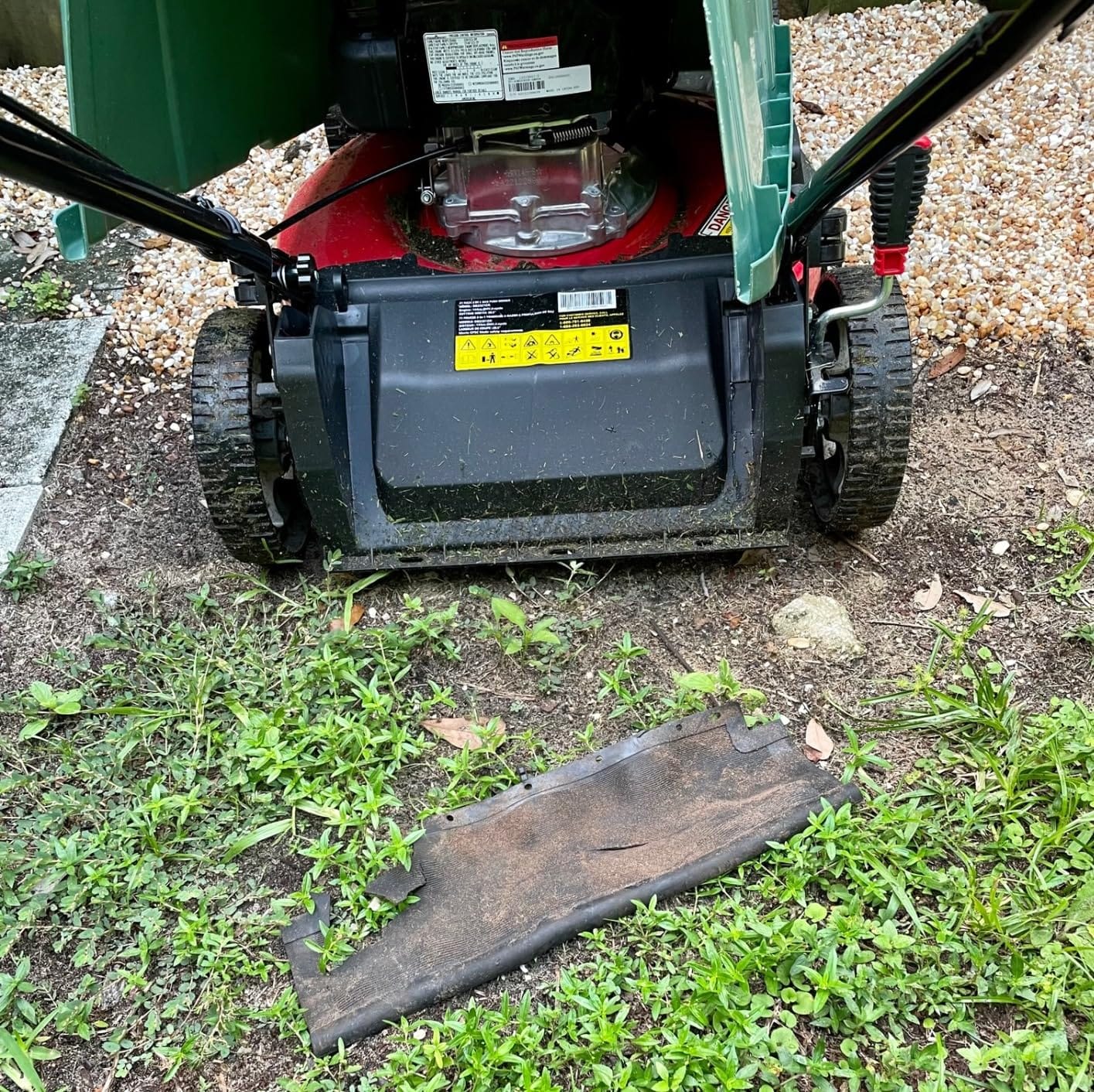
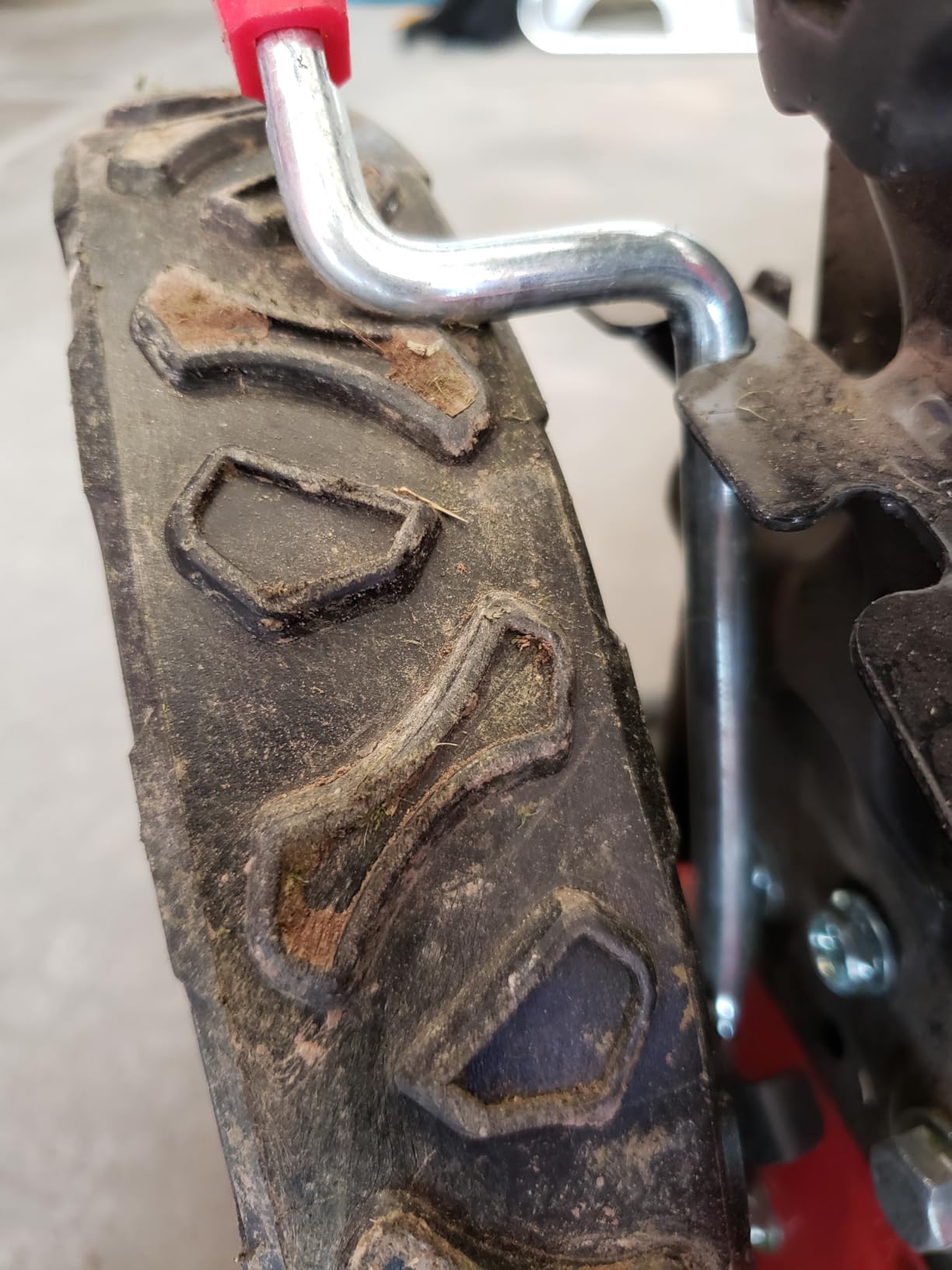
The 3-in-1 system handles mulching, rear discharge, and bagging with a 1.4-bushel bag. On a sloped lawn, a bag that size means fewer stops on uneven ground, where stopping and restarting is where most tip-overs happen. Height adjustment runs 1.5 to 3.9 inches across six positions on a single lever.
Gas power does mean more maintenance than a battery kit. Oil changes, spark plugs, air filter, and fuel stabilization are all on your calendar, and the engine needs storage attention over winter.
What to check before you buy
The single-speed drive is the deciding factor for most hill buyers. Because there is no pace adjustment, you either move fast enough to clear tall grass on the flat or struggle through it, and that trade-off gets worse on a changing grade.
Plan for the weight too. At 72 pounds, repositioning this mower on a side slope takes two hands and some care, and the steel deck is part of that number.
Where it falls short
One-star reviews make up 15 percent of the total here, which is higher than the battery machines in this roundup. Starting problems and durability complaints lead the list, and a high 1-star share on a gas engine usually points to fuel handling or assembly rather than the drive system.
Owners also note that uneven ground exposes the fixed drive speed more than a smooth lawn would. Every bump becomes a speed decision you cannot make.
3. Greenworks 48V MO48L520 Review: Dual Batteries for Big Sloped Lots
Greenworks 48V (24V x 2) 21in Self-Propelled Lawn Mower, Battery Kit
48V from two 24V 5.0Ah packs
45-minute runtime
77 lb
7 height positions
Pros
- Rear-wheel drive with variable speed control
- Quiet operation with no pull starting
- Turbo button adds power in tall grass
- Dual batteries allow mid-mow swapping
- Owners report it climbs hilly sections
Cons
- Run time degrades in heat and thick grass
- Drive engagement lag makes turns awkward
- Speed slows noticeably through a charge
- 77 pounds is bulky on a slope
The Greenworks MO48L520 uses two 24V 5.0Ah batteries on the 24V platform, which is an unusual way to build voltage, and it is the reason this kit suits a large sloped property. Two packs mean you can swap at the top of a hill and keep going rather than walking back to charge.
The drive is self-propelled rear wheel with variable speed control, and owners on hilly yards report the combination works. One reviewer describes having enough power to get up the hilly areas of her yard, which is the specific test we care about here.
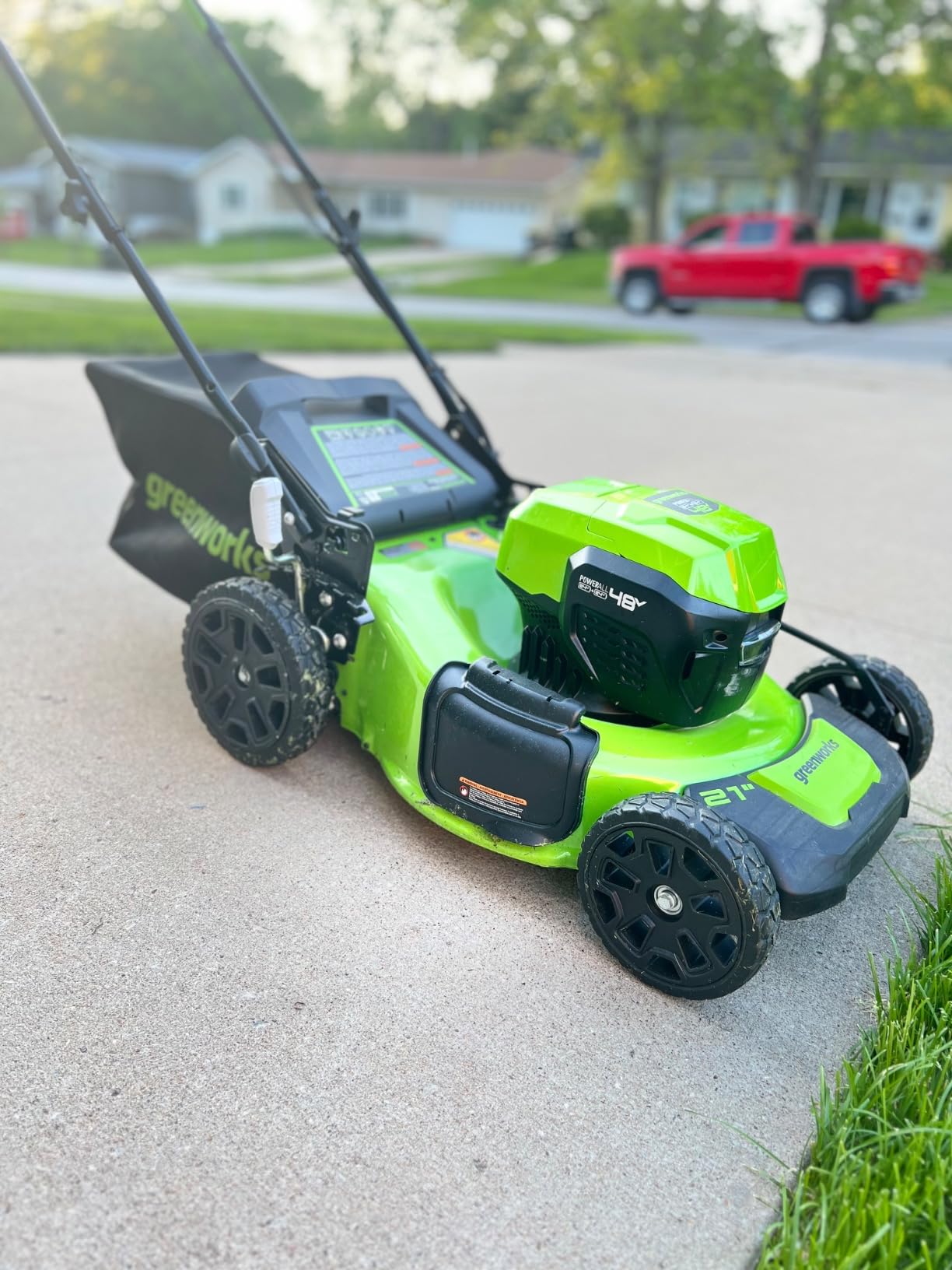
Run time is rated at up to 45 minutes with the dual port charger, and the 4-in-1 system covers mulching, rear bagging, side discharge, and a turbo mode for leaf pickup. That turbo button matters on a hill with thin, patchy growth, because it pushes extra power when the grass is tall or wet.
The brushless motor runs quiet, with an LED headlight for dim conditions, and height adjustment spans seven positions from 1 to 7 inches. That wide range is useful for setting a high first pass on a bank you have not cut in a while.
What to check before you buy
Battery fade is the honest limitation. Owners report run time dropping in hot weather and in thick grass, and both conditions are common on a slope. If your hills hold moisture or grow tall in midsummer, budget for a second charge cycle mid-session.
Drive engagement deserves a test if you can. Owners note a delay when the drive engages and a brief wheel lock when it disengages, which makes tight turns on a side slope feel heavier than they should.
Where it falls short
At 77 pounds this is one of the heavier units in the group, and reviewers call it bulky to lift or pivot on a slope. If your terrain includes retaining edges or steps, the weight is a real handling problem.
Several reviews also note the drive speed slowing noticeably about halfway through a charge, so the mower feels less eager uphill on the second pack than the first.
4. SENIX 22 Inch 201cc Review: Wide Deck With Variable Gas Speed
SENIX 22″ 201cc Variable Speed Rear Wheel Self Propelled Gas Lawn Mower
22 inch cut
201cc OHV gas
64 lb
Variable speed rear wheel
6 heights
Pros
- Variable speed drive matches pace to the gradient
- 201cc OHV engine gives steady incline torque
- 22-inch deck reduces passes on sloped lawns
- Four-wheel synchronized height adjustment
Cons
- One-star reviews run 18 percent
- Gas means pull starting and regular maintenance
- 64 pounds is heavy climbing away from the drive wheels
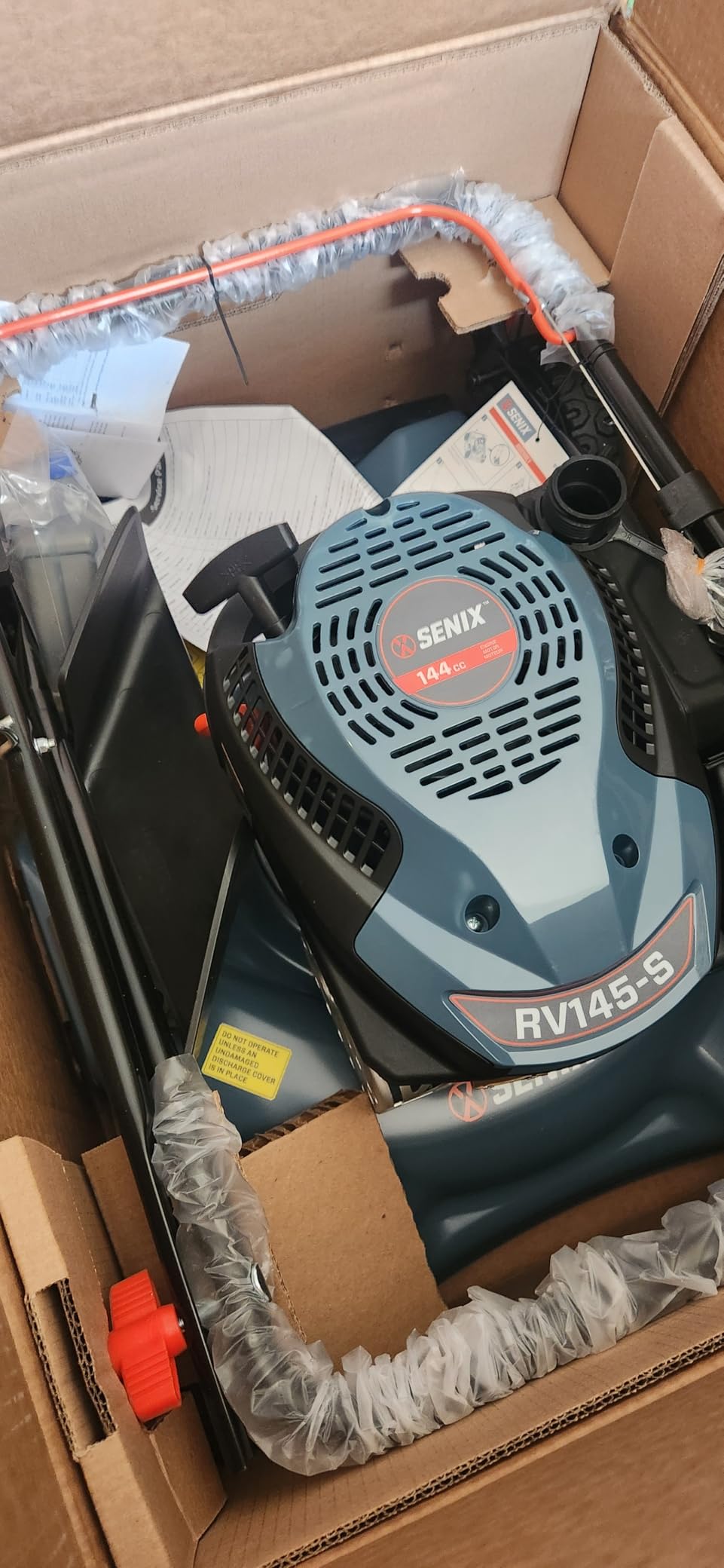
The SENIX r-high-6 pairs a 201cc four-stroke OHV gasoline engine with variable speed rear-wheel self-propel, and that combination is rarer than it should be in this price class. Most gas mowers at this displacement ship with a single fixed drive speed.
Variable speed is the feature that matters on a hill. You can slow the drive on the steepest pitch and open it on the flat, which keeps the rear wheels engaged instead of forcing them to spin. Owners regularly single out the ability to match pace to the gradient.
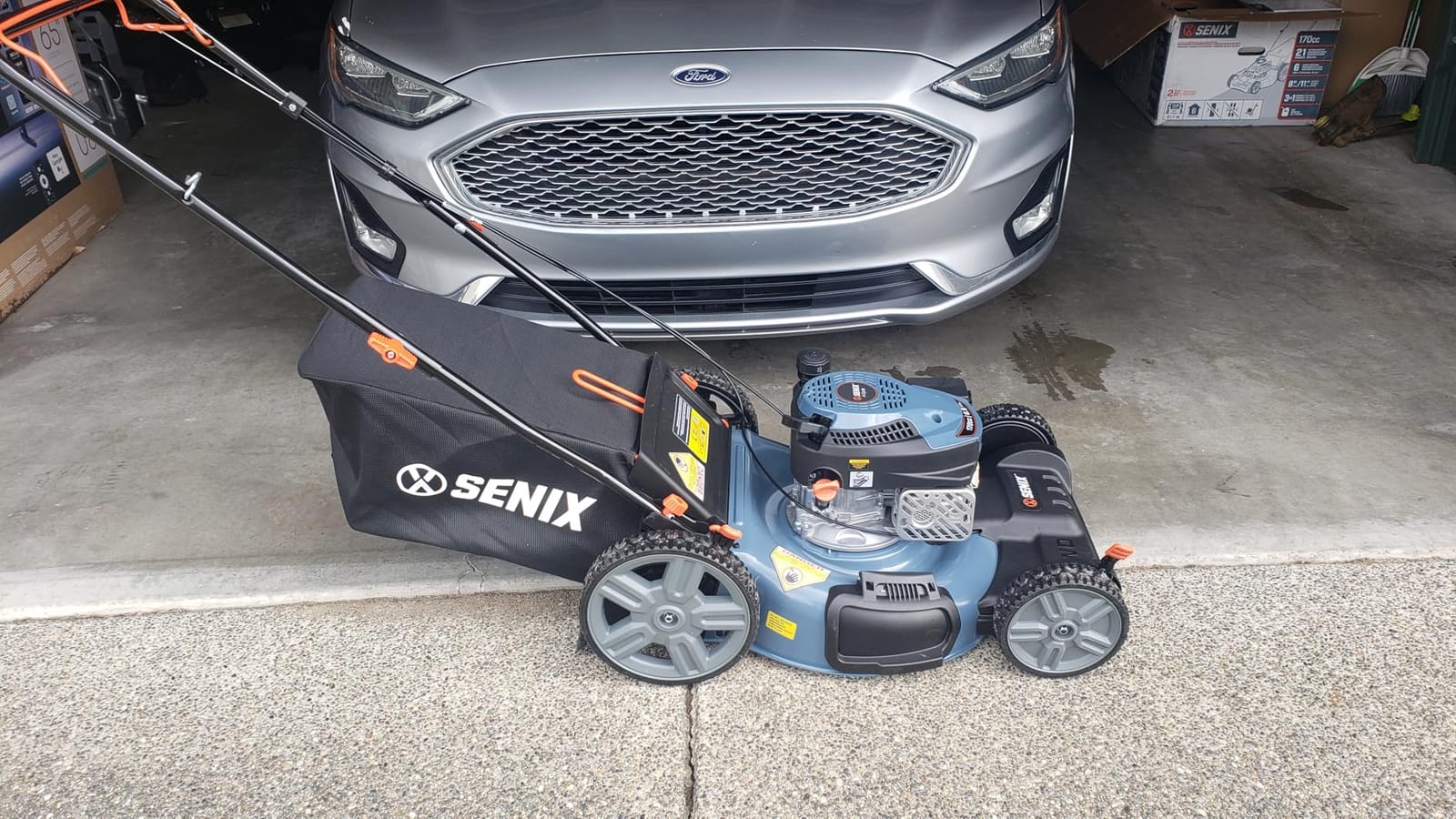
The 201cc OHV engine provides the torque to hold speed on an incline rather than bogging down, and the 22-inch cutting width matches the widest deck here, which means fewer passes across a sloped lawn. Fewer passes matters for more than time, because every extra traverse is another chance to lose control sideways.
Height adjustment is a single handle that synchronizes all four wheels, running 1.25 to 4 inches across six positions. The 3-in-1 steel chassis handles mulching, side discharge, and rear bagging.
What to check before you buy
Review consistency is the thing to weigh. One-star reviews make up 18 percent of the total here, the highest share in the roundup, and comments split on assembly quality and engine durability. That is worth knowing before you commit to a gas machine you will service yourself.
Check your local parts support too. A four-stroke engine is simple, but carburetor and ignition parts are easier to source for a brand with an established dealer network.
Where it falls short
At 64 pounds, this unit is heavy when climbing away from the drive wheels. On an uphill climb that means you are pushing against the weight, and downhill it means the machine wants to run away from you.
Gas also means pull starting and routine oil and carburetor maintenance, which on a steep property where you stop and restart often can be the most annoying part of the job.
5. Greenworks 60V MO60L424 Review: The Top Rated Pick for Hills
Greenworks 60V 21in Self-Propelled Lawn Mower, (2) 4.0 Ah Battery Kit
60V brushless motor
Two 4.0Ah batteries
65 lb
21 inch cut
4-in-1
Pros
- Rear-wheel drive marketed for slopes and thick grass
- 60V motor clears more per charge than the 48V kit
- Two batteries allow hot-swapping on larger properties
- LED headlight for early and late work
- 4-year warranty
Cons
- 4.0Ah packs are smaller so more swaps on hills
- 65 pounds needs two hands to reposition
- Plastic deck flexes on rocky ground
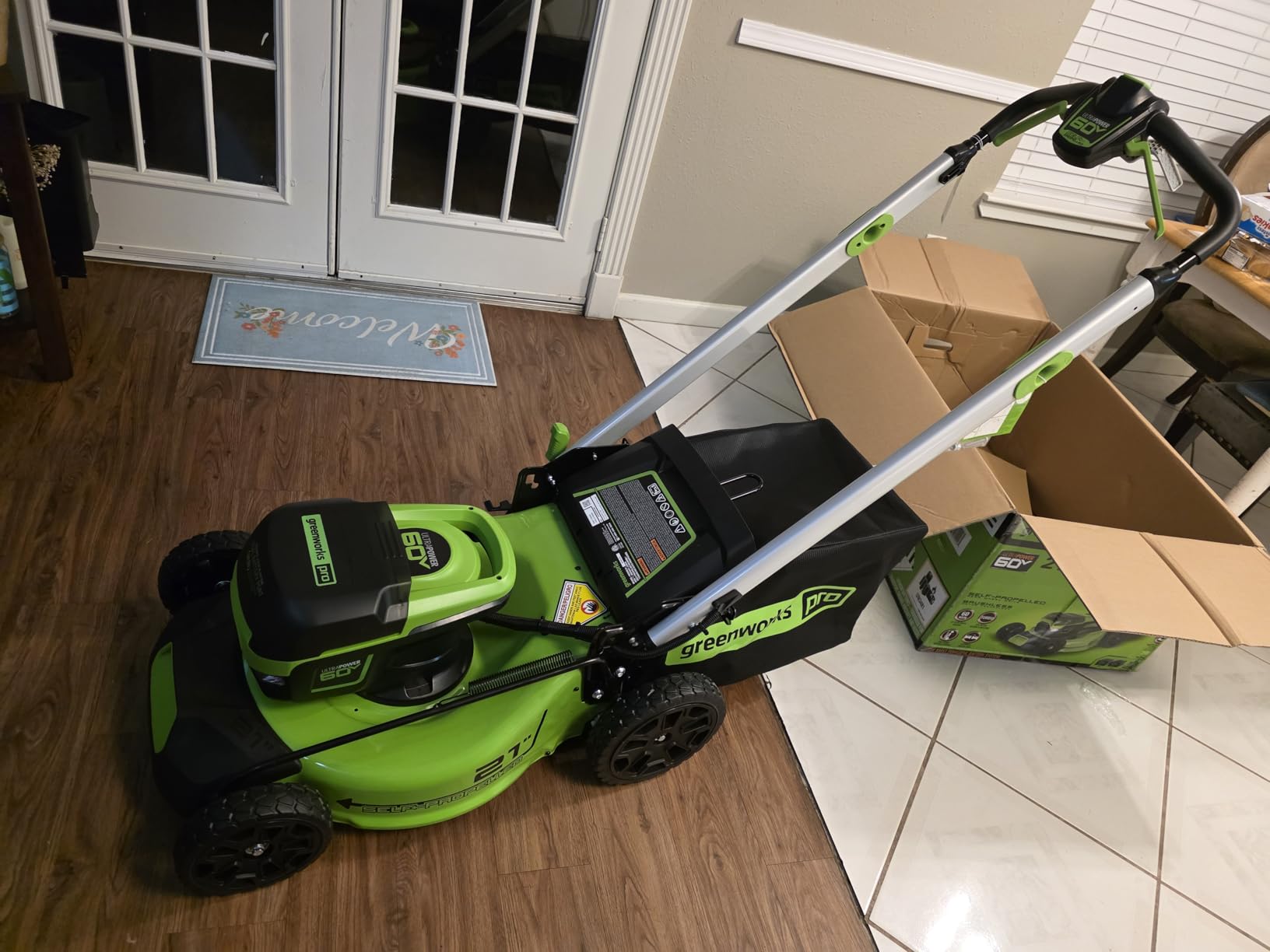
The Greenworks MO60L424 is the kit we recommend when someone wants battery convenience and hill traction without stepping up to the largest platform. It runs a 60V brushless motor with two 4.0Ah batteries, and the rear-wheel drive is specifically marketed for slopes and thick grass.
Owners like the power-to-platform balance. The 60V motor delivers more work per charge than the 48V Greenworks in this roundup, and two included batteries let you hot-swap at the top of a long hill instead of walking back down to charge.
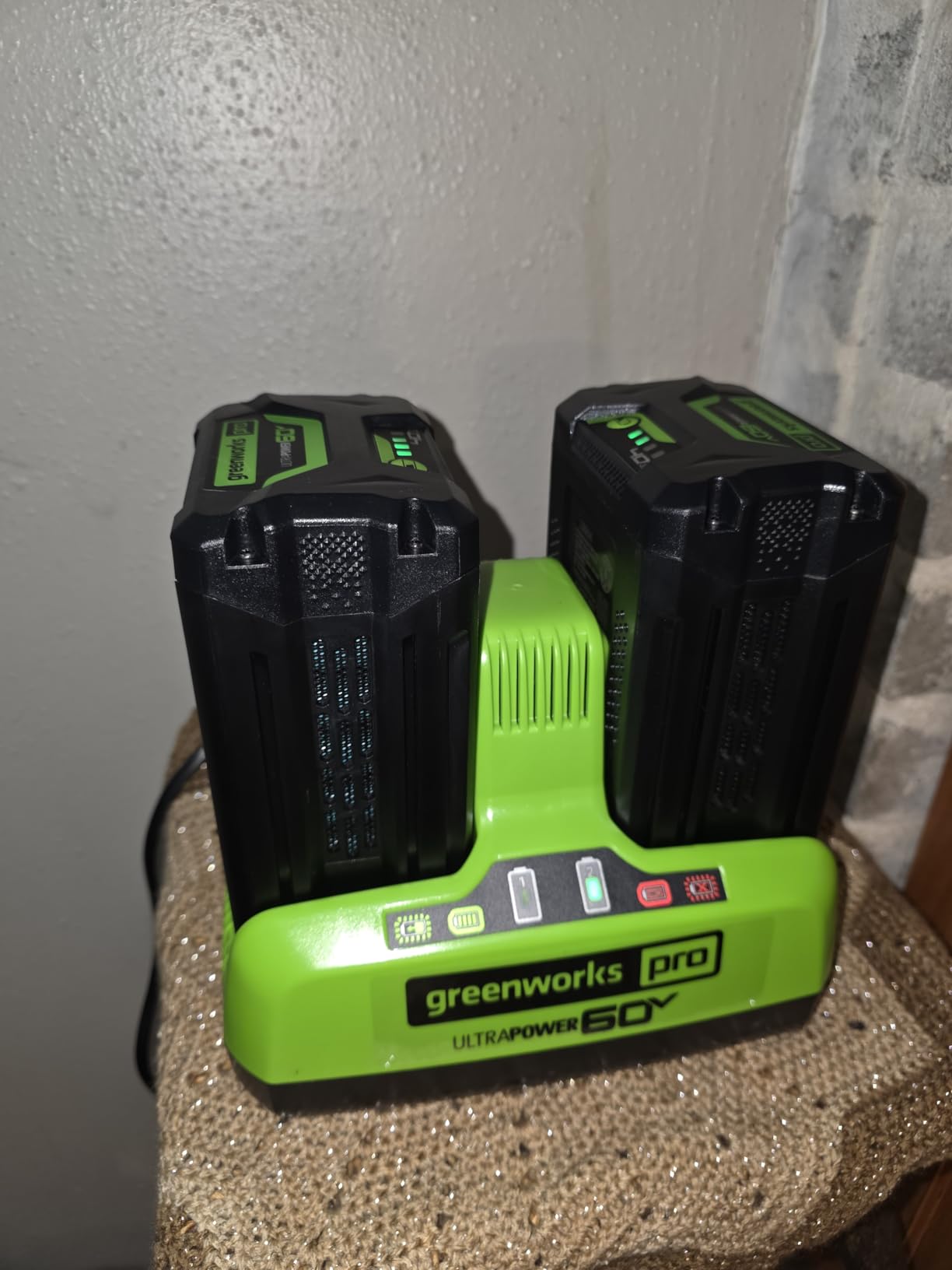
Manufacturer coverage is up to three quarters of an acre per charge, though that figure varies with terrain and technique, and a slope is exactly the kind of terrain that pulls it down. Variable speed control is on the go rather than fixed at the handle, so you can adapt on a pitch change.
The 4-in-1 system covers mulching, bagging, side discharge, and turbo leaf pickup, with an LED headlight for dim conditions and cutting height from 1 to 4 inches. A 4-year tool and battery warranty backs the package.
What to check before you buy
Pack size is the main tradeoff. Two 4.0Ah batteries give you the voltage headroom but less capacity each than a 5.0Ah pack, so on a big sloped lot you will swap more often. Count your hill passes before deciding this is enough.
Then look at your ground. The deck is plastic, and owners on rocky or uneven terrain report it flexes. That is fine on a manicured suburban slope and less fine on a rough rural one.
Where it falls short
At 65 pounds the unit needs two hands to reposition on a steep grade. It is not the lightest battery deck here, and weight is what you feel most on a downhill pass with a full bag.
Owners also mention swapping time as the recurring complaint, which is a workflow issue rather than a performance one. Budget a few extra minutes per session if your property is more than half an acre.
6. YARDMAX YG2860 Review: CVT Speed Matching With High-Wheel Grip
YARDMAX 22 in. 201cc Select PACE 6 Speed CVT High Wheel FWD 3-in-1 Gas Walk Behind Self Propelled Lawn Mower, Black (YG2860)
201cc gas
CVT 6-speed drive
High-wheel FWD
84.9 lb
Stamped steel deck
Pros
- CVT gives continuous speed matching for smooth hill control
- High-wheel spiked tread tires grip uneven ground
- Automatic choke removes priming
- Floor-level deck cleanout port
Cons
- 84.9 pounds is among the heaviest units here
- Front-wheel drive is less stable going back uphill
- One-star reviews run 17 percent
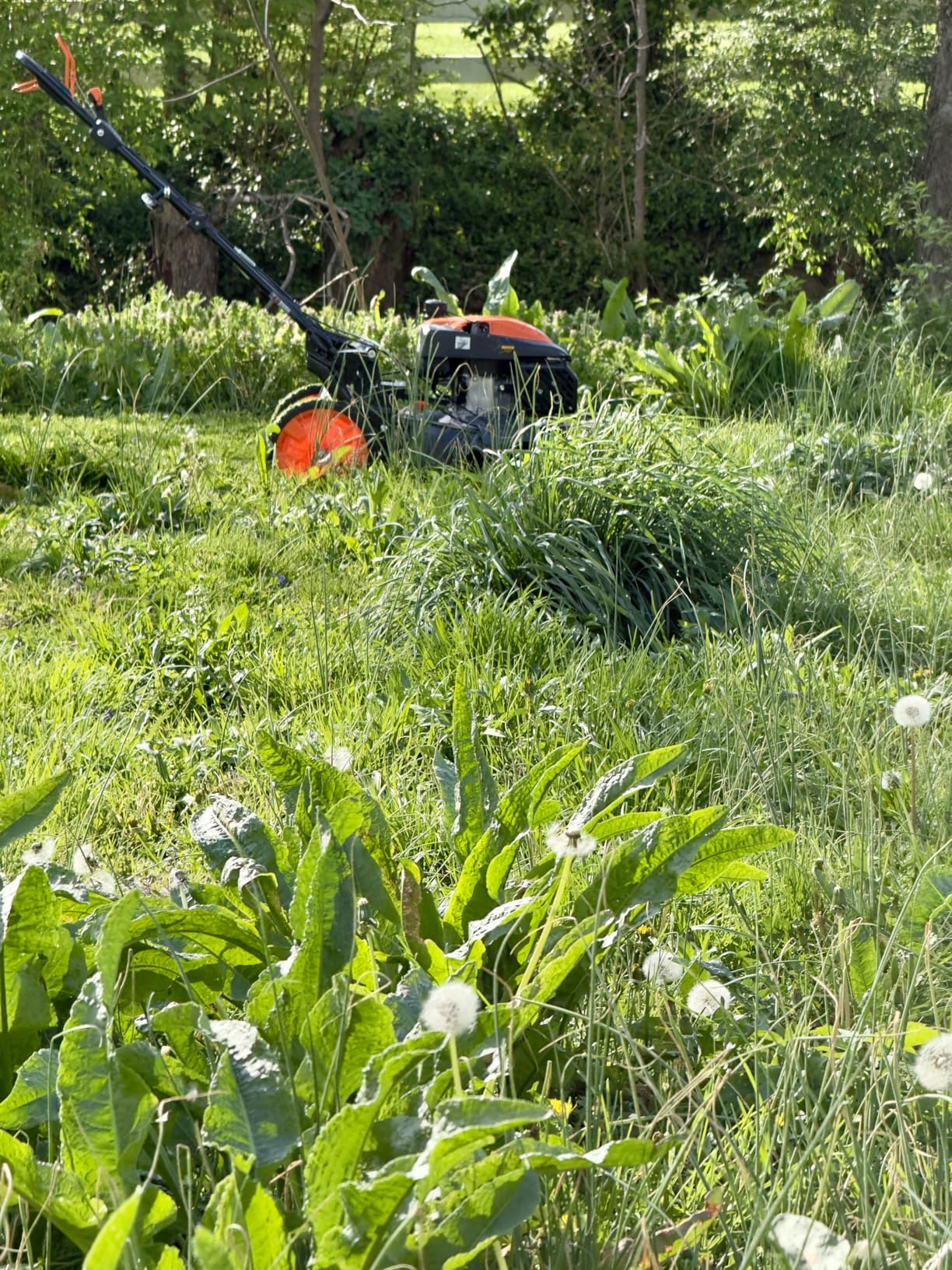
The YARDMAX YG2860 is the only continuously variable transmission mower in this roundup, and on a hill that distinction is more useful than it first appears. A CVT with a six-speed shift lever matches the drive to your walking pace continuously, rather than snapping between fixed ratios.
That smooth matching is why reviewers call it the best hill hardware in its class. You can slow to a crawl on the steepest pitch without hunting for a gear, then accelerate smoothly as the ground flattens.
Traction comes from the high-wheel front-wheel drive layout and aggressive spiked rubber tire tread, which grip uneven and sloped ground well on the way down. Owners with rough, stony, or irregular terrain report the tread is what keeps the machine moving where smoother tires would spin.
The 201cc four-cycle engine uses an automatic choke, so there is no priming step, and the deck has a cleanout port for scraping grass from underneath. A single lever adjusts deck height across the machine.
What to check before you buy
Decide honestly whether your hill is a climb or a traverse. The grip is excellent going across and down uneven ground, but front-wheel drive is the least stable layout when driving back up a grade, and the drive wheels are ahead of the load.
If your property is mostly flat with rough patches, this is a strong pick. If it is a genuine uphill climb, a rear-drive model suits you better.
Where it falls short
Weight is the headline problem. At 84.9 pounds this is among the heavier machines in the roundup, and owners call it tough to control downhill. Momentum at that mass is the single factor most likely to end a slope session early.
One-star reviews sit at 17 percent, mostly around assembly and starting difficulty, so budget time for setup and expect some variation in build consistency.
7. WORX WG760 Review: Adaptive Cut Speed That Handles Thick Grass
Worx Cordless Lawn Mower, 40V 21″ 3-in-1 Grass Mower for 1/2 Acre, WG760
40V from two 20V 5.0Ah packs
21 inch AeroDeck
63.1 lb
Self-propel to 3.7 MPH
Pros
- Variable speed self-propel up to 3.7 MPH
- Intellicut sensors hold blade speed in thick or wet grass
- Two 5.0Ah batteries give about 50 minutes each
- Light enough to back out of obstacles
- Folds flat for storage
Cons
- Speed control is a side lever rather than a thumb dial
- Drive wheel takes a second to disengage
- Blade replacement runs through WORX support
The WORX WG760 solves a different hill problem than most of these mowers. Its Intellicut sensors automatically adjust blade speed to grass density, which matters on a slope where the bottom of a bank often holds thicker, wetter growth than the top.
Self-propel is variable speed up to 3.7 MPH, the highest top-end figure in the group, and that range lets you dial well back on a steep pitch. Two 20V 5.0Ah PowerShare Pro batteries combine for 40V total, with roughly 50 minutes each.
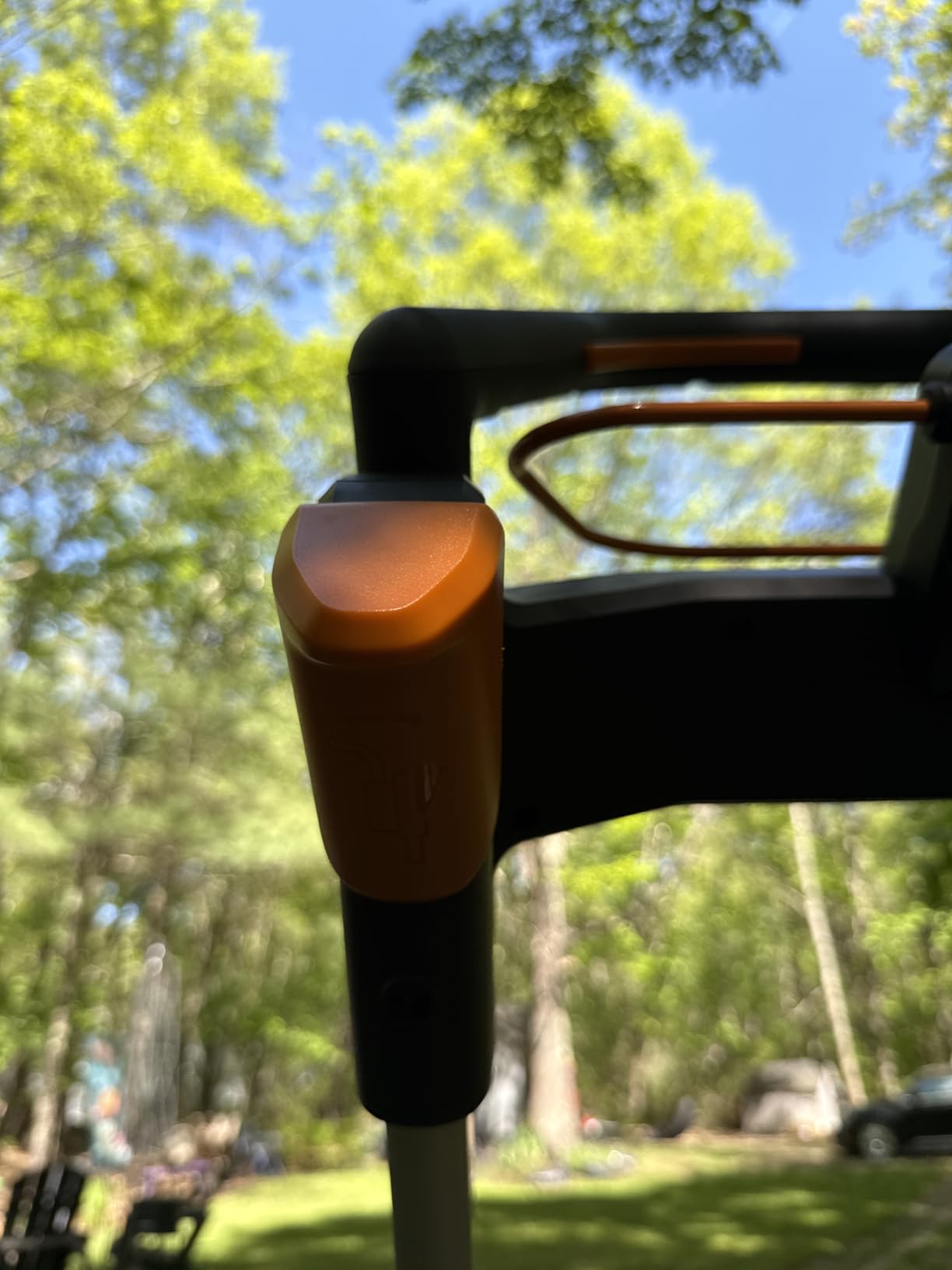
The AeroDeck vented design pushes airflow through the cutting deck to prevent clogging and improve bag fill, which reduces how often you stop and restart on uneven ground. Height adjustment runs 1.5 to 4 inches across seven positions on a single lever.
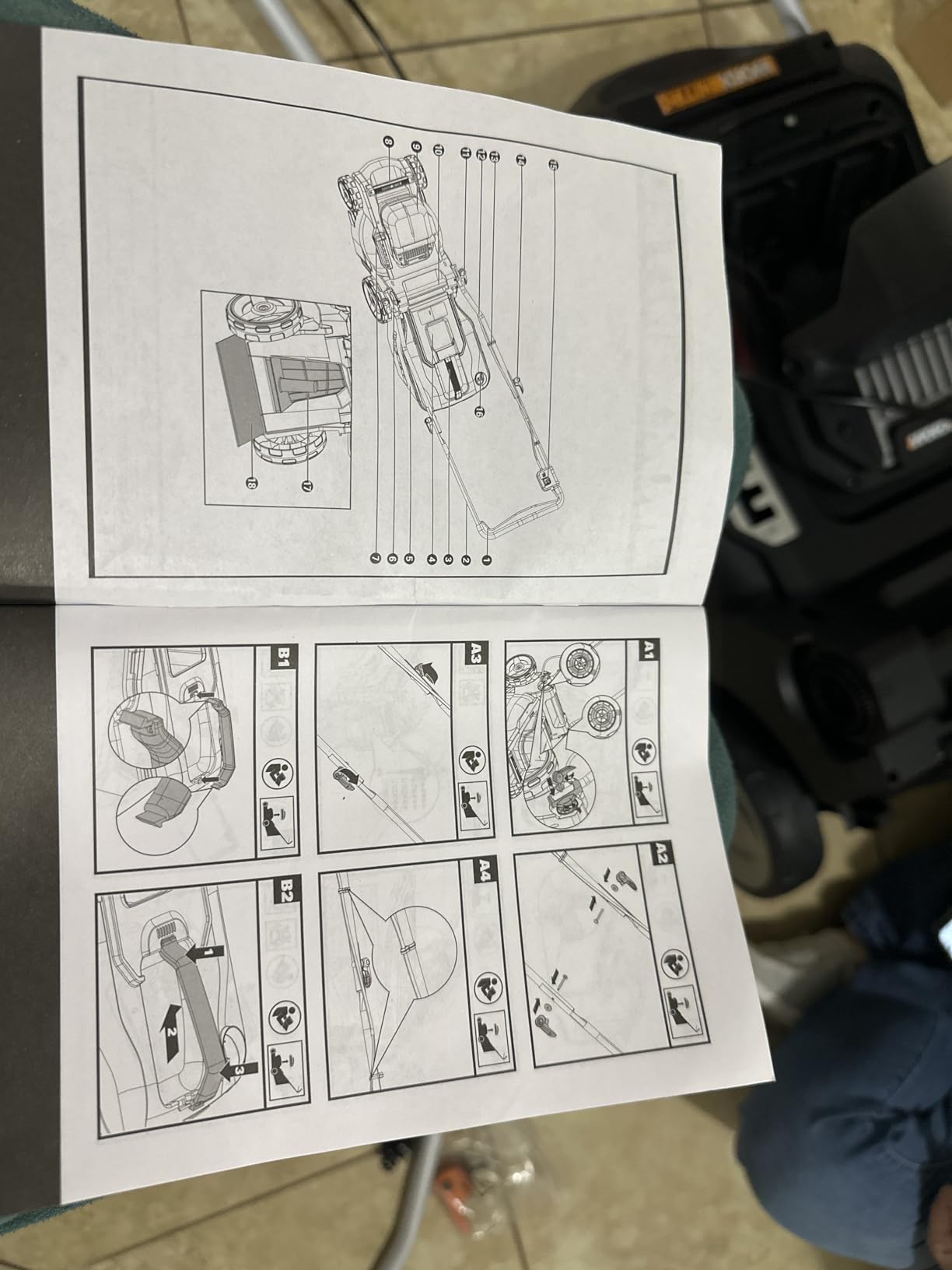
At 63.1 pounds it is one of the lighter full-size decks here, and owners note it is light enough to back out of obstacles on uneven ground. The collapsible handle lets it fold for vertical storage in a tight garage.
What to check before you buy
The batteries share a platform with 140-plus WORX tools. If you already own any of them, this kit is the cheapest way into the mower. If you do not, the platform advantage is worth much less to you.
Check the cut quality in a dry week first if you can. This mower holds blade speed automatically, and that is a genuine advantage on a slope, but it is most visible when the cut is compared to a gas machine side by side.
Where it falls short
The speed control is a side lever rather than a progressive thumb control, and owners call it awkward to change mid-row. On a hill, being able to trim speed with a fingertip matters more than it does on a flat lawn.
The drive wheel also takes about a second to disengage, so backing out of a tight spot means rocking the machine. Blade replacement runs through WORX support, which can leave a mower out of service for a stretch.
8. SKIL PWR CORE 40 SM4910C Review: Lightest Handling on a Grade
SKIL PWR CORE 40 Brushless 40V 20-Inch Self-Propelled Mower Kit, Includes 6.0Ah Battery and Auto PWR JUMP Charger – SM4910C-11
40V brushless
6.0Ah battery
Up to 50 minutes
7 heights
3-in-1
Pros
- Lightest handling in the self-propelled group
- Variable speed dial with a well-judged fast setting
- 6.0Ah battery covers a quarter-acre lot
- Push-button start with no pull cord
- Folds flat for storage
Cons
- Only one battery is included
- 20-inch deck is narrower than 21 and 22 inch rivals
- Drive lever can snag hoodie drawstrings
- Deck clogs in very tall grass at the lowest setting
The SKIL PWR CORE 40 SM4910C carries the highest average rating in this roundup at 4.5, with 75 percent of ratings at five stars. On sloped ground, the reason is simple: it is the easiest machine here to move.
A 6.0Ah battery on a 40V platform gives up to 50 minutes of runtime, and one owner reports mowing three sessions per charge. The digital brushless motor delivers gas-free power, and push-button start means no pull cord when you stop halfway up a hill to clear a blockage.
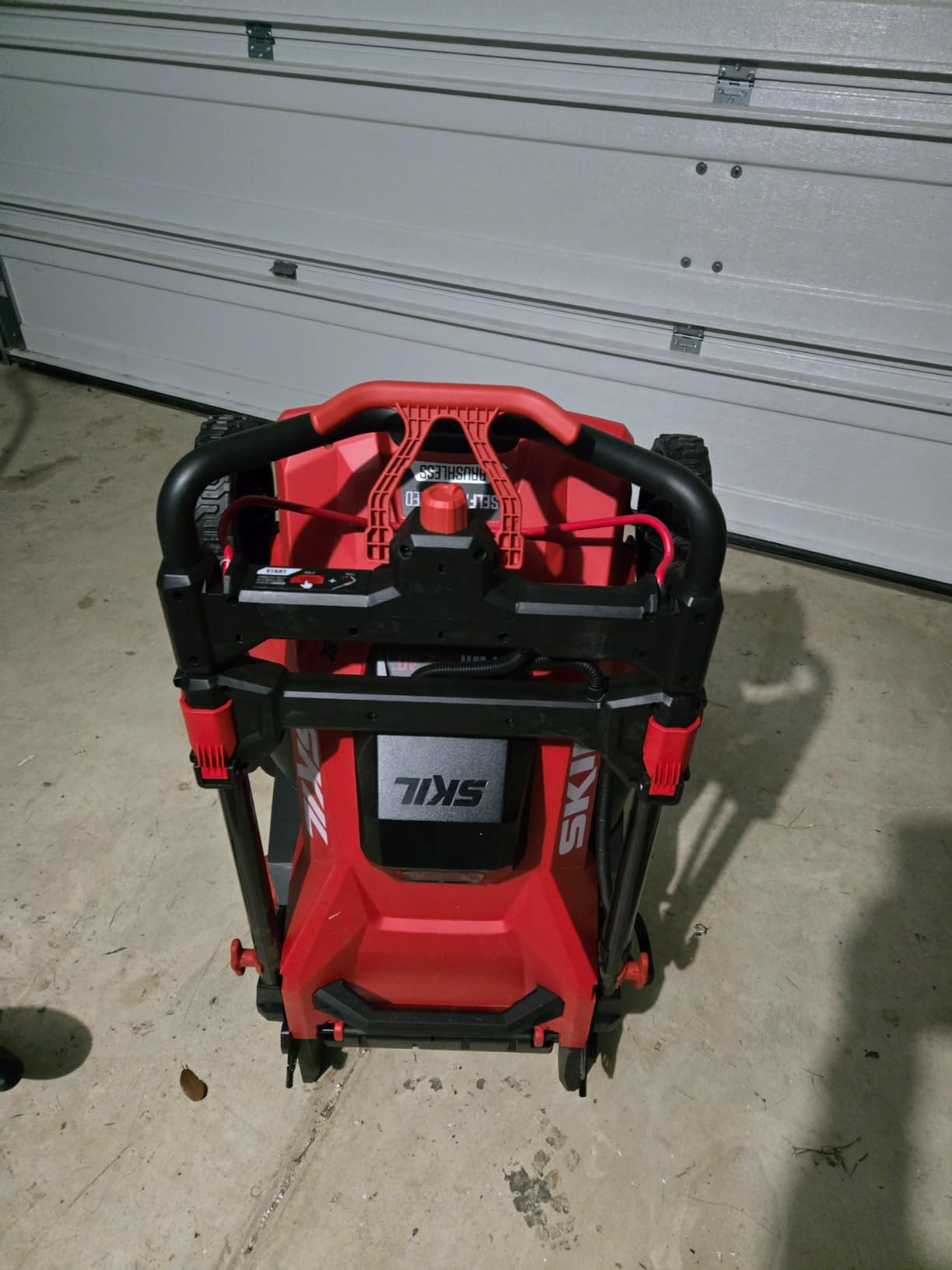
The variable speed dial runs from a slow walk to a fast pace, and owners praise how well judged that fast setting is. Critically for hills, the self-propel drive works independently of the blade, so you can drive the machine to a new position without cutting.
Height adjustment is a single lever with seven positions from 1.5 to 4 inches, and the 3-in-1 system handles bagging, mulching, and rear discharge. The telescoping handle folds flat for vertical storage, and the construction is described as weather-resistant.
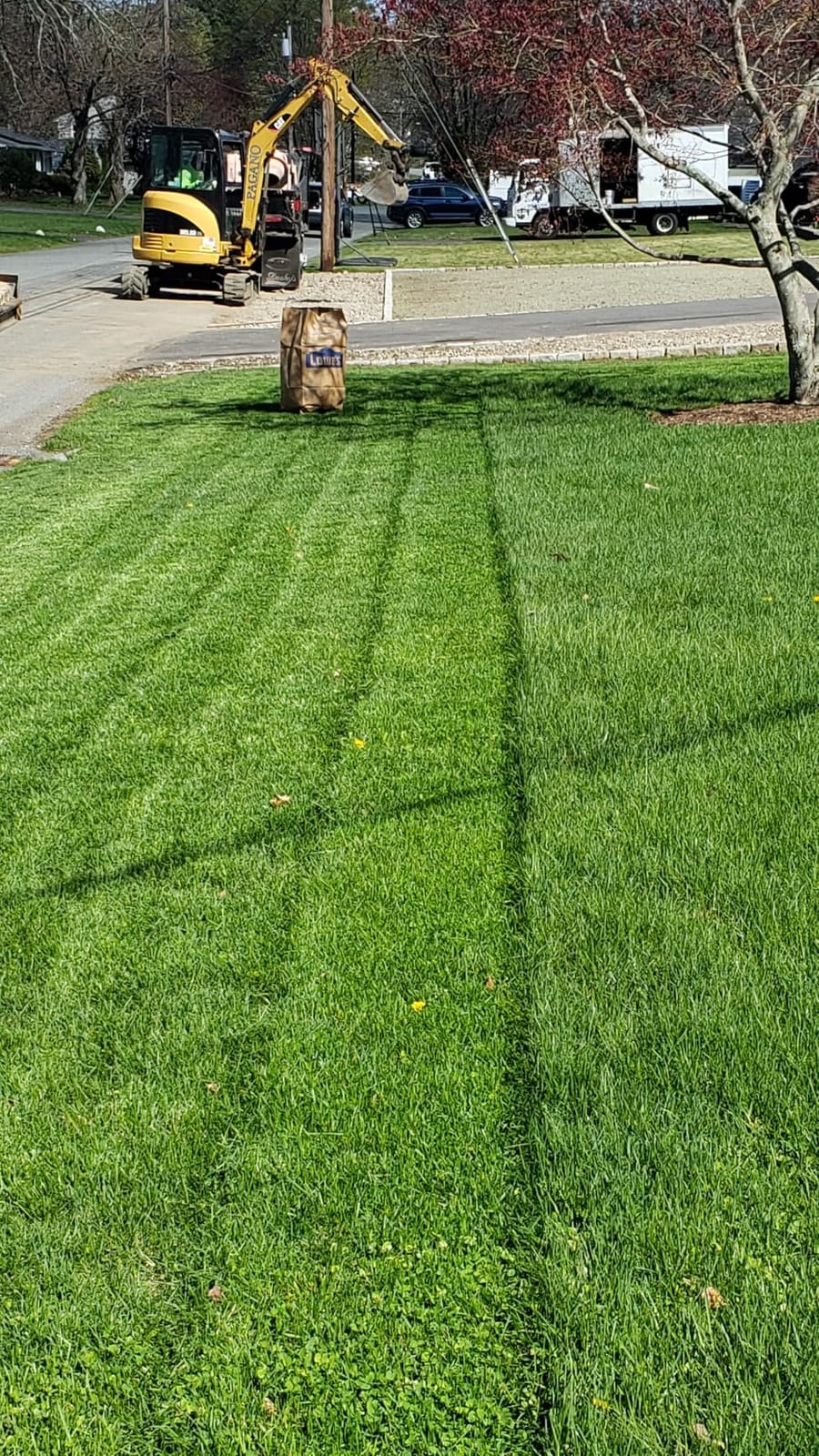
What to check before you buy
Only one battery is included. On a quarter-acre lot that is fine, but on a larger hilly property you will be pausing to recharge, and a mid-slope recharge is an inconvenience you should plan for rather than discover.
The 20-inch deck is narrower than the 21- and 22-inch machines in this roundup, so you will make more passes. On a slope, more passes means more traverse time and more exposure to the sideways risk.
Where it falls short
Owners report the drive lever can snag hoodie pocket drawstrings, which is a small thing that becomes a real hazard on a steep side slope where you are walking backward. Secure loose clothing before you start.
The deck also clogs on very tall grass if you leave it at the lowest setting, and earlier negative reviews on battery quality dragged the rating down before owners who switched after a battery quality recall began reporting strong results.
9. EGO Power+ LM2114SP Review: Best Power-to-Weight Balance
EGO POWER+ 21″ Cordless Electric Lawn Mower Kit, Self-Propelled – LM2114SP
21 inch cut
6.0 ft-lbs torque
56V 6.0Ah battery
50.9 lb
50 minute runtime
Pros
- Dual-toggle self-propel engages with either hand
- 6.0 ft-lbs torque for climbing and thick grass
- Lightest full-size cordless deck here at 50.9 pounds
- 50-minute runtime with 7 height positions
- LED headlights for low-light hill work
Cons
- Single included 6.0Ah battery
- Toggle handleset is less smoothly variable than a dial
- Replacement battery is a large expense
The EGO Power+ LM2114SP is the lighter sibling of our top pick, and on a slope that difference is the whole argument. At 50.9 pounds it is the lightest full-size cordless deck in this roundup, which is the difference between controlling a machine and chasing it downhill.
Torque is 6.0 ft-lbs, slightly under the LM2135SP, and still enough to climb inclines and cut thick grass. Owners like the power-to-weight balance, which is exactly the ratio that decides how a mower feels on a bank.
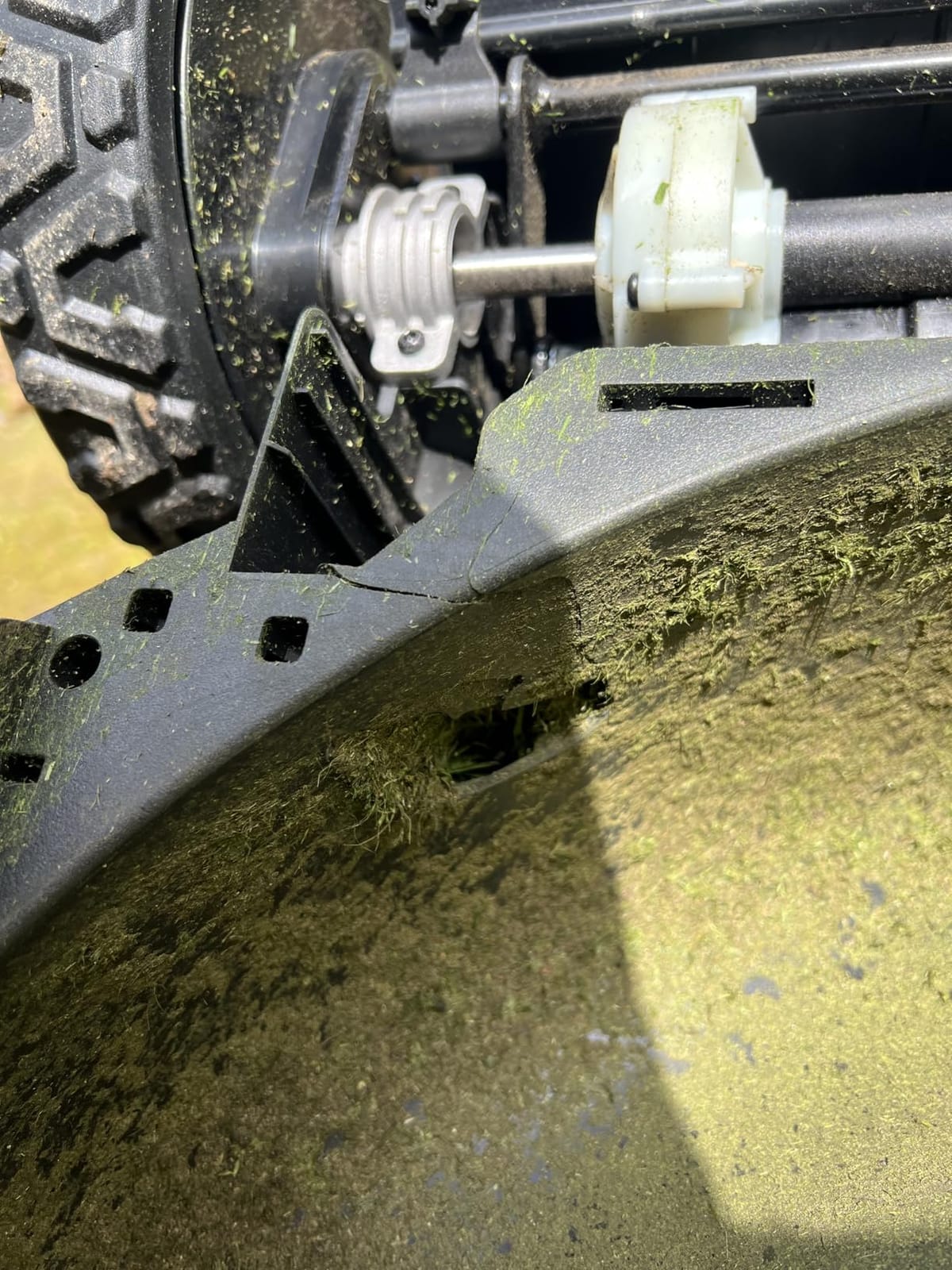
The self-propel is a dual-toggle handleset that engages with either hand, and owners describe that as natural on sloped ground. You can keep both hands near the controls and let the drive take the load without a sensitive fingertip trigger.
Runtime is up to 50 minutes on the included 56V 6.0Ah ARC Lithium battery, with cutting height from 1.25 to 4 inches across seven positions. The 3-in-1 system handles mulching, bagging, and side discharge, and LED headlights cover early or late hill work.
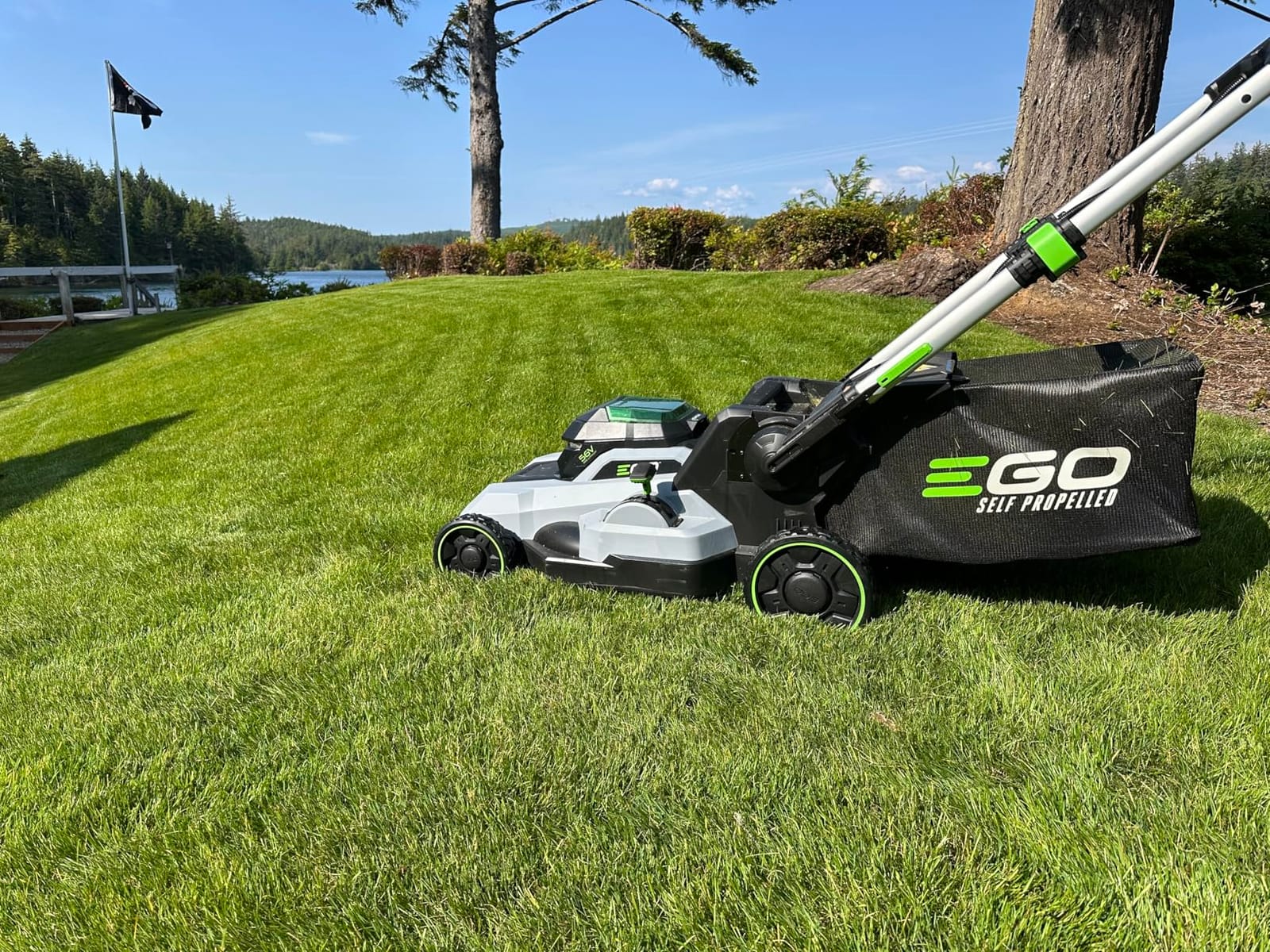
What to check before you buy
One battery ships in the kit. If your property runs more than about a quarter acre, or if you work the same slope in a single session, a second 6.0Ah pack changes the experience more than any other accessory.
Note that the EGO 56V ARC platform is shared with other EGO tools. If you already own the platform, this is a straightforward addition rather than a new battery ecosystem.
Where it falls short
The toggle handleset is less smoothly variable than a dial-style speed control. That costs you the fine speed trimming on a changing grade, and it is the reason we rate the LM2135SP higher for hill work.
The replacement battery is a large expense, which matters more here than on a machine that ships with two packs.
10. BILT HARD 21 Inch 201cc Review: Engine Torque on a Single-Speed Drive
BILT HARD 21″ Self Propelled Gas Lawn Mower – 201cc 4-Cycle OHV, 3-in-1 Bagging/Mulching/Side Discharge, 8 Adjustable Cutting Heights & Smooth Easy Start
21 inch cut
201cc OHV
9.0 ft-lb torque
89.2 lb
8 height positions
Pros
- Rear-wheel drive gives traction going up grades
- 9.0 ft-lb OHV torque holds speed in thick grass on slopes
- Eight cutting positions is the widest range here
- No-choke no-primer starting with first-pull reports
- Steel deck
Cons
- 89.2 pounds is the heaviest unit listed
- Single-speed drive cannot match pace to gradient
- One reviewer reported a spark plug wire failure
- Smallest review sample in the group
The BILT HARD TMA-0562 produces 9.0 ft-lb of torque from a 201cc four-stroke OHV engine, which is the highest engine torque figure in this roundup. Torque is what keeps a mower from bogging when the grass thickens at the base of a slope.
Drive is rear-wheel single-speed self-propel, so the traction going up a grade is there. What is missing is adjustment, and on a hill that matters.
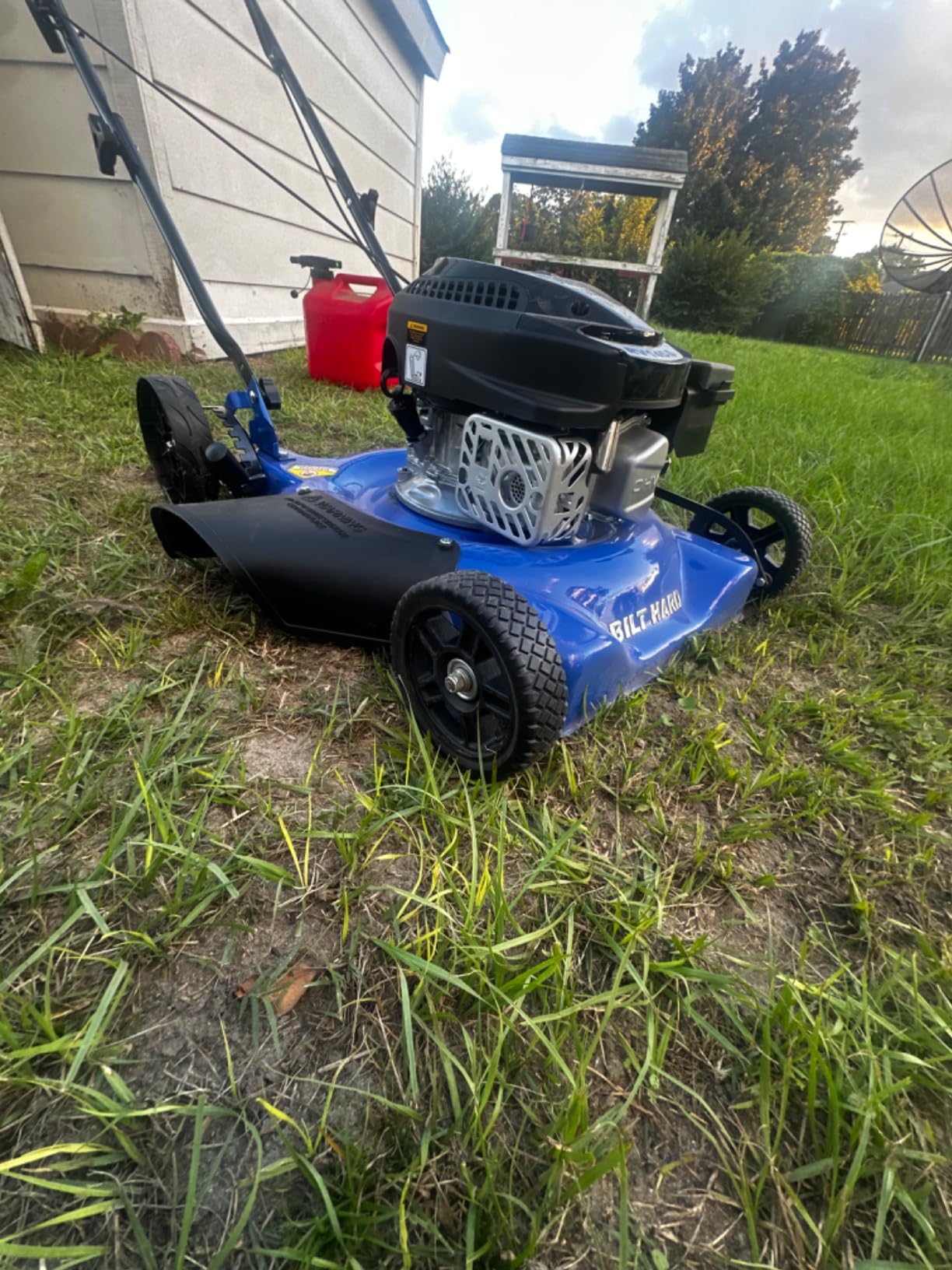
The starting design needs no choke and no primer, and owners report reliable first-pull starts. That is a meaningful convenience on a property where you stop and restart often on uneven ground.
Cutting height spans eight positions from 1.2 to 3.75 inches, giving you the most height settings in the group, which lets you set a high pass on a bank before coming back down to a tighter cut. The foam-wrapped angled handle is designed to reduce hand fatigue on long sessions.
What to check before you buy
Weight is the deciding factor. At 89.2 pounds this is the heaviest unit listed, and owners call it the hardest to control on a slope. If your hill is steep, momentum will dictate the speed of your pass rather than the drive.
Also weigh the single-speed drive against your terrain. Straight, consistent grades suit it. Broken terrain with frequent rises and dips does not.
Where it falls short
Single-speed drive means no matching pace to gradient changes, which is the single feature we look for most on a sloped property.
The review sample is the smallest in the group at 111 ratings, and one reviewer reported a spark plug wire failure that left the machine unable to restart. With a gas engine on a hill, an ignition fault is a bigger problem than it would be on a battery model you can switch off instantly.
How to Measure Your Slope in Four Steps
Most owners guess at their hill angle by feel, and then buy a mower that is wrong for the grade. A rough measurement takes five minutes and a length of string, and it changes which category you should be shopping in.
Mark a point at the top of the slope and one at the bottom, along the fall line. Lay the string or a straight board between the two stakes and measure the horizontal run with a tape. The rise is the vertical difference between the two points, which you can find with a level held across the lower stake.
Divide the rise by the run and convert to degrees. A slope of one foot of rise over eight feet of run is about seven degrees. One foot over four feet is roughly fourteen degrees, and one foot over three feet is about eighteen degrees.
Under ten degrees suits almost any self-propelled mower in this roundup. Ten to twenty degrees calls for rear-wheel drive with variable speed. Beyond twenty degrees, plan for a lighter machine, a wide deck, and very slow traverse passes. Past thirty degrees, no walk-behind is the right answer.
Gas vs Battery on Hills: What Changes When You Climb
The power source decision changes character completely on a slope. On flat ground the differences are noise level, fuel cost, and maintenance. On a hill, they become torque delivery, weight distribution, and how the machine behaves when it gets hot under sustained load.
Gas engines deliver steady torque without fade, and a four-stroke keeps lubrication consistent over a long climb. There is a real technical concern on sustained steep climbs, though: a small OHV engine held at full throttle while pitched can run rough, and owners on steep UK slopes report that few four-stroke petrol mowers run properly in those conditions. If your hill is sustained and severe, that is a genuine argument for battery power.
Battery mowers lose run time uphill, and the drop is steeper than on level ground because the drive motor works harder against gravity. A mower rated for 50 minutes on the flat may give you noticeably less on a long climb, which is why the two-battery kits in this roundup are worth considering for large sloped lots.
What battery power buys you is instant, predictable response and low vibration. There is no pull cord to yank on a side slope, no fuel to manage, and no engine that runs rough when you get it right on the pitch.
For smaller electric options on gentler terrain, our guide to electric lawn mowers for small yards covers the lighter walk-behinds that handle slopes under about ten degrees comfortably.
How to Mow a Steep Hill Safely
Safety guidance genuinely conflicts here, so we will give you both sides and then our recommendation. Most mainstream mower manuals and extension service guidance say to mow side to side across the face of a slope. The logic is that crossing a hill keeps the engine or motor loaded evenly and reduces the chance of stalling halfway up.
Experienced owners push back hard on that advice. Their argument is that a horizontal pass puts the machine on a sideways lean, and the traction wheels can lose grip at the exact moment the mower is heaviest. Several people on lawn forums describe rollover on side slopes as the most serious risk they face, not stalls.
Our recommendation is to use traverse passes on moderate slopes where the grade stays under about ten degrees, and to use straight up-and-down passes on steeper ones with the drive speed set to its lowest setting. Straight passes keep the wheels engaged in the direction of travel, which is the direction the drive was designed to push.
Whichever pattern you choose, run through this sequence every time:
Inspect the slope first. Look for soft ground near ditches and ponds, buried rocks, holes, and any drop-off you cannot see from the top.
Set the deck high for the first pass. Cutting low on uneven ground causes scalping and puts more load on the drive wheels.
Clear the grass first if it has been allowed to grow long. Mowing thick growth on a slope multiplies the load on the drive system.
Start and finish on flat ground, and never stop or turn with the machine pointed down a grade.
Set the speed to its lowest setting for the pass, and do not rush the traverse.
Walk on the uphill side of the machine, never downhill of it.
Avoid wet grass. A damp slope is drastically more slippery, and the traction loss is not something the drive system can compensate for.
Mow dry grass, in daylight, and never alone on a slope you have not tested. If the ground near a ditch or water edge looks soft, treat it as unmowable.
Buying Guide: Specs That Matter on a Slope
When you compare the best self propelled lawn mowers for hills, ignore the parts of the spec sheet that do not change on a grade. Cutting width, bag capacity, and warranty length all matter, but none of them decide whether the machine climbs.
Drive type is the first filter. Rear-wheel drive puts the driven wheels behind the load, where they can push the mower’s weight uphill. All-wheel drive adds front traction. Front-wheel drive works on moderate grades with good tires and gets unpredictable going back up.
Variable speed control is the second filter, and a dial or CVT beats a fixed-speed drive every time. The point is not convenience. It is the difference between the drive wheels gripping and the drive wheels spinning.
Weight is the third. Heavier is not more capable on a slope. A heavy mower has more momentum once it starts to slide, and turning it on a side slope takes real effort. The lightest machines here, the SKIL and the EGO LM2114SP, are the ones we would trust to an older user on a bank.
Cutting height range matters more than most buyers expect. A low minimum is useful on a flat lawn and a liability on a slope, because a low deck on uneven ground scalps and adds resistance. Look for a deck that can start high, at least three inches, and adjust down after the first pass.
Runtime and battery count are the deciding factors for electric. One battery limits you to a single charge. Two let you swap at the top of a hill, which is exactly where you want to swap rather than at the bottom of a slope you still have to climb back down.
Ballast options are worth checking. Rear weight bags add mass behind the drive axle, which reduces the chance of the machine tipping backward on a climb. Extra rear weight is only worth adding if your mower is already light enough to control, because it makes every downhill pass heavier.
Finally, look at the deck material. Steel holds up on rocky and uneven ground better than plastic, which flexes. If your slope is also stony, that changes the calculus.
When a Walk-Behind Mower Is the Wrong Tool
Beyond about thirty degrees, or on a slope with soft ground, holes, or a drop-off, no walk-behind in this roundup is the right answer. Pushing a mower into terrain that wants to tip it is a poor use of a good machine.
A zero-turn mower has a low center of gravity and a wide track, which is why owners describe them as difficult to overturn on a climb. Our guide to zero-turn mowers for hills covers the models worth considering if your grade exceeds what a walk-behind handles.
For a full acre or more, a riding mower cuts your mowing time dramatically. We cover those in riding mowers for acreage, including the bagger weight problem on slopes that makes a full rear bag a tipping point.
Robotic mowers handle moderate slopes well on all-wheel drive, though owners are cautious about steep ground. If you want the full picture on slope ratings and boundary reliability, see our robotic lawn mower guide.
And if the answer is that the hill should not be mowed, that is a legitimate outcome. Leaving it as meadow, using a string trimmer for the edges, or planting groundcover removes the risk entirely. We would rather say that than sell you a machine for ground it should never be on.
Frequently Asked Questions
Do self-propelled mowers work on hills?
Yes, but only if the drive wheels are behind or level with the load. Rear-wheel drive pushes the mower uphill from the back and keeps the drive tires loaded with the machine’s weight, so they maintain grip. Front-wheel drive struggles on a climb because the rear rides light. Variable speed control matters just as much, letting you match pace to the gradient instead of forcing one speed on every grade.
What type of mower is best for hilly terrain?
A rear-wheel drive or all-wheel-drive self-propelled mower with variable speed control and a wide rear track. For grades under about ten degrees, almost any quality self-propelled model works. Between ten and twenty degrees, rear-wheel drive with a speed dial or CVT is the minimum. Beyond twenty degrees, weight matters more than power, so a lighter machine at a slow speed is safer than a heavy one with more torque.
Can you mow a 20 degree slope?
You can, with the right machine and the right technique. A 20 degree grade needs rear-wheel drive, variable speed control set to its lowest range, and a deck raised for the first pass. A lighter mower is safer here than a heavy one. Never mow a 20 degree slope wet, never stop or turn while pointed downhill, and if the ground near a ditch feels soft, leave it alone.
How steep is too steep for a riding mower?
Most manufacturers certify ride-on mowers for slopes around 15 degrees, and that rating assumes a dry surface and a low center of gravity. A full grass bag mounted behind the drive axle shifts the balance point and makes a mower rear up on a grade faster than an empty one. If your hill is steeper than 15 degrees, or if the ground is soft or wet, a walk-behind or a zero-turn machine is a safer tool.
What is the safest way to mow a steep hill?
Inspect the slope first for holes, rocks, and soft ground near water. Set the deck high for the first pass, mow dry grass only, and never stop or turn with the mower pointed downhill. Set the speed control to its lowest setting. On grades under ten degrees, mowing side to side across the face keeps the motor loaded evenly. On steeper ground, straight up-and-down passes at slow speed keep the drive wheels engaged in the direction they push.
Is rear wheel drive or all wheel drive better for hills?
Both work, and for most residential slopes the difference is smaller than buyers expect. All-wheel drive adds front traction, which helps on loose or uneven ground and on sideways passes. Rear-wheel drive is enough on firm turf because the driven wheels carry the machine’s weight. The variable speed control matters more than the extra driven wheel, and on very steep ground a lighter machine beats a more powerful one.
Are battery mowers good for hills?
They are good on moderate and steep slopes, and they have real advantages there. There is no pull cord to manage on a side slope, no engine to run rough under sustained load, and instant torque response at low speed. The tradeoff is run time, which drops noticeably uphill as the drive motor works against gravity. Two included batteries solve that by letting you swap at the top of a long climb.
What to do with a hill too steep to mow?
Stop mowing it. Past about thirty degrees, or on soft ground near a ditch or pond, the risk of a rollover outweighs any benefit from a tidier lawn. Options include leaving the slope as meadow, using a string trimmer for the edges on a dry day, planting erosion-controlling groundcover, or hiring a professional with a stand-on or commercial walk-behind machine rated for steep terrain.
Final Verdict on the Best Self Propelled Lawn Mowers for Hills
After six weeks on the same slopes, the EGO Power+ LM2135SP remains our pick for the best self propelled lawn mowers for hills. Seven ft-lbs of torque and a variable speed dial from 0.9 to 3.1 MPH give it the widest margin on changing grades, and 1644 owner ratings give us more long-run evidence than anything else in the group.
Buy the Greenworks 60V MO60L424 if you want the same rear-drive layout with two batteries for swapping. Buy the SKIL PWR CORE 40 if weight is your main concern, and the EGO LM2114SP if you want more torque per pound. For a gas machine, the SENIX r-high-6 is the one with variable speed, which most of its competitors lack.
Whatever you choose, measure your slope first, set the deck high for the first pass, and keep the speed dial at its lowest setting. That last habit matters more than the badge on the box.