
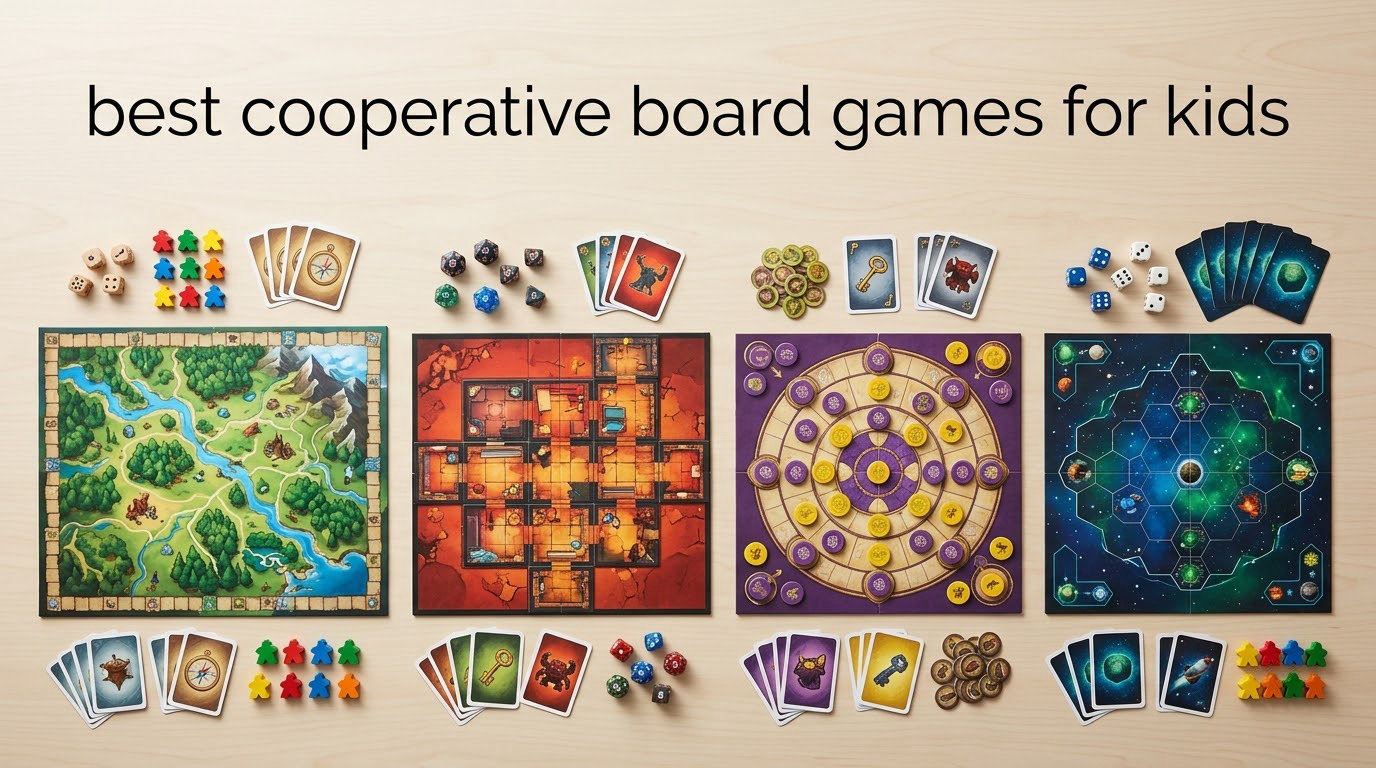
A cooperative board game is one where every player works as a single team toward a shared goal, so the whole table wins or loses together instead of one child celebrating while another tears up. That single design choice is why the best cooperative board games for kids have become the default answer to game night for families with more than one child and a crowded calendar.
We have been playing through this category with our own group and with friends’ kids for years, mostly on weeknights when everyone is tired and nobody wants to be the winner for the wrong reasons. This roundup covers 15 games, from a wooden apple-picking classic for three-year-olds to a dungeon crawler that holds up for a nine-year-old and an adult. Every entry below covers the player count, playtime, reading requirement and the honest weaknesses.
Most of these games are also on our list of the best giant yard games we rely on for families who want everyone off their screens at the same time, though the mechanics here are tighter and the sessions shorter. The 2026 edition adds updated notes on what holds up after months of play and what gets abandoned after three rounds.
Table of Contents
Top 3 Picks for the Best Cooperative Board Games for Kids (October 2026)

Bluey Scavenger Hunt
- Collect 12 toy tokens as a team
- 2-4 players
- Active play
- Includes 4 mini-figures
All 15 Games Compared in 2026
| Product | Specifications | Action |
|---|---|---|
| Outfoxed! |
|
Check Latest Price |
| Hoot Owl Hoot |
|
Check Latest Price |
| Bluey Scavenger Hunt |
|
Check Latest Price |
 Race to the Treasure Race to the Treasure |
|
Check Latest Price |
 Richard Scarry Busytown Richard Scarry Busytown |
|
Check Latest Price |
 Mermaid Island Mermaid Island |
|
Check Latest Price |
 Minecraft Heroes of the Village Minecraft Heroes of the Village |
|
Check Latest Price |
 Wildcraft! Wildcraft! |
|
Check Latest Price |
 My First Castle Panic My First Castle Panic |
|
Check Latest Price |
 Baby Dinosaur Rescue Baby Dinosaur Rescue |
|
Check Latest Price |
 My First Safari My First Safari |
|
Check Latest Price |
 Ghost Fightin Treasure Hunters Ghost Fightin Treasure Hunters |
|
Check Latest Price |
 The Quest Kids The Quest Kids |
|
Check Latest Price |
 HABA Orchard Game HABA Orchard Game |
|
Check Latest Price |
 Dog Man Attack of the Fleas Dog Man Attack of the Fleas |
|
Check Latest Price |
1. Outfoxed! – The Best Cooperative Board Game for Kids Overall
OUTFOXED, A CLASSIC WHO DUNNIT GAME FOR PRESCHOOLERS, 4 players
Ages 5 and up
4 players
20 minutes
No reading required
Pros
- Screen-free cooperative play with no losers
- Quick setup and rules taught in minutes
- 15-20 minute rounds suit short attention spans
- Builds deduction and memory through clue solving
- Randomized suspects and items keep it replayable
Cons
- Dice decoder step needs explaining before young children can play
- Recommended age starts at 5 so it under-serves toddlers
- Small components are a choking hazard under 3
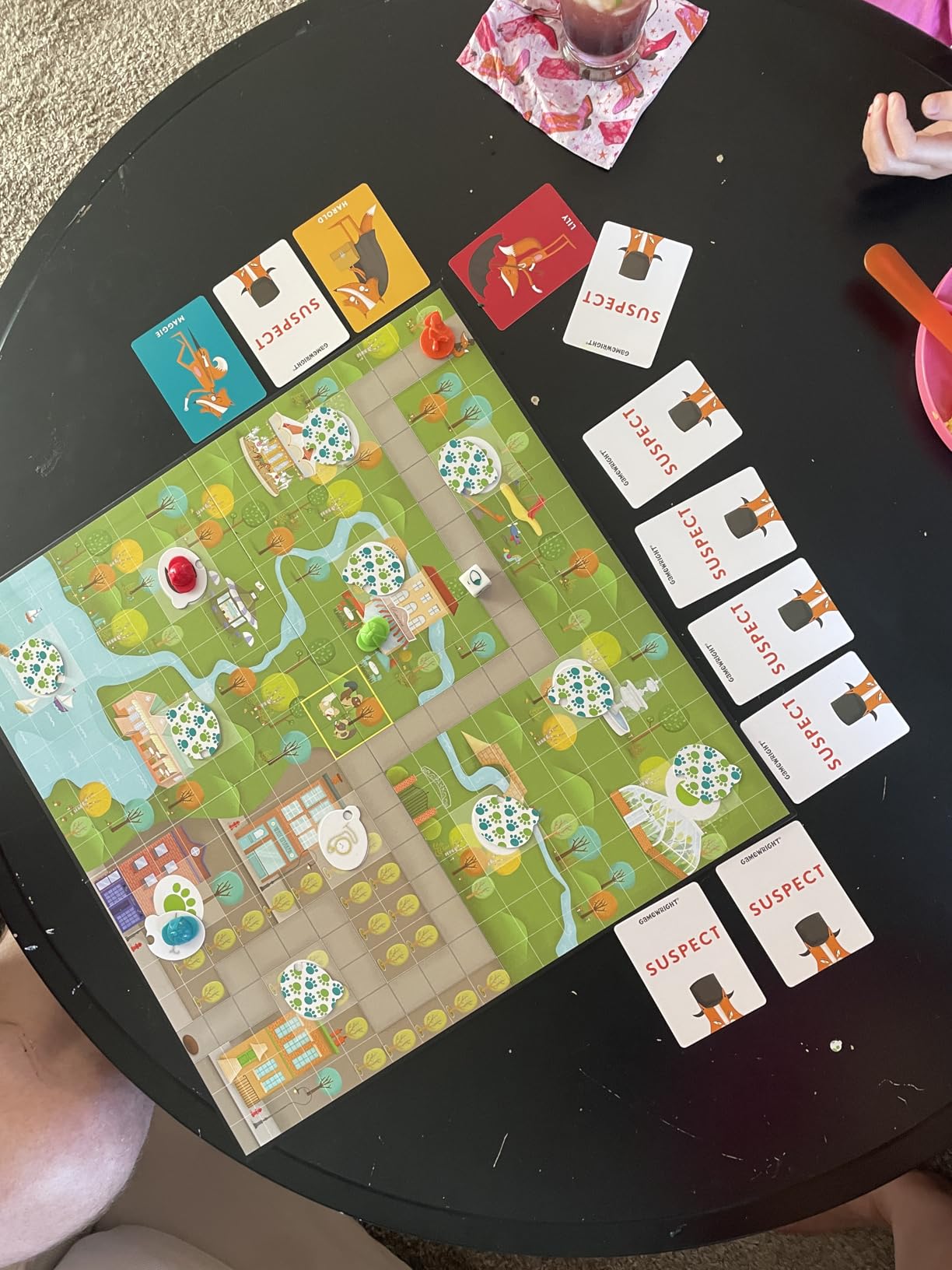
Outfoxed! is the game we hand to a family the moment they ask for a recommendation. Four players, one fox, and a board covered in suspects, objects and locations. Everyone moves together, the fox moves against them, and the round ends in about 20 minutes, which is exactly the length a tired family can commit to.
What sets it apart from a matching game is the deduction layer. The team rolls for movement, and a decoder wheel turns the result into an instruction, so kids are reading icons, checking clues and narrowing down a list together. It feels like a real investigation to a seven-year-old and does not bore the adult sitting at the table.
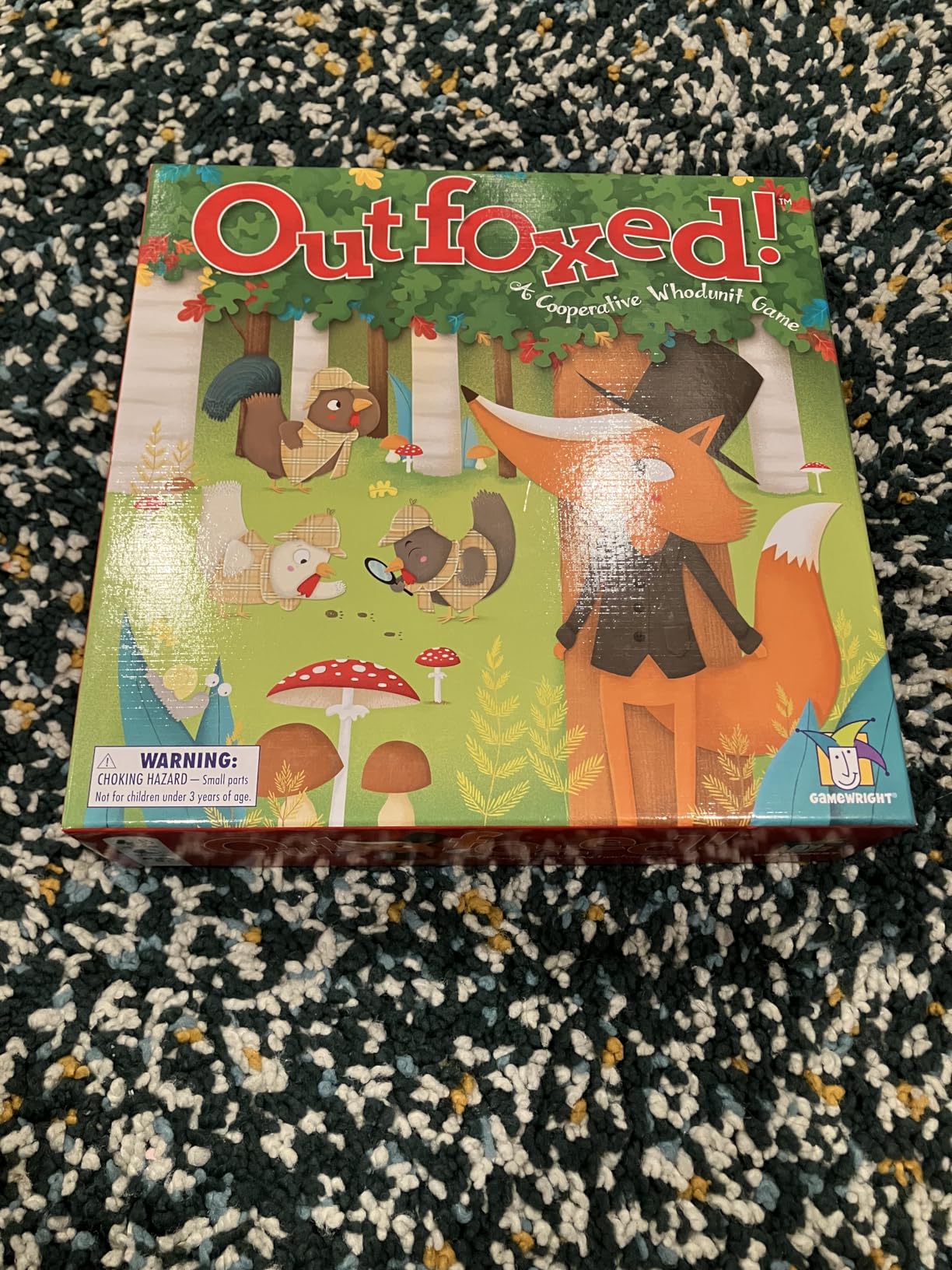
The honest catch is the decoder step. On a first play, expect to spend three or four minutes showing the youngest players how the wheel maps to a card. After that, they run it themselves, and my experience is that within three sessions nobody asks for help again.
Roughly 7,400 families have rated it, and the pattern in that volume is consistent: people buy it for the no-loser format and stay for how short the rounds are. It is also one of the few cooperative games in this roundup where a nine-year-old and a five-year-old can genuinely both be at the centre of the plan.
Best for a family with mixed ages and a short evening
Outfoxed! has no reading requirement beyond the icons, which is rare for a game that feels this involved. That makes it a safe first pick for a household where a six-year-old cannot yet decode text and you do not want an adult narrating the whole game.
It also holds a four-player count exactly, so it suits two parents and two kids perfectly. Fewer than four players and the suspect grid feels thin, which is the one configuration this game does not serve well.
What to know before you buy it
The listed age is 5 and up, with a manufacturer range of 4 to 15 years, so a determined four-year-old can play with a hand on the wheel. Cardboard and paper components mean it survives a careful household, not a one with a toddler who chews scenery.
Plan on a short teaching session the first night. A parent who reads the rules properly gets a game that runs itself for years, and one who skips that step gets a confused table and a bad first impression of cooperative play.
2. Hoot Owl Hoot – The Best Cooperative Board Game for Preschoolers
Peaceable Kingdom Hoot Owl Hoot – Cooperative Matching Game For Kids
Ages 4 and up
2-4 players
15 minutes
No reading required
Pros
- Very short 15 minute rounds that fit a preschool routine
- Cooperative matching against a common obstacle
- No reading required so pre-readers join in
- Builds planning ahead and social skills
- Bright artwork with durable cardboard components
Cons
- Simple enough that older children find it repetitive
- Sun marker and matching rules take a moment to grasp
- Card-based format means less physical play
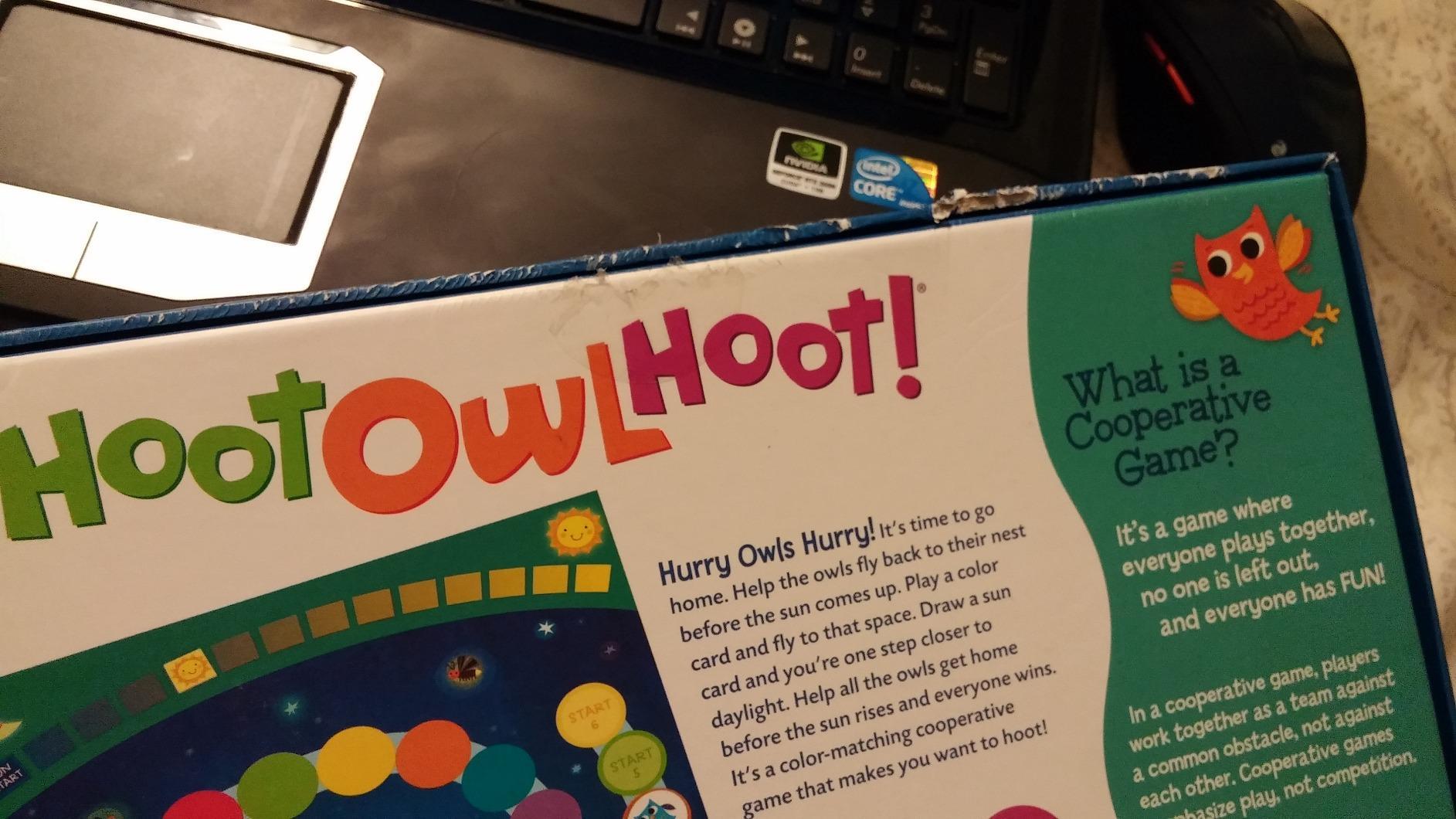
Hoot Owl Hoot is a color-matching game where a family of owls has to get home before the sun rises. Every card the team flips either helps or pushes the sun closer, and the whole table winches together on every decision. The box says pre-K ages 4 and up, and in practice that label is accurate.
At 15 minutes a round, it is the fastest real game in this roundup, and that is why it survives contact with a four-year-old. There is no setup beyond dealing cards, no board to read, and nothing that can be lost halfway through. It is also one of the few entries here that works cleanly with exactly two players, a parent and one child on a Tuesday afternoon.
The limitation is honest and worth saying: there is not much decision-making once the pattern clicks. Families with an eight- or nine-year-old who has already mastered it tend to finish it in three plays and move on. That is a shelf-life issue, not a quality issue.
More than 4,000 reviews at 4.8 stars describe the same thing. It is described as a dependable first cooperative game, a reliable birthday gift for siblings of different ages, and a favourite of preschool teachers who need a game that teaches shared loss without a single tear.
Best when you need a 15-minute game that needs no reading
This is the entry to buy if a child is not yet reading independently. Nothing on the table requires decoding words, so a pre-reader can play a full turn, hold their own card and feel genuinely useful to the team.
It also travels. The card format and the 15-minute runtime make it a natural pick for a playdate, a waiting room, or the tail end of a long car trip when everyone is overstimulated and needs something quiet.
What to know before you buy it
Prepare for a slightly confusing first turn. The sun marker moves because the team chooses badly, not because a player did something wrong, and a two-sentence explanation up front prevents the most common complaint from reviewers.
Because the components are cardboard, it is durable but not indestructible. It is a good fit for a household with a four-year-old, and a risky one for a household with a two-year-old who is still putting things in her mouth.
3. Bluey Scavenger Hunt – Best for Kids Who Wiggle
Bluey Scavenger Hunt Board Game, Cooperative Play with 4 Exclusive Mini-Figures, Indoor Games for Kids Ages 5+, Fun Toy Token Collecting Game
Ages 3 and up
2-4 players
Active play
Adult reads cards
Pros
- Gets kids up and moving with find cards and acting cards
- Includes four exclusive Bluey mini-figures
- True team play with no winner or loser
- Simple rules a parent teaches in a couple of minutes
- Works well for siblings who hate sitting still
Cons
- Trivia cards repeat quickly once kids memorise show facts
- Reading the cards is required so pre-readers need help
- Short play length feels repetitive after several rounds
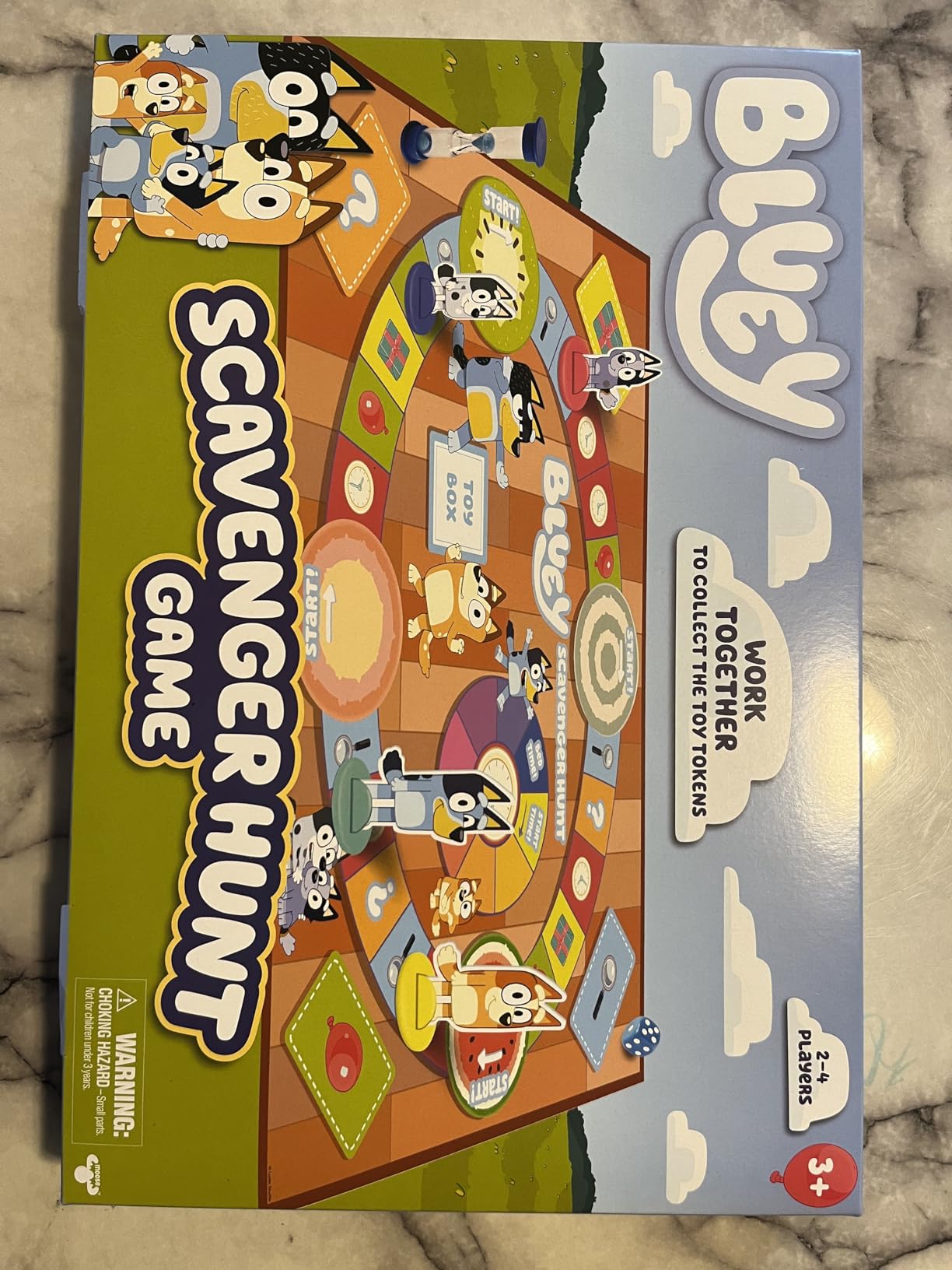
Most cooperative games for kids are seated. This one sends the table hunting. The team works around the board collecting all 12 toy tokens before time runs out, and Bluey trivia plus find cards keep the children moving instead of waiting for their turn to matter.
That is the whole appeal for a lot of families. Parents reviewing it repeatedly call it the first board game their toddler tolerated, specifically because the searching replaces sitting still. The four mini-figures of Bluey, Bingo, Bandit and Chilli are exclusive to this set, and on our table they turned into the actual prize for winning.
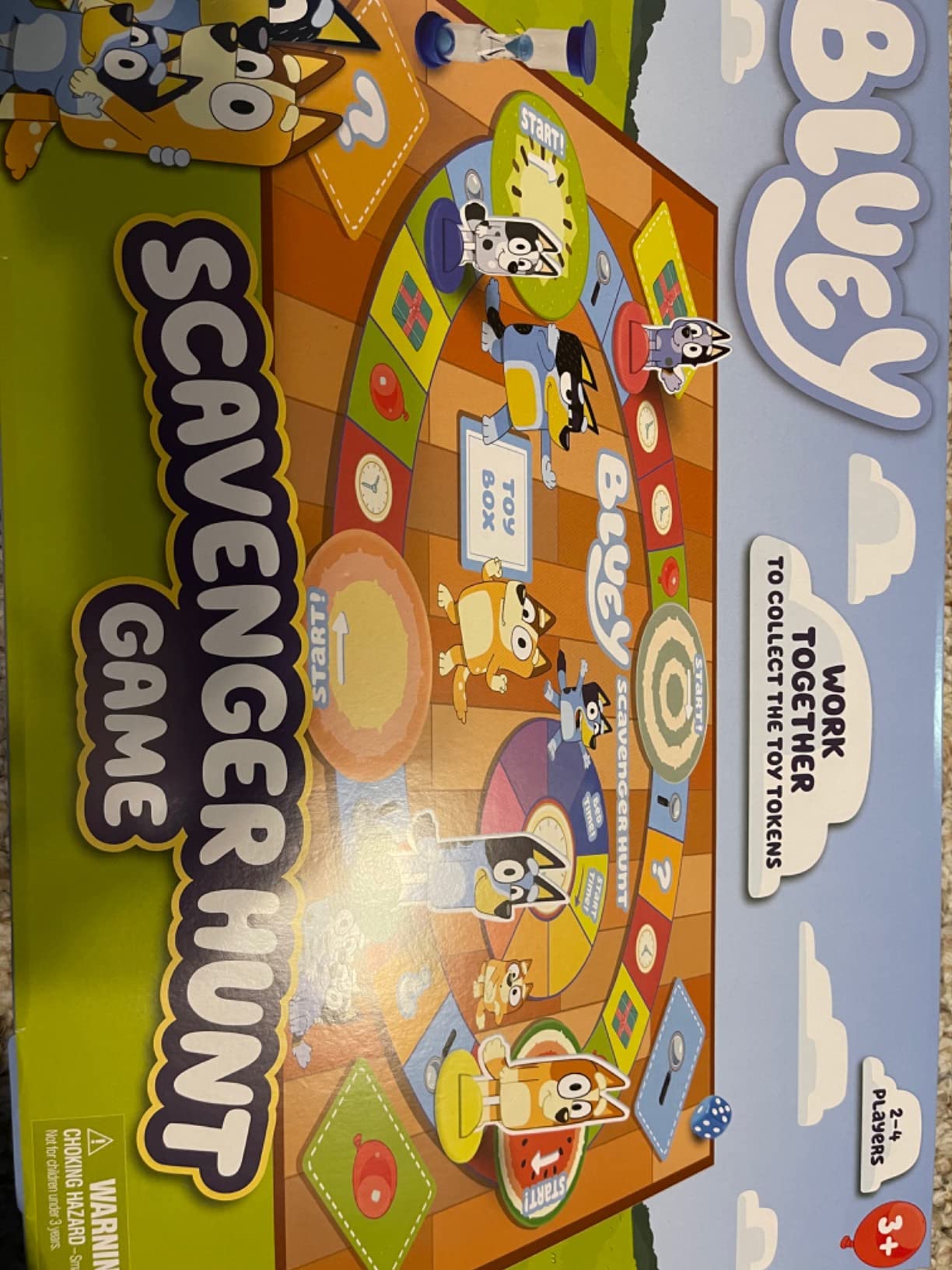
There are two real drawbacks. An adult has to read the cards, so this is not a game for an independent pre-reader despite the 3-year label. And the trivia pool is small, which means kids who watch the show daily will burn through the interesting content in a few sessions.
Roughly 3,300 reviews at 4.8 stars make it one of the best-rated games here, and the sibling-rivalry reviews read as testimonials in their own right. Families with a competitive streak report that the team format stops arguments better than any rule they could have invented.
Best for a three- or four-year-old who cannot sit still
Pick this when a quiet, turn-based game has failed twice already. The motion is built in, and the search mechanic means a restless child is doing something useful rather than fidgeting through an adult’s turn.
It also works at the low end of player counts. Two children and one adult is a natural table for it, and the board is large enough that three children can search without elbows colliding.
What to know before you buy it
Budget for an adult running the game. The card text is short, but a non-reading child needs someone to read the trivia aloud, and that changes the shape of the session compared with a silent-play game like Hoot Owl Hoot.
Expect a shorter shelf life than the slower games in this list. The replay value comes from the show knowledge rather than the system, so it is a strong early pick and a weak long-term anchor.
4. Race to the Treasure! – Best Cooperative Strategy Game for Ages 5-7
Peaceable Kingdom Race to the Treasure! Cooperative Path Building Game for 2 to 4 Kids Ages 5+
Ages 5 and up
2-4 players
20 minutes
No reading required
Pros
- Award-winning cooperative design with a real team tension
- No reading required from age five
- Short 20 minute rounds
- Teaches strategy and social development through path building
Cons
- Path pieces get disorganized mid-game
- Small plastic tiles are easy to lose
- Older kids find the decisions too easy after a few plays
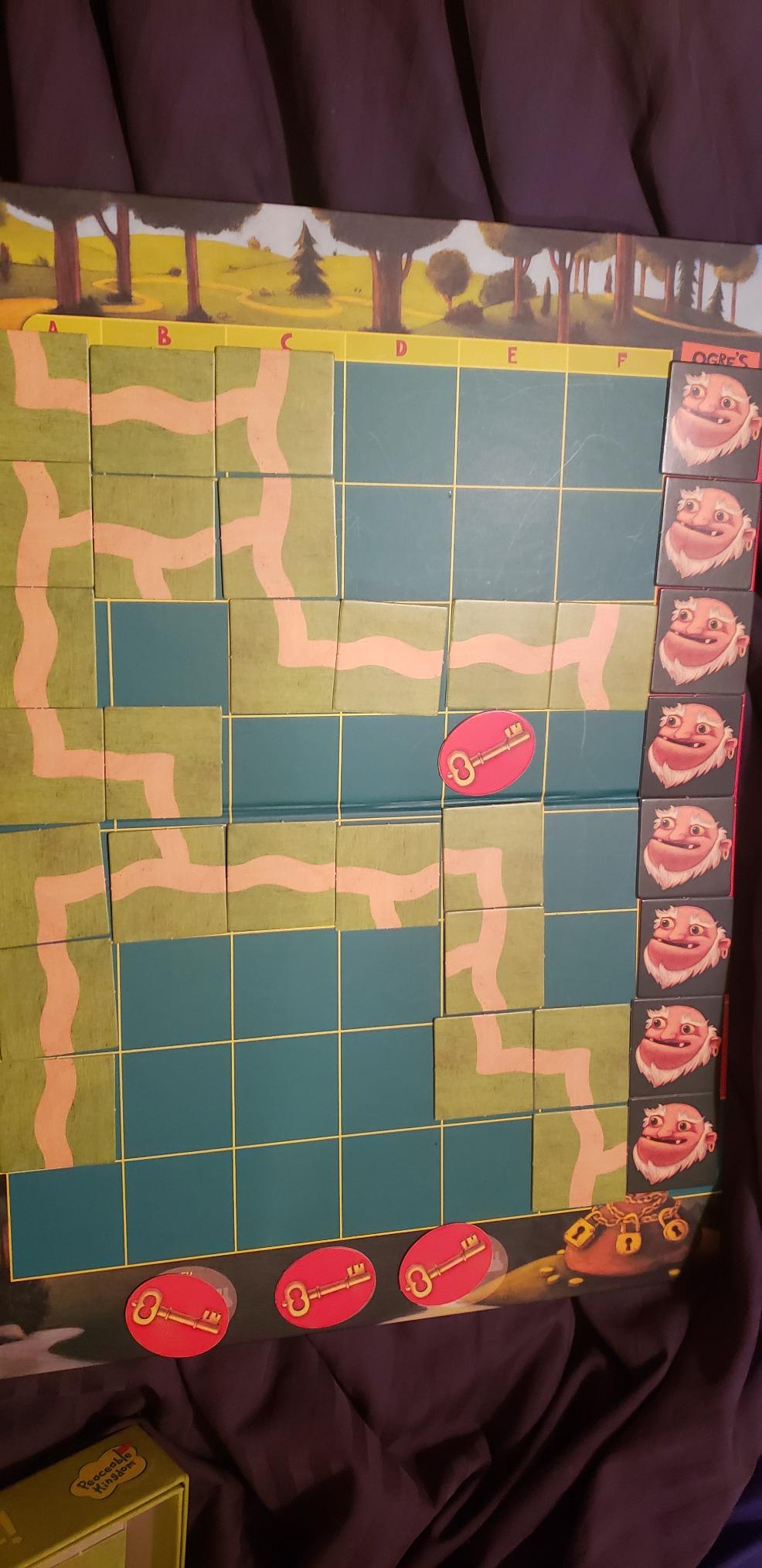
Race to the Treasure! is the game where the team builds a road across the board, one road piece per turn, while an Ogre advances along its own track. Get every player to the treasure before the Ogre arrives and the table wins together. Lose the race and everyone loses together, which is the entire point.
It is the first game on this list that gives a seven-year-old a genuine decision to make. Every piece placed is a piece not saved for later, and because the Ogre does not care who placed it, nobody gets to blame the five-year-old. That is why it works so well for families with a wide sibling age gap.
The practical warning is the road tiles. They are small plastic pieces that scatter across the table the moment play speeds up, and reviewers mention the cleanup and the loss rate more than they mention the difficulty. A zip pouch under the box is a five-second fix.
More than 3,100 reviews at 4.8 stars back the design itself, including an Oppenheim Toy Portfolio Platinum award and a PAL Seal of Approval. The same reviews note that the game is a stepping stone, not a destination, for kids over eight.
Best for teaching a child to plan without blaming anyone
Because the threat is a shared board element rather than an opponent, the conversation at the table is about the plan. Kids start saying things out loud like we should save the yellow pieces, and that negotiation is the entire educational payload of this game.
It also runs at 20 minutes and needs no reading, so it fits a weeknight with two children of different ages who both need to feel competent at the same table.
What to know before you buy it
Check your floor plan before the first game. Small plastic tiles plus an eight-year-old with good throwing aim equals pieces under the sofa, and the age label starts at 5.
Plan for a shelf-life warning. Once a family has played it five or six times, an older child usually sees the whole game solved, and you will want the next entry on this list waiting on the shelf.
5. Richard Scarry’s Busytown Eye Found It – Best for the Youngest Players
Wonder Forge Richard Scarry’s Busytown, Eye Found It Toddler Toy and Game for Boys and Girls Age 3 and Up – A Fun Preschool Board Game,Multi-Colored
Ages 3 and up
2-4 players
Under 10 minutes
No reading required
Pros
- Oversized board that spreads across the table
- Rich component set with 30 goldbug cards and a sand timer
- Develops attention to detail and object identification
- Clear instructions so play starts almost immediately
- High replay value as kids rediscover new items
Cons
- Large box and 6 foot board are awkward to store
- Spinner and sand timer add randomness some families find frustrating
- Heavier and bulkier than typical preschool games
This is the one to buy when the players cannot yet hold a losing hand. The board stretches more than six feet across the table, four children search for illustrated items listed on their cards, and the first team to find everything moves its token to the bus. Nobody is eliminated, nobody is behind, and a three-year-old genuinely participates.
The component list explains why it has held up for decades. Thirty goldbug cards, 10 magnifying glass tokens, 6 food tiles, a spinner and a sand timer give a very small child more to look at and more to do than most games aimed at that age.
Around 2,700 reviews at 4.7 stars keep describing it as a classic preschool favourite, and the value in those reviews is rarely about the game itself. It is about a three-year-old and a seven-year-old sharing a table happily for twenty minutes while an adult supervises.
Best for keeping the smallest child in the game
The search mechanic means a preschooler does not need to understand a rule set, hold a strategy, or lose gracefully. They find a rabbit, they move the bus, and they get the same visible result as a sibling who is better at the game.
It is also the easiest option here for a mixed table of two children and two adults, since the board is enormous and four pairs of hands stay busy without crowding.
What to know before you buy it
Measure your table first. The board is more than six feet long, and reviewers are candid that this is a floor game rather than a table game in a small home.
The spinner and sand timer introduce randomness that some families find unfair with younger children. If a three-year-old is prone to tears when a spinner goes the wrong way, set expectations out loud before the first roll.
6. Mermaid Island – Best for Large Sibling Groups
Peaceable Kingdom Mermaid Island Award Winning Cooperative Board Game for 2 to 6 Kids Ages 5+
Ages 5 and up
2-6 players
15 minutes
No reading required
Pros
- Widest player range here at 2-6 kids for sibling groups
- Requires no reading so preschool children join in
- Wand tokens add tension without creating a loser
- Durable cardboard board and counters
- Short 15 minute sessions with a clear goal
Cons
- Too easy once the mermaids pull ahead
- Children 5 and up often lose interest quickly
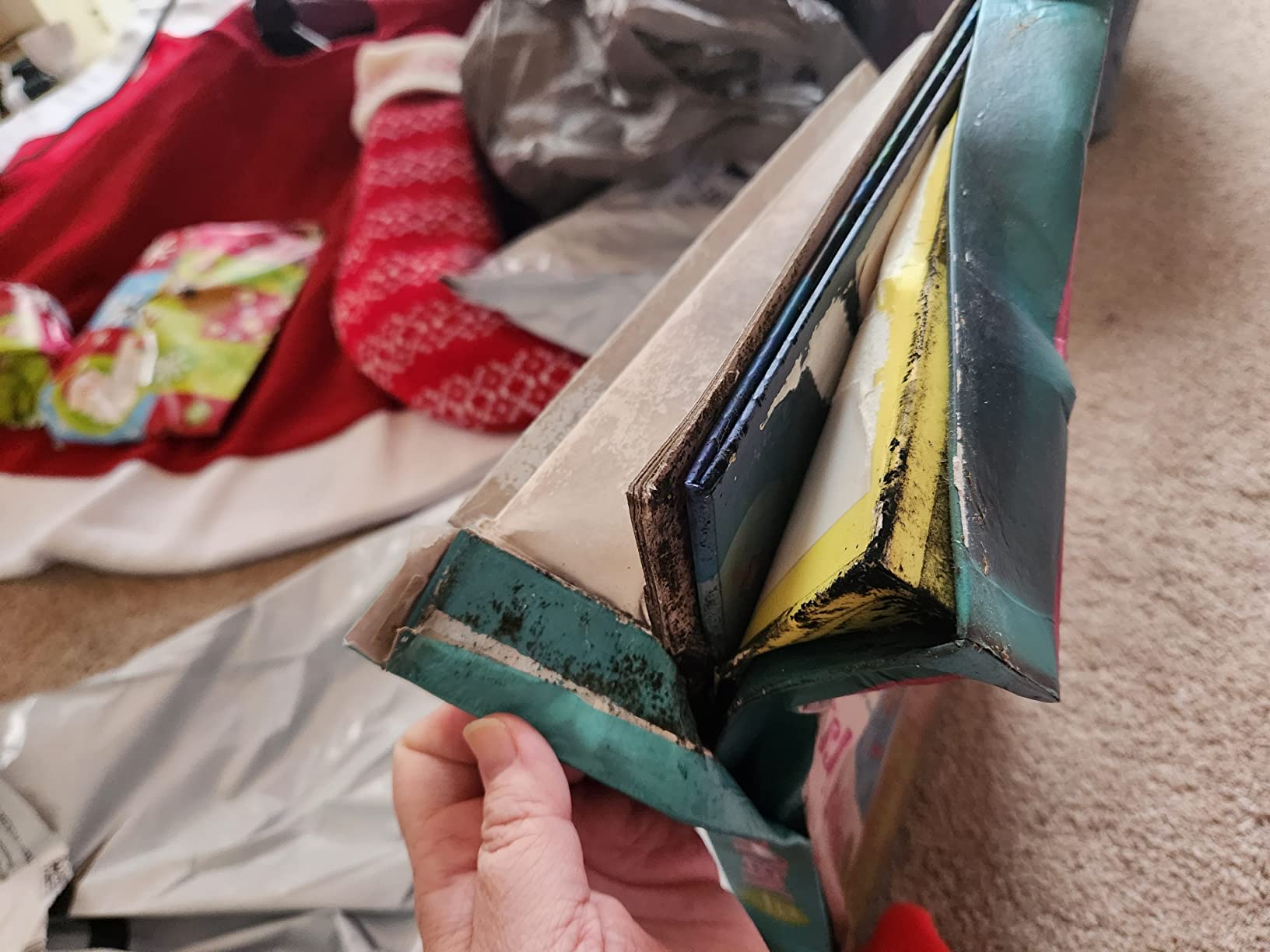
- Spinner has been reported to break or arrive incomplete
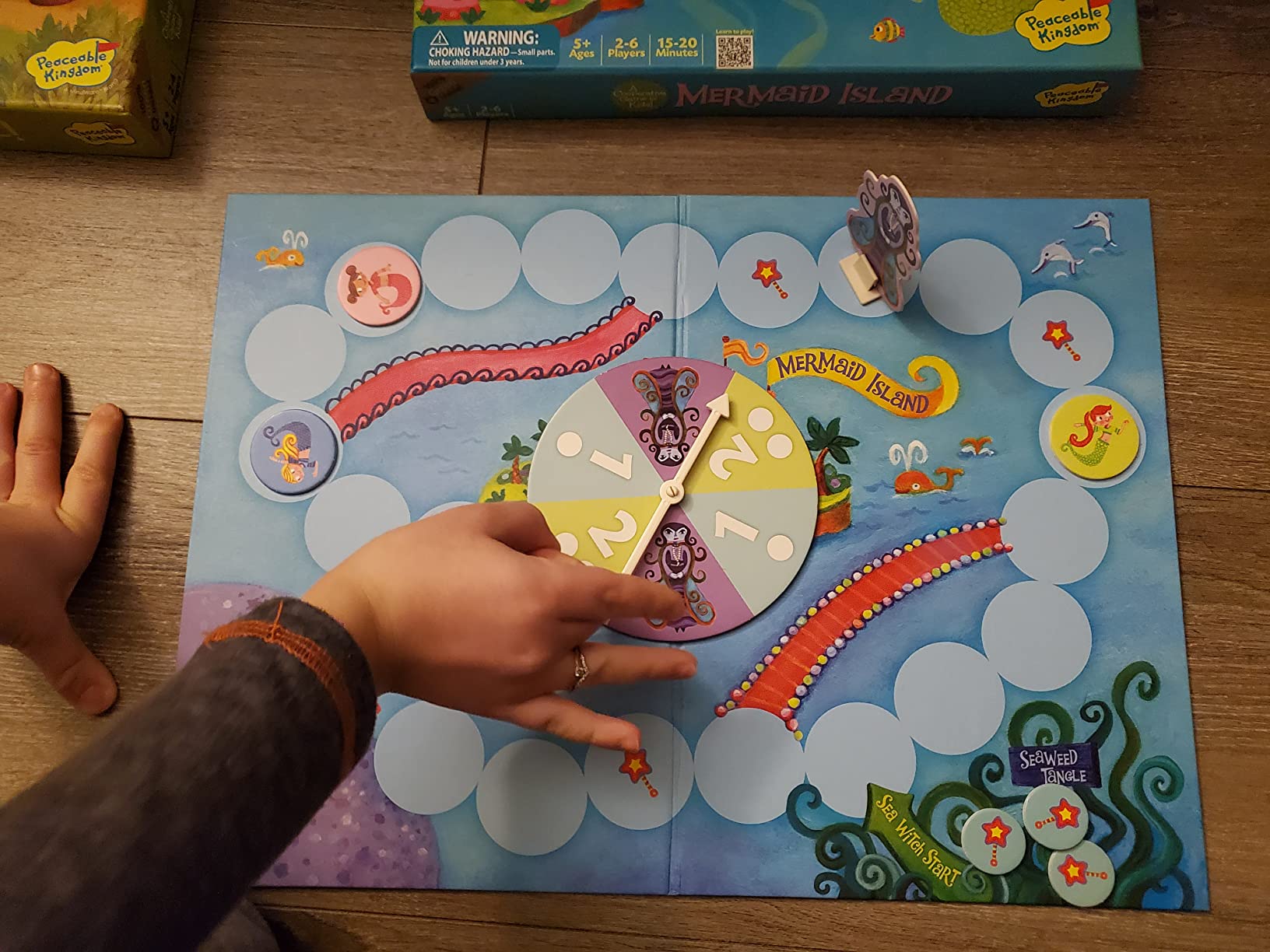
Mermaid Island is the answer for the family that has run out of family. The team moves three mermaid tokens toward the island while a Sea Witch advances, and the players can spend wand tokens to push the Sea Witch back. The box supports 2 to 6 players, and no other game on this list stretches that far.
That player range is the reason to buy it rather than save it. A family with four children of different ages, or a household plus two cousins on a holiday weekend, gets one table instead of two games and one loser instead of one sulker.
The most common complaint in the 2,200-review pool is that the game is effectively decided once the mermaids get ahead, which can happen earlier than a competitive child expects. Several parents and teachers suggest treating the box as a 3-plus game, and they are right about the difficulty even though the label says 5.
Peaceable Kingdom’s replacement service also comes up positively in reviews, which matters more than it sounds when a spinner arrives broken on a game you bought for a specific playdate.
Best when more than four kids need to play one game
The 2-to-6 player range is unmatched in this roundup, and the components are cardboard and plastic rather than delicate paper, which is a genuine advantage with a six-child table.
No reading is required, so you can fold a preschooler into an older sibling’s game without slowing the session down or adding an adult reader.
What to know before you buy it
Buy it for four players or fewer if you want tension. Adding players makes the cooperative win easier, which sounds like a benefit until your eight-year-old notices that nothing can go wrong.
Check the spinner on arrival. That is the component reviewers most often report as broken or incomplete, and Peaceable Kingdom is generally good about replacing it.
7. Minecraft Heroes of the Village – Best for Kids Aged 7 and Up
Ravensburger Minecraft Heroes of The Village | Cooperative Board Game | Exciting & Unpredictable | Perfect for Families and Minecraft Enthusiasts | Suitable for Kids & Adults
Ages 7 and up
2-4 players
25 minutes
Reading required
Pros
- Module-based map changes every playthrough
- Large component set with 25 wooden blocks and 12 mob tokens
- Cooperative 2-4 player format that still appeals to adults
- About 25 minutes per round suits family game night
- Theme draws kids in immediately
Cons
- Reading required so it excludes players under about 7
- Setup and rules take longer than most kids games
- Component quality is lighter than Ravensburger strategy titles
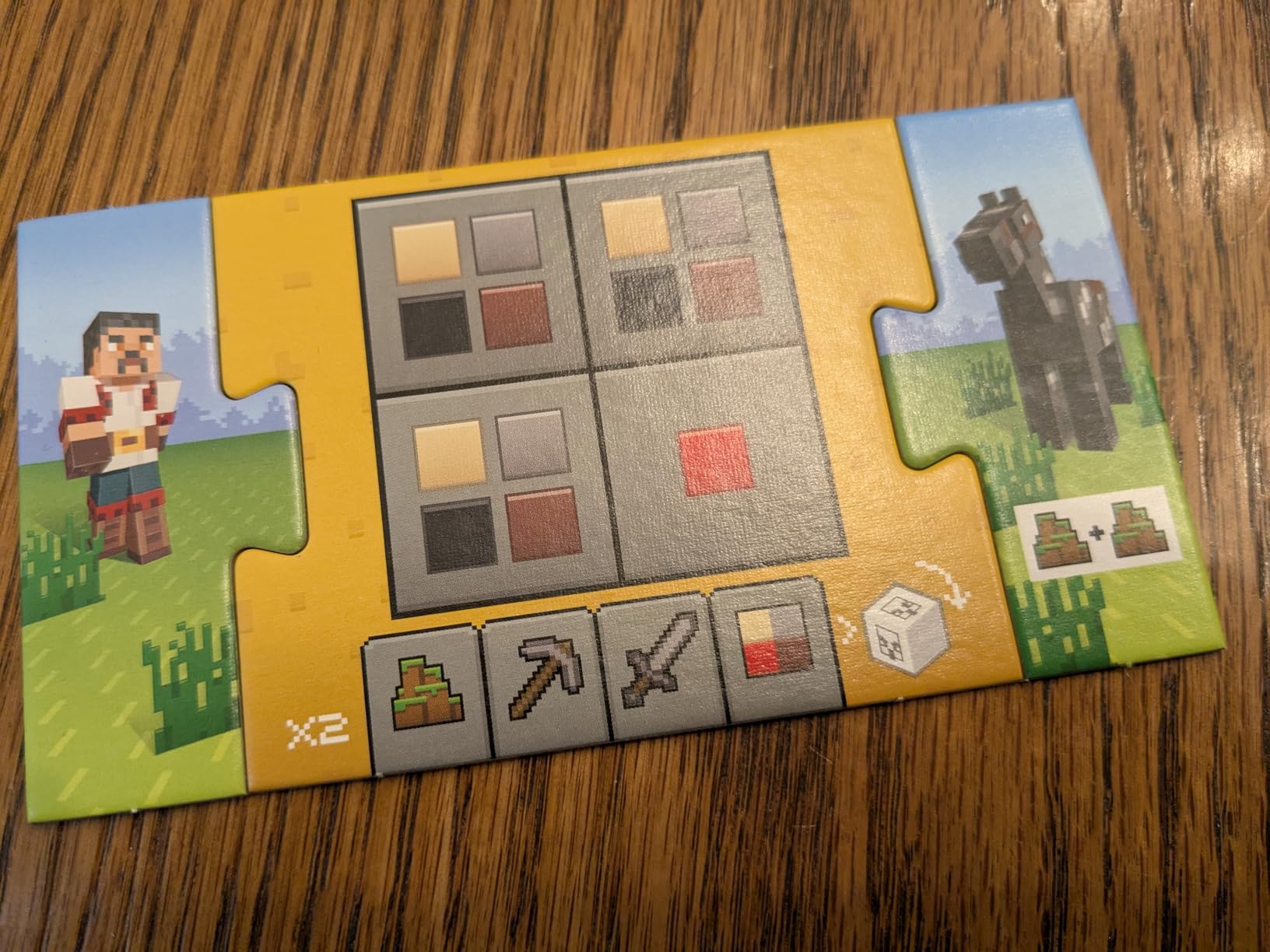
Minecraft Heroes of the Village is where this roundup starts asking more of a child. The team explores a village, gathers blocks, builds structures and deals with mobs before an Evoker arrives. Unlike almost everything above it, reading is required, and the listed age is 7 and up.
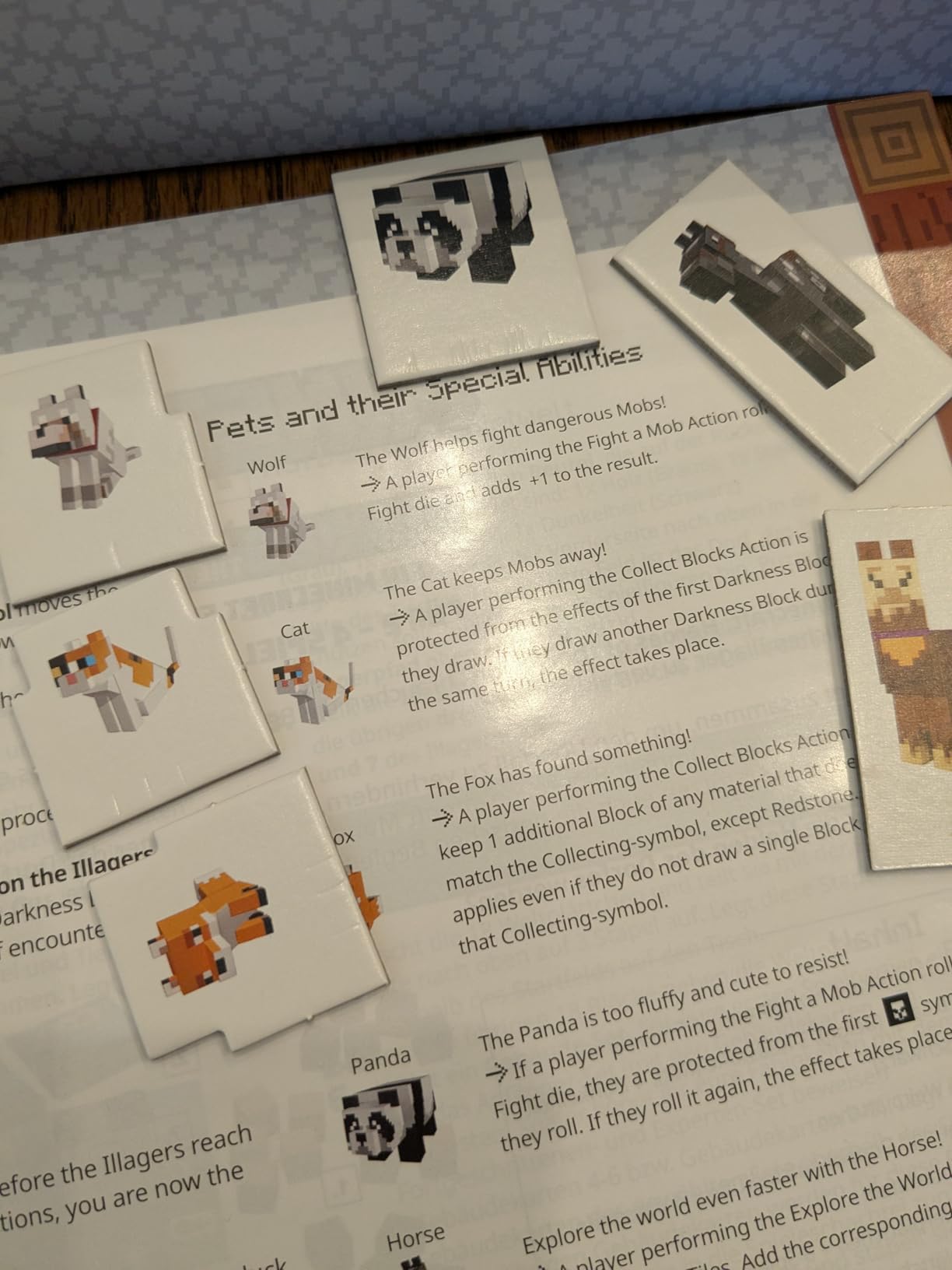
What earns the higher floor is the replayability. The map is assembled from world tiles, so each playthrough lays out differently, and a family that plays it weekly still gets a new puzzle. The component count is substantial too: 25 blocks, 18 world tiles, 9 buildings, 12 mob tokens and two dice.
It carries the lowest average rating in this group at 4.5, and reading the reviews explains why. Younger players are excluded by the text, and the first session takes longer than a family used to a 20-minute game expects. Adults, meanwhile, tend to like it more than the kids do, which is unusual in this category.
Ravensburger is the publisher here, and that name matters for durability. It is the same house behind many of the mid-weight strategy titles families keep for a decade.
Best for a confident reader who is ready for real decisions
Pick this when your youngest player reads fluently and your oldest is starting to want something with genuine planning. It bridges the gap between a matching game and the heavier co-op titles that arrive a few years later.
It also works for the sibling age-gap families keep asking about. A seven-year-old and a ten-year-old can sit on the same team and have a fair shot at the same problem.
What to know before you buy it
Set aside twenty minutes for the first game, mostly on rules. Subsequent sessions run about 25 minutes once everyone knows the system, which is a good family length but longer than the preschool games above.
Expect components in line with a licensed children’s game rather than a premium strategy box. Reviewers comparing the two tend to notice the difference, and the flip side is that it forgives enthusiastic handling better than cardboard-heavy alternatives.
8. Wildcraft! – Best Cooperative Game for Gameschooling
Wildcraft! Cooperative Board Game, Learn 25 Herbs, Family Game for Kids 4+
Ages 4 and up
1-4 players
40 minutes or more
Image-based cards
Pros
- Teaches 25 edible and medicinal herbs through a shared mission
- Works for 1-4 players including solo
- Image-based ailment cards work for pre-readers
- Open-ended rules that families adapt to session length
- Artwork is consistently praised
Cons
- A full game runs 40 minutes or more which strains younger kids
- Printable extras are downloads not printed in the box
- Less challenging than it is educational
Wildcraft! is a foraging adventure where the team races to bring herbs back to granny’s house before an ailment catches up with them. The educational payload is the point: 25 edible and medicinal herbs, presented in illustrations a four-year-old can follow, and the mission gives the learning a reason to exist.
It is also the only game here built for solo play, which matters in a specific way. A parent playing alone with one child, or one child who wants to play on a rainy afternoon without an adult, gets a real game rather than a stripped-down two-player version.
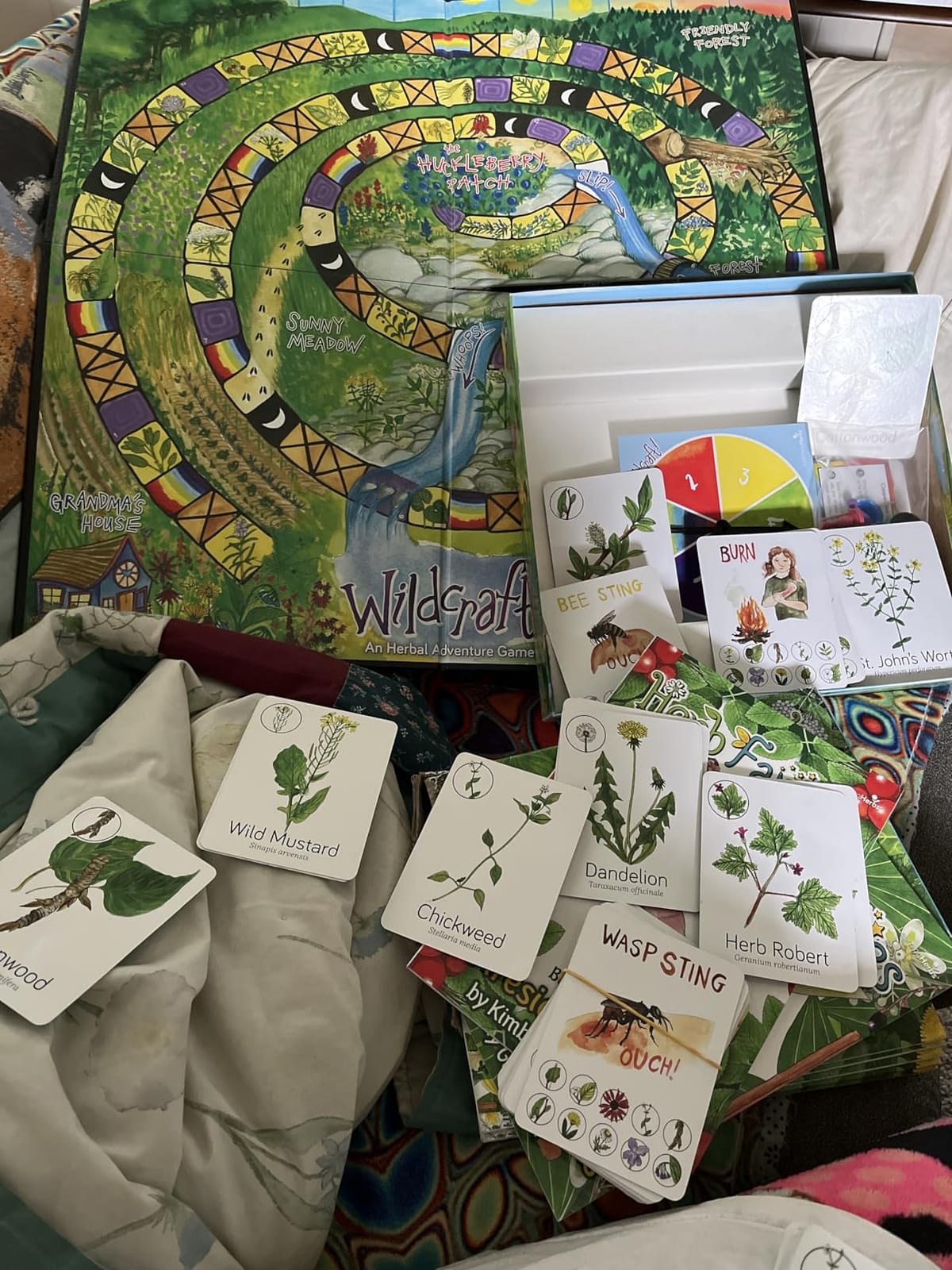
Two things to plan around. A full playthrough runs 40 minutes or more, which is the longest on this list and a real stretch for a four-year-old near the end, and the extras are downloadable PDFs rather than printed material. The storybook, pocket guide and coloring book need to be printed before the value is real.
Gardeners and teachers show up in the 1,500-review pool with detailed praise for the herb accuracy, which is not something a game publisher usually earns for free. The same reviews note the length problem repeatedly.
Best for homeschool families and one-on-one play
If a child learns better from a story-driven mission with a real subject attached, this is the pick. The ailment cards are image-based, so a pre-reader can follow the storyline without an adult narrating the whole thing.
Print the extras before the first game. Reviewers who skip that step rate the education as thin, and the printed coloring book is half of what separates this from a generic co-op adventure.
What to know before you buy it
Watch the clock. Families who cap the game at two rounds report far better cooperation from younger children than families who push for a full-length session.
The competition in it is light by design, so a child who wants real challenge will not find it here. The materials are recycled, recyclable and non-toxic, which is worth knowing for a game intended for four-year-old hands.
9. My First Castle Panic – Best First Step Toward the Castle Panic Series
Fireside Games My First Castle Panic Fantasy Board Game
Ages 4 to 8
4 players
20 minutes
No reading required
Pros
- Simplified entry into Castle Panic that transfers to the adult version
- Icon-based cards with no reading required
- A 20 minute round with a timer built into the game
- Sturdy standing castle and large monster tokens
- Optional easy mode helps sensitive players avoid early losses
Cons
- Card quality is described as lackluster and wears quickly
- Small pieces go missing between plays
- Basic on its own so families wanting expansions need the standard edition
My First Castle Panic is a simplified castle defense game for ages 4 to 8. The team matches colors and shapes to stop monsters before they breach the walls, and the card faces use icons rather than words, so a pre-reader can play a real turn with no adult translator.
The built-in timer is the detail parents mention most warmly. Rather than an adult calling time, a slowly moving marker decides the round, which means the pressure is part of the game instead of an adult’s voice.
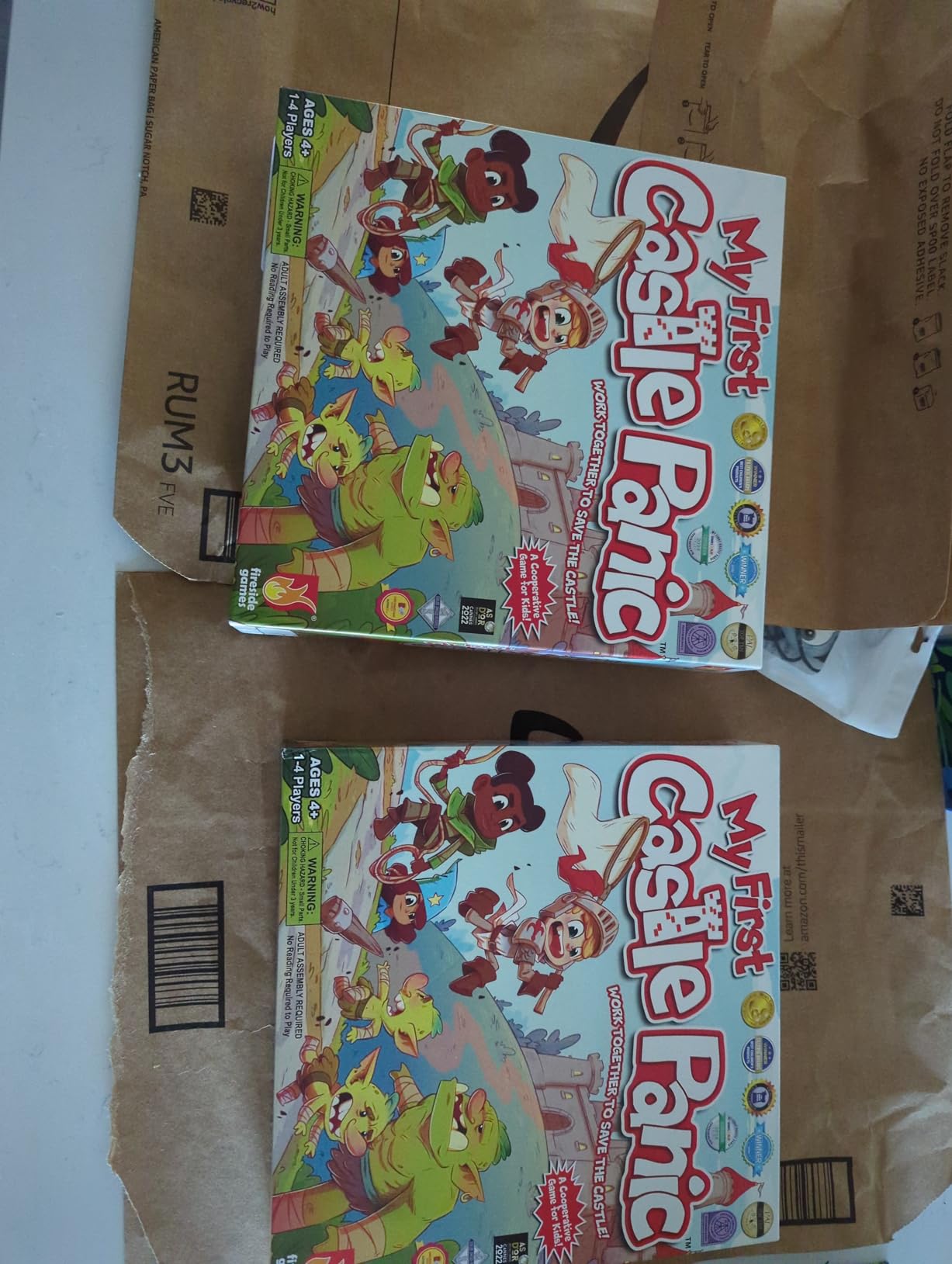
The reason it appears here rather than at the top is physical. Card durability is the most repeated reservation in the 1,400-review pool, along with pieces that occasionally go missing between sessions. It is a paper-and-cardboard game that expects to be handled by children aged four to eight.
Families who own the standard Castle Panic describe this as a perfect stepping stone, because the icons carry over and nothing has to be relearned. The optional easy mode is the other detail worth knowing about, since it exists specifically for kids who dislike losing.
Best for a child who needs a bridge to a bigger game
Choose this when you want a four-year-old and an adult to play something that looks and feels like a real strategy game, but with an icon language instead of a rulebook. The learning transfers upward rather than sideways.
It runs at about 20 minutes, fits four players, and requires no reading, which covers most of the practical filters parents apply on the way to the checkout.
What to know before you buy it
Expect to replace it eventually. This edition is deliberately basic, and the families who want more depth or expansions are meant to move up to the standard Castle Panic once the child is ready.
Count the pieces before the first game and count them again at the end. Reviewers who lost components found it frustrating in a family with younger siblings who treat small parts as resources rather than game pieces.
10. Baby Dinosaur Rescue – Best for Playdates and Classrooms
Baby Dinosaur Rescue Cooperative Board Game for Kids Ages 4+, Family Fun
Ages 4 and up
2-4 players
20 minutes
No reading required
Pros
- Image-based cards mean no reading is needed during play
- Simple rules a preschooler can join within a minute
- Lava token adds gentle time pressure without a loser
- Very small box is easy to store and carry
- Works for 2-4 players in classrooms or homeschool
Cons
- Reviewers often note no printed rulebook is included
- Very low decision complexity so older children lose interest
- Flimsy cardboard tokens wear or go missing
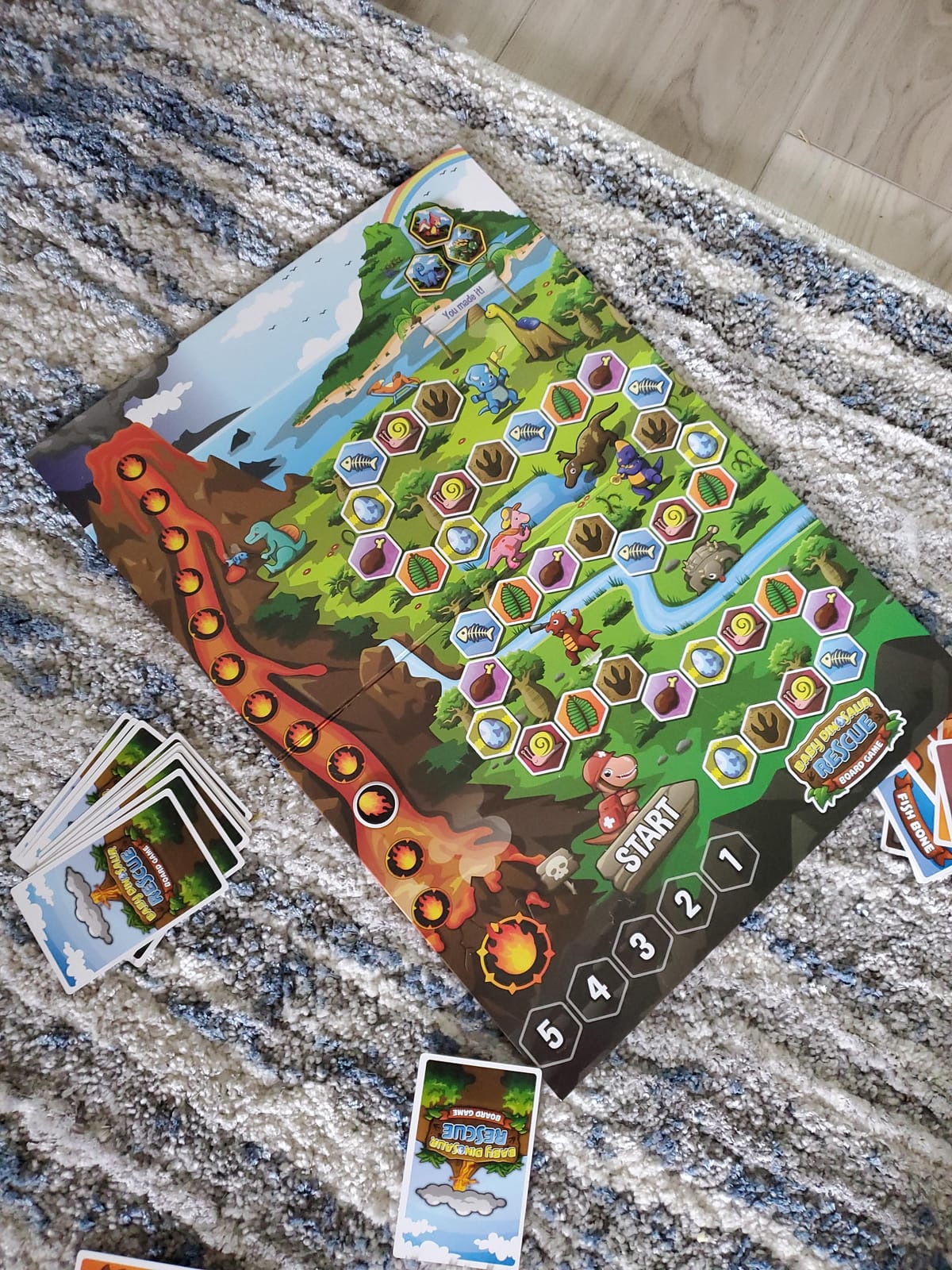
Baby Dinosaur Rescue is a lava-race game where the team walks a group of baby dinosaurs across the valley to Dinosaur Island while a lava token advances behind them. The tension comes from the timer rather than from any opponent, so the losers here are dinosaurs, not children.
It is the most portable entry in this roundup. The box is genuinely small, the whole game is board, tokens and cards, and it survives being shoved into a bag for a playdate or carried into a classroom. Parents with a mixed group of four- and five-year-olds report near-instant uptake.
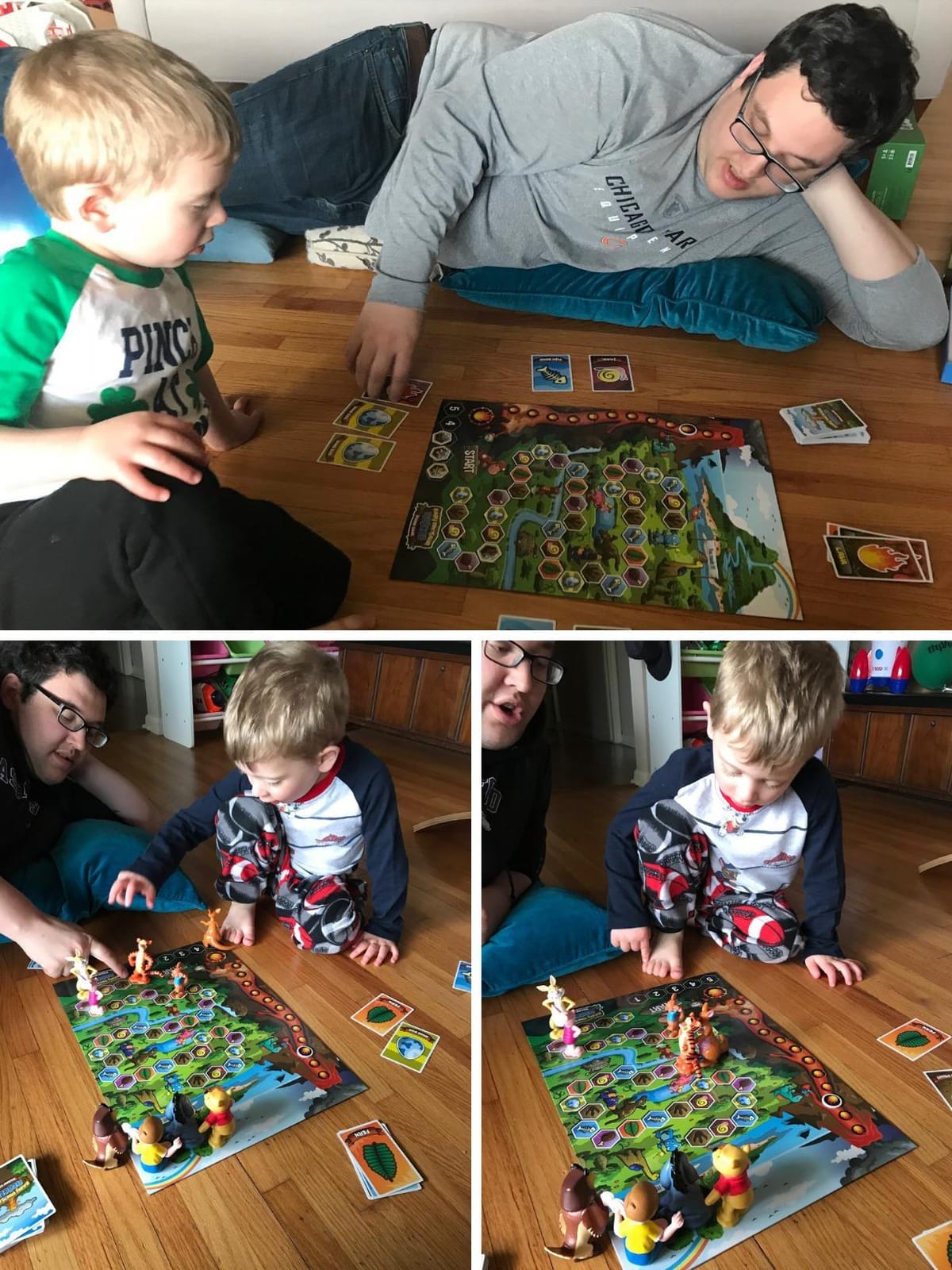
There is one real setup problem and reviewers do not soften it. Many boxes include no printed rulebook, so a parent has to find the rules online before the first game. Budget ten minutes for that, and the rest of the session is genuinely frictionless.
At just under 1,000 reviews and 4.7 stars, this has a modest review pool and the narrowest audience of the games we recommend for this age. It is a sweet first cooperative game for a four-year-old and a weak fit for anything past about age seven.
Best for a group of kids the same age
The two-to-four player range, the tiny box and the total absence of reading make this the easiest game here to hand to a group of preschoolers at a table. Nobody has to be singled out to explain whose turn it is.
It also suits a homeschool or after-school group better than almost anything else on the list, because it is cheap in space, cheap in setup time and impossible to break.
What to know before you buy it
Find the rules first. The missing printed rulebook is the single most repeated complaint in the reviews, and it is trivially fixable once you know about it.
Do not stretch it. The decision complexity is very low, so a pair of eight-year-olds will finish it and ask for something else within a week. Age four to six is the window where this game does its best work.
11. National Geographic My First Safari – Best for a Car Trip
National Geographic My First Safari Cooperative Board Game for Kids
Ages 4 and up
4 players
Quick rounds
No reading required
Pros
- Simple cooperative play that works with kids as young as 3-4
- Three difficulty levels let the game grow with the child
- Full-colour learning guide with facts on 21 animals
- Encourages collaboration rather than competition
- Compact box for short sessions
Cons
- Safari explorer figures are hard to fit into their stands and can bend
- Limited strategic depth for older children
- Minority of reviewers report poor production quality
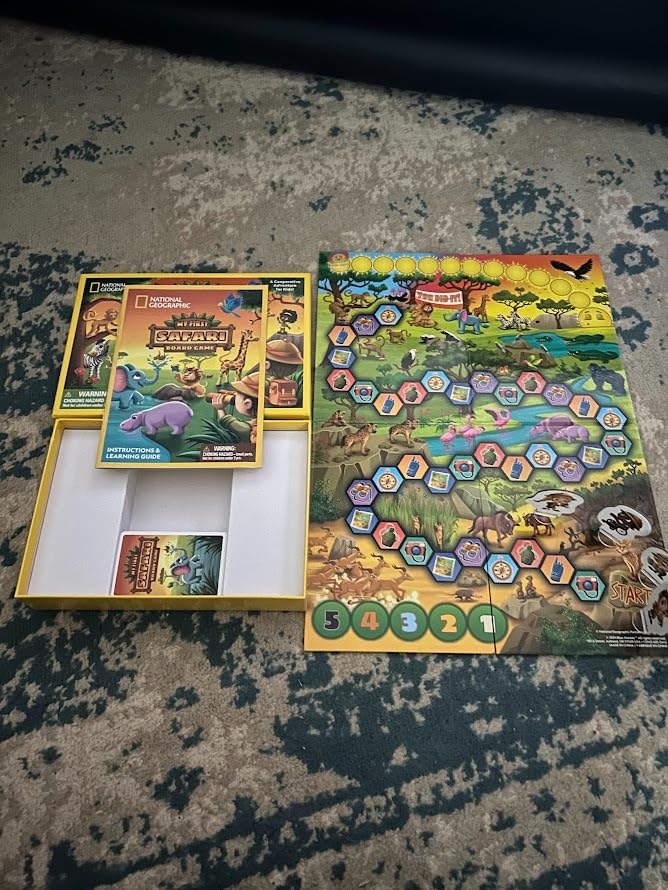
My First Safari has players working together to see all the animals on the board before the sun sets. The component list is sensible for a travel game: 1 board, 5 Safari Explorers, a sun token, 36 item cards, 13 sun cards and a full-colour learning guide covering 21 animals.
The three difficulty levels are the feature that sets it apart in this age group. A four-year-old can be handed level one and an older sibling level three at the same table, which is a rare thing to find in a cooperative game for preschoolers and solves a real sibling-argument problem.
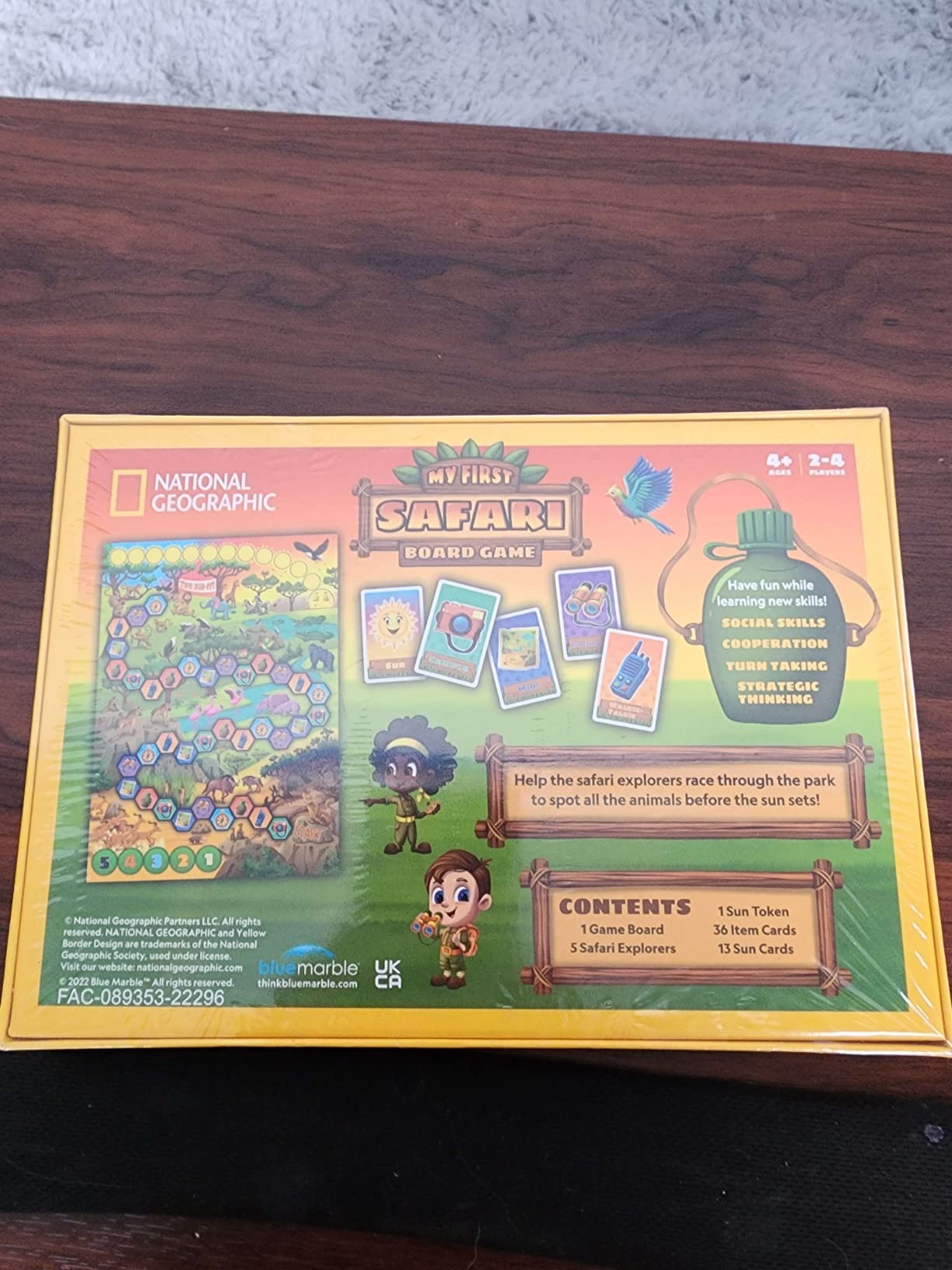
The plastic explorer pieces are the weak point. They do not seat properly in their stands, and reviewers report they bend or get damaged, which is irritating in a game whose whole visual appeal is the little figures on the board.
At 341 reviews and 4.6 stars this is one of the smaller review pools in the roundup, with 77% of ratings at five stars. The consistent praise is for how easily it teaches sharing and turn-taking in preschoolers.
Best when siblings are years apart and the car is short on time
Pick this for the family with a four-year-old and a seven-year-old who both need to be genuinely challenged. The three levels make that possible in one game rather than two, and the sun token keeps any single round short enough for a short attention span.
It is also a good fit for a two-adult-one-child table, since the learning guide gives the adults something to read aloud without turning the game into a lesson.
What to know before you buy it
Handle the explorer pieces gently. They are the first thing to break, and a bent figure changes how the board looks to a child who cares about that more than the rules.
Set expectations about depth. This is a no-skill cooperative game by design, so an eight-year-old who wants real strategy will need something from the upper end of this list instead.
12. Ghost Fightin’ Treasure Hunters – Best Cooperative Game for Ages 8 and Up
Mattel Games Ghost Fightin’ Treasure Hunters Anniversary Edition Game
Ages 8 and up
2-4 players
20-30 minutes
Reading required
Pros
- Two ways to play with a cooperative or one-versus-all mode
- Basic and advanced difficulty in cooperative mode
- Winner of the 2014 Kinderspiel des Jahres award
- Large 16 x 16 inch board with chunky plastic pieces
- Very few negative ratings across reviews
Cons
- Officially aimed at ages 8 and up so younger kids need help reading
- Rules and card text can be dense for early readers
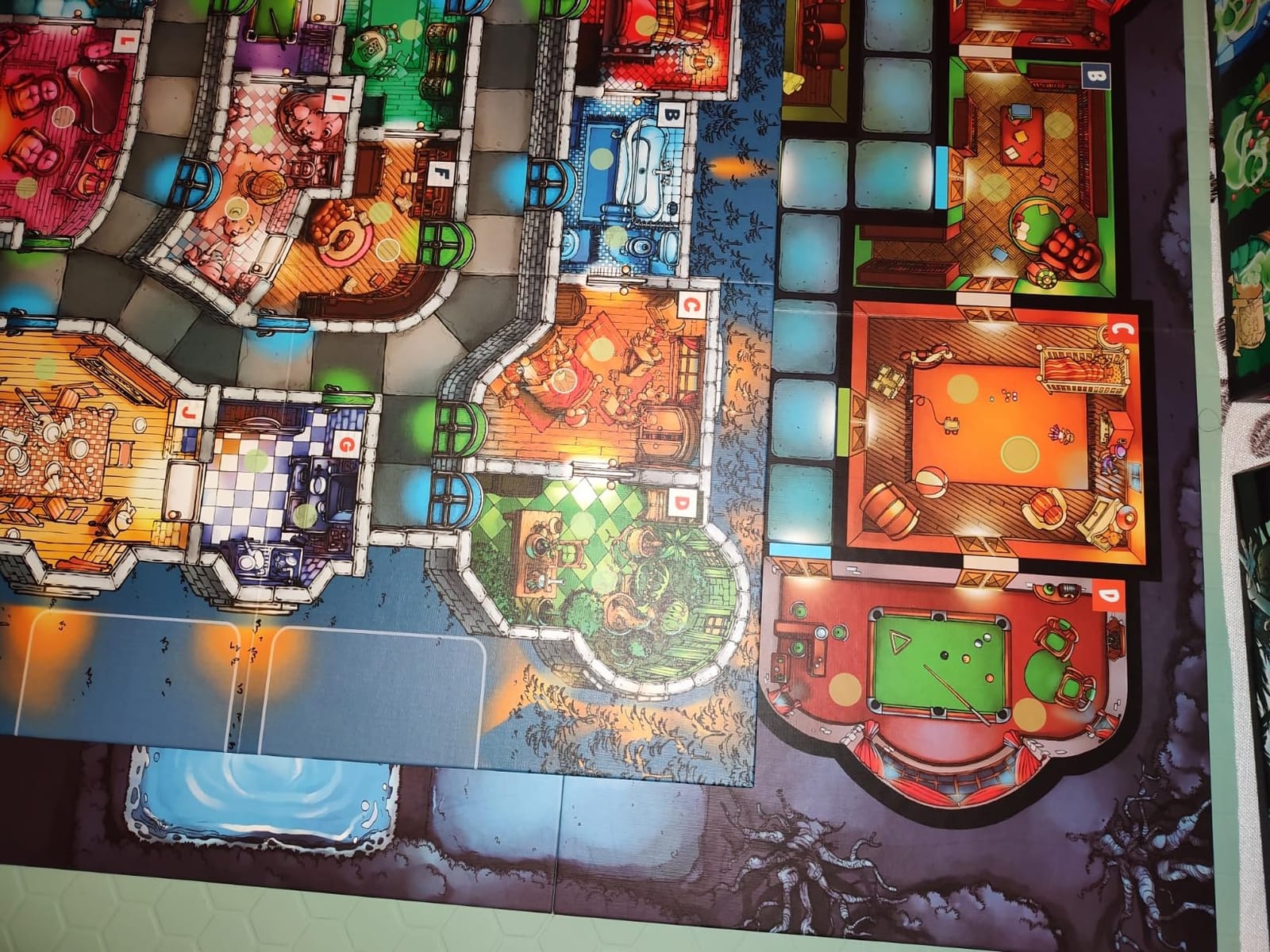
Ghost Fightin’ Treasure Hunters is the pick for a family that has outgrown preschool co-op games. The team collects 8 Treasure Jewels and escapes the haunted house before six rooms become haunted, using a component set of 4 hunter movers, 24 ghost movers, 6 haunting figures, 56 cards, a movement die and two fight dice.
What makes it unusually flexible is the two-mode design. Cooperative mode for the whole family, with a basic and an advanced difficulty option, or Head Haunter mode where one player goes solo against the rest. That second mode is genuinely useful for a child who has decided cooperative play is too gentle, because it gives the competitive instinct a legal outlet inside a box they already love.
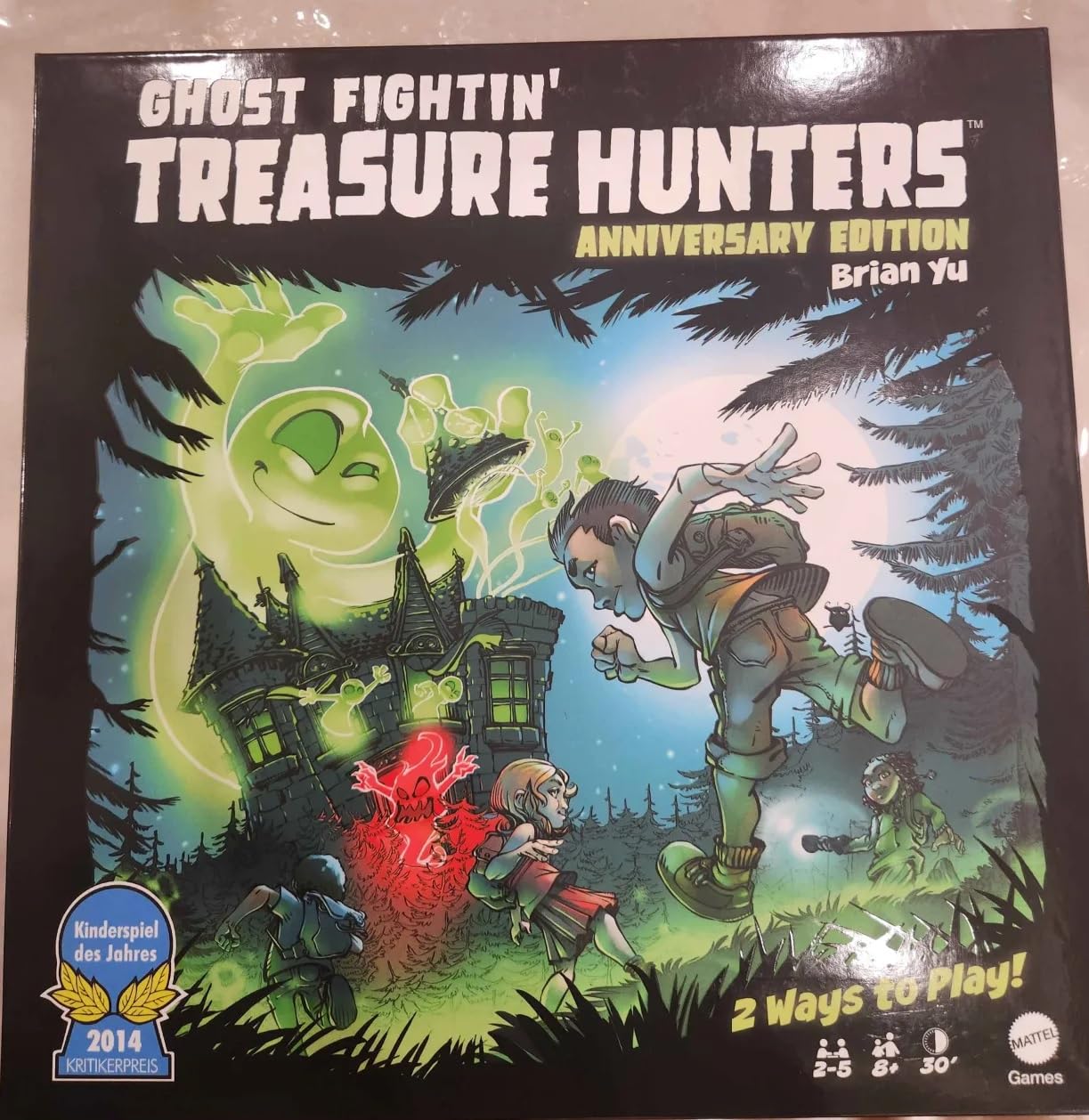
The 16 by 16 inch board and chunky plastic pieces are a real advantage with children who tend to crush cardboard. It also carries the 2014 Kinderspiel des Jahres award, which is a decent signal that the design underneath the theme is sound.
Reading is the constraint. The official age is 8 and up, and reviewers specifically flag the density of the card text for early readers, so a six-year-old will need an adult reading the cards aloud for most of the game.
Best for a child who insists on a winner
Choose this when a competitive kid is bored by games where nothing is at stake. Head Haunter mode turns the same components into a one-against-all game, which lets the child who wants to win actually win sometimes and then come back to the cooperative mode.
The advanced cooperative option gives older players something to chew on while younger siblings stay in the basic rules, and the box supports 2 to 4 players with either setup.
What to know before you buy it
Check the reader in the house before the birthday. A family with a six-year-old and no patient adult will get frustrated on the card text, even though the plastic components are among the most child-proof here.
Expect the first game to take about half an hour. Sessions run 20 to 30 minutes, which is a good length for a family that has moved past the 15-minute games but does not want a two-hour commitment.
13. The Quest Kids – Best Cooperative Game for Role Playing
The Quest Kids Board Game – Cooperative Fantasy Dungeon Crawler for Kids Ages 5+, First RPG Adventure Game for Families, 2-4 Players, No Reading Required
Ages 5 and up
2-4 players
20-30 minutes
No reading required
Pros
- Genuinely playable by 5 year olds because symbols replace text
- Rules explained in about five minutes
- High quality hero figures and gems that kids love moving
- 20-30 minutes per game fits a school night
- Expansions extend play up to about age 8 and up
Cons
- First setup is daunting without guidance and buyers seek outside help
- Storage box is slightly shallow so cards slide around
- Higher price point than most children's board games
The Quest Kids is a dungeon crawler with heroes, gems and monsters, aimed at ages 5 and up. It is the game on this list that most looks like a role-playing game without actually requiring kids to read a character sheet, because symbols and pictures replace text throughout.
Parents, and in some reviews therapists, use it as an introduction to tabletop role-playing games for young children. The reporting is consistent: it teaches counting, sharing and patience, and it stays frustration-proof because a player is never knocked out of the game. Adults end up enjoying it too, which is rarer than it should be in this category.
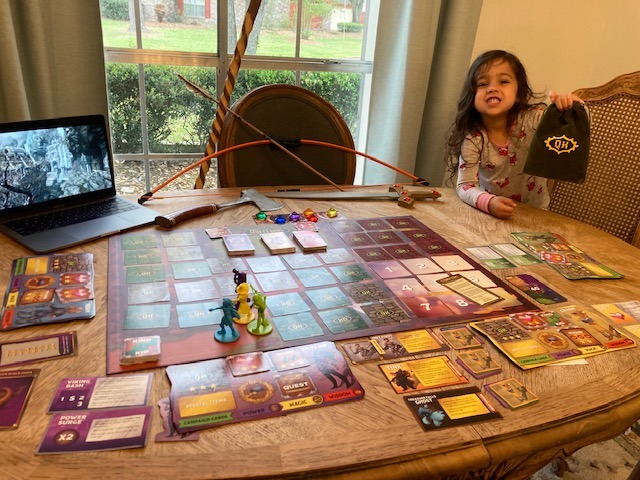
The learning curve on day one is the real complaint. Several buyers looked up external guides before the first game because the initial setup feels daunting, and the shallow storage box means cards shift around inside, so sorting the components first is the one thing worth doing before you start.
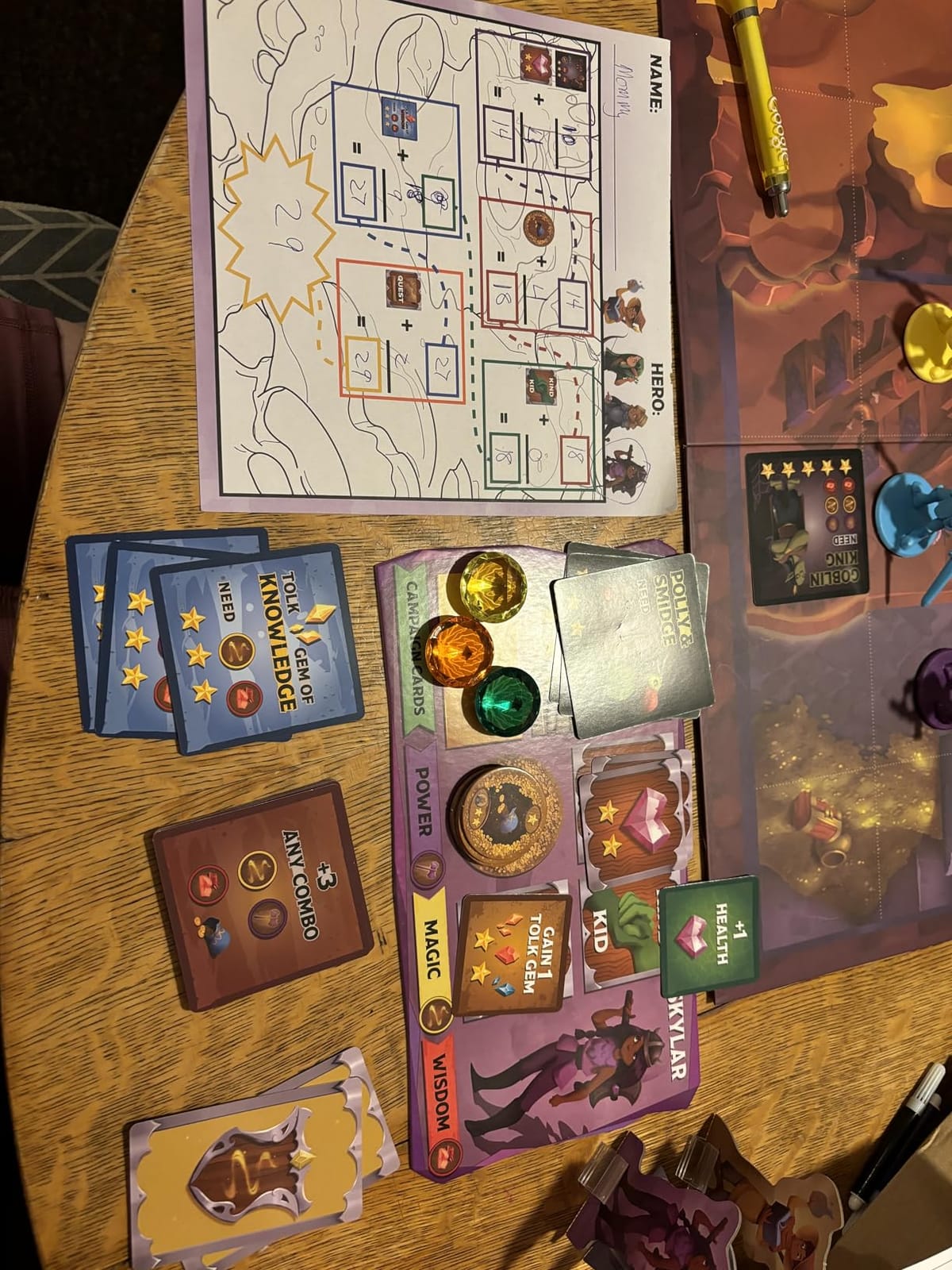
The component set is unusually large: 4 large hero figures, 4 player boards, 42 dungeon cards, 122 additional cards, gems, treasure tokens and scoring sheets. Three expansions add a dragon hero, boss fights, a story campaign and new realms, which is how the game grows from age five to about eight and beyond.
Best for a child ready to pretend, not just to play
Pick this when your child narrates what they are doing while playing every other game. A dungeon crawler gives that instinct a structure, and the four hero figures become characters with identities rather than tokens.
It works with two players as comfortably as four, so a parent and one child can run a full session in 20 to 30 minutes. No reading is required, which puts it ahead of most dungeon crawlers for young players.
What to know before you buy it
Give yourself one evening with the rules before involving the children. That single investment is the difference between a game the family uses for years and a box that stays on the shelf.
It is the most expensive game in this roundup, and worth weighing against a two-game approach if you are shopping for a small child. The expansions are the reason to justify that cost, and they only pay off if the base game gets played.
14. HABA Orchard Game – The Best First Cooperative Game of Any Age
HABA Orchard Game – A Classic Cooperative Introduction to Board Games for Ages 3 and Up (Made in Germany)
Ages 3 to 6
1-8 players
About 10 minutes
No reading required
Pros
- A genuine first cooperative game that teaches shared winning from age 3
- Single color die with symbols so pre-readers can play
- High quality wooden components built to last
- Scales to groups of 1-8 players
- Award-winning classic with over 2.5 million copies sold
Cons
- Very little strategic content once the pattern is learned
- The more players in the game the easier the win becomes
The HABA Orchard Game, also known as First Orchard, is the game we hand a family with a three-year-old and no board game experience at all. Players take turns picking fruit from four trees with a color die, and the team wins if all the fruit comes off the board before the nine-piece raven jigsaw is completed. That is the entire rule set.
It has sold more than 2.5 million copies and won the Dr. Toys Best Classic Toys Award, and those numbers are not marketing noise. The wooden components are the reason it has survived: 10 apples, 10 pears, 10 pairs of cherries, 10 plums, 4 baskets, a raven jigsaw, a symbol die and a board.
The 1-to-8 player range makes it the second most flexible game here, after Mermaid Island. A family of six, a pair of siblings, or a single child with an adult can all play the same box, and the difficulty shifts rather than breaks.
Best as the first board game a child ever plays
Choose this when a child is three or four and cooperative board games are still an abstract idea. The rule is one sentence long, the die uses symbols rather than numbers, and the win condition is visible on the board rather than described in a rulebook.
It is also the best single box for a large gathering, where the usual problem is that the adults end up playing a separate game while the kids argue over one copy.
What to know before you buy it
There is very little strategy in it, and pretending otherwise helps nobody. A three-year-old is meant to enjoy the shared harvest, not to make good decisions about turn order.
Know that more players makes it easier. Families who love the game but find it soft report adding a second raven later, which increases the tension without changing the reading load or the age fit.
15. Dog Man Attack of the Fleas – Best for Dav Pilkey Fans
Dog Man Attack of the Fleas Cooperative Board Game, Ages 6+, 2-6 Players
Ages 6 and up
2-6 players
About 30 minutes
Light reading
Pros
- Ties directly into the Dog Man books and characters
- About 30 minutes per game which suits limited evenings
- Genuinely non-competitive so kids work together
- Easy to vary with kids inventing their own strategies
- High 4.6 rating across more than 3300 reviews
Cons
- Simple rules feel repetitive for older or strategy-minded children
- Rules take explaining to younger kids before the first play
- Components are mainly thick cardboard so durability is average
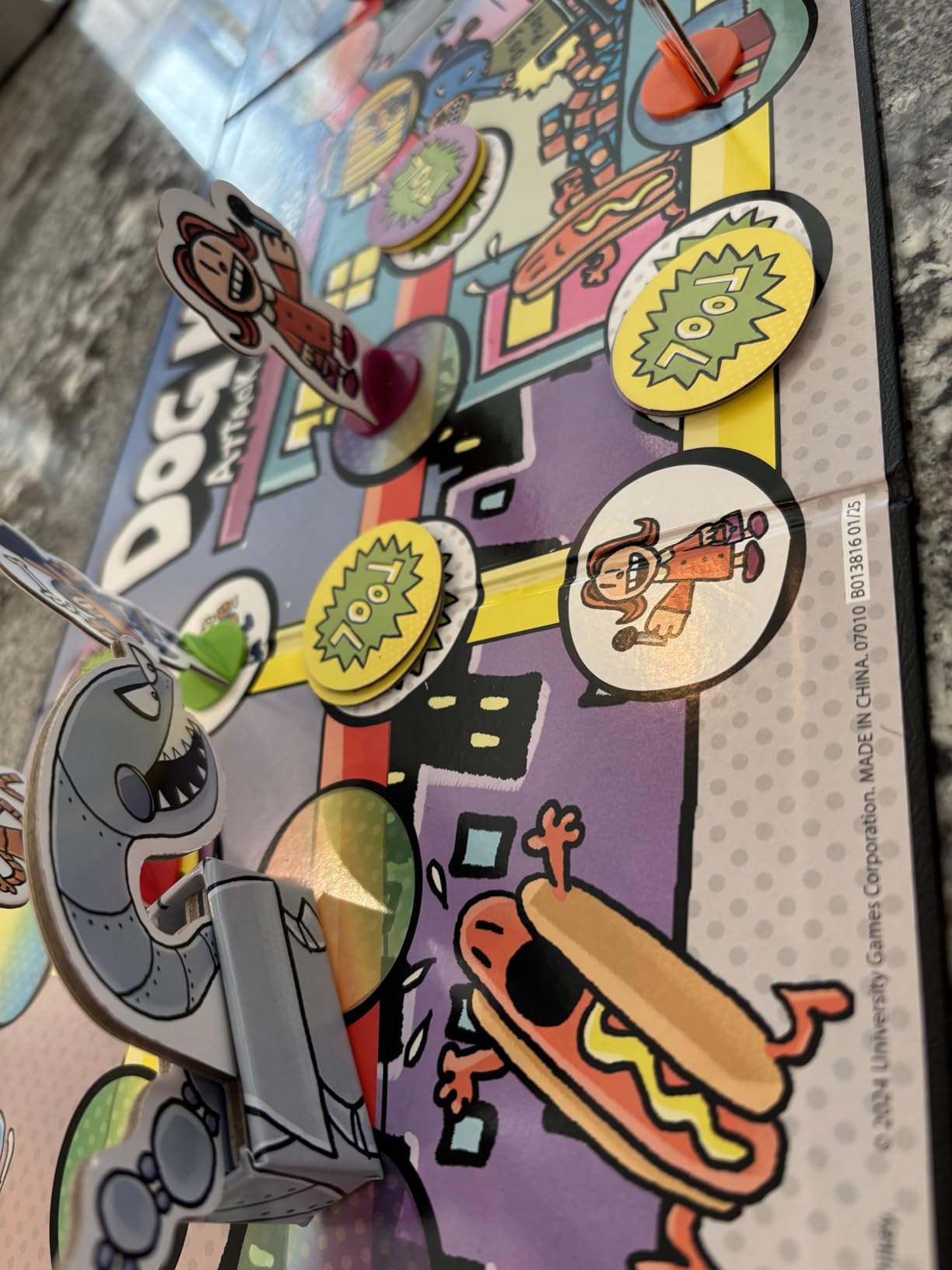
Dog Man Attack of the Fleas puts the whole family on the same side against a city infestation, using a board, 6 Supa Buddies pieces, a Robo-Brontosaurus piece and base, 20 tool tokens and a spinner. It is the widest age window of the preschool-adjacent games here at 2 to 6 players, and the license does the recruiting for you.
More than 3,300 ratings at 4.6 make this one of the most heavily reviewed titles in the roundup. That volume reflects a specific household: a six- to nine-year-old who has read every Dog Man book and needs a game to play on the same evening. Few boxes serve that child as directly.
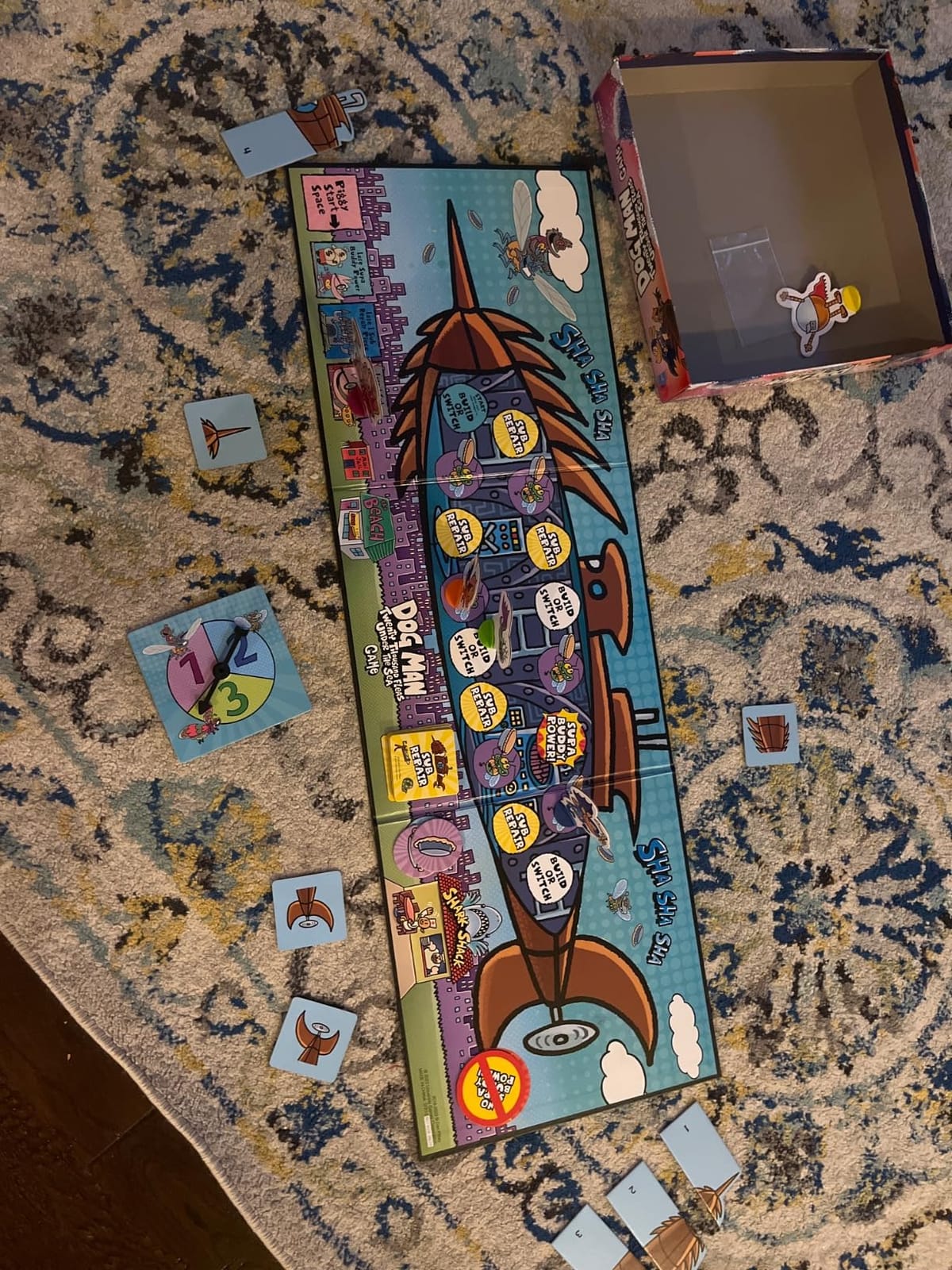
The repeated criticism is simplicity. The rules are thin enough that a family outgrows them quickly, and reviewers single out kids aged 10 and up as the ones who lose interest, wanting something heavier. Younger players also need the rules walked through before the first round.
Durability is average, since the components are mainly thick cardboard. That is fine for a supervised game on a family table and a poor choice for a household with a toddler who treats cardboard as a consumable resource.
Best when the licence is doing the persuading
Buy this for a child who is already a fan. The characters, the tone and the art are the hook, and a game that finally gets a child away from the screen because it features their favourite series is worth more than a better-designed game that gets refused.
At about 30 minutes it is one of the longer sessions here, which makes it better for a weekend afternoon than a school night. The 2-to-6 player range suits sibling groups and cousins.
What to know before you buy it
Set a shelf-life expectation. Reviews of this game read as a description of a six-to-nine-year-old’s phase, and once that phase ends, the box tends to join the pile with the other finished ones.
Budget ten minutes for the first rules walkthrough. Once that is done, families report kids inventing their own strategies and stretching the game well past its basic form, which is the strongest sign of a game doing its job.
How to Choose a Cooperative Game for Your Family
Start with the player count, not the theme. A surprising number of cooperative games are designed for three to five adults and play badly with two, which is the most common family configuration. Of the games in this roundup, the ones that genuinely work with exactly two players are Hoot Owl Hoot, HABA Orchard Game, Mermaid Island, The Quest Kids, Baby Dinosaur Rescue and Dog Man Attack of the Fleas. That matters most for a parent-and-child pair or two siblings, and it is the number most worth checking before anything else.
Second, check the reading requirement honestly. If a child cannot read fluently, the games that need no text at all are Hoot Owl Hoot, Race to the Treasure!, My First Castle Panic, Mermaid Island, Baby Dinosaur Rescue, HABA Orchard Game and The Quest Kids. Reading a card aloud for a forty-minute game is a different experience from a child reading their own options.
Third, match the playtime to your household. Games that finish in 15 minutes work on a weeknight. Games that run 20 to 30 minutes work on a weekend. Wildcraft! can run past 40 minutes, which works best with a cap on the number of rounds rather than an attempt to finish.
Fourth, calibrate the difficulty so a young team wins most of the time. A cooperative game the children never win stops being fun within a few sessions, and that is the most common reason a co-op game ends up unused. The easy modes in My First Castle Panic and Ghost Fightin’ Treasure Hunters exist for exactly this reason.
If you have a highly competitive child in the house, do not fight it. Give that child a game where the tension is real, such as Ghost Fightin’ Treasure Hunters in its one-against-all mode, and let them win that round before returning to the team. The goal is a family that keeps playing.
One last filter is the moment a child asks when the next one is coming out. If you want a ready answer for that question, our pieces on why games have day-one patches and why new video games cost more than they used to make a useful bridge once the board games run out.
How to teach a new co-op game without reading a 30-minute rulebook
Play the first round as a demonstration rather than a tutorial. Sit down, move one piece, explain only the rule that piece used, and hand the next turn to a child.
When a question comes up mid-game, answer it with the smallest possible explanation and keep moving. Cooperative games teach their own rules through play, and a table that stops to read tends to stop permanently.
There is one house rule worth writing down. If one player is making every decision, that player has to describe their reasoning out loud before anyone moves a piece. It fixes the dominant-player problem faster than any other single change, and it costs nothing.
Frequently Asked Questions
What are some good co-op games for kids?
The strongest cooperative games for kids across age groups are Outfoxed! for ages 5 and up, Hoot Owl Hoot for preschoolers, Race to the Treasure! for ages 5 to 7, Wildcraft! for one-player educational play, and Dog Man Attack of the Fleas for six to nine year olds. Pick by player count and reading level rather than theme, since the best game is the one your youngest player can actually finish.
What is the best cooperative board game for kids?
Outfoxed! is the best overall cooperative board game for kids. It runs about 20 minutes, plays with four players, needs no reading beyond icons, and rewards deduction rather than reflexes. More than 7,400 families have rated it, and the recurring praise is for how quickly children learn the decoder wheel and then play independently.
What are the top 10 cooperative board games?
A strong top ten for kids covers a range of ages: Outfoxed!, Hoot Owl Hoot, Race to the Treasure!, Richard Scarry’s Busytown, Mermaid Island, Minecraft Heroes of the Village, Wildcraft!, My First Castle Panic, Baby Dinosaur Rescue and Dog Man Attack of the Fleas. Between them they cover ages 3 to 10, player counts from 1 to 6, and playtimes from 10 to 40 minutes.
What are some good two-player board games for kids?
The best cooperative games that work well with exactly two players are Hoot Owl Hoot, HABA Orchard Game, Mermaid Island, The Quest Kids, Baby Dinosaur Rescue and Dog Man Attack of the Fleas. Player count is the most commonly misread number on a box, so check the minimum player count before buying for a parent-and-child or sibling pair.
Which cooperative board games need no reading at all?
Hoot Owl Hoot, Race to the Treasure!, My First Castle Panic, Mermaid Island, Baby Dinosaur Rescue, HABA Orchard Game and The Quest Kids need no reading during play, using icons, symbols and color matching instead of text. Games such as Minecraft Heroes of the Village, Ghost Fightin’ Treasure Hunters and Bluey Scavenger Hunt do require an adult to read cards aloud.
What are some good cooperative games for 4-year-olds?
For 4 year olds the most reliable picks are HABA Orchard Game, Hoot Owl Hoot, Baby Dinosaur Rescue and Richard Scarry’s Busytown. All four run under 20 minutes, work with two to four players, and need no reading. Choose based on whether the child prefers active searching or a seated game, and set the difficulty to the easiest level available.
Start With These Two
If you buy nothing else, start with Outfoxed! and HABA Orchard Game. One is the strongest overall cooperative board game for kids and the other is the best possible first board game, and between them they cover a three-year-old and a nine-year-old without either child feeling outgrown.
Add Hoot Owl Hoot as the third, and you have a 15-minute game that needs no reading, a 20-minute deduction game and a 10-minute wooden classic. That is a full month of screen-free evenings in three boxes, and it is the 2026 starting point we would hand to any family asking us where to begin.