
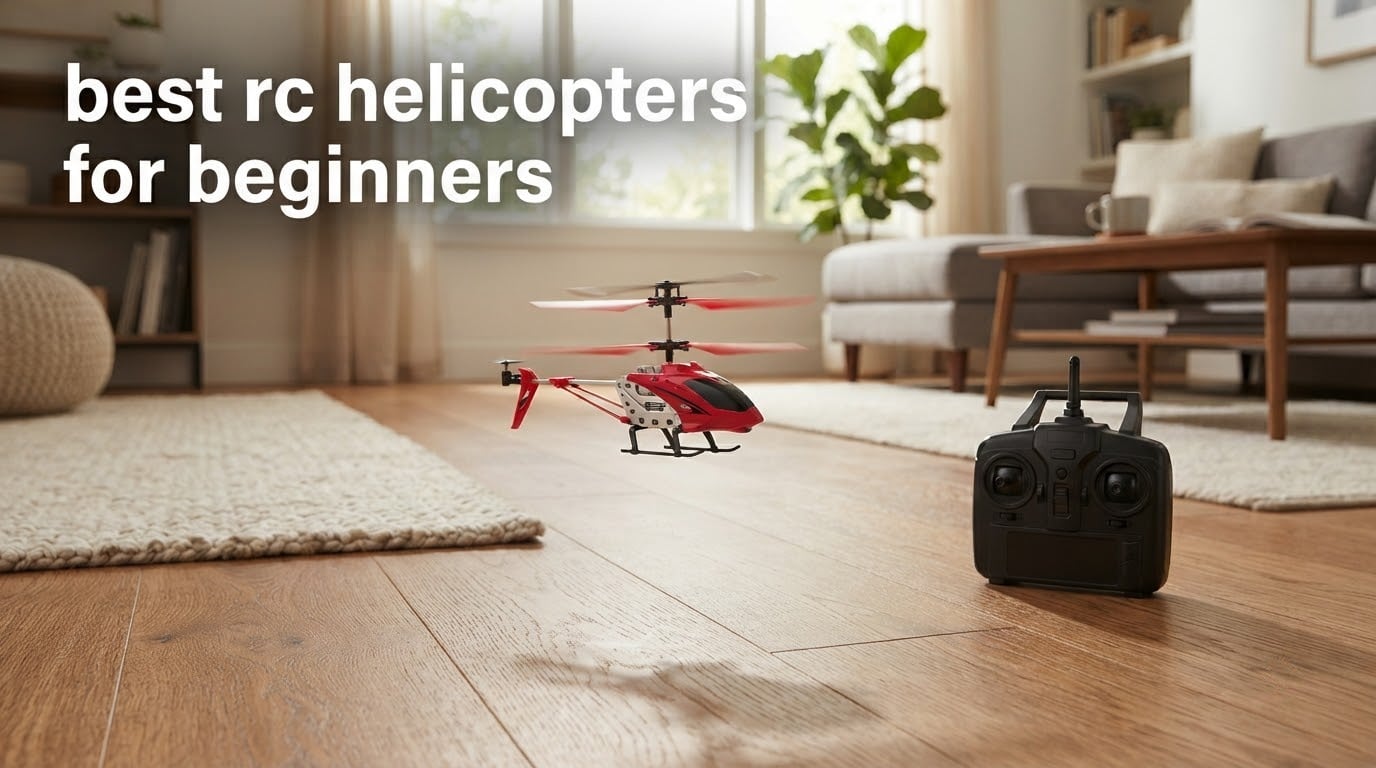
Short answer: the SYMA S107H-E is the best RC helicopter for beginners overall in 2026. Its alloy body, one-key takeoff and landing, altitude hold and dual speed modes make it forgiving enough for a first flight, and the review volume behind it gives you a huge sample of real-world reports to read before you commit. It is not the most advanced machine here, and that is exactly the point.
There is a fork in this market that most roundups ignore, and it matters more than any spec sheet. Some buyers are parents looking for an indoor helicopter for a child aged eight and up that survives hard landings and charges over USB. Others are adults who want to learn real helicopter flying and will happily spend a season in a simulator before touching a collective-pitch trainer.
Those two buyers want different helicopters, and a drone-like stabilised machine teaches the second group almost nothing. We split our picks accordingly, and every product below is listed in the order we would hand it to a friend. We compared the ten most-reviewed beginner helicopters on the market, checked every specification against the manufacturer listing, and read the customer review patterns rather than the marketing copy.
If you are just starting and want the surrounding equipment sorted out too, our guides to the best RC planes for beginners and the best RC LiPo battery chargers cover the same first-year learning path from the other two directions.
Table of Contents
Top 3 Picks for the Best RC Helicopters for Beginners (October 2026)


Cheerwing S107G
- 3.5-channel control
- Two selectable frequencies
- Upgraded gyro
- Compact indoor size
The S107H-E wins on balance: a 4.3 rating across nearly 6000 reviews, an alloy frame that shrugs off rough landings, and assist features that remove the two hardest parts of a first flight. The BUSSGO X11C doubles the flying time with two batteries, which matters more than most buyers expect. The Cheerwing S107G is the pick if you want the simplest machine on the market and do not mind earning your hover manually.
All 10 Beginner RC Helicopters Side by Side in 2026
| Product | Specifications | Action |
|---|---|---|
| SYMA S107H-E |
|
Check Latest Price |
| BUSSGO X11C |
|
Check Latest Price |
 Cheerwing U12S Cheerwing U12S |
|
Check Latest Price |
 SYMA S100 SYMA S100 |
|
Check Latest Price |
 DEERC DE28 DEERC DE28 |
|
Check Latest Price |
 DEERC Apache DEERC Apache |
|
Check Latest Price |
 GoolRC K127 GoolRC K127 |
|
Check Latest Price |
 SYMA S108G SYMA S108G |
|
Check Latest Price |
 XIKOTEC XK1 XIKOTEC XK1 |
|
Check Latest Price |
| Cheerwing S107G |
|
Check Latest Price |
Every one of these sits in the toy-grade to entry coax tier. That is deliberate, and it is also an honest limitation: the collective-pitch trainers the hobby forums recommend for adults are a different product category with different economics, and you will not find them in this list. More on that in the buying guide below.
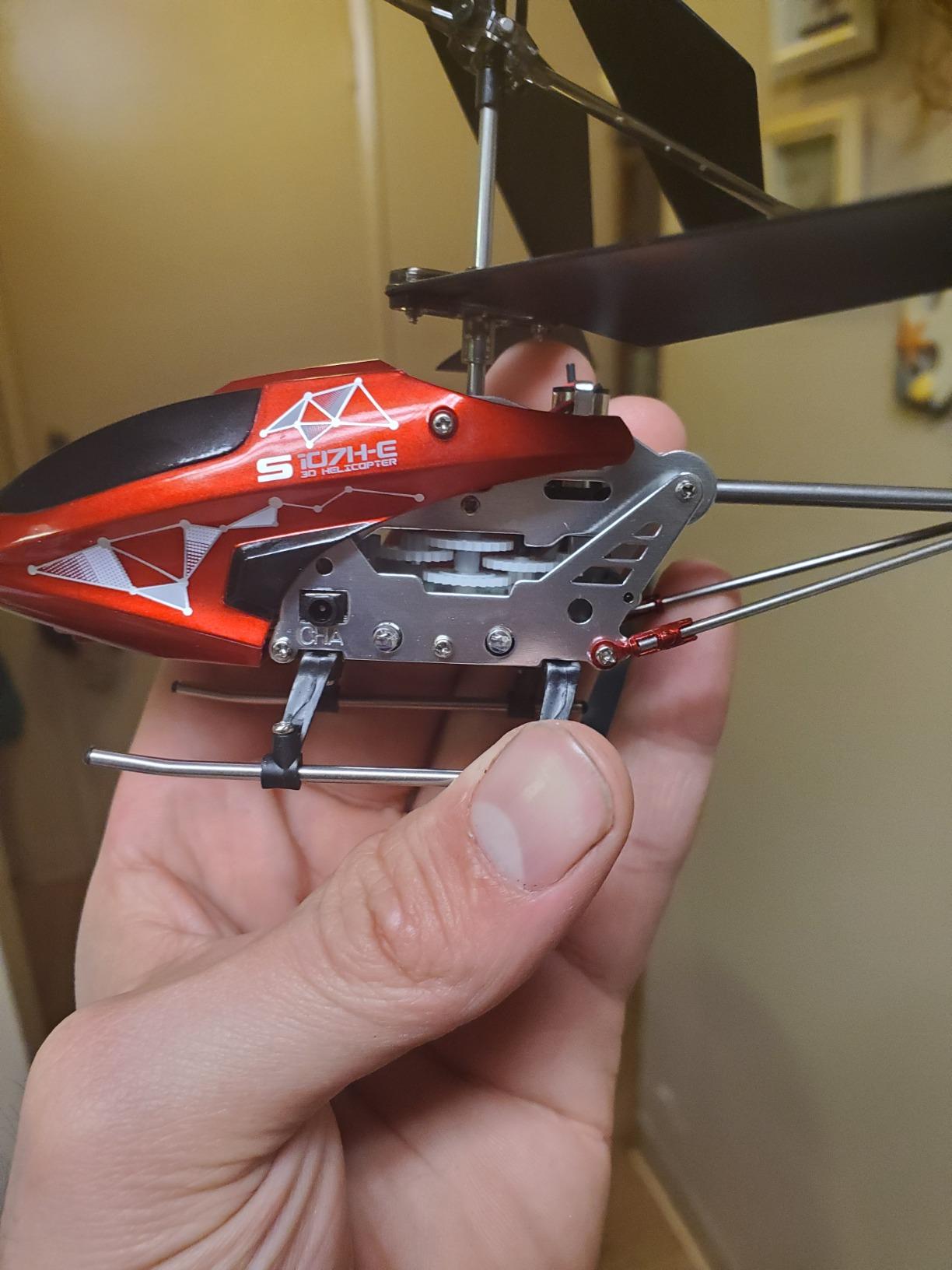
1. SYMA S107H-E RC Helicopter for Kids, Alloy Body, Altitude Hold, Red
SYMA S107H-E RC Helicopter for Kids, Alloy Body, Altitude Hold, Red
Alloy body
One-key takeoff/landing
Altitude hold with gyro
Dual speed modes
Pros
- Alloy body survives rough landings
- One-key takeoff and landing plus altitude hold
- Dual speed modes let a beginner start slow
- 2.4GHz lets several helicopters fly at once
Cons
- Indoor only with a small coaxial frame
- Disturbed by air conditioning and open windows
- Shorter flight time per battery than dual-battery models
This is the helicopter I hand to people who say the words “I want to try one of these” without knowing what they are getting into. The S107H-E measures 8.66 by 1.5 by 4.1 inches and weighs almost nothing, which is exactly why it is safe indoors and exactly why it disappears in a draught.
The three assist features do the heavy lifting. One-key takeoff and landing removes the most intimidating moment, altitude hold takes the throttle out of the hover equation, and a low-speed mode gives you a chance to learn the controls before the thing moves quickly enough to be interesting. The built-in gyroscope keeps the nose pointed where you leave it.
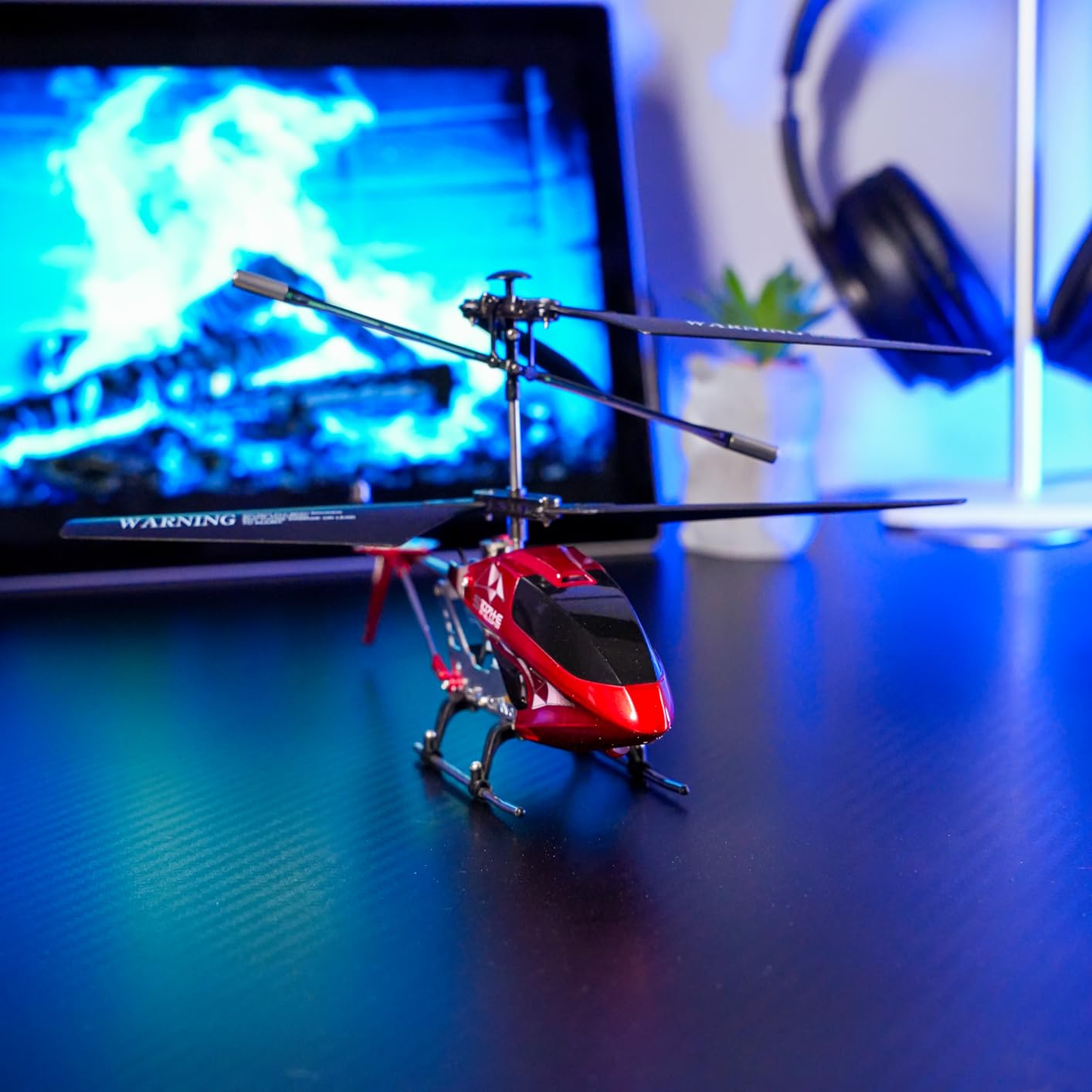
The alloy construction is the quiet advantage. Owners report putting this model through hard landings that destroy plastic-bodied helicopters of the same size, and the 2.4GHz link means you can run several at once if you have more than one child. Manufacturer recommendation is eight years and up.
Where it struggles is honest but predictable: this is a small coaxial helicopter, and a coaxial rotor is inherently self-stable but also has very little power margin. Open a window in summer and the air conditioning current will carry it into a wall regardless of how carefully you fly. It is also a single-battery design, so you are charging as often as you are flying.
One detail worth knowing: the listed item weight of 0.27 g is a listing error rather than a real figure. Judge the class by the dimensions instead.
How forgiving is it for a first-time pilot?
More than any other coaxial in this list. The combination of altitude hold and a low-speed mode means a child can achieve a stable hover on their first attempt rather than their fortieth, and the one-key start removes the panic that usually ends session one.
That assistance has a limit. The assist stabilises attitude and height, not your coordination, so someone who wants to learn real helicopter flying will still need a later step up.
When should you skip it?
Skip it if you want to fly outdoors, if you want long uninterrupted sessions rather than four or five short ones, or if you plan to grow into the hobby. As a first helicopter to build coordination, it is excellent. As a final destination, it is a dead end with no parts ladder above it.
2. BUSSGO X11C Remote Control Helicopter with Two Batteries and LED Modes
BUSSGO RC Helicopter, Remote Control Helicopter for Kids
Altitude hold with gyro
One-key takeoff/landing
Two batteries, 30 minutes
7 LED modes
Pros
- Two batteries give roughly 30 minutes of combined flight
- LED colour modes and auto-rotation demo keep kids engaged
- Alloy structure with PVC body handles bumps
- No assembly beyond inserting the batteries
Cons
- Pushed around by any breeze outdoors
- Very small so indoor flying space is limited
- One buyer received a crushed box
The single most common complaint we saw in the reviews was not about flying. It was about the clock. Every helicopter that ships with a single pack makes you spend more time plugged in than in the air, and the X11C is the pick that fixes it without changing anything else.
Two modular batteries give 15 to 17 minutes each, which works out to roughly 30 to 34 minutes of combined flight. That is the longest included flight time of anything in this roundup, and it is not a small difference when you are trying to practise a hover over several sessions.
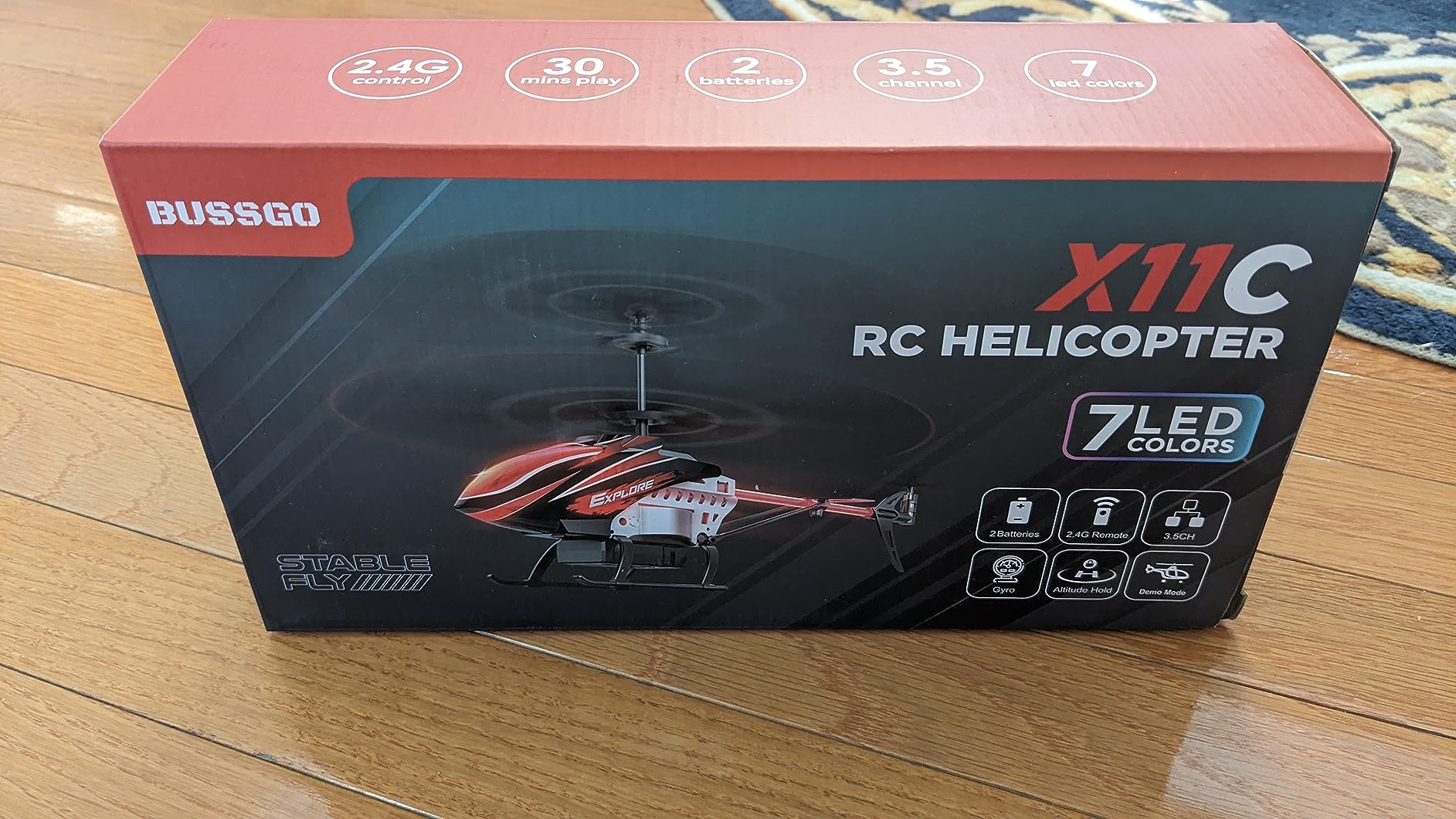
The rest of the feature list is sensible for the class. A 2.4GHz link with anti-interference handling lets multiple helicopters fly together, the gyro holds a stable hover when you release the sticks, and there is a low battery alert. The seven LED colour modes and the auto-rotation demo are the features children actually ask about.
Build quality is a PVC body over an alloy structure, which is the standard recipe in this tier and adequate for indoor use. One buyer reported receiving a crushed box with all-Chinese packaging and manual, so inspect the unit on arrival rather than assuming a damaged carton means a damaged helicopter.
Consistent across the reviews is the same caveat you will see on nearly every model here: at 1.44 ounces it is light enough that a ceiling fan or an open door ruins the flight. Size is 8.5 by 4.8 by 7.5 inches, so it needs a clear room rather than a large one.
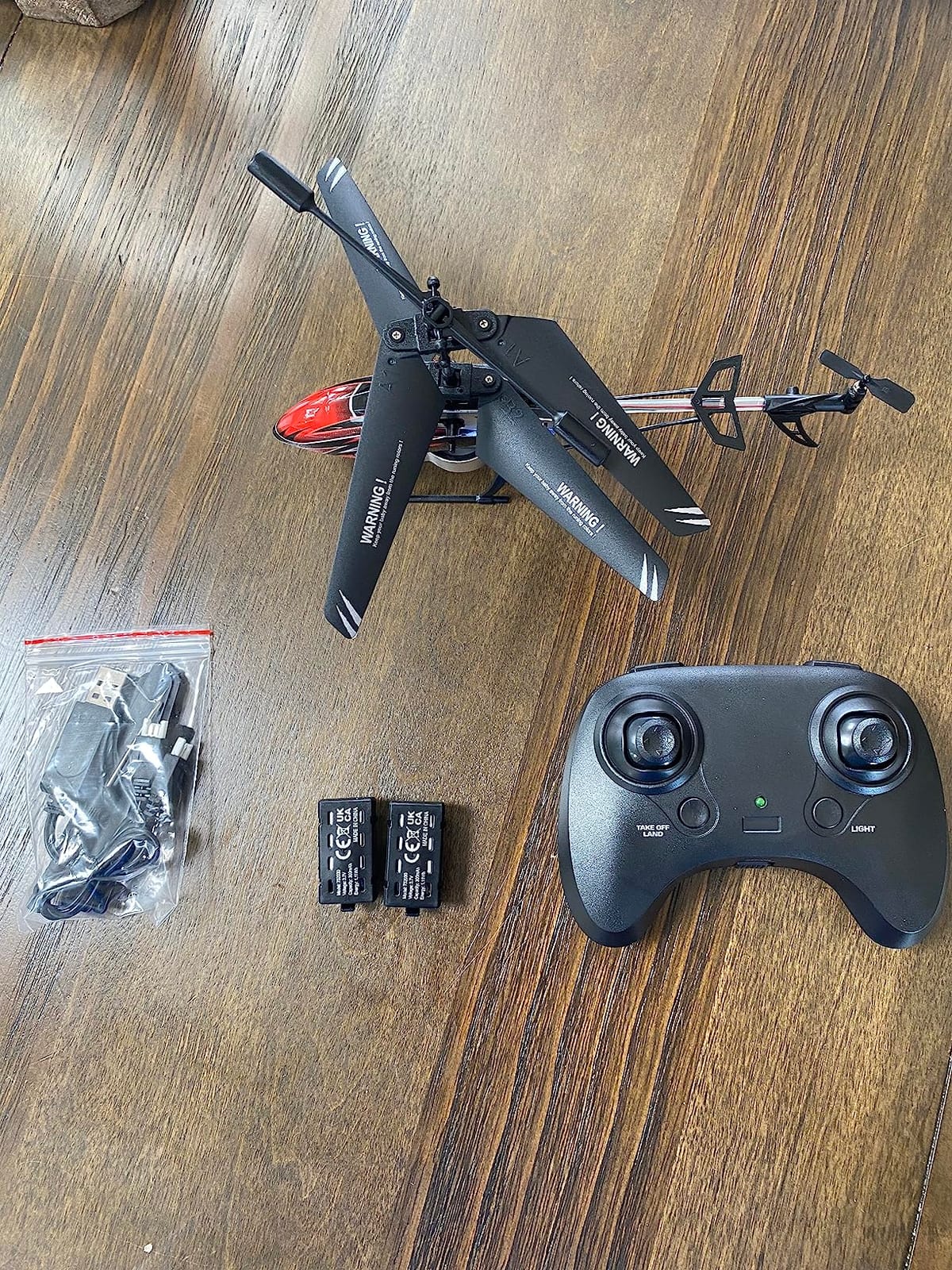
Is two batteries worth the extra bulk?
For indoor practice, yes, without much qualification. Swap the pack when one drops and you keep flying, which is where most of the learning happens. The trade-off is more parts to store and more charging to manage safely.
It does not help outdoors. Nothing in this class survives meaningful wind, and two batteries do not change the power-to-weight ratio.
What about the lights and demo mode?
They matter more than they sound. LED colours make the helicopter easy to track in a dim room, and the auto-rotation demo gives a new pilot something to look at that is not their own shaky flying. Parents should treat it as a confidence tool, not a substitute for supervision.
3. Cheerwing U12S Mini RC Helicopter with WiFi FPV Camera
U12S Mini RC Helicopter with Camera Remote Control Helicopter Yellow
WiFi FPV camera with app control
One-key takeoff/landing
Altitude hold
Two speed modes
Pros
- Only pick here with a built-in camera and live phone feed
- One-key takeoff and altitude hold ease the learning curve
- Metal frame and flexible blades take repeated crashes
- 2.4GHz supports multiple pilots at once
Cons
- App-based camera adds setup steps
- Small indoor airframe is easily disturbed by air currents
- Short flight time per battery
Every other coaxial here is a pure flying machine. The U12S has a WiFi camera built in, streams live video to a phone through a companion app, and takes photos. For a child who is motivated by seeing the flight from outside, that changes the appeal of the whole hobby.
It is also the only pick in this roundup that gives you any idea of what a camera-equipped aircraft feels like, which is a genuine stepping stone toward FPV flying later. Nothing else here does that.
The flying is ordinary for the class, and ordinary is fine. One-key take-off and landing, altitude hold, and two speed modes give a beginner a workable learning curve. The 2.4GHz radio supports multiple pilots, and the metal frame with flexible blades is built to absorb impacts rather than transmit them to the airframe.
The tradeoff is complexity. WiFi app control adds a setup step that a plain transmitter does not have, and the app is the first thing that tends to give people trouble. If the camera is the draw, that is a worthwhile trade. If you just want to hover, you are carrying extra electronics you will not use.
Dimensions are 10.63 by 1.77 by 4.72 inches and the listing specifies indoor use, which is the correct guidance. Like everything else here, it is not a wind-capable aircraft.
Is the camera worth the extra setup?
Yes for a motivated beginner, no for a first hover. The app adds a step between unboxing and flying, and first flights go better when there is one fewer variable. Set the camera up on the second or third session, not the first.
Also expect a shorter flight time per battery than a plain coaxial. Streaming and recording draw power from the same pack that powers the rotors.
Who should skip it?
Skip it if you want a clean introduction to hovering with the minimum of distractions, or if your household has limited WiFi coverage in the room you would fly in. The plain coaxials do the core job better for less money.
4. SYMA S100 Mini RC Helicopter for Small Indoor Spaces
SYMA S100 Mini RC Helicopter for Kids, Indoor Flying, Altitude Hold, Black
Palm-sized 4 inch body
One-key takeoff and landing
Altitude hold
3.5-channel
Pros
- Fits a bedroom
- playroom or small apartment
- Altitude hold and one-key controls make it a real entry trainer
- PVC body and landing gear cushion impacts
- Pocket-sized enough to carry anywhere
Cons
- Roughly 5 to 7 minutes of flight per charge
- Vulnerable to light indoor air currents
- Micro size limits performance and payload
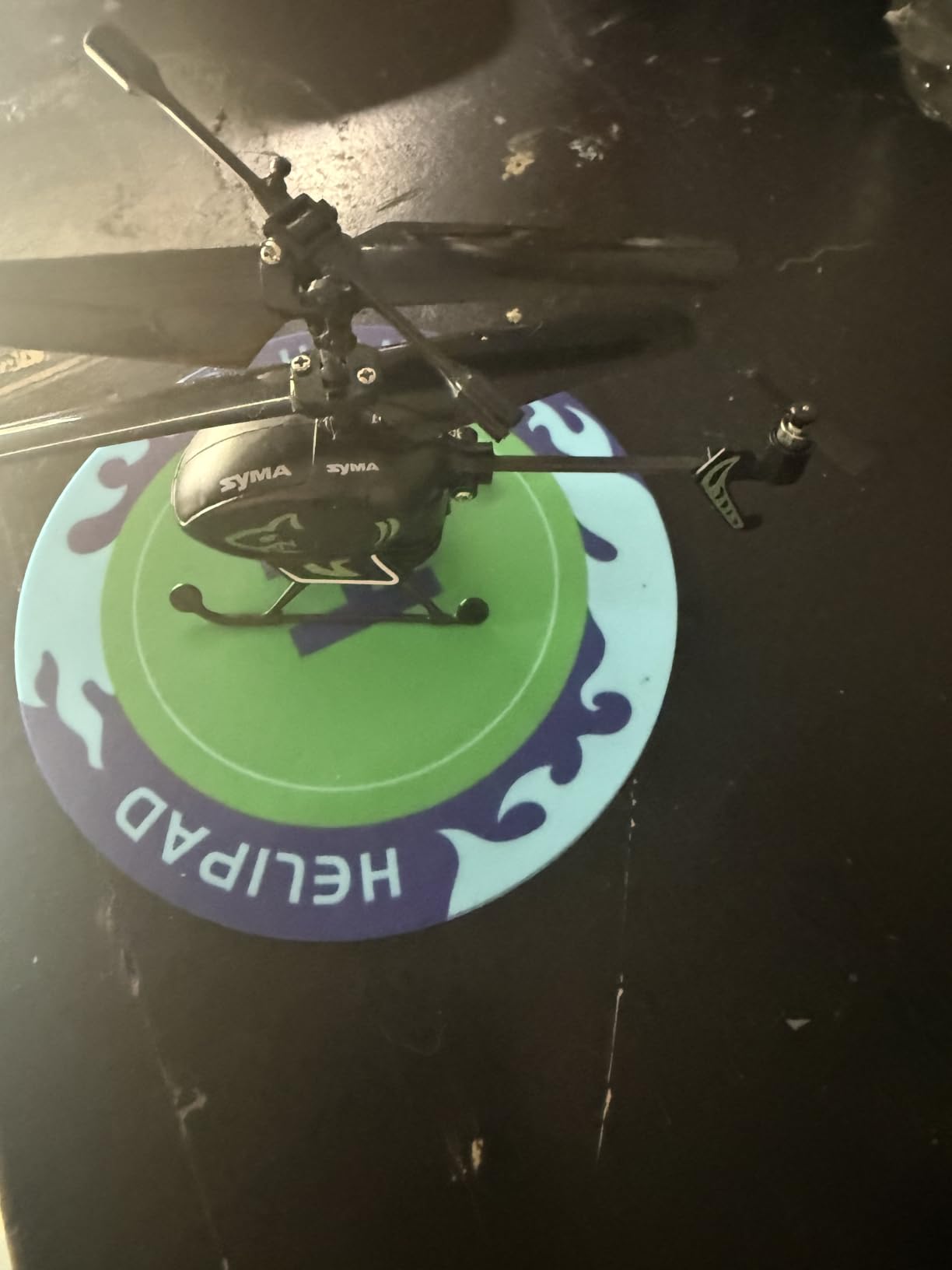
Size is the entire argument here. At 4.13 by 1.06 by 2.36 inches the S100 is genuinely palm-sized, and it will hover in a bedroom, a playroom, or a small apartment where nothing else in this roundup will fit.
If you are an adult living in a flat without a garden, that constraint decides the purchase for you. There is no point buying a better helicopter you cannot legally or safely fly anywhere.
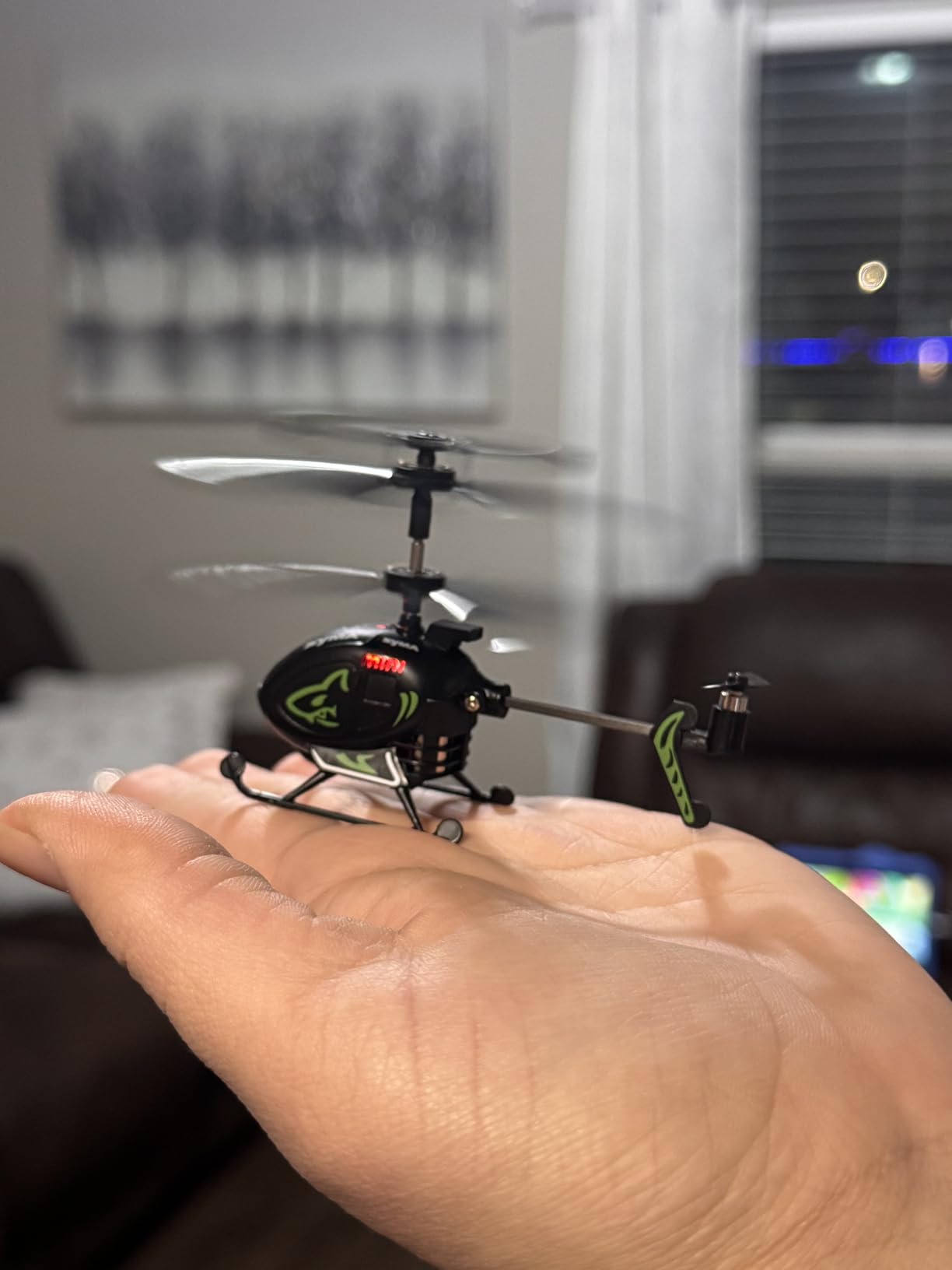
Feature-wise it is a competent entry trainer rather than a novelty. One-key take-off and landing, altitude hold, and 3.5-channel control covering up and down, forward and back, and left and right turns. The 2.4GHz link supports multiple players, and the PVC body and landing gear are designed to absorb impacts.
Manufacturer recommendation is 8 to 10 years, which fits the tiny indoor envelope this model is built for.
The flight time is the catch, and it is a real one. Five to seven minutes per charge is the shortest useful session of the group, and the pack is small enough that you will watch it closely. A micro airframe is also that much more sensitive to a door opening, so you need genuinely still air to enjoy it.
Can it really fly in a normal bedroom?
Yes, and that is the whole point of this model. A bedroom, a hallway, or a quiet corner of a living room is exactly the space it was designed around. The lower your ceiling, the more you will enjoy it.
Do not expect performance headroom. Micro size means low power and almost no payload, which is fine indoors and irrelevant if you ever want to try anything outdoors.
What about the battery situation?
Plan around it. At five to seven minutes a pack, you are flying in short bursts, so set a charge routine rather than charging on demand. A dedicated balance charger is worth it even at this level, and we cover the reasoning later in this guide.
5. DEERC DE28 Altitude Hold Helicopter with Two LED Shells
DEERC Remote Control Helicopter, 3.5 CH Altitude Hold RC Helicopters w/Gyro for Beginner, 2 Shells LED Light One Key Take Off/Landing, 2.4GHz Aircraft Indoor Flying Toy for Kids Boys Girls
Metal airframe with flexible blades
Altitude hold
Built-in gyro
One-key takeoff/landing
Pros
- Metal frame and flexible blades rated for dozens of crashes
- Altitude hold and gyro give forgiving stable flight
- One-key takeoff and landing removes the hardest part
- Two LED shells add variety and visibility
Cons
- Indoor flier that only copes outdoors in light wind
- Small airframe is easily blown off course
- Transmitter needs two A batteries
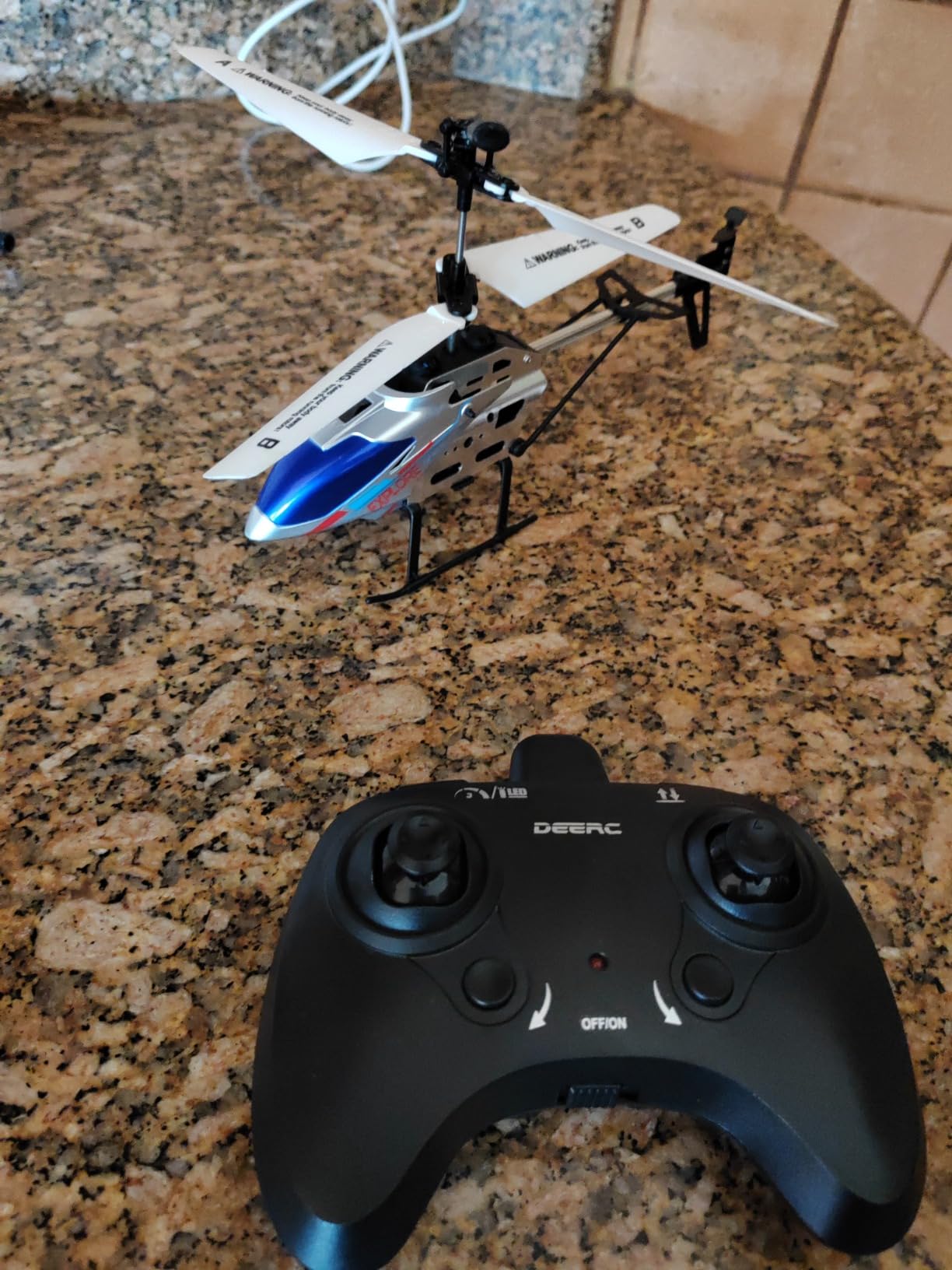
The DE28 shares a 4.3 rating with our top pick, but it arrives with a different advantage: two interchangeable LED shells. Swap the canopy and the same helicopter looks like a different machine, which matters more than it sounds for a child who has flown the same object for a month.
Structurally, the DEERC leads this group on crash tolerance. A metal airframe with flexible ABS blades is specified to take dozens of impacts, and there is no part of the airframe that shatters on contact with a skirting board.
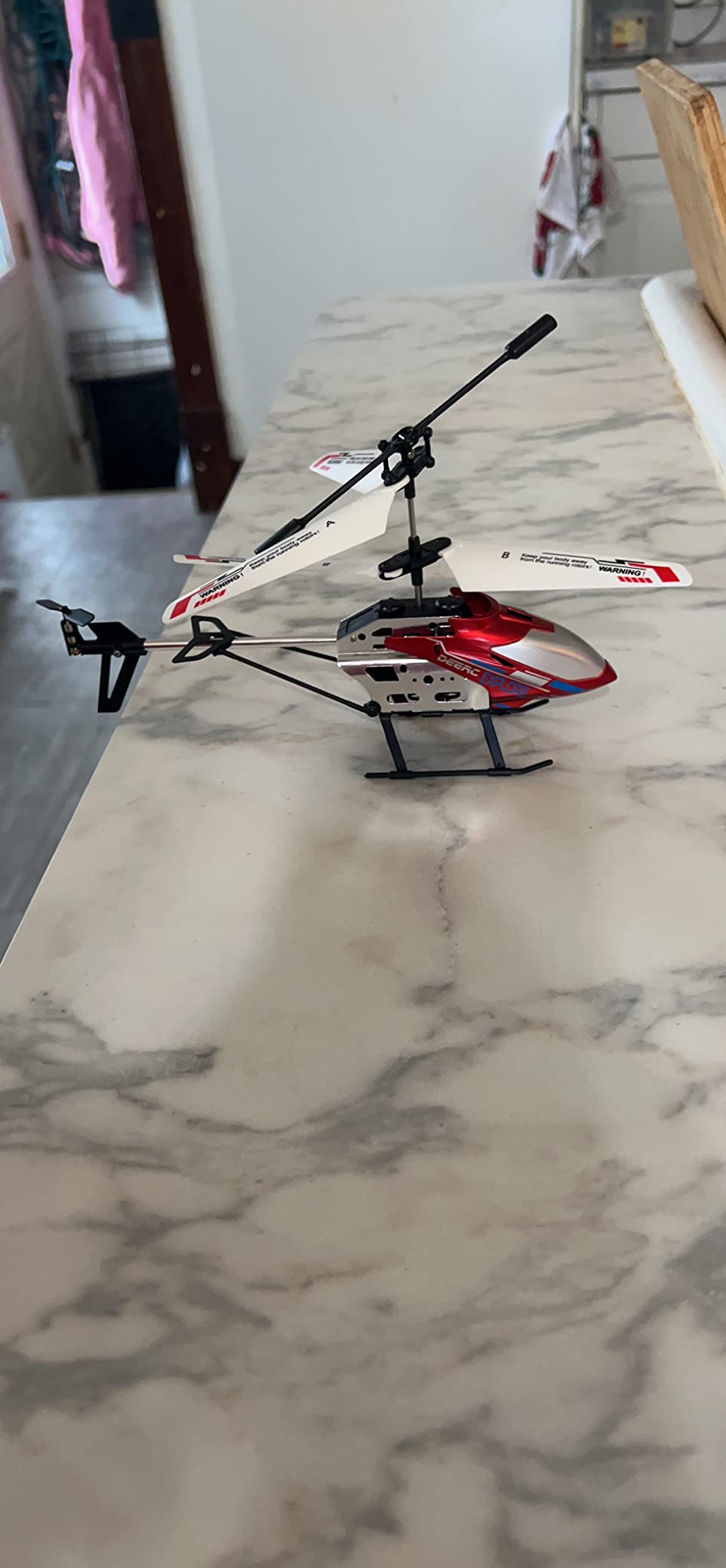
Altitude hold works by air pressure rather than by sensor fusion, and combined with the built-in gyro it gives a steady hover for a beginner. One-key take-off and landing handles the start and finish. The 2.4GHz transmitter has no external antenna, which removes the single most common way a controller gets broken in a household with children.
Dimensions are 7.87 by 6.3 by 2.87 inches and the item weight is listed at 0.15 kg, which makes it one of the more substantial indoor coaxials here. Manufacturer recommendation is 10 years and up.
The limitation is the same one that runs through this entire roundup. It is an indoor flier, it only tolerates outdoor conditions in genuinely light wind, and the small airframe gets pushed off course by air movement in the room.
Which model takes the most punishment?
Among the lightweight plastic-bodied coaxials, this one. The metal frame and flexible blades are the reason its owners report far fewer breakages, and a replaceable-looking canopy means cosmetic damage does not end the fun.
Do not confuse crash tolerance with repairability. The electronic and airframe parts on a model this size are still the hardest thing to find when something breaks, which is a point we return to in the buying guide.
Why no rechargeable pack in the box?
The flight battery is rechargeable; the two A batteries listed are for the transmitter, which needs them and is not included. That is a common point of confusion, so check the box before you order a second set.
6. DEERC Apache RC Helicopter with 26 Minutes of Flight Time
DEERC Apache RC Helicopter, Remote Control Helicopter for Kids & Adults
26 minutes from two USB-C batteries
USB-C charging
Altitude hold
Spare blades included
Pros
- Two USB-C batteries deliver up to 26 minutes of total flight
- Spare main blades
- tail rotor and a screwdriver in the box
- Altitude hold and one-key controls suit young pilots
- LED lights help in dim rooms
Cons
- One owner reported the centre rotor failing to engage
- Another reported body damage despite heavy play
- Light build is easily blown off course
The Apache is the second pick here that solves the charge-time problem, and it does it with the most convenient charging in the group. Two modular batteries charge over USB-C and give up to 26 minutes of total flight, so you swap a pack rather than wait on a wall adapter.
It is also the only model in this roundup that ships with spares. Four spare main blades, two tail rotor blades, and a small screwdriver are in the box, which is precisely the part that is usually missing when a toy helicopter breaks and cannot be repaired.
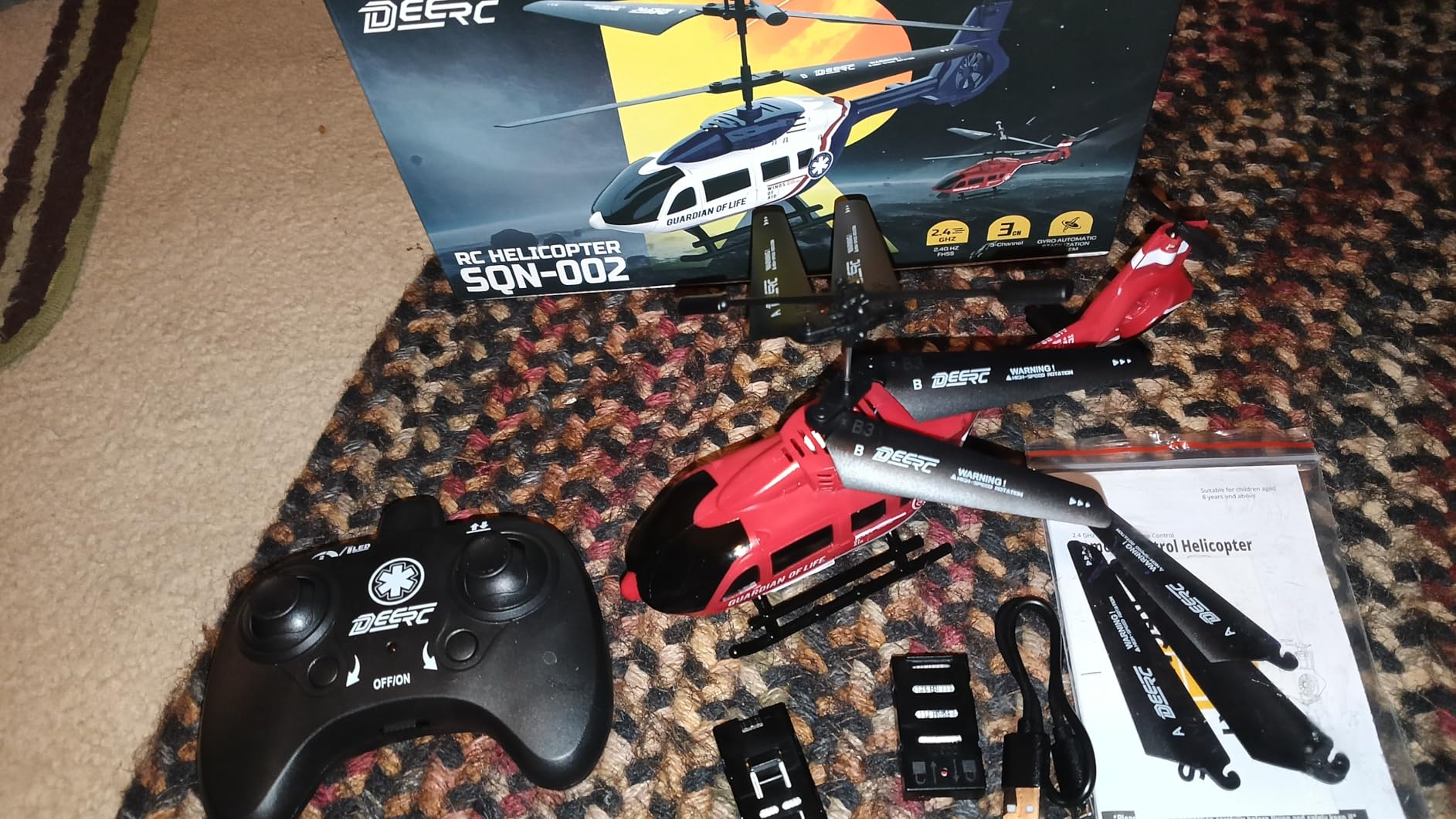
The rest is competent entry-grade flying: altitude hold, one-key take-off and landing, 3.5-channel control with adjustable speed settings, and a 2.4GHz anti-interference system for flying several together. The Apache-style body with LED lights gives it the scale military look that appeals to a lot of first-time buyers.
Reliability is where the reviews are mixed. The most common specific complaint is a centre rotor that fails to engage after a day or so of use, reported by more than one owner. A separate owner reported the body breaking under heavy play, and the lightweight ABS shell is easily blown off course if you take it outside.
For an indoor helicopter that spends most of its life on a carpet, none of that is a serious problem. For a child who crashes constantly on purpose, the spares matter and the shell does not.
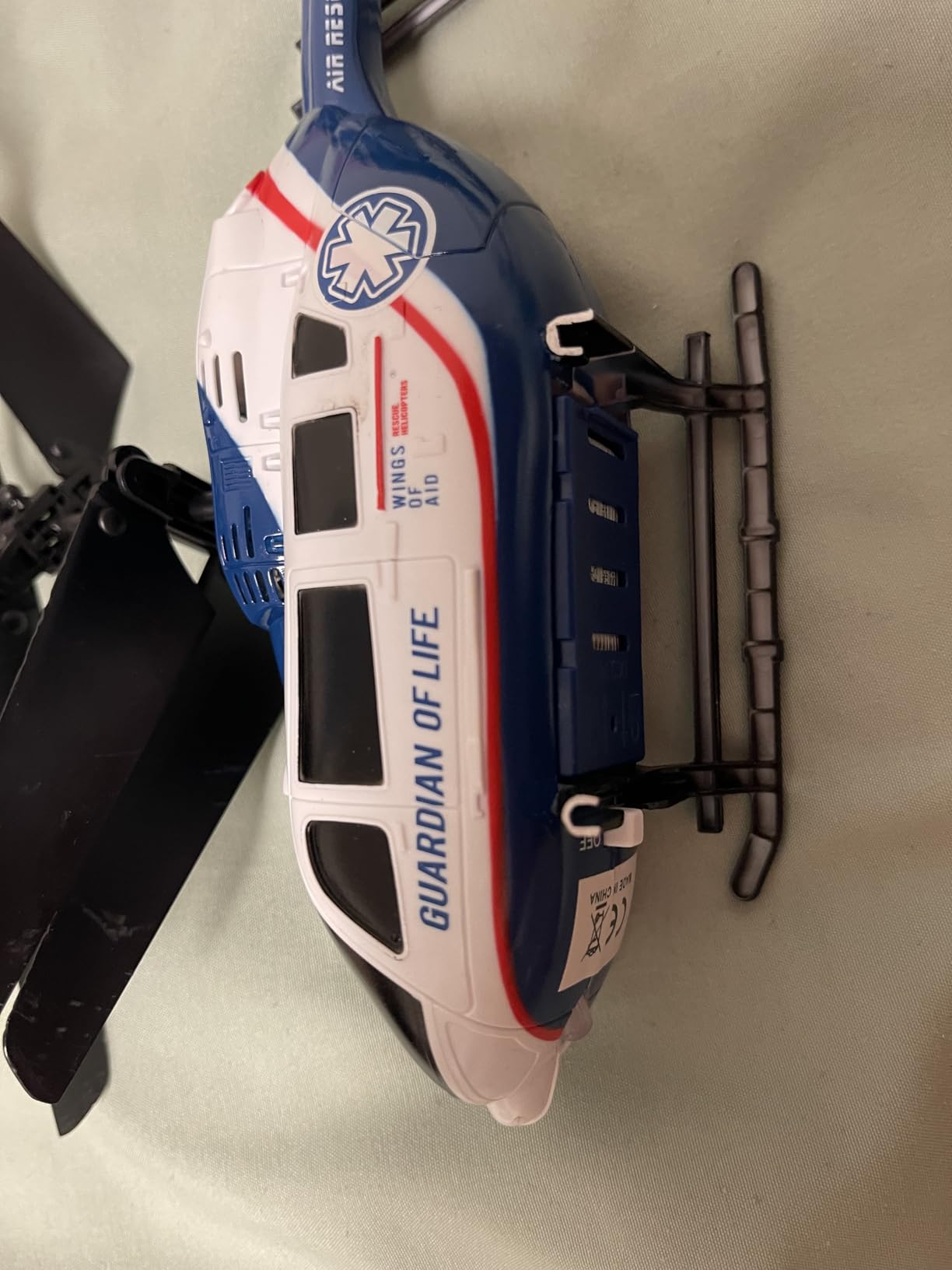
Are the spare blades really useful?
More than you would expect. Rotor blades are the first thing to break on a light coaxial helicopter, they are cheap, and shipping a single spare is rarely an option. A full set in the box is a genuine convenience on a model at this level.
The included screwdriver matters as much as the blades, because the alternative is fishing one out of a draw and scratching a screwdriver head on the airframe.
What should you check on arrival?
Test the centre rotor engagement immediately, before the child is excited and before anyone has flown it hard. That single failure is the most-reported issue and it is easy to confirm in the first minute. Check the shell clips too, since that is the other recurring complaint.
7. GoolRC K127 4-Channel Helicopter with 6-Axis Gyro
GoolRC RC Helicopter, WLtoys XK K127 Remote Control Helicopter, 4 Channel RC Aircraft with 6-Axis Gyro, Altitude Hold, One Key Take Off/Landing, Easy to Fly for Beginners, Include 2 Batteries
4-channel with rudder conversion
6-axis gyro
Altitude hold
Detachable tail motor
Pros
- 4-channel control is the most in this list
- 6-axis gyro and altitude hold make it a genuine trainer
- Reported to survive walls and hard landings without repairs
- Detachable plug tail motor is easy to replace
Cons
- Altitude hold is inconsistent and needs tweaking
- Very light airframe is caught by wind and rotor wash
- Weak manual so watch a video first
- Proprietary batteries and a brushed tail motor
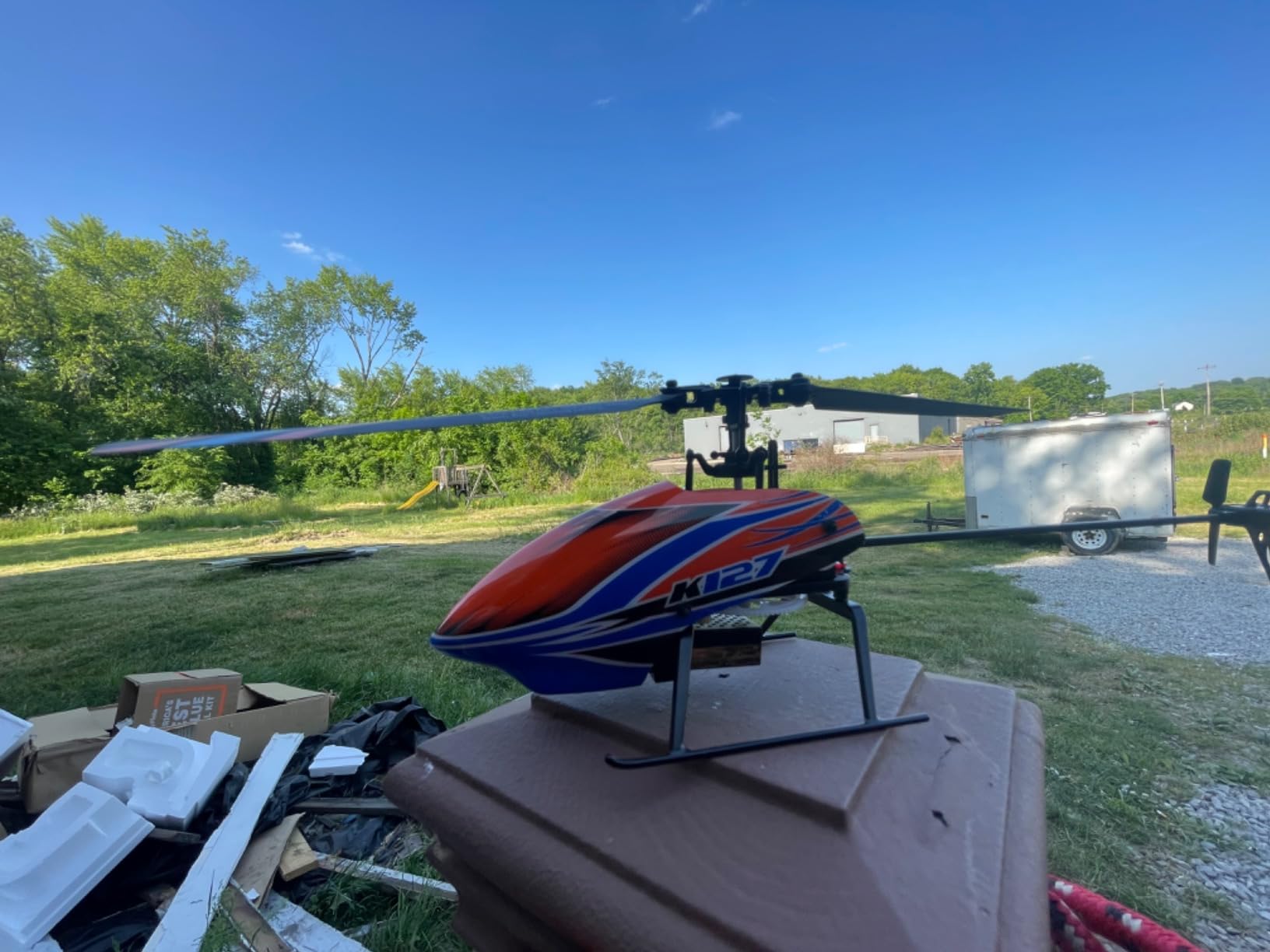
This is the one helicopter in the roundup listed for outdoor use, and the reason is channel count. Every other model here is 3.5-channel, which means throttle, yaw, and forward and back. The K127 adds a fourth channel with rudder capability conversion, and that extra axis is what makes it recoverable when it drifts.
Add a 6-axis gyro, a barometric altitude hold, a hovering midpoint setting, and an 8520 coreless motor running a 3.7V 400mAh 20C pack, and you have the most capable airframe here for a pilot who is already getting the hang of it.
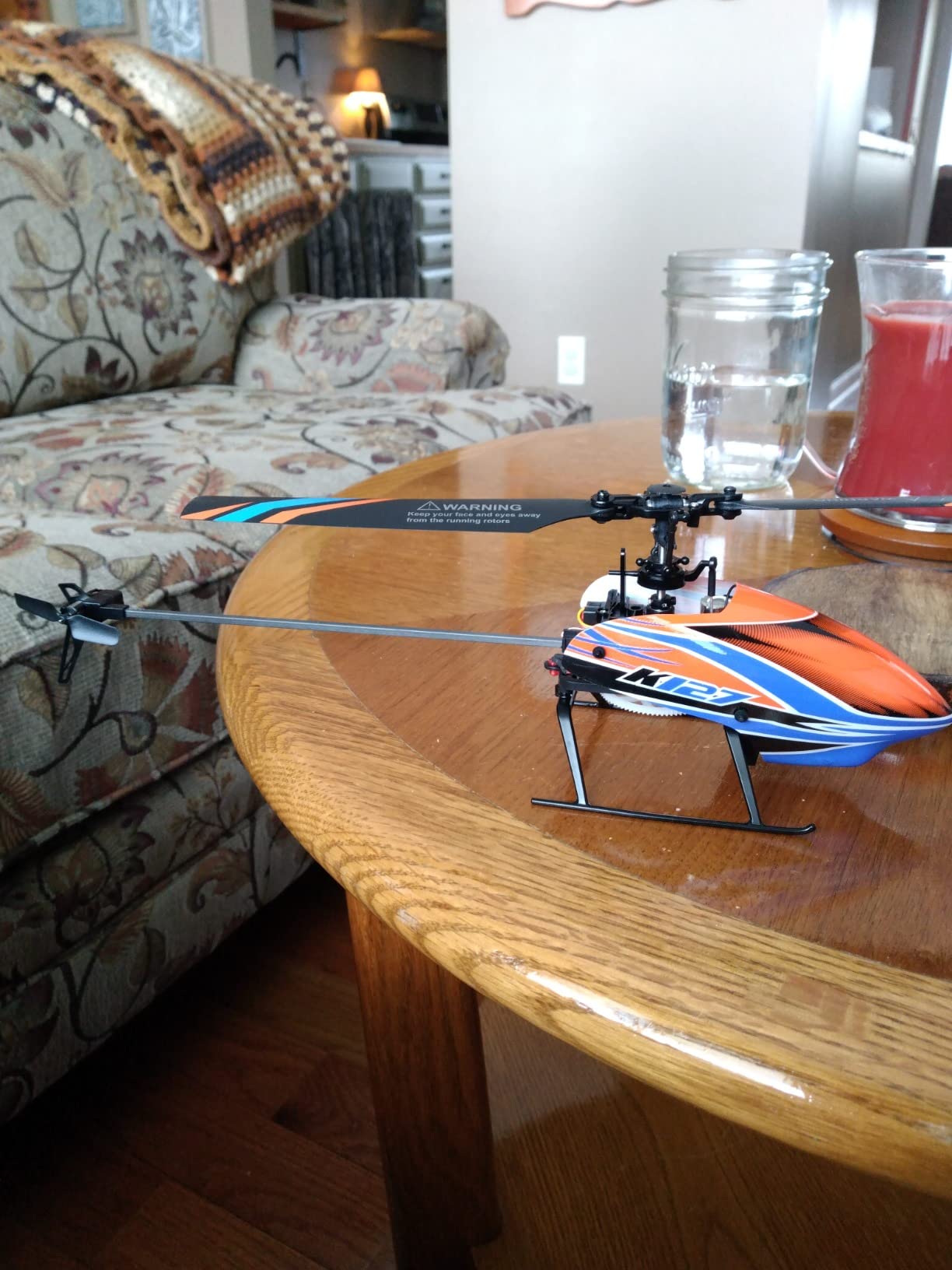
Owners who fly it seriously treat it as a trainer. It is reported to survive contact with walls, trees, bushes, and multiple hard landings without repairs, and the slower yaw rate makes it tamer than earlier models in the same lineage. Reported flight time is around 12 minutes or more.
The detachable plug-in tail motor is a small detail that matters. Tail motors are a common failure point, and on this model you can replace one rather than retire the helicopter.
It also carries the most caveats. Altitude hold is described as inconsistent and needing constant adjustment during a flight. The airframe is very light, so it is caught by wind and by its own rotor wash at low altitude. The manual is weak, and one owner described the throttle taking five to seven seconds to cut the motor on landing.
Is four channels worth learning?
For a beginner, the extra channel is less important than the gyro, and you do not have to use the rudder conversion. What you are really buying is the airframe and the rotor head, which hold up better to being thrown around than anything else in this list.
It is listed for ages 16 and up, which matches how experienced its owners describe it. A small child would get more out of the S107H-E.
Why does a lower rating not rule it out?
Because the rating is based on far fewer reviews than any other pick here, and the recurring complaints are specific and manageable. Inconsistent altitude hold, wind sensitivity, and a poor manual are annoyances you can work around, not defects that end the product.
Proprietary batteries and a brushed tail motor are the real long-term concern, and they are why we would not build a long-term hobby around it.
8. SYMA S108G 3.5 Channel Helicopter with Gyro
Syma S108G 3.5 Channel RC Helicopter with Gyro
3.5-channel with gyro
AH-1 Cobra airframe
Front LED light
LiPo battery
Pros
- Flyable out of the box with almost no tuning
- All-plastic body took 100 crashes with cosmetic damage only
- Chargeable from the remote or a USB source
- Three channels allow three helicopters in the air
Cons
- Roughly 4 to 6 minutes per charge and the pack degrades
- Spring-loaded throttle makes hovering a fight
- Any breeze sends it off course
The S108G is the least electronic helicopter in this roundup and one of the most likeable. There is no altitude hold, no one-key start, no assist of any kind. There is a 3.5-channel radio, a gyro, and a detailed AH-1 Cobra airframe with a bright front LED for night flying.
What it has that most competitors do not is a track record. Owners report putting this airframe through more than a hundred crashes with only cosmetic damage, and the LiPo pack can be charged from the remote or from a USB source, which removes the wall-adapter problem.
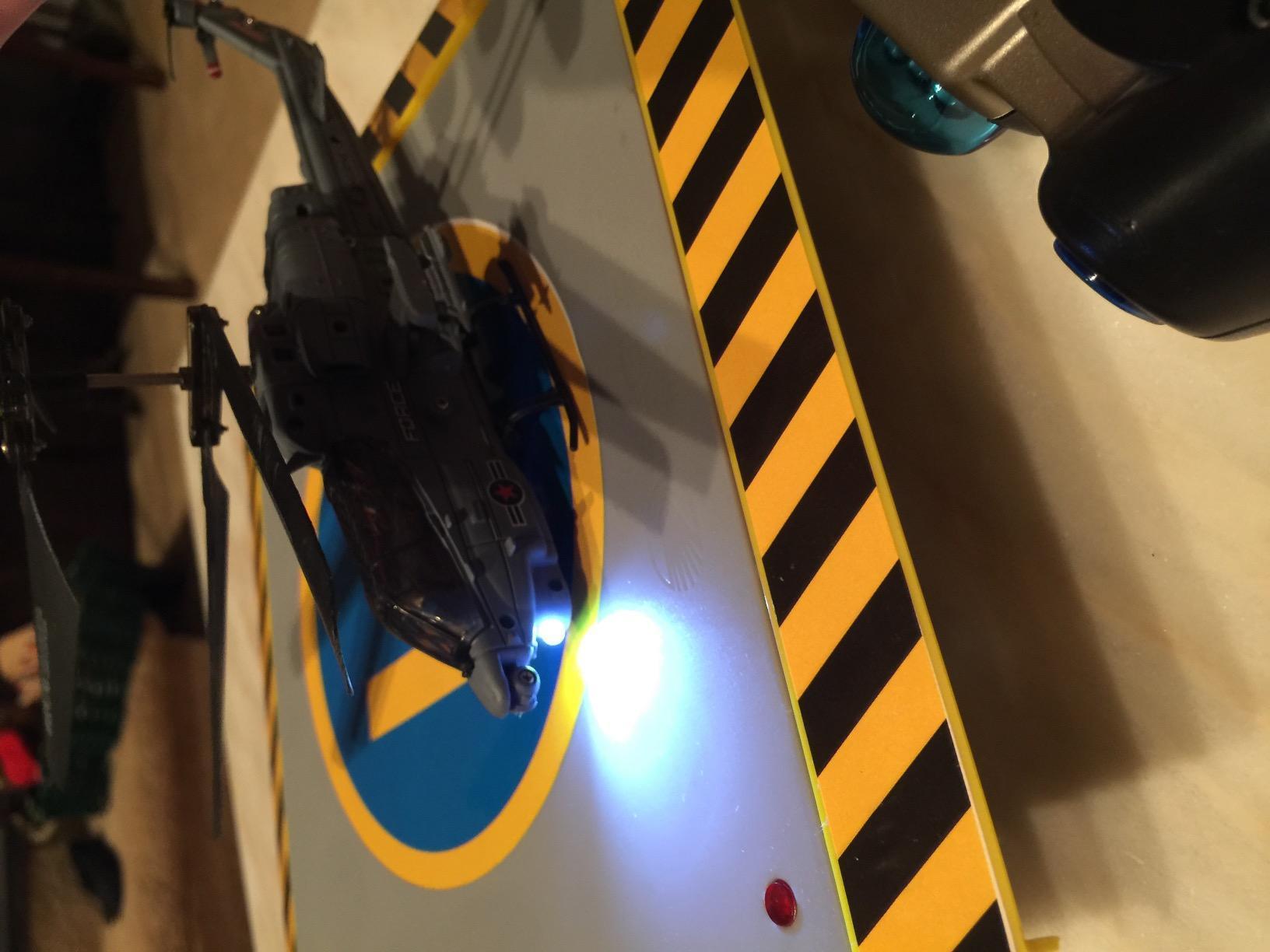
That durability is a real argument. Cheap toy helicopters usually end their lives after a first hard landing because a canopy or a rotor assembly snaps and no replacement exists. This one keeps flying.
It is also a 90 day manufacturer warranty against defects, which is not generous but is at least documented.
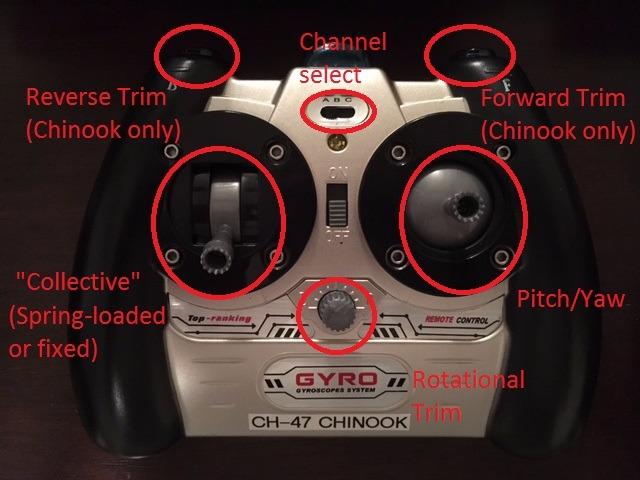
The difficulty is the throttle. The spring-loaded stick makes a steady hover a genuine fight for a new pilot, and there is no altitude hold to rescue a shaky hand. Add a flight time of roughly four to six minutes per charge with a pack that degrades over time, and you are re-learning the same hover every session.
Several owners also report an upper rotor motor or battery failing within days, and one unit would not lift at all. The listing gives an item weight of 1.2 pounds, which is almost certainly wrong for a helicopter this size, so treat the specification block cautiously.
Is a helicopter with no assists still a good first helicopter?
For most people, no. Learning a hover unaided is exactly the frustration that puts people off the hobby. The S108G makes more sense as a second machine, or as a purchase for someone who has already proved they can fly a stabilised one and wants to feel the difference.
It is also the one here that rewards a patient adult. The spring-loaded throttle does not change with practice as much as people hope.
Why choose it anyway?
The Cobra detailing and the front LED are the reasons to buy this specific model. For a scale-model enthusiast or a child who wants a military replica rather than a glowing toy, appearance is a legitimate criterion.
Also credit the crash record. Nothing else at this level has owners reporting a hundred-plus crashes without structural damage.
9. XIKOTEC XK1 Military Helicopter with Dual USB-C Batteries
XIKOTEC RC Helicopter, Remote Control Helicopter Toy for Kids(Green)
Altitude hold and one-key landing
Built-in gyro
Two USB-C batteries, 20 minutes
LED lights
Pros
- Largest and heaviest airframe in this roundup
- Onboard gyro keeps it stable and easy for kids to control
- Two modular USB-C batteries give up to 20 minutes
- Realistic military model with switchable LED lights
Cons
- No charging indicator on the USB-C charger
- One owner reported a model that would not descend on command
- Light enough to be caught by the slightest breeze
- Some models arrived without a manual
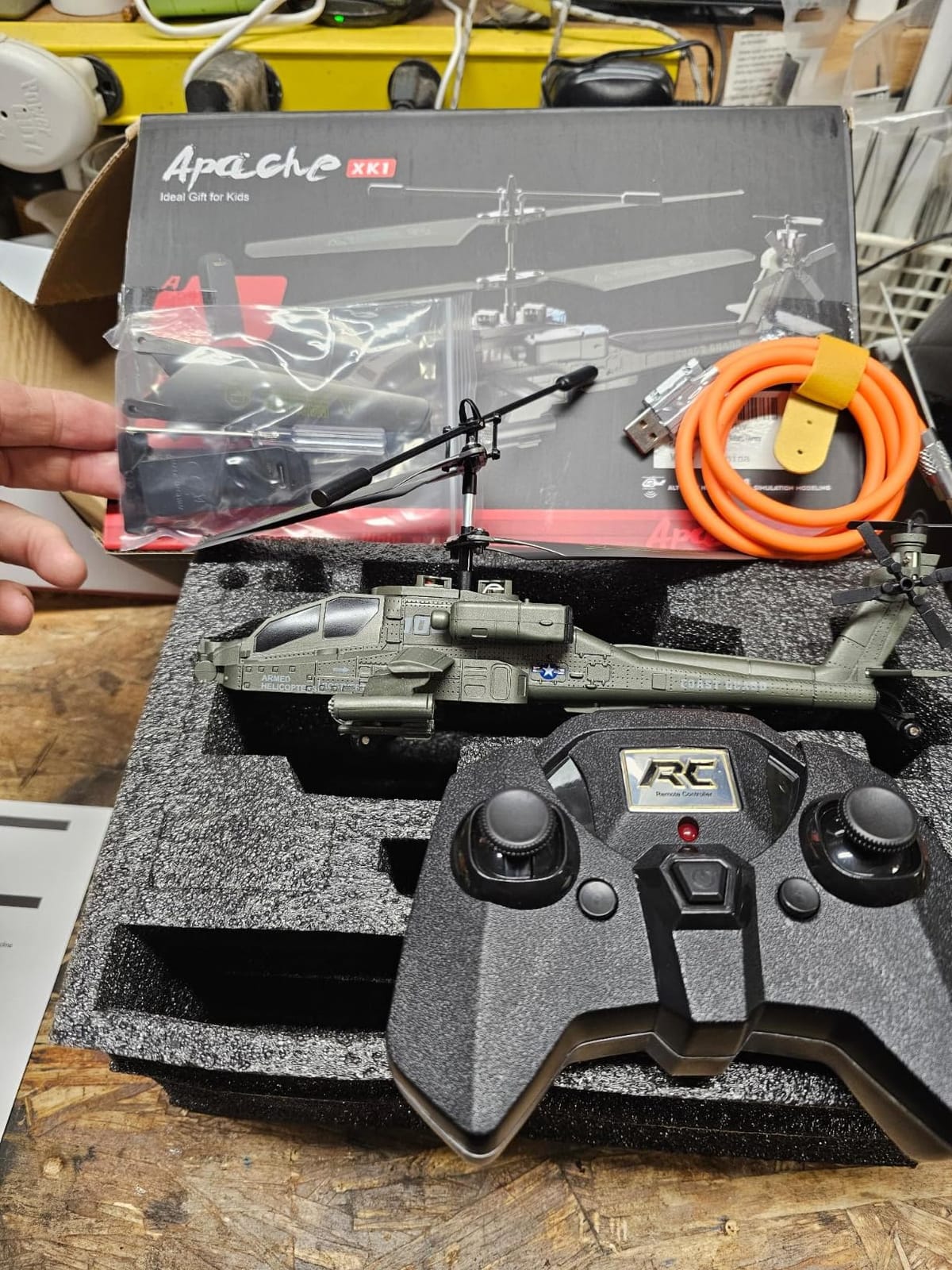
The XK1 is the biggest machine in the roundup, and that is the whole case for it. At 11.22 by 7.4 by 5 inches and 0.92 kg it is a substantial model rather than a desk toy, and a heavier airframe is measurably more stable against the air movement that ruins the smaller coaxials.
That extra mass does not make it a wind-capable helicopter, but it does mean it holds a hover in a room with a ceiling fan on a low setting, which plenty of homes have.
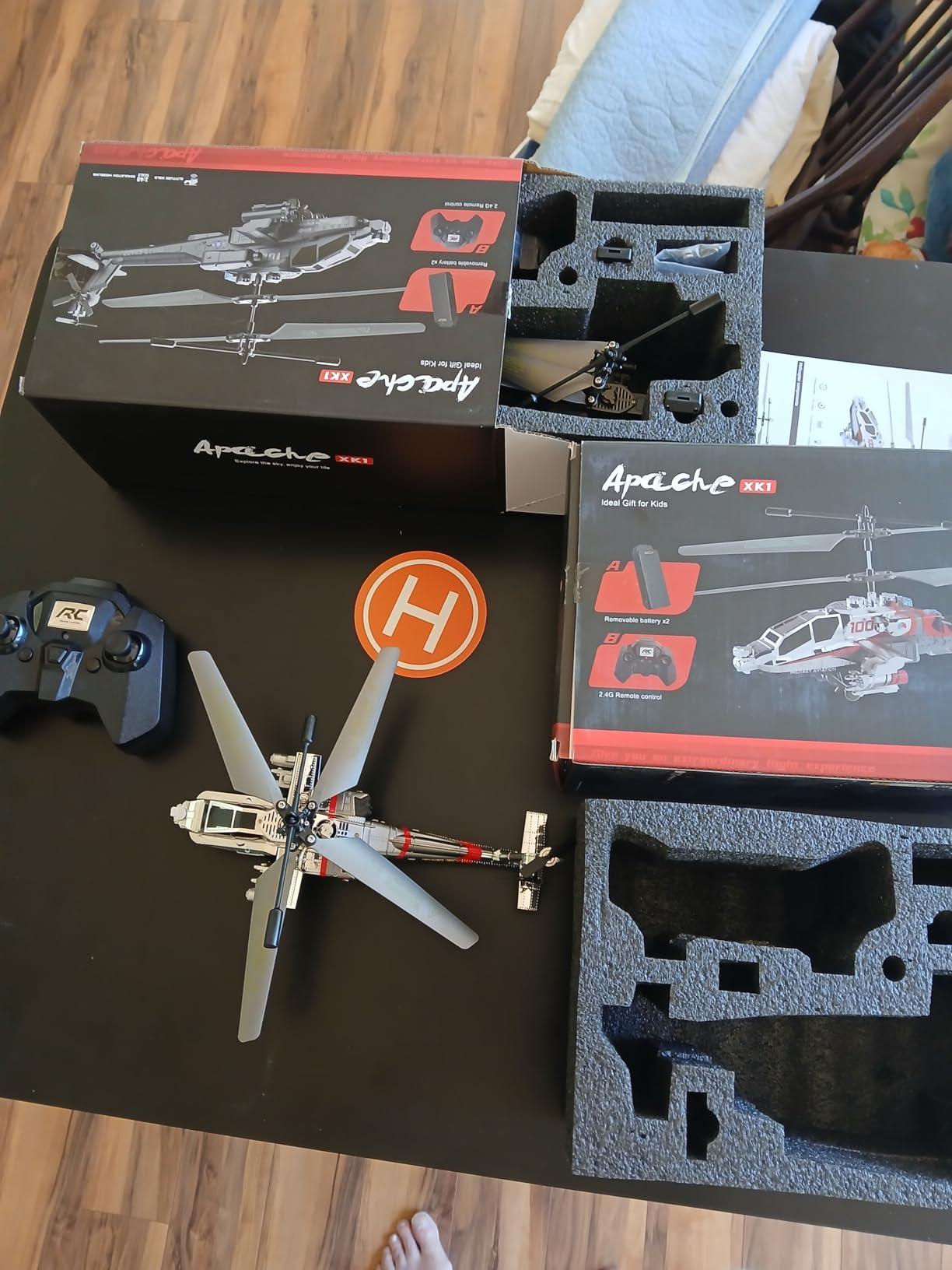
The feature list is complete for the class: altitude hold, one-key take-off and landing, a built-in gyro with 3.5-channel control, two modular USB-C batteries giving up to 20 minutes of flight, 2.4GHz control with a listed range of 50 metres, LED lights switchable from the transmitter, and a low battery alert.
Owners consistently praise the stability and the build, and one reviewer noted the unit arrived well packed and in perfect condition. The military detailing is convincing for the price bracket.
Three issues keep it out of the top three. The USB-C charger has no charging indicator, so you have no way of knowing when a pack is full. One owner reported a model that would not descend on command after a few flights. And several models arrived without a manual, which on a model with trim and speed settings is a genuine problem.
It is listed for indoor use and for ages 8 to 10, with a low battery alert that is worth keeping enabled.
Does size actually improve stability?
Within the toy tier, yes. More mass and a wider frame mean the helicopter resists being pushed around by indoor air currents, and the reviews back that up. It will not fix a fundamental lack of thrust, so it still belongs indoors.
The trade-off is that it needs a bigger clear space. A 11.22-inch helicopter does not hover comfortably in a small bedroom, which is the one thing the S100 does better than anything else here.
What about the missing charging indicator?
It is a genuine annoyance and it is worth working around. Watch the charge time on the first cycle, then judge by temperature and duration rather than by a light. Overcharging small packs is the fastest way to shorten their life.
If a model arrives without a manual, watch a setup video before the first flight. The controls on this class are not guessable.
10. Cheerwing S107G Phantom 3.5 Channel Mini Helicopter
Cheerwing S107/S107G Phantom 3CH 3.5 Channel Mini RC Helicopter with Gyro Blue
3.5-channel control
Two selectable frequencies
Upgraded gyro
Compact indoor size
Pros
- Two selectable frequencies fly two helicopters at once
- Tolerates repeated crashes once trimmed
- Small enough to hover in a normal room
- Helicopter
- remote
- battery and charger in the box
Cons
- No altitude hold so throttle is a constant fight
- Roughly 5 to 8 minutes per charge with a hardwired battery
- Infrared control is indoor only and easily overwhelmed by air-con
The S107G has been in continuous production for years and has accumulated more than 5000 reviews, which makes it the most battle-tested helicopter in this roundup. It is also the simplest, with no altitude hold, no one-key start, and a 3.5-channel radio that gives you throttle, yaw, and forward and back.
Two selectable frequencies means you can fly two of them at the same time without interference, which turns a solo purchase into a two-child activity. That alone justifies it in a lot of households.
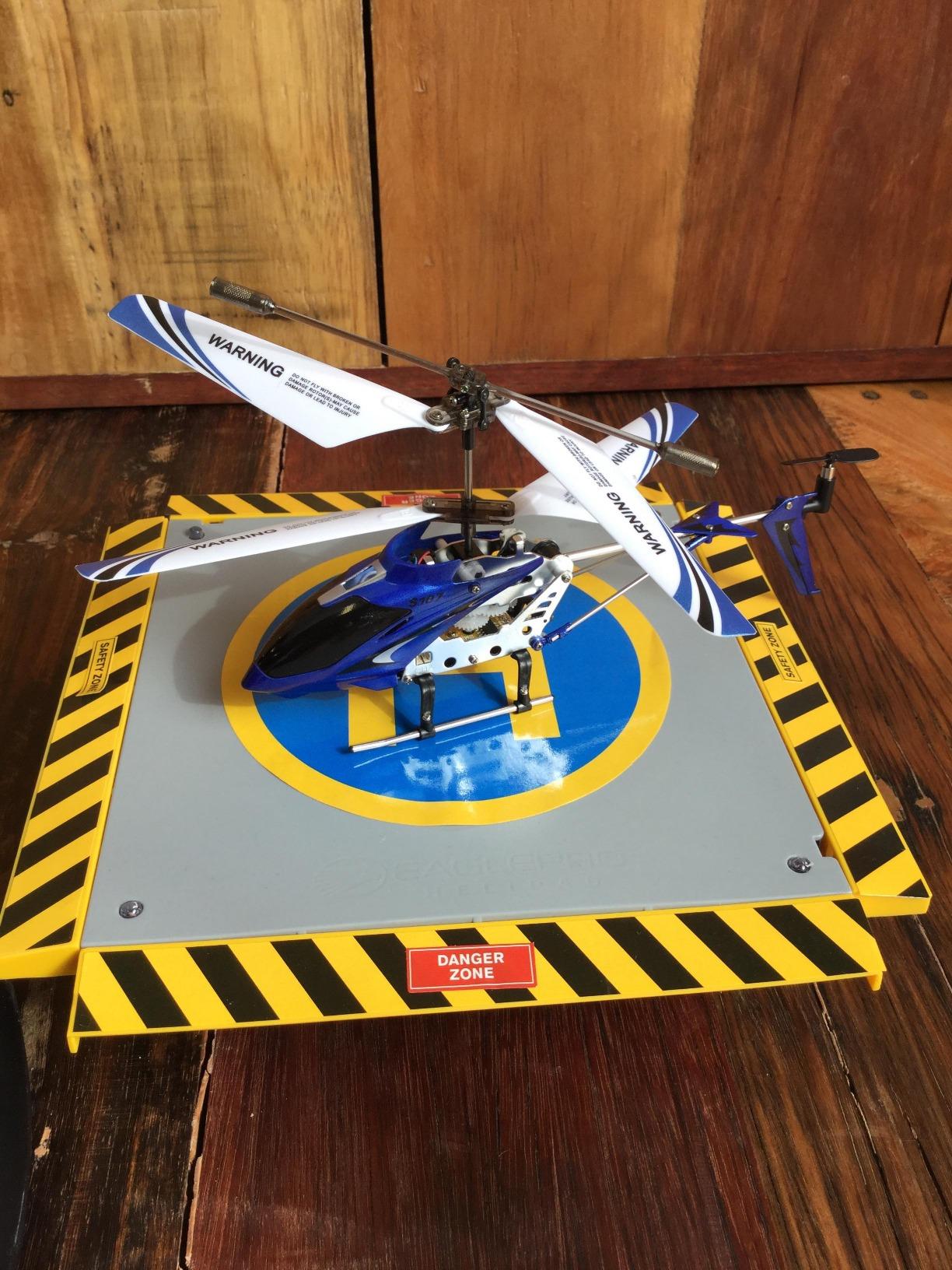
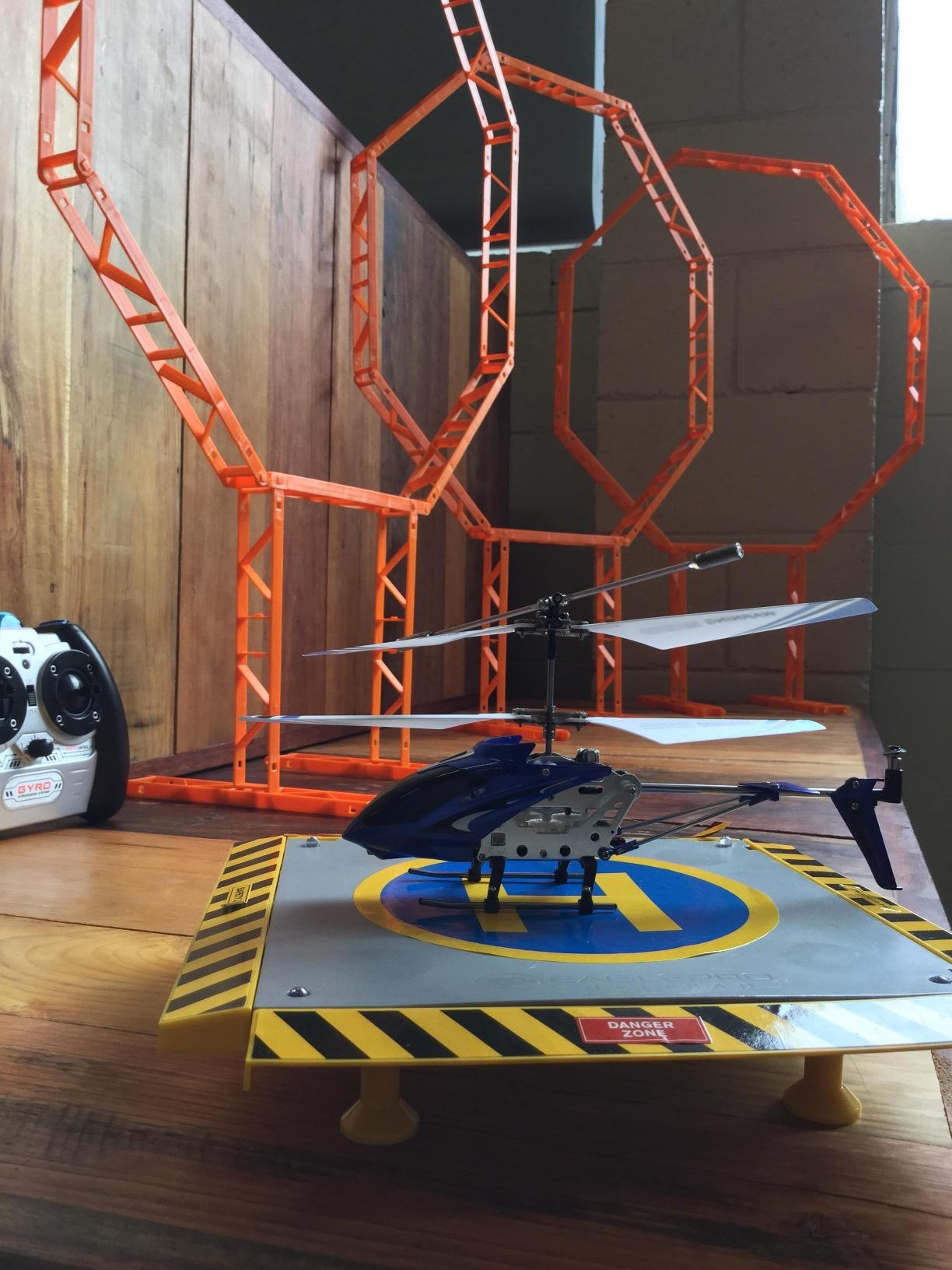
Build quality is better than the price suggests. Owners describe clean construction that tolerates repeated crashes, and once it is trimmed it hovers predictably in a normal room. The supplied package includes the helicopter, two remote controllers, a battery, and a charger.
Dimensions are 16.8 by 2.6 by 6.1 inches with a listed weight of 13.28 ounces, so it is a mid-sized indoor model rather than a micro one.
What makes it hard is the throttle. Without altitude hold you are flying on the throttle stick alone, and reviewers regularly note that compass-style trim correction is needed before every flight. The battery is hardwired, flight time is roughly five to eight minutes, and infrared control means it is indoor only and totally overwhelmed by an air conditioning draught.
Several buyers also report units that would not hold altitude or drifted unpredictably, so check the hover carefully in a large room before letting a child try it alone.
Is the manual hover worth learning?
Yes, and it is the strongest argument for this model. Altitude hold hides throttle control from you. Learning to hold a hover by feel on a machine with no assist is the single most transferable skill in this hobby, and it is why experienced pilots still practise on simple helicopters.
Just do not expect a child under about 10 to enjoy the first few sessions. The reviews are consistent that this is a demanding machine despite the simple spec sheet.
Who should buy it instead of an assisted model?
Buy it if you are an adult, or an older teenager, who wants to build real throttle coordination cheaply. Buy it if you want two helicopters to fly at once, since the dual frequency system is the best in this roundup.
Skip it as a gift for a younger child, and skip it if you want to fly outside at all. Infrared control makes the indoor restriction absolute.
How to Choose a Beginner RC Helicopter
Coaxial, fixed-pitch or collective pitch: the decision that actually matters
Every helicopter in this list uses a coaxial rotor arrangement: two main rotors stacked on the same mast spinning in opposite directions. They cancel each other’s torque, which is why coaxial helicopters hover without a swashplate and why they are so much more stable than a single rotor. That stability is free, and it comes with a ceiling. You will not grow into a hobby-grade machine from here.
A fixed-pitch helicopter uses a single main rotor with blades that cannot change angle in flight. The rotor tilts the whole way to move. This is the next class up, and it is where you start learning how a real helicopter actually controls attitude rather than having the software hold it for you.
Collective pitch is the real helicopter configuration, where the swashplate changes blade angle and the tail rotor controls yaw. This is the class the hobby communities treat as genuine helicopter flying, and it is where the collective-pitch trainers such as the OMP M2, the Goosky S2, and the Blade 230S sit. None of those are in this roundup, and the reason is honest: they need a proper radio system, a real charger, and roughly 20 hours of simulator time before the first flight.
Our advice is simple. If you are buying for a child, stay coaxial. If you are an adult who wants the hobby, skip this roundup and start with a simulator.
Toy grade versus hobby grade, and what it actually means
Toy grade means a plastic airframe, a two or three-function transmitter bundled with the helicopter, a coaxial or single fixed-pitch rotor, and no support for standard radio protocols. That is everything above. Hobby grade means a radio you can grow with, a flybarless rotor head, brushed or brushless motors you can replace, and a parts catalogue that will still exist in two years.
The critical difference is not performance. It is that the hobby-grade transmitter is a standard piece of equipment you keep, while the bundled toy transmitter dies with the helicopter. A pilot who buys two toy-grade helicopters in a year has thrown away two radios.
Second critical difference is parts. We picked up several common complaints about cheaper models arriving with no manual, no spares, and no obvious route to replacement blades. A helicopter with no available blades is not a purchase, it is a paperweight with a rotor on it.
What size should a beginner actually buy?
Match the machine to the space, not to the specification. A palm-sized micro like the SYMA S100 is the only realistic option for a bedroom, a hallway, or a small apartment. A mid-size coaxial around 8 to 9 inches needs a clear living room. A large indoor model such as the XIKOTEC XK1 at 11.22 inches needs a room you can genuinely clear.
For outdoor flying, nothing in this roundup is the right answer. Lightweight coaxials are uncontrollable in anything beyond still air, and no amount of altitude hold fixes a helicopter that has less thrust than the wind pushing it. If you want to fly outside, you are looking at a different product category entirely.
Indoor versus outdoor, and how much wind is too much
Beginner helicopters are indoor machines. The two limits people hit are wind outside and air currents inside, and the second catches more beginners than they expect. A ceiling fan on a low setting, an open window in summer, and a heating vent are all enough to carry a 1.44-ounce helicopter into a wall.
House rules that make indoor flying pleasant: turn off ceiling fans, close the door to the room, keep a clear landing area on a soft surface, and keep the flight away from televisions, lamps, and ceiling lights. Our RC telemetry and monitoring guide covers the less common failure signals worth knowing about.
For a first outdoor experience, wait for a still evening with no wind at all, and stay in a wide open space away from people and power lines. Even then, expect the helicopter to be a passenger on the weather.
Battery and charge economics, normalised
Flight time per battery across this roundup runs from about four minutes on the S108G to 17 minutes per pack on the BUSSGO X11C. The dual-battery models are the practical winners: the X11C gives roughly 30 minutes combined, the DEERC Apache 26 minutes, and the XIKOTEC XK1 up to 20 minutes. The single-pack designs mean you spend more time on the charger than in the air.
Charge rates are the other half of this. The USB chargers that ship with these helicopters vary in quality, and the specific complaint that appears across reviews is the absence of a charging indicator, which means you are guessing when a pack is done. Guessing wrong means overcharging, and overcharging is what kills small LiPo packs.
Two rules will protect your batteries. Charge at 1C, which means a 1000mAh pack at 1A, and never leave a finished pack plugged in or sitting on the charger overnight. For a proper charger that handles balance charging and storage mode, see our guide to the best RC LiPo battery chargers, with a higher-budget option covered in the RC LiPo charger picks for larger packs.
Store packs at around half charge rather than empty or full, in a fireproof container, at room temperature. Repairing small electronics is a separate skill, and a decent soldering iron turns a dead tail motor from a write-off into a five-minute fix.
Before You Buy: Simulators, Transmitters and Chargers
Do the simulator hours first, if you want a real hobby
This is the single most repeated instruction in the helicopter communities and it appears in none of the ranking roundups we studied. If your goal is to learn to fly a helicopter rather than to hover a toy, spend 20 hours in a simulator before you buy anything.
The reasoning is simple. A helicopter has one rotor, and small collective inputs produce large attitude changes. That is a skill you can build on a keyboard with unlimited crashes, and it is nearly impossible to build while breaking a real machine. Simulators such as AccuRC, RealFlight, Phoenix, and Heli-X model a helicopter with far more fidelity than any toy in this roundup.
Our suggested order is simulator, then a helicopter that matches the simulator’s controls, then the radio. Doing it the other way round is how people end up owning four damaged helicopters and no skill.
Do not plan around the bundled transmitter
Every helicopter in this roundup includes a transmitter designed for that one helicopter. Pilots with thousands of flight hours describe those bundled radios as one of the weakest parts of any ready-to-fly kit, and the pattern repeats at the hobby grade too, where the stock mode-2 radio is the first thing a new pilot replaces.
The fix is a standard multi-protocol radio that supports both the toy band and the hobby protocols. One radio then runs everything you own, and it is the only piece of equipment you carry from your first helicopter to your fifth. Check that the protocol list includes the band your helicopter uses before you commit.
Charge properly, or buy a new battery
Small LiPo packs from toy helicopters are among the most abused batteries in the hobby, almost entirely because the bundled charger offers no feedback. A balance charger with a storage mode removes the whole category of mistake for a modest outlay, and it also lets you buy better packs later.
Never leave a pack charging unattended, never charge a swollen or damaged pack, and never charge below freezing. If a pack puffs, move it outside to a non-combustible surface and let it sit. These are small batteries, but they are still lithium metal and they deserve the same respect.
Frequently Asked Questions
What is the best entry-level RC helicopter for beginners?
The SYMA S107H-E is the best entry-level RC helicopter for beginners. Its alloy body survives rough landings, one-key takeoff and landing removes the hardest part of a first flight, and altitude hold with a built-in gyroscope keeps the hover steady. Dual speed modes let a new pilot start slow. It draws on thousands of owner reviews describing the same stable, forgiving behaviour.
What is the best helicopter for a child buying their first one?
For a child aged eight and up, the SYMA S107H-E is the safest all-round choice because the alloy frame tolerates hard landings. If your child is easily frustrated, pick the BUSSGO X11C instead, since two batteries give roughly 30 minutes of combined flight and the LED modes keep the sessions interesting. For a small bedroom with no open floor space, the palm-sized SYMA S100 is the only realistic option.
What is the best indoor RC helicopter for beginners?
The SYMA S100 is the best indoor choice for tight spaces at just over 4 inches long, and the SYMA S107H-E is the best indoor choice for a normal living room. Whichever you pick, turn off ceiling fans and close the room. A draught from air conditioning or an open window will carry a light coaxial into a wall regardless of how well you fly it.
Can RC helicopters be flown outdoors?
Only the GoolRC K127 in this roundup is listed for outdoor use, and even that is marginal. Lightweight toy helicopters have very little thrust margin, so any breeze takes control away from the pilot. If outdoor flying is your main goal, look at a larger hobby-grade machine with a brushless motor and a real radio system rather than a toy coaxial.
Are RC helicopters hard to fly?
With altitude hold and one-key takeoff, a beginner can usually achieve a stable hover in the first session. Without those assists, hovering takes practice, and models like the Cheerwing S107G and SYMA S108G demand constant throttle correction. The hard part is never takeoff. It is holding a steady hover while also learning which stick movement does what.
How long do RC helicopter batteries last?
Flight time per battery ranges from about four to six minutes on the SYMA S108G to 15 to 17 minutes per pack on the BUSSGO X11C. Dual-battery models deliver roughly 20 to 34 minutes combined. Pack lifespan depends far more on charging than on flying: charge at 1C, use a balance charger, and store packs at around half charge.
What size RC helicopter is best for beginners?
Match the size to the room. A palm-sized micro around 4 inches long is the only option for a bedroom or small apartment. A mid-size coaxial of 8 to 9 inches needs a clear living room. Larger indoor models around 11 inches are more stable against air currents but need a genuinely clear space and still belong indoors.
Do I need a simulator to learn RC helicopters?
If you want to learn real helicopter flying rather than hover a toy, yes. Around 20 hours in a simulator such as AccuRC, RealFlight, Phoenix, or Heli-X teaches collective-pitch control without breaking hardware. Simulators cost far less than one damaged hobby-grade helicopter, and the communities treat the simulator step as non-negotiable before a collective-pitch trainer.
The Verdict: Best RC Helicopters for Beginners in 2026
The SYMA S107H-E is the best RC helicopter for beginners in 2026 because it combines an alloy frame that survives real handling with the assist features that make a first hover achievable, and thousands of reviews describing exactly that behaviour. Buy it for a child, and buy it for an adult who wants to understand hovering before going near a collective-pitch trainer.
Choose the BUSSGO X11C when the session length matters more than the frame, the Cheerwing U12S when a camera will hook a beginner in, and the SYMA S100 when the flying space is a bedroom. The Cheerwing S107G is the pick for an adult who wants to learn throttle control the hard way, on purpose.
And if your ambition goes past hovering, skip all of them: open a simulator, put in the hours, and buy a hobby-grade trainer with a radio you will keep for the next decade. That is a far better first year than any of the ten helicopters above.