
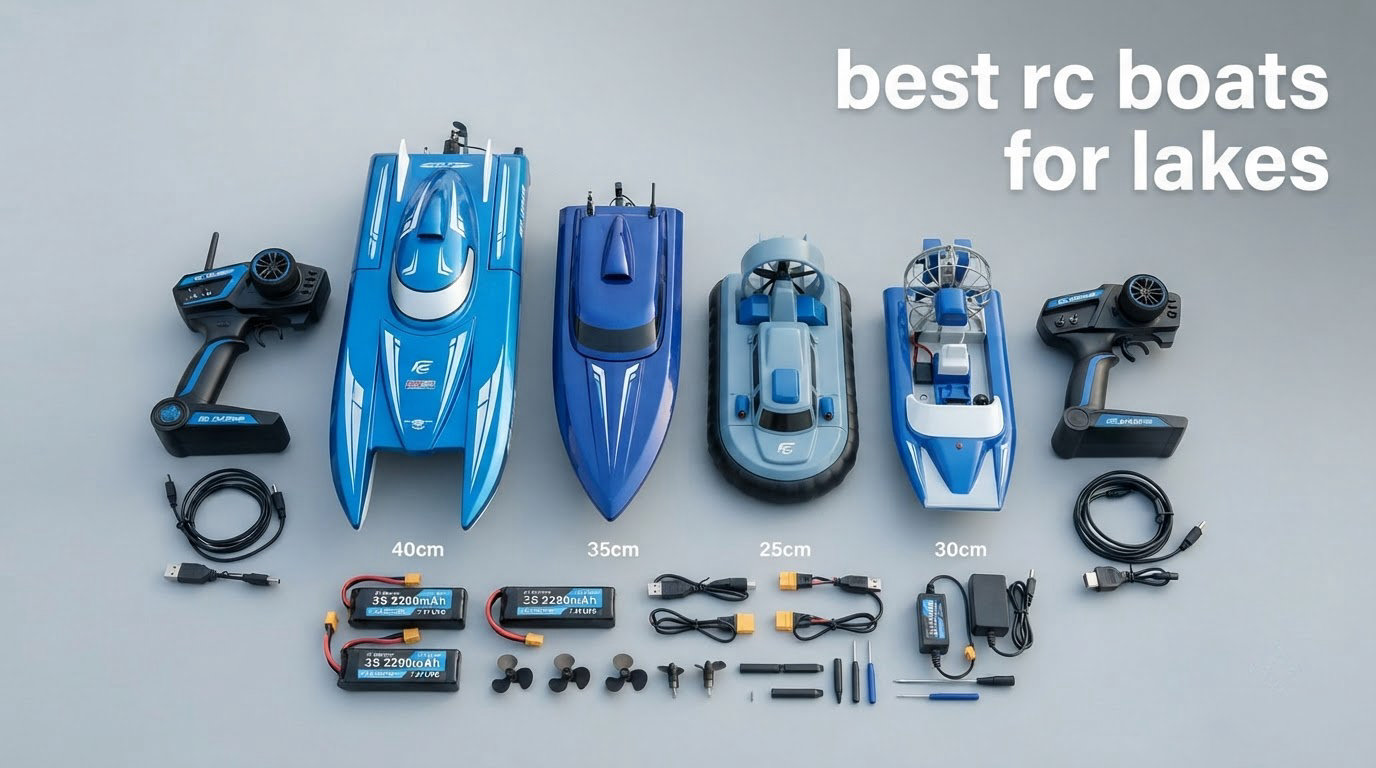
Short answer: the best RC boat for a lake is a self-righting hull of roughly 18 inches or longer, powered by a brushless motor with a water-cooled ESC and a 2.4GHz radio giving you at least 300 feet of control range. Small pool boats look cheap next to a 25-inch racer, but wind-driven chop flips them and they drift past your reach. Four specs decide everything here: hull length, self-righting, motor type and control range.
That is the whole problem with buying an RC boat for a lake. Almost every listing you will see mixes swimming pool toys with 30-inch offshore racers under one label, and most of them never mention what size water the boat is actually safe on. A 12-inch hull is fun for an afternoon on a sheltered pond and genuinely frustrating on a wide lake when a gust puts a metre of wind chop across the surface and your boat is suddenly 150 feet away, bow-up, going sideways.
Our team put the eight boats in this roundup side by side and sorted them by what matters on open freshwater. We looked at hull length, how the self-righting system actually works, motor and ESC cooling, advertised control range, battery count and the real complaints owners report after a season of use. Everything below is a boat you can buy today and run on freshwater, with the honest limitation of each one spelled out.
We also mapped water conditions to hull length, which almost no roundup does, and covered the retrieval question that decides whether a lake boat is a good idea at all. If you are comparing full-size watercraft for the same outing, our guides to the best aluminum fishing boats for lakes and the best inflatable paddle boards for lakes cover the human-sized end of the spectrum.
Table of Contents
Top 3 Picks for the Best RC Boats for Lakes (October 2026)

Cheerwing UDI022 25-Inch Brushless
- 25-inch self-righting racing hull
- Brushless water-cooled motor
- 2.4GHz marine radio

BEZGAR TX123 14-Inch Tumbler Hull
- 180-degree capsize recovery
- Two 1200mAh batteries included
- 300 ft control range

BEZGAR TX126 12-Inch RC Boat
- 400 ft control range
- Double-layer waterproofing
- Motor water cooling
Best RC Boats for Lakes in 2026: Quick Overview
All eight boats below ship with a rechargeable battery and a charger or charging cable, and all are freshwater models. The last column of the table is the water each hull is genuinely suited to, which is the spec most listings leave out entirely.
| Product | Specifications | Action |
|---|---|---|
| Cheerwing UDI022 25-Inch Brushless |
|
Check Latest Price |
| BEZGAR TX123 14-Inch Tumbler Hull |
|
Check Latest Price |
| BEZGAR TX126 12-Inch RC Boat |
|
Check Latest Price |
 DEERC 14-Inch High Speed RC Boat DEERC 14-Inch High Speed RC Boat |
|
Check Latest Price |
 DEERC H120 20+ MPH RC Boat DEERC H120 20+ MPH RC Boat |
|
Check Latest Price |
 DEERC Shark Racing RC Boat DEERC Shark Racing RC Boat |
|
Check Latest Price |
 Force1 Velocity Green RC Boat Force1 Velocity Green RC Boat |
|
Check Latest Price |
 Akargol LED RC Boat Akargol LED RC Boat |
|
Check Latest Price |
1. Cheerwing UDI022 25-Inch Brushless RC Boat – Best Overall for Lakes
25″ Brushless RC Boat for Adults, 30+MPH Fast Remote Control Boat for Lakes
25 inch self-righting hull
KV1800 brushless water-cooled motor
Machined aluminum rudder
Pros
- Genuinely large 25-inch racing hull built for open water
- Brushless water-cooled motor rated for sustained high-speed running
- Self-righting hull with double covers to limit water ingress
- Machined aluminum rudder
- support
- drive strut and dual trim tabs
- 2.4GHz marine radio supports multi-boat synchronous racing
Cons
- 10 percent of ratings are one-star
- mostly motor and electronics reliability over time
- 25-inch size is harder for younger or first-time users to handle
- Heavy to carry from a car to a shoreline alone
This is the only hull in the roundup sized for genuinely open freshwater. At 25 inches with a self-righting monohull layout, it is a different category of object from the 12-inch pool boats most people arrive with, and the difference is obvious the first time wind chop comes across the launch area.
The powerplant is a KV1800 brushless motor with automatic water flow directed against the casing, feeding a marine ESC with an integrated water-cooling heat sink. The ESC carries low-voltage detection, thermal overload, voltage overload, locked-rotor and throttle-neutral protection, which is a long list of things that stop a cheap controller from dying on a long run. Advertised top speed is 30 MPH, or about 50 km/h.
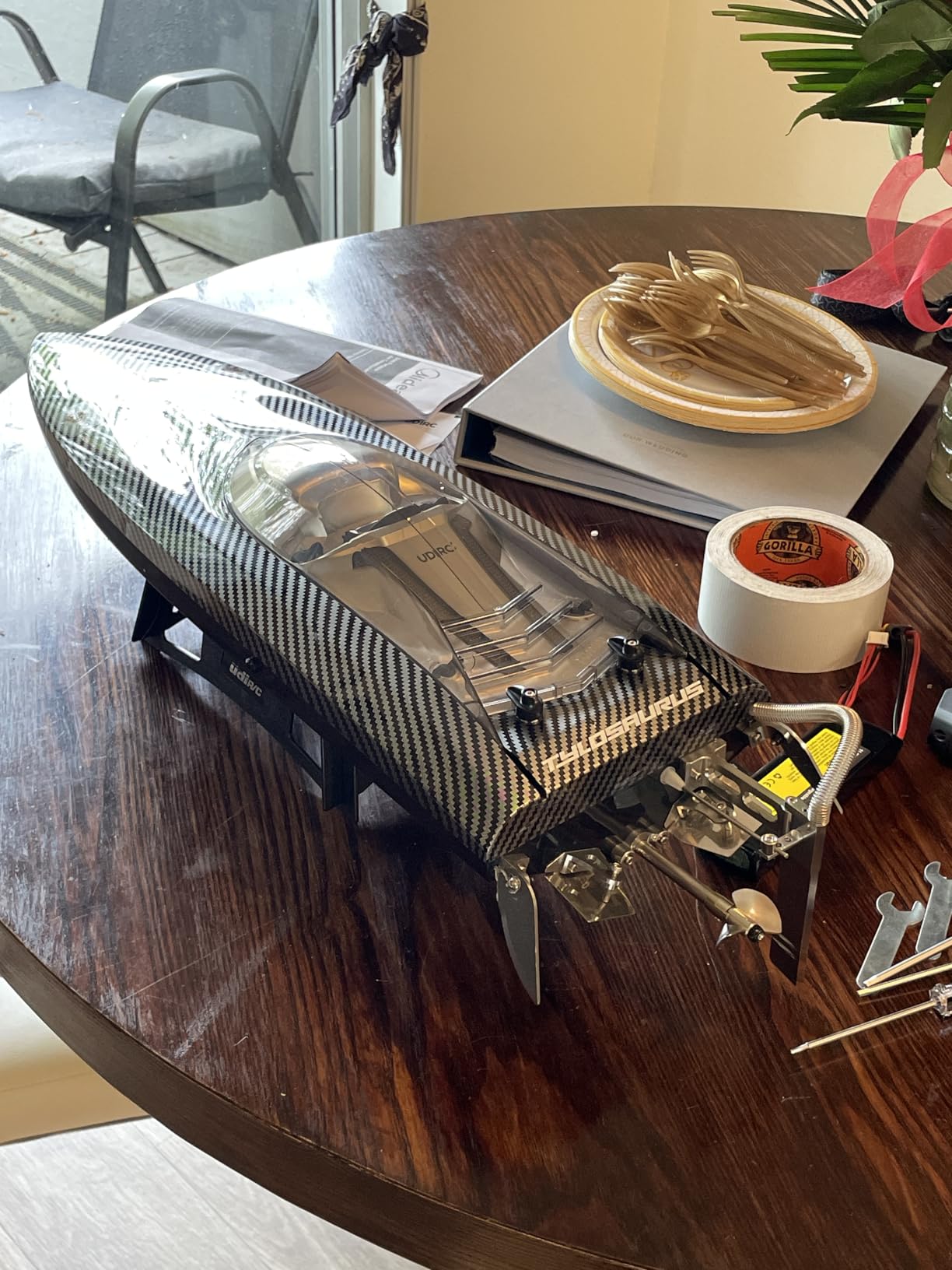
Hardware is where this boat separates itself from the toy tier. You get an extruded and machined aluminum rudder, a rudder support, dual trim tabs, turn fins and a drive strut, and those parts are the ones that take the punishment when the boat meets a wake at an angle. The hull carries double covers to slow water ingress if it does go over.
Weighing 2.7 pounds, it is the heaviest boat in this group and needs a two-handed carry from the vehicle. Owners rate the handling as sharp and the turning as confident, and the 819-rating average holds at 4.2 stars.
The honest caveat is the long tail in the ratings. Ten percent of reviews are one-star, and those complaints cluster around motor and electronics reliability developing over time rather than anything about day-to-day running. If you want a boat that keeps its electronics dry through a full season of heavy use rather than a season or two, weigh that before settling.
Why this one works on a big lake
Twenty-five inches of hull pushes bow-up through chop instead of planing flat and burying the nose, and the self-righting behaviour means a flip costs you seconds rather than the rest of the session. Double trim tabs help the rudder bite at speed, which is what keeps the boat tracking straight when crosswind pushes it sideways.
Owners on this model consistently describe it as capable on open water where smaller hulls get swamped, and the self-righting is the feature they mention first.
Where it falls short
The size cuts both ways. A 2.7-pound boat with a fast brushless motor is a lot of energy for a younger driver, and the speed needs a shoreline with clearance behind it. Plan your first runs on a wide stretch of water with a soft bank, not a crowded ramp.
If your lake is a small sheltered pond, this boat is more machine than you need. For a kid’s first session a smaller hull with training-style speed limiting is a better match.
2. BEZGAR TX123 14-Inch RC Boat – Best Value Tumbler Hull
BEZGAR TX123 Remote Control Boats – Fast Speed RC Boat 32+ KPH with Suitcase for Lakes & Pools & Salt Water
Tumbler hull with 180-degree capsize recovery
Two 1200mAh batteries, 40 min run
300 ft range
Pros
- Highest average rating in this roundup at 4.5 stars
- 180-degree capsize recovery keeps the boat upright in waves and wind
- Two 1200mAh batteries deliver up to 40 minutes of combined run time
- Only boat here rated for salt water as well as lakes and pools
- 300 ft two-player 2.4GHz range for racing with a friend
- Hard suitcase makes transport to a lake straightforward
Cons
- 14-inch hull is smaller than the large racing options in this roundup
- Plastic construction is lighter duty than boats with metal hardware
The TX123 is the boat we recommend to anyone who wants a first lake session without a steep learning curve. Its tumbler hull design gives 180-degree capsize recovery, so when the boat goes over on a wave it rotates back upright on its own rather than lying there filling with water.
At 14.16 inches it is not a big boat, but two 1200mAh batteries give up to 40 minutes of combined run time, which is longer than most rivals manage. A low-power audible beep on the transmitter acts as a return-to-shore reminder, and bright LED lighting makes evening runs possible.
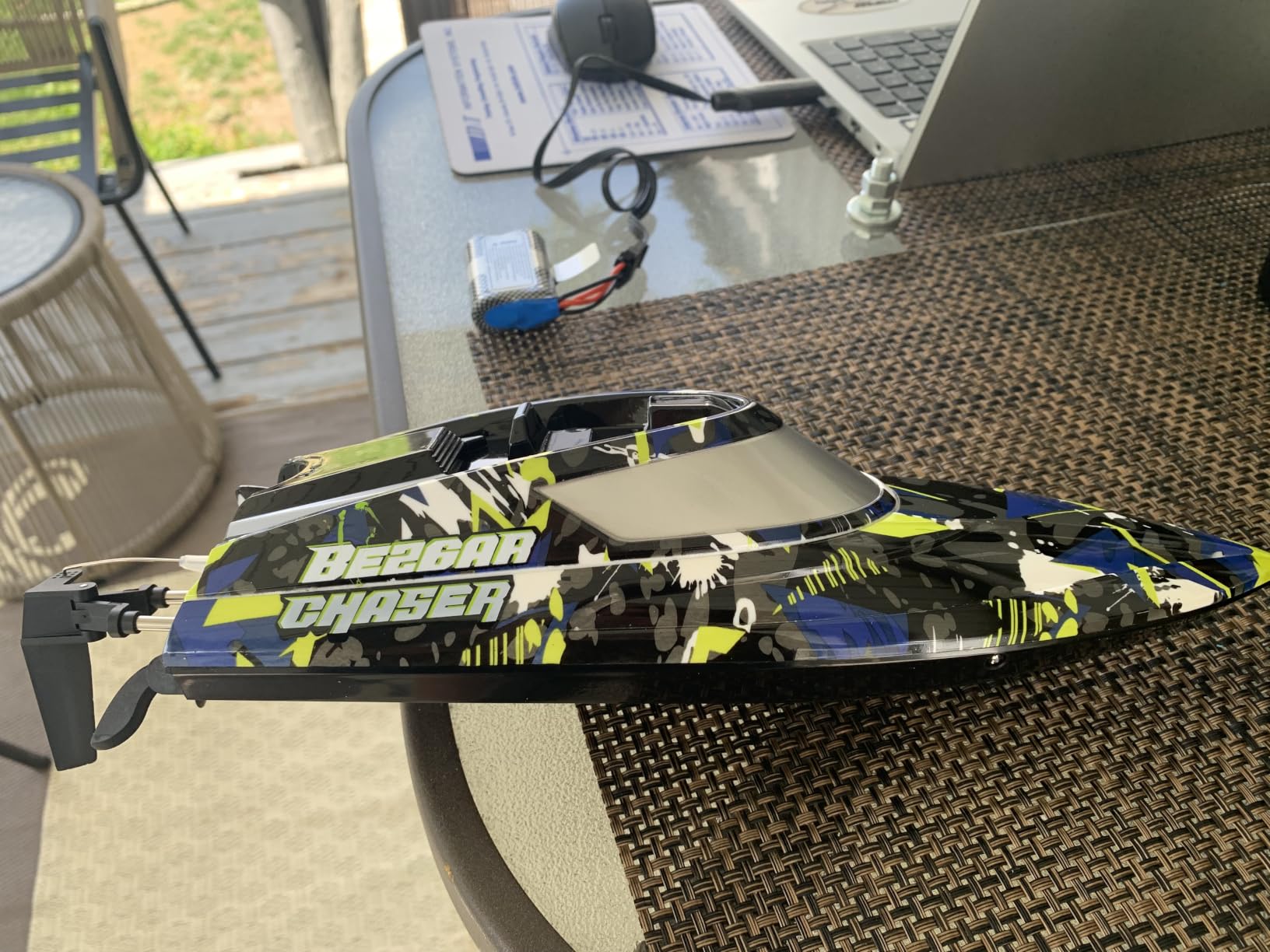
Control reach is 300 feet on a non-jamming 2.4GHz transmitter that supports more than one pilot. That is a sensible figure for a pond or the near half of a small lake, and the included hard suitcase with mesh bags and custom slots is a genuinely thoughtful bit of kit when you are hauling everything down a boat ramp.
It is also the only boat in this roundup the manufacturer rates for sea water as well as lakes, pools and rivers, which widens where you can take it. The 4.5-star average across 593 ratings is the highest in the group.
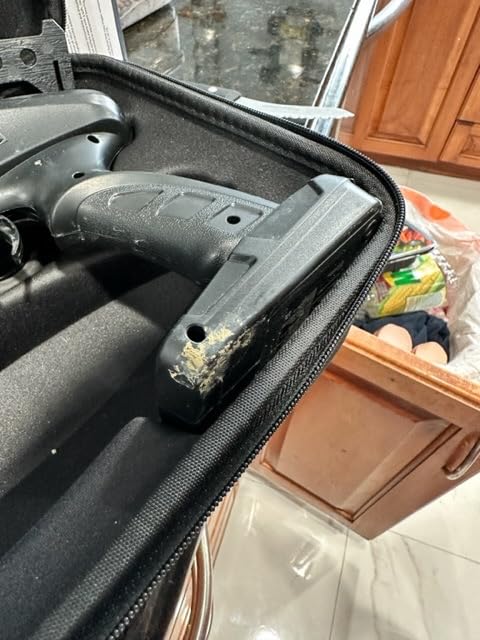
Reviewers do flag that the 14-inch hull is smaller than the large racing options, and that the plastic construction is less rugged than boats with machined metal hardware. On heavily weedy or shallow shorelines that matters, because a plastic keel finds the bottom sooner.
Why the tumbler hull suits beginners
Most first-time buyers underestimate how much of a session gets lost to a boat floating upside down. A self-righting tumbler design removes that frustration entirely, and on a lake with swimmers or birds nearby it removes a real safety problem as well.
With two batteries and a 40-minute combined run time, a family can swap packs rather than wait out a charge cycle, which is the difference between one good hour at the lake and two.
Where it falls short
At 14 inches with an all-plastic build, this is a sheltered-water boat. In sustained wind chop it will get pushed, and the smaller hull has less momentum to punch back through a wave face. Keep your runs to a bay or a lee shore rather than the exposed middle of a lake.
The 32 km/h top speed is modest compared with the MPH-rated racers, so anyone coming here for speed runs will be disappointed.
3. BEZGAR TX126 12-Inch RC Boat – Most Versatile
BEZGAR RC Boat TX126-12 Inch Remote Control Boat for Lakes and Pools
12 inch hull reaching 25 KPH
400 ft range with low-battery warning
Double-layer waterproofing
Pros
- Category best seller rank showing strong demand
- 400 ft control range suits larger lakes
- Double-layer waterproofing plus a water cooling system for the motor
- One-click 180-degree flip and LED lights for dusk and night running
- Low-battery warning helps you avoid losing the boat far from shore
Cons
- 12-inch hull is on the small side for open-water running
- 25 KPH top speed is modest against MPH-rated racing hulls
- Single 700mAh battery limits run time against twin-battery models
The TX126 is the cheapest way into a boat that can genuinely handle a lake edge rather than a paddling pool. At 12.01 inches with a metal and plastic build weighing 1.3 pounds, it is still a small hull, but the 400-foot control range is one of the longest here and that single figure changes how far you can safely go.
Waterproofing is double-layer, and the motor has its own water cooling system, which is the detail that separates this from the cheapest listings. A 2.4GHz radio system with an 8-shape figure maneuver mode gives you demo moves on command, and LED lights with a one-click 180-degree turn make dusk runs the most fun time of day.
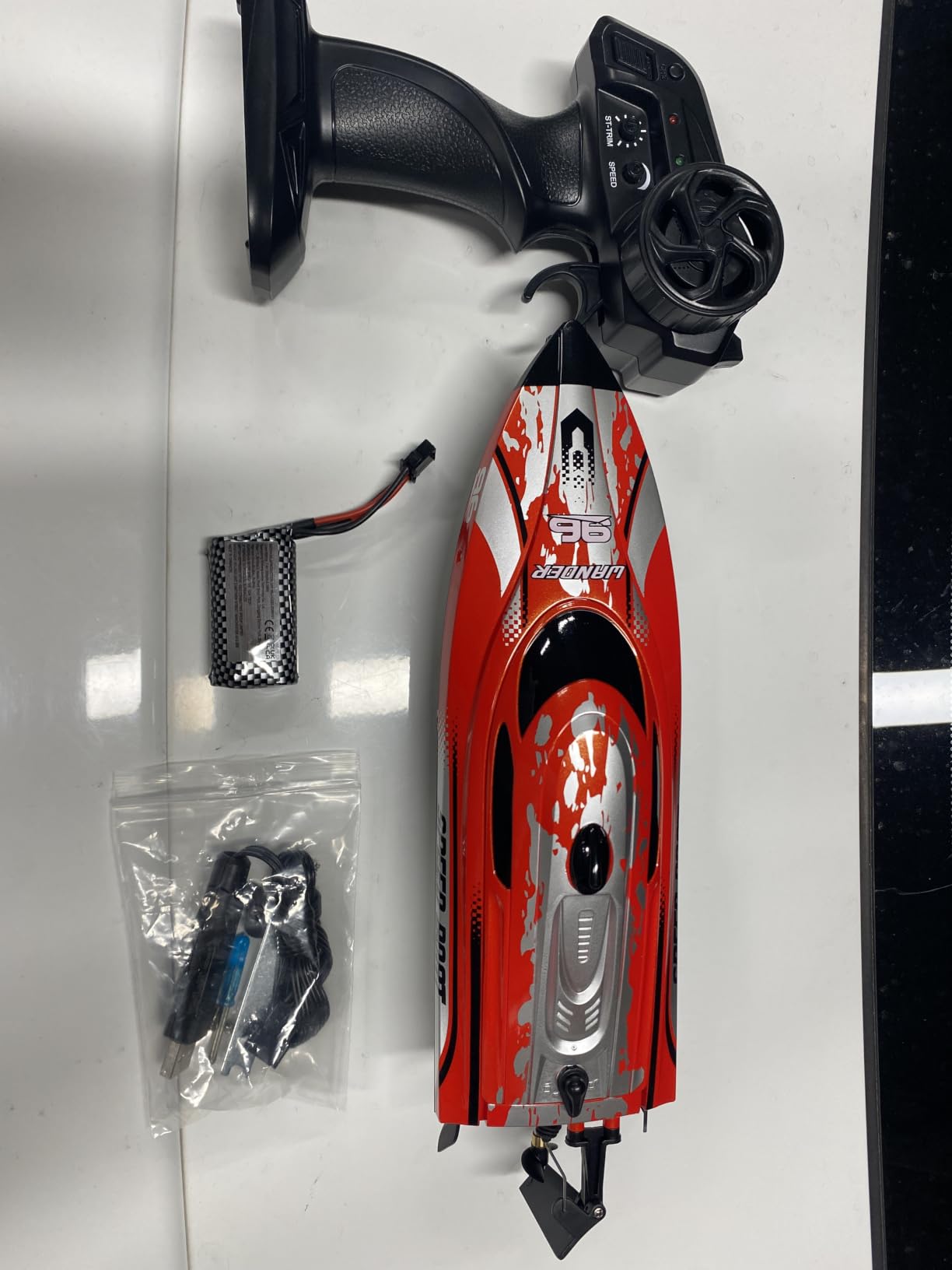
A low-battery warning is included, and the boat ships with a 700mAh rechargeable battery, charging cable and remote. The average rating is 4.3 stars across 566 ratings, and it currently holds the number one sales rank in the remote and app-controlled boats category, which tells you how many people it is being bought by.
Owners consistently rate it highly for value, the lighting and the flip function, and reviewers commonly set the expectation that it suits calmer, smaller water rather than wide open lakes. That is honest and worth repeating: this is a sheltered-water and near-shore boat.
The single 700mAh battery is the weakest part of the package. Compared with the twin-battery models here, you will be waiting on a charge between runs rather than swapping packs, and 25 KPH is a gentle top speed.
What 400 feet of range actually buys you
Control range is the spec nobody puts on a listing but everybody on a lake cares about. Once a boat passes the limit of your signal, you are steering nothing and watching it drift. At 400 feet you can cover a good stretch of near-shore water or a small lake end to end and still have margin.
Pair that range with a low-battery warning and you get a realistic boundary: when the beep sounds, you turn back with time to spare instead of gambling on a gust.
Where it falls short
Twelve inches is twelve inches. In chop, the boat takes water over the deck rather than slicing through it, and a flip means reaching in to right it. Do not run it alone on open water with a rocky shoreline in the water behind it.
It is also slower than the MPH-rated racers, so the sensation on open water is a cruise rather than a run. Pick it for range, lighting and price rather than for speed.
4. DEERC 14-Inch High Speed RC Boat – Best for Families
DEERC 14-Inch High Speed RC Boat, 20+ MPH, Auto Self-Righting, 2 Batteries
14 inch hull with water-cooled motor over 20 MPH
Automatic self-righting, no button
Pros
- Two 7.4V 1200mAh batteries give 30+ minutes of combined run time
- Automatic self-righting works with no button press
- Full proportional throttle and steering for smooth control
- 492 ft range is among the longest here
- High and low speed toggle makes it easy for beginners to learn
- Kit includes display stand
- spare propeller
- screwdriver and silicone bow bumper
Cons
- Rough or weedy water can snag the rudder and propeller
- Only one charger included so the second battery needs its own
- Batteries take roughly 90 minutes to charge and the remote needs AA cells
- Some units reported water ingress or steering failure after a few outings
- Exposed propeller blade is a cut hazard when reaching in
This is the boat we point at when a parent and a nine-year-old are sharing a controller. The forum consensus for a first lake boat with a child keeps coming back to a self-righting hull in the 17 to 20 inch range, and this 14-inch model lands just under that with a much lower barrier to entry and far more runtime than most.
Its standout feature is automatic self-righting that needs no button press. The boat rights itself after a capsize on its own, which means a child does not have to learn a recovery procedure mid-lake. Two 7.4V 1200mAh batteries total more than 30 minutes of run time, and a high/low speed toggle lets a new driver start slow.
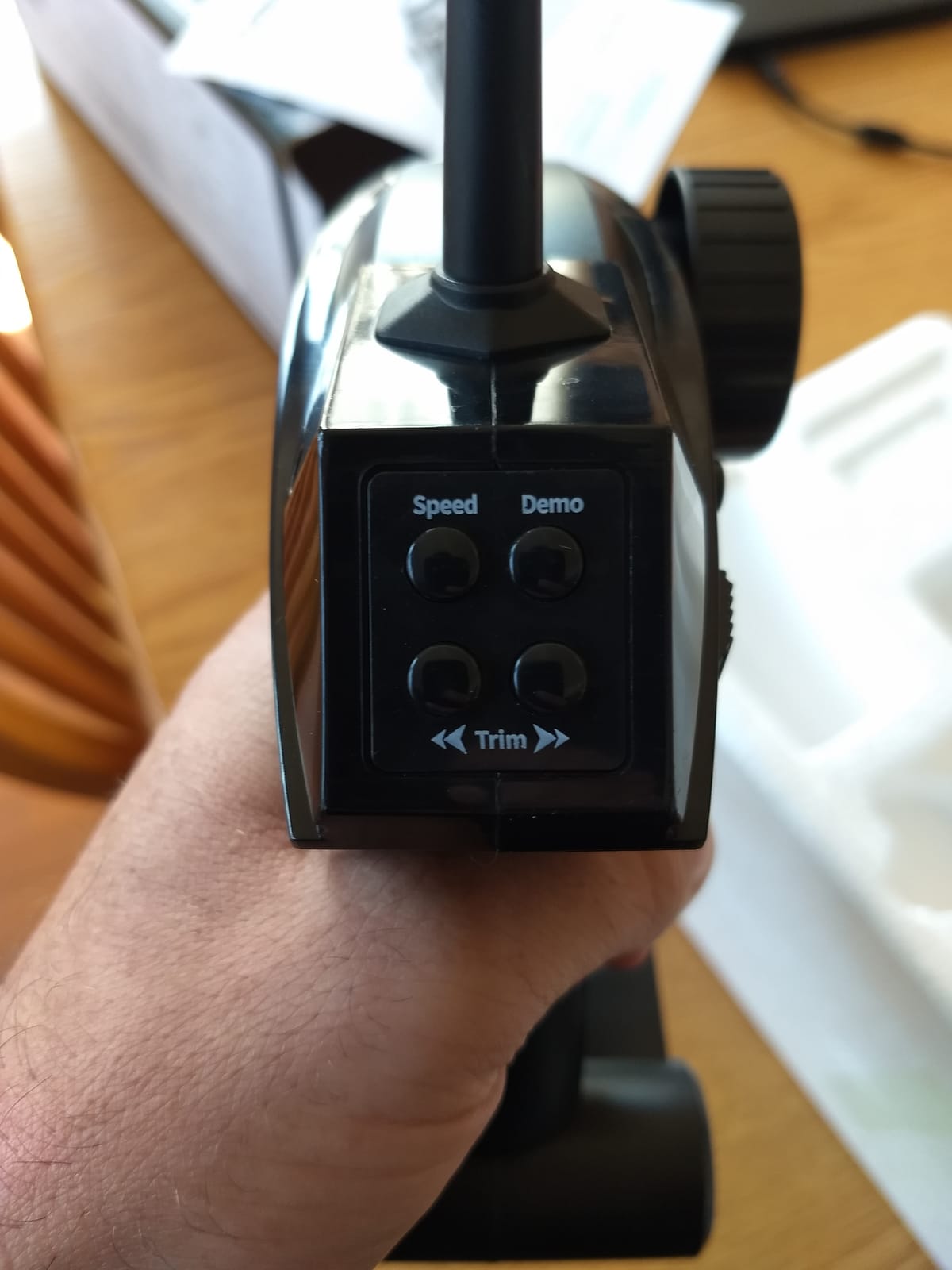
Control is full proportional with 492 feet of range, and there is a one-touch autopilot demo that runs 8 and O shape maneuvers, which buys you a few calm minutes at the start of a session. The hull has a built-in water cooling system, LED lighting, a low battery alarm, a water-activated power-on sensor on the hull bottom and a silicone bow bumper that takes the hit from a nose-first landing.
At 2 pounds it is portable for an adult, and the included display stand keeps the rudder and propeller off the ground when the boat is not in the water. The 4.2-star average sits across 2168 ratings, and several owners mention customer service replacing a faulty unit outright.
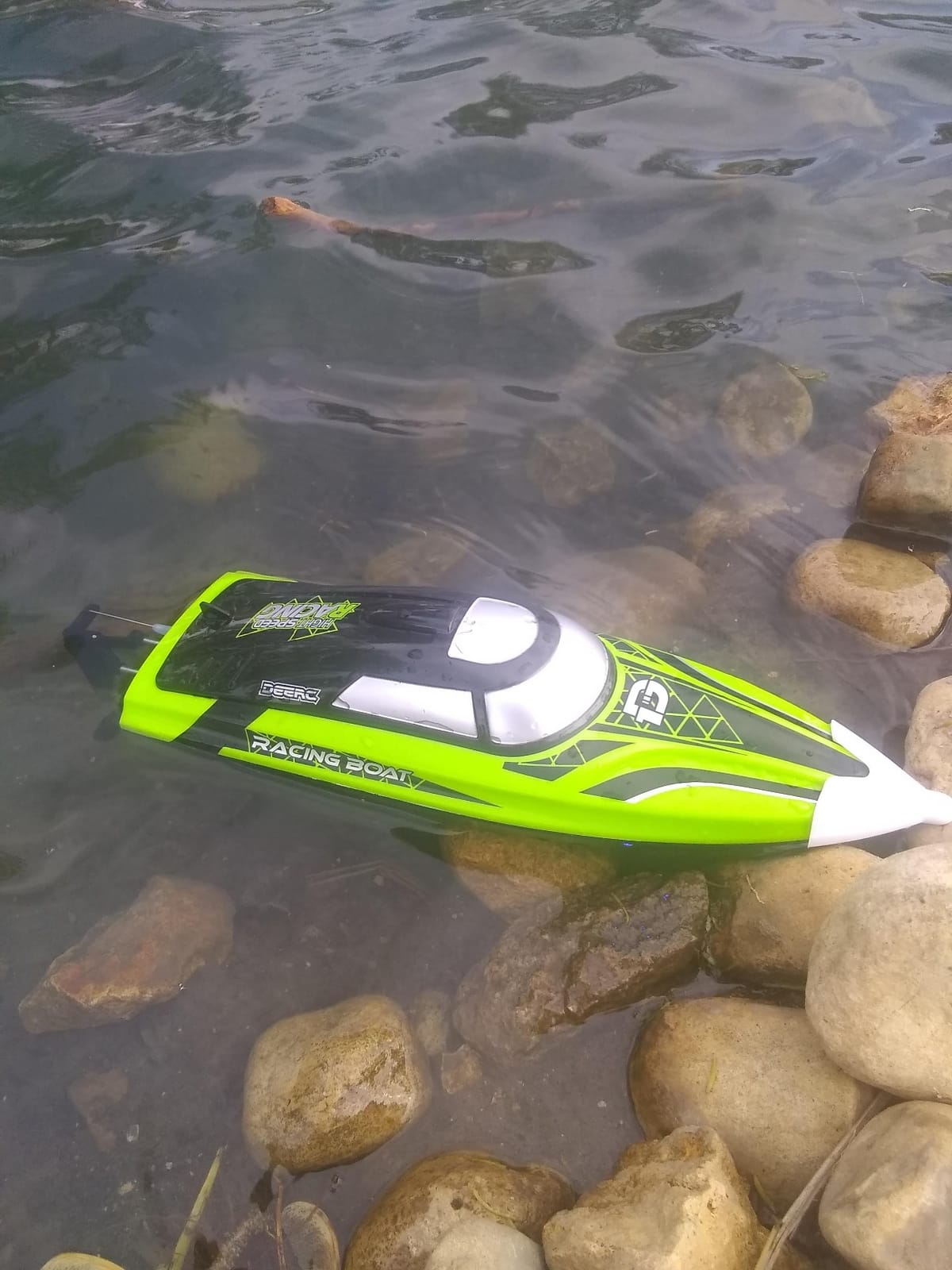
The durability feedback is the reason this is not our top pick. A 12 percent one-star cluster describes water getting into the hull or the steering motor failing within weeks, which is the common experience of a plastic hull at this price point over a full season of heavy use.
Why families keep coming back to this one
Two batteries with a quick swap, a high/low speed toggle and self-righting that needs no button are exactly the three things that stop a child’s session from ending early. You get more usable time on the water than with a single-battery boat of the same size.
The 492-foot range means you can send a younger driver out toward open water without constantly working the throttle to keep the boat close, and the display stand means the prop is not sitting in a garage floor puddle when you are packing up.
Where it falls short
Only one charger comes in the box, so the second battery needs its own, and each takes around 90 minutes to charge. The remote also needs AA cells that are not included, a small detail that catches people out at the ramp.
Weedy or shallow water snags the rudder and propeller on this hull, and the exposed prop blade is a cut hazard when you reach in to flip it. Check the water ahead before you commit to a run.
5. DEERC H120 20 MPH RC Boat – Best All-Round Starter
DEERC H120 Fast RC Boat for Pools and Lakes, 2.4 GHz 20+ MPH Racing Boats for Kids & Adults with Rechargeable Battery,Low Battery Alarm,Capsize Recovery,Gifts for Boys Girls
20 MPH freshwater racing hull
Self-righting capsize recovery
4-channel 2.4GHz, 150 m range
Pros
- Largest review base in this roundup with over 3700 ratings
- Self-righting capsize recovery keeps the boat pointing the right way
- 4-channel 2.4GHz control for reliable handling
- Low battery alarm helps avoid losing the boat
- Accessory kit includes wrench
- lock nut
- spare propeller
- support frame and anti-collision head
- Lightweight 16-ounce body is easy to carry to the shoreline
Cons
- 150 meter range is the shortest here
- which limits very large lakes
- Single battery means waiting for a recharge between runs
- Freshwater only and not rated for salt water
- PP plastic hull is less rigid than metal-reinforced models
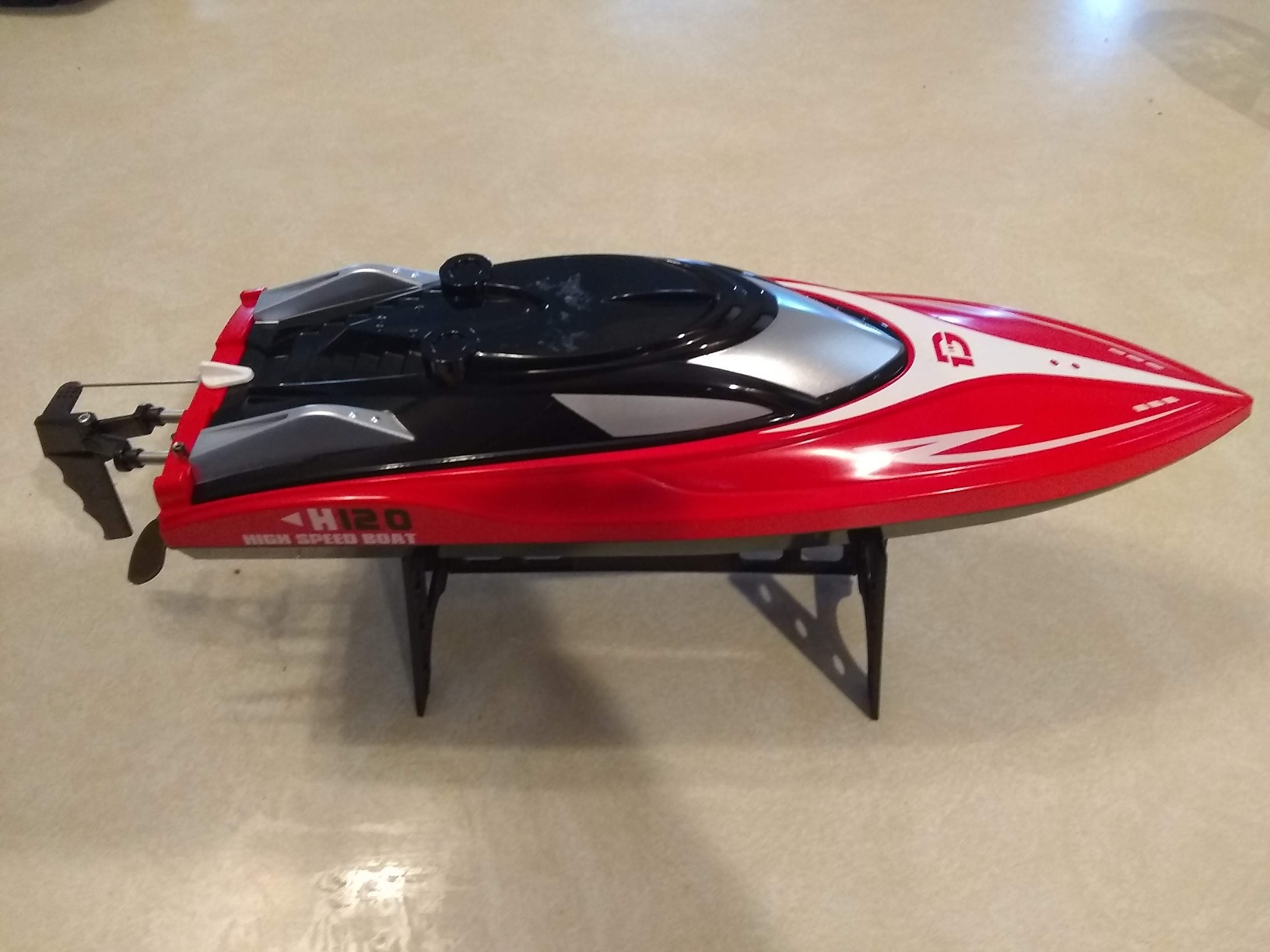
With 3735 ratings averaging 4.3 stars, the H120 is the most established boat here and the safest default choice for a first lake run. The specification list is unfussy in a good way: a 20 MPH freshwater racing hull, self-righting capsize recovery, a 4-channel 2.4GHz remote and a double-hatch design to reduce water ingress.
It is also the lightest boat in the roundup at 16 ounces, so carrying it from a car to a shoreline is a one-hand job. That matters more than it sounds when you are launching alone with a gear bag.
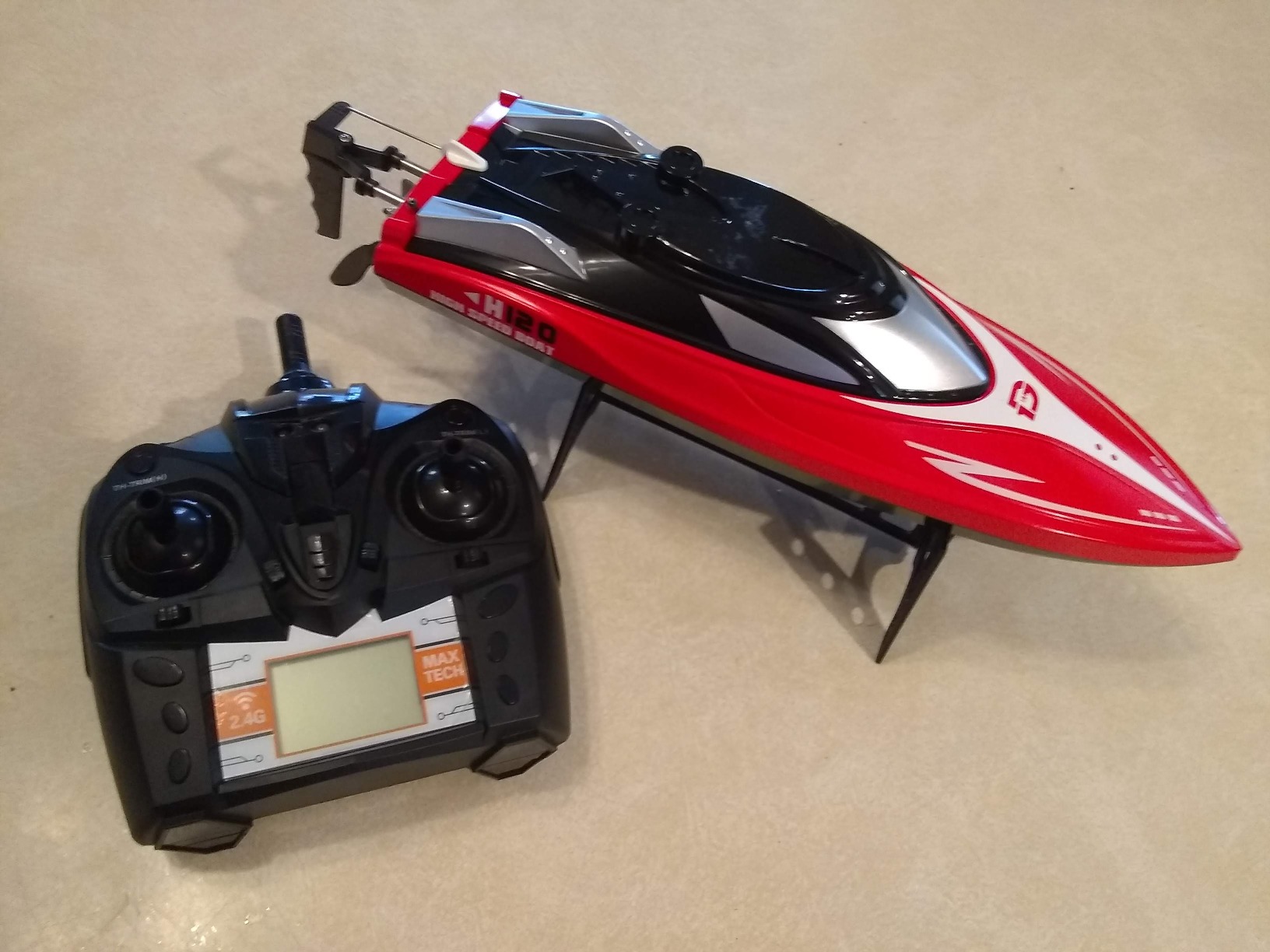
The accessory kit is unusually complete for this class: a wrench, lock nut, spare propeller, support frame, lubricant, USB charger and an anti-collision head. You can fix a stripped prop bolt at the ramp instead of driving home, and the low battery alarm on the controller gives you an audible cue to head back.
Owners consistently cite the self-righting recovery, easy handling and the complete kit as the reasons it works for both kids and adults. The recurring criticisms are all about scale: limited control range on big lakes, single-battery runtime and a freshwater-only design.
Weighing 13.86 inches and 16 ounces, this is a pond and sheltered-shore boat in a package that will not let you down on a calm evening.
Why the 150 meter range is the deciding spec here
This boat is frequently described as a lake boat, and on a small lake it is one. At 150 meters of signal, roughly 490 feet, you have a usable bubble around you. The moment the shoreline is further away than that, the boat is outside your control and drifting on its own.
That is why we would not send this one out across a wide lake alone, even with self-righting working perfectly. Self-righting solves a flipped boat, not a boat you can no longer reach.
Where it falls short
One battery, one run, then a wait. Compared with the twin-battery boats here, that is the biggest practical limitation for a family session, and the PP plastic hull has less rigidity in rough water than a metal-reinforced model.
It is freshwater only, and the 20 MPH figure assumes the included battery rather than a pack you buy later. On a big open lake you will be choosing between range and runtime, and this boat gives you less of both than most.
6. DEERC Shark Racing RC Boat – Best for Multiplayer Racing
DEERC High-Speed RC Boat, 20+ MPH, Fast Remote Control Shark Racing Boat
ABS hull with twist-lock waterproof cover
20+ MPH proportional throttle
2.4GHz to 328 ft
Pros
- Full proportional throttle and speed regulation for smooth control
- Twist-lock waterproof cover with multiple seals
- Water circulation cooling reduces motor heat
- 2.4GHz controller supports more than 20 boats racing simultaneously
- 328 ft range suits mid-size lakes
- Capsize recovery plus low battery and out-of-range alarms
Cons
- 11.8-inch hull is among the smallest here and is less suited to choppy open water
- Single battery limits continuous run time
- 10 percent one-star cluster points to occasional electronics or motor failures
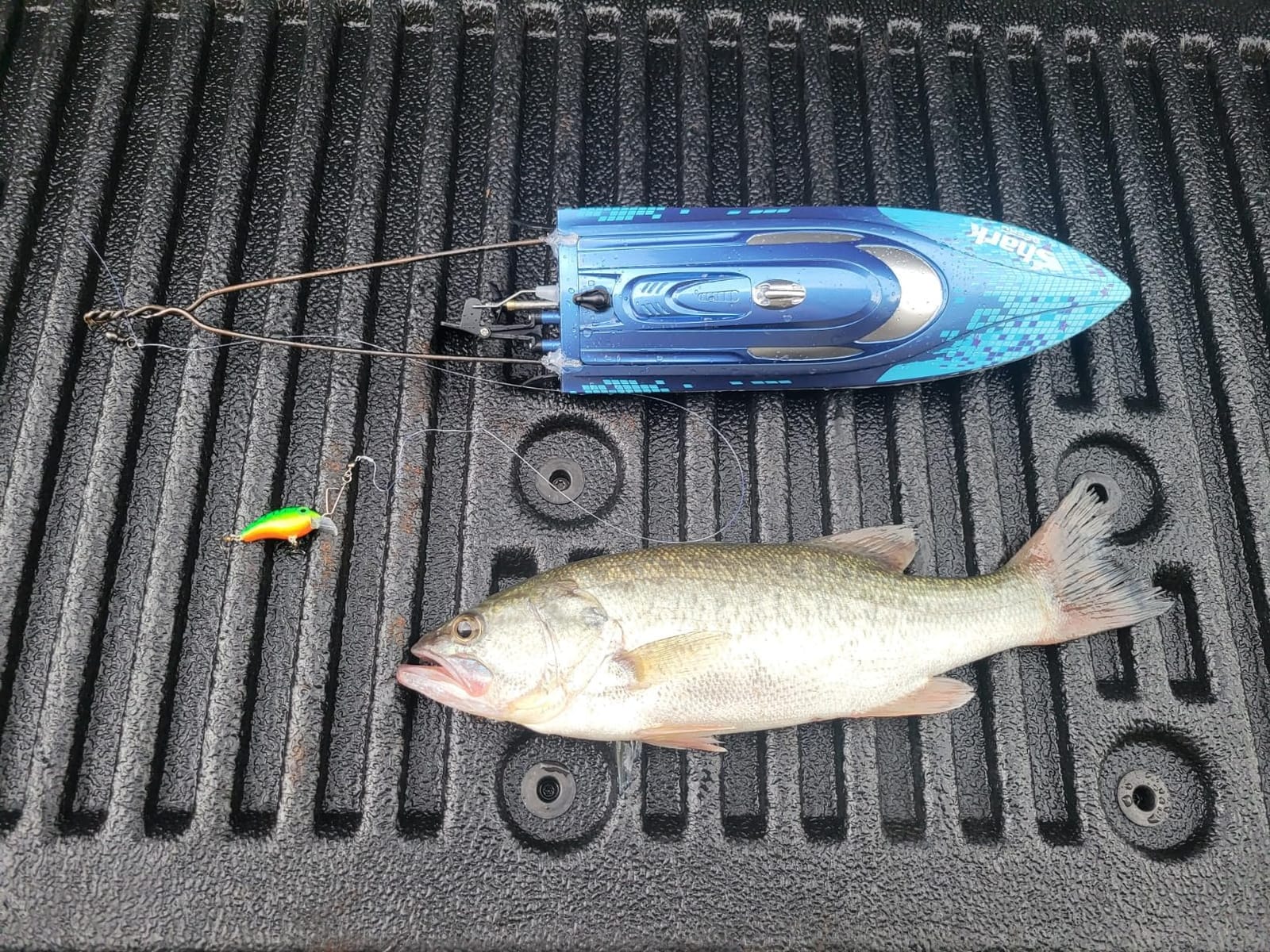
The shark hull is a crowd-pleaser and the most capable multi-pilot boat here. The 2.4GHz controller supports more than 20 boats racing at the same time, so a family gathering or a club session on a wide calm bay can run several pilots off separate frequencies without interference.
Control is full proportional with speed regulation, and the 20+ MPH figure is a genuine step up from the KPH-rated entries. At 328 feet of range it covers a good stretch of mid-size lake water.
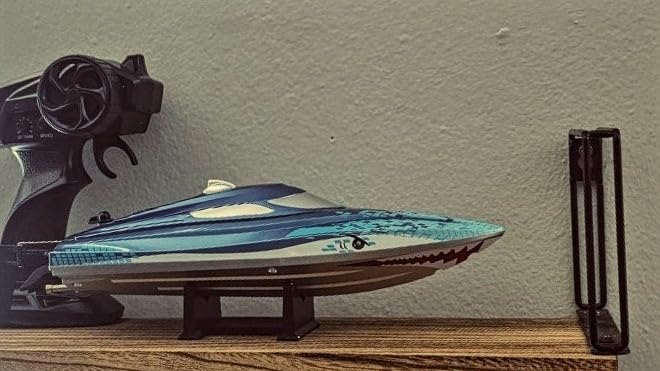
Durability details are the strongest part of the build. The ABS plastic hull has a waterproof cover with multiple twist-lock seals, and a water circulation cooling device is designed to reduce motor heat and extend service life. Audible alarms cover both low battery and exceeding control distance, which in a race is exactly the information you want.
The shark graffiti graphic with glowing eyes and a one-click demo mode is the bit kids remember. The 4.2-star average across 755 ratings is solid, with 67 percent five-star and 14 percent four-star.
The 10 percent one-star group reports motor, water-ingress or remote reliability problems, and reviewers advise keeping to calmer water given the small hull.
What twenty-boat racing actually means for a lake
Multi-pilot support changes the social side of running a boat on a lake. A group can line up at a slipway, run parallel courses and compare lap times, which turns a solo toy into an actual hobby rather than a demonstration.
Plan the course along a sheltered shoreline, though. Twenty boats spread across open water at 20 MPH is a lot of energy pointed in different directions, and the 328-foot range only holds if everyone stays inside it.
Where it falls short
At 11.81 inches this is among the smallest hulls in the roundup, and in anything resembling chop it will take water on deck rather than pushing through it. The single battery also caps your session length.
If your lake is exposed, pick a bigger hull and race with two or three boats instead. This one wants a bay, a flat evening and a group rather than open water.
7. Force1 Velocity Green RC Boat – Best Track Record
Force1 Velocity Green Fast RC Boat- Remote Control Boats for Adults and Kids, Underwater Speed Racing Mini RC Toy for Pools and Lakes, 2.4GHZ Transmitter, 2 Rechargeable Batteries, Low Battery Alert
10.85 inch hull with underwater driving
2.4GHz remote, 328 ft range
Two 800mAh batteries
Pros
- Unique underwater diving and driving function no other boat here offers
- Two rechargeable batteries plus boat stand
- spare propeller and spanner included
- Capsize recovery mode works reliably and saves cold-water rescues
- Water-activated power switch means it only powers on in water
- Trim adjustment
- reverse throttle and low signal warning
- Track record of responsive customer service with free replacement boats
Cons
- 120 minute charge time for only 12 minutes of play per battery
- Transmitter is not waterproof and fails if it gets wet
- Freshwater with low surface debris only
- not salt water
- 20 km/h top speed is the slowest of the racing boats here
- Some owners report hull leaks and battery compartment flooding
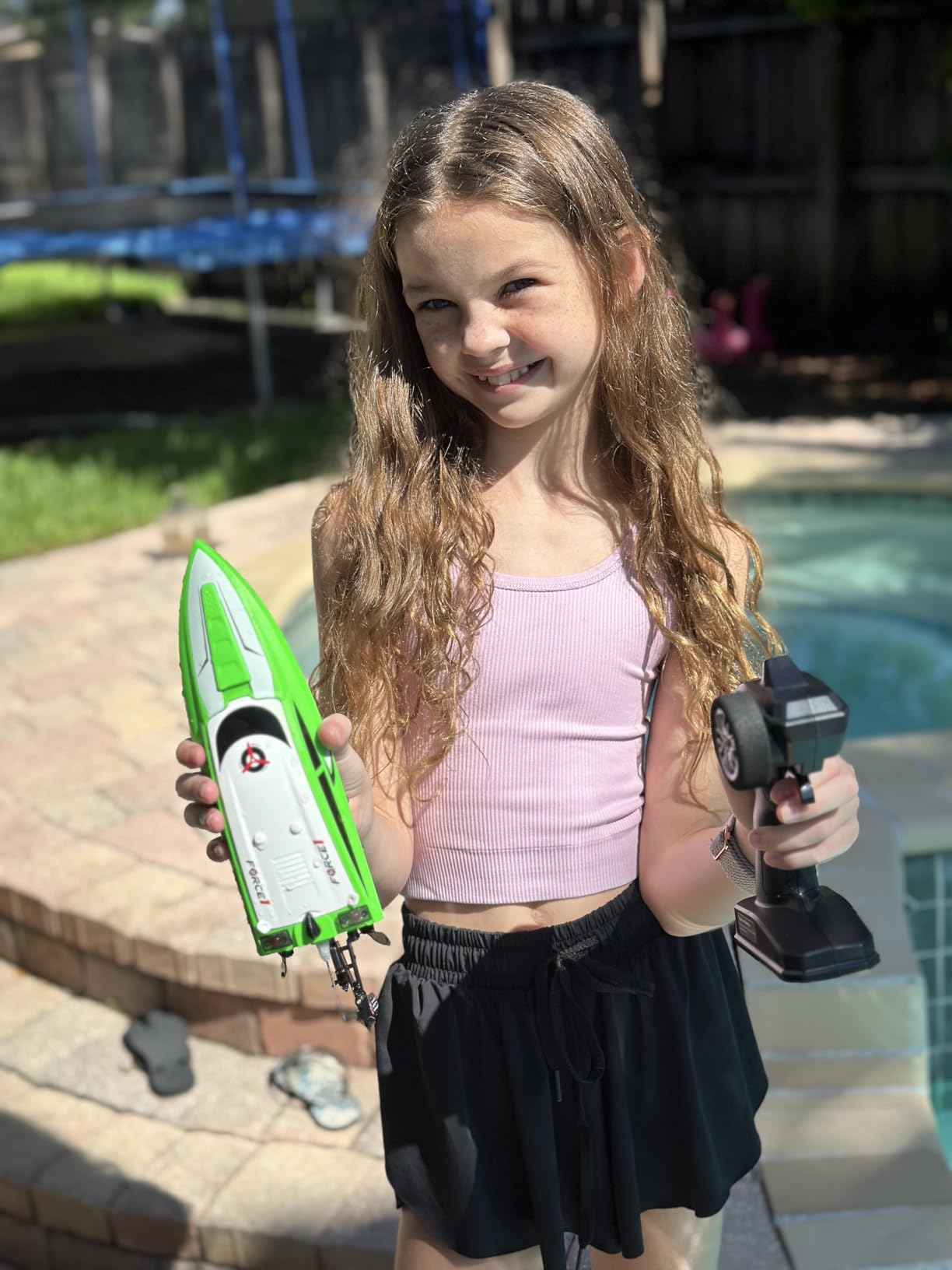
The Velocity is the odd one out and the most fun for a single session. It has an underwater driving and diving capability that no other boat in this roundup offers, controlled by a dedicated dive button on the transmitter, and it changes what a session on a calm evening feels like.
That capability has a cost. The 10.85-inch hull is small, top speed is 20 km/h, and the product is intended for freshwater with low surface debris, so it is not a boat for weed-choked shallows or salt water.
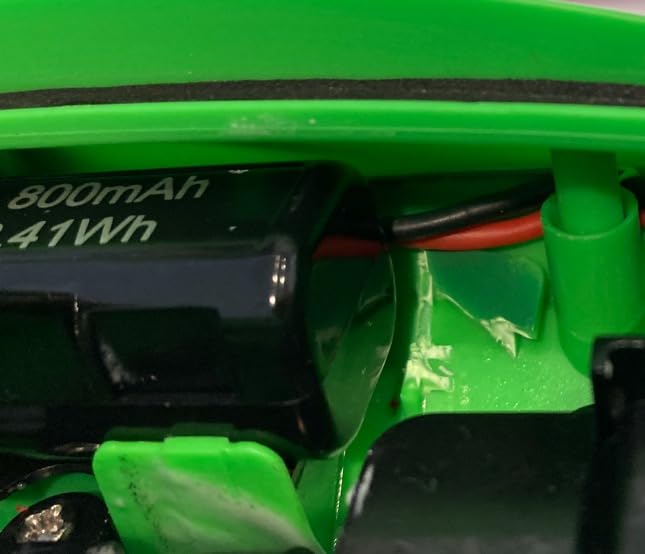
The package is good for the money it sits at. Two 3.7V 800mAh rechargeable Li-Ion batteries, a 2.4GHz remote with power LED, trim adjustment, forward and reverse throttle and a low signal warning, plus a USB charging cable, spanner, boat stand, spare propeller, waterproof ring and a manual.
Two practical features stand out. The water-activated power switch means the boat only powers on once it is actually in the water, which removes a real hazard around children. Auto capsize recovery works reliably and saves you from reaching into cold water, and several owners describe the capsize recovery as the reason they never had to go swimming for it.
With 5422 ratings, this is the largest review base in the roundup, averaging 4.2 stars. Force1’s customer service, sending free replacement boats, comes up often and positively in the reviews.
Why the diving function changes a session
A dive button turns a surface boat into something you can send under and steer back up, and on a glassy evening on a sheltered lake that is a genuinely different experience. Combined with reverse throttle and trim adjustment, it handles like a small powered submersible rather than a toy.
It is also the reason to buy this one rather than a faster surface boat of the same size. If you are not going to run it in rough water, the extra capability is worth more to you than speed.
Where it falls short
The charge cycle is the biggest practical problem. Each 800mAh battery takes about 120 minutes to charge and delivers around 12 minutes of play, so a two-hour session means a long wait at the ramp. The transmitter itself is not waterproof and fails if it gets wet.
Some owners report hull leaks and battery compartment flooding after a few uses, and at 7.52 ounces the boat is light enough to be pushed around by a stiff breeze. Keep it on still water with a clear bottom.
8. Akargol LED RC Boat – Best for Night Running
Akargol RC Boat with LED – Remote Control Boat for Pools and Lakes 2.4 GHZ RC Boats with 2 Rechargeable Battery Whole Body Waterproof, Low Battery Alarm, Water Play Toy Gift for Boys&Girls
LED lighting under transparent cover
Two batteries, 2+ hours run time
165 ft control distance
Pros
- Longest run time here with two batteries giving more than 2 hours at medium speed
- Bright LED lighting under a transparent cover makes heading easy to see at night
- Ultrasonic welding fuses the upper and lower shells for stronger waterproofing
- Water sensor switch means the engine only starts on contact with water
- Low voltage protection drops speed by 40 percent as a return-to-shore warning
- Four-player support on 2.4GHz
Cons
- 165 ft control range is the shortest in this roundup
- Smallest hull at 10.2 inches and best suited to calm water
- Lowest average rating here at 4.1 with a 12 percent one-star cluster
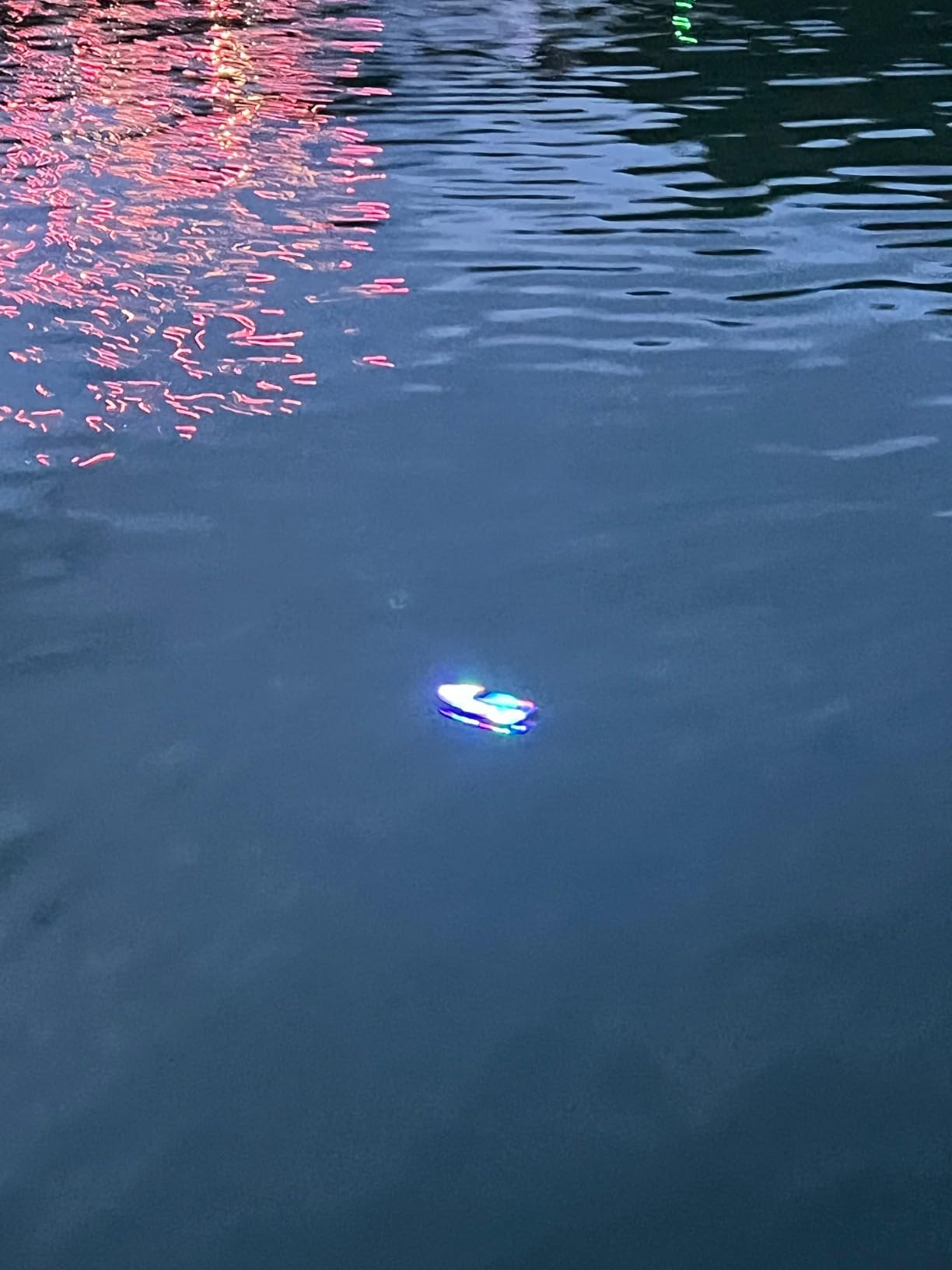
The Akargol is the night-run special. A transparent cover with multiple LEDs underneath throws light through the whole body, so you can read its heading and position after sunset in a way the other boats in this roundup cannot.
Runtime is the second reason to pick it. Two batteries deliver more than two hours of run time at medium speed, which is the longest session figure here by a wide margin, and with a 10.2-inch hull it is also the easiest to carry.
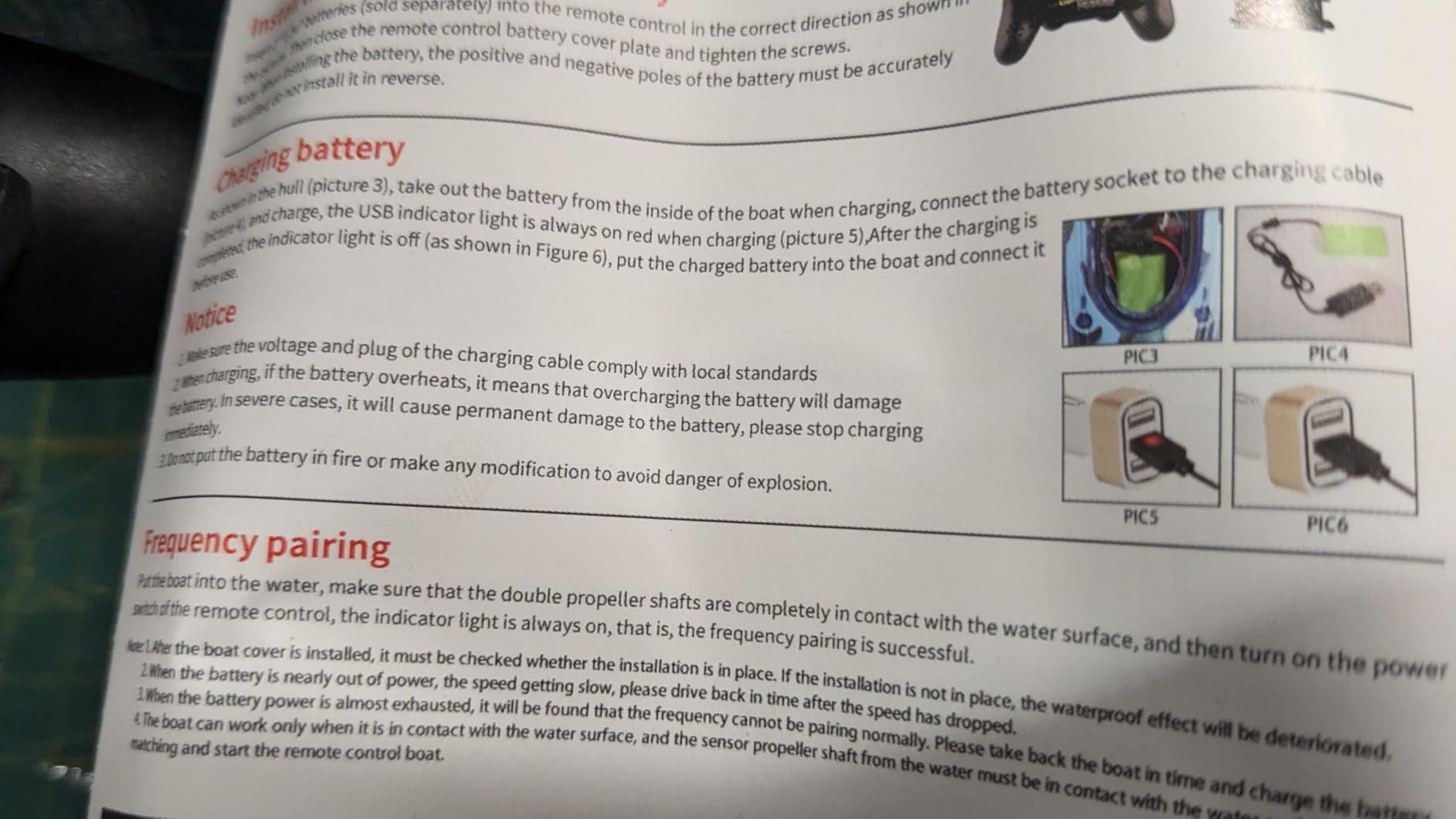
Build details are better than the rating suggests. Ultrasonic welding fuses the upper and lower shells together rather than relying on a seam alone, a water sensor switch means the engine only starts once the hull contacts water, and low voltage protection drops speed by 40 percent as an unmissable signal to return to shore.
That water-activated start is the feature a parent will care about most, because it means the boat does not spin up in a child’s hands on dry land. Four-player support on the 2.4GHz radio means a small group can run together on a pond.
The 4.1-star average across 849 ratings is the lowest in the group, and 12 percent of ratings are one-star, reflecting the short range, small hull and some build-quality complaints.
Why night running changes which boat you need
Once the light goes, the boat is no longer the thing you control, it is the thing you track. A boat you cannot see is a boat you cannot retrieve, so lighting is a safety feature on a lake rather than a novelty.
Combine the LEDs with a two-hour runtime and you can run from dusk well into the evening. The low voltage speed drop doubles as a return-to-shore cue, since a boat suddenly crawling at 40 percent speed is unmistakable from the bank.
Where it falls short
At 165 feet, this is the shortest control distance in the roundup and it limits you to a small pond or water close to shore. Ten inches of hull belongs on calm water, and a light breeze will move it more than you expect.
If your lake is anything other than sheltered, the short range and small hull make this a garden-pond and near-shore boat rather than a lake boat, however good the lighting is.
What to Look for in an RC Boat for Lakes
Four specifications decide whether a remote control boat is fun on a lake or a lesson in frustration: hull length, self-righting, motor type and control range. Everything else is preference. Here is how each one actually behaves on open freshwater.
Match hull length to your water, not to your wish list
Hull length is the single biggest factor in chop handling, because a longer hull has more mass and more forward length to push water aside rather than take it on deck. A 12-inch boat in an inch of wind chop throws spray and gets pushed sideways. A 25-inch boat at the same speed cuts through it and keeps its heading.
Forum advice for a first lake boat with a child keeps pointing at 17 to 20 inches as the sweet spot, with a self-righting hull, LiPo power and a brushless motor as the other three conditions. That is a sensible starting point, and it is the reason the middle of this roundup is the part we would actually recommend to most people.
Self-righting is the feature that saves the boat
Self-righting comes in three flavours. Passive flood chamber designs let water in on purpose so the hull rights itself under buoyancy. Active systems use reverse throttle or a button to spin the propeller the right way. Tumbler hulls rely on a weighted deck that rotates the boat back upright.
None of them are useful without power, so a flat battery means a boat floating on its side. The key question is whether recovery happens automatically, because a button-triggered system needs a steady pilot, and a beginner who has just capsized the boat is not a steady pilot.
One more thing worth saying plainly: catamaran hulls cannot self-right, because both hulls face the same direction. Wide catamarans are fast and stable on flat water, but in chop they are the hull most likely to end up inverted.
Brushless motors matter more than speed numbers
A brushed motor uses carbon brushes that wear against the commutator. A brushless outrunner has no brushes, spins faster, runs cooler and is quieter, which on a boat translates directly into longer run time and less heat in the electronics.
Advertised speed is also the least reliable number on any listing. Figures are measured with a specific battery and prop, and real speed on a lake with a headwind or a light chop is commonly several percent lower. Treat a quoted MPH figure as a ceiling rather than a promise, and read reviews for what owners actually see rather than what the box claims.
Control range decides whether you get the boat back
Range figures in this roundup run from 165 feet to 492 feet, and that spread matters enormously on a wide lake. Once a boat passes the limit of your signal it stops responding, and nothing in the setup will bring it back.
Aim for 300 feet or more for anything beyond a pond. Pair it with an out-of-range alarm or a low-battery warning, and treat that alarm as the point where you turn back rather than the point where you start thinking about it.
Battery count and runtime decide how long the day lasts
Two included batteries are worth a lot more than one larger battery, because you swap instead of waiting. The boats here range from about 12 minutes per battery on the Force1 to more than an hour per battery at medium speed on the Akargol, and that spread is the difference between one run and a full afternoon.
Check what charges are included too, because some kits ship with a single charger for two packs and some remotes need AA cells that are not in the box. Budget for a spare battery and a dedicated charger before you commit to a season of use.
Brands worth knowing in freshwater RC boats
Pro Boat and Traxxas are the reference names in hobby-grade lake boats, with brushless systems, self-righting deep-V hulls and proper radio gear. Kyosho, Volantex, ARRMA and TFL cover the mid and upper tiers with strong value. In the entry class, BEZGAR, DEERC, Force1, Akargol and UDIRC build the self-righting pool and pond boats most families start with.
That lower tier is not bad, it is different. The engineering budget goes into self-righting hatches, LED lighting and sealed covers rather than into brushless motors and water-cooled ESCs, which is exactly the trade-off you are making when you buy one.
Lake Conditions to Hull Size
Map the water you actually have, not the water you wish you had. The table below is the shortcut we use, and it is the calculation most roundup pages skip entirely.
Calm pond or sheltered bay, no wind : 10 to 14 inches is plenty. A tumbler or automatic self-righting hull covers the occasional flip, and anything larger is more boat than the water can use.
Small lake, light breeze, near-shore running : 14 to 18 inches. You want a hull that pushes water rather than taking it on deck, and 300 feet of range or more so the boat stays reachable.
Big open lake with wind-driven chop : 18 inches and up, ideally a 25-inch deep-V style hull. This is the range where the Cheerwing UDI022 and the deeper hobby-grade monohulls make sense, and where small pool boats start to disappoint.
Exposed water or strong afternoon wind : 25 inches or more, with self-righting, machined rudder hardware and trim tabs. Plan a retrieval route before you commit to a run this far out.
Short on range, wide on water : pick the boat by control distance first. The 492-foot DEERC 14-inch and the 400-foot BEZGAR TX126 cover more water per unit of risk than any larger hull with 150 feet of signal.
Safety, Rescue and Rules on Public Lakes
Retrieval planning matters more than speed. Before every session, identify the nearest safe landing point, check the water depth along your intended route and decide your maximum distance. If the shoreline behind the boat is rocks, drop your planned range rather than your pace.
Never run a non-self-righting boat alone on open water, and treat a capsized non-self-righting hull as lost rather than temporarily inverted. Boats with automatic self-righting and a low-battery alarm are the safest first choice for anyone launching solo.
Reach-in hazards are real on small boats. The exposed propeller on the entry models in this roundup is a genuine cut risk, so switch off before you put a hand in the water, and keep children clear of a running boat at the shoreline.
On rules, model boats are treated differently depending on where you are. Some states require freshwater vessel registration for powered craft, some parks and lake authorities restrict model boats to certain areas or hours, and private shoreline means the owner’s permission. Check the specific lake authority and any posted watercraft rules before your first run rather than after a complaint.
On freshwater care, flush the hull and cooling passages with clean water after every session so algae does not clog the intake, keep marine grease on the flex shaft and stuffing tube, and let a wet boat air dry before you pack it away. Cold water is the other quiet risk, since a capsize recovery in a lake in early spring is a very different proposition from the same flip in August.
Frequently Asked Questions
What is the best type of boat to have on a lake?
A self-righting hull of about 18 inches or longer, with a brushless motor, a water-cooled ESC and at least 300 feet of 2.4GHz control range, is the right choice for open freshwater. Below 14 inches you are buying a pond boat that will struggle once wind-driven chop appears, and a catamaran cannot self-right at all.
What is the best RC boat for the money?
The BEZGAR TX123 is the strongest value pick in this roundup. It pairs a tumbler hull with 180-degree capsize recovery, two 1200mAh batteries for up to 40 minutes of combined run time, a 300-foot 2.4GHz link and an included hard suitcase, at the highest average rating in the group.
What is the best RC boat hull for rough water?
A deep-V monohull with a good deadrise angle is the best hull for rough water, because it lifts its bow and cuts through chop instead of planing flat and burying the nose. Monohulls also self-right, which catamarans physically cannot do, since both hulls on a catamaran face the same direction when it flips.
What size RC boat is best for a lake?
For a small lake, 14 to 18 inches is the useful range, with self-righting and 300 feet of control range as the priorities. For a big open lake with wind-driven chop, move to 18 inches and up, ideally 25 inches for exposed water. On short-range setups, choose range over hull size every time.
What are good RC boat brands?
Pro Boat and Traxxas lead the hobby-grade tier with brushless systems, self-righting deep-V hulls and proper radio equipment. Kyosho, Volantex, ARRMA and TFL cover the middle of the market. BEZGAR, DEERC, Force1, Akargol and UDIRC build the entry self-righting boats most families start with.
How far can an RC boat go from the controller?
It depends entirely on the model. The boats in this roundup range from 165 feet to 492 feet, and 2.4GHz systems are unaffected by most other RC traffic. Once a boat passes its signal limit it stops responding and drifts, so aim for 300 feet or more on anything wider than a pond.
Are RC boats legal on lakes?
Rules vary by state, park authority and shoreline ownership. Some states require freshwater vessel registration for powered craft, some lake authorities limit model boats to certain areas or hours, and private shoreline needs the owner’s permission. Check the specific lake authority and any posted watercraft rules before launching.
Conclusion
For most people reading this on the shore of a real lake, the Cheerwing UDI022 is the best of the best RC boats for lakes in 2026. It is the only hull here genuinely sized for open water, with a brushless water-cooled motor, machined aluminum hardware and self-righting that works without a button press.
If your water is smaller or your budget is tighter, match the boat to the conditions instead. The BEZGAR TX123 is the value pick with the strongest rating, the DEERC 14-inch is the family favourite with two batteries and 492 feet of range, and the DEERC H120 is the dependable default with the largest review base in the group.
Whichever you choose, check the lake authority’s rules before you launch, and pick your landing point before you power up. We have covered floating docks for lakes if you want somewhere to stage from, and deck boats for families if the day is about being on the water together rather than driving a model across it.