
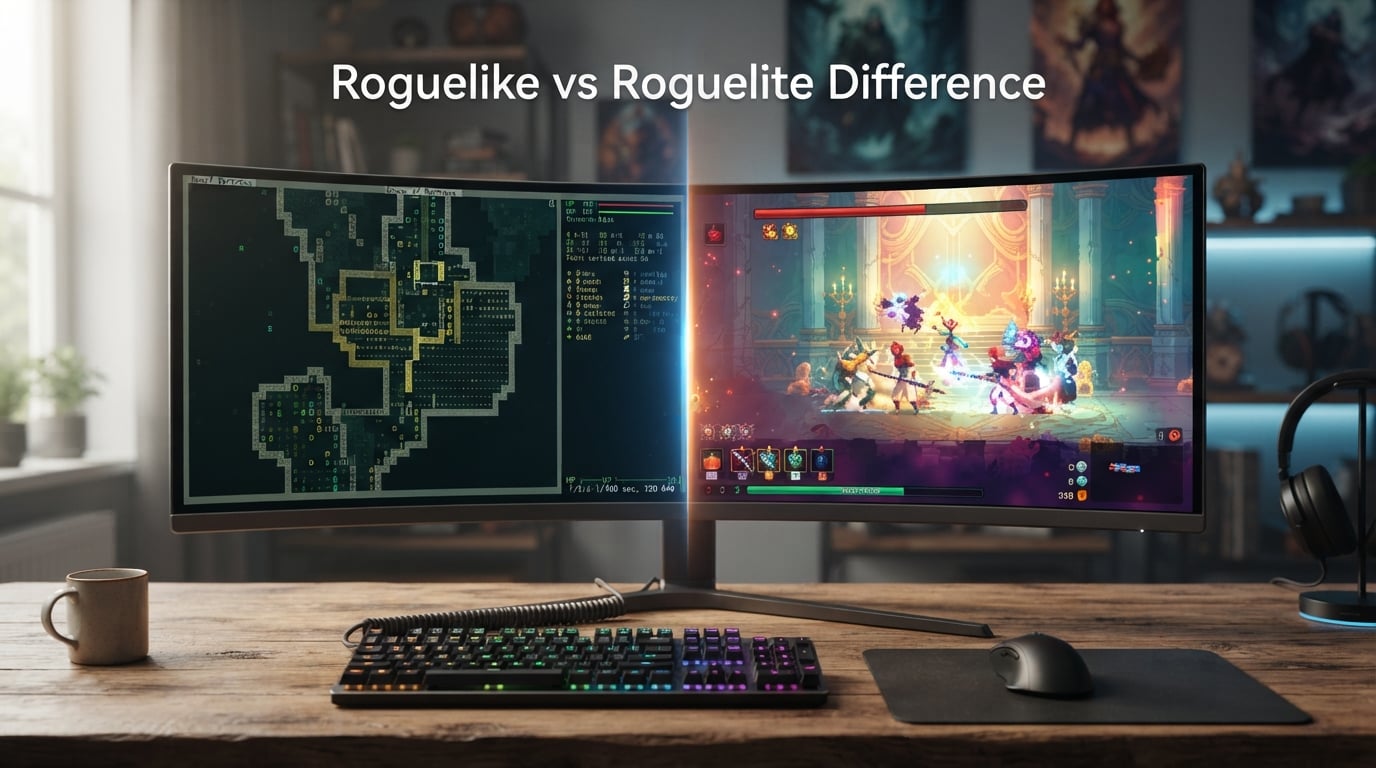
I have spent more hours than I can count dying in randomly generated dungeons. Somewhere around my 200th run in Hades, a friend asked me if it was a roguelike or a roguelite, and I genuinely paused. The roguelike vs roguelite difference sounds trivial until you try to explain it out loud.
Here is the short version. Roguelikes are turn-based, grid-based dungeon crawlers where death wipes everything, just like the 1980 game Rogue. Roguelites borrow procedural generation and permadeath but keep permanent upgrades between runs, turning failure into forward progress.
That single distinction, whether death erases all progress or feeds a meta-progression system, reshapes how these games feel to play. In this guide I break down where each genre came from, how they actually differ in practice, and where popular games like Hades, Slay the Spire, and Balatro really belong. If you have ever been confused by the terminology, you are in the right place.
Table of Contents
What Is a Roguelike?
A roguelike is a turn-based, grid-based dungeon crawler with permadeath and procedurally generated levels, designed to mimic the structure of the 1980 game Rogue. When your character dies, the run ends completely and you start over from scratch with nothing carried forward.
The genre traces back to Rogue itself, a Unix-based dungeon crawler built by Michael Toy and Glenn Wichman around 1980. Rogue used ASCII characters for graphics, meaning your hero was an @ symbol and a dragon was a D. Every floor was randomly generated using procedural generation, so no two playthroughs were identical. Death was permanent, and the only thing you carried into your next attempt was knowledge.
Classic roguelikes lean heavily on strategic decision-making. You can take as long as you want between moves because the game waits for your input, similar to a game of chess. This turns every encounter into a puzzle where positioning, resource management, and risk assessment matter more than reflexes. Games like NetHack, Dungeon Crawl Stone Soup, Ancient Domains of Mystery (ADOM), and Tales of Maj’Eyal (ToME) all sit firmly in this camp.
True roguelikes also tend to feature deep character creation systems, identification mechanics where potions and scrolls must be tested to reveal their effects, and food clocks that prevent infinite grinding. They are dense, demanding, and built for players who enjoy learning systems over dozens or hundreds of hours.
What Is a Roguelite?
A roguelite is a game that borrows roguelike elements like procedural generation and permadeath but adds meta-progression, meaning you unlock permanent upgrades, new characters, or new content that persists across runs even after you die.
This is the mechanic that changed everything. In a roguelite, death is not a hard reset. Instead, the currency you earned, the weapons you unlocked, or the skill trees you progressed carry forward. Each failed run makes the next attempt slightly different, either measurably stronger or simply offering new options. This loop is enormously satisfying because failure always produces something.
Roguelites also break free from the turn-based, grid-based constraint. They can be twin-stick shooters, deck builders, action platformers, or strategy games. The Binding of Isaac plays as a twin-stick shooter. Slay the Spire works as a card game. Dead Cells is a fast-paced action platformer. The unifying thread is the run structure and the meta-progression, not the moment-to-moment gameplay genre.
This flexibility is why roguelites exploded in popularity. They deliver the tension and replayability of a roguelike without requiring players to lose absolutely everything on death, which makes them far more approachable for mainstream audiences.
Roguelike vs Roguelite Difference: The Core Distinctions
The roguelike vs roguelite difference comes down to five key factors. Here is the breakdown that matters most when you are trying to classify a game or decide which style fits your taste.
Progression on death: Roguelikes wipe everything when you die. Roguelites carry permanent unlocks, upgrades, or currencies forward, so every run builds toward something even if you fail.
Combat style: Roguelikes are turn-based and grid-based, meaning enemies only move when you move. Roguelites typically use real-time action combat, deck-building, or other fast-paced systems that react in real time.
Strategic vs tactical depth: Roguelikes reward long-term strategic thinking, like a chess match where you plan several moves ahead. Roguelites reward tactical reflexes and split-second decisions, more like an action game or a fast card combo.
Run length: Roguelike runs often stretch over hours or even days because the games are designed for deep, extended sessions. Roguelite runs are usually shorter, sometimes 15 to 45 minutes, designed for quick repeatable sessions.
Gameplay genre: Roguelikes are almost always dungeon crawlers. Roguelites can be anything, from twin-stick shooters to deck builders to rhythm games, because the roguelite label describes the structure rather than the genre.
Reddit users on r/roguelikes and r/roguelites have summarized this well. One comment that stuck with me described roguelikes as offering challenge fun, where the enjoyment comes from mastering a difficult system, while roguelites lean toward expression fun, where you enjoy experimenting with different builds and combinations each run. Both are valid. They just scratch different itches.
The chess analogy comes up constantly in roguelike communities, and it is apt. In a roguelike, you can stare at the screen for five minutes before making a move because nothing happens until you act. In a roguelite, you are dodging, shooting, or playing cards in real time. The cognitive load is different, and that difference defines the entire experience.
The Berlin Interpretation and Why It Matters
The Berlin Interpretation is a community-created definition of what makes a roguelike, established at the 2008 International Roguelike Development Conference. It lists high-value and low-value factors that separate true roguelikes from games that merely borrow roguelike elements.
The high-value factors include random environment generation, permadeath, turn-based gameplay, grid-based movement, and non-modal gameplay, meaning all actions happen on the same screen. Low-value factors include inventory management, killing everything in your path, exploring to find items, and procedural content that changes every playthrough.
The Berlin Interpretation is useful as a reference point, but it is not a strict rulebook. Many gamers and even developers treat it as a guideline rather than law, and the community has debated its relevance for years. Some argue it is too rigid and excludes excellent games that feel like roguelikes even if they bend a rule or two. Others value it as a way to preserve the identity of a genre that has been diluted by marketing teams slapping roguelike labels on anything with procedural levels.
This tension is exactly why the roguelite label exists. It gives a home to games that use roguelike mechanics without meeting the full Berlin criteria, and it spares everyone from pedantic arguments about whether Hades counts as a real roguelike. For practical purposes, if a game has permanent progression between runs, it is a roguelite regardless of how it markets itself.
Popular Game Classifications
Specific games cause the most confusion, so let me classify the titles that come up again and again in forums, search results, and arguments among friends.
Is Hades a Roguelike or Roguelite?
Hades is a roguelite. Every time Zagreus dies, he returns to the House of Hades and keeps his accumulated Darkness crystals, which permanently upgrade his stats through the Mirror of Night. He also unlocks new weapons, keepsakes, and story progress across runs. The action combat is real-time, not turn-based, which further confirms the roguelite classification.
Is Slay the Spire a Roguelike or Roguelite?
Slay the Spire sits in a gray area but is generally classified as a roguelite. Each run is a self-contained deck-building challenge with permadeath, but the game unlocks new cards, relics, and character options that persist permanently between runs. That meta-progression pushes it into roguelite territory even though the turn-based card combat shares DNA with traditional roguelikes.
Is Balatro a Roguelike or Roguelite?
Balatro is a roguelite. It uses procedural generation and run-based structure, but unlocks new decks, jokers, and stakes that carry forward between runs. The poker-themed deck-building gameplay is turn-based and strategic, which gives it a roguelike flavor, but the persistent unlock system defines it as a roguelite.
Is Elden Ring Nightreign a Roguelike or Roguelite?
Elden Ring Nightreign is a roguelite. It condenses the Elden Ring formula into short, repeatable sessions with procedural elements, but players carry progress and upgrades forward between runs. The real-time action combat and meta-progression both place it firmly in roguelite territory.
Is Zelda a Roguelike?
No, mainline Zelda games are not roguelikes or roguelites. They feature fixed, hand-designed dungeons and a persistent world where death simply respawns you nearby. Some spinoffs with randomized dungeons and run-based structure could qualify, but the core Legend of Zelda series uses none of the defining roguelike or roguelite mechanics.
Beginner-Friendly Recommendations
If you are new to these genres, here is where I would point you. For roguelites, start with Hades if you love action, Slay the Spire if you prefer strategy, or Balatro if you want something fast and addictive. For a taste of traditional roguelikes, try Tales of Maj’Eyal or Caves of Qud, both of which offer friendlier entry points than the classic ASCII-heavy titles while preserving the strategic depth that defines the genre.
Roguevania and Other Subgenres
Roguevania is a hybrid subgenre that blends roguelite mechanics with metroidvania-style exploration. In a roguevania, levels are procedurally generated for each run, but you unlock permanent abilities that gradually open up new areas and paths, just like a traditional metroidvania.
Dead Cells is the poster child for this hybrid. Each run generates a fresh layout of interconnected biomes, but permanent upgrades like the runes that let you wall-jump or break specific floors persist across deaths. The result is a game that satisfies both the roguelite craving for repeatable runs and the metroidvania desire for gated exploration.
Other subgenres have emerged as developers continue experimenting. You will see terms like roguelike deckbuilder for games like Slay the Spire and Monster Train, action roguelite for fast-paced shooters like Risk of Rain 2 and Returnal, and even roguelike auto-battlers. The terminology keeps evolving, which is why understanding the core principles matters more than memorizing every label.
Which Should You Play?
Choosing between roguelikes and roguelites comes down to what kind of challenge you enjoy and how much time you can commit per session.
If you love strategic planning, methodical decision-making, and the satisfaction of slowly mastering a complex system over many hours, roguelikes are your genre. The turn-based nature means you can play at your own pace, and the depth of systems in games like Dungeon Crawl Stone Soup or Caves of Qud can keep you engaged for years. Just be prepared for runs that can last hours or even days.
If you prefer fast-paced action, quick repeatable sessions, and the dopamine hit of unlocking new content after every run, roguelites will suit you better. Games like Hades, Dead Cells, and Balatro are designed to respect your time while still delivering the tension and replayability that makes run-based games so compelling. Most roguelite runs wrap up in 20 to 45 minutes.
The community insight about challenge fun versus expression fun is genuinely useful here. Roguelikes challenge you to get better at a fixed, demanding system. Roguelites let you express creativity through build variety and experimentation. Neither is objectively better, and many players enjoy both depending on their mood.
FAQs
Which is better, roguelike or roguelite?
Neither is objectively better. Roguelikes appeal to players who enjoy strategic, turn-based depth and slow mastery of complex systems. Roguelites suit players who prefer fast action, shorter sessions, and permanent progression that makes every run feel productive. Your preference depends on whether you want challenge fun or expression fun.
Is Hades a roguelite or roguelike?
Hades is a roguelite. Death sends Zagreus back to the House of Hades, but he keeps Darkness crystals for permanent stat upgrades, plus unlocked weapons and story progress. The real-time action combat also confirms the roguelite classification.
Is Elden Ring Nightreign a roguelike or roguelite?
Elden Ring Nightreign is a roguelite. It uses procedural elements and run-based sessions, but players carry upgrades and progress forward between runs. The real-time combat and meta-progression both place it in roguelite territory.
Is Zelda a roguelike?
No, mainline Zelda games are not roguelikes or roguelites. They feature fixed, hand-designed dungeons and a persistent world where death simply respawns you nearby. The core series uses none of the defining roguelike mechanics like procedural generation or permadeath.
Why are roguelikes called roguelikes?
Roguelikes are named after Rogue, a 1980 Unix dungeon crawler that featured procedural generation, permadeath, turn-based combat, and ASCII graphics. Games that replicated those core mechanics were described as Rogue-like, and the term eventually became a genre name.
What does roguelite mean?
Roguelite refers to a game that uses roguelike elements like procedural generation and permadeath but adds meta-progression, meaning permanent upgrades or unlocks persist between runs. The lite suffix signals that these games do not adhere to the strict definition of a traditional roguelike.
Conclusion
The roguelike vs roguelite difference is simple at its core. Roguelikes are turn-based dungeon crawlers with full permadeath and no carryover, built for players who love strategic mastery. Roguelites keep the procedural generation and run-based tension but add permanent meta-progression, making them more accessible and replayable for a wider audience.
If you remember just one thing, let it be this. If death erases everything, it is a roguelike. If death feeds a progression system that carries forward, it is a roguelite. Everything else, the combat style, the run length, the genre of moment-to-moment play, flows from that single distinction.
The terminology will keep evolving as developers blend genres and invent new hybrids. But now that you understand the foundation, you can cut through the marketing labels and figure out what a game actually is. Pick up Hades for action, Slay the Spire for strategy, or Caves of Qud for old-school depth. The dungeons are waiting, and they will be different every single time.