
If you have spent any time in gaming circles, you have probably heard the word thrown around. Maybe a friend recommended a game and called it one. Maybe you spotted the tag on a Steam sale page.
Or maybe you played Hollow Knight and wondered why everyone keeps using this strange portmanteau. So, what is a Metroidvania?
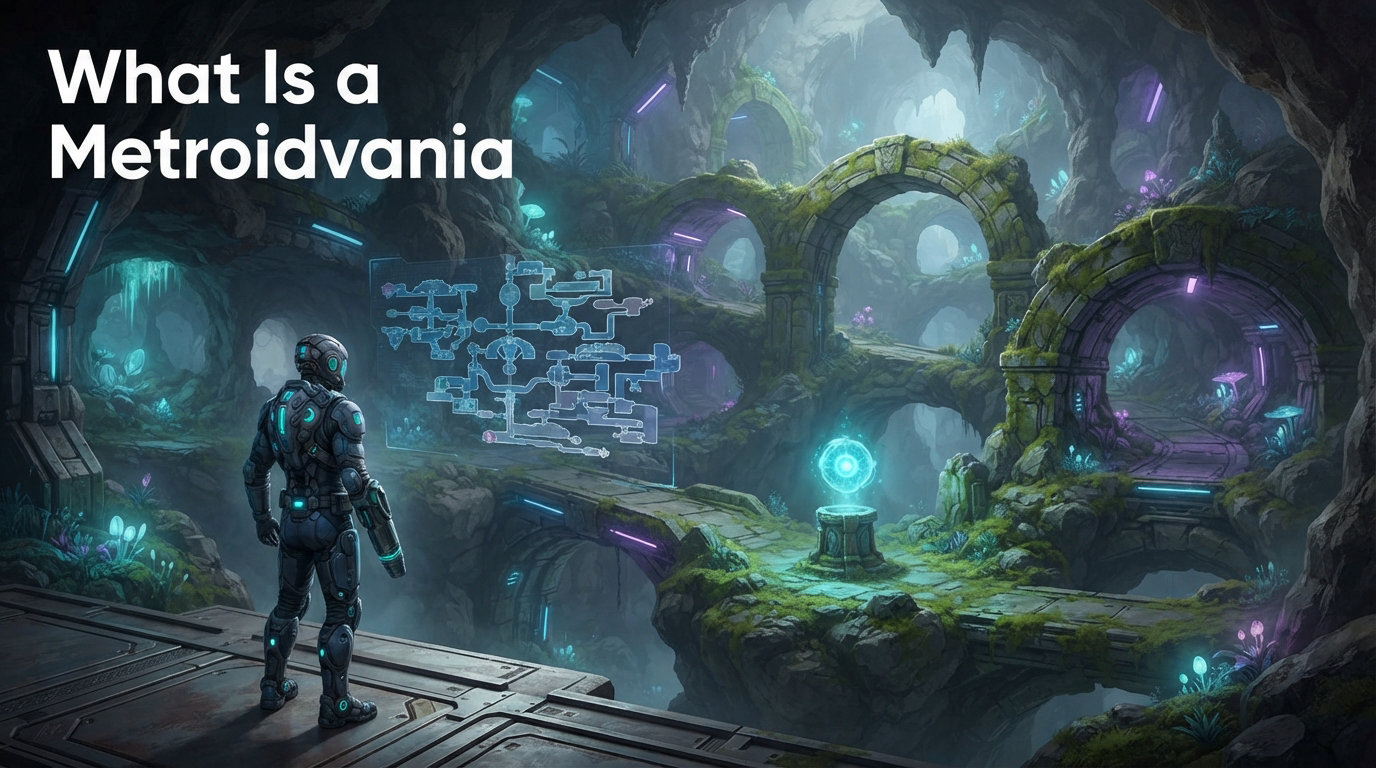
The short answer: a Metroidvania is a video game subgenre built around non-linear exploration and ability-gated progression. You explore one large, interconnected world, and certain areas stay locked until you find a specific power-up or item. Once you grab that upgrade — say, a double jump or a dash — you backtrack to previously visited areas and open new paths.
The genre gets its name from two pioneering franchises: Metroid (Nintendo, 1986) and Castlevania (specifically Castlevania: Symphony of the Night, 1997). Developers borrowed the best ideas from both, and fans needed a word for the result. Metroidvania stuck.
I have played dozens of these games over the years — from the 8-bit original to modern indie darlings — and the genre remains one of my absolute favorites. There is something deeply satisfying about spotting a mysterious door early on, then returning hours later with the right tool to finally crack it open. That eureka moment never gets old.
This guide breaks down everything you need to know. We will cover the definition, the origin story, the core characteristics, the key mechanics, popular examples, and the debates that still divide the community.
Table of Contents
What Is a Metroidvania?
A Metroidvania is a subgenre of action-adventure games defined by two pillars: interconnected world design and ability-gated progression. Unlike linear games that funnel you from level 1 to level 10, a Metroidvania drops you into a single, continuous map and lets you roam. The catch? You cannot reach everywhere right away.
Progression is gated behind abilities. You might see a gap too wide to jump across early in the game. Hours later, you find a dash ability that lets you cross it.
That simple loop — explore, get blocked, find an upgrade, return, break through — is the heartbeat of every Metroidvania ever made.
Here are the core characteristics that define the genre:
Interconnected world: One large map with no level select screens. Areas loop back on each other through shortcuts and hidden passages.
Ability-gated progression: Specific paths require specific powers. A high wall needs a wall-jump. A cracked floor needs a ground-pound. A dark tunnel needs a light source.
Backtracking: Returning to earlier areas with new abilities to find secrets, items, or entire new zones you could not access before.
Non-linear exploration: The game rarely tells you exactly where to go. You follow curiosity, landmarks, and subtle environmental cues.
Persistent upgrades: Once you earn an ability, you keep it. Your toolkit grows steadily, opening more of the map over time.
This design philosophy is sometimes called “Search Action” in Japan, a term popularized by Nintendo and Konami developers. Western audiences adopted the portmanteau “Metroidvania” instead, and it spread like wildfire across forums and review sites.
Importantly, a Metroidvania is not just a platformer with a big map. The exploration and progression systems are what separate it. A traditional platformer like Super Mario Bros. sends you left-to-right through discrete stages, while a Metroidvania hands you a sprawling world and says, “Figure it out.”
That distinction matters. Many players confuse large 2D platformers with Metroidvanias. The difference comes down to whether progression is locked behind abilities you find through exploration, not just whether the game scrolls sideways.
The Origin of the Term
The word “Metroidvania” is a blend of two game titles: Metroid and Castlevania. Understanding why requires a quick trip back to the 1980s and 90s.
In 1986, Nintendo released Metroid for the NES (Famicom in Japan). It was radical. Instead of scrolling stages, players explored a single interconnected map on the planet Zebes.
Progression depended on finding power-ups like the Morph Ball, Varia Suit, and Screw Attack. You could not reach certain areas without specific upgrades. The game dropped players into an alien world with almost no guidance — a bold design choice for the era.
Super Metroid arrived in 1994 on the Super Nintendo and refined the formula into something close to perfection. It added a deeper map system, more abilities, better atmosphere, and tighter controls. To this day, game designers cite Super Metroid as the template for the entire genre.
A year before Metroid, in 1985, Konami launched Castlevania. The original was a linear action-platformer, but the series evolved over time.
The turning point came in 1997 with Castlevania: Symphony of the Night for the PlayStation. It borrowed Metroid’s exploration formula wholesale — a single connected castle, RPG-style leveling, ability-gated progression, and constant backtracking. Fans and critics noticed the similarity immediately.
The term “Metroidvania” emerged from fan communities and gaming forums in the early 2000s. Players needed a shorthand for games that followed the Metroid and Castlevania: Symphony of the Night template. The portmanteau stuck and eventually became the standard label across reviews, storefronts, and game design discussions.
Some developers prefer the term “Search Action,” arguing it better describes the gameplay loop — you search for items that unlock new actions. But Metroidvania has won the popularity contest. As of 2026, it appears on store tags, Wikipedia, and in everyday gaming vocabulary worldwide.
The naming debate itself reveals something important about this genre: its identity was forged by players, not marketers. Community adoption made it real.
No PR firm coined it. No developer trademarked it. Gamers did, and that grassroots origin is part of why the label feels so organic.
Core Characteristics of a Metroidvania
What separates a Metroidvania from every other action-adventure game? It comes down to a specific set of design pillars. Here is what you should look for when trying to identify one.
Interconnected World Design
The entire game takes place in one continuous, connected map. There are no level select screens or discrete stages. Every area connects to every other area through passages, elevators, teleporters, and hidden shortcuts.
When you open a new route, it physically links to places you have already been. This creates a genuine sense of place — you are not moving through levels, you are learning a world. By the end of the game, you know the map like the back of your hand.
Ability-Gated Progression
This is the defining mechanic. The game blocks your path with obstacles that require specific abilities to bypass. A ledge too high needs a double jump, a barrier of rocks needs a bomb, and a toxic area needs a hazard suit.
You cannot sequence-break these gates easily, though some games allow it. The intended path is: encounter obstacle, remember it, find the relevant upgrade elsewhere, then return to overcome it.
Backtracking
Backtracking is the act of revisiting earlier areas with new powers. It is not busywork — it is the reward loop. When you return to a familiar zone with a new ability, you discover hidden rooms, collectibles, lore entries, or entire new sub-areas that were invisible to you before.
Good Metroidvanias make backtracking satisfying by providing shortcuts, fast-travel systems, and subtle visual cues that hint at where your new power might be useful. The best ones make you want to backtrack rather than forcing you to.
Non-Linear Exploration
The game rarely holds your hand. There may be a general objective, but how you get there is up to you. Multiple paths branch from any given hub.
You might stumble into a late-game area early and get wrecked by tough enemies — a clear signal to come back later when you are stronger. This non-linearity rewards curiosity above all else.
The best moments in the genre come from organic discovery, not following a waypoint marker.
Power-Up Acquisition
Your character starts weak and grows steadily stronger. Each new ability serves double duty: it makes you more powerful in combat and unlocks new traversal options.
The Morph Ball lets you roll through tight tunnels. A grappling hook swings you across chasms. A ground pound shatters weak floors hiding secrets below.
These upgrades are permanent. Once earned, they become part of your expanding toolkit, and the map opens further with each acquisition.
Environmental Storytelling
Most Metroidvanias tell their stories through the environment rather than cutscenes. You piece together what happened by reading item descriptions, finding abandoned logs, observing ruined architecture, and encountering strange creatures. The world itself is the narrative.
This contextual storytelling approach was a hallmark of Super Metroid and reached its peak in games like Hollow Knight. Entire civilizations are revealed through background details and NPC dialogue rather than exposition dumps.
Key Mechanics That Define the Genre
Beyond the high-level characteristics, certain mechanics appear across nearly every Metroidvania. Understanding these helps you recognize the genre instantly, even when a game does not advertise itself as one.
Double Jump
The double jump is almost a genre mascot. Early in the game, you encounter ledges just out of reach, and the message is clear: come back when you can jump higher.
When you finally unlock the double jump, a wave of new paths opens at once. The world suddenly feels smaller in the best possible way.
Dash and Movement Abilities
Dashes, air-dashes, wall-jumps, and slides are common traversal tools. They expand your movement vocabulary and gate access to areas requiring precise navigation.
Games like Hollow Knight and Ori build entire challenge sequences around chaining these abilities together in rapid succession.
Map and Exploration Systems
A Metroidvania map is usually revealed incrementally. You start with a blank or partial map and fill it in by finding map rooms, stations, or specific items. Unexplored areas appear as fog or question marks, teasing the player with unknown territory.
The map interface itself becomes a puzzle tool. Players study it for suspicious gaps, odd shapes, or unreachable rooms — clues that secrets are hiding nearby.
Finding that last hidden room to reach 100% completion is a genre obsession that keeps players hooked for dozens of hours.
Shortcuts and Interconnectivity
As you progress, you unlock shortcuts that connect distant areas. An elevator might link the starting zone to a mid-game region. A bombable wall might create a passage between two formerly separate areas.
These shortcuts reduce travel time and reinforce the world’s cohesion. This interconnectivity is why the genre feels so different from open-world games — in an open world, everything is accessible from the start, but in a Metroidvania, the world opens up gradually and each new connection feels earned.
Boss Encounters as Gates
Many Metroidvanias use bosses as progression gates. Defeating a boss often grants a new ability or opens a new region.
Bosses also serve as skill checks — if you cannot beat one, you are probably underpowered for the areas that lie beyond it. This design creates a natural difficulty curve without the game ever needing to tell you to turn back.
Sequence Breaking
Skilled players sometimes find ways to bypass intended progression through glitches, precise movement, or creative ability use. This is called sequence breaking.
Some developers embrace it, like the Metroid series, which has rewarded creative routing since the beginning. Others patch it out. Speedrunners love games that allow it, because it opens up routing creativity and keeps the community engaged for years.
Save Rooms and Checkpoints
Save rooms or benches serve as safe havens and respawn points. They are strategically placed to balance difficulty with exploration freedom.
In Hollow Knight, benches become iconic community gathering spots in spirit — places where players rest, refill, and plan their next expedition into the unknown.
Popular Metroidvania Examples
The genre spans decades and platforms. Here are some of the most influential and beloved titles that define what a Metroidvania can be:
Metroid (1986) and Super Metroid (1994): The originals. Super Metroid is still considered one of the greatest games ever made and the blueprint for the entire genre.
Castlevania: Symphony of the Night (1997): The game that completed the formula. Its RPG elements and gothic exploration set the standard for everything that followed.
Hollow Knight (2017): The modern indie benchmark. Its hand-drawn world of Hallownest is sprawling, gorgeous, and brutally challenging.
Ori and the Blind Forest (2015) and Ori and the Will of the Wisps (2020): Stunning visual storytelling with fluid, emotional platforming.
Axiom Verge (2015): A love letter to retro Metroid with a glitchy, sci-fi horror atmosphere.
Blasphemous (2019): A dark, gothic action game with Metroidvania exploration elements and Souls-like combat.
Guacamelee! (2013): A luchador-themed brawler-platformer with vibrant, Mexican-folklore-inspired Metroidvania design.
Metroid Dread (2021): Nintendo’s long-awaited return to 2D Metroid, bringing the series to modern hardware with polished, tense gameplay.
These titles showcase the genre’s range — from eerie sci-fi to colorful brawlers to hand-drawn insect kingdoms. What unites them all is that same core loop: explore, find a power, backtrack, and discover something you never knew was there.
If you are new to the genre and wondering where to start, Hollow Knight is the most commonly recommended entry point. It is accessible on nearly every platform, features generous exploration freedom, and introduces all the core mechanics in a way that teaches without hand-holding.
3D Metroidvanias and the Genre Debate
Not every Metroidvania is a 2D side-scroller. This surprises many newcomers who associate the genre strictly with side-scrolling pixel art. The community regularly debates which games qualify, and the conversation gets heated.
Metroid Prime (2002) proved the formula works brilliantly in first-person 3D. You still explore an interconnected world, find ability-gated upgrades, and backtrack constantly — just from a first-person perspective.
Nintendo followed up with Metroid Prime Remastered and the highly anticipated Metroid Prime 4, both confirming that 3D Metroidvania design is alive and well as of 2026.
The debate gets especially heated with games like Dark Souls. It has an interconnected world where shortcuts loop areas together, progression requires defeating bosses to unlock new paths, and players backtrack constantly.
Many fans argue Dark Souls is a 3D Metroidvania at its core. Others insist it belongs exclusively to the Souls-like genre and reject the comparison entirely.
Then there is Zelda. This is the comparison that frustrates the r/metroidvania community the most. Zelda games feature exploration and item-based progression, but the key difference is structure.
Most Zelda titles use discrete dungeons and an overworld rather than a single, fully interconnected map. The backtracking is also minimal — once you clear a dungeon, you rarely return to it. This is why most genre enthusiasts agree that Zelda is an action-adventure game, not a Metroidvania.
Forum discussions reveal genuine fatigue around these debates among long-time fans. But they also reveal passion — people care deeply about what counts because the label carries meaning.
My take: if a game has interconnected world design and ability-gated backtracking at its core, it shares DNA with the genre. Genres blur, and the best games often wear multiple labels comfortably.
Modern Metroidvanias have also pushed into accessibility territory. Games like Ori and the Will of the Wisps offer difficulty options and assist modes, making the genre more welcoming to players who might find classic entries too punishing.
This evolution matters. The genre’s core appeal — exploration and discovery — should be available to as many players as possible.
FAQs
What qualifies as a Metroidvania?
A Metroidvania must feature an interconnected world design, ability-gated progression, and meaningful backtracking. The player explores a large connected map where certain areas are blocked until they acquire specific power-ups or abilities, which then open new paths when they return to earlier locations.
What is the difference between a platformer and a Metroidvania?
A traditional platformer sends players through discrete, linear levels from start to finish. A Metroidvania features one interconnected world with no level select, and progression is gated behind abilities the player must find through exploration. Backtracking and non-linear discovery separate the two genres.
Why is Hollow Knight a Metroidvania?
Hollow Knight is a Metroidvania because it features a single interconnected world (Hallownest), ability-gated progression where new movement powers unlock new areas, and extensive backtracking to discover hidden secrets and paths. Players start limited and grow their toolkit through exploration, which is the genre’s core loop.
Is Zelda a Metroidvania?
No, most Zelda games are not considered Metroidvanias. While Zelda features item-based progression, it uses discrete dungeons and an overworld rather than one fully interconnected map, and backtracking is minimal. Zelda belongs to the action-adventure genre, though it shares some design DNA with Metroidvanias.
What was the first Metroidvania game?
Metroid, released by Nintendo in 1986 for the NES, is considered the first game to establish the core Metroidvania formula. It featured a single interconnected map, ability-gated progression, and backtracking. The term itself was coined later, after Castlevania: Symphony of the Night (1997) adopted the same design.
Conclusion
So, what is a Metroidvania? At its heart, it is a genre about discovery — exploring an interconnected world, earning abilities that unlock new paths, and backtracking to uncover secrets you could not reach before.
Born from Metroid (1986) and Castlevania: Symphony of the Night (1997), it has grown into one of gaming’s most beloved and enduring design philosophies.
Whether you are a newcomer starting with Hollow Knight or a veteran who played Super Metroid back in 1994, the genre offers something rare: the thrill of earning your way deeper into a world that genuinely rewards curiosity. Pick a game from the examples above, grab a map, and start exploring. The path forward is yours to find.