
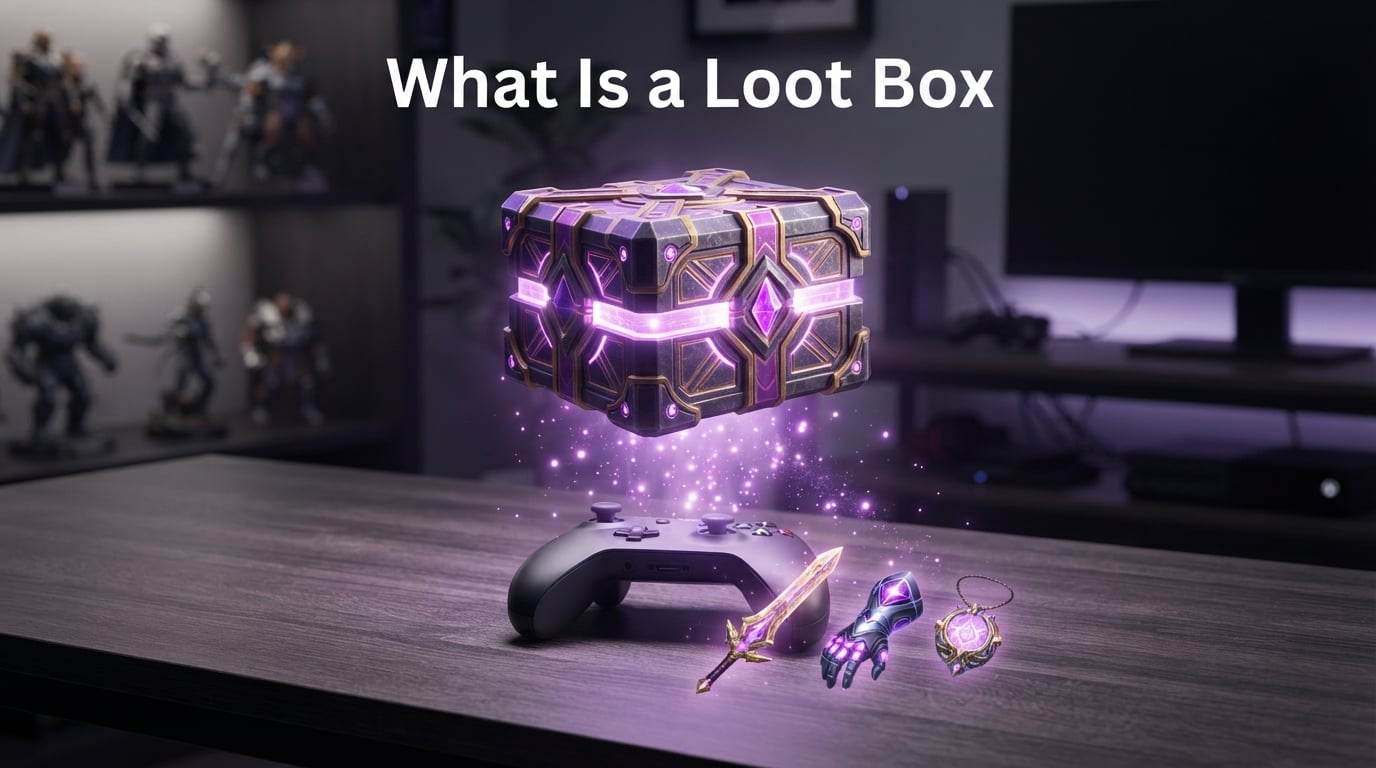
A loot box is a consumable virtual item in a video game that you open to receive a randomized selection of further virtual items, such as skins, weapons, characters, or cosmetics. You can earn these digital crates through gameplay or buy them with real money as a microtransaction. In 2026, loot boxes remain one of the most debated features in modern gaming, and understanding what they are matters whether you play, parent a player, or just want to know where the industry is headed.
I have spent the last several months digging through research papers, regulatory filings, and forum threads to put together this guide. I want to give you a clear, honest answer to the question what is a loot box and explain why the answer is more complicated than most articles suggest.
Table of Contents
What Is a Loot Box?
A loot box is a mystery bundle of virtual items inside a video game that delivers randomized rewards when opened. Think of it as a digital trading card pack or a surprise egg toy: you pay (in time or money), you crack it open, and you find out what is inside. Some loot boxes drop cosmetic items like character skins or emotes, while others unlock gear that affects how the game plays.
The loot box concept goes by several names. Developers call them loot crates, prize crates, treasure chests, card packs, or simply “packs” depending on the game. Mobile games borrowed the Japanese term gacha for the same mechanic, named after the toy capsule machines that dispense random figures. Whether you see it called a loot box in Overwatch or a pack in FIFA Ultimate Team, the underlying idea is identical: pay, randomize, reveal.
To answer what is a loot box in gaming in one line: it is a chance-based microtransaction that gates cosmetic or gameplay content behind a randomized reward system. That single sentence captures most of what makes loot boxes controversial, which we will get into shortly.
Key terms you should know
- Microtransaction: A small in-game purchase, usually between 99 cents and $20, that unlocks digital content.
- Drop rate: The published (or unpublished) probability of receiving a specific item from a loot box.
- Rarity tier: A category like Common, Rare, Epic, or Legendary that signals how often an item appears.
- Cosmetic: An item that changes appearance but does not affect gameplay, like a skin or emote.
How Loot Boxes Work: The Three-Step Process
Loot boxes work through a simple three-step cycle: acquire, open, and receive. Understanding each step shows you where the design choices shape both the player experience and the controversy.
Step 1: Acquisition
You get a loot box in one of two ways. Either you earn it by playing the game (completing matches, leveling up, finishing daily challenges) or you buy it directly with real money. Most modern games blend both: free boxes keep casual players engaged, while paid boxes drive revenue. FIFA Ultimate Team, for example, hands out free packs for winning matches but also sells premium packs for $10 to $30 a pop.
Step 2: Randomization
When you open the box, a random number generator (often a pseudo-random algorithm) selects what you receive. Items are weighted by rarity. A typical Overwatch loot box, for example, might give you four items, with each Legendary skin having a tiny chance like 1 in 200 while Common sprays have a near-certain chance like 1 in 5. The publisher controls those odds, and the math is rarely disclosed to players before the box is opened.
Step 3: Contents Revealed
Once the random roll finishes, the loot box “pops” with an animation. Rare items get flashy reveals with sound and light effects; common items get a quick, plain reveal. This reveal animation is not just decoration. It is a carefully designed hit of feedback that research has linked to dopamine release, the same neurological pathway that slot machines trigger. That is a major reason loot boxes are compared to gambling.
Here is the part many players miss. Loot boxes are not legally required to disclose their odds in every country, and even when publishers do publish drop rates, those rates are often opaque or buried in fine print. Belgium forced publishers to reveal drop rates back in 2018, and most global publishers now list them, but the listing itself does not solve the underlying problem of chance-based monetization.
A Brief History of Loot Boxes
Loot boxes are not as new as people think. Random in-game rewards have existed since the 1980s. The 1985 NES game Gauntlet dropped random treasure when you killed enemies, and Diablo II randomized loot drops throughout the 2000s. What changed is the addition of real-money purchases and the bundling of those drops into discrete boxes.
The modern loot box traces back to three key moments:
- 2007: MapleStory, a free-to-play MMO, sells “gacha” capsules that grant random cosmetic items.
- 2010: Team Fortress 2 introduces crates that drop random items and can be opened with keys bought for real money.
- 2017: Star Wars Battlefront II sparks global outrage when players realize progression is locked behind pay-to-win loot boxes, leading to temporary removal of the system before launch.
By 2018, surveys showed more than 60% of top-grossing mobile games used loot boxes or similar randomized purchase mechanics. Today, in 2026, nearly every major live-service game, from Call of Duty to Genshin Impact, includes some form of loot box or gacha pull. The mechanic has become one of the most profitable monetization tools in gaming history, generating billions of dollars a year worldwide.
Are Loot Boxes Gambling? The Core Controversy
Yes, loot boxes function a lot like gambling, even when they are not legally classified as such. The comparison is the heart of why what is a loot box has become a public health and policy question, not just a gaming trivia one.
Here is why researchers, regulators, and parents draw the parallel:
- Real money in, random reward out: You pay cash with no guarantee of value. That mirrors a slot machine.
- Variable ratio reinforcement: Rewards arrive on an unpredictable schedule, which is the exact reinforcement pattern that psychologists have linked to compulsive behavior for decades.
- Near-miss effect: Loot box reveals often show “almost got it” moments, like a duplicate Legendary skin right next to a new one, which encourages another purchase.
- Sunk cost loop: Once you have spent $200 on packs, leaving empty-handed feels wasteful, so you keep going.
Plenty of academic work backs this up. A 2017 study in Nature Human Behaviour found loot box spending correlated with problem gambling severity, even after controlling for general gaming habits. A 2022 follow-up review concluded that “loot boxes meet the structural criteria for gambling” in most jurisdictions. In 2023, a peer-reviewed paper in PLOS One estimated that roughly 1 in 20 gamers showed behaviors consistent with gambling disorder linked to loot boxes.
The 2024 EA class action lawsuit pushed the conversation further. Plaintiffs alleged that EA’s Ultimate Team pack odds were misleading and that the publisher used design tricks to push players toward higher-priced bundles. EA settled for an undisclosed sum in late 2024. The settlement did not change the legality of loot boxes in the US, but it did open the door to more private litigation in 2026.
That said, not everyone agrees loot boxes are gambling. Publishers argue that you always receive an item of some value, so it is not a “wager.” Some games also let players earn loot boxes for free, which removes the cash-out element. These arguments have not held up well in courts or with regulators in Belgium, the Netherlands, and a growing list of other countries.
Where Are Loot Boxes Banned or Regulated?
Loot boxes are not universally illegal, but several countries have moved to restrict them. Here is the regulatory landscape in 2026.
Belgium and the Netherlands
Belgium led the way in 2018, when the Belgian Gaming Commission ruled that loot boxes sold by Blizzard, EA, and Valve constituted unlicensed gambling. The companies were ordered to remove paid loot boxes from games sold in Belgium, and both Overwatch and FIFA Ultimate Team complied. The Netherlands followed in 2019 with similar rulings, though enforcement has been looser in practice.
United Kingdom
The UK has not banned loot boxes outright, but a 2022 House of Commons report recommended that they be regulated under gambling law. In 2024, the UK government published a response accepting some recommendations but stopping short of an outright ban. Loot boxes remain legal in the UK but must follow disclosure rules and age-rating guidance.
Australia
Australia’s classification system rates games with loot boxes as M (Mature), and the Australian government has launched ongoing inquiries into whether loot boxes should be reclassified as gambling. As of 2026, there is no national ban, but the conversation is active.
United States
The US has no federal loot box law. A 2019 Senate bill called the “Protecting Children from Abusive Games Act” stalled in committee. State-level action has been limited. The 2024 EA settlement and several state attorney general inquiries signal that regulation may be coming, but for now, loot boxes remain legal across the US.
China and Asia
China requires publishers to publicly disclose drop rates, a policy in place since 2017. South Korea banned loot boxes for players under 16 in 2024. Japan requires publisher-level transparency but does not treat loot boxes as gambling. Mobile gacha games in Asia often include “pity systems,” guaranteeing a rare item after a fixed number of pulls, which is one workaround publishers use to avoid direct gambling classification.
The trend is clear: more countries are tightening rules every year, especially for minors. If you want to know whether loot boxes are legal in a specific market, check your local classification board.
Popular Games That Use Loot Boxes
If you have played a major online game in the last decade, you have almost certainly seen a loot box. Here are the most famous examples.
- FIFA / EA Sports FC Ultimate Team: Paid packs containing random player cards. The single largest loot box ecosystem in console gaming, with billions in yearly revenue.
- Overwatch and Overwatch 2: Originally sold loot boxes with cosmetics; Overwatch 2 removed them in 2022 in favor of a direct-purchase Battle Pass.
- Counter-Strike 2 (CS:GO): Cases that drop free and require a $2.50 key to open, producing a real-money skin market that is effectively a secondary gambling economy.
- Destiny 2: “Engrams” that drop from gameplay, with Bright Engrams available for purchase. Bungie also publishes full drop rate percentages.
- Fortnite: Switched away from paid loot boxes in 2019. Now uses a flat Item Shop and Battle Pass.
- Genshin Impact and mobile gacha: Uses “Wishes” that work like loot boxes. Players spend premium currency on randomized characters and weapons, with pity timers that guarantee rare drops.
Notice that several big publishers, including Blizzard with Overwatch 2 and Epic with Fortnite, have voluntarily removed paid loot boxes. Their stated reason is consumer pressure and regulatory uncertainty. Other publishers, especially EA, have stuck with the model and tweaked how odds are presented.
The Psychology Behind Loot Box Design
Loot boxes are not just a pricing trick. They are a behavioral design system that borrows directly from slot machines and skinner-box psychology. If you are asking why are loot boxes controversial, this is the part most articles skip.
Variable ratio reinforcement
Rewards that arrive unpredictably are the most addictive form of operant conditioning. B.F. Skinner showed this in pigeons in the 1950s, and slot machines rely on it. Loot boxes copy the same schedule: you pull, sometimes you win big, most times you win small, and the unpredictability keeps you pulling.
Loot box animations and “juice”
The sound, color, and motion when a loot box opens is not accidental. Designers call this “juice.” Studies using eye-tracking and skin-conductance sensors show players’ physical arousal spikes during rare-item reveals. The bigger the prize, the louder the sound and the longer the animation. That feedback loop trains players to associate spending with excitement.
Loss aversion and pity mechanics
Most loot box systems include some form of “pity” or duplicate protection. You might be guaranteed a Legendary skin after 50 boxes, or duplicates converted into a currency you can eventually trade. These mechanics feel generous, but they actually increase total spending. Players rationalize “just a few more pulls to hit pity,” which keeps them engaged longer than a flat-rate shop would.
I have seen forum threads where players describe opening hundreds of boxes chasing a single skin, then feeling unable to stop. That is not a willpower failure. It is a designed outcome, and recognizing it is the first step toward making better choices.
Tips for Parents: Keeping Kids Safe Around Loot Boxes
If your child plays games with loot boxes, you do not need to panic, but you should be proactive. Here is what actually works.
- Turn off stored payment methods. Most gaming platforms let you require a password for every purchase. Use it. Even a 30-second pause cuts impulse spending dramatically.
- Set spending limits inside the game or platform. PlayStation, Xbox, and Nintendo Switch all allow monthly purchase caps. Steam has Steam Wallet limits. Pick a number your kid agrees to and lock it in.
- Check the age rating. PEGI 18 and ESRB Mature (17+) ratings apply to most games with paid loot boxes. If the game is rated for younger kids but still has paid loot boxes, treat that as a red flag.
- Watch the free loot boxes too. Many parents focus only on paid purchases, but free-to-play progression can still encourage long sessions and emotional investment.
- Talk about odds openly. A simple “the chance of getting the skin you want is around 1 in 100” helps kids see the math, not the marketing.
Reddit threads in r/gaming and r/Overwatch are full of adult players describing how loot boxes ate into their budgets when they were teenagers. The pattern is consistent, and the fixes above are the same ones those players wish their parents had used.
Frequently Asked Questions
Are loot boxes illegal?
Loot boxes are not universally illegal, but they are restricted in several countries. Belgium and the Netherlands have effectively banned paid loot boxes after regulators classified them as gambling. The UK requires disclosure but allows them. The US has no federal ban as of 2026, though several states have launched inquiries and a 2024 EA class action lawsuit opened the door to private litigation. Other countries including China and South Korea impose strict transparency and age rules.
Is loot box gambling?
Loot boxes function much like gambling because you pay real money for a randomized outcome, but most countries do not legally classify them as gambling. They lack a key gambling feature: you cannot legally cash out the items you win. Regulators in Belgium and the Netherlands have nonetheless ruled that loot boxes meet the structural criteria for gambling. Research in 2026 continues to show a link between loot box spending and problem gambling behavior.
Is loot box safe?
Loot boxes are safe in the sense that you cannot get a virus or harm your device, but they are not safe for your wallet or mental health if you cannot control spending. Children and teens are particularly vulnerable because the design borrows from gambling psychology. Use parental controls, set spending limits, and treat loot boxes the way you would treat any age-restricted purchase.
What exactly is a loot box?
A loot box is a virtual container in a video game that holds a randomized selection of items such as skins, weapons, or cosmetics. You earn it by playing or buy it with real money. When you open it, the contents are decided by chance, with rarer items appearing less often. That randomness, combined with real money, is what makes loot boxes controversial.
What is the lootbox concept?
The lootbox concept is the same as a loot box: pay or play to earn a digital container, then open it for randomized in-game rewards. The mechanic is also called a loot crate, prize crate, gacha pull, or card pack depending on the game. The core idea is chance-based reward gated behind a microtransaction.
Why are loot boxes controversial?
Loot boxes are controversial because they expose players, including minors, to gambling-like mechanics. Critics argue that randomized paid rewards exploit variable ratio reinforcement, a psychological pattern known to drive compulsive behavior. Several countries have moved to regulate or ban them, and a 2024 EA class action lawsuit in the US added fuel to the debate.
Final Thoughts on What Is a Loot Box
So, what is a loot box? It is a chance-based virtual reward system that has reshaped the business of gaming over the last 15 years. For players, it offers a thrill that flat-priced shops do not. For publishers, it is one of the most profitable monetization tools ever built. For parents, regulators, and researchers, it is a behavioral risk that needs clearer rules.
If you play games, treat loot boxes like any other discretionary spending: set a budget, stick to it, and walk away when the math stops making sense. If you parent a gamer, use platform-level controls and have honest conversations about odds. The mechanic is not going away in 2026, but a smarter, more transparent version of it can coexist with healthy gaming habits.
I will keep updating this guide as more countries act and as more research comes out. Drop a comment if you want me to dig into a specific game, country, or study next.