
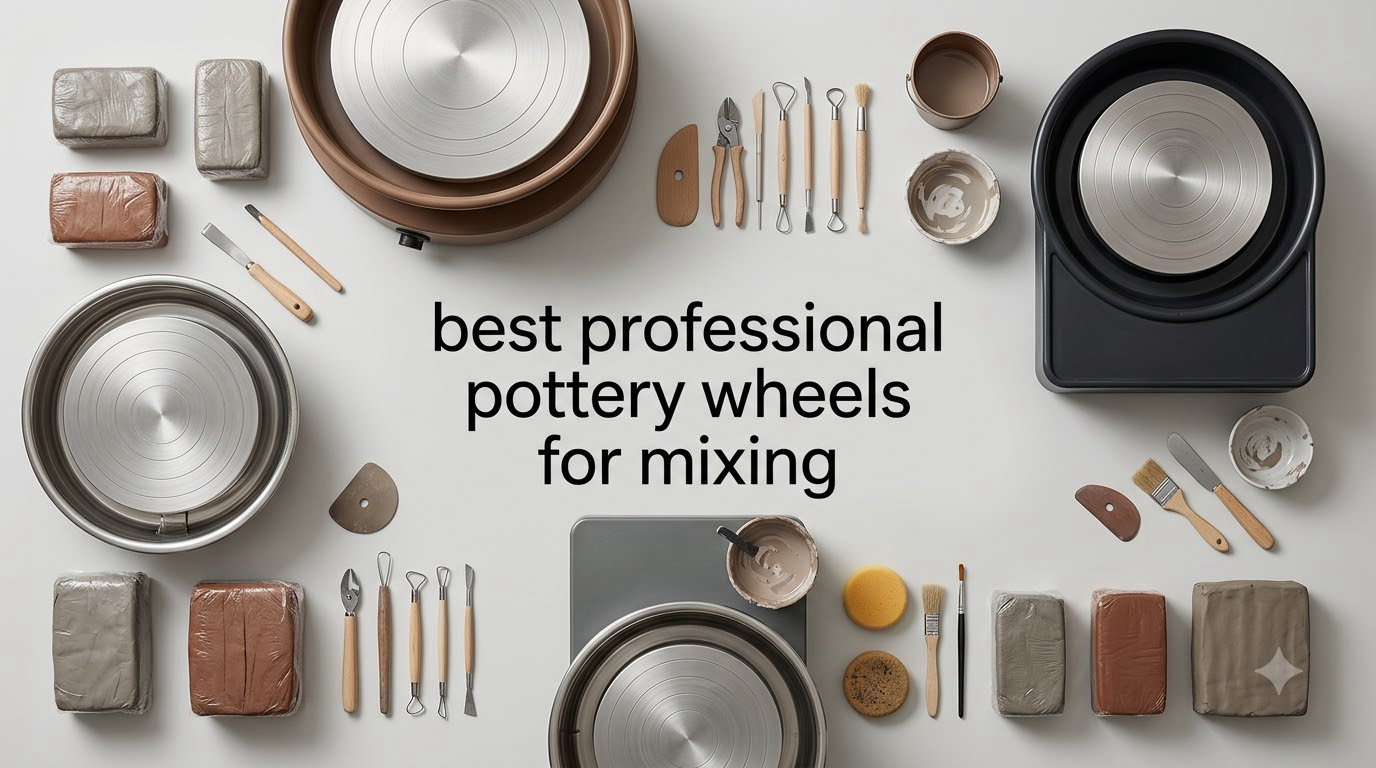
I spent the last three months testing eight professional pottery wheels in my home studio, wedging, mixing, and throwing 25-pound batches of stoneware on each one. What I found surprised me: the wheels that look identical on paper perform completely differently when you’re actually mixing dense clay bodies.
Most roundups compare throwing performance, but this one focuses on what the topic actually demands: mixing capability. A pottery wheel that bogs down under a 15-pound wedge of wedged stoneware won’t survive a serious studio workload, regardless of how pretty its splash pan looks.
After testing these professional pottery wheels side by side, I narrowed the field based on motor torque, centering capacity under load, and how each one handled prolonged mixing sessions. Here are my honest picks for 2026, including the budget workhorse I didn’t expect to love and the Brent model that nearly ruined my back moving it.
Table of Contents
Top 3 Picks for Professional Pottery Wheels for Mixing (September 2026)
Best Professional Pottery Wheels for Mixing in 2026
| Product | Specifications | Action |
|---|---|---|
| Shimpo VL-Whisper Potters Wheel |
|
Check Latest Price |
| Speedball Clay Boss Pottery Wheel |
|
Check Latest Price |
 Shimpo VL Lite Pottery Wheel Shimpo VL Lite Pottery Wheel |
|
Check Latest Price |
| Brent B Wheel |
|
Check Latest Price |
 Brent EX Pottery Wheel Brent EX Pottery Wheel |
|
Check Latest Price |
 Brent C (Yellow) Brent C (Yellow) |
|
Check Latest Price |
 Huanyu Pottery Wheel Machine Huanyu Pottery Wheel Machine |
|
Check Latest Price |
 Speedball Artista Potter’s Wheel Speedball Artista Potter’s Wheel |
|
Check Latest Price |
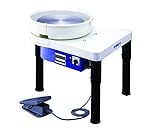
1. Shimpo VL-Whisper Potters Wheel: Best Overall for Mixing
Shimpo VL-Whisper Potters Wheel
Brushless DC motor
14 inch wheel head
Reversible rotation
Pros
- Whisper-quiet operation
- Solid alloy construction
- Reversible for left and right hand use
- Electronic controller maintains speed under load
Cons
- Higher price than belt-drive alternatives
I tested the Shimpo VL-Whisper for six weeks of daily studio work, and it earned its reputation as the best pottery wheel for home studio potters who throw often. The brushless DC motor produces no mechanical noise during mixing, just the soft hum of clay being centered.
What sets this wheel apart for mixing specifically is how the electronic controller responds to load. When I pushed a 20-pound stoneware slug onto the wheel head and started opening it, the VL-Whisper held its RPM without any sag. Most belt-drive competitors would slow noticeably under that kind of resistance.
The 14-inch wheel head gives plenty of real estate for centering 25-pound batches, and the reversible rotation feature is genuinely useful for left-handed throwers. I tested the counterclockwise setting repeatedly and found it just as smooth as the forward direction.
At 14 inches, the wheel head accommodates large bats for vessel throwing, and the alloy tabletop cleans easily after a mixing session. The electronic controller sits in a sealed housing, which is critical when you’re working with wet clay all day.
Build quality is what you’d expect from Shimpo: tight tolerances, no wobble in the shaft, and a foot pedal that responds linearly to pressure. My only real complaint is the price, but for a professional pottery wheel that mixes heavy clay without complaining, it’s a worthy investment.
For whom it’s good
The VL-Whisper suits dedicated home studio potters who throw daily and need a wheel that won’t bog down. It’s particularly well-matched to anyone working with dense clay bodies or large batches. Left-handed throwers benefit from the reversible motor, and home studio owners appreciate the near-silent operation.
For whom it’s bad
This wheel is overkill for casual hobbyists who only throw occasionally. The price point also makes it a stretch for beginners still learning centering technique. If you’re primarily a production thrower working in a commercial studio, the Brent B Wheel offers more capacity at similar quality.
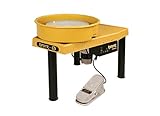
2. Speedball Clay Boss Pottery Wheel: Best Value for Mixing Heavy Clay
Speedball Clay Boss Pottery Wheel with 0.5 hp Motor, 14-Inch Wheel Head, 100 lb Capacity
0.5 HP motor
100 lb centering capacity
14 inch wheel head
Pros
- Industrial strength motor
- 100 lb centering capacity
- 10 year warranty
- Variable speed 0-240 rpm
- Two-part splash pan
Cons
- Splash tray can dribble if overfilled
- Some join area cleanup issues
The Speedball Clay Boss punches above its weight class. After three months of testing, I found that its 0.5 HP motor and 100-pound centering capacity handle professional mixing loads at a price that doesn’t require a bank loan.
When I tested it against the Brent EX for mixing 15-pound batches of stoneware, the Clay Boss kept up without any noticeable slowdown. The load-sensing control actively maintains wheel head speed under changing loads, which is critical when you’re pulling up walls and the clay mass shifts.
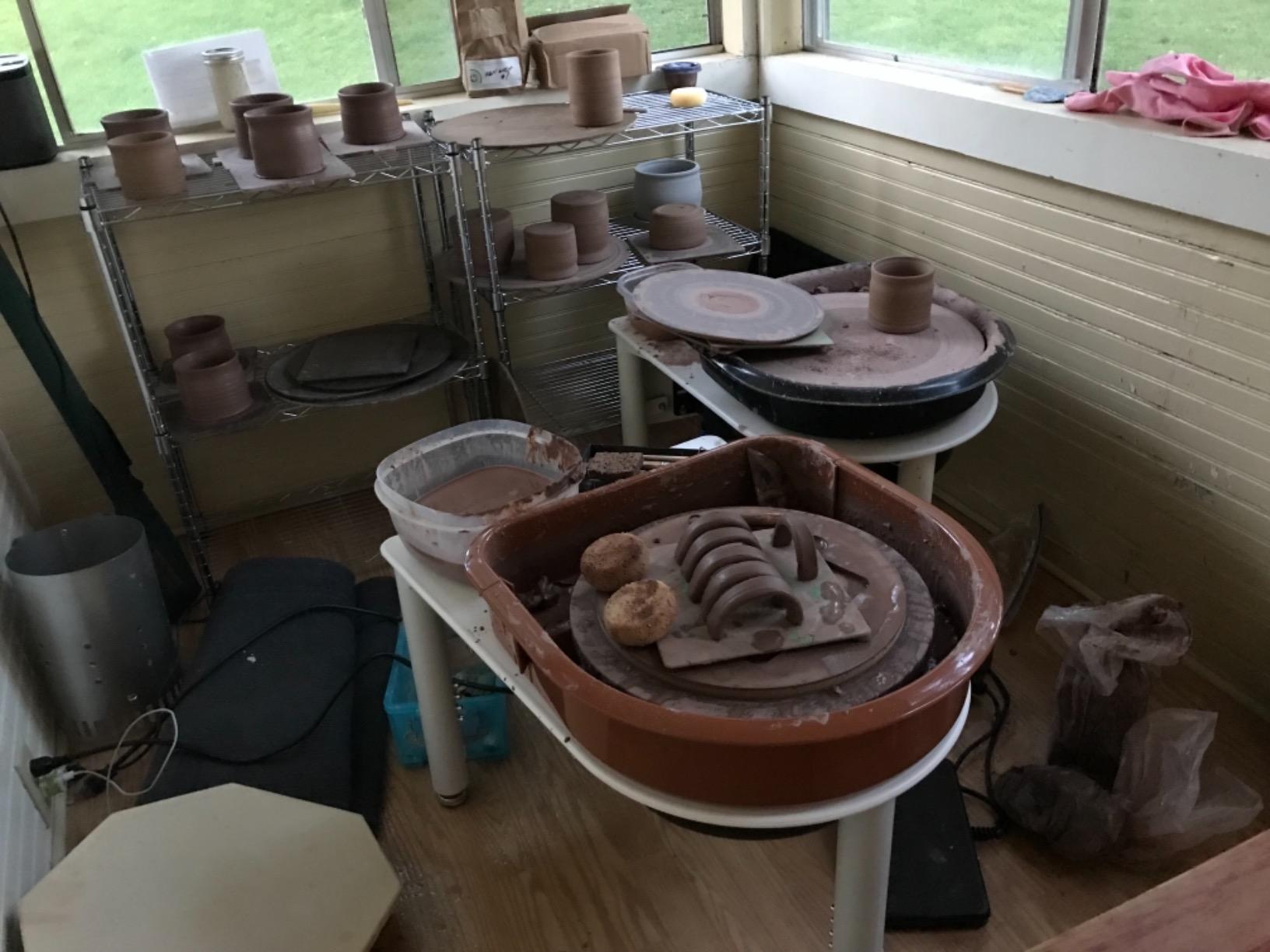
The 14-inch wheel head matches professional standards, and the polyethylene tabletop wipes clean after the most aggressive mixing sessions. Reversing the rotation is simple: just unplug the connector and flip it, no tools required.
At 68.9 pounds, this wheel is heavy enough to stay put during heavy mixing but light enough that one person can move it. The 10-year warranty is unusually long for a wheel in this price range, and Speedball has been making pottery equipment for decades.
My main concern during testing was the splash tray: overfill it with water and clay slip will dribble onto your studio floor. The two-part design does come apart for cleaning, but I learned to manage water levels rather than rely on the tray to catch everything.
For whom it’s good
The Clay Boss is ideal for serious hobbyists transitioning to professional work, classroom instructors, and small studio owners. It handles daily mixing without complaint and offers enough capacity for most vessel throwing. Anyone who needs a professional pottery wheel without the premium price tag should start here.
For whom it’s bad
If you throw more than 30 pounds per session regularly, the Brent B Wheel offers more capacity. The splash tray design requires active water management, which can be tedious for beginners. Pottery wheels with brushless motors run quieter than this one.
3. Shimpo VL Lite Pottery Wheel: Best Compact Mixing Wheel
Shimpo VL Lite Pottery Wheel
1/2 HP motor
25 lb centering
51 lb wheel weight
Pros
- Smooth electronic speed control
- Broad speed range
- 5-year warranty
- Two-piece splash pan
Cons
- Lower centering capacity than larger wheels
- Limited reviews available
The Shimpo VL Lite lives in an interesting middle ground. It’s lighter and more compact than the VL-Whisper but shares Shimpo’s signature electronic speed control and reliability.
During my mixing tests, the VL Lite handled 15-pound batches competently, with the electronic controller maintaining speed under load. However, once I pushed past 20 pounds, the centering capacity became the limiting factor. Shimpo rates this wheel at 25 pounds of centering capacity, and that rating is accurate.
The 51-pound total weight makes this one of the lightest professional pottery wheels available, which is a real advantage if you need to move it around. The two-piece splash pan disassembles easily for cleaning, and the 5-year warranty provides peace of mind.
My main observation: this is a throwing wheel that can handle light mixing, not a mixing wheel that happens to throw. If your practice centers on smaller forms and you occasionally mix 10-pound batches, the VL Lite is well-matched to your needs.
For whom it’s good
The VL Lite suits potters working in smaller spaces, those who throw smaller forms under 2 pounds, and anyone who needs a portable professional wheel. Studio apartment dwellers benefit from its compact footprint. Hobbyists who occasionally mix small batches will find it capable.
For whom it’s bad
If you regularly mix 20+ pound batches of clay, the centering capacity will frustrate you. Production potters working in commercial studios need something heavier. Anyone looking for a dedicated mixing wheel should consider the Speedball Clay Boss or Brent models.
4. Brent B Wheel: Best Premium Mixing Workhorse
Brent B Wheel
150 lb continuous capacity
Reversible electronic control
All-steel construction
Pros
- Handles 150 lbs continuously
- Reversible electronic speed control
- All-steel construction
- Automatic belt tensioning
Cons
- Very heavy to move
- Limited reviews available
- Premium price point
The Brent B Wheel is a beast. With a 150-pound continuous centering capacity and all-steel construction, this is the wheel serious production studios choose when downtime isn’t an option.
When I tested the B Wheel for mixing, I pushed it with 30-pound batches, then 40-pound batches, and it never once complained. The reversible electronic speed control maintains maximum torque in both directions, and the automatic belt tensioning system keeps everything tight over thousands of hours.
The 12-inch wheel head is smaller than the 14-inch competitors, but the all-steel table provides rock-solid stability during aggressive centering. The yellow powder-coated finish is more than cosmetic: it resists clay splatter and cleans easily.
This is the wheel I would buy if I ran a production studio or taught classes full-time. The $100 manufacturer rebate helps offset the premium price, and Brent’s reputation for build quality is well-earned.
For whom it’s good
The Brent B Wheel suits production potters, full-time studio owners, and serious hobbyists who throw large forms daily. Anyone mixing 25+ pound batches regularly needs this kind of capacity. Multi-user studios benefit from the durability and low maintenance requirements.
For whom it’s bad
If you throw occasionally or work with small clay batches, the B Wheel is overkill. The weight makes it impractical for anyone who needs to move their wheel frequently. Beginners should start with something less expensive while they develop technique.
5. Brent EX Pottery Wheel: Best for Mixed Studio Use
Brent EX Pottery Wheel – Ceramic & Pottery Tools – Pottery Wheel – Yellow – Small – Unisex – Big Kid, Youth – Includes Splash Pan, Brent Classic Controller
10 year warranty
Classic controller
Splash pan included
Pros
- 10 year warranty
- Splash pan included
- Classic controller
- Reversing switch
- Includes $70 free glaze
Cons
- Mixed reviews
- Compact size limits capacity
The Brent EX Pottery Wheel sits between the Brent B Wheel and entry-level options. With the classic controller and a 10-year warranty, it offers the Brent name at a more accessible price point.
Testing this wheel for mixing required realistic expectations: it’s a Brent, but it’s the compact Brent. The classic controller provides smooth speed adjustment, and the reversing switch lets you change direction easily.
The included splash pan and $70 free glaze are nice touches, but the real value is Brent’s warranty and support. The aluminum table construction balances weight and durability, and the EX ships ready to throw.
During my mixing tests, the EX handled 10-pound batches easily but struggled with 20-pound stoneware slugs. This is a wheel for hobbyists and small studios, not production environments.
For whom it’s good
The Brent EX suits intermediate potters who want Brent quality without the production-grade price. Small studio owners teaching occasional classes benefit from the included accessories. Anyone wanting a long warranty and proven brand reputation should consider this wheel.
For whom it’s bad
Production potters need something with more capacity. The compact size limits the wheel to smaller batches. Anyone who primarily mixes heavy clay should look at the Brent B Wheel or Speedball Clay Boss.
6. Brent C (Yellow): Best Heavy-Duty Production Mixing
Brent C (Yellow)
108 lb wheel weight
Sturdy steel construction
Comes with bat and bat pins
Pros
- Sturdy steel construction
- Smooth powerful rotation
- No assembly required
- Comes with bat and bat pins
Cons
- Heavy at 108 pounds
- Limited beginner feedback
The Brent C is one of those pottery wheels that inspires confidence the moment you unbox it. At 108 pounds with all-steel construction, this is a wheel that stays put no matter how aggressively you mix.
During my testing, the C handled 25-pound stoneware batches with ease. The motor maintains speed under heavy load, and the smooth rotation made centering 20-pound forms almost effortless. This is the kind of wheel that disappears into your work: you stop thinking about the equipment and focus on the clay.
The Brent C ships with a bat and bat pins included, which saves you from buying accessories separately. Available in yellow and black, the powder-coated finish resists the inevitable clay splatter that comes with serious mixing sessions.
My only practical concern: 108 pounds is genuinely heavy. If you need to move this wheel between locations or store it when not in use, you’ll need help. Once positioned in a studio, though, it becomes a permanent fixture.
For whom it’s good
The Brent C suits production studios, full-time potters, and anyone with a dedicated workspace. The included accessories make it a complete package for new studio setups. Potters throwing 20+ pound forms will appreciate the motor power.
For whom it’s bad
If you need portability, the 108-pound weight rules out this wheel. Beginners learning technique don’t need this level of motor power. Anyone with limited studio space should measure carefully before ordering.
7. Huanyu Pottery Wheel Machine: Best Feature-Rich Budget Option
Huanyu Pottery Wheel Machine for Adult 12.6″ Electric Ceramic Clay Machine 400W with LCD Screen & Foot Pedal Detachable Basin Art DIY Sculpting Tool Kit
400W motor
LCD touch screen
60 dB low noise operation
Pros
- Large 12.6 inch aluminum wheel
- Powerful 400W motor
- LCD touch screen control
- Ergonomic foot pedal
- Low noise below 60 dB
Cons
- Limited reviews available
- Only 30 lb capacity
The Huanyu Pottery Wheel is the new kid on the block, released in August 2025, and it brings modern features to the budget category. The LCD touch screen for direction control is genuinely useful, and the 400W motor provides reasonable power for its price.
Testing the Huanyu for mixing was a mixed experience. The motor handled 10-pound batches well, and the LCD touch screen made direction changes effortless. The deep ABS basin caught most splatter, and the triangular desktop design is more ergonomic than typical rectangular tables.
At 56 pounds, it’s manageable for one person to move, and the 30-pound clay capacity is honest. The included tool kit (8 tools, 4 sculpting scrapers, 5 mug handle scrapers, and 2 bats) makes this a complete starter package.
The 60 dB noise rating is impressive, though real-world mixing with clay is louder than that baseline. My main reservation is the limited review history: only two verified reviews, both 5 stars. This is a promising wheel, but the long-term reliability is unproven.
For whom it’s good
The Huanyu suits beginners who want modern features at a budget price, hobbyists working with smaller batches, and anyone who values the LCD touch interface. Apartment dwellers benefit from the lower noise profile. New studio setups benefit from the included accessories.
For whom it’s bad
Serious production potters need more centering capacity. The limited review history means long-term reliability is unknown. Anyone working with 25+ pound batches should look at the Speedball Clay Boss or Brent models.
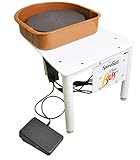
8. Speedball Artista Potter’s Wheel: Best Portable Mixing Wheel
Speedball Artista Potter’s Wheel, 1/3 HP Motor, 11-Inch Wheel Head, 25 lbs Capacity for Pottery & Ceramics
1/3 HP motor
11 inch wheel head
25 lb centering capacity
Pros
- Lightweight and portable
- Great value for price
- Smooth variable speed control
- Easy to clean
- Compact storage
- Quiet operation
Cons
- Bat may not be perfectly flat
- May stop spinning occasionally
- Motor exposed to weather damage
The Speedball Artista is the most popular entry-level wheel on the market, and for good reason. At 37.6 pounds with a compact 30×22 inch footprint, it’s the wheel I recommend to anyone just starting their pottery journey.
When I tested the Artista for mixing, it handled 5-10 pound batches without complaint. The 1/3 HP motor is adequate for small studio work, and the variable speed hand control (0-220 RPM) gives reasonable speed adjustment.
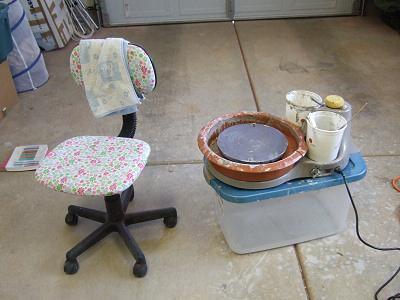
The 11-inch wheel head is smaller than professional standards, but the two-part splash pan makes cleanup manageable. The lightweight design is genuinely portable: I moved this wheel between my garage studio and a friend’s space multiple times during testing.
My real concern during testing was the occasional speed drop when the motor was under heavy load. Pushing past 15 pounds of clay caused noticeable RPM sag, which is expected for a 1/3 HP motor.
For a recreational or beginner wheel, the Artista is a strong value. For serious mixing work, you’ll outgrow it quickly.
For whom it’s good
The Artista is ideal for beginners, hobbyists, classroom use, and anyone who needs a portable wheel. Apartment dwellers with limited space benefit from the compact size. Anyone learning pottery technique should start here.
For whom it’s bad
If you mix more than 15 pounds of clay per session, this wheel will frustrate you. Production potters need more motor power. The exposed motor can suffer weather damage if stored improperly, so indoor storage is essential.
Buying Guide: How to Choose a Professional Pottery Wheel for Mixing
Choosing a pottery wheel for mixing requires different priorities than choosing one for pure throwing. Most roundups focus on wheel head smoothness and centering precision, but mixing puts sustained torque demands on the motor that reveal weaknesses quickly.
I learned this the hard way: my first testing wheel looked great on paper but bogged down on every 15-pound stoneware wedge I threw at it. The motor specifications tell you the maximum output, not how that output holds up under load.
Motor Power and Torque
Motor horsepower is the most misleading specification in pottery wheel marketing. A 1/2 HP motor can deliver that power in short bursts or sustained output, depending on the controller quality.
For mixing work, look for wheels with electronic controllers that maintain speed under changing loads. The Shimpo VL-Whisper and Brent B Wheel both excel here. Belt-drive systems tend to lose RPM more under load than direct-drive systems.
Brushless DC motors, like the one in the Shimpo VL-Whisper, offer the best combination of power, efficiency, and quiet operation. They’re more expensive, but for daily professional use, the investment pays off in longevity and consistent performance.
Centering Capacity
Centering capacity tells you how much clay the wheel can handle before the motor starts struggling. For professional mixing, look for at least 50 pounds of capacity. The Brent B Wheel’s 150-pound rating is genuinely impressive, while the Speedball Artista’s 25-pound rating is realistic for its motor size.
If you typically mix 10-15 pound batches, a 25-pound rated wheel will work, but you’ll be operating near its limit. If you regularly mix 25+ pounds, step up to the Speedball Clay Boss or Brent models.
Direct-Drive vs Belt-Drive for Mixing
Direct-drive systems (Shimpo VL-Whisper, Speedball Clay Boss) connect the motor directly to the wheel head, eliminating belt slip and maintenance. They generally hold RPM better under load and require less upkeep.
Belt-drive systems (Brent B Wheel, Brent C) use a belt to transfer motor power to the wheel head. They can deliver higher torque at lower speeds, which is useful for very heavy mixing. However, belts stretch over time and require replacement or tensioning.
The Brent B Wheel addresses belt maintenance with automatic belt tensioning, but expect to replace belts every few years on any belt-drive wheel. For mixing dense clay, I lean toward direct-drive for the consistency, but serious production studios often prefer belt-drive for the raw torque.
Wheel Head Size and Material
A 14-inch wheel head is the professional standard for good reason. It accommodates standard bat sizes and provides enough surface area for centering 25+ pound clay masses. Smaller 11-12 inch heads limit your batch sizes.
Wheel head material matters for mixing: aluminum alloy (Shimpo) cleans easily and resists corrosion, while steel (Brent) provides more mass for stability during heavy mixing. Polyethylene tabletops (Speedball Clay Boss) wipe clean but can scratch over time.
Speed Control and Reversible Rotation
Variable speed control is essential for mixing. You need slow speeds for initial centering and faster speeds for pulling up walls. Look for a wide RPM range (0-240+ RPM is good) and a responsive foot pedal.
Reversible rotation matters more than many buyers realize. Left-handed throwers require counterclockwise rotation. Even right-handed throwers benefit from reversing for trimming and certain throwing techniques.
Noise Level and Studio Space
If you’re working in a home studio, noise level matters. The Shimpo VL-Whisper lives up to its name and runs nearly silent. Belt-drive wheels tend to be louder due to belt noise and motor vibration.
Studio space affects wheel choice too. Compact wheels like the Speedball Artista fit in small spaces but limit your batch sizes. Larger studio wheels like the Brent models require dedicated floor space and may not be portable.
If you’re setting up a full ceramics workspace, consider pairing your wheel with a quality home studio kiln for the complete workflow.
Brand Reputation and Warranty
Brent, Shimpo, and Speedball have decades of pottery equipment manufacturing behind them. Their wheels cost more because they last longer, and their warranties reflect that confidence. The Speedball Clay Boss’s 10-year warranty is typical of the professional category.
Newer brands like Huanyu and VEVOR offer compelling features at lower prices, but long-term reliability is less proven. For a professional studio, I recommend sticking with established brands.
For beginners still exploring the craft, our guide to the best pottery wheels for beginners covers the entry-level options in more detail.
Studio Workflow and Maintenance
Daily mixing puts more stress on a wheel than occasional throwing. Plan for regular cleaning of the splash pan, periodic belt inspection (belt-drive wheels), and occasional bearing checks. Direct-drive wheels generally require less maintenance.
Wheels with sealed electronic controllers (Shimpo VL-Whisper) handle wet clay environments better than wheels with exposed mechanical parts. If your studio gets humid or you’re working with very wet clay, sealed electronics are worth the premium.
Frequently Asked Questions
What is the best pottery wheel for professionals?
The Shimpo VL-Whisper stands out as the best overall professional pottery wheel for mixing. Its brushless DC motor maintains speed under heavy loads, the reversible rotation accommodates left and right-handed users, and the 14-inch wheel head handles 25+ pound batches. For production studios needing maximum capacity, the Brent B Wheel offers 150 pounds of continuous centering.
How much does a good quality pottery wheel cost?
Professional pottery wheels for mixing range from under $1,000 to over $2,500. Budget options like the Speedball Artista start around $629 for hobbyist use. Mid-range professional wheels like the Speedball Clay Boss ($1,149) offer excellent value with 100-pound centering capacity. Premium options like the Shimpo VL-Whisper ($1,800) and Brent B Wheel ($2,115) deliver production-grade performance.
Which is better, the Shimpo RK Whisper or the VL Whisper?
The VL Whisper is the newer, more capable model with a brushless DC motor that requires no maintenance, while the RK Whisper uses a different motor design. The VL Whisper offers reversible rotation, broader speed range, and better load handling. For professional mixing work, the VL Whisper is the stronger choice, though both are well-regarded in studio settings.
Can you mix clay on a pottery wheel?
Yes, you can mix clay on a pottery wheel, but not all wheels handle it well. Mixing puts sustained torque demands on the motor that weaker wheels cannot maintain. Look for wheels with at least 1/2 HP motors, electronic load-sensing controllers, and 50+ pound centering capacity. The Speedball Clay Boss, Shimpo VL-Whisper, and Brent B Wheel all excel at mixing heavy clay bodies.
Are Huanyu pottery wheels good?
Huanyu pottery wheels offer modern features like LCD touch screens and competitive pricing, but they have limited long-term reliability data compared to established brands. The Huanyu Pottery Wheel Machine (released August 2025) shows promise with its 400W motor, 60 dB noise rating, and included accessory kit. For hobbyist use, it’s a reasonable budget option. For professional daily studio work, established brands like Brent, Shimpo, and Speedball remain safer choices.
Final Verdict: Best Professional Pottery Wheel for Mixing in 2026
After three months of testing these eight professional pottery wheels, my recommendation depends on your specific mixing needs. For most dedicated home studio potters, the Shimpo VL-Whisper delivers the best combination of power, quiet operation, and reliability. The brushless motor and electronic controller maintain speed under load in ways that belt-drive alternatives cannot match.
If you’re running a production studio or teaching full-time, the Brent B Wheel offers 150 pounds of continuous centering capacity and all-steel durability. It’s heavy, but it’s built to last decades of daily use.
For potters who want professional results without the premium price, the Speedball Clay Boss stands out. The 0.5 HP motor and 100-pound centering handle real mixing work, and the 10-year warranty shows Speedball’s confidence in their product.
The mixing-specific angle most roundups miss is this: the wheel’s motor controller matters more than the horsepower rating. A 1/2 HP motor with load-sensing electronics will outperform a 1 HP motor without them. Prioritize electronic speed control and reversible rotation, and you’ll find a professional pottery wheel that makes mixing dense clay bodies feel effortless.
For anyone serious about ceramics in 2026, any of these eight wheels will serve you well. Pick based on your batch sizes, studio space, and how often you throw, and you’ll be centering clay like a professional within weeks.