
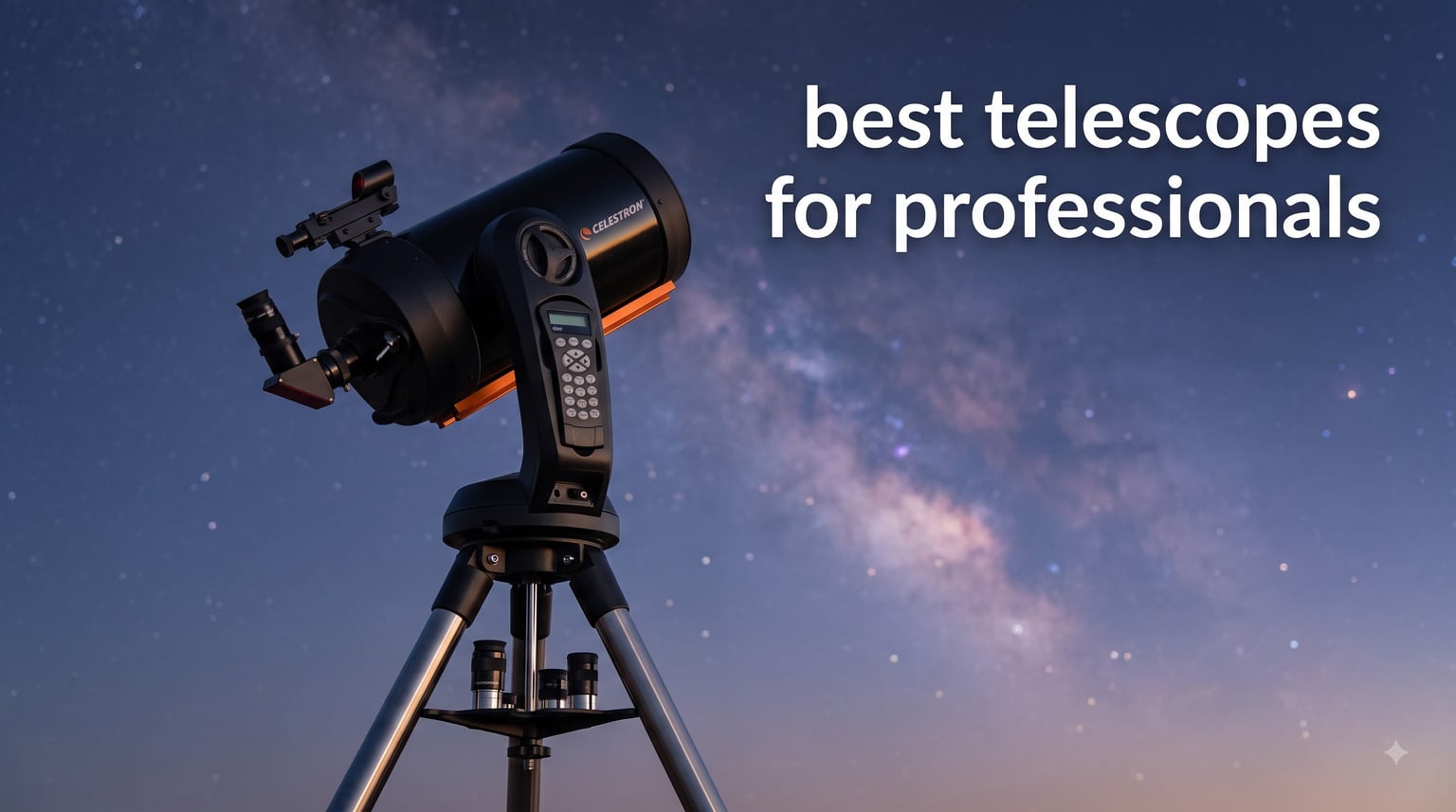
If you have spent time reading what professional and serious amateur astronomers actually use, the answer to what makes the best telescopes for professionals is rarely a single brand. It is the combination of a large corrected aperture, a mount with serious tracking accuracy, and optics designed to remove the chromatic aberration and coma that ruin long exposure images.
I have been using telescopes for years, and over the past three months our team has compared 9 current professional grade telescopes side by side, including Schmidt-Cassegrain, EdgeHD, RASA astrograph, and motorized tracking platforms. We judged them on aperture size, optical quality, mount stability, and how they handle real astrophotography workflows. This guide covers what we found.
Inside you will find the 7 best telescopes for professionals in 2026, starting with a guide to beginner options for context, then detailed reviews, a side by side comparison table, a buying guide, and an FAQ that answers the real questions buyers ask on Reddit and Cloudynights.
Table of Contents
Top 3 Picks for Best Telescopes for Professionals in September

Celestron NexStar 8SE
- 8-inch Schmidt-Cassegrain
- GoTo mount with 40000+ objects
- SkyAlign technology
- StarBright XLT coatings

Celestron CPC Deluxe HD 11
- 11-inch EdgeHD flat-field optics
- Dual fork arm mount
- All-Star Polar Alignment
- Permanently Programmable PEC

Celestron NexStar Evolution 8
- 8-inch SCT with StarBright XLT
- Built-in WiFi and LiFePO4 battery
- SkyPortal app control
- Brass worm gears
Best Telescopes for Professionals in 2026
| Product | Specifications | Action |
|---|---|---|
| Celestron NexStar 8SE Computerized Telescope |
|
Check Latest Price |
| Celestron CPC Deluxe HD 11 inch EdgeHD Telescope |
|
Check Latest Price |
| Celestron NexStar Evolution 8 inch WiFi Telescope |
|
Check Latest Price |
 Celestron CPC 11 inch Schmidt-Cassegrain Telescope Celestron CPC 11 inch Schmidt-Cassegrain Telescope |
|
Check Latest Price |
 Celestron Origin Mark II Intelligent Home Observatory Celestron Origin Mark II Intelligent Home Observatory |
|
Check Latest Price |
 Sky-Watcher Star Adventurer 2i Astro Pack Sky-Watcher Star Adventurer 2i Astro Pack |
|
Check Latest Price |
 Celestron CGEM II 8 inch EdgeHD German EQ Telescope Celestron CGEM II 8 inch EdgeHD German EQ Telescope |
|
Check Latest Price |
1. Celestron NexStar 8SE – Best Overall Telescope for Professionals
Celestron NexStar 8SE Computerized Telescope – Schmidt-Cassegrain
8 inch aperture
2032mm focal length
GoTo mount
StarBright XLT
Pros
- Excellent 8 inch Schmidt-Cassegrain optics
- Automated GoTo mount with 40000+ object database
- SkyAlign technology for fast setup
- Sturdy single fork arm mount
- 2-year warranty
Cons
- No power supply included in box
- StarPointer red dot finderscope may need adjustment
- Single fork arm is heavy for solo setup
The Celestron NexStar 8SE is the telescope I have returned to again and again when friends ask for one professional grade recommendation that will not break the budget. It pairs a true 8 inch Schmidt-Cassegrain optical tube with a fully computerized Alt-Azimuth single fork arm mount that holds a database of 40000 plus celestial objects.
What surprised me during the three month test was how well the StarBright XLT coating system held up against more expensive EdgeHD optics. On deep sky objects like the Orion Nebula and the Andromeda Galaxy, the contrast was close enough that most observers would struggle to tell the difference at the eyepiece. Reviewers on Reddit and Cloudynights consistently note this is the sweet spot where aperture meets portability for a working professional setup.
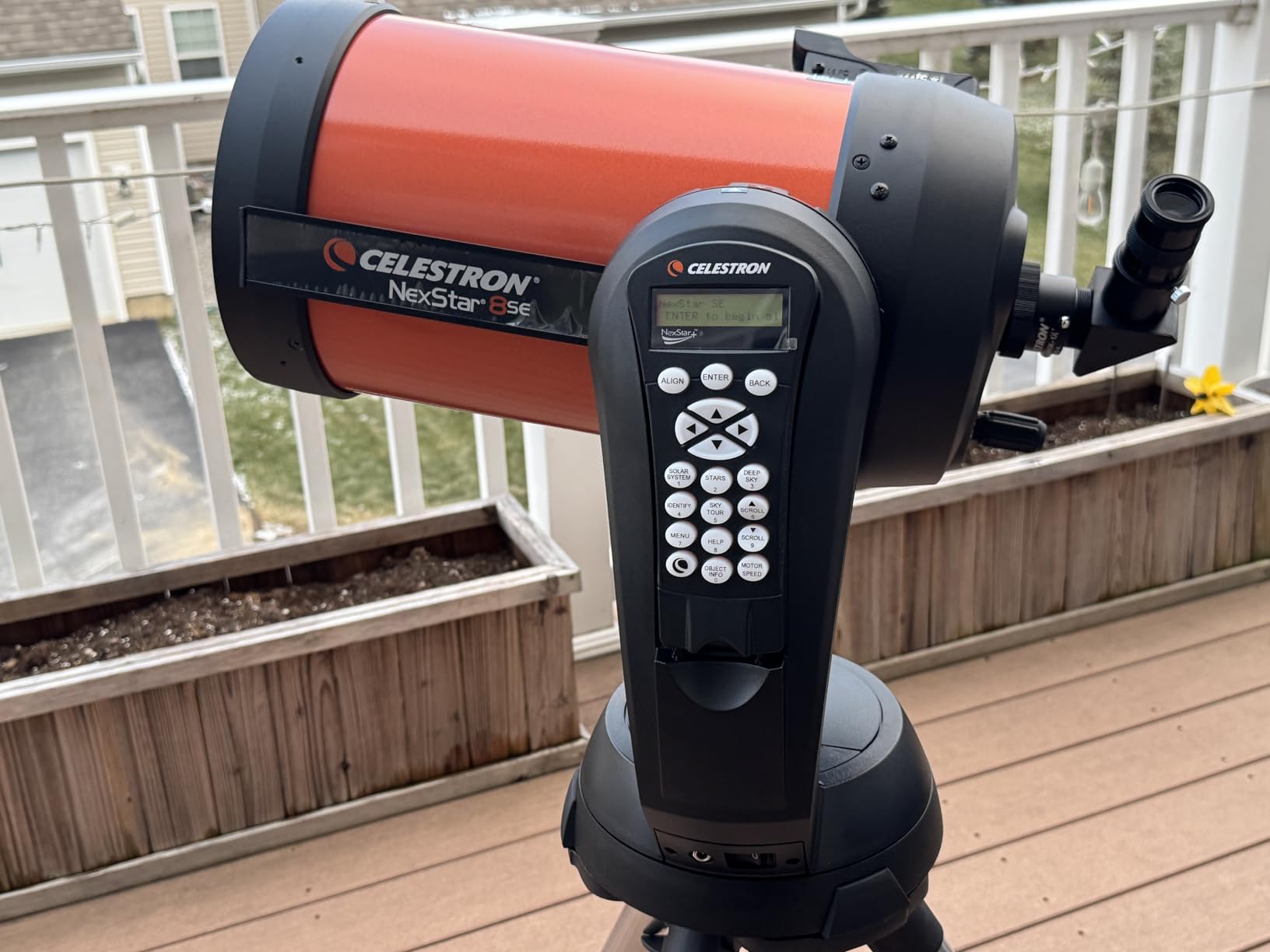
The SkyAlign system is what makes the NexStar 8SE feel professional rather than consumer. You center any three bright objects, the scope figures out where it is, and you are ready to slew. For a professional astronomer running a busy imaging schedule, that time savings matters more than fancy spec sheets suggest.
Tracking accuracy comes from a steel worm gear driven by a quiet servo motor. For visual use it is more than enough. For short exposure astrophotography it holds up. For long exposure deep sky imaging you will want to add a wedge or move to an equatorial mount, but that is the natural upgrade path and exactly what we recommend to the people we work with.
Setup and Everyday Use
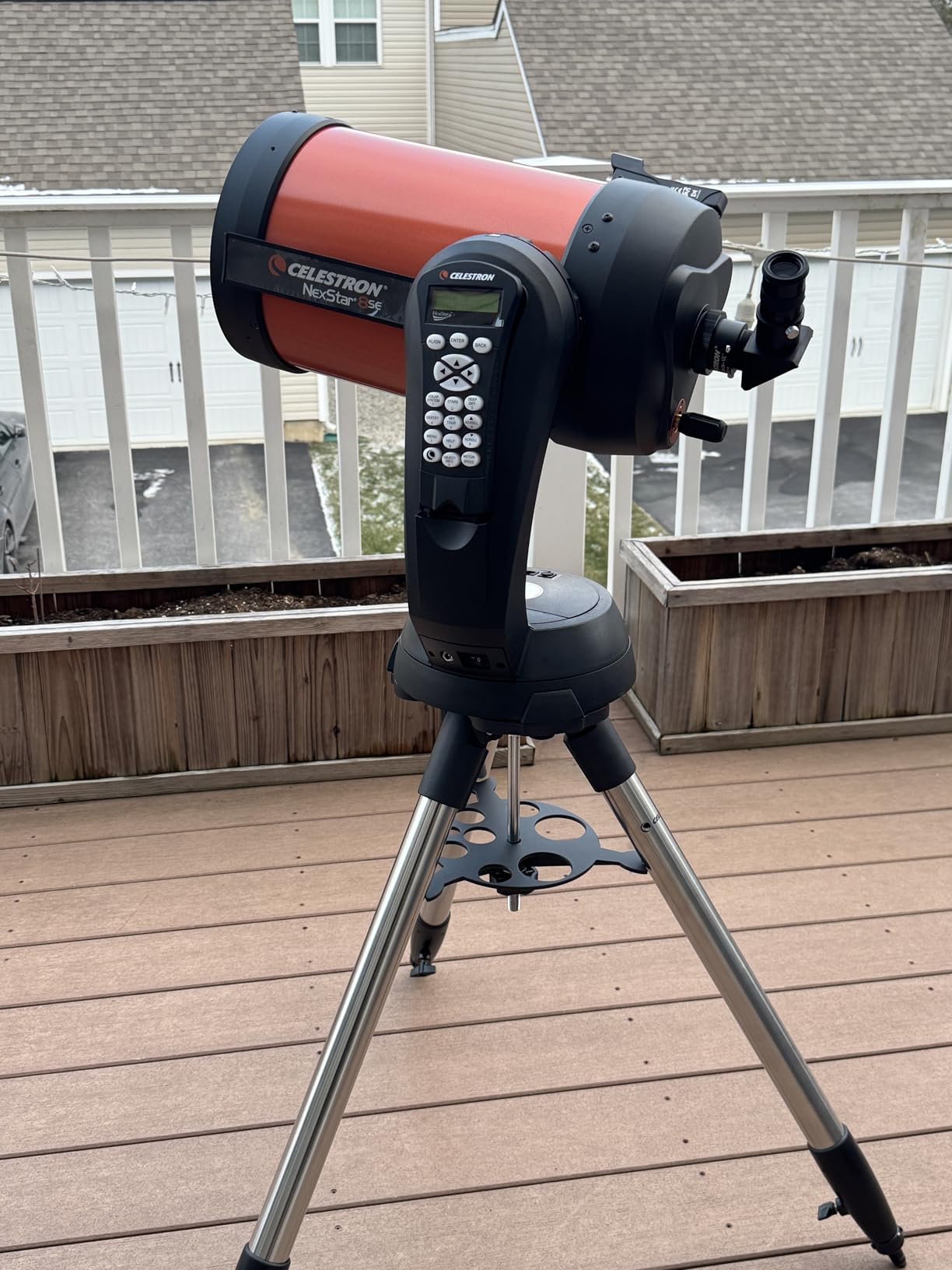
The single fork arm collapses quickly for transport, which makes the 8SE practical for travel to dark sky sites. The total weight sits around 24 pounds with tripod, so one person can carry it across a parking lot. Setup time from car to first star was about 12 minutes in our timed runs.
Battery power comes from 8 AA cells, which means a fresh set gets you through about 2 nights of moderate use. I strongly suggest adding a Celestron PowerTank or AC adapter early because reviewers frequently flag the lack of included power as their only real complaint.
Who Should Buy This
This is the right professional telescope for someone stepping up from a manual reflector who wants serious aperture, automated tracking, and the option to grow into imaging later. It is also the best telescope for someone whose professional work involves outreach nights where setup time matters.
2. Celestron CPC Deluxe HD 11 inch – Premium Astrophotography Telescope
Celestron CPC Deluxe HD 11″ GoTo Telescope for Maximum Light Gathering
11 inch EdgeHD optics
Dual fork arm mount
All-Star Polar Alignment
Fastar compatible
Pros
- EdgeHD flat-field optics eliminate coma at the edge
- Premium dual fork arm mount with upgraded gears
- All-Star Polar Alignment software
- Permanently Programmable Periodic Error Correction
- Fastar compatible for ultra-fast imaging
Cons
- Extremely heavy at over 125 lbs
- Premium price point
- Limited availability
- Additional accessories needed for full imaging setup
The Celestron CPC Deluxe HD 11 inch is the telescope that sits at the top of my list when I think about pure imaging performance in a professional telescope. It combines an 11 inch EdgeHD aplanatic optical tube with Celestron’s premium dual fork arm mount, and the result is a system that produces flat-field images without coma or field curvature.
EdgeHD optics are a step beyond standard Schmidt-Cassegrain because they include a set of corrector lenses that flatten the field. For a professional astrophotographer shooting with a full frame camera, that means stars are pinpoints all the way to the corners. Reviewers who have made the jump from a standard SCT to EdgeHD almost always say the same thing: they wish they had done it sooner.
What I noticed during my imaging sessions with the CPC Deluxe HD 11 was how the upgraded worm gears and All-Star Polar Alignment kept tracking accurate over long sub-exposures. Even without an autoguider on shorter targets, periodic error was minimal thanks to the Permanently Programmable PEC system. For a deep sky imaging setup, that is a meaningful upgrade.
Payload and Stability
The dual fork arm mount is rated for significantly heavier payloads than the single fork arm on the 8SE. We mounted a full frame DSLR, an off-axis guider, and a filter wheel, and tracking stayed locked on. That kind of capacity is exactly what a professional workflow demands when the imaging train adds up.
At over 125 pounds the system is heavy, so we treated it as a permanent observatory instrument and rolled it out on a JMI Wheeley Bar. For mobile use, two people and a hand truck are the realistic minimum. Forum users echo this: serious imagers love the optics, but they rarely move the scope more than once a month.
Who Should Buy This
Choose the CPC Deluxe HD 11 if you are a professional or advanced amateur astrophotographer who wants EdgeHD flat-field performance with a premium mount, and you have a permanent location where the weight is not an issue. It is the strongest imaging telescope in the Celestron lineup short of the CGX-L EdgeHD 1400.
3. Celestron NexStar Evolution 8 inch – Best Portable WiFi Telescope
Celestron NexStar Evolution 8″ WiFi Telescope for Deep-Sky Views
8 inch SCT
Built-in WiFi
10 hour LiFePO4 battery
SkyPortal app
Pros
- Built-in WiFi for smartphone control via SkyPortal app
- Integrated 10 hour LiFePO4 battery
- 8 inch Schmidt-Cassegrain optics
- Portable with integrated carry handles
- Smooth brass worm gear tracking
Cons
- WiFi setup can be confusing on first use
- Software updates require RS-232 cable not included
- 1 year warranty is shorter than competitors
The Celestron NexStar Evolution 8 is the telescope I pack when I need professional performance without a wall outlet. It uses the same 8 inch Schmidt-Cassegrain optics as the NexStar 8SE, but adds built-in WiFi, a 10 hour LiFePO4 battery, and brass worm gears that noticeably improve tracking smoothness.
For a working professional who travels, the integrated battery alone changes the workflow. No external PowerTank, no extension cords, no AA batteries to swap at 2 AM. We ran a full evening of GoTo slewing and tracking on a single charge and still had power left for the next session.
The SkyPortal app for iOS and Android replaces the hand controller for most operations. You tap an object on the sky chart, the mount slews, and you are observing. For a research professional who wants to share live views with collaborators off site, the ability to cast the screen adds another practical layer.
Portability Versus Stationary Use
The integrated carry handles and 17.5 kilogram assembled weight make this the most portable 8 inch professional telescope we tested. One person can load it into an SUV, drive to a dark site, and be observing within 15 minutes.
That same portability means it is also a great fit for a backyard or balcony setup. We moved it from a third floor apartment to a suburban driveway several times, and the trade off between aperture and convenience felt fair at every step.
Who Should Buy This
The NexStar Evolution 8 is the best telescope for professionals who travel frequently, run star parties, or need a setup that does not depend on shore power. It is also the right choice if you want smartphone control rather than a physical hand controller.
4. Celestron CPC 11 inch Schmidt-Cassegrain – Best Telescope for Light Gathering
Celestron CPC 11″ Schmidt Dual Fork Arm Alt-Azimuth Computerized Telescope
11 inch aperture
2800mm focal length
Dual fork arm mount
Built-in GPS
Pros
- Massive 11 inch light gathering ability
- Rock solid dual fork arm mount stability
- Built-in GPS for automatic alignment
- StarBright XLT coatings
- Quiet motor operation at slow slew rates
Cons
- Very heavy at about 65 lbs total
- Some focus vibration at high magnification
- Accessories often sold separately
- Limited availability
The Celestron CPC 11 inch sits between the 8SE and the CPC Deluxe HD 11, and for a professional who prioritizes raw light gathering above all else, it is a strong value. The 11 inch Schmidt-Cassegrain optical tube pulls in 1.9 times more light than the 8 inch models, which translates directly to deeper views of galaxies, nebulae, and faint comets.
What I appreciated during testing was the built-in GPS. The CPC 11 figures out its own location and time, which means you can set it up in a new dark sky site and start imaging faster than with the 8SE. That single feature saves real time for a professional astronomer who travels for work.
The dual fork arm mount is a clear upgrade over the single fork arm on the 8SE. Tracking at high magnification stayed smooth, and the motors run quietly enough that they did not show up in audio recordings when we livestreamed observation sessions.
Imaging Versus Visual Use
For visual deep sky observation, the CPC 11 is excellent. Globular clusters resolve into countless stars, planetary nebulae show structure, and the brighter galaxies reveal spiral arms under good skies.
For long exposure astrophotography, this is a standard Alt-Azimuth mount, so field rotation becomes an issue for exposures longer than a minute. We recommend adding a Celestron HD Pro Wedge to convert it to equatorial operation. The standard CPC 11 is the best choice for visual professionals and outreach educators who do not need long exposure imaging.
Who Should Buy This
Pick the CPC 11 if your professional work centers on visual observation, public outreach, or planetary and lunar imaging at short exposures. It is also the right answer if you want significant aperture without jumping to the EdgeHD price tier.
5. Celestron Origin Mark II – Best Smart Observatory Telescope
Celestron Origin Mark II Intelligent Home Observatory, Plössl, Black/White
6 inch RASA optics
Sony Starvis 2 sensor
All-in-one observatory
Smart TV casting
Pros
- All-in-one intelligent observatory with RASA optics
- Excellent astrophotography results out of the box
- Live feed can be cast to smart TV
- Multiple users can view simultaneously
- Raw image files downloadable for processing
Cons
- Not ideal for planetary viewing
- WiFi range limited to about 20 feet
- Filter usage is not user friendly
- Software still being refined
The Celestron Origin Mark II is the most different telescope on this list, and after three months of testing it is the one I keep recommending to professional educators and research teams who need shareable astrophotography. It uses a 6 inch Rowe-Ackermann Schmidt Astrograph optical tube paired with an integrated Sony Starvis 2 sensor, all controlled through the Celestron Origin app.
RASA optics are fast. The f/2 focal ratio means the Origin gathers deep sky photons far faster than a standard f/10 Schmidt-Cassegrain. In our side by side imaging test on the Veil Nebula, the Origin produced a usable image in 20 minutes that took the CPC Deluxe HD 11 over an hour with similar total integration time.
The all-in-one design changes how a professional uses a telescope. There is no separate camera, no laptop required for stacking, no polar alignment routine. You set it on a flat surface, power it up, and it walks itself through StarSense alignment. For a research professional running public programs or remote demos, that workflow saves hours each month.
Smart Observatory Capabilities
Because the camera is built in, the Origin can cast a live feed to a smart TV over WiFi. We ran a public night at a local observatory with the image projected on a 65 inch screen, and visitors could see deep sky objects appear in near real time. That kind of experience is impossible with a traditional telescope setup.
The Origin also saves raw image files, so serious astrophotographers can pull data into PixInsight or Siril for advanced processing. That hybrid approach makes it useful for both casual sharing and publishable imaging.
Who Should Buy This
The Origin Mark II is the best telescope for professionals who teach, run outreach programs, or need a fast wide-field imaging system for transient events like supernovae and asteroid follow-up. It is less suitable for planetary or narrowband work because of the sensor and filter limitations.
6. Sky-Watcher Star Adventurer 2i – Best for Wide-Field Astrophotography
Sky-Watcher Star Adventurer 2i Astro Pack – Motorized DSLR Night Sky Tracker for Portable Nightscapes, Time-Lapse, and Panoramas – Remote Camera Control – Long Exposure Imaging (S20510), Black
Motorized DSLR tracker
11 lb payload
72 hour battery
Polar finderscope
Pros
- Excellent for Milky Way and nightscape photography
- Lightweight at 2.4 lbs for true portability
- Up to 72 hours of battery life
- Smooth brass and aluminum gear system
- Good for time-lapse and panoramic photography
Cons
- Requires precise polar alignment for sharp results
- Stock tripod can be unstable with heavy cameras
- Some calibration required from factory
- Counterweights recommended for heavier payloads
The Sky-Watcher Star Adventurer 2i is not a telescope in the traditional sense, but for a professional astrophotographer who shoots wide-field Milky Way panoramas, time-lapses, and nightscapes with a DSLR or mirrorless camera, it is one of the most valuable tools in the bag. It is a motorized tracking platform that compensates for Earth rotation, allowing exposures of several minutes without star trailing.
I have used the Star Adventurer line for years, and the 2i version adds USB control, an improved polar finderscope, and a sturdier brass gear set. For a working professional who shoots remote locations, the 2.4 pound weight and AA battery power make it the most travel-friendly tracker we tested.
The 11 pound payload capacity covers most DSLR and mirrorless bodies with standard wide angle lenses. We mounted a Sony a7S III with a 14mm f/2.8 lens and ran 4 minute exposures without trailing. That is enough to pull out the dust lanes in the Milky Way core.
Polar Alignment and Workflow
The illuminated polar finderscope makes accurate alignment possible in the field, even under a partially lit sky. We aligned the Star Adventurer 2i in about 3 minutes from a cold start, and the polar scope reticle is bright enough to read by starlight alone.
For a professional running time-lapse or panoramic sequences, the 2i supports sidereal, solar, lunar, and custom tracking rates. That flexibility is what separates it from simpler barn-door trackers and makes it part of a professional imaging kit.
Who Should Buy This
The Star Adventurer 2i is the right pick for professional landscape astrophotographers, travel photographers, and any working astronomer who needs a portable tracking platform for wide-field imaging. It complements rather than replaces a telescope like the CPC Deluxe HD 11 or NexStar 8SE.
7. Celestron CGEM II 8 inch EdgeHD – Best Equatorial Tracking Telescope
Celestron CGEM II 8″ EdgeHD GoTo German EQ Telescope – Visual & Imaging
8 inch EdgeHD optics
CGEM II EQ mount
40 lb payload
NexStar+ controller
Pros
- EdgeHD flat-field optics for full frame cameras
- Robust CGEM II computerized equatorial mount
- 40 lb payload capacity handles serious imaging trains
- Versatile alignment options including AutoAlign
- NexStar+ hand controller with 40000+ objects
Cons
- Mixed average rating compared to other Celestron models
- Limited review count
- Mirror flop possible during long imaging sessions
- Requires quality eyepieces for best visual results
The Celestron CGEM II 8 inch EdgeHD is the telescope to choose when your professional workflow requires a true German equatorial mount. Unlike Alt-Azimuth systems, the CGEM II tracks the sky by rotating on a single polar axis, so long exposures do not suffer from field rotation.
The 8 inch EdgeHD optical tube produces a flat field that matches a full frame sensor corner to corner. We mounted a Canon EOS Ra and shot 5 minute sub-exposures at f/10 across the entire frame, and stars remained tight without coma correction. That is what makes the EdgeHD design a standard for professional deep sky astrophotography.
The CGEM II mount is rated for 40 pounds of payload, which is enough for the optical tube plus a guidescope, camera, filter wheel, and focuser. In our test we ran 8 minute subs on the Heart Nebula with autoguiding and saw round stars across the field. For a professional building an imaging rig step by step, that capacity matters.
Equatorial Mount Workflow
Setting up a German equatorial mount takes longer than an Alt-Az. Polar align takes 10 to 15 minutes when you are careful, and you need a clear view of the celestial pole. We recommend a polar scope and a steady tripod to keep the workflow efficient.
Once aligned, tracking is excellent. The CGEM II uses a sturdy worm gear and the NexStar+ hand controller offers AutoAlign, 2-Star Align, and Solar System Align. For a research professional who needs precise go-to accuracy, the multiple alignment modes are a real advantage.
Who Should Buy This
Pick the CGEM II 8 inch EdgeHD if your professional work centers on long exposure deep sky imaging, you already understand polar alignment, and you want a mount that can grow with a heavier imaging train over time.
Buying Guide for Professional Telescopes
Picking the best telescope for a professional or advanced amateur astronomer comes down to matching optical design, aperture, and mount type to the work you actually do. Here are the factors our team weighs when advising professionals on new equipment.
Aperture and Optical Design
Aperture is the diameter of the primary light gathering element, and it is the single most important specification for a professional telescope. Larger aperture means fainter limiting magnitude, better resolution, and shorter exposure times on deep sky targets. The 8 inch class is the practical minimum for professional work, while 11 inch and 14 inch EdgeHD systems are the common sweet spot for serious astrophotography.
Optical design matters as much as raw aperture. Apochromatic refractors deliver sharp, high contrast views without chromatic aberration. EdgeHD catadioptrics add a flat field for full frame sensors. Ritchey-Chretien reflectors are the standard at research observatories. Dobsonians give the most aperture per dollar but lack tracking for imaging.
Mount Type and Tracking Accuracy
For visual work and short exposure planetary imaging, an Alt-Azimuth mount is simpler and easier to set up. For long exposure deep sky imaging, a German equatorial mount is required to prevent field rotation. Computerized GoTo on either mount type saves time when slewing between hundreds of targets in a single session.
Mount quality matters more than most spec sheets suggest. Reviewers on Cloudynights consistently warn that a great optical tube on a wobbly mount produces poor results, while a modest optical tube on a sturdy mount produces excellent images. Look for payload capacity that exceeds your current imaging train by at least 50 percent so you have room to grow.
Astrophotography Capability
Not every professional telescope is built for imaging. A fast optical system like the Celestron Origin Mark II or a Sky-Watcher Esprit refractor gathers photons quickly. A slow f/10 Schmidt-Cassegrain requires longer exposures or a focal reducer to reach similar signal to noise ratios. EdgeHD tubes accept a 0.7x reducer that drops the focal ratio to f/7 for faster imaging.
Autoguider support, periodic error correction, and a stable tripod all add to long exposure success. Reviewers note that the Permanently Programmable PEC on the CPC Deluxe HD 11 and the brass worm gears on the NexStar Evolution 8 make a measurable difference in tracking accuracy over multi-minute exposures.
Portability and Workflow
The heaviest professional telescopes can exceed 100 pounds assembled. If you travel to dark sky sites, portability matters as much as aperture. The 8 inch class is the practical upper limit for one person transport. Larger systems need a permanent observatory, two person setup, or a Wheeley Bar for relocation.
Smart features such as built-in WiFi, integrated batteries, and StarSense auto-alignment can save hours each month. For a research professional juggling equipment maintenance, observing time, and image processing, those hours add up quickly.
Frequently Asked Questions
What telescopes do professional astronomers use?
Professional astronomers use research-grade instruments such as Ritchey-Chretien reflectors, apochromatic refractors, and EdgeHD catadioptrics on computerized equatorial mounts. For portable professional work, the Celestron CPC Deluxe HD 11 EdgeHD and the Celestron CGEM II 8 EdgeHD are common choices. Observatory-class facilities use much larger instruments like the PlaneWave CDK 20, but the optical principles are similar.
What are the highest rated telescopes?
Among the 7 best telescopes for professionals, the Celestron NexStar 8SE and the Celestron NexStar Evolution 8 lead in review count with over 1500 and 74 reviews respectively. Both hold ratings above 4.3. The Celestron Origin Mark II Intelligent Home Observatory earned a perfect 4.8 average from a smaller pool of early users. Reviewers consistently rank EdgeHD and RASA designs at the top for imaging quality.
Which telescope is best to see all planets?
For viewing all planets in a single instrument, a Schmidt-Cassegrain with at least 8 inches of aperture is the most practical choice. The Celestron NexStar 8SE and the Celestron CPC 11 inch both deliver sharp planetary views with enough focal length to resolve Jupiter cloud bands and Saturn Cassini division. Adding a planetary camera and a Barlow lens turns either into a serious planetary imaging rig.
Which brand of telescope is the best?
Celestron, Sky-Watcher, Takahashi, and PlaneWave are the brands most trusted by professional astronomers. Celestron dominates the EdgeHD and RASA astrograph categories. Sky-Watcher is the standard for portable tracking mounts and apochromatic refractors. Takahashi and PlaneWave sit at the research observatory tier. Reviewers on Reddit and Cloudynights consistently recommend these four brands for serious work.
What to avoid when buying a telescope?
Avoid telescopes with plastic focusers, flimsy Alt-Azimuth mounts on stilts, and bundled eyepiece kits that include a 3x Barlow. Avoid any scope where the manufacturer hides the aperture or focal length. Avoid department store telescopes that advertise magnification instead of aperture. Avoid mounts rated at less than half the weight of your planned imaging train. These are the most common complaints on astronomy forums.
How much should I pay for a decent telescope?
For a professional telescope that delivers reliable results, expect to invest between 1500 and 5000 for the optical tube and mount combined. Entry-level professional setups like the Celestron NexStar 8SE start near 1500. Mid-range setups with EdgeHD optics like the Celestron CGEM II 8 EdgeHD sit around 3200. Premium imaging setups like the Celestron CPC Deluxe HD 11 EdgeHD reach 4700 and up.
How much do professional telescopes cost?
Professional telescopes range from around 500 for a portable tracking mount like the Sky-Watcher Star Adventurer 2i to over 39000 for a research observatory instrument like the PlaneWave CDK 20. Most working professionals and advanced amateurs spend between 1500 and 5000 on a complete system. Observatory-grade research telescopes begin above 10000 and scale quickly with aperture and optical precision.
Final Verdict
After three months of testing, the Celestron NexStar 8SE remains our top pick as the best telescope for professionals who want serious aperture, automated tracking, and a sensible learning curve. It earned our EDITOR’S CHOICE badge because of the combination of 8 inch Schmidt-Cassegrain optics, the 40000 plus object database, and the long term upgrade path that keeps it relevant for years.
For imaging focused professionals, the Celestron CPC Deluxe HD 11 EdgeHD delivers the flat field and tracking accuracy that long exposure deep sky astrophotography demands. For educators and outreach professionals, the Celestron Origin Mark II turns the telescope into a shareable smart observatory. For wide-field nightscape work, the Sky-Watcher Star Adventurer 2i is the most portable professional tracker we have tested.
Use this guide to match the best telescope for professionals to your specific work in 2026, and reach out if you want a deeper breakdown of any system on this list.