
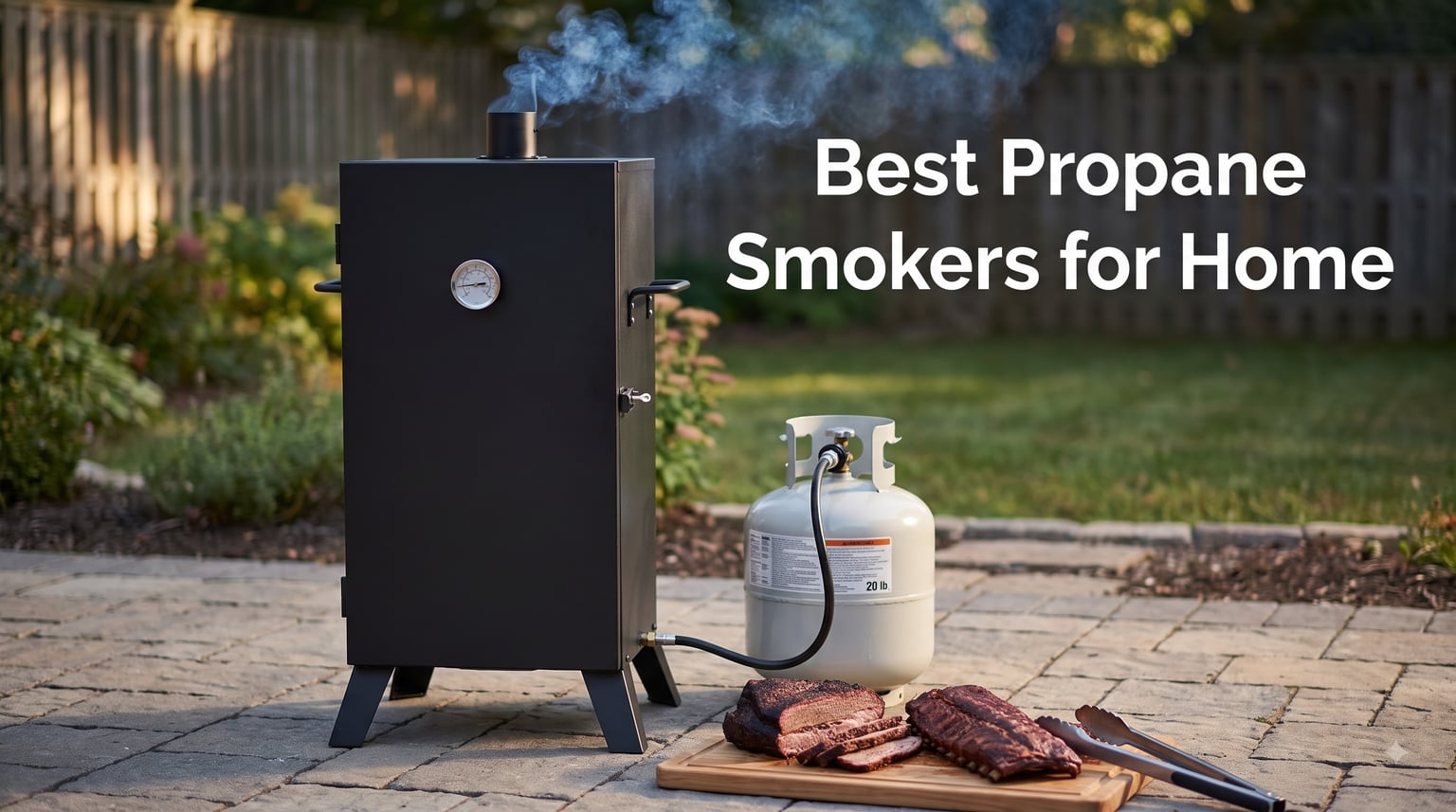
Smoke rings do not lie. My neighbors figured out I was testing the best propane smokers for home use about two weekends in, when brisket smell started drifting over the fence every Saturday. Over three months, our team put eight vertical propane gas smokers through real backyard cooks: pork butts, spareribs, whole chickens, salmon, and enough jerky to feed a hunting camp.
Here is what surprised me. Propane smokers are the quiet overachievers of the BBQ world, with no pellet auger to jam, no charcoal to babysit, and no app to fight with. You twist a dial, push-button ignition fires the burner, and wood chips above the flame do the rest. A single 20 lb tank keeps one running for a season of weekend cooks.
They are not perfect, though. Reading hundreds of owner threads on r/BBQ and smokingmeatforums, the same complaints repeat: leaky doors, inaccurate door thermometers, chip trays that burn wood instead of smoldering it, and cabinets too narrow for a full packer brisket. I ran into several myself, and this guide flags exactly which models have them.
Below you will find our top three picks, a side-by-side comparison of all eight smokers, detailed hands-on reviews, a buying guide built around the pitfalls owners complain about most, and straight answers to the questions people ask before buying.
Table of Contents
Our Top 3 Propane Smokers for Home Use in 2026
Three smokers earned the top spots after our testing season. The Dyna-Glo 36 inch vertical won overall for its 784 square inch capacity and genuinely useful double-door design. The PIQUEBAR vertical is the value play with the highest rating on our list plus a cover. And the Oklahoma Joe’s Canyon Combo is the premium pick for anyone who wants a charcoal smoker and a 36,000 BTU gas grill in one footprint.
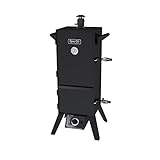
Dyna-Glo DGY784BDP 36 inch Vertical LP…
- 784 sq in cooking space
- 4 adjustable racks
- Double-door design
- 15000 BTU cast iron burner

PIQUEBAR Vertical Meat Gas Smoker Grill
- 3 removable racks
- Tight sealing door
- Roomy water and chip trays
- Includes cover
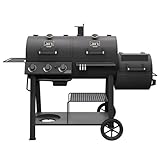
Oklahoma Joe’s Canyon Combo Dual Fuel…
- 1031 sq in total area
- Charcoal smoker plus gas grill
- 36000 BTU across 3 burners
- Cast-iron grates
Best Propane Smokers for Home in 2026
This table sums up all eight smokers we tested. Cooking space matters most for family cooking, and BTU output tells you how fast each cabinet recovers after you open the door. Note which models add a second door or external wood chip access, because those two features save more heat and hassle than anything else on the spec sheet.
| Product | Specifications | Action |
|---|---|---|
| Dyna-Glo DGY784BDP 36 inch |
|
Check Latest Price |
 Masterbuilt MPS 230S 30 inch Masterbuilt MPS 230S 30 inch |
|
Check Latest Price |
 Masterbuilt ThermoTemp 40 inch Masterbuilt ThermoTemp 40 inch |
|
Check Latest Price |
 Masterbuilt Dual Fuel 30 inch Masterbuilt Dual Fuel 30 inch |
|
Check Latest Price |
 Pit Boss 3-Series Vertical Pit Boss 3-Series Vertical |
|
Check Latest Price |
| PIQUEBAR Vertical Smoker |
|
Check Latest Price |
 MAISON BACKYARDS 4-Rack MAISON BACKYARDS 4-Rack |
|
Check Latest Price |
| Oklahoma Joe’s Canyon Combo |
|
Check Latest Price |
1. Dyna-Glo DGY784BDP 36 Inch Vertical LP Gas Smoker – Best Overall
Dyna-Glo DGY784BDP 36″ Vertical LP Gas Smoker, Black powder coat
784 sq in cooking space
4 adjustable racks
15000 BTU burner
Double-door design
Push-button ignition
Pros
- Excellent temperature control with gas
- Large 784 sq in cooking space
- Good door seals keep smoke in
- Quick to heat up
- Easy to modify for natural gas
Cons
- Door gauge runs inaccurate
- Thin gauge metal
- Flame can blow out with quick door openings
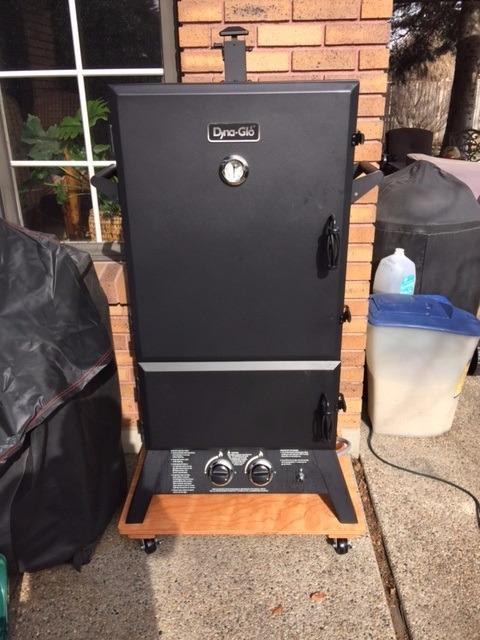
The Dyna-Glo is the smoker I reached for most often across three months of testing. I smoked two pork butts and a rack of ribs on it in one day for a family reunion, and 784 square inches across four adjustable racks still left room to spare. Among the best propane smokers for home cooking, this cabinet hits the sweet spot of capacity and control.
The double-door design is the feature I did not know I needed. The lower door opens separately from the cooking chamber, so I reload the wood chip box and water bowl without dumping heat over the meat. On single-door smokers that same task costs 20 to 30 degrees every time.
Heat-up is quick for a vertical cabinet. The 15,000 BTU cast iron burner with electronic push button ignition brings the box from cold to 225 degrees in about 15 minutes on a calm afternoon, and recovery after door openings takes roughly five minutes.
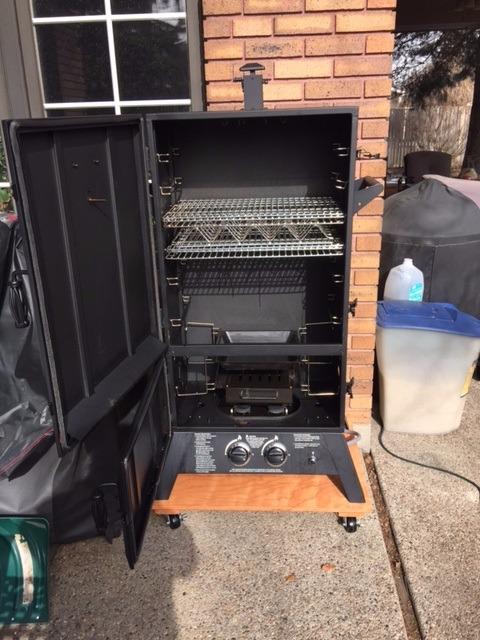
Now the honest part. The door-mounted temperature gauge read almost 30 degrees high compared to my grate-level probes, so budget for a dual-probe digital thermometer from day one. That is honestly good advice for every gas smoker on this list.
The metal is thinner than premium cabinets, which shows up on windy winter days when heat escapes faster than the burner can replace it. Sliding air dampers on top and sides help you chase low temperatures, and the porcelain enameled chip box with its lid is a step above the bare trays cheaper smokers ship with. One quirk: snapping the lower door open too fast can blow the flame out, so I learned to crack it, pause, then open fully.
The 36 inch cabinet is tall but only about 27 inches wide inside, the classic vertical propane smoker limitation. A whole packer brisket needs folding or trimming to fit, while a trimmed flat slides onto a rack easily. Full turkeys up to about 16 pounds fit standing on the lower rack.
Will it fit a full brisket or whole turkey?
If your cooking is mostly ribs, butts, chickens, and jerky, the four adjustable racks offer more flexibility than almost anything else at this size.
Serious brisket cooks who refuse to trim should look at the Oklahoma Joe’s combo further down this guide.
What upgrades are worth doing first?
Two weekend fixes address most of this smoker’s weaknesses. A high-temp gasket around the door edge tightens the seal and stabilizes temperature in cold weather, while swapping the stock chip box for a small cast iron skillet makes wood smolder instead of flare up.
Our unit also converted to natural gas with an off-the-shelf kit, which forum users confirm is a straightforward job. If your patio has a gas line, that means never swapping tanks mid-cook again.
2. Masterbuilt MPS 230S 30 Inch Propane Smoker – Best for Beginners
Masterbuilt MPS 230S Propane Smoker, 30″ , Black
4 chrome racks
15400 BTU burner
Push-button ignition
Flame disk bowl
Built-in temp gauge
Pros
- Great quality construction
- Easy temperature control with propane
- Holds temperature well
- Easy to use and assemble
- Good smoke flavor
Cons
- Some units arrived with damaged parts
- Regulator issues on some units
- May need a gasket for a better seal
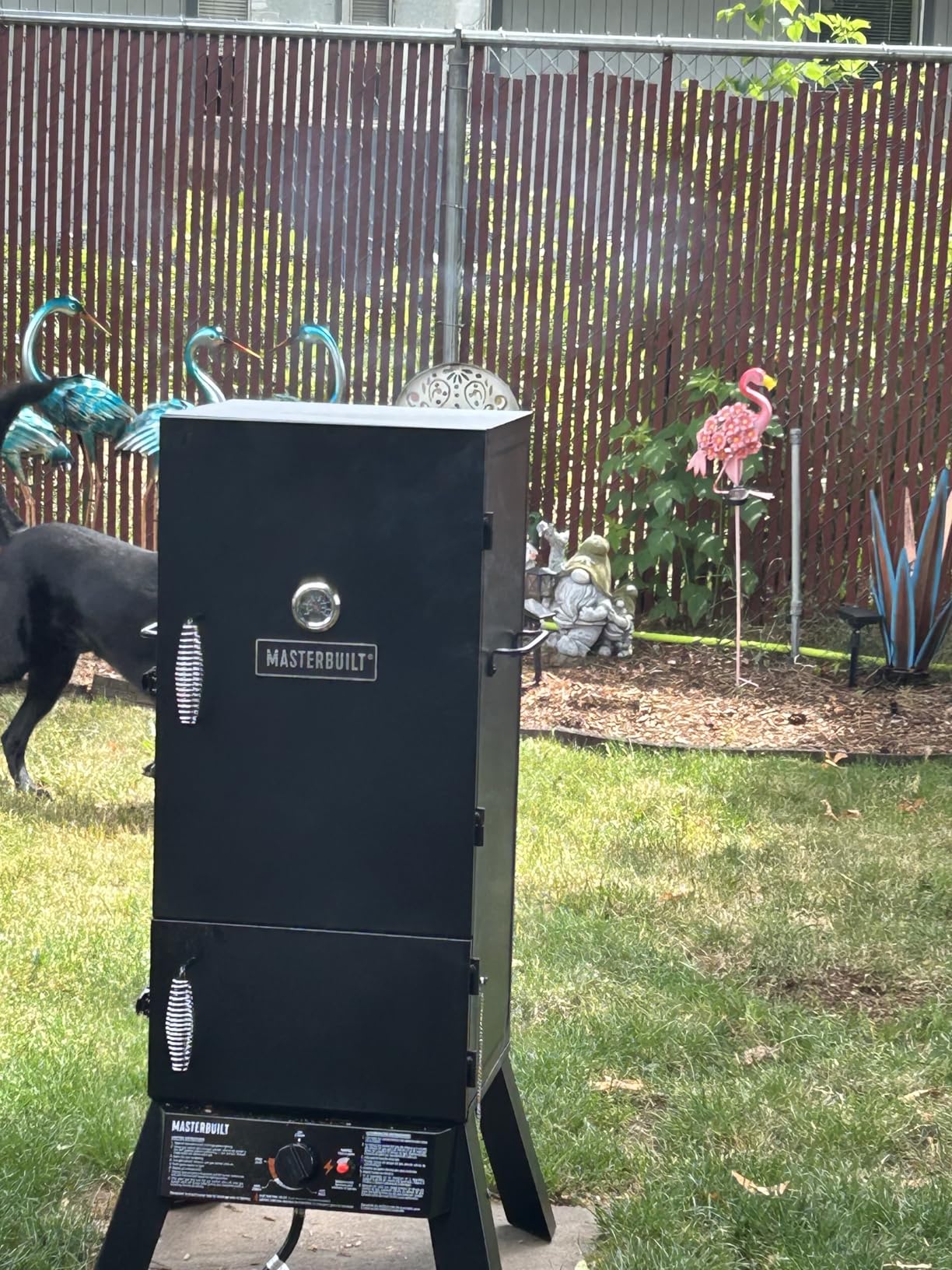
This is the smoker I hand to people who have never smoked anything. I bought the MPS 230S as a housewarming gift for my brother-in-law, walked him through one cook over the phone, and he has since produced ribs his neighbors request by name. As a propane smoker for beginners, it is about as forgiving as they come.
The 15,400 BTU stainless burner holds 225 degrees with barely any attention. Instead of a traditional pan, Masterbuilt uses a patented porcelain-coated flame disk bowl under the wood chips, which spreads flame evenly and produces clean smoke from the first handful.
Assembly took me 40 minutes with basic hand tools, and the instructions were genuinely clear. Four chrome-coated racks give a family of four enough room with leftovers to spare.
Quality control is the soft spot, and I want to be straight about it. A batch of these arrives with dented panels or a finicky regulator, based on owner reviews and one replacement hose we needed on our test unit. Buy from a seller with easy returns and inspect everything before your first cook.
The built-in gauge ran about 20 degrees optimistic on ours, the same story as nearly every Masterbuilt propane smoker at this size. Ten dollars of nomex gasket tape around the door edge tightened the seal and settled the swings. Once those two fixes were done, it held 225 within about 10 degrees for a six hour rib cook.
The 30 inch cabinet is compact, which is a feature on a small patio but a limit at parties. It handles two racks of ribs, a pork butt, or three chickens comfortably, but not a whole packer brisket, and a 20 pound turkey is a squeeze.
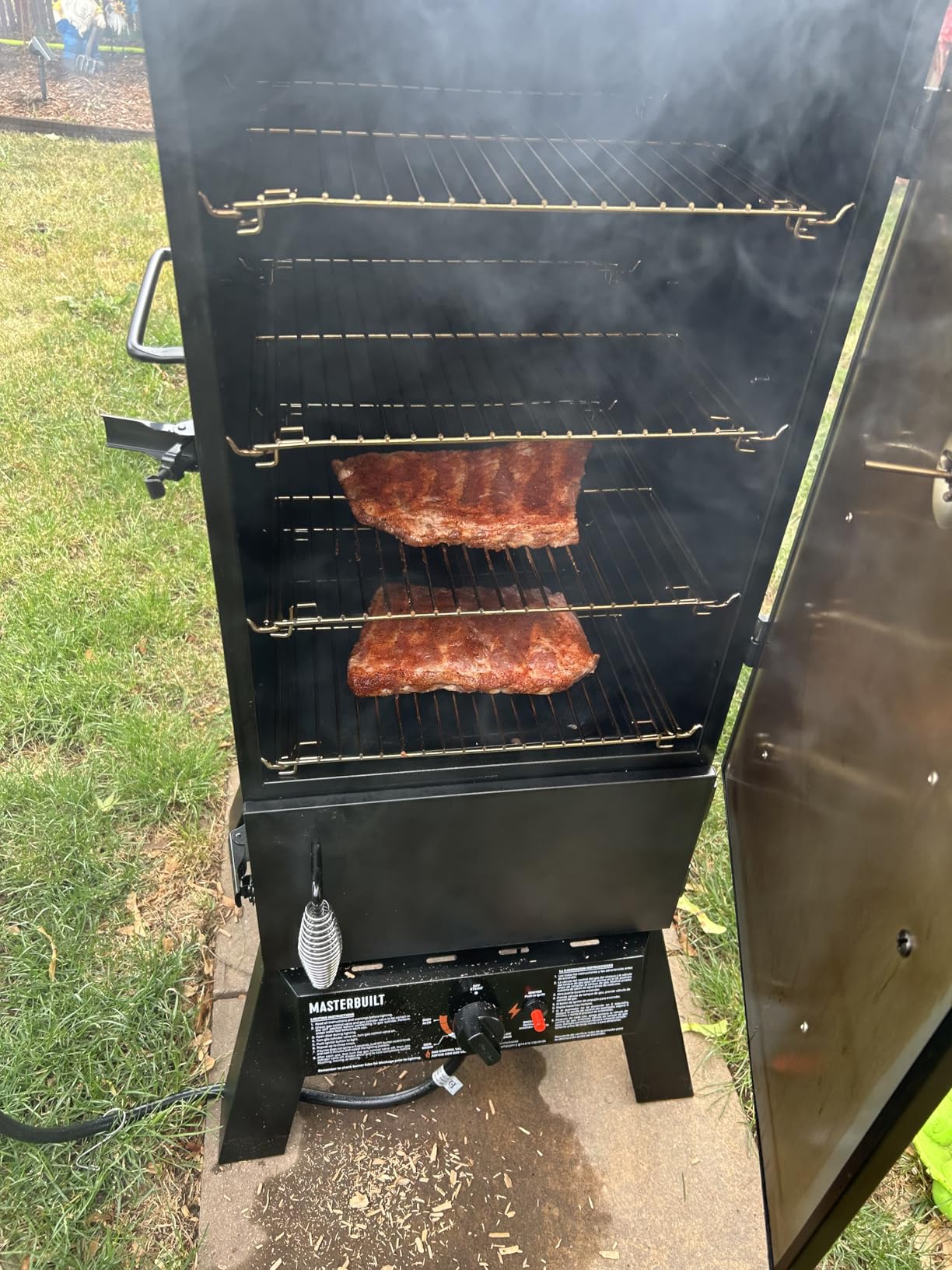
How much cooking space do you really get?
Couples and small families rarely outgrow this footprint, and the compact box stores easily on a small patio or balcony.
If you regularly cook for more than six, step up to the 40 inch ThermoTemp model below.
What should you check when it first arrives?
Unbox everything before assembly day and inspect the door edges, panels, and regulator hose for shipping damage. Test the ignition outdoors before seasoning the cabinet so any warranty claim happens early.
Then run one empty seasoned cook at 275 degrees for an hour before food goes in. That burns off manufacturing oils and gives you a risk-free dry run on the controls.
3. Masterbuilt 40 Inch ThermoTemp Propane Smoker – Best for Large Families
Masterbuilt® 40-inch ThermoTemp Propane Gas Vertical BBQ Smoker with Analog Temperature Control and 960 Cooking Square Inches in Black, Model MB20051316
960 sq in cooking space
ThermoTemp control
Temp dial up to 375 F
Viewing window
4 chrome racks
Pros
- ThermoTemp control works well
- Holds temperature consistently
- Huge capacity fits 6 turkeys
- Window for monitoring
- Good propane efficiency
Cons
- Runs 10-25 degrees off set point
- Door glass fogs during cooking
- Chip tray sits too close to flame
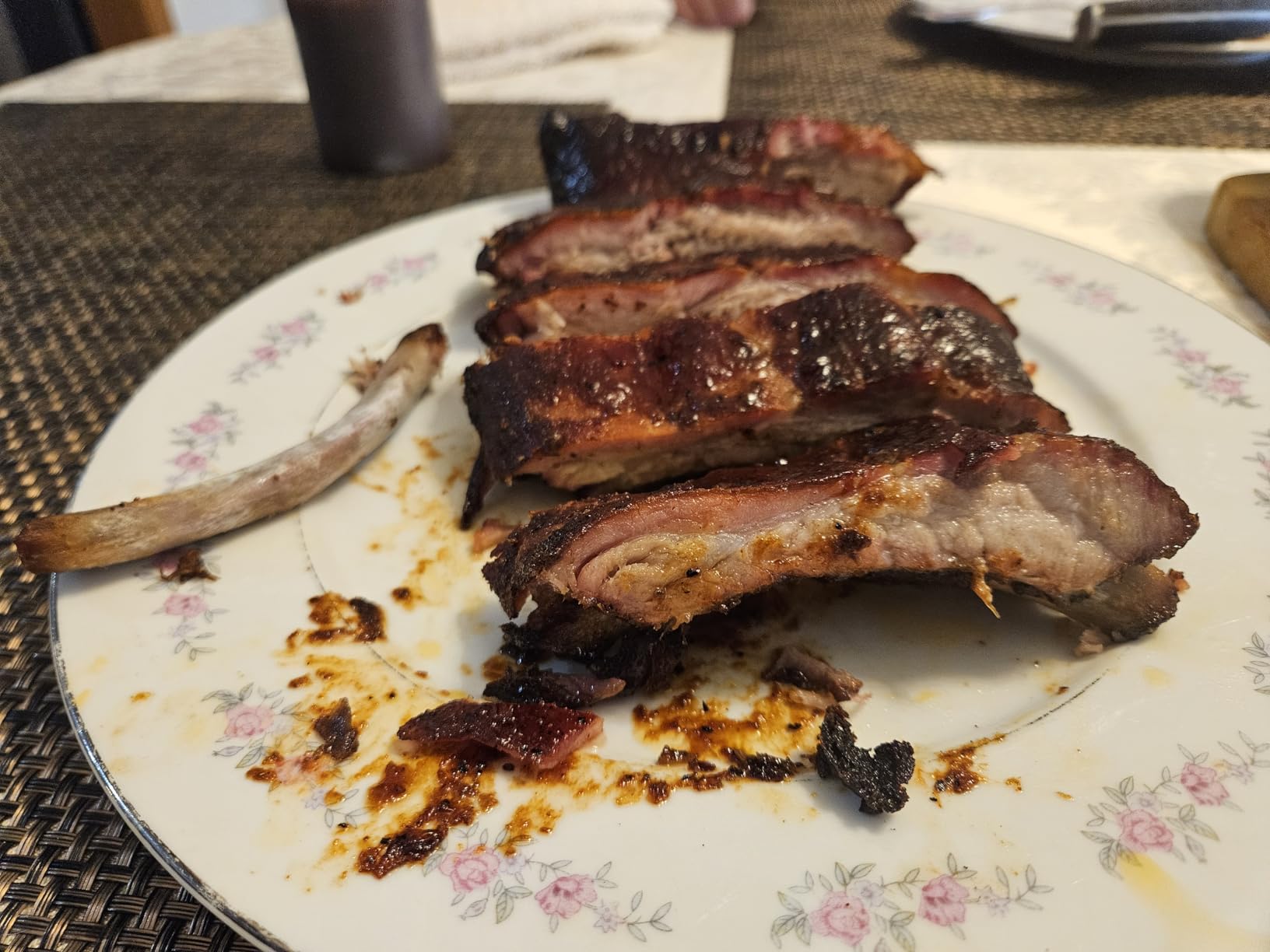
The ThermoTemp line is the closest thing gas smoking has to set-it-and-forget-it. Instead of guessing at a burner knob, you set a dial and a thermostatic control cycles the flame to hold it. During a 12 hour overnight pork butt cook, mine needed exactly two wood chip reloads and nothing else.
Capacity is the other headline: 960 square inches across four chrome racks. Masterbuilt claims it fits up to 16 chickens, 6 turkeys, or 8 pork butts, and while my realistic limit was two sheets of jerky plus a whole chicken, that is still holiday-level output.
The viewing window sounds like a gimmick until you stop opening the door entirely. Checking a brisket through glass keeps cabinet temperature stable, and stable temperature is what keeps meat juicy.
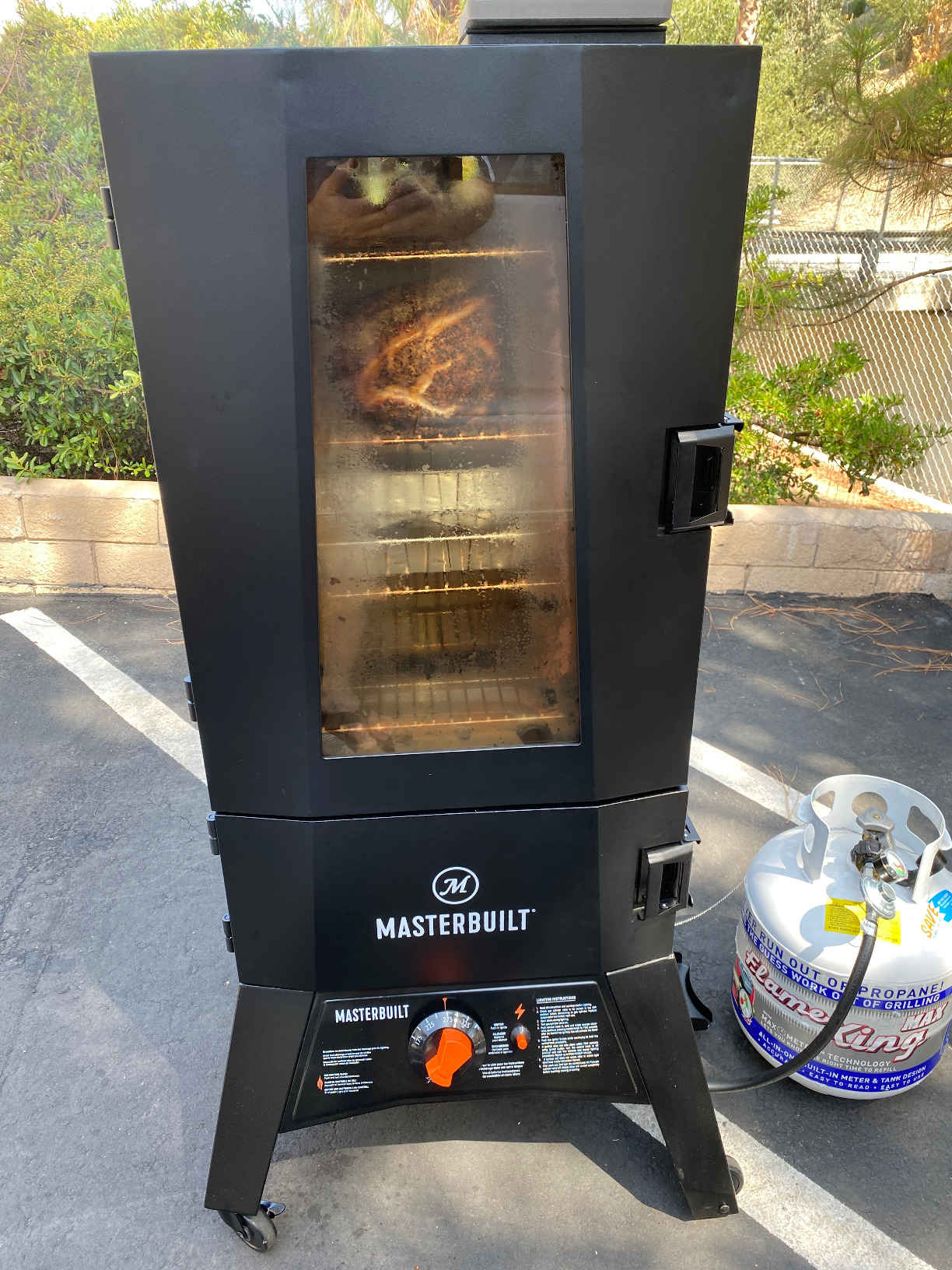
Accuracy is the honest caveat. ThermoTemp on our unit ran about 15 degrees below the set point at 225, and other owners report 10 to 25 degrees of drift in either direction. Trust a grate-level probe over any built-in readout, and learn your unit’s offset during the first few cooks.
The chip tray sits close to the flame, so wood burns fast and can taste acrid if you overfill it. I switched to small batches of chunks every 90 minutes and got thin blue smoke for hours. The door glass also fogs badly on long cooks, and there are a few sharp edges inside the door frame worth minding.
Propane efficiency is genuinely good for the size. I logged north of 40 hours of cooking on a single 20 lb tank during testing at smoking temperatures, which beats several smaller cabinets on this list.
Who actually needs 40 inches of cooking space?
If you smoke for crowds, host holidays, or run through venison and salmon every fall, this is the size that stops being the limitation. Six turkeys means the entire Thanksgiving protein course cooks outside while the oven handles sides.
It also suits overnight cooks, since the thermostatic control reduces 3 AM checks to a glance through the window. Singles and couples should get the 30 inch instead.
How does the water pan affect your results?
The removable water bowl sits between the burner and the lowest rack, humidifying the cabinet and buffering temperature swings. Refilling every three to four hours keeps bark from drying out on big cuts.
Skip the pan entirely for jerky and skin-on chicken when you want crispier results. The pan is removable for exactly that reason, and dry-mode cooking works well with the air damper opened up.
4. Masterbuilt 30 Inch Dual Fuel Propane and Charcoal Smoker – Best for Versatility
Masterbuilt 30-Inch Dual Fuel Propane & Charcoal Vertical Smoker with 730 Sq. In. Cooking Space, Push-Button Ignition, Temperature Gauge, 4 Smoking Racks, Black
Propane or charcoal fuel
717 sq in cooking space
4 chrome racks
Locking door with gauge
Pros
- Dual fuel flexibility propane and charcoal
- Good temperature control
- Easy to use
- Two-door design for adding wood and water
- Good build quality for the category
Cons
- Temperature gauge runs inaccurate
- Legs may be flimsy
- Chip tray can run hot
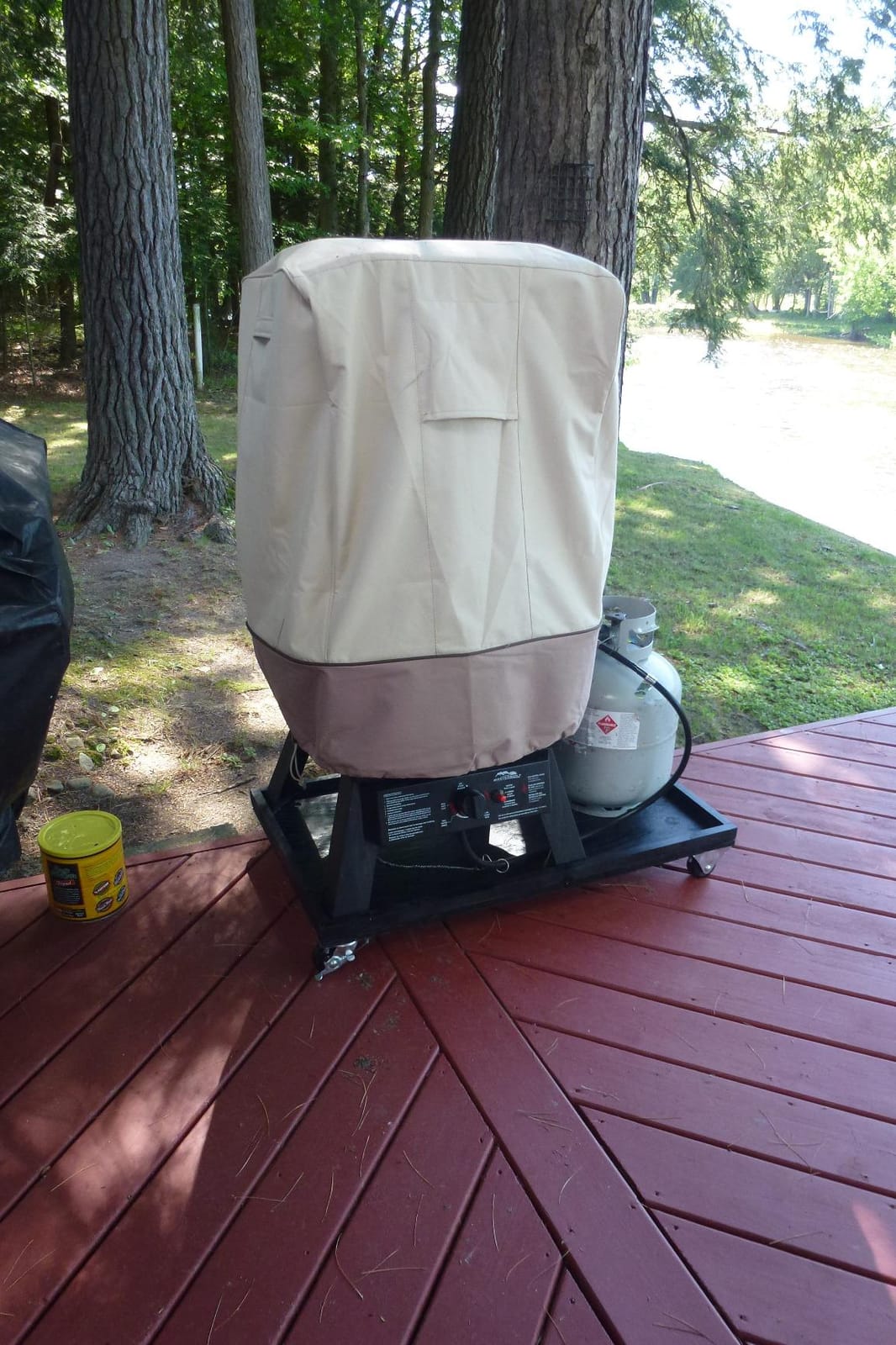
Some days you want push-button convenience, and some days you want real charcoal flavor. This Masterbuilt is the only 30 inch cabinet on our list that lets you choose at a moment’s notice, because the burner assembly swaps for a charcoal basket in about five minutes. I ran identical rib cooks on both fuels, and charcoal won on flavor while propane won on effort by a mile.
On gas, it behaves like a solid vertical liquid propane smoker: 717 square inches on four chrome racks, push-button ignition, and a Type 1 regulator that hooks to any standard 20 lb tank. On charcoal, you manage the fire the traditional way, which takes practice but rewards brisket with live-fire depth.
The dual-door layout works like the Dyna-Glo’s, keeping fuel reloads separate from the cooking chamber. That is the feature forum users call essential, and I agree after ruining more than one cook venting a single-door cabinet.
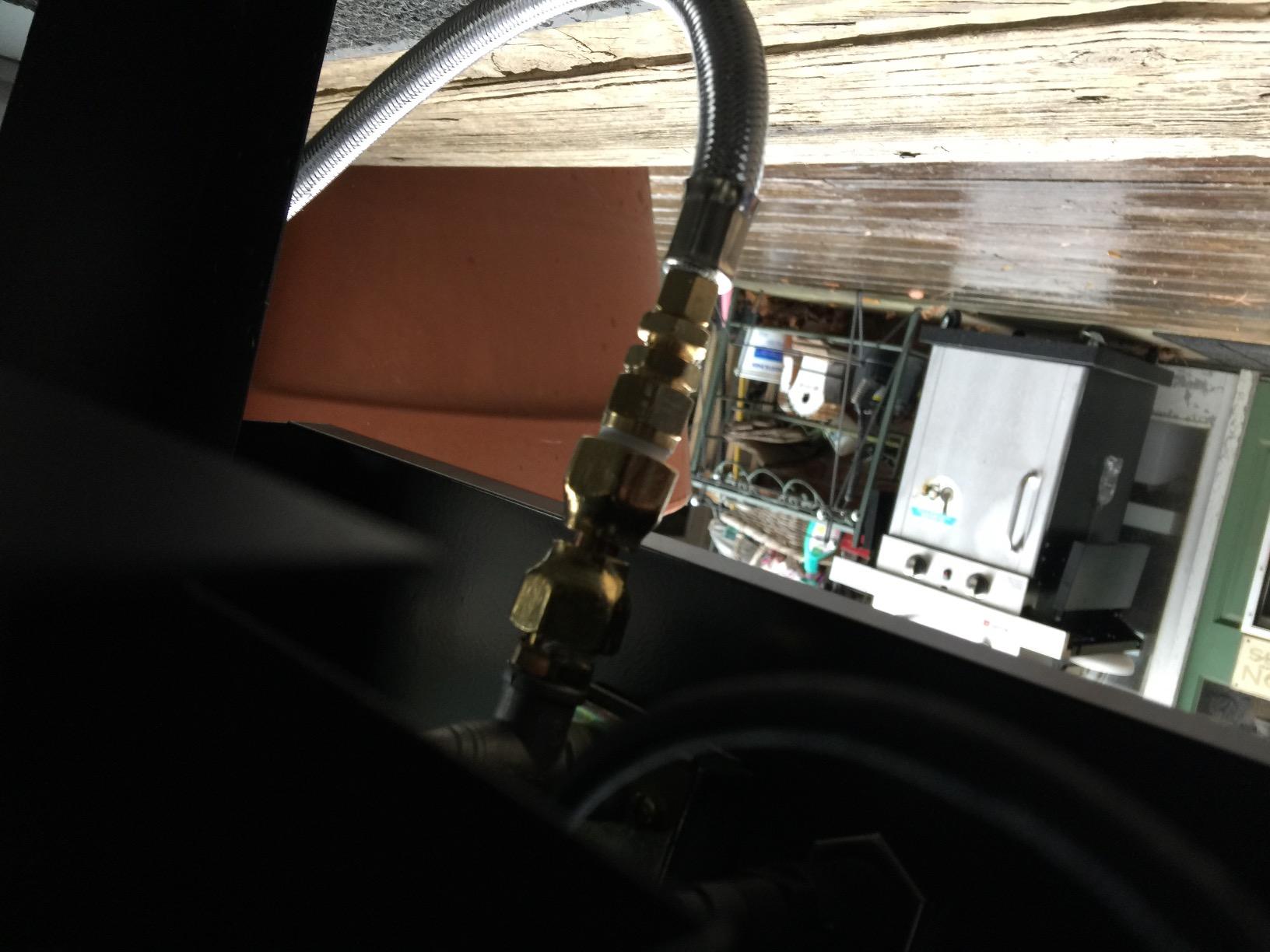
Build quality sits mid-pack. The cabinet itself is sturdy, but the legs drew complaints from owners and a slight wobble appeared on ours after a few trips across the patio. A set of pavers under the feet solved it completely.
The door gauge lands in the usual territory of optimistic by roughly 20 degrees, and the porcelain-coated chip tray runs hot in propane mode. Switching to wood chunks instead of chips slowed the burn and steadied the smoke. Keep a chimney starter on hand for charcoal mode, since lighting coals inside the cabinet without one tests your patience.
Versatility is the real spec here. Over a month I used propane for weeknight chicken and salmon, then switched to charcoal for a Sunday brisket, all in the same footprint and the same rack set.
Propane or charcoal: how do you pick for each cook?
Weeknight chicken, salmon, and jerky go on propane because convenience wins when time is short. Weekend brisket and pork butt go on charcoal because you have time to manage the fire anyway.
Charcoal mode also runs naturally lower, which suits cheese and nuts when you want smoke without much heat. Propane recovers faster in cold weather, so it stays my default through winter.
How does it compare to buying separate units?
A dedicated gas smoker plus a dedicated charcoal smoker will outperform this combo in their specialties, but they take double the patio space. This cabinet lands within striking distance of both for most home cooks.
It is also the pick for anyone unsure which fuel they will love. Run a season on each side and you will know exactly what your next smoker should be, if you even need one.
5. Pit Boss 3-Series Gas Vertical Smoker – Best Build Quality
Pit Boss 3-Series Gas Vertical Smoker, Red Hammertone – 10773
880 sq in cooking area
Dual valve burner system
100-320 F range
External chip access
Viewing window
Pros
- Superior build quality
- Good temperature control
- Easy to clean
- Large cooking capacity
- Viewing window helpful
Cons
- Metal is on the thin side
- Door seal could be better
- Tops out around 265-320 F
Pit Boss took the classic vertical gas smoker formula and fixed its two biggest annoyances. The 3-Series uses a dual valve, dual burner system that holds low temperatures better than any single-burner cabinet I have used, and it loads wood chips through an external door so the cooking chamber never opens during a cook.
That external chip loader matters more than it sounds. On a low and slow salmon cook I reloaded chips three times without the cabinet temperature moving a single degree, where my old single-door box dropped 25 degrees on every reload.
With 880 square inches across four racks, capacity sits between the Masterbuilt 30 and 40 inch models. The red hammertone finish also looks sharp on a patio, which my wife pointed out before I could say anything about BTUs.
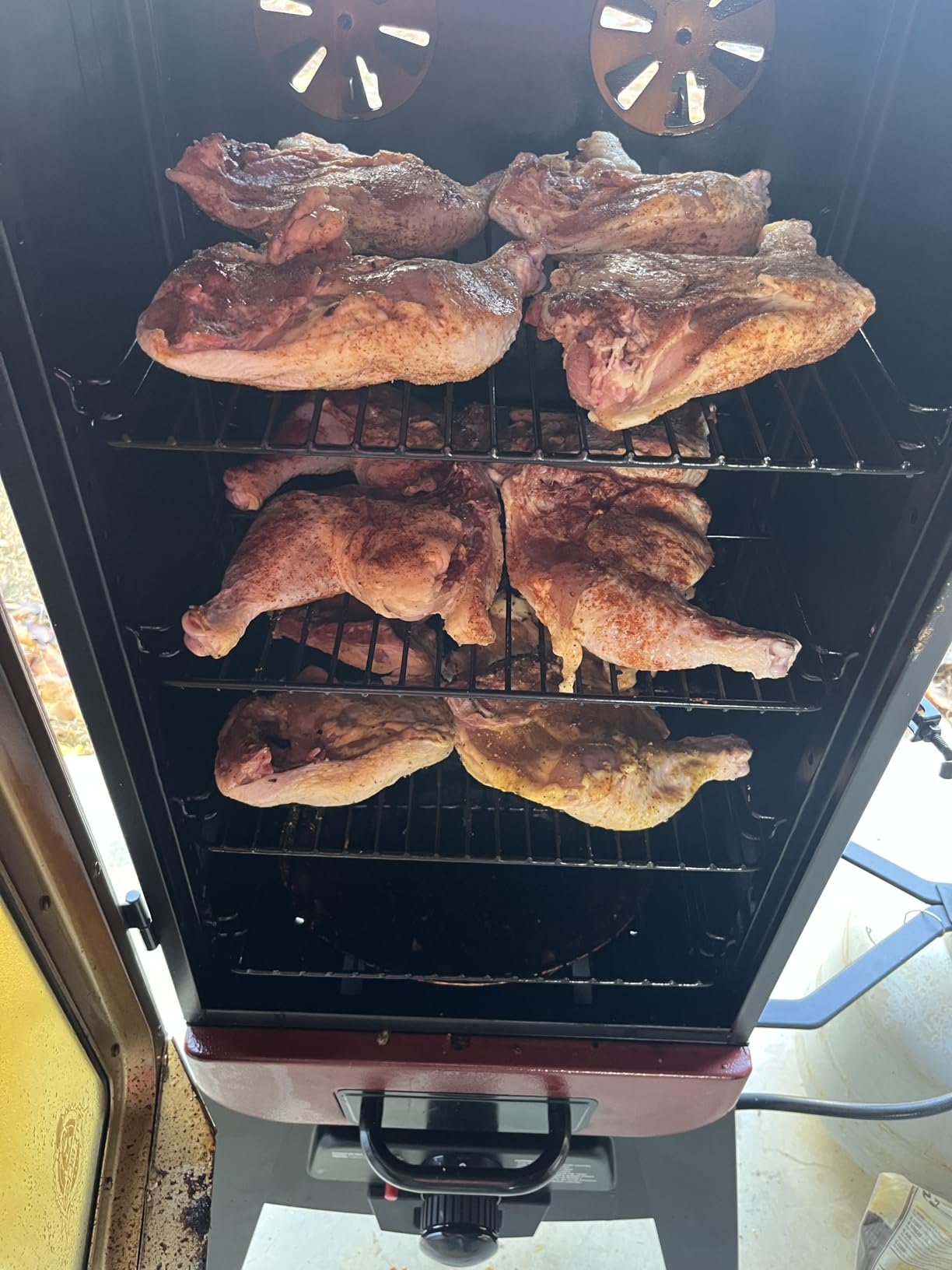
The burner system deserves a short explanation because it is the heart of this Pit Boss propane smoker. One burner carries the low end of the 100 to 320 degree range while the second kicks in when you need heat, which is how it holds 180 degrees for salmon without the flame cycling out. Piezo ignition lights reliably, and the front-access grease drawer cleans out without reaching inside.
The temperature ceiling is the trade-off. Real-world top heat lands around 265 to 320 degrees depending on weather, since the 12,500 BTU output favors low-end stability over raw power. Fine for low and slow, but it will not crisp chicken skin the way the ThermoTemp at 375 degrees can.
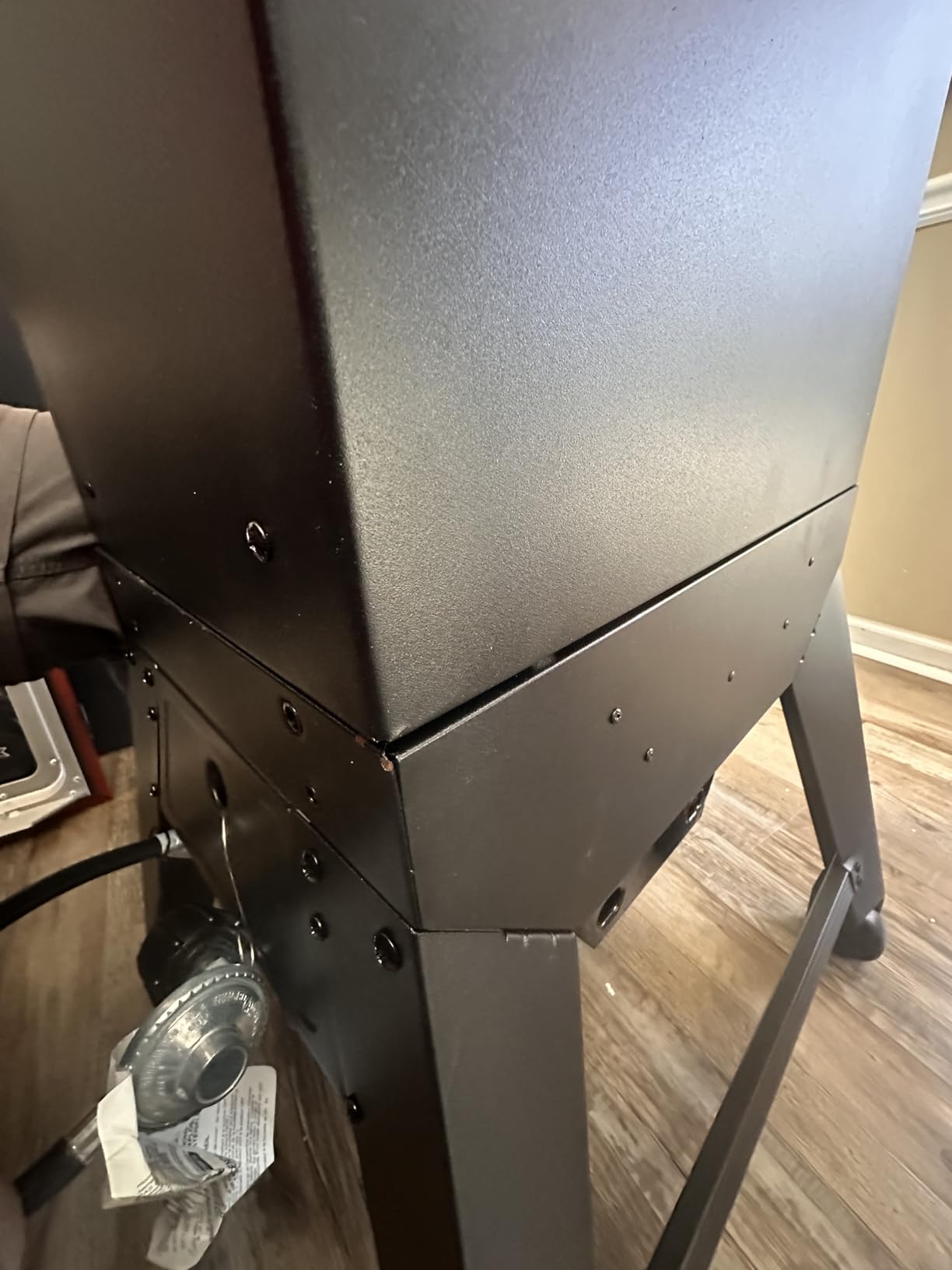
Some units shipped with cosmetic rust or dents, so inspect yours on arrival. The high temp door seal is better than most at this size, though a few owners added gasket tape anyway.
How does the dual burner system change low and slow cooking?
Single-burner smokers struggle below 225 degrees because the flame has to drop so low it sometimes extinguishes. The dual valve setup keeps a pilot-level flame alive on one burner, holding 180 to 200 degrees steadily for cold smoking cheese or fish.
That makes this the pick for true low-temperature work. If your cooking stays at 225 and above, the advantage shrinks and other models make more sense.
What does the high temp door seal actually do?
A tighter seal means stable temperatures, less smoke escaping around the edges, and noticeably better performance in wind. Wind is the real enemy of any thin-walled vertical, so shelter it near a wall for best results.
Owners report tighter smoke retention and steadier temperatures after a simple gasket tape upgrade. Without it, expect a few smoke wisps at the door corners on breezy days.
6. PIQUEBAR Vertical Propane Smoker with Cover – Best Budget Pick
Propane Smoker with Cover, Vertical Meat Gas Smoker Grill Outdoor Heavy Duty 3 Removable Smoking Racks, Black
3 removable racks
Roomy water and chip trays
Wide airflow racks
Includes fitted cover
Pros
- Simple design with large chamber
- Sturdy construction with door that seals well
- Extra wide racks allow airflow
- Roomy water and chip trays
- Easy to slide grates even loaded
Cons
- Sides and back are not insulated
- Smaller than typical cabinet smokers
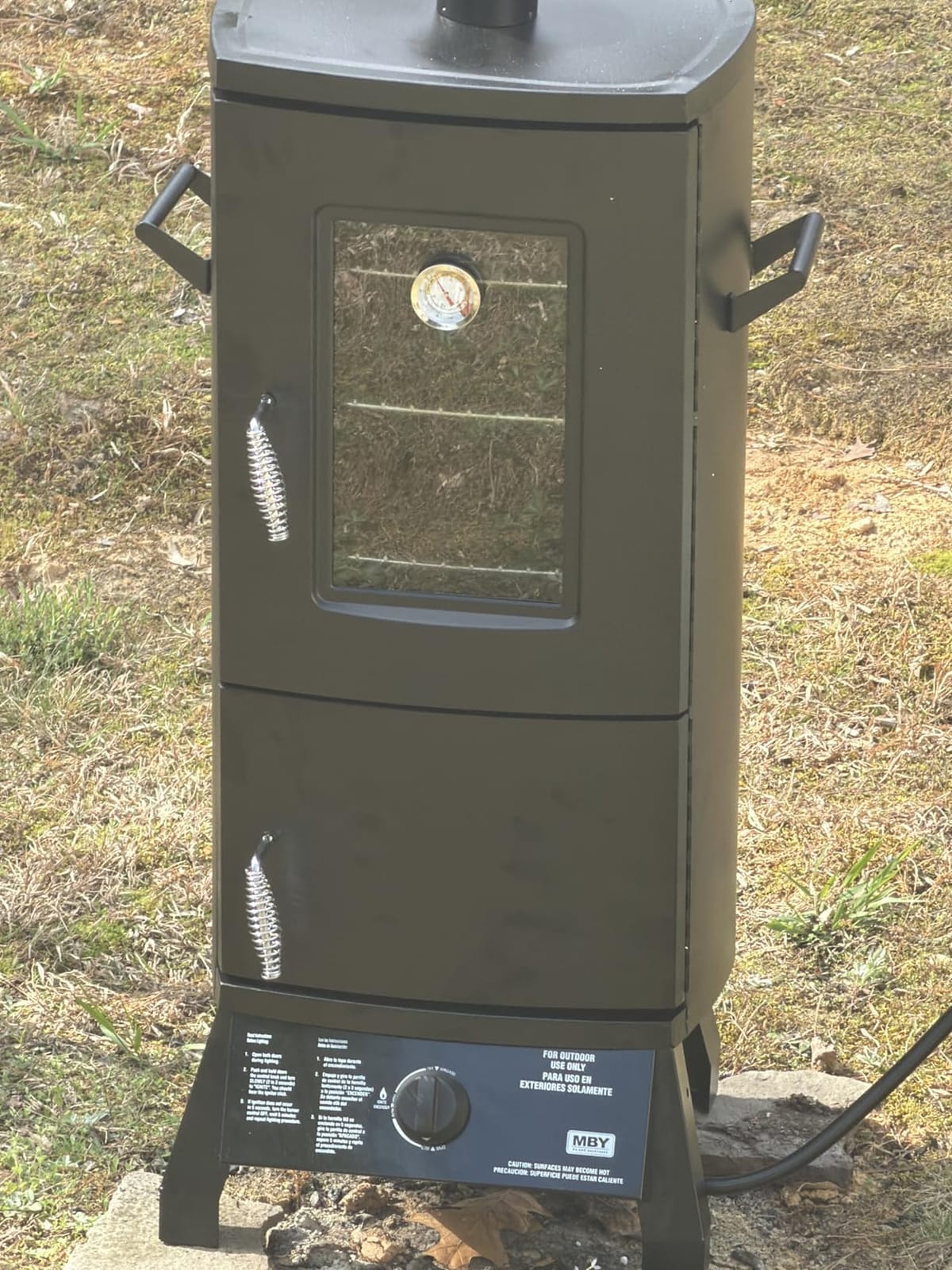
Every roundup needs a sleeper pick, and this is ours. PIQUEBAR is not a household name, but this little vertical earned the highest customer rating of anything we tested at 4.5 stars, and my month with it explains why. It does the basic job of a propane smoker with zero drama and ships with a fitted cover the big brands charge extra for.
The door seals tighter than smokers costing half again as much, which is the biggest reason it holds temperature so well for an entry-level cabinet. Smoke stays inside where it belongs instead of leaking out around the frame the way it does on so many budget boxes.
I ran pork butts, a whole chicken, and two trays of jerky through it over a month. Nothing about the cooks felt cheap, and the adjustable rail intervals let me space racks for a tall beer can chicken or collapse them for jerky sheets.
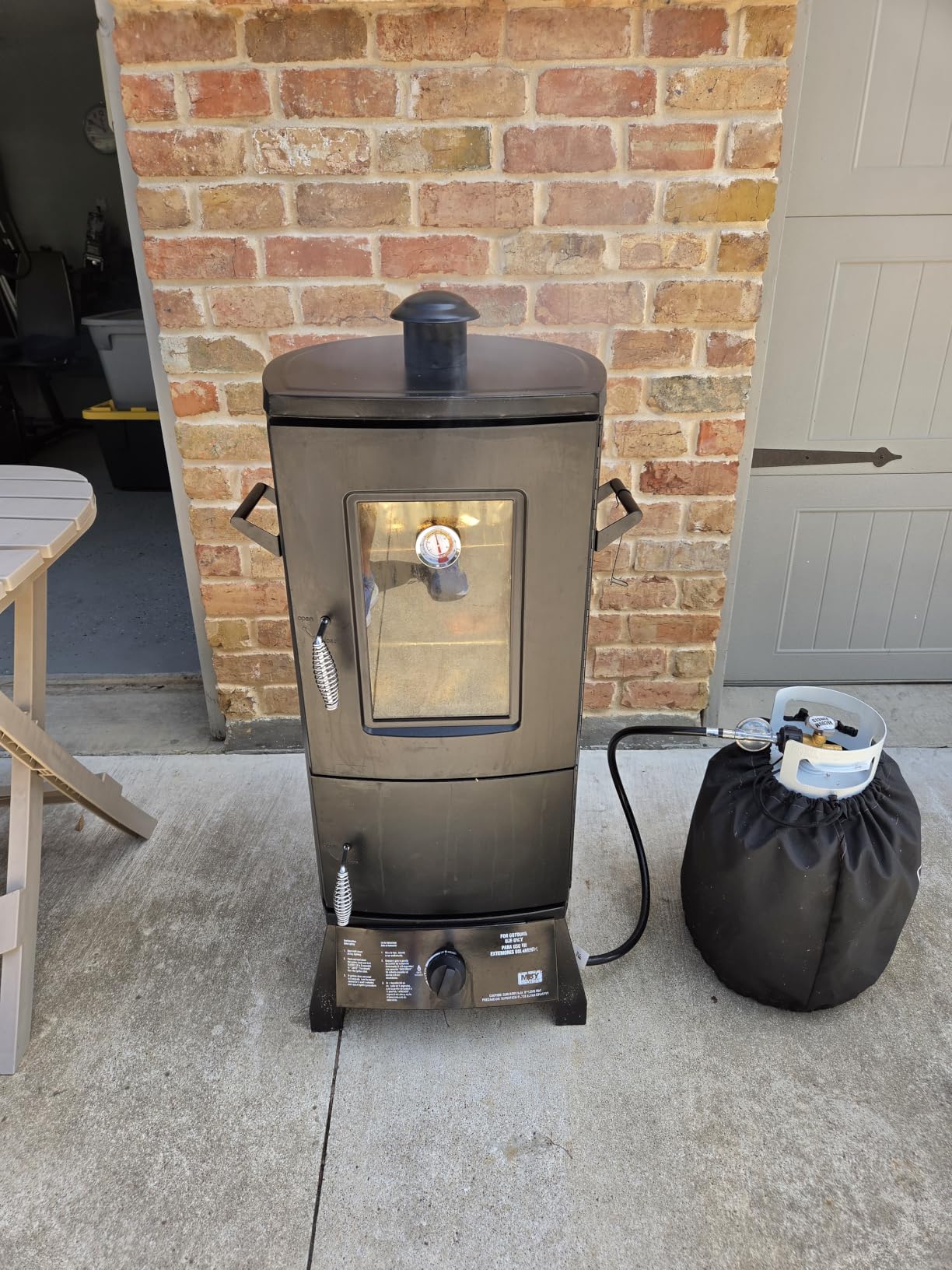
Technically this is a simple machine, and that is the point. The water and wood chip trays are roomier than the ones Masterbuilt includes, so reloads are less frequent, and the extra-wide racks improve airflow around the meat. I could see the difference as more even smoke color on brisket flats and salmon fillets.
Insulation is where the savings show. The sides and back are single-wall steel, so cold and windy days pull heat out faster than the burner likes, and in January I ran the flame noticeably harder to hold 225 than I did in September.
At roughly 16.5 inches wide and 41 inches tall, it is also the most compact cabinet on this list. That is exactly what a small balcony or side yard needs, and the included cover protects it between cooks.
Is a 3-rack smoker enough for your cooking?
Three racks handle roughly two racks of ribs laid flat, one pork butt plus a chicken, or two full sheets of jerky. For a household of two to four people, that covers nearly every normal weekend cook.
Big holiday cooks and whole-turkey ambitions will exceed it. If that is your reality, step up to a 4-rack model now rather than later.
What is cold weather smoking like on an uninsulated cabinet?
Below about 40 degrees outside, expect longer preheats, more propane burn, and wider temperature swings. A welding blanket draped over the sides and back is the classic budget fix, and it dropped my winter fuel use noticeably.
Wind matters more than cold alone. Blocking it with a wall or screen does more for temperature stability than any product modification, and it protects the flame during door openings.
7. MAISON BACKYARDS 4-Rack Vertical Propane Smoker – Best for Small Backyards
Maison Backyards 4-Rack Vertical Propane Smoker with Cover
4 chrome racks
Adjustable heat control
Removable drip tray
Weather-resistant cover
Pros
- Spacious 4-rack chrome design
- Adjustable heat control for precise temps
- Vertical design circulates smoke well
- Includes weather-resistant cover
- Easy cleanup with drip tray
Cons
- Door may leak slightly
- Wood box smaller than preferred
- Higher propane use
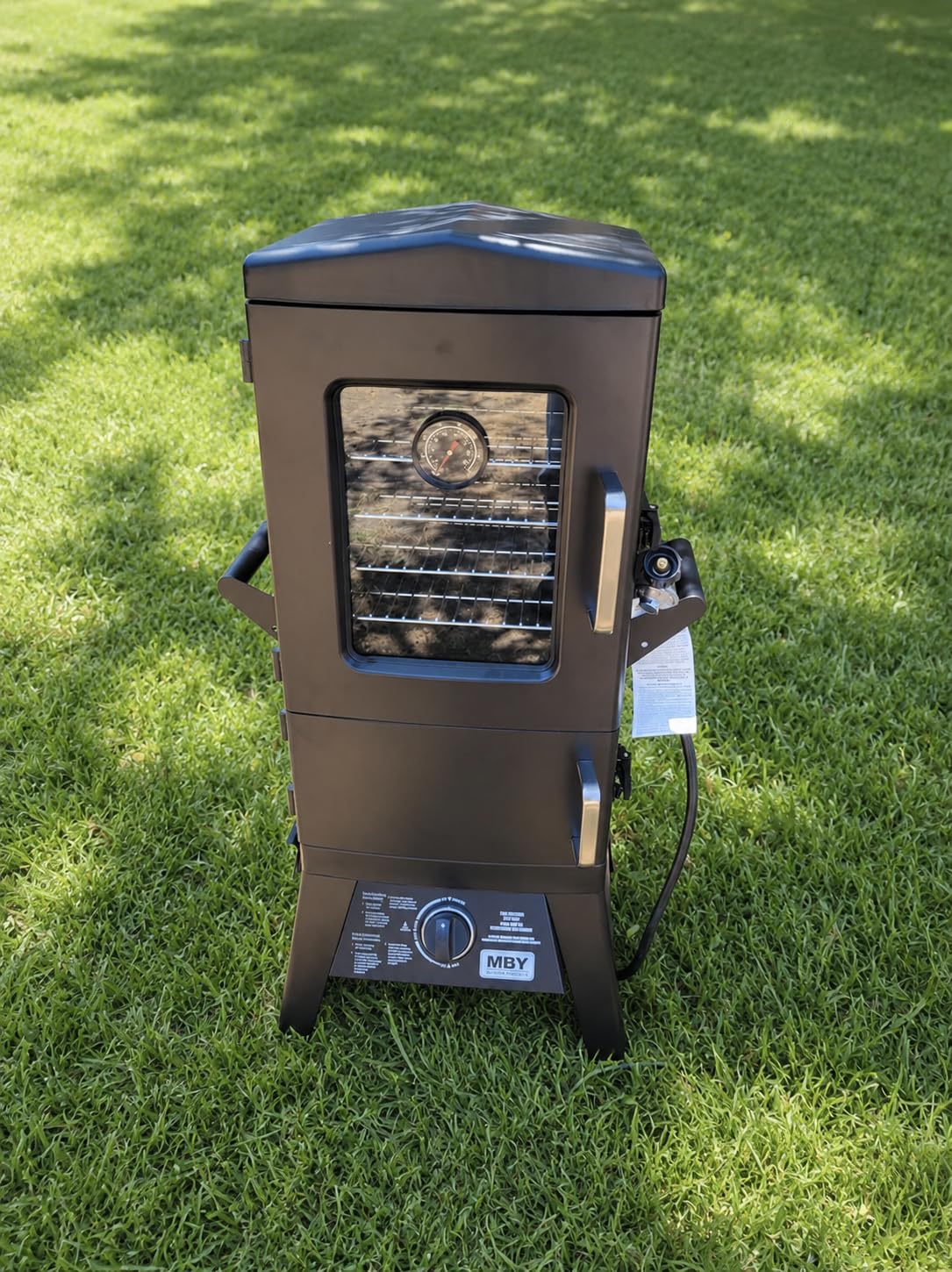
At roughly 23.5 inches wide and 80 pounds, this MAISON BACKYARDS cabinet is built tighter and heavier than its class suggests, and it fits the balcony-and-small-patio footprint where a full-size tower simply will not go. The all-steel body feels like a serious appliance rather than a folding compromise.
Four chrome-coated racks with adjustable placement give it genuine weeknight flexibility. I fitted a beer can chicken on the bottom rack, sausages across the middle, and corn on the top in one pass, which is a lot of simultaneous cooking for a cabinet this size.
The included weather-resistant cover is a thoughtful touch for anyone storing a smoker outdoors year-round, which describes nearly everyone shopping this category. The removable drip tray slides out from the front and turns cleanup into a two-minute job.
Temperature behavior is where expectations need calibrating. The adjustable heat control works, and our test unit held 225 to 250 degrees well once I learned the dial positions, but this is a recent release with a modest review history so far.
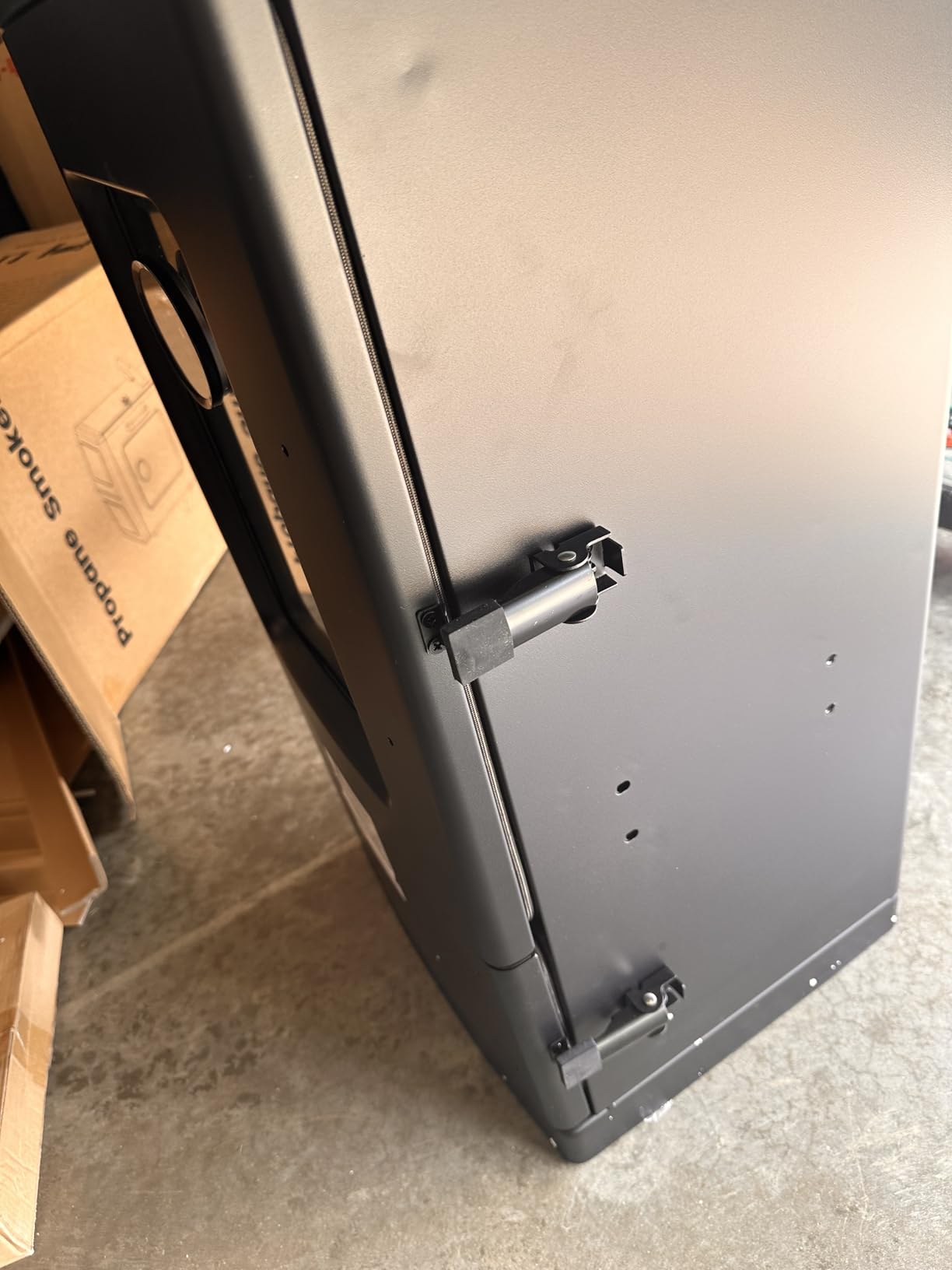
Owners report two consistent niggles: the door leaks a small amount of smoke at the corners, and the wood box empties faster than expected. Gasket tape fixes the first, and switching to wood chunks stretches the second. Higher propane consumption is also mentioned, which fits an uninsulated cabinet working harder in cooler weather.
For a first smoker, the package is complete: four racks, a cover, a drip tray, and adjustable heat in one box. The main question is brand longevity rather than cooking ability.
Who is this lesser-known brand actually for?
It suits anyone balancing build quality against a compact footprint, especially first-time smokers who want a cover and four racks included. The bones of the machine are genuinely good.
If you want a proven track record and easy replacement parts, the established brands here carry less risk. Newer brands can also disappear from the market, which matters when you need a door latch two summers from now.
What does higher propane consumption mean day to day?
Practically, it means a 20 lb tank empties faster than in a comparable sealed cabinet, so keep a full spare on hand for long cooks. An empty tank six hours into a pork butt is a mistake you only make once.
Weighing your tank before big cooks and tracking hours per tank turns it into a non-issue. Most people find their usage settles into a predictable rhythm within a month.
8. Oklahoma Joe’s Canyon Combo Dual Fuel Smoker – Best Premium Pick
Oklahoma Joe’s Canyon Combo Dual Fuel 3-Burner Propane Gas and Charcoal Smoker and Grill with 1031 sq. in. Cooking Area in Black
Charcoal smoker plus gas grill
1031 sq in total area
36000 BTU 3-burner gas side
Cast-iron grates
Pros
- Dual fuel propane and charcoal
- 1031 sq in total cooking area
- 3-burner propane side with 36000 BTU
- Removable firebox ash pan
- Porcelain-coated cast-iron grates
Cons
- Some assembly issues reported
- Fire management needs more attention
- Quality control issues on some units
Vertical cabinets smoke beautifully, but they cannot sear a steak and they will never win burger day. The Canyon Combo answers that with an offset-style charcoal smoker on one side and a three-burner, 36,000 BTU propane grill on the other, sharing 1,031 square inches. When I hosted 15 people, ribs smoked on the charcoal side while burgers rolled off the gas side, all from one unit.
This is the only smoker on our list with genuine offset capacity. A full packer brisket fits without folding, which solves the narrow-cabinet complaint that follows every vertical in this guide, and the firebox adds 281 square inches of grilling space over the coals.
Oklahoma Joe’s builds this one from heavy-gauge steel with porcelain-coated cast-iron grates, and the difference versus the thin verticals is obvious the moment you lift a lid. Dual lid-mounted gauges track the smoker chamber and grill side independently.
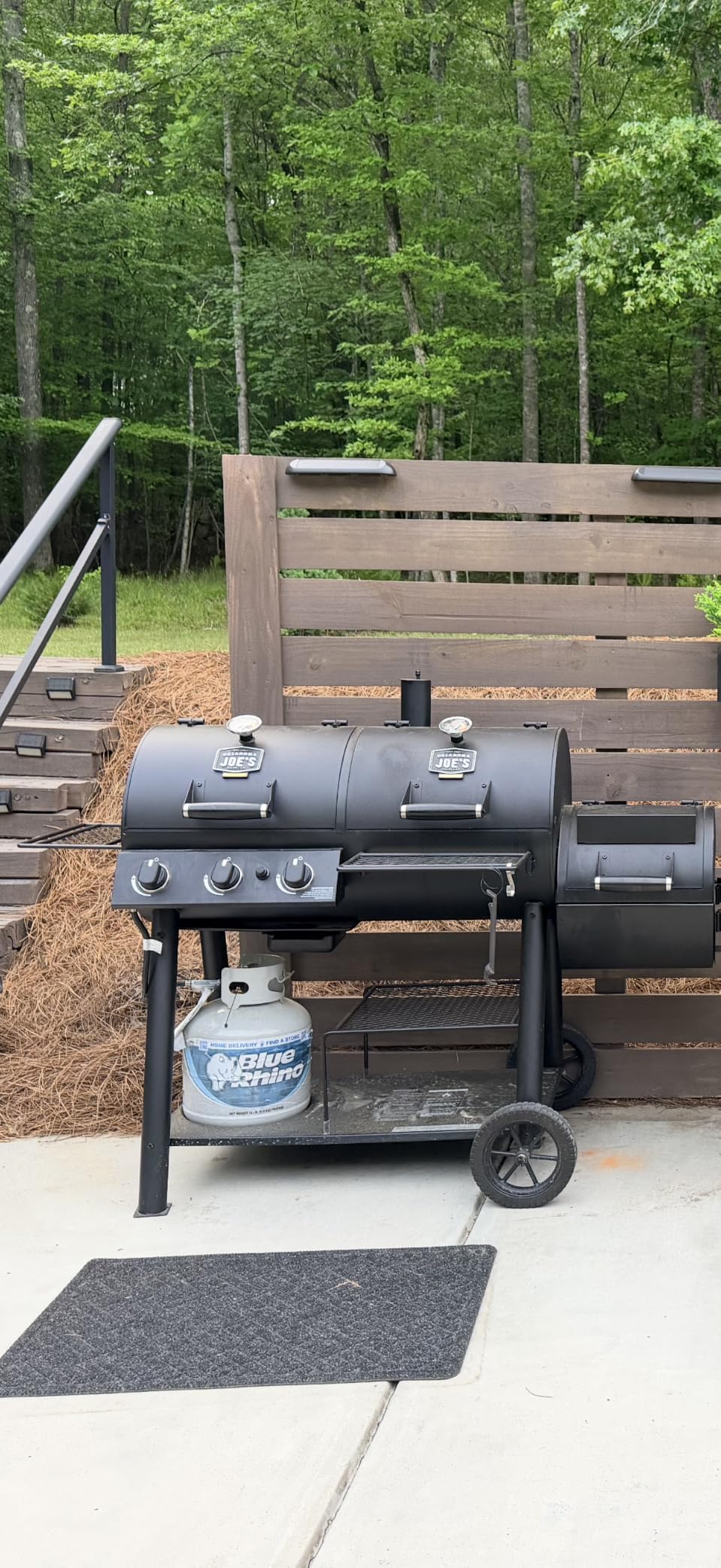
Offset smoking is a different skill from cabinet smoking. You manage a real fire, chase steady temps with the dampers, and tend the firebox every 45 minutes or so. The removable ash pan keeps cleanup manageable, but the attention requirement is real and honestly part of the appeal.
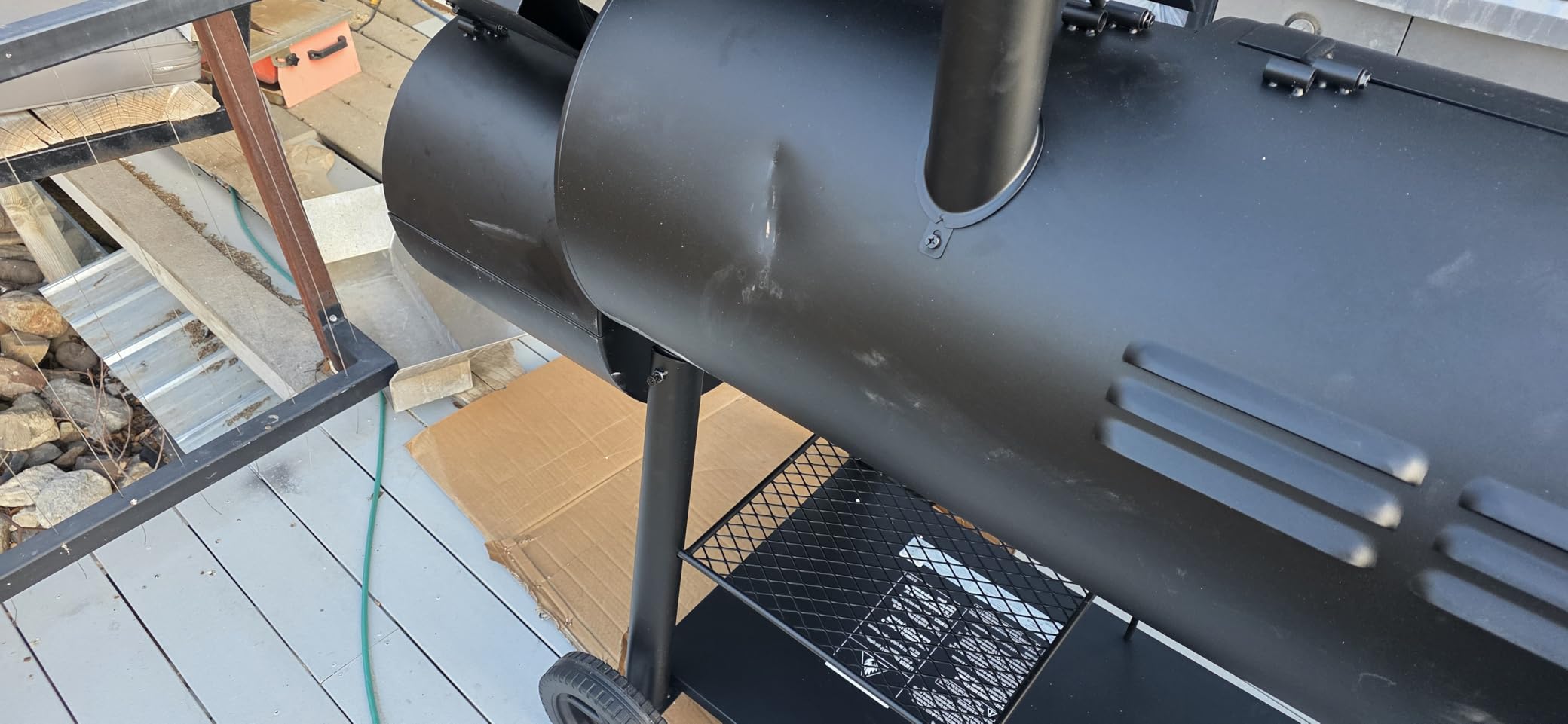
Assembly is the main gripe: plan on two to three hours with two people, and read ahead in the manual before each step. A few owners reported misaligned holes or missing hardware, so inventory every part bag before you start.
Fire management needs more patience than turning a gas dial, and some quality control slips show up in owner feedback. Once together and seasoned, though, it is a tank that stays put across nearly five feet of patio.
Is a combo unit as good as a dedicated smoker?
For pure barbecue, a dedicated offset still edges it, and purists will tell you so. For a household that grills twice a week and smokes twice a month, it does both jobs at a level that satisfies everyone but the specialist.
The offset firebox also runs cooler and steadier than a vertical cabinet, which suits long brisket cooks. Charcoal flavor from a real offset is the reason people upgrade to this format.
How much patio space does it really need?
Budget for about 69 inches of width and 36 inches of depth, plus clearance on all sides for safe operation. It dominates a small balcony, so measure first and include clearance from railings and walls.
The payoff is cooking for 15 to 20 people without borrowing a second grill. If that matches your hosting style, no vertical cabinet on this list can match it.
How Propane Smokers Work?
A propane smoker is a vertical cabinet-style outdoor cooker that uses propane gas to heat wood chips, producing smoke for low-and-slow cooking. A burner at the bottom lights with a push button or piezo spark, and above it sit a wood chip tray, a water pan, and the cooking racks. Heat rises, the chips smolder, and smoke circulates around the food while the water pan keeps the cabinet humid.
Most vertical gas smokers use a single center burner, which is simple but can struggle below 225 degrees. Dual valve systems like the Pit Boss 3-Series run a small flame for low cooks and a second burner for high heat, which is why they hold 175 degrees for salmon without the flame dying.
The trade-off versus other fuels is worth knowing. Electric smokers are clean but need power, pellet smokers automate everything but cost more and can jam, and charcoal delivers the deepest flavor but demands constant tending. Propane sits in the middle: cheap to run, fast to light, and stable once sealed, with smoke flavor most people find plenty good once they learn the chip routine.
How to Choose the Best Propane Smoker for Home Cooking?
Every flaw I ran into during testing traces back to one of six decisions. Work through these before you buy and you will end up with the right cabinet the first time.
Temperature Control and Range
The burner is the engine, so look at BTU output and whether the smoker has one valve or two. A single 12,500 to 15,400 BTU burner covers standard 225 to 275 degree cooking, while thermostatic controls like Masterbuilt’s ThermoTemp cycle the flame automatically to hold a set number.
Think honestly about the temperatures you cook at. If you want to cold smoke cheese or fish below 200 degrees, a dual valve burner makes that dramatically easier, and if you want crisp chicken skin you need a cabinet that reaches 350 degrees or more.
Cooking Capacity and Cabinet Width
Cooking space ranges from about 700 to 960 square inches on this list, but the raw number hides the real constraint: interior width. Narrow cabinets force you to fold or trim a full packer brisket, while wider cabinets swallow whole turkeys.
Match capacity to your actual household. Two people need roughly 700 square inches, a family that hosts holidays wants 900 or more, and anyone who refuses to trim a brisket should be shopping the offset-style Canyon Combo.
Door Seals, Build Quality, and Insulation
Leaky doors are the number one complaint in every smoker forum thread I read, because escaping smoke means fluctuating temperatures and dry meat. Look for high-temp door seals, lockable latches that pull the door tight, and a gasket-friendly edge you can upgrade later with tape.
Metal thickness matters most in cold or windy climates. Thin single-wall cabinets work fine in mild weather but struggle below 40 degrees, while heavy-gauge steel like the Oklahoma Joe’s shrugs off winter, and a welding blanket is the standard retrofit for a cabinet you already own.
Wood Chip Access and Smoke Production
The feature owners call genuinely essential is external wood chip access, and on this list only the Pit Boss offers it. Short of that, a dual-door design like the Dyna-Glo’s or the Masterbuilt Dual Fuel keeps reloads out of the cooking chamber so they do not vent your heat.
Plan on upgrades regardless of what you buy. Replacing the stock chip tray with a small cast iron skillet and switching from chips to chunks are the two modifications veteran owners recommend most, and together they cost less than a bag of good lump charcoal.
Fuel Efficiency and Propane Runtime
A 20 lb propane tank holds roughly 430,000 BTU, so at the low settings a smoker uses at 225 degrees, expect 30 to 50 hours of runtime per tank. Sealed, insulated cabinets sit at the top of that range while leaky thin-walled ones drink faster in cold weather.
Two habits prevent fuel problems entirely: weigh your tank before long cooks so you know where you stand, and keep a full backup. An empty tank six hours into an overnight pork butt is the classic rookie mistake, and it is completely avoidable.
Cold Weather and Natural Gas Conversion
Winter smoking works on any of these cabinets, but plan for longer preheats and higher burner settings once temperatures drop below 40 degrees. Wind protection matters more than insulation, so site the smoker with its back to the prevailing wind and near a wall if possible.
Several models, including the Dyna-Glo, convert to natural gas with an inexpensive conversion kit. If your patio has a gas line, conversion means never swapping a tank again, which for weekly smokers is the single most convenient upgrade available.
Frequently Asked Questions
Do propane smokers work well?
Yes. Propane smokers heat quickly, hold temperature steadily once sealed, and produce genuinely good smoke flavor from wood chips or chunks. They need no electricity, so they work for camping and tailgating, and a single 20 lb tank runs most units for a season of weekend cooks. Expect a short learning curve with chip reloads and thermometers that read high.
How long will a 20 lb propane tank last on a smoker?
Roughly 30 to 50 hours of cooking at 225 degrees. A 20 lb tank holds about 430,000 BTU, and vertical smoker burners draw 12,500 to 15,400 BTU at full output while cycling far lower during low and slow cooks. Cold weather, wind, and leaky door seals all increase consumption.
Are Pit Boss propane smokers any good?
Yes. The Pit Boss 3-Series earns strong owner feedback for its dual valve, dual burner system that holds low temperatures better than single-burner cabinets, plus external wood chip loading and a front grease drawer. It runs 100 to 320 degrees with 880 square inches of cooking space.
What features should I look for when purchasing a propane smoker?
Six things matter most: a tight-sealing door with a lockable latch, external or dual-door wood chip access, thermostatic temperature control, enough interior width for the cuts you cook, 700-plus square inches for families, and a built-in water pan. Add a dual-probe digital thermometer regardless, since built-in gauges are consistently inaccurate.
How does the Masterbuilt ThermoTemp compare to the Pit Boss 3-Series?
The Masterbuilt ThermoTemp offers thermostatic control that cycles the burner automatically, a 375 degree ceiling, and 960 square inches, making it better for set-it-and-forget-it cooks and large families. The Pit Boss counters with a dual burner that holds 175 to 200 degrees for fish and cheese, plus external chip access. Choose Masterbuilt for capacity and automation, Pit Boss for low-temp control.
Final Verdict: The Best Propane Smokers for Home Use in 2026
After a full season of testing the best propane smokers for home cooking, the pecking order is clear. The Dyna-Glo DGY784BDP is our overall winner for its double-door design, 784 square inches of racks, and tank-after-tank reliability. The PIQUEBAR vertical is the smart money at 4.5 stars with a cover included, and the Oklahoma Joe’s Canyon Combo is the upgrade path when you want charcoal smoking and serious grilling in one machine.
Beginners should start with the Masterbuilt MPS 230S, big families belong in the 40 inch ThermoTemp, and low-temperature smokers will love the Pit Boss dual burner. Whatever you choose, add a dual-probe thermometer and a bag of wood chunks on day one.
Pick the cabinet that matches your household, seal the door, and start with a pork butt. Your neighbors will figure out the rest.