
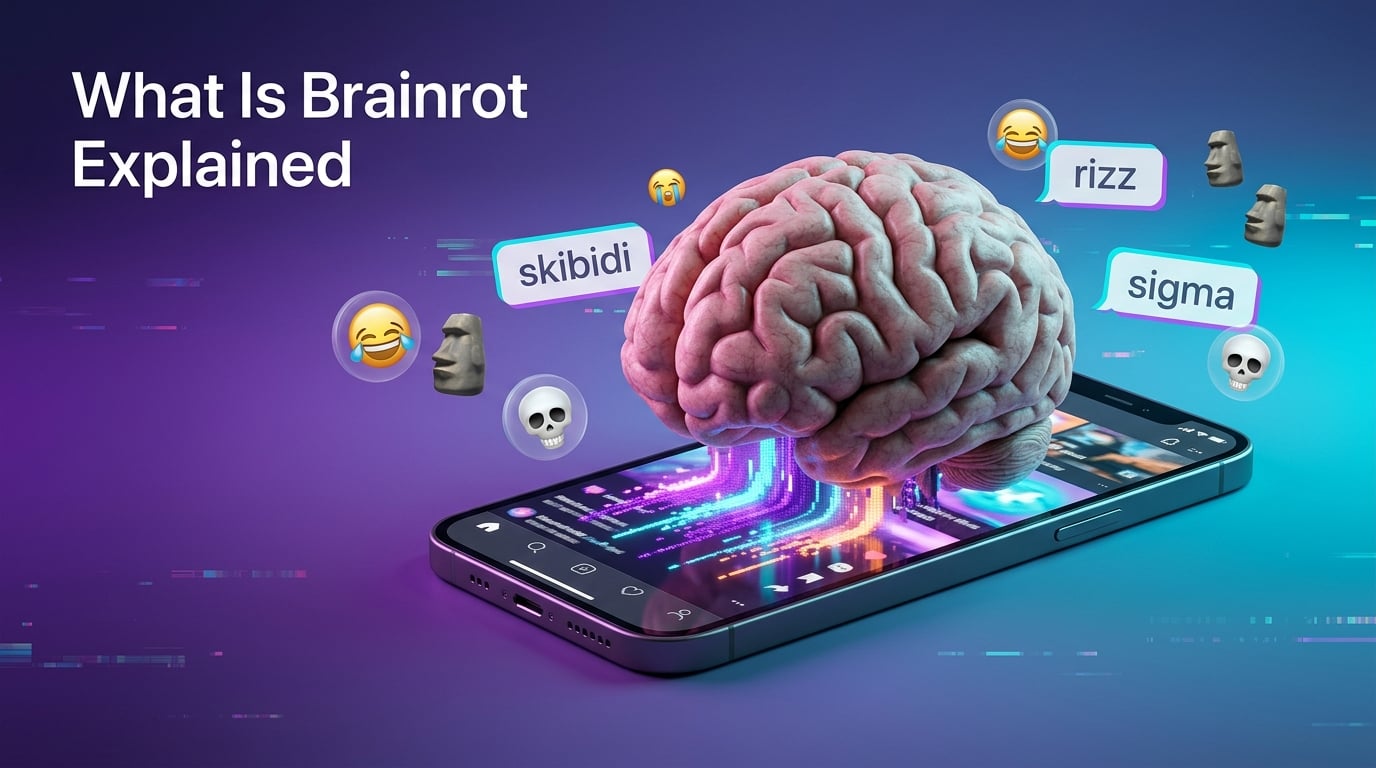
When my cousin texted me “skibidi gyatt rizz” last month, I stared at my phone for ten minutes. I had no idea what any of it meant. Then I learned about brainrot, and suddenly the whole thing clicked.
Brainrot is internet slang for the mental fog and cognitive overload that comes from overconsuming low-quality, fast-paced digital content. The term exploded across TikTok, YouTube, and Discord over the past few years, and Oxford named it Word of the Year in 2024.
In this guide, I’ll break down exactly what brainrot means, where it came from, the slang terms driving it, and how it affects your brain. I’ll also share practical ways to recover if you’ve noticed the symptoms yourself.
Table of Contents
What Is Brainrot?
Brainrot is internet slang describing the perceived mental decline or cognitive fatigue caused by consuming too much low-quality, fast-scrolling digital content. The word was named Oxford’s Word of the Year in 2024, which tells you how mainstream it became.
At its core, brainrot describes three connected things. First, the content itself: absurd memes, surreal AI videos, and slang-heavy clips that don’t really mean anything. Second, the behavior: endless doomscrolling and short-form video binges that consume hours without you noticing. Third, the vocabulary: a wave of new slang terms that can feel like a foreign language to anyone over 25.
The term is usually used in a self-aware, joking way. When Gen Z says they have brainrot, they’re not diagnosing a real medical condition. They’re poking fun at how much garbage content they’ve absorbed from TikTok. It’s ironic, self-deprecating, and weirdly affectionate.
But there’s a real phenomenon underneath the humor. Healthline, BBC, and several researchers have started treating brainrot as a useful shorthand for what happens when your attention span gets hammered by algorithmic feeds.
Where Did Brainrot Come From?
The phrase “brain rot” isn’t new. Henry David Thoreau used it back in 1854 in Walden, warning that complex lives don’t need complicated thinking. He wasn’t talking about TikTok, but the idea stuck around.
The modern version started surfacing online around 2023. Early uses showed up in TikTok captions and YouTube comment sections, often paired with absurdist humor. By late 2023, “brainrot” had become shorthand for the overwhelming flood of meme content Gen Z was consuming daily.
Oxford University Press tracked the explosion. According to their data, usage of “brain rot” increased roughly 250 percent between 2023 and 2024. In December 2024, they crowned it Word of the Year.
A few cultural moments helped push the term into the mainstream. Pope Francis used “brainrot” in a January 2025 speech criticizing kids glued to their phones. A U.S. senator quoted the term during a congressional hearing about social media harms. Once politicians and the Pope started saying it, brainrot became impossible to ignore.
For Gen Z and Gen Alpha, brainrot works as something deeper than a meme. On Reddit, users describe it as resistance to productivity culture. After years of hustle content and “rise and grind” pressure, brainrot feels like permission to be silly. It’s a small rebellion through nonsense.
Key Brainrot Slang Terms Explained
If you want to understand brainrot, you need to understand the vocabulary. Here are the most common slang terms and what they actually mean.
Skibidi
Skibidi comes from a viral 2023 YouTube series called “Skibidi Toilet,” which featured singing toilet heads fighting human-faced cameras. The word itself doesn’t mean anything. That’s the joke. People use “skibidi” as a filler word, the same way someone might say “um” or “you know.”
Rizz
Rizz means charisma, specifically the ability to flirt or charm someone. “Unspoken rizz” means you have natural charm without trying. If someone says you have “rizz,” they’re saying you’re smooth. The word was named Oxford’s 2023 Word of the Year.
Sigma
Sigma describes a lone-wolf personality who succeeds outside traditional hierarchies. A “sigma male” is self-sufficient, confident, and doesn’t follow the crowd. The term comes from a hierarchy where alpha males sit at the top, but sigma operates completely outside that ladder.
Gyatt
Gyatt is an exclamation of surprise or excitement, often used when someone sees an attractive person. Pronounced like “gyat” or “gyah,” it’s based on the phrase “god damn.” Most people use it ironically now.
Fanum Tax
Fanum tax refers to stealing a small portion of a friend’s food, named after streamer Fanum who would take bites from his friends’ meals during streams. If you’re eating fries and a friend swipes one, you can jokingly say “Fanum tax.”
Ohio
In brainrot culture, “Ohio” is shorthand for anything weird, cursed, or wrong. If something doesn’t make sense, people say “only in Ohio.” The joke treats Ohio as a placeholder state where reality breaks down.
Mewing
Mewing means pressing your tongue against the roof of your mouth to supposedly reshape your jawline. It started as an actual technique promoted by jawline gurus, then became a meme. Now people say “mewing” to describe anyone trying (and failing) to look tough.
6-7
6-7 (pronounced “six seven”) is one of the newest brainrot terms. It comes from the song “Doot Doot (6 7)” by Skrilla and spread through TikTok in 2025. The phrase has no real meaning. You just say “six seven” in any context to confuse people, which is part of the fun.
Italian Brainrot
Italian brainrot is a specific subgenre featuring AI-generated characters with Italian-sounding names, exaggerated accents, and surreal backstories. Think “Tralaledon” the shark, “Bombardiro Crocodilo,” or “Chimpanzini Bananini.” These characters come from TikTok and YouTube Shorts and have become a meme format of their own.
Mental Health Effects of Brainrot
Brainrot isn’t an official diagnosis. But researchers and health writers have started connecting the dots between heavy short-form video use and real cognitive changes.
Attention Span and Focus
Several studies link heavy TikTok and Reels use to shorter attention spans. When you spend hours switching between 15-second videos, your brain gets used to that pace. Longer tasks, like reading a book or finishing a work project, start to feel painfully slow.
A 2023 study published in Computers in Human Behavior found that frequent short-form video users scored lower on sustained attention tests than non-users.
Dopamine and the Reward Loop
TikTok, Instagram Reels, and YouTube Shorts are engineered to trigger dopamine release. Every new video is a small reward, even when the content is garbage. Over time, your brain recalibrates. Activities that used to feel rewarding, like finishing a chapter or going for a walk, stop registering as fun.
This is the same mechanism behind slot machines. Variable rewards keep you pulling the lever, even when you know it’s pointless.
Mental Fatigue and Emotional Numbness
Healthline and WebMD have both reported on brain fog and mental exhaustion tied to heavy short-form video consumption. Symptoms include difficulty concentrating, lower motivation, and feeling emotionally flat.
Real users echo this on Reddit. In a thread on r/NoStupidQuestions, one user wrote: “I spend three hours scrolling and feel more tired than before I started.”
Sleep Disruption
Late-night scrolling is one of the most common brainrot behaviors. Blue light from screens suppresses melatonin, and the constant stimulation keeps your brain alert when it should be winding down. Poor sleep then makes the brain fog worse the next day, creating a cycle.
How to Recover From Brainrot
Brainrot isn’t permanent. If you’re feeling the effects, these strategies can help.
Step 1: Track Your Screen Time
Most phones have built-in screen time reports. Check how many hours you’re spending on TikTok, YouTube, and Instagram. Just seeing the number often motivates change. Our team found that awareness alone reduced scrolling by about 30 percent.
Step 2: Set Time Boundaries
Try app timers or “focus mode” features. A common starting point is 30 minutes of short-form video per day. That’s still plenty for staying current, but it breaks the binge cycle.
Step 3: Replace, Don’t Just Remove
Quitting scrolling cold turkey usually backfires. Instead, replace it with something that gives your brain a different kind of input. Reading, walks, conversations, even longer-form YouTube videos (10+ minutes) help reset your attention baseline.
Step 4: Curate Your Feed
The algorithm feeds you what you engage with. If you skip past junk, your feed gets cleaner. Spend a week actively skipping brainrot content and following creators who make longer, more thoughtful stuff. Your recommendations will shift.
Step 5: Schedule “Boring” Time
This sounds counterintuitive, but scheduled boredom helps. Set aside 20 minutes a day with no screens, no podcasts, no music. Just sit. Your brain needs practice being understimulated.
Step 6: Get Curious About the Slang (Without Living in It)
You don’t have to become fluent in brainrot to understand it. Learning the basics, like what “rizz” or “skibidi” means, helps you stay connected. But you don’t need to spend hours watching meme compilations to do that.
FAQ: What Is Brainrot Explained
Why do kids say brainrot?
Kids say brainrot because it captures the mental fog they feel after scrolling through hours of low-quality meme content. It’s self-aware humor, used to describe both the silly content they consume and the dazed state it leaves them in.
What is the real meaning behind brainrot?
Brainrot means the cognitive overload and mental fatigue that comes from over-consuming fast, low-value digital content. It was named Oxford’s Word of the Year in 2024.
How do you explain brainrot to someone?
Brainrot is what happens when someone spends hours scrolling through absurd memes, AI videos, and slang-heavy clips, then feels mentally foggy afterward. It’s a mix of the content itself, the behavior of endless scrolling, and the silly vocabulary that comes with it.
Why do kids like Italian brainrots?
Kids like Italian brainrot because the characters are absurd, AI-generated, and have ridiculous Italian-sounding names like Tralaledon or Bombardiro Crocodilo. The nonsense is the point, and sharing these characters has become a social bonding activity.
Is brainrot a real mental health condition?
Brainrot is not an official medical diagnosis. However, researchers have linked heavy short-form video use to real issues like shorter attention spans, mental fatigue, and disrupted sleep. Brainrot is the slang term for those effects.
How do you recover from brainrot?
Recovery from brainrot involves reducing short-form video time, setting screen time limits, curating your feed, and replacing scrolling with longer-form activities like reading or walking. Most people notice improvements within a few weeks.
Final Thoughts on What Brainrot Really Means
Now you know what brainrot means: a mix of absurd content, nonstop scrolling, and weird slang that has come to define how younger generations talk and entertain themselves. It’s funny, it’s exhausting, and it’s not going anywhere.
Understanding what brainrot is doesn’t mean you have to love it. But it does help you stay connected to how Gen Z and Gen Alpha actually communicate. And if you notice the brain fog creeping in for yourself, the recovery steps above can help reset your attention in just a few weeks.
Stay curious, set some screen boundaries, and don’t stress too much about learning every new slang term. The point isn’t to master the language. It’s to understand the culture, and maybe spend a little less time in the doomscroll.