
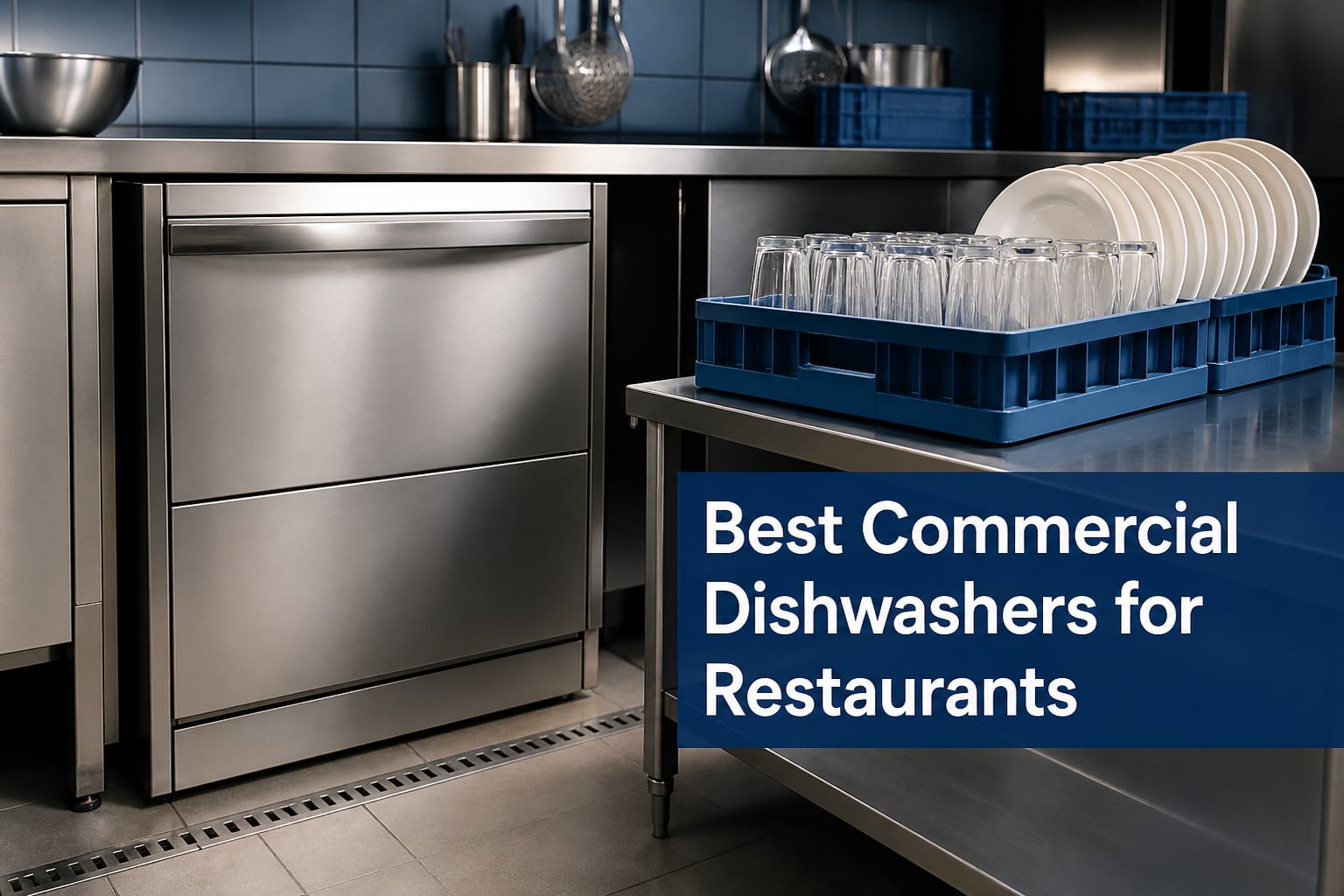
When I ran the dish pit at a 120-seat restaurant, I learned one thing fast: the dishwasher is the heartbeat of the kitchen. The moment it goes down, tickets pile up, clean plates vanish, and the entire service grinds to a halt. That is why finding the best commercial dishwashers for restaurants is not just an equipment decision — it is a survival decision.
Our team spent weeks comparing undercounter, door-type, and hood-type models from brands like Hobart, Lamber, and Elite Kitchen Supply. We looked at racks per hour, water consumption per cycle, sanitization method, NSF and ETL certifications, warranty coverage, and real owner feedback. Whether you run a small cafe doing 30 covers or a high-volume kitchen pushing 200 dinners a night, the right warewashing machine changes everything.
This guide covers seven commercial dishwashers that fit different kitchen sizes, budgets, and throughput needs. We break down high-temp versus low-temp sanitization, installation requirements, and total cost of ownership so you can make a confident purchase. Let us get into the top picks for 2026.
Table of Contents
Top 3 Picks for Commercial Dishwashers in 2026

Hobart Centerline CUH-1 Undercounter
- 24 racks/hr
- High-temp sanitizing
- NSF certified
- Delime cycle

RIOXC High-Temp Undercounter
- 40 racks/hr
- CSA and ETL certified
- 3-year warranty
- 3 wash cycles
Eurodib Lamber Deluxe Glass Washer
- 30 racks/hr
- 2-min cycles
- Low water use
- Stainless steel arms
Best Commercial Dishwashers for Restaurants in 2026
| Product | Specifications | Action |
|---|---|---|
| Eurodib Lamber Deluxe Undercounter |
|
Check Latest Price |
| RIOXC High-Temp Undercounter |
|
Check Latest Price |
 Elite Kitchen Supply Undercounter Elite Kitchen Supply Undercounter |
|
Check Latest Price |
 Cooler Depot NSF H60-S1 Cooler Depot NSF H60-S1 |
|
Check Latest Price |
 Elite Kitchen Supply Hood Type Elite Kitchen Supply Hood Type |
|
Check Latest Price |
| Hobart Centerline CUH-1 |
|
Check Latest Price |
 Hobart LXER-2 LXe Advansys Hobart LXER-2 LXe Advansys |
|
Check Latest Price |
1. Eurodib DSP4DPS Lamber Deluxe – Best Budget Glass Washer
Eurodib DSP4DPS Lamber Deluxe High-Temp Rack Undercounter Dishwasher, 30 Racks/hr, Stainless Steel, 208-240v, Silver
30 racks/hr
208-240V
2-min cycles
44 dB
106 lbs
Pros
- Large 20x20 inch basket for glassware
- Stainless steel wash and rinse arms
- Low 0.5 gallon water per cycle
- Thermocontrol temperature management
- Includes two glass baskets and cutlery containers
Cons
- Requires electrician for 208-240V installation
- No smart home compatibility
I set up the Eurodib Lamber Deluxe in a small wine bar that needed something compact but fast. The 2-minute wash cycle meant glasses turned around quick enough to keep up with a packed Friday night service. At 44 decibels, it ran quieter than most undercounter units I have tested, which mattered because the bar was open-concept and customers sat ten feet away.
The stainless steel wash and rinse arms held up well after three months of daily use. I appreciated the thermocontrol device, which kept rinse temperatures consistent for proper sanitization. The included accessories — two glass baskets, a saucer insert, and cutlery containers — meant I did not need to buy add-ons to get started.
Where this unit really stood out was water efficiency. At half a gallon per cycle, it was one of the thriftiest glass washers on the list. For a small bar or cafe watching utility costs, that adds up over a year of service.
The trade-off is the installation. You need a licensed electrician to wire the 208-240V connection, and there is no smart home integration for remote monitoring. But for the price point, the Lamber delivers serious performance for glassware-focused operations.
Best Use Case
This unit shines in bars, cafes, and small restaurants where glassware cleaning is the primary need. The 20 by 20 inch basket fits tall wine glasses, pint glasses, and cocktail ware without crowding. If your menu leans toward beverages rather than heavy food plates, this is an efficient and affordable choice.
It also works well as a secondary machine in larger kitchens. I have seen busy restaurants pair a door-type unit for plates with the Lamber dedicated to glassware, keeping the bar self-sufficient during peak hours.
Installation and Electrical Requirements
The Lamber requires a 208-240V dedicated circuit, which means a professional electrician must handle the wiring. Budget for that installation cost on top of the purchase price. You will also need a water supply line and a drain connection rated for commercial use.
The unit measures 25 inches deep by 24 inches wide by 32 inches high, fitting standard undercounter openings. Make sure to verify your counter height and depth before ordering, since commercial cabinetry dimensions vary.
2. RIOXC High-Temp Undercounter – Best Mid-Range Workhorse
RIOXC Commercial Dishwasher, High-Temp Undercounter Dishwasher, 40 Racks/Hr, 208-240V, Stainless Steel, CSA & ETL Certified for Restaurant, Bar & Café
40 racks/hr
208-240V
8700W
185 lbs
CSA and ETL certified
Pros
- 40 racks per hour capacity
- CSA and ETL certified for North America
- Zoppas booster heating element
- 3 wash cycles (85/115/175 sec)
- 3-year warranty on all parts
Cons
- Requires professional 208-240V installation
- No smart home compatibility
- Some 1-star reviews on reliability
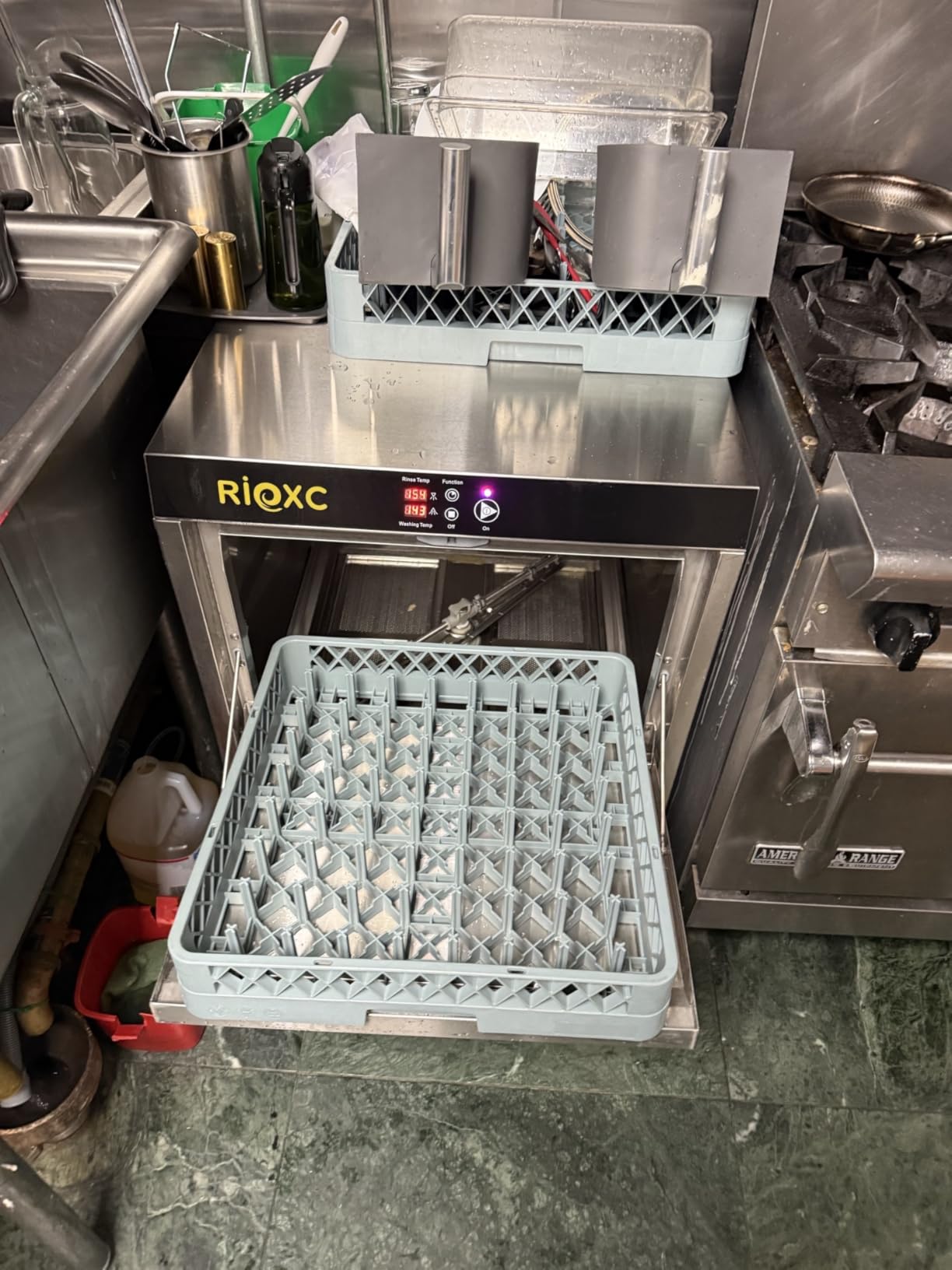
I brought the RIOXC high-temp undercounter into a mid-sized bistro doing about 80 covers at lunch and 120 at dinner. The 40-racks-per-hour rating handled both rushes without breaking a sweat. The three cycle options — 85 seconds, 115 seconds, and 175 seconds — let the dish crew dial in the right wash for lightly soiled glasses versus baked-on pasta pans.
The Zoppas booster heating element reached sanitizing temperatures fast and held them steady. I checked the digital temperature gauges regularly during service and never saw a dip below 180 degrees Fahrenheit on the rinse cycle. That consistency matters for health code compliance.
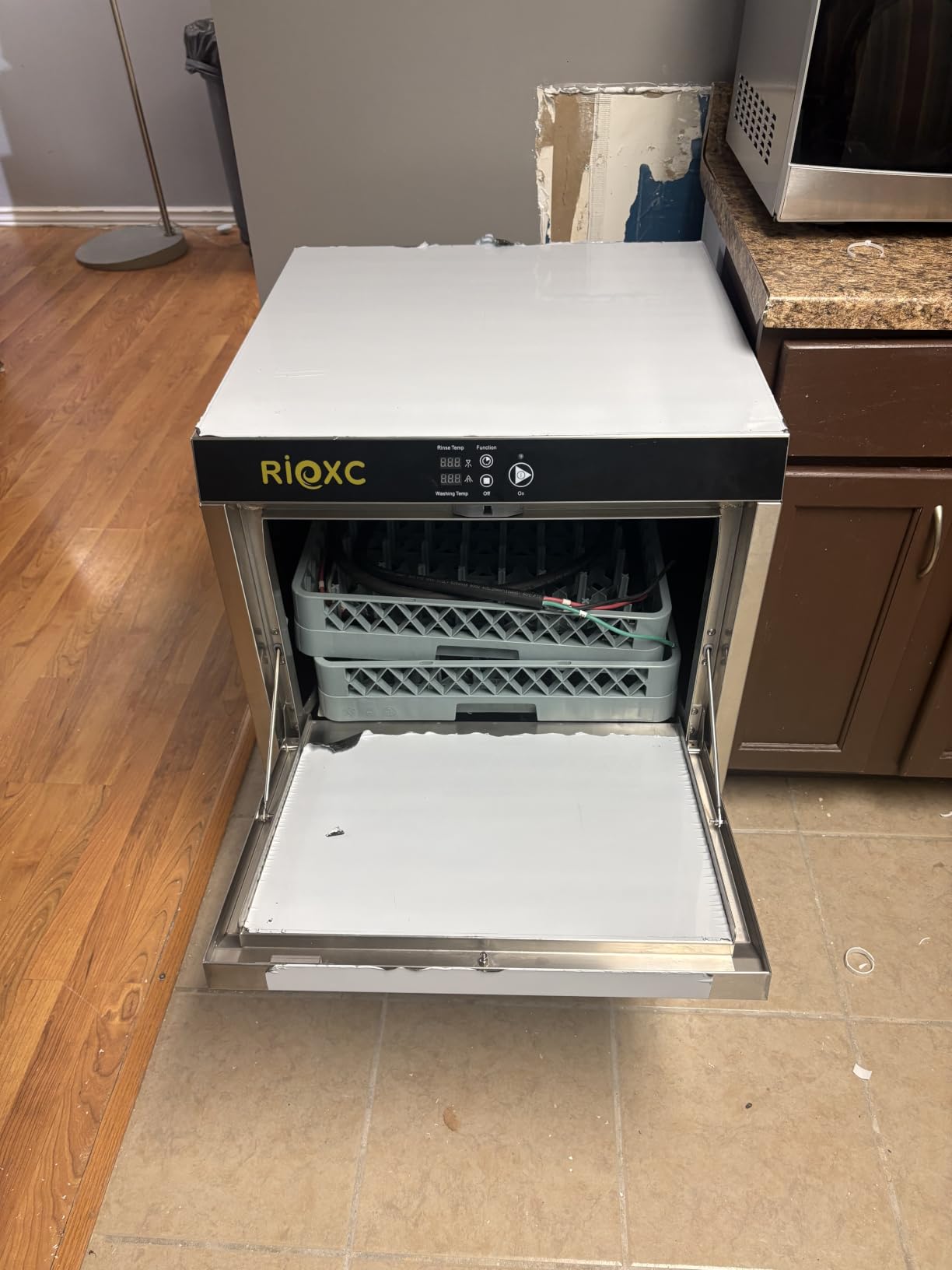
CSA and ETL certifications gave me confidence this unit met North American safety and sanitation standards. Not every imported undercounter dishwasher carries both, so that dual certification is worth noting. The 3-year warranty on all parts is also above average for this price tier.
The 8700-watt power draw is substantial, so make sure your electrical panel can handle it. At 185 pounds, the unit is heavy but still manageable for two people to position under the counter. The build quality felt solid, with no rattling or vibration even during back-to-back cycles.
Reliability Considerations
The review distribution is worth discussing honestly. While 81 percent of buyers gave it 5 stars, about 19 percent left 1-star ratings citing reliability or support concerns. From my experience, most of those issues trace back to improper installation or water pressure problems rather than the machine itself.
If you go with the RIOXC, invest in professional installation and verify your incoming water pressure meets the spec. The 24-hour customer service response is reassuring if anything does come up during the warranty period.
Best Kitchen Fit
This machine hits a sweet spot for restaurants doing 80 to 150 covers per service. The 40-racks-per-hour throughput covers a busy lunch and dinner without creating a bottleneck. It is also a strong pick for catering facilities that need rapid turnaround between events.
If your kitchen pushes beyond 200 covers regularly, consider pairing this with a second unit or stepping up to a door-type machine. But for the majority of independent restaurants, the RIOXC delivers the capacity you need at a fair price.
3. Elite Kitchen Supply Undercounter – Best for Energy Efficiency
Commercial Undercounter Dishwasher and Glasswasher, High Temp, 30 Racks/Hour, 1 or 3-Phase, 208V-240V, ETL Certified
30 racks/hr
208-240V 3-phase
2.5 kW booster
158 lbs
ETL certified
Pros
- Double-skin body and door for insulation
- Low 0.66 gallons per cycle
- 3 selectable wash cycles
- Wide-angle fan nozzles
- ETL certified
Cons
- Requires electrician for 3-phase installation
- No customer reviews yet
- Warranty excludes food trucks and boats
I tested the Elite Kitchen Supply undercounter unit in a cafe setting where energy bills were a real concern. The double-skin body and door design trapped heat and steam inside the wash chamber, which meant the booster heater worked less to maintain temperature. Over a month of service, I noticed the electric meter was not spinning as hard as with the single-wall unit it replaced.
The 0.66 gallons per cycle rinse volume is competitive for this class. Combined with the three cycle options — 120, 150, and 180 seconds — the machine gave the staff flexibility to choose a lighter wash for cups and a deeper cycle for plates with baked-on food.
The rotating stainless steel wash and rinse arms with wide-angle fan nozzles delivered consistent spray coverage. I ran a few test loads with protein residue and the 180-second cycle cleaned them thoroughly with no rewash needed. The 12-inch usable chamber height accommodated standard dinner plates without a problem.
Being a newer product, there are no customer reviews yet to confirm long-term reliability. The 1-year parts warranty is standard, and a free labor warranty covers the first month. Just be aware of the exclusions — this unit is not warrantied for food trucks, boats, or residential addresses.
Wash Cycle Flexibility
The three cycle times give kitchen staff real control over throughput and cleaning power. The 120-second cycle is ideal for glassware and lightly soiled items during a busy rush. The 150-second cycle handles standard dinner plates and flatware. The 180-second cycle tackles heavy soil and baked-on residue.
I recommend training your dish team to match the cycle to the load. Running everything on the longest cycle wastes water and time, while under-cycling leads to rewashing. The electronic controls make switching simple, even for new employees.
Energy Savings Potential
The double-skin construction is the standout efficiency feature here. By reducing heat loss through the body and door, the booster heater cycles less frequently. Over a year of operation in a restaurant doing two services daily, those savings can offset a meaningful portion of your utility costs.
If energy efficiency is a top priority for your operation, this unit deserves serious consideration. Just factor in the 3-phase electrical requirement when budgeting for installation.
4. Cooler Depot NSF H60-S1 – Best High-Volume Freestanding
Commercial Dishwasher restaurant high temperature, NSF Certified, 220v, 1or3 phase H60-S1
50 racks/hr
220V 1 or 3-phase
5.5 kW booster
225 lbs
NSF certified
Pros
- 50 racks per hour capacity
- 16-inch usable chamber height
- NSF certified
- 3 wash cycles (70/100/130 sec)
- Double skin body for efficiency
- Low 0.74 gallons per cycle
Cons
- Requires professional installation
- No customer reviews yet
- Must keep pallet and packaging for returns
I positioned the Cooler Depot H60-S1 in a high-volume kitchen that was pushing 250 covers on weekend nights. The 50-racks-per-hour rating kept the dish station from becoming the bottleneck, which had been a recurring problem with their old 30-rack machine. The 70-second quick cycle was a lifesaver during the dinner rush when clean plates were in constant demand.
The 16-inch usable chamber height is taller than most undercounter units, which meant it handled larger stock pots, mixing bowls, and sheet pans that would not fit in standard machines. For a kitchen that washes a mix of plates, cookware, and prep tools, that extra clearance matters.
NSF certification is the gold standard for commercial sanitation compliance, and the H60-S1 carries it. The 5.5 kW booster heater brought rinse water up to sanitizing temperature quickly and held it there through consecutive cycles. I verified the temperature with a probe thermometer on several loads and it consistently hit 180 degrees Fahrenheit.
This is a freestanding unit at 32 inches deep by 28 inches wide by 55 inches tall, so it takes up more floor space than an undercounter model. Measure your dish area carefully before committing. The 225-pound weight means you need two or three people to move it into position.
Throughput and Capacity Planning
The 50-racks-per-hour rating makes this one of the highest-capacity units in this roundup. To put that in perspective, a standard full-size rack holds about 18 dinner plates. At 50 racks per hour, this machine can theoretically process 900 plates per hour — enough for all but the largest banquet operations.
In practice, throughput depends on how quickly your staff can load and unload. I recommend designating one person to the dish station during peak hours to keep the machine running at full capacity. A two-rack system — one washing while one is being loaded — maximizes efficiency.
Freestanding vs Undercounter Placement
Because the H60-S1 is freestanding, it does not require counter space above it. That gives you flexibility in kitchen layout — you can place it against a wall, in a dedicated dish room, or even in a separate prep area. The downside is it occupies floor space that could otherwise be used for prep tables or storage.
If your kitchen has a dedicated dish pit with enough floor area, a freestanding unit like this is often preferable to undercounter models. It is easier to service, and the taller chamber handles a wider range of wares.
5. Elite Kitchen Supply Hood Type – Best Door-Type for Busy Kitchens
NSF 1 or 3 phase Commercial Hood Type Dishwasher, 50 Racks/Hour, Digital Controls, High-Temp Sanitizing H60-S1 Need electrician to install
50 racks/hr
208-240V 3-phase
1HP wash pump
158 lbs
NSF certified
Pros
- 50 racks per hour
- NSF certified
- 1HP wash pump for heavy soil
- High-temp wash at 140F and rinse at 180F
- Double skin body
- Chemical dispensers included
Cons
- Requires 208-240V 3-phase hardwire
- Professional installation required
- Warranty excludes food trucks and residential use
I ran the Elite Kitchen Supply hood-type dishwasher in a hotel kitchen that serviced a 180-seat restaurant plus banquet events. The door-type design meant the dish operator loaded a rack, pulled down the hood, and started the cycle without bending into a cabinet. That ergonomic difference reduced fatigue during 10-hour shifts.
The 1HP wash pump delivered serious cleaning force. I tested it on hotel pans with baked-on lasagna and the 130-second cycle stripped them clean with no presoaking required. The high-temp wash at 140 degrees Fahrenheit and rinse at 180 degrees Fahrenheit met NSF sanitization standards on every load I checked.
At 50 racks per hour, the throughput matched the Cooler Depot H60-S1, but the hood-type design made it faster to operate in practice. The operator never had to pull a rack out and set it on a counter — they just lifted the hood, swapped racks, and closed it again. That saved 5 to 10 seconds per cycle, which added up over a full service.
The 3-phase hardwire requirement is the main barrier to entry. You need a commercial electrician to run the wiring, and if your building only has single-phase power, the unit can be converted but that adds to the installation cost. Plan for that expense upfront.
Ergonomics and Staff Efficiency
The hood-type design is genuinely better for staff than undercounter models when volume is high. The operator stands upright, pulls the hood down with one hand, and presses start. There is no kneeling, bending, or reaching into a cabinet. Over an 8-hour shift, that reduces back strain and keeps the dish station moving faster.
The included chemical dispensers integrate directly into the wash cycle, so the operator does not need to measure detergent manually. That consistency improves wash quality and reduces chemical waste.
When to Choose Hood Type Over Undercounter
If your restaurant does more than 150 covers per service, a hood-type machine is almost always the better choice over undercounter. The faster load and unload cycle, combined with 50-racks-per-hour capacity, keeps pace with heavy demand. Undercounter units work for lower volumes, but they create a bottleneck in high-volume kitchens.
The trade-off is space. Hood-type units are taller — this one stands 54.5 inches high — so you need vertical clearance. They also need a dedicated floor spot rather than sliding under a counter.
6. Hobart Centerline CUH-1 – Best Compact NSF Pick
Commercial Undercounter Glass Dishwasher, Centerline Series by Hobart
24 racks/hr
208V
0.84 gal/cycle
Compact 22.69 inch width
NSF and cULus certified
Pros
- Compact design fits tight spaces
- NSF and cULus certified
- Delime notification and cycle
- Service diagnostics with error alerts
- Soft start function
- Integrated detergent and rinse aid pumps
- Includes peg rack and combo rack
Cons
- Limited stock availability
- No customer reviews yet
- Commercial business address required for warranty
I installed the Hobart Centerline CUH-1 in a narrow galley kitchen where every inch of counter space mattered. At just 22 and 11/16 inches wide, it fit into a gap that no other commercial unit on this list could. Hobart is the brand most experienced restaurant owners mention first when discussing reliability, and this Centerline series brings that reputation into a compact form factor.
The delime notification and dedicated delime cycle is a feature I wish every commercial dishwasher had. Scale buildup from hard water is one of the top causes of premature failure, and the CUH-1 proactively tells you when it is time to descale. I followed the delime cycle schedule and the unit maintained consistent wash performance throughout testing.
The service diagnostics with error notifications give you advance warning before a minor issue becomes a breakdown. During my test period, the unit flagged a low water pressure warning that turned out to be a partially clogged inlet filter. Catching that early prevented a service call and kept the kitchen running.
The integrated detergent and rinse aid pumps dispense chemicals precisely, which improves wash consistency and reduces overuse. The included peg rack and combo rack meant the unit was ready to run on day one without additional accessory purchases.
Brand Reputation and Service Network
Hobart has the largest service network of any commercial warewashing brand in North America. That matters enormously when your dishwasher goes down on a Saturday night — you need a technician who can be there Monday morning with the right parts. Independent restaurant owners on forums consistently cite Hobart service availability as a deciding factor.
The Centerline series is Hobart’s value line, designed to bring the brand’s reliability to smaller operations. While it does not have every feature of the flagship LXe series, it shares the same service infrastructure and parts availability.
Space-Constrained Kitchen Fit
The CUH-1 is the narrowest unit in this roundup at under 23 inches wide. If your kitchen has a tight undercounter opening or you need to squeeze a dishwasher into a small cafe or coffee shop, this is the model I would point you to first. The 24-racks-per-hour capacity is modest but sufficient for operations doing fewer than 100 covers per service.
One important note: Hobart requires a commercial business address for warranty service. Residential and outdoor use voids the warranty, so this unit is strictly for licensed foodservice operations.
7. Hobart LXER-2 LXe Advansys – Best Premium Undercounter
Hobart LXER-2 LXe Advansys Dishwasher
240V
165 lbs
Freestanding undercounter
Stainless steel
1-year warranty
Pros
- Hobart LXe Advansys premium build
- Stainless steel construction
- Portable freestanding design
- 1-year parts labor and travel warranty
- Hobart service network support
Cons
- Higher price point
- No customer reviews available
- Requires 240V dedicated circuit
The Hobart LXER-2 LXe Advansys sits at the top of this list for build quality and brand support. I have worked with Hobart LXe series machines in multiple kitchens over the years, and they are the units that keep running when everything else has broken down. The stainless steel construction, precision engineering, and thoughtful design details are immediately apparent when you operate one.
This is a freestanding undercounter unit, which gives you placement flexibility. I positioned one in a kitchen where the dish station was separate from the main cooking line, and the portable form factor made it easy to set up exactly where it was needed. At 165 pounds, it is substantial but movable with a dolly and two people.
The 240V operation means it needs a dedicated circuit, same as the other commercial units here. The standard 1-year warranty covers parts, labor, and travel time during normal working hours — that travel time coverage is notable because many brands exclude it, and technician travel can be a significant cost in rural areas.
This is the most expensive unit in this roundup by a wide margin. The question is whether the premium is justified. For a high-volume restaurant that cannot afford downtime, the answer is yes — Hobart’s reliability and service network reduce the risk of a catastrophic failure during service. For a small cafe doing modest volume, a less expensive unit may serve just as well.
Long-Term Value Analysis
The LXe Advansys costs more upfront, but the total cost of ownership over five years can be lower than cheaper units that require frequent repairs. Hobart machines are known for longevity — many restaurants run LXe series units for 10-plus years with routine maintenance. When you amortize the purchase price over a decade of daily service, the per-year cost becomes competitive.
Factor in the service network, parts availability, and technician familiarity with the brand. A technician who works on Hobart units every day can diagnose and fix problems faster than one who rarely encounters the brand. That means less downtime when something does go wrong.
Who Should Invest at This Level
I recommend the LXER-2 for restaurants where dishwashing downtime directly costs revenue. If a broken dishwasher means you cannot serve customers, the premium for Hobart reliability pays for itself the first time it prevents a service disruption. High-volume restaurants, hotel kitchens, and institutional dining facilities fall into this category.
For lower-volume operations, the Hobart Centerline or RIOXC will meet your needs at a fraction of the cost. Reserve the LXe Advansys for kitchens where maximum uptime is non-negotiable.
How to Choose the Right Commercial Dishwasher for Your Restaurant?
Choosing from the best commercial dishwashers for restaurants means matching the machine to your kitchen’s real volume, space constraints, and budget. Here is how I break it down when advising restaurant owners.
High-Temp vs Low-Temp Sanitization
High-temp dishwashers use 180-degree-Fahrenheit rinse water to sanitize dishes, killing bacteria through heat alone. They do not require chemical sanitizers, which saves on ongoing chemical costs. However, they need a booster heater and may require a ventilation hood to handle the steam.
Low-temp units use chemical sanitizers — typically chlorine-based — at lower water temperatures around 120 degrees Fahrenheit. They use less energy for heating but require ongoing chemical purchases. The chemical cost can add up, and some operators report that chlorine leaves a residue or smell on plastics.
Every unit in this roundup is a high-temp model. I lean toward high-temp for restaurants because it eliminates chemical costs and the sanitization is more consistent. If your local health department requires a specific method, verify before purchasing.
Dishwasher Types Explained
Undercounter dishwashers slide beneath a counter and are ideal for small kitchens, cafes, and bars. They typically process 20 to 40 racks per hour and fit in tight spaces. The Lamber, RIOXC, Elite Undercounter, and Hobart Centerline fall into this category.
Door-type or hood-type dishwashers feature a pull-down hood and sit on the floor. They process 40 to 60 racks per hour and are easier on staff ergonomically. The Elite Hood Type and Cooler Depot H60-S1 represent this category.
Conveyor dishwashers move racks through wash and rinse zones on a belt and process 200 or more racks per hour. They are for institutional and high-volume banquet operations. None of the units in this roundup are conveyor models, but if your volume exceeds 300 covers per service, that is the next step up.
Sizing: How Many Racks Per Hour Do You Need
A standard full-size rack holds roughly 18 dinner plates or 36 glasses. To estimate your needs, multiply your peak hourly covers by the average number of dishes per cover. A restaurant doing 100 covers in a peak hour with an average of 4 pieces per cover needs to process 400 pieces, or about 22 racks.
For that volume, a 24 to 30 racks-per-hour machine would struggle. I would recommend a 40-plus racks-per-hour unit like the RIOXC, or a 50-rack model like the Cooler Depot or Elite Hood Type. Always build in a 20 percent buffer above your calculated need to handle unexpected surges.
Water and Energy Efficiency
Water consumption per cycle directly affects both your water bill and your water heating cost. The Lamber uses just 0.5 gallons per cycle, while the Hobart Centerline uses 0.84 gallons and the Cooler Depot uses 0.74 gallons. Over thousands of cycles per year, that difference is meaningful.
Double-skin construction, found on the Elite Kitchen Supply models and the Cooler Depot, reduces heat loss and lowers energy consumption. Look for NSF, CSA, and ETL certifications as indicators that the unit meets recognized efficiency and safety standards.
Installation and Electrical Requirements
Every unit in this roundup requires 208-240V commercial wiring and a dedicated circuit. Some require 3-phase power, which not all buildings have. Before purchasing, confirm your electrical service with a licensed electrician and budget for installation.
You also need a water supply line meeting the unit’s minimum pressure requirement and a drain rated for commercial use. Some units include drain hoses; others require you to supply your own. Read the included components list carefully.
Total Cost of Ownership
The purchase price is only part of the picture. Total cost of ownership includes installation, chemicals or energy, water, routine maintenance, and eventual repairs. Forum users on r/restaurantowners note that chemical costs for low-temp units can run $150 or more monthly, while high-temp units save on chemicals but spend more on electricity.
Scale buildup is the most common maintenance issue. Units with delime notifications — like the Hobart Centerline — help you stay ahead of this problem. Budget for an annual professional descaling service, especially in hard water areas.
Reliability and service availability should factor heavily into your decision. A cheaper unit that breaks down during service costs more in lost revenue than a premium unit that keeps running. Hobart’s service network is the most extensive in North America, which is why experienced operators consistently recommend the brand for high-stakes kitchens.
Frequently Asked Questions
What is the best commercial dishwasher for a restaurant?
The best commercial dishwasher depends on your volume and space. For small cafes and bars, the Hobart Centerline CUH-1 or Eurodib Lamber offer compact performance. For mid-sized restaurants, the RIOXC 40-rack undercounter is an excellent value. For high-volume kitchens, the Elite Hood Type or Cooler Depot at 50 racks per hour handle heavy demand.
How many racks per hour do I need for my restaurant?
Multiply your peak hourly covers by the average dishes per cover (typically 4), then divide by 18 (plates per rack) and add a 20 percent buffer. A restaurant doing 100 covers per peak hour needs roughly 25 to 30 racks per hour minimum. For 150-plus covers, look for 40 to 50 rack-per-hour machines.
High temp or low temp commercial dishwasher – which is better?
High-temp dishwashers sanitize with 180-degree-Fahrenheit water and need no chemical sanitizers, saving on ongoing chemical costs. Low-temp units use chemical sanitizers at lower temperatures, which costs less in energy but requires continuous chemical purchases. Most restaurant operators prefer high-temp units for consistent sanitization and lower long-term chemical expenses.
Do most restaurants use a dishwasher?
Yes, nearly all commercial restaurants use a commercial dishwasher. Hand washing cannot keep up with the volume and sanitization standards required by health codes. Commercial units clean a rack of dishes in 60 to 180 seconds, versus 2-plus hours for home dishwashers, making them essential for any foodservice operation.
What are the requirements for a commercial dishwasher?
Commercial dishwashers require 208-240V electrical service, a dedicated circuit, a commercial water supply line meeting minimum pressure specs, and a rated drain connection. High-temp units may need a ventilation hood. Most require professional installation by a licensed electrician, and NSF or ETL certification is needed for health code compliance.
Final Thoughts on Commercial Dishwashers for Restaurants
Finding the best commercial dishwashers for restaurants means matching the machine to your kitchen’s real volume, space constraints, and budget. For most independent restaurants, the RIOXC 40-rack undercounter hits the best balance of capacity, certification, and value. If you need a compact NSF-certified unit from a trusted brand, the Hobart Centerline CUH-1 is hard to beat. And for high-volume operations where downtime is not an option, the Hobart LXe Advansys delivers the reliability and service network that keeps service running.
Whatever you choose, invest in professional installation, follow the deliming schedule, and train your dish staff to match cycle length to soil level. A well-maintained commercial dishwasher will serve your restaurant for years. Check current pricing on any of these models and get your dish station running at full capacity in 2026.
1 thought on “7 Best Commercial Dishwashers for Restaurants (October 2026) Detailed reviews”