
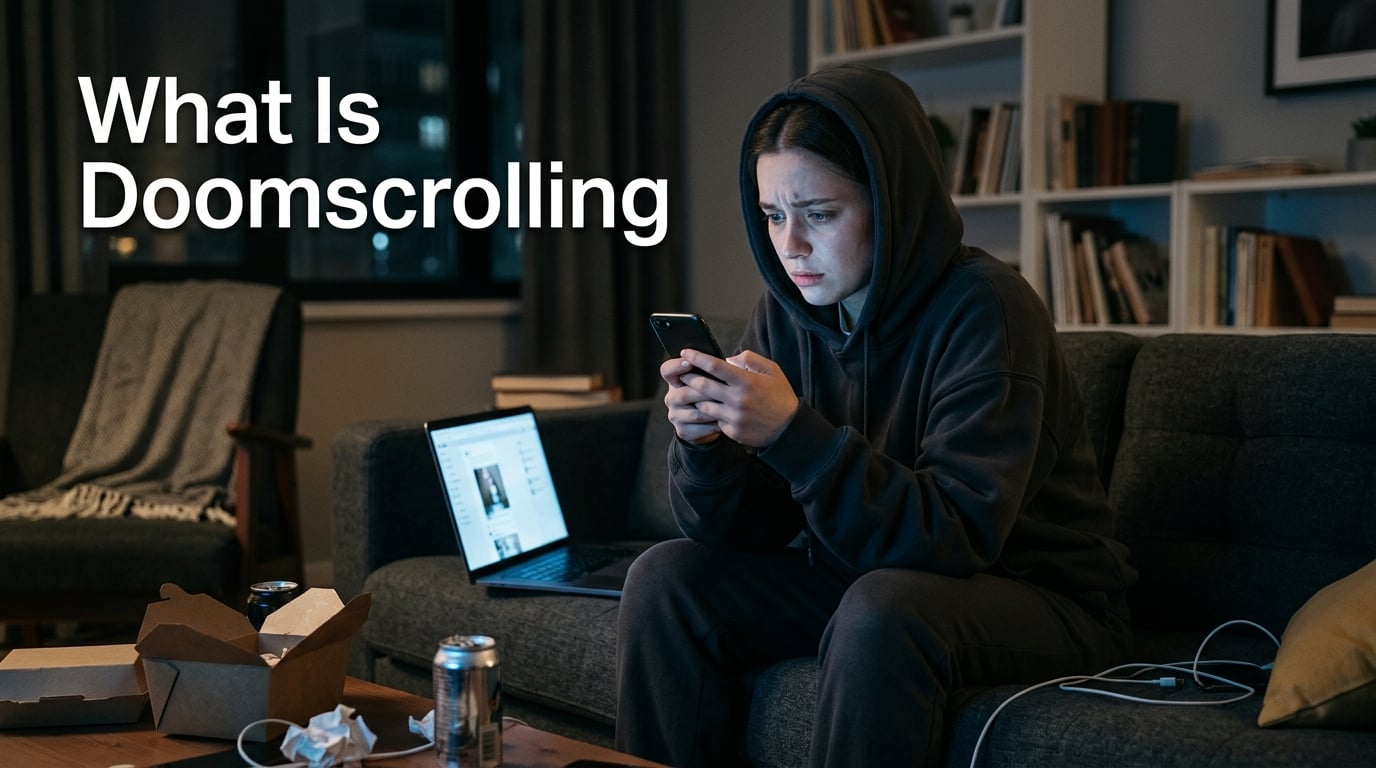
I lost two hours last Tuesday watching earthquake footage on Twitter. By the time I put my phone down, my chest felt tight and my sleep was wrecked. If that sounds familiar, you have probably been doomscrolling, and you are not alone.
Doomscrolling is the habit of endlessly scrolling through social feeds, news apps, or forums to consume negative, alarming, or distressing content, even when it is actively making you feel worse. It is one of the most common forms of smartphone addiction I see in friends, family, and our community of gamers and streamers.
In this guide, I will break down the doomscrolling definition, explain why your brain gets hooked, walk through the mental and physical effects, and share the practical steps our team uses to break the cycle.
Table of Contents
What Is Doomscrolling
Doomscrolling is the compulsive consumption of large amounts of negative news or upsetting digital content, often through social media feeds, news apps, or comment sections. The term describes a behavior where you keep scrolling for new bad news even when the content is harming your mood, sleep, or focus.
The word itself is a blend of “doom” and “scrolling.” It went mainstream around 2020 during the COVID-19 pandemic, when endless bad news made the behavior impossible to ignore. Dictionary.com, Merriam-Webster, and the Oxford English Dictionary have all added it as a recognized term.
In slang, doomscrolling refers to that late-night habit of refreshing Twitter, Reddit, or TikTok when you know nothing good is going to come up. You keep going anyway because your brain is chasing the next hit of information.
Common examples include:
Reading breaking news about conflicts or disasters for over an hour before bed
Refreshing Reddit threads about layoffs or layoffs rumour cycles during a recession
Watching TikTok reaction videos about trending tragedies on loop
Scrolling YouTube comments under political or true-crime videos for hours
Checking Discord servers for updates about a controversy in your gaming community
Doomscrolling is closely related to a term called doomsurfing. Doomsurfing describes browsing widely without a clear direction or destination, jumping between tabs, articles, and feeds. Doomscrolling is the narrower, more compulsive version where you fixate on negative content specifically.
Why Do People Doomscroll? The Psychology Behind It
People doomscroll because their brains are wired to detect threats, and modern feeds deliver an endless supply of them. The behavior combines three psychological forces: negativity bias, variable rewards, and the fight-or-flight response.
Your brain has a built-in system called the amygdala, which acts as a 24/7 threat detector. When you read something alarming, the amygdala lights up and signals the limbic system to release stress hormones. This is the same fight-or-flight response that once kept our ancestors alive.
Modern news feeds exploit a phenomenon called negativity bias. Research shows humans pay roughly twice as much attention to negative information as positive information. Social media algorithms know this, so they surface more negative content because it keeps you scrolling longer.
On top of that, every refresh of your feed works like a slot machine. You never know if the next post will be a small update or a major headline. That uncertainty triggers dopamine spikes in the same way a jackpot does. One user on r/digitalminimalism described it perfectly as a self-soothing loop you cannot break.
ADHD and anxiety can intensify this loop. People with ADHD often crave high-stimulation content, and bad news delivers that in spades. For people with anxiety, doomscrolling feels productive because it promises information that might keep them safe, even when it is actually feeding the worry.
Signs You Are Doomscrolling
You are doomscrolling if the behavior is compulsive, persistent, and leaves you feeling worse. Here is a quick checklist our team uses:
You tell yourself “one more refresh” and lose 30 minutes or more
You scroll negative news right before bed, even though you know it ruins your sleep
You feel anxious or restless when you cannot check your phone
Your screen time report shows 3+ hours daily on news or social apps
You notice mood drops, headaches, or tension in your shoulders after scrolling
You keep checking for updates about a topic even when you are emotionally drained by it
You feel behind or uninformed when you take a break from your feeds
If three or more of these ring true, you are likely in a doomscrolling pattern. The good news is that it is reversible once you understand the trigger.
How Doomscrolling Affects Your Mental and Physical Health
Doomscrolling affects both your mind and your body because chronic negative input raises stress hormones around the clock. The effects show up fast and tend to compound if the habit continues.
Mental Health Effects
Constant exposure to distressing news increases anxiety, depression, and feelings of helplessness. Psychologists call this vicarious trauma: absorbing the emotional weight of events you did not personally experience. Over time, you start carrying stress that does not belong to you.
It also causes information overload. Your brain cannot process that much negative input, so it stays stuck in a low-grade panic. That is why you feel mentally foggy after a long scrolling session.
Physical Health Effects
Doomscrolling keeps your nervous system on high alert, which disrupts sleep in two ways. The blue light from your phone suppresses melatonin, the hormone that makes you sleepy. The stressful content raises cortisol, which keeps your body wired.
Other physical effects include tension headaches, eye strain, neck and shoulder pain from hunching over your phone, and a faster resting heart rate. I have personally dealt with the shoulder pain one. After a 3-hour doomscrolling session, my upper back felt like it had run a marathon.
The sleep loss alone creates a vicious cycle. Poor sleep increases anxiety, which makes you more likely to reach for your phone the next night. That is how doomscrolling becomes a habit you cannot shake.
Who Is Most Likely to Doomscroll
Everyone with a smartphone can doomscroll, but research from Harvard Health shows some groups are more vulnerable than others.
Women and trauma survivors tend to doomscroll at higher rates, partly because they often feel responsible for staying informed about safety-related news. Younger people, especially teens and young adults, are also highly susceptible because they grew up with feeds as their primary news source.
People with anxiety, depression, or ADHD are particularly prone because their brains already lean toward threat detection and reward-seeking. And gamers and streamers, our core audience here at Spencer Locke, sit in a unique risk zone because long sessions of information overload and emotionally charged Discord or Twitch chats can blur the line between entertainment and compulsive scrolling.
Doomscrolling and the Gaming/Streaming Connection
Doomscrolling and gaming culture are tightly linked, and most general wellness articles skip this. Long streaming marathons on Twitch or Netflix train your brain to crave constant stimulation. When the stream ends, your nervous system is still hungry for input, so you reach for your phone.
This is what researchers call the popcorn brain effect: your mind gets used to rapid-fire content and loses patience for slower, calmer activities. A 3-hour Twitch stream of a battle royale sets you up perfectly for an hour of TikTok doom content right after.
Discord communities add another layer. Servers dedicated to gaming news, esports drama, or creator controversies turn scrolling into a social activity. You check for updates because you do not want to be the only one in the group chat who missed the news.
Our team has found that reducing one stream or game session per day makes a measurable difference in nighttime scrolling. Your brain needs downtime, and giving it that window lowers the urge to doomscroll.
How to Stop Doomscrolling: Practical Tips
Stopping doomscrolling is less about willpower and more about removing triggers and replacing the habit. These are the steps our team and our community have tested over months of real use.
Set a daily screen time budget. Use your phone’s built-in Screen Time or Digital Wellbeing tools. Cap social apps at 30-60 minutes per day.
Schedule your news intake. Pick two windows, like 8 AM and 6 PM, to catch up on news. Outside those windows, log out of news apps.
Move your phone out of the bedroom. Charge it in another room at night. This single change often fixes broken sleep within a week.
Turn off push notifications. Every alert is a micro-trigger. Keep notifications off for news, social, and Discord.
Replace, do not just remove. When you feel the urge to scroll, switch to a slower activity: a book, a podcast, a short walk, or a low-stimulation game.
Use grayscale mode at night. Black-and-white screens make your phone feel less rewarding, which weakens the scroll urge.
Try a weekly digital detox. Pick one day per week to log out of all social apps for 12-24 hours. Notice how your mood shifts.
None of these are magic on their own. Stack two or three together, and the habit loses most of its grip within two to three weeks. I personally rely on the bedroom ban and the grayscale trick. My sleep has never been better.
FAQs
What is an example of doomscrolling?
Reading breaking news about a disaster for over an hour before bed, refreshing Reddit threads about layoffs during a recession, or watching TikTok reaction videos about tragedies on loop are all classic examples of doomscrolling. The key sign is that you keep scrolling negative content even when it is actively hurting your mood or sleep.
Who is most likely to doomscroll?
Women, trauma survivors, younger people, and anyone with anxiety, depression, or ADHD are most likely to doomscroll. Heavy gamers and streamers are also at risk because long sessions of stimulation train the brain to crave constant input.
Why do ADHD people doom scroll?
ADHD brains crave high-stimulation content, and bad news delivers that in spades. Doomscrolling also feels productive to people with anxiety because it promises information that might keep them safe, even when it actually feeds the worry loop.
What is doomscrolling slang for?
Doomscrolling is slang for the habit of endlessly scrolling negative, alarming, or distressing digital content, often late at night, even when it is making you feel worse. The word blends doom and scrolling and went mainstream during the COVID-19 pandemic.
How do I know if I am doomscrolling?
You are likely doomscrolling if you tell yourself one more refresh and lose 30+ minutes, scroll negative news before bed, feel anxious without your phone, or notice mood drops and physical tension after scrolling sessions. Three or more of these signs usually indicate a doomscrolling pattern.
Why is doomscrolling addictive?
Doomscrolling is addictive because it combines negativity bias, variable rewards like a slot machine, and the fight-or-flight response in the brain. Every refresh could deliver a small update or a major headline, which keeps your brain chasing the next hit of information.
Final Thoughts on Doomscrolling
So, what is doomscrolling? It is your brain chasing the next hit of threatening information on an endless feed, even when the cost is your sleep, your mood, and your focus. Once you see the loop clearly, you can start breaking it.
Pick one or two of the tips above and run them for two weeks. Move your phone out of the bedroom, cap your news apps to two check-ins a day, and replace one streaming session with a slower activity. Track how your sleep and anxiety shift.
If you are part of our gaming and streaming community, treat the popcorn brain effect as seriously as any other performance issue. Better inputs mean better focus, better play, and a better mood when you finally put the phone down.