
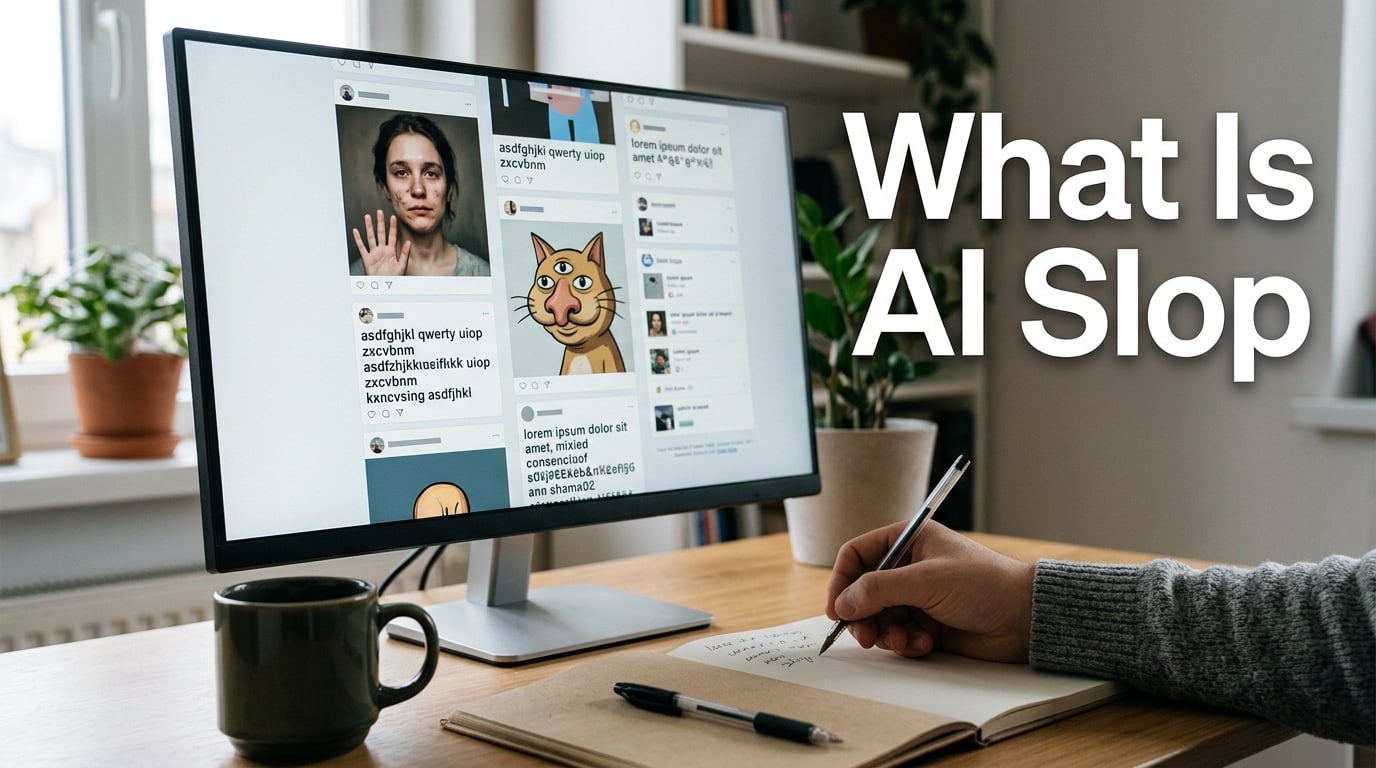
AI slop is low-quality digital content created with generative artificial intelligence, usually mass-produced for clicks, ad revenue, or algorithmic reach rather than for any real value to a reader. The term spread fast in 2026 because the internet suddenly looks different.
Feeds fill with six-fingered saints, wooden tutorials no human wrote, and short videos narrated by voices that have never existed. Search results are crowded with articles that say a lot and explain nothing. Bookstores carry covers with mangled hands and blurry type. The shared web is no longer quite as shared as it used to be, and that is the story behind AI slop.
I have been writing and editing online content for years, and the shift in 2026 is hard to miss. I will walk you through what AI slop means, where the word comes from, what it looks like in the wild, why it matters, and how you can spot it before it wastes your afternoon. By the end, you will have a sharper eye for what to trust and what to scroll past.
This matters because AI slop is not just an aesthetic complaint. It changes what shows up in your feed, who gets paid for their work, and which stories you believe about the world. Once you can name it, you can push back against it.
Table of Contents
What Is AI Slop?
AI slop is digital content made with generative AI tools that looks rushed, generic, glitchy, or pointless. The phrase is shorthand for content where effort, accuracy, and originality were sacrificed so a system could pump out more posts, images, or videos in less time.
Not every piece of AI-assisted content is slop. A research assistant helping a journalist draft questions is not slop. A fantasy author using AI to brainstorm names is not slop. A marketer using AI to summarize meeting notes is not slop. The line that turns helpful AI use into slop is effort and intent. Slop exists to game an algorithm, harvest ad revenue, or stuff a feed. Good AI use supports a human purpose.
Think of slop as the difference between a home-cooked meal made with a microwave shortcut and a vending machine sandwich dropped on a conveyor belt. Both use machines. Only one has a person at the controls, and only one cares whether you enjoy it.
It is also worth keeping in mind that the label is observer-relative. The same image can feel impressive to one person and slop to another. That is part of why the term spread so fast in 2026. People finally had a single word for a feeling the internet had been giving them for months.
Where the Term “Slop” Comes From
The word slop has been used for cheap or low-grade food for centuries. Farmers fed pigs a thin mix of kitchen scraps called slop, and the image stuck. Anything watery, tasteless, and produced without care picked up the label.
Online, the word moved from AI art communities into the mainstream around 2026. Early adopters used slop to describe AI images that looked technically impressive at first glance but felt hollow on a second look. By 2026, mainstream publications and dictionary editors had noticed.
Merriam-Webster added “slop” as a slang term referring to AI-generated content of poor quality. Cambridge Dictionary named slop its Word of the Year for 2026 after seeing the term explode across social media, news, and academic papers. When dictionaries pay attention, the culture has already moved.
The naming was also useful because it did not attack AI itself. It targeted a particular use of AI, the careless, manipulative kind. That distinction matters, because reasonable people disagree about generative tools but can agree that flooding the web with junk is bad.
Forms AI Slop Takes Across the Internet
AI slop is not one thing. It shows up in almost every content format online, and each form has its own tells.
Text slop is the most common. It fills blogs, Amazon listings, LinkedIn posts, and answer sites with the same generic phrasing. Watch for the same handful of power adjectives repeated across paragraphs, and stock phrases about modern living, all of which AI models love to overproduce. I see this constantly when reviewing drafts sent to our team, and the pattern is unmistakable.
Image slop floods social feeds with glitchy portraits. Common giveaways include extra fingers, melted jewelry, text that turns into alphabet soup, and backgrounds that blend into skin. Facebook became a home for these images in 2026, with viral posts of Jesus made of shrimp and saints rendered with seven fingers.
Video slop runs on YouTube, TikTok, and Reels. Many channels upload fully automated videos with AI narration over stock footage, fake movie recaps, or AI-generated children giving life advice. YouTube removed more than 130,000 channels in 2026 as part of what insiders called an “AI slop purge.”
Audio slop appears in podcasts and songs that sound almost human but feel slightly off. Sped-up voices, strange breathing, and oddly placed pauses are common signals. AI bands have charted on Spotify, and listeners often cannot tell whether a track came from a human artist or a model.
Code slop has become its own problem. Junior developers using AI assistants can ship functions that look plausible but break under edge cases. Senior reviewers call these outputs confident nonsense, technically shaped solutions that fail the moment real users show up.
Real-World Examples of AI Slop
One of the clearest examples is “Shrimp Jesus.” In 2026, Facebook feeds were overrun with AI images of Jesus Christ rendered as a shrimp or made of seafood. The posts attracted millions of likes and shares from users who did not notice the absurdity, and the pages behind them earned real ad money.
During Hurricane Helene in 2026, AI-generated images of a young girl holding a puppy in floodwaters went viral. The image was fake, but thousands of users shared it as proof of the storm’s impact. That is slopaganda, the term coined for AI-generated political or crisis misinformation that is built to spread quickly rather than inform anyone.
On TikTok and YouTube Shorts, Italian brain rot characters dominate AI slop feeds. Ballerina Cappuccina, Tralalero Tralala, and Bombardiro Crocodilo are AI-generated mascots with jingles, absurd backstories, and synthetic voices. They pull billions of views from children and teens, mostly through automated channels.
Independent creators have also been targeted. The magazine Clarkesworld stopped accepting submissions in 2026 after being buried in AI-generated short stories. Many of the pieces were obviously synthetic, and the editors could not keep up with the flood of incoming junk.
Outside the creative world, the same pattern shows up in commerce. Entire Amazon storefronts list products with AI-written descriptions that contradict themselves. One listing I clicked in 2026 promised a tent that was both “perfect for cold winter camping” and “lightweight mesh for hot desert days.” Both claims came from the same generator in the same afternoon.
Why AI Slop Is a Problem
AI slop harms three groups at once. Readers lose trust in what they see. Creators lose income as synthetic content floods their platforms. And the public loses shared reality when fake images pass as news.
The economic engine behind slop is attention. Every platform pays per view, like, or click, so a single viral post of fake disaster footage can earn thousands in ad revenue. That payoff is why content farms moved so quickly from cheap human writers to even cheaper AI pipelines. Our team tracked several networks in 2026 that pushed the same AI article across dozens of sites with different headlines.
The harm is not abstract. Hurricane Helene misinformation caused real confusion during relief efforts. Synthetic product reviews trick shoppers into bad purchases. Fake celebrity endorsements push scams. When the baseline of online media drops, everyone pays the price in time lost and trust burned.
Creators feel this directly. Illustrators, writers, voice actors, and translators report fewer jobs and lower rates since 2026. Some clients assume they can replace a freelancer with a chatbot. Even when the output is worse, the speed and cost advantages tempt decision-makers. That is the displacement problem hiding inside the slop conversation, and it is one of the loudest complaints on r/Futurology and r/ProductManagement.
There is also a quieter harm. Constant exposure to junk content conditions people to expect less. After enough six-fingered portraits and breathless listicles, even a careful reader can lower their standards. That is the brain-rot effect, and it is one reason the discussion has moved beyond tech circles into schools, newsrooms, and families.
AI Slop and the “Brain Rot” Era
AI slop did not appear in a vacuum. It rides a wider cultural wave researchers and journalists call brain rot. Brain rot describes the dulling effect of scrolling endless low-effort content, especially short videos optimized to keep you watching without thinking.
Italian brain rot is the meme-flavored branch of that wave. Surreal AI characters with nonsense names and ear-worm jingles rack up billions of views. Britannica named the trend a defining example of how AI slop meets brain rot culture in 2026, and it is a useful case study for anyone studying how algorithms reward absurdity.
Slopaganda is the darker cousin. The same tools that create silly shrimp Jesuses also create fake political photos, synthetic war footage, and invented quotes from real public figures. The line between entertainment and manipulation gets thin quickly.
What makes the era unusual is the speed. A trend that took years to spread in the early internet now travels in weeks. AI slop is the first wave of synthetic content to reach mainstream audiences at scale, and society is still working out the etiquette for it.
How to Identify AI Slop
You do not need technical tools to spot most slop. A few habits catch the majority of it before it shapes your view of the world.
Check the visuals for physical tells. Look for hands with six fingers, glasses that fuse into cheeks, teeth that merge into lips, and text on signs that turns into nonsense letters. AI models still struggle with hands and small text more than anything else.
Read the text for telltale phrasing. If you see the same three paragraphs repeating the same idea with slightly different words, or if every sentence seems to start with the same handful of stock transitions, you are reading slop. Models overuse these patterns because they appear often in their training data.
Look at the source. Anonymous accounts posting dozens of high-volume pieces per day, sites with no author names, and pages full of vague stock imagery are common signs. Real creators usually have a history, a face, or a body of work you can check.
Reverse-image search anything that triggers a strong emotion. Fake disaster photos and synthetic political images spread because people share before they verify. A two-second image search can save you from being part of the chain.
Test for internal logic. AI slop often contradicts itself inside a single paragraph. A product that is “lightweight and durable” is suspicious. A recipe that lists eggs as both optional and required is suspicious. Real writers catch these mistakes before they ship, and synthetic text usually does not.
Trust your gut when something feels off. AI content often hits every emotional button without earning any of them. That hollow feeling is your signal.
How to Avoid AI Slop in Your Feed and Your Work
Curate your feeds ruthlessly. Unfollow accounts that post nothing but synthetic clips, mute hashtags that drag you into slop loops, and rely on human-run newsletters or publications with named editors. The algorithm rewards engagement, not quality, so the only reliable filter is you.
Use browser tools and platform flags. YouTube now lets you label AI content, and many platforms are adding similar tools. Browser extensions can flag suspected AI images on social feeds. These are not perfect, but they tip the odds in your favor.
If you create content, keep a human fingerprint on your work. Edit AI drafts the way you would edit a junior writer’s first pass. Add original reporting, personal experience, or your own visuals. The point is not to avoid AI entirely. The point is to make sure a person is in charge of quality.
Support creators directly. Paid newsletters, Patreon, Ko-fi, and memberships keep independent voices funded when ad networks reward slop. I subscribe to several writers whose work I want to survive the algorithm shift, and it is one of the best moves I made for my own feed this year.
Set personal rules before you publish. Decide what AI tools you will use and what you will not. Will you use AI for outlines but never for finished copy? Will you label AI-generated images on social media? Will you cite AI transcripts in your research? Clear rules protect your credibility and your audience.
Talk to the people around you. Slop spreads fastest where nobody questions it. Share what you have learned with a friend, a coworker, or a younger family member. The more people who know what AI slop looks like, the harder it is for bad content to win by default.
Finally, slow down. Slop thrives on speed. The single best defense is to pause before sharing, double-check sources, and ask whether the piece adds anything that a thoughtful human would care to read. A thirty-second pause often beats any detection tool.
Frequently Asked Questions
What is an example of AI slop?
Common examples include Facebook images of Jesus made of shrimp, automated YouTube channels posting fake movie recaps narrated by AI voices, generic blog posts full of repetitive phrasing, and TikTok videos of Italian brain rot characters like Ballerina Cappuccina. Fake disaster photos shared during events like Hurricane Helene also count as AI slop.
How to identify AI slop?
Look for hands with extra fingers, melted jewelry, and garbled text in images. Watch for repetitive phrasing and stock transition words repeated across paragraphs. Check the source for missing author names, high posting volume, and no traceable history. Reverse-image search anything that triggers a strong emotion.
What 3 jobs will not be replaced by AI?
Jobs that lean on lived human experience are the hardest to automate. Skilled trades like electricians and plumbers rely on physical judgment in unique spaces. Care roles like nurses, therapists, and special education teachers depend on real human empathy and accountability. Investigative journalism and original creative work, where the value comes from a specific person’s voice and reporting, also remain difficult to replicate with synthetic content.
How to avoid AI slop?
Curate your feeds by muting high-volume anonymous accounts and following human-run publications. Use platform labels and browser tools that flag AI content. When creating, treat AI drafts as a starting point and add original reporting, personal experience, or your own visuals. Support creators directly through paid newsletters or memberships, and slow down before sharing anything that triggers a strong emotion.