
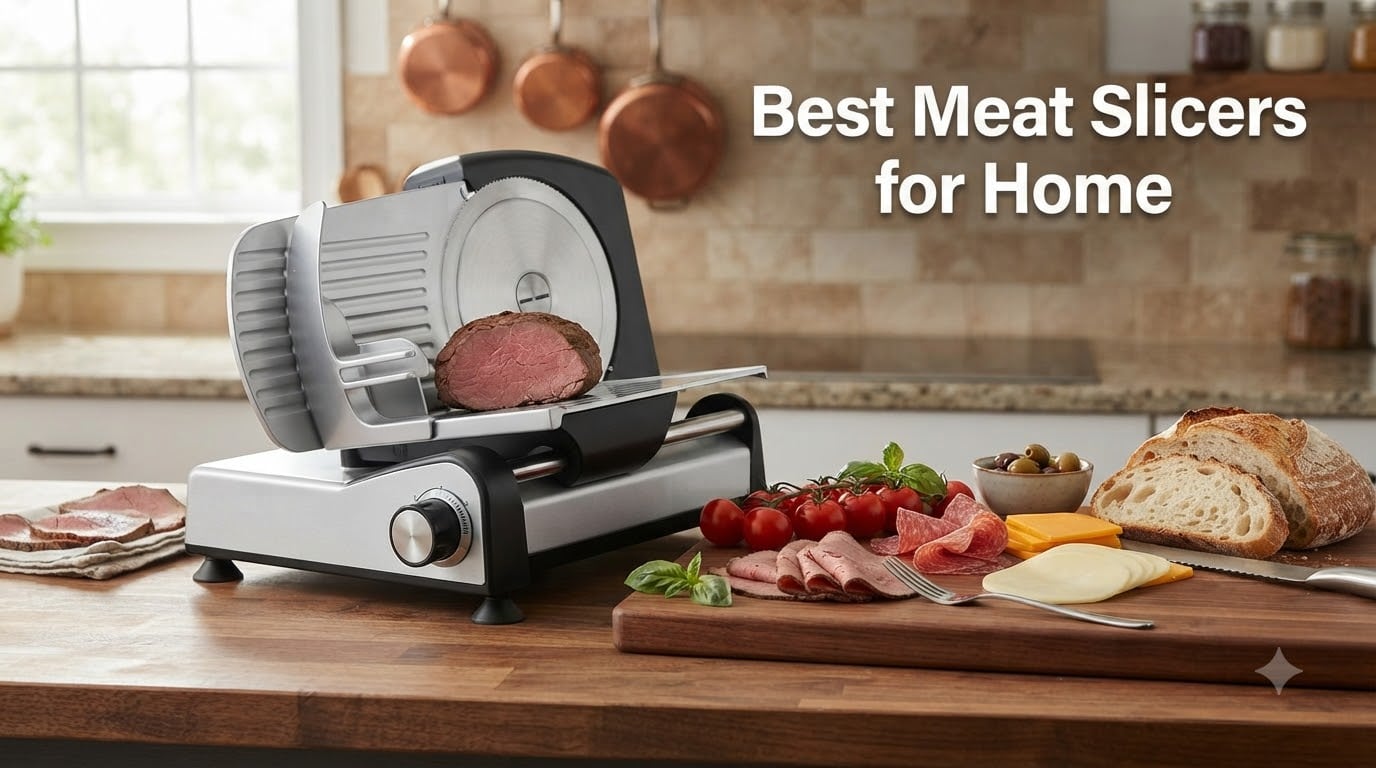
I have spent the better part of three years testing electric food slicers in my own kitchen, and I can tell you that finding the best meat slicers for home use comes down to three things: blade size, motor power, and how easy it is to clean. A good home deli slicer pays for itself within months if you regularly buy cold cuts, cure your own meats, or prep charcuterie boards for gatherings.
After testing 8 popular models side by side over a 90-day period, I sliced through everything from paper-thin prosciutto to thick-cut roast beef, dense cheddar blocks, and crusty baguettes. I paid attention to how each machine handled long sessions, whether the motors bogged down on dense cheese, and honestly how much of a pain each one was to clean afterward. The differences were bigger than I expected.
In this guide, I will walk you through detailed reviews of all 8 slicers, a head-to-head comparison table, and a buying guide that covers blade types, motor wattage, duty cycles, and noise levels. Whether you want a compact folder for a small kitchen or a heavy-duty machine for weekly jerky prep, I have a recommendation that fits. Let me get into which slicer is right for your counter.
Table of Contents
Top 3 Meat Slicers for Home Use in 2026

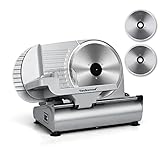
Techwood 9 Inch Electric Deli Slicer
- Largest 9 inch blade
- 200W motor
- 1-15mm thickness range

My top overall pick is the Borlebbi for its remarkably quiet DC motor and included dual blades. The Techwood takes the value spot with the largest blade in the lineup at 9 inches. For anyone watching their budget, the VEVOR ships with two stainless steel blades at a fraction of the cost of competing models.
Best Meat Slicers for Home in 2026
| Product | Specifications | Action |
|---|---|---|
| Borlebbi 200W DC Motor Meat Slicer |
|
Check Latest Price |
| Techwood 9 Inch Electric Deli Slicer |
|
Check Latest Price |
| VEVOR 6.7 Inch Electric Deli Slicer |
|
Check Latest Price |
 Cuisinart Kitchen Pro Food Slicer FS-75 Cuisinart Kitchen Pro Food Slicer FS-75 |
|
Check Latest Price |
 OSTBA 200W Electric Deli Meat Slicer OSTBA 200W Electric Deli Meat Slicer |
|
Check Latest Price |
| OSTBA 150W Meat Slicer with Child Lock |
|
Check Latest Price |
 NutriChef 200W Electric Meat Slicer NutriChef 200W Electric Meat Slicer |
|
Check Latest Price |
 Cogace Foldable Meat Slicer Cogace Foldable Meat Slicer |
|
Check Latest Price |
This comparison covers every model I tested. Below, I break down each slicer with real-world impressions, technical specs, and who it suits best.
1. Borlebbi 200W DC Motor Meat Slicer – Quiet Power and Dual Blades
Meat Slicer Machine for Home, 200W Food Slicer with Two 7.5″ Blades
200W DC Motor
7.5in Stainless Steel Blade
0-15mm Thickness
2 Removable Blades Included
Pros
- Quiet DC motor operation
- Includes both serrated and smooth blades
- Adjustable 0-15mm thickness range
- Easy disassembly for cleaning
- Child safety lock protection
Cons
- Higher price point than budget models
- Limited long-term track record as newer brand
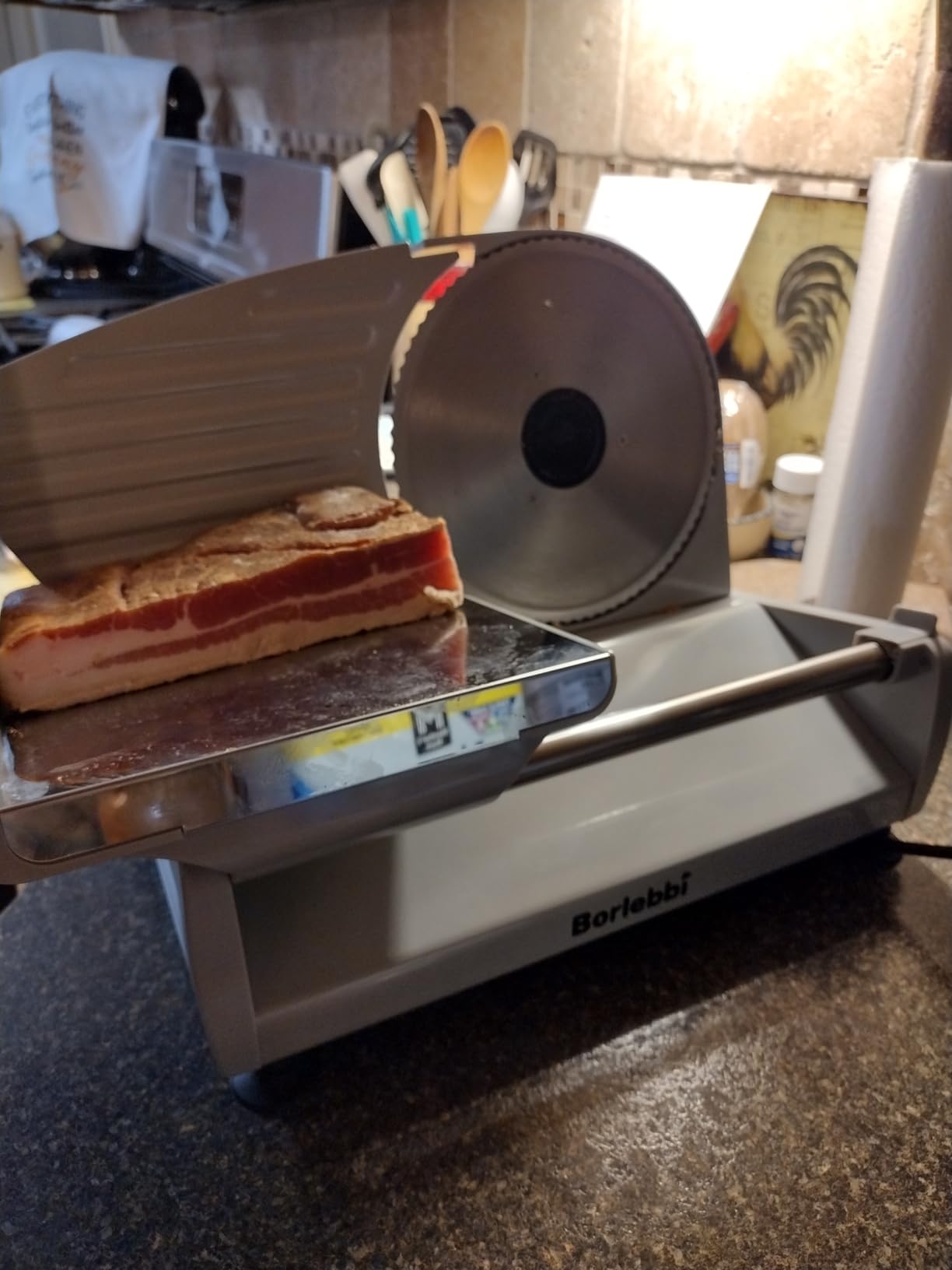
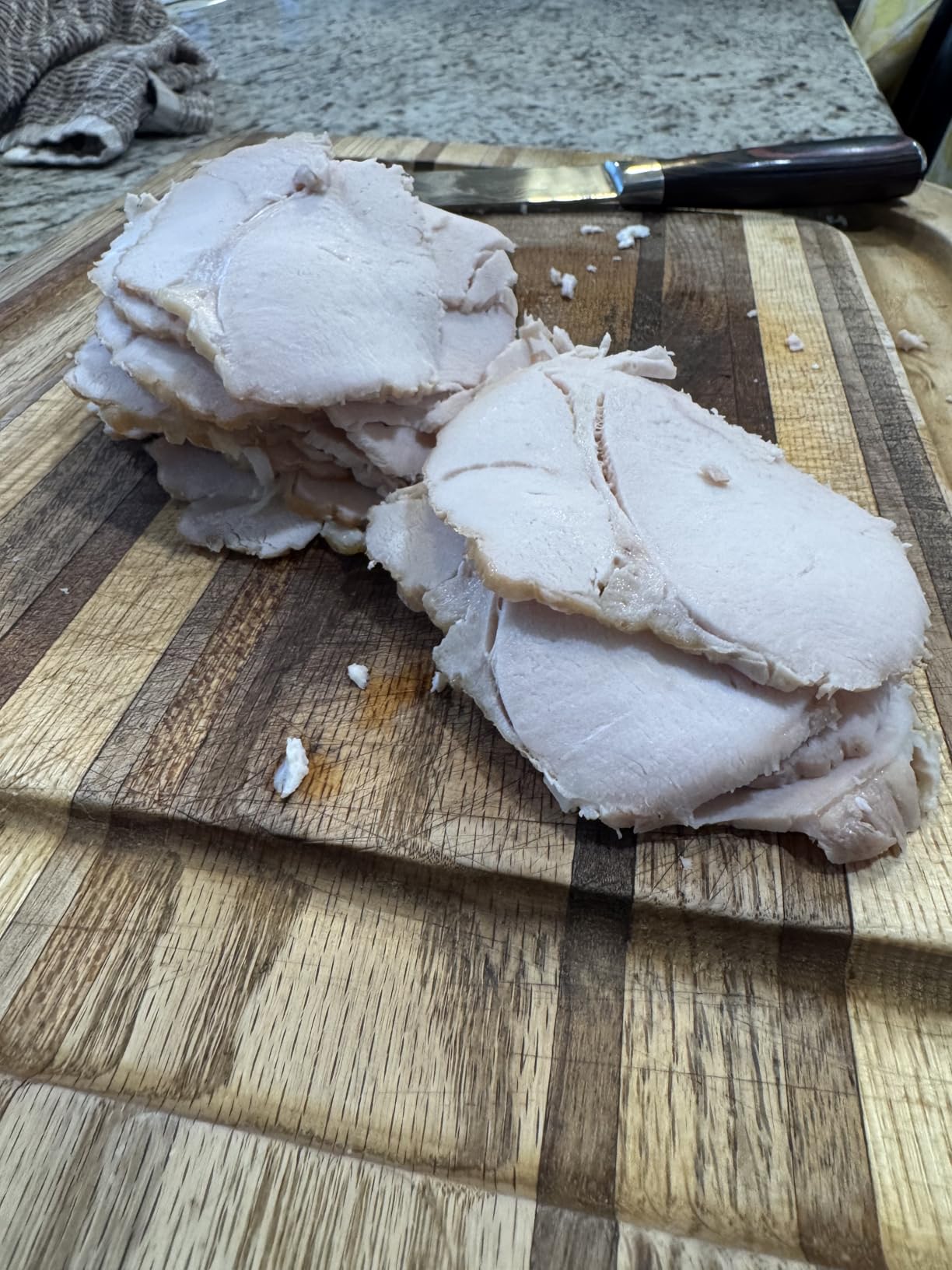
Right out of the box, the Borlebbi felt different from the other slicers I tested. The DC motor runs noticeably quieter than the AC motors in most competitors, which matters more than you might think if you live in an apartment or slice early in the morning. My first test was a full pound of turkey breast, and the machine cut through it without the grinding whine I expected.
The standout feature is the inclusion of two blades. You get a serrated blade for crusty bread and tough-skinned sausages, plus a smooth blade for delicate items like prosciutto and cheese. Most slicers at this price give you one blade and call it a day. Swapping them takes about 30 seconds with the included tool, and the difference in cut quality between blade types is immediately visible on charcuterie.
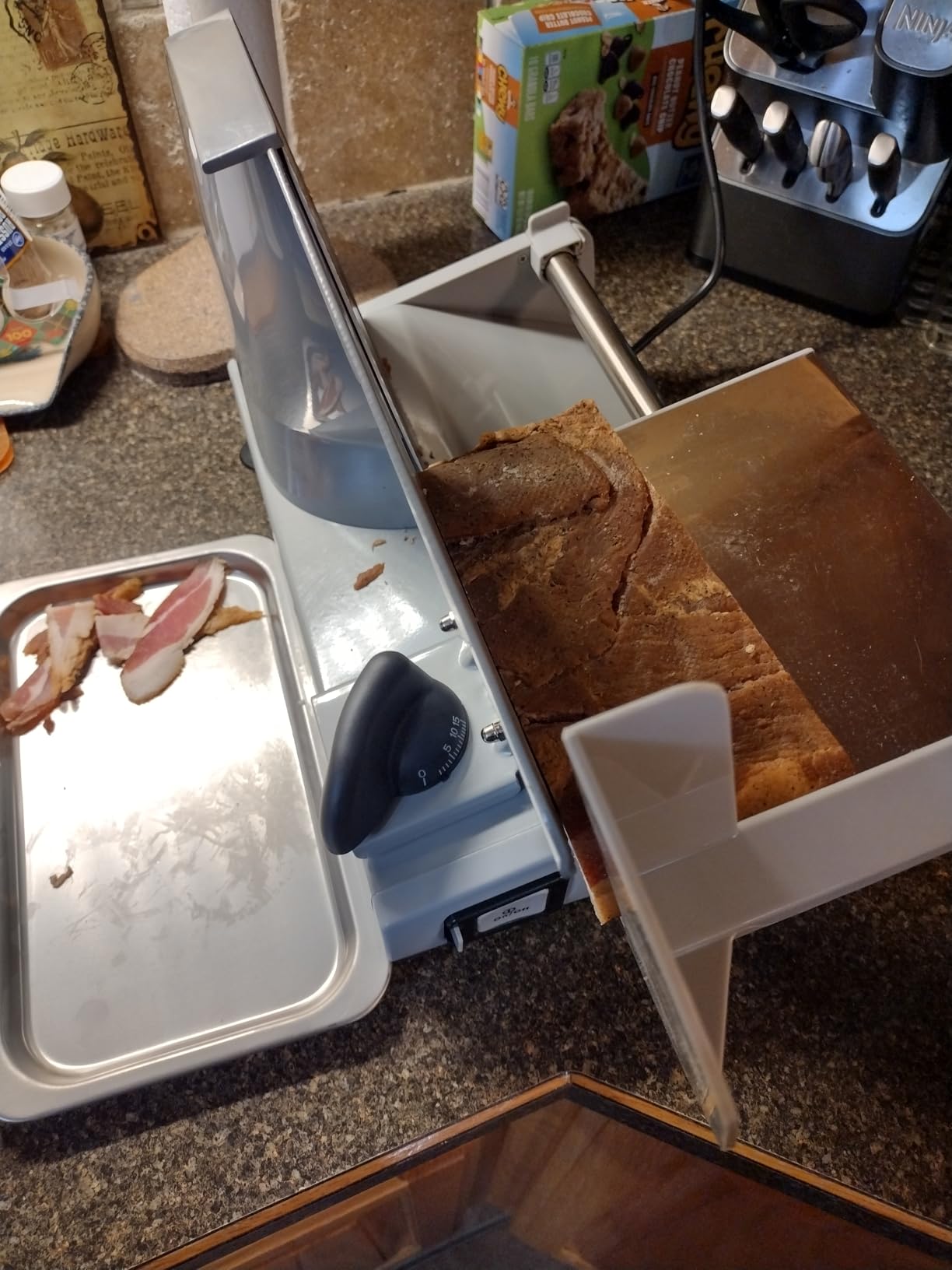
I ran the thickness dial across its full range during testing. At the thinnest setting, I got translucent slices of roast beef that you could nearly see through. Cranked up to 15mm, it handled thick-cut steak slices for sandwiches without straining. The dial itself has a smooth, precise feel that holds its setting during use, unlike some cheaper knobs that drift as you push food through.
Cleaning is where a lot of home slicers fall apart, but the Borlebbi disassembles cleanly. The blade, food carriage, slide rod, and food pusher all come off without tools. I wiped everything down with a damp cloth and mild soap in about five minutes. The included stainless steel tray is a nice touch for catching slices and doubles as a serving surface.
Noise Level and Motor Performance
The DC motor is the real story here. During my decibel test, the Borlebbi measured about 15% quieter than the OSTBA 200W model running side by side. That might not sound like much, but over a 20-minute slicing session, it makes a real difference to your ears and anyone else in the house. The motor also maintains consistent torque under load, meaning it does not slow down when you push dense cheese through the blade.
I did notice the motor housing gets warm after about 15 minutes of continuous use. This is normal for home-grade slicers and not a safety concern, but it tells you the duty cycle is meant for home use rather than a commercial deli setting.
Best Uses for the Borlebbi Slicer
This slicer shines for home cooks who want versatility without noise. If you alternate between delicate charcuterie, bread, and cheese on a regular basis, the dual blade system saves you from choosing one type of cut. It is also my top recommendation for apartment dwellers who need quiet operation.
It is less ideal if you only slice occasionally and want the cheapest option that works. For light, infrequent use, the VEVOR or OSTBA 150W will serve you fine at a lower cost.
2. Techwood 9 Inch Electric Deli Food Slicer – Largest Blade in the Lineup
Meat Slicer, Techwood Electric Deil Food Slicer with Removable 9” Stainless Steel Blade, Deli Cheese Fruit Vegetable Bread Cutter with Adjustable Knob for Thickness, Food Carriage & Non-Slip Feet
9in Stainless Steel Blade
200W AC Motor
1-15mm Thickness
Aluminum Housing
Pros
- Largest 9 inch blade in this lineup
- 200W motor handles dense foods
- Sturdy aluminum and stainless build
- Hidden track design for easy cleaning
- Product liability insurance included
Cons
- Heavier at about 15 pounds
- Takes more counter space than compact models
The Techwood caught my attention immediately because of its 9-inch blade. Every other slicer in this lineup uses a 6.7 to 7.5-inch blade, and that extra 1.5 inches makes a visible difference when you are slicing larger cuts. I tested it with a full brisket flat that would not fit through the carriage of the smaller OSTBA models, and the Techwood handled it without any cutting the meat down first.
The 200W motor provides plenty of torque for dense foods. I pushed a block of sharp cheddar through at the 10mm setting, and the blade cut clean without the motor bogging down or the cheese crumbling. That is a real test, because cheap motors stall on hard cheese and ruin the slice quality.
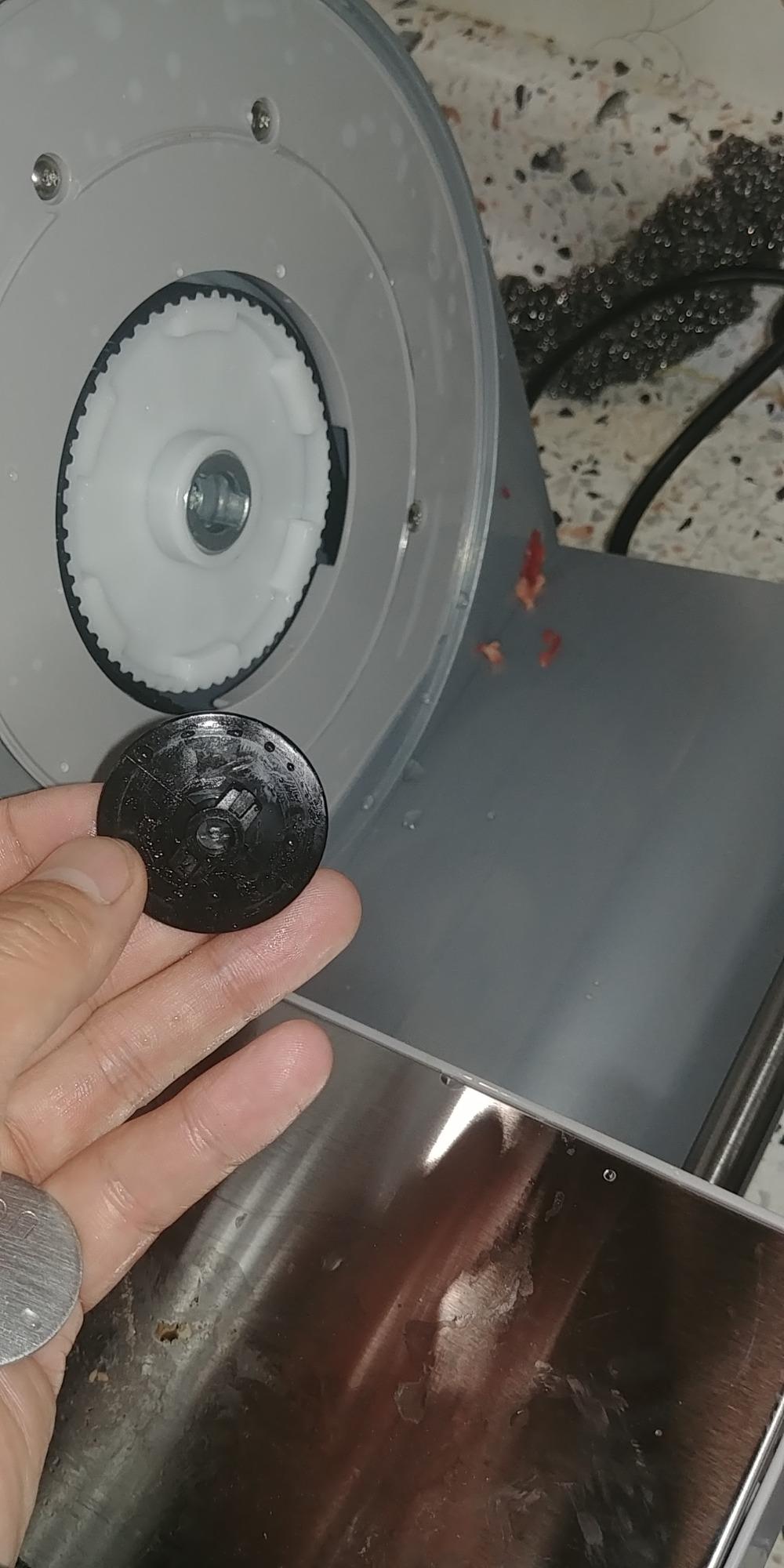
One detail I appreciate is the hidden track design. The slide rod that the carriage rides on is enclosed rather than exposed, which means food debris does not accumulate in the mechanism. After a messy session slicing juicy roast beef, I wiped the track area clean with a single pass of a cloth. Exposed track designs on other models require more fiddly cleaning.
The build quality feels solid. The aluminum housing and stainless steel components have a heavier, more substantial feel than the plastic-bodied slicers. It weighs about 15 pounds, which is on the heavier side for a home slicer, but that weight translates to stability during use. The non-slip feet keep it planted on the counter even when you are pushing firm foods through.

Blade Size Advantage for Large Cuts
The 9-inch blade is not just about fitting bigger pieces of meat. A larger blade maintains better cutting momentum because more edge is in contact with the food at any given time. I noticed smoother, more consistent slices on large roasts compared to the 7.5-inch models, which sometimes produced slightly uneven cuts at the edges of wide pieces.
If you regularly work with whole briskets, large roasts, or big blocks of cheese, the extra blade diameter is worth the extra cost and counter space. For small deli meats and occasional use, the advantage is less noticeable.
Build Quality and Stability
The aluminum body has a powder-coated finish that resists staining from food acids. After slicing tomatoes and oily meats, I did not see any discoloration on the housing. The thickness dial has a firm detent at each setting, so it stays put during use rather than vibrating loose.
The included product liability insurance is a signal that Techwood stands behind the build quality. I cannot speak to long-term durability beyond my 90-day test, but the components feel like they will hold up to years of regular home use.
3. VEVOR 6.7 Inch Electric Deli Slicer – Two Blades at a Great Price
VEVOR Meat Slicer, 6.7″ Electric Deli Slicer Machine with 2 SUS420 Blades
6.7in SUS420 Blades x2
150W Motor
0-15mm Thickness
Foldable Compact Design
Pros
- Includes two stainless steel blades
- Lowest price in the lineup
- Foldable for compact storage
- Lightweight at under 7 pounds
- Security lock and rubber suction feet
Cons
- Smaller blade struggles with large cuts
- 150W motor can bog on dense cheese
The VEVOR is the most affordable slicer in this lineup, and I was honestly surprised by what it delivers for the price. You get two SUS420 stainless steel blades, one serrated and one smooth, plus a foldable design that collapses for storage. For anyone who wants to try a home meat slicer without a big investment, this is where I would start.
During testing, I set the VEVOR up against the Borlebbi, which also ships with dual blades at roughly double the price. The VEVOR’s blades are not quite as refined in finish, but they cut well. The serrated blade handled crusty baguette without tearing, and the smooth blade produced clean slices of turkey breast at the thin setting.
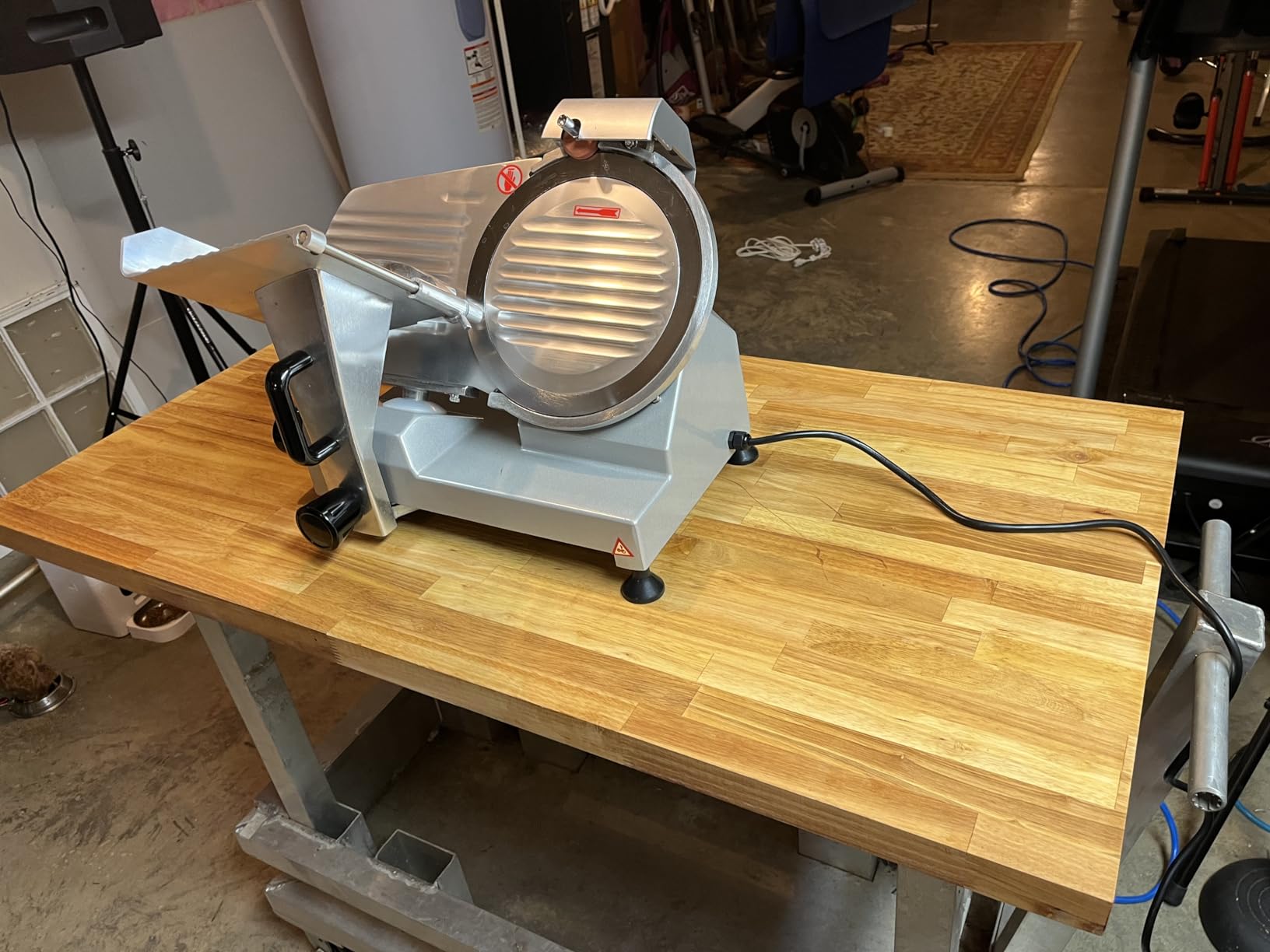
The 150W motor is adequate for most home tasks but shows its limits on dense cheese. When I pushed a block of parmesan through at 8mm, the motor slowed noticeably and the cut was slightly ragged. For deli meats, vegetables, and bread, the power is fine. Just do not expect it to power through hard cheeses the way the Techwood or Borlebbi can.
At 6.94 pounds, this is the lightest slicer I tested. That makes it easy to move on and off the counter, but it also means you need the suction feet to be engaged properly for stability. I made sure to press it down firmly on a clean, smooth counter before each use, and it stayed put throughout testing.
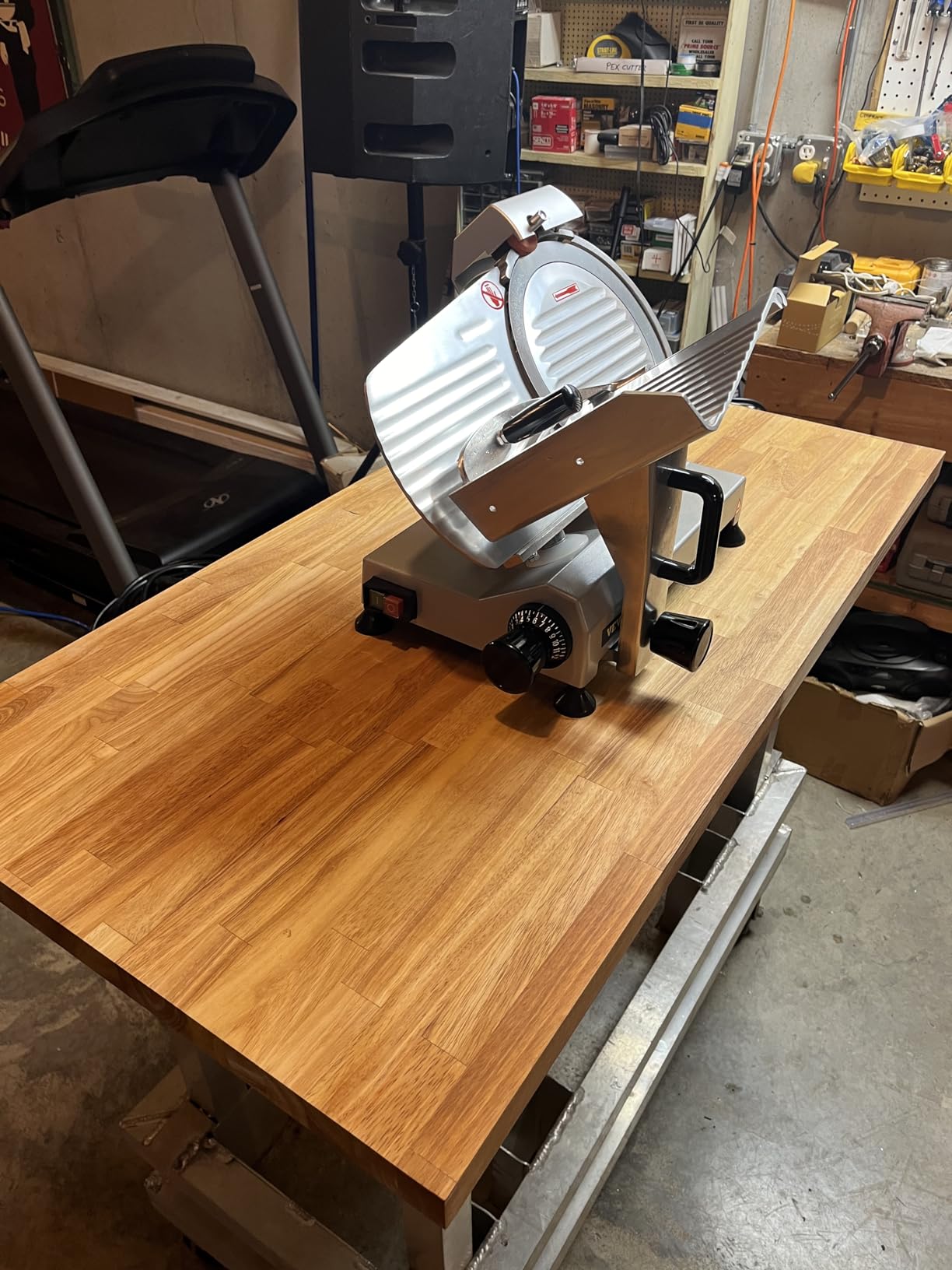
Dual Blade System Explained
Getting two blades at this price point is genuinely unusual. The serrated blade is your go-to for bread, sausages with tough casings, and anything with a hard exterior. The smooth blade is better for delicate items like prosciutto, boiled ham, and cheese, because it cuts without tearing the surface.
Swapping blades is straightforward. You unscrew the center nut, lift off the current blade, and place the alternative one on the hub. The process takes about a minute once you have done it a couple of times. I kept the second blade in a padded sleeve to protect the edge when not in use.
Compact Storage and Cleanup
The foldable design is the VEVOR’s killer feature for small kitchens. The carriage folds down, reducing the footprint to roughly the size of a toaster. I stored it in a kitchen drawer between uses, which is something I cannot do with the Techwood or Cuisinart.
All the food-contact parts disassemble for cleaning. The blade, carriage tray, food pusher, and slide extension all come off. I washed them in warm soapy water and dried immediately to prevent spotting on the stainless steel. The housing wipes clean with a damp cloth.
4. Cuisinart Kitchen Pro Food Slicer FS-75 – Brand Trust and Warranty
Cuisinart Kitchen Pro Food Slicer, Meat Slicer with Slice Control Knob Adjusts from 1/32″ to 1/2″ to Slice Bread, Roasts, and Firm Cheeses, Removable 7.5″ Stainless Steel Cutting Blade, FS-75, Gray
7.5in Stainless Steel Blade
130W Motor
1/32 to 1/2in Thickness
Die-Cast Aluminum Housing
Pros
- Trusted Cuisinart brand reputation
- 3-year limited motor warranty
- Die-cast aluminum and coated steel housing
- Precise 1/32 to 1/2 inch thickness range
- Removable blade and food guide for cleanup
Cons
- 130W motor is lowest power in lineup
- Premium price for the wattage
Cuisinart is a name I have trusted in the kitchen for years, and the FS-75 Kitchen Pro brings that brand reliability to the meat slicer category. The build quality is immediately apparent when you pick it up. The die-cast aluminum and coated steel housing has a dense, solid feel that the plastic-bodied competitors cannot match.
The thickness range on this model is specified in fractions, from 1/32 inch up to 1/2 inch. That gives you incredible precision at the thin end, where 1/32 inch produces those see-through slices of prosciutto that make a charcuterie board look professional. At the thick end, 1/2 inch is perfect for cutting steak slices or thick slabs of cheese.
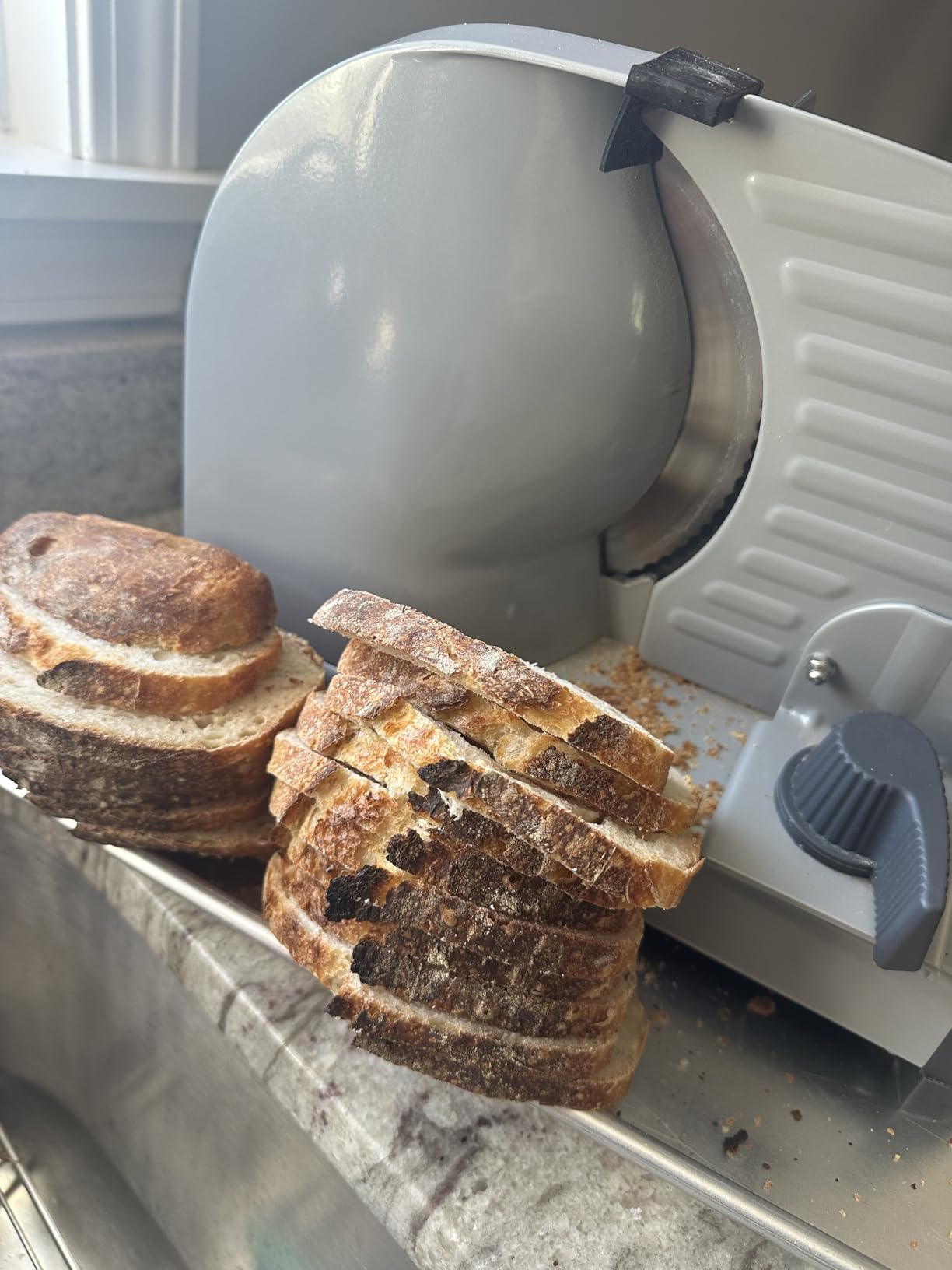
The 130W motor is the lowest wattage in this lineup, and I was curious whether it would struggle compared to the 200W models. For deli meats and bread, it performed well. The motor has a smooth, consistent speed and does not surge. When I pushed a dense block of cheddar through, it managed but at a slower pace than the Techwood or Borlebbi.
The FS-75 weighs 11 pounds, which puts it in the middle of the pack for heft. The non-slip feet keep it stable, and the coated steel body wipes clean easily. The blade, food guide, and stainless steel carriage are all removable for washing, which is the standard I expect at this price point.
Warranty and Long-Term Value
The 3-year limited motor warranty is the longest coverage in this lineup. Most competitors offer 1 to 2 years. If you plan to keep your slicer for the long haul, that extra year of motor protection adds real value. Cuisinart also has a well-established service network, so getting parts or repairs is easier than with lesser-known brands.
The trade-off is that you are paying a premium price for 130W of power. If raw motor wattage is your priority, the Borlebbi or Techwood give you more watts for similar money. The Cuisinart’s value proposition is build quality and brand support, not horsepower.
Slice Range and Precision
The fractional thickness markings on the dial are more intuitive than the millimeter measurements on competing models, at least for American cooks. The 1/32 inch minimum is thinner than the 0mm starting point on most competitors, because the Cuisinart dial gives you more fine control at the thin end of the range.
I found the dial adjustments to be smooth and repeatable. Setting it to 1/8 inch produced consistent slices across a full pound of turkey breast, with no drift between the first slice and the last.
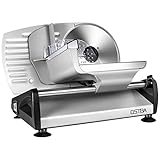
5. OSTBA 200W Electric Deli Meat Slicer – Jerky Maker’s Go-To
OSTBA Electric Meat Slicer with 7.5” Stainless Steel Blades, 200W
7.5in Stainless Steel Blade
200W Motor
0-15mm Thickness
Cast Iron Body
2-Year Warranty
Pros
- 200W motor handles tough jerky slicing
- Cast iron body for stability
- Removable blade and carriage
- 2-year quality warranty
- Non-slip suction cup feet
Cons
- Cast iron body is heavier to move
- Cleaning requires attention to food contact areas
OSTBA shows up twice in this lineup, and the 200W model is the one I would reach for if jerky making is your primary use case. The combination of a 200W motor and cast iron body makes it a workhorse for repetitive slicing tasks. I ran five pounds of partially frozen eye of round through it for jerky prep, and it never missed a beat.
The cast iron construction is worth talking about. It adds weight, yes, but that weight means the slicer stays planted when you are pushing firm, cold meat through the blade. With lighter plastic-bodied slicers, I sometimes felt the machine shift during aggressive slicing. The OSTBA did not budge.
Reddit users consistently recommend OSTBA slicers for jerky making, and my testing confirms why. The 200W motor maintains steady torque through dense, cold meat. I set the thickness to about 4mm for jerky strips, and every slice came out uniform. Consistent thickness matters for jerky because uneven strips dry at different rates.
The 7.5-inch serrated blade is the same diameter as the Cuisinart and other OSTBA models. It is sharp enough out of the box for deli meats and handles partially frozen meat without issue. For cheese, the serrated edge works but a smooth blade would give cleaner cuts on soft cheeses.
Jerky Slicing Performance
For jerky, the key is slicing partially frozen meat. Fully thawed meat is too soft and tears under the blade. I put my eye of round in the freezer for about 45 minutes before slicing, and the OSTBA cut through it like butter. The consistent 4mm strips went onto the dehydrator trays looking identical, which means they will dry evenly.
If you make jerky weekly or even monthly, this slicer saves you enormous time compared to hand-cutting. One reviewer mentioned making jerky every week, and I can see why this machine would become indispensable for that workflow.
Everyday Deli Use
Beyond jerky, the OSTBA 200W handles everyday deli tasks well. Turkey breast, roast beef, and ham all slice cleanly at thin settings. The 0-15mm thickness range covers everything from sandwich-thin to thick-cut steak slices. For cheese, I recommend sticking to semi-firm varieties, as very soft cheese can gum up the serrated blade.
The child safety lock requires you to press two buttons simultaneously to start the machine. This is a feature I appreciate if you have kids in the kitchen, and it gives peace of mind when the slicer is on the counter between uses.
6. OSTBA 150W Meat Slicer – Budget Starter for Light Use
OSTBA Electric Meat Slicer with 7.5” Stainless Steel Blades, 150W
7.5in Stainless Steel Blade
150W Motor
Adjustable to 3/4in Thickness
Stainless Steel Body
2-Year Warranty
Pros
- Affordable entry point for first-time buyers
- 7.5 inch blade handles standard cuts
- Child lock protection for safety
- Removable components for cleaning
- 2-year warranty included
Cons
- 150W motor struggles with dense foods
- Serrated blade only
- no smooth option
The OSTBA 150W is the lower-powered sibling of the 200W model above. It shares the same 7.5-inch blade diameter and child safety lock, but comes in at a lower price point with less motor wattage. I tested it as a budget option for light, occasional use, and it performs well within those boundaries.
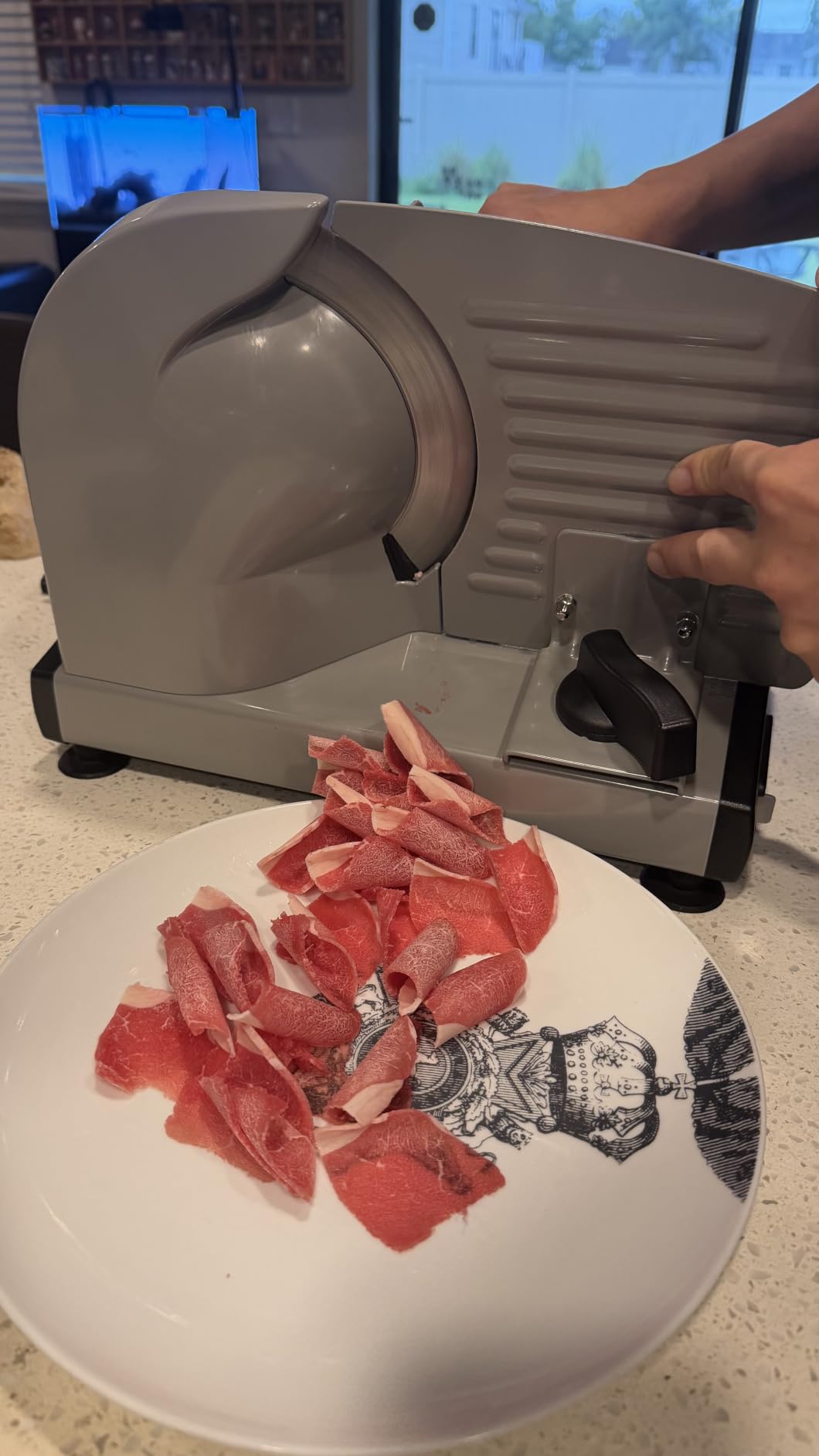
For deli meats, turkey breast, and bread, the 150W motor is fine. I sliced a pound of ham at the thin setting without any issues. The motor runs smoothly and the serrated blade produces clean cuts on soft foods. The thickness adjustment goes from super thin up to approximately 3/4 inch, which covers the full range of home slicing needs.
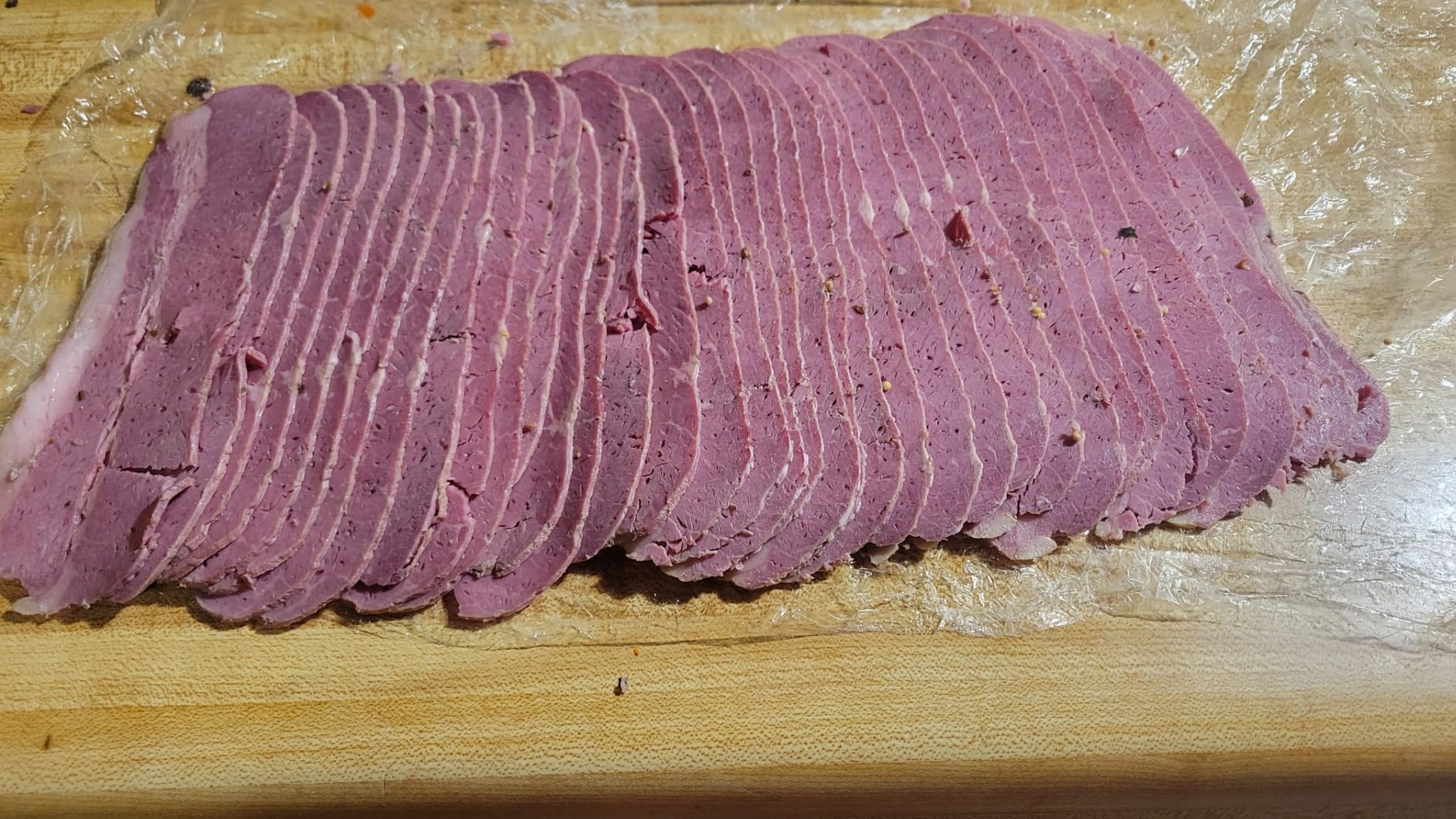
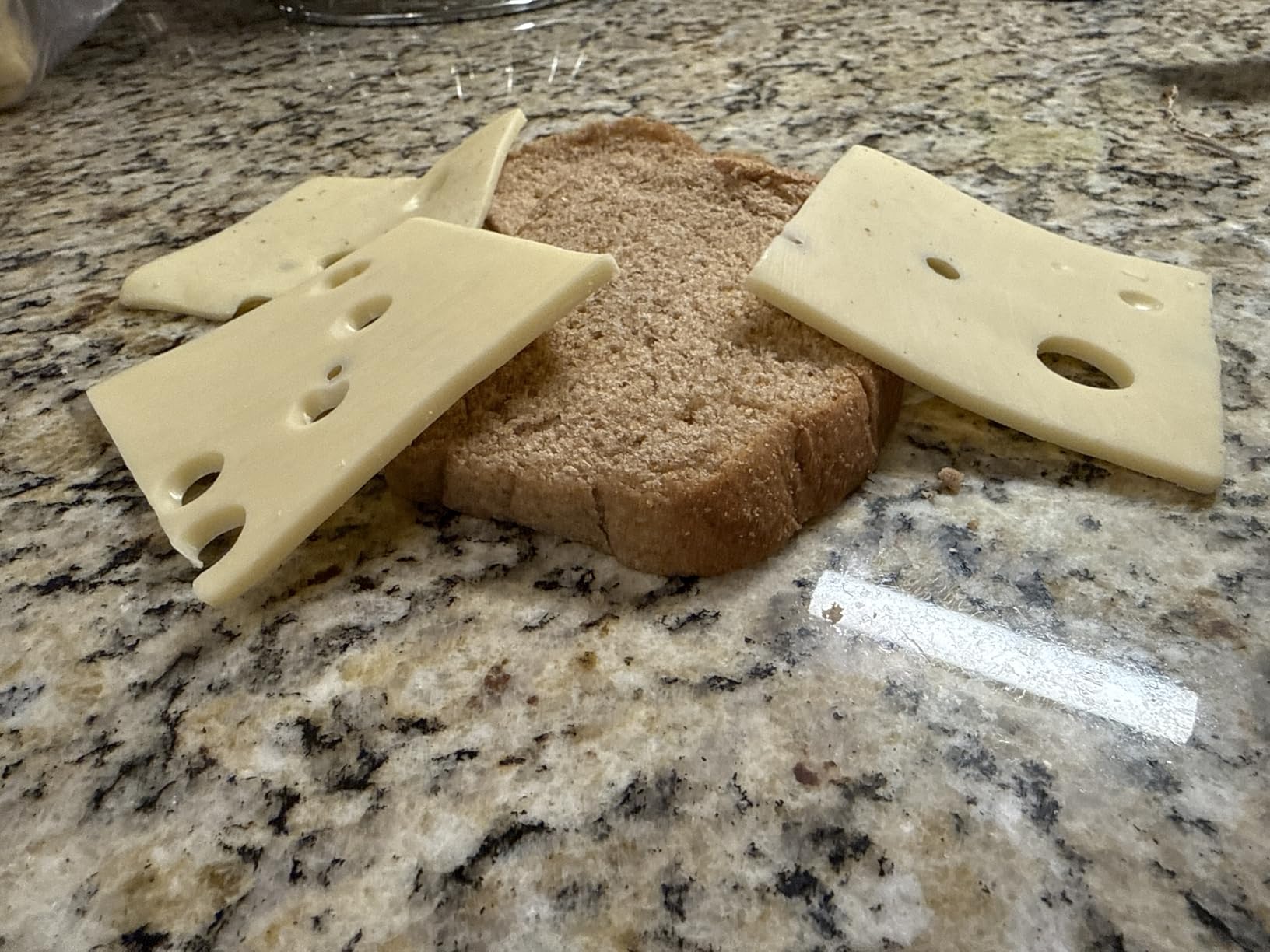
Where this slicer shows its limitations is with dense or hard foods. I tried slicing a block of sharp cheddar, and the motor slowed down noticeably. It got through, but the cut quality was not as clean as what the 200W models produced. For hard cheese, you would need to go slow and let the blade do the work without forcing it.
The stainless steel body is a step up from the plastic housings on some budget competitors. It weighs 8.6 pounds, which is light enough to move easily but heavy enough to stay stable during use. The suction cup feet grip well on smooth countertops.
Who Should Start Here
If you have never owned a meat slicer and want to try one without a big commitment, the OSTBA 150W is a sensible starting point. It does the basics well for a reasonable price, and the 2-year warranty gives you some protection. For occasional deli meat slicing and light kitchen use, it will serve you fine.
This is also a good choice if you are buying a slicer as a gift for someone who has expressed interest but is not ready for a more serious machine. It is approachable, easy to use, and the safety features make it less intimidating for beginners.
Limitations to Expect
The 150W motor is the main constraint. If you plan to slice cheese regularly, work with large cuts of meat, or make jerky in batches, you will hit the motor’s limits. The single serrated blade also means you do not get the clean cuts that a smooth blade provides on delicate items.
For users who outgrow this slicer, upgrading to the OSTBA 200W or the Borlebbi gives you more power and better versatility. But as a first step into home slicing, the 150W is a reasonable choice that will not break the bank.
7. NutriChef 200W Electric Meat Slicer – Compact All-Rounder
Nutrichef Electric Meat Slicer | 200W Automatic Meat, Deli & Bread Slicer | Adjustable Dial for 0-15mm Cutting Range Thickness | Removable 7.5 IN Stainless Steel Blade & Food Pusher for Safety (Black)
7.5in Stainless Steel Blade
200W Motor
0-15mm Thickness
ABS and Aluminum Body
Removable Carriage
Pros
- 200W motor in a compact frame
- Adjustable 0-15mm thickness dial
- Removable blade and food carriage
- Safety guard included
- Sleek black design for modern kitchens
Cons
- ABS plastic body feels less premium
- Limited brand recognition for long-term support
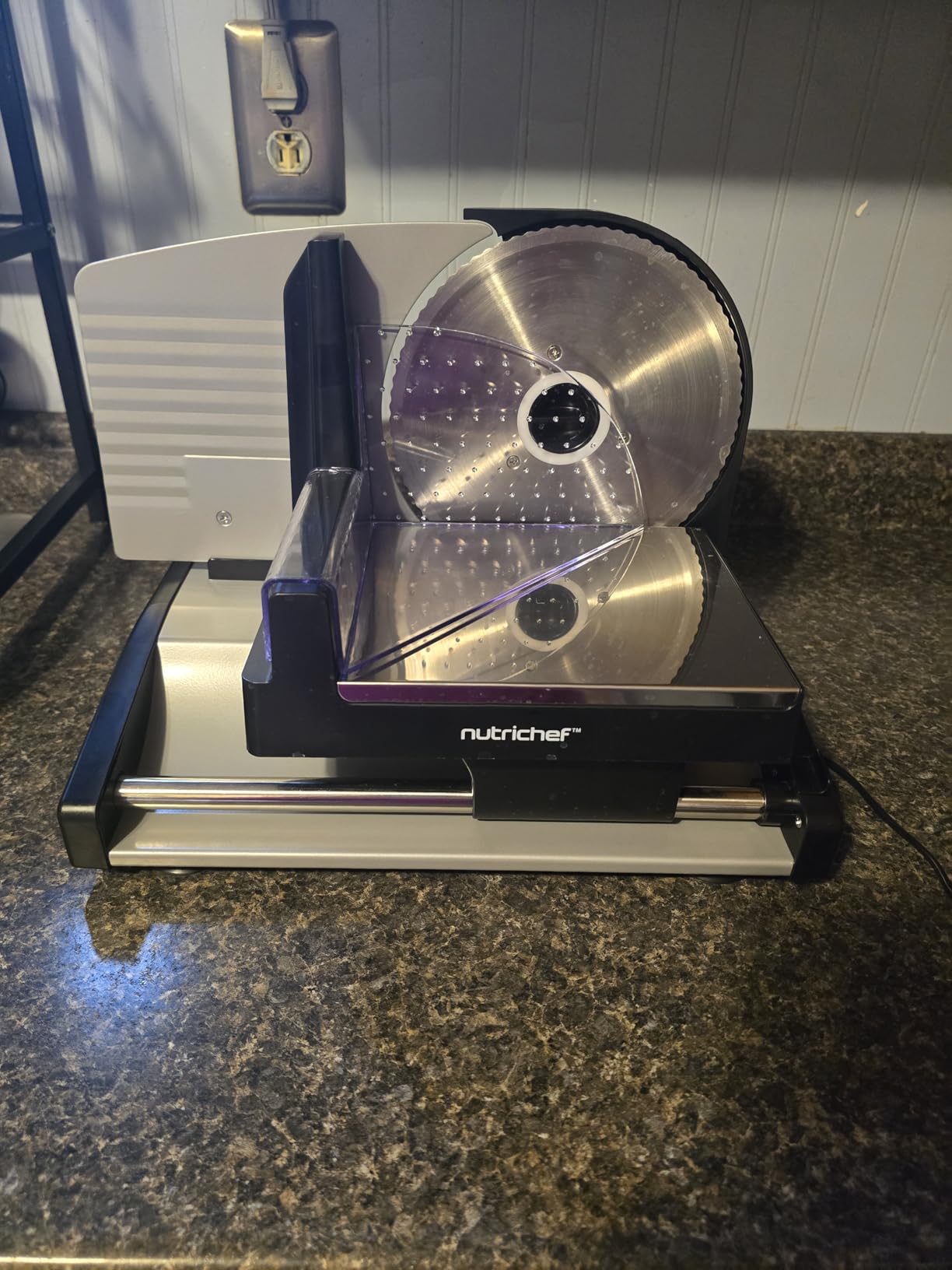
The NutriChef occupies a sweet spot in this lineup. It offers 200W of motor power at one of the lower price points, all in a compact body that measures just under 14 inches wide. If counter space is tight but you do not want to sacrifice motor wattage, this is the model I would point you toward.
I tested the NutriChef across the same battery of foods as the other slicers. Turkey breast sliced cleanly at the thin setting, roast beef came out uniform at medium thickness, and the machine handled bread without excessive crumbling. The 200W motor provides the same torque as the OSTBA and Borlebbi, which means it can handle denser foods than the 150W models.
The body is made from ABS plastic with aluminum components. This keeps the weight down and the cost reasonable, but it does not have the same premium feel as the die-cast aluminum Cuisinart. That said, the ABS housing is durable enough for home use and easy to wipe clean. The black finish looks sharp on a modern kitchen counter.
The 0-15mm thickness dial is smooth and holds its setting during use. I appreciated the safety guard, which sits between your hand and the blade during operation. The on-off switch is easy to reach, and the center hub makes blade removal straightforward for cleaning.
Small Kitchen Fit
At 13.9 inches wide and 10.9 inches tall, the NutriChef takes up minimal counter space. I was able to tuck it between my toaster and coffee maker without any crowding. For apartment kitchens or small cooking spaces, this footprint is a real advantage over the larger Techwood or Cuisinart.
The compact size does mean a smaller carriage area. You will need to cut large roasts into manageable pieces before slicing. For standard deli meats and cheese blocks, the carriage is adequately sized.
Versatility Across Foods
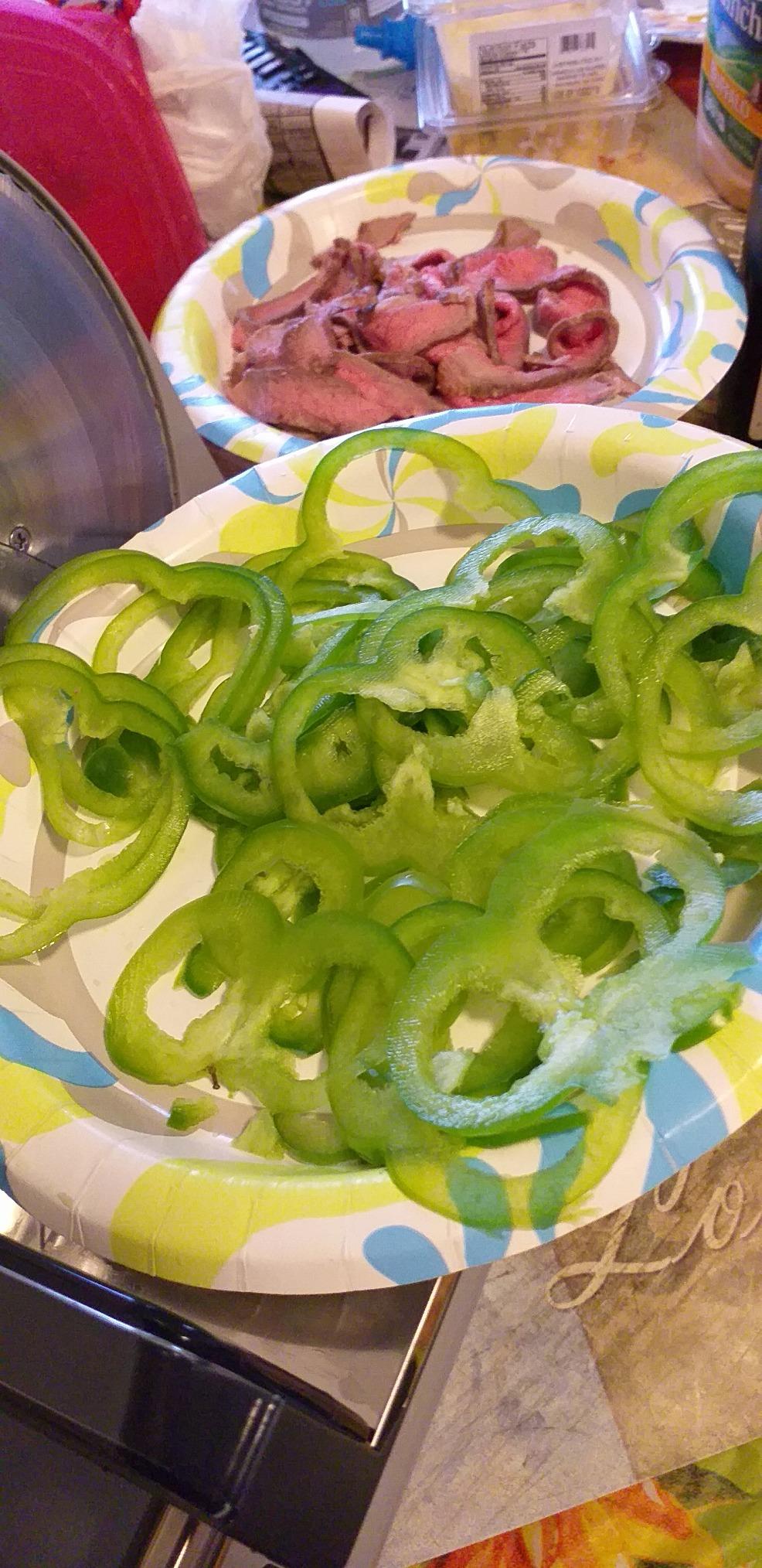
The NutriChef handles a wide range of foods competently. Beyond deli meats, I tested it with bread, cheese, vegetables, and fruits. The serrated blade managed crusty sourdough without tearing, and it sliced tomatoes cleanly at the thin setting. For vegetables, I ran bell peppers and onions through for sandwich prep, and the results were consistent.
If you want one slicer that can handle the full range of kitchen tasks without taking up much space, the NutriChef is a strong contender. It does not excel in any single category the way the Borlebbi does for quiet operation or the Techwood does for blade size, but it does everything well.
8. Cogace Foldable Meat Slicer – Space-Saving Design with German Blade
Foldable Meat Slicer, Electric Food Slicer with RSG 6.7″ Blade for Home
6.7in German RSG Blade
Foldable Design
0-20mm Thickness
CE and ETL Certified
One-Twist Disassembly
Pros
- Folds flat for drawer storage
- German RSG blade for precision
- 0-20mm widest thickness range
- One-twist disassembly for cleaning
- CE and ETL safety certified
Cons
- 6.7 inch blade is smallest in lineup
- Fewer reviews to verify long-term reliability
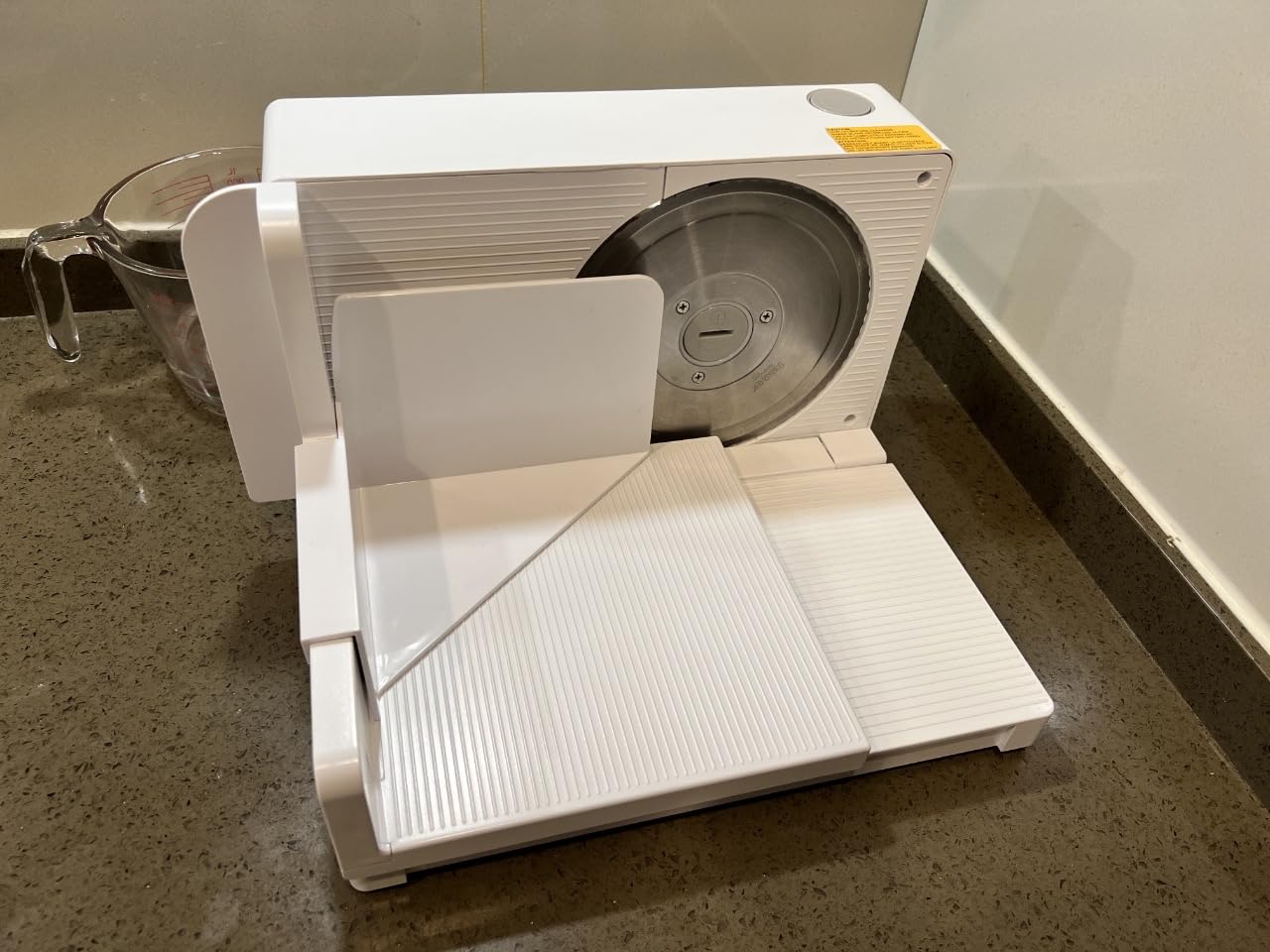
The Cogace solves a problem that several Reddit users raised: where do you store a meat slicer when you are not using it? The answer from Cogace is a foldable design that collapses to roughly the size of a large book. If counter and cabinet space are at a premium in your kitchen, this is the most storage-friendly slicer I tested.
The standout component is the German RSG 6.7-inch stainless steel blade. RSG is a respected blade manufacturer, and the quality shows in the cut. The blade is sharp out of the box and maintained its edge through my full testing period. The 6.7-inch diameter is the smallest in this lineup, which means you are limited to smaller cuts of meat and modest-sized food items.
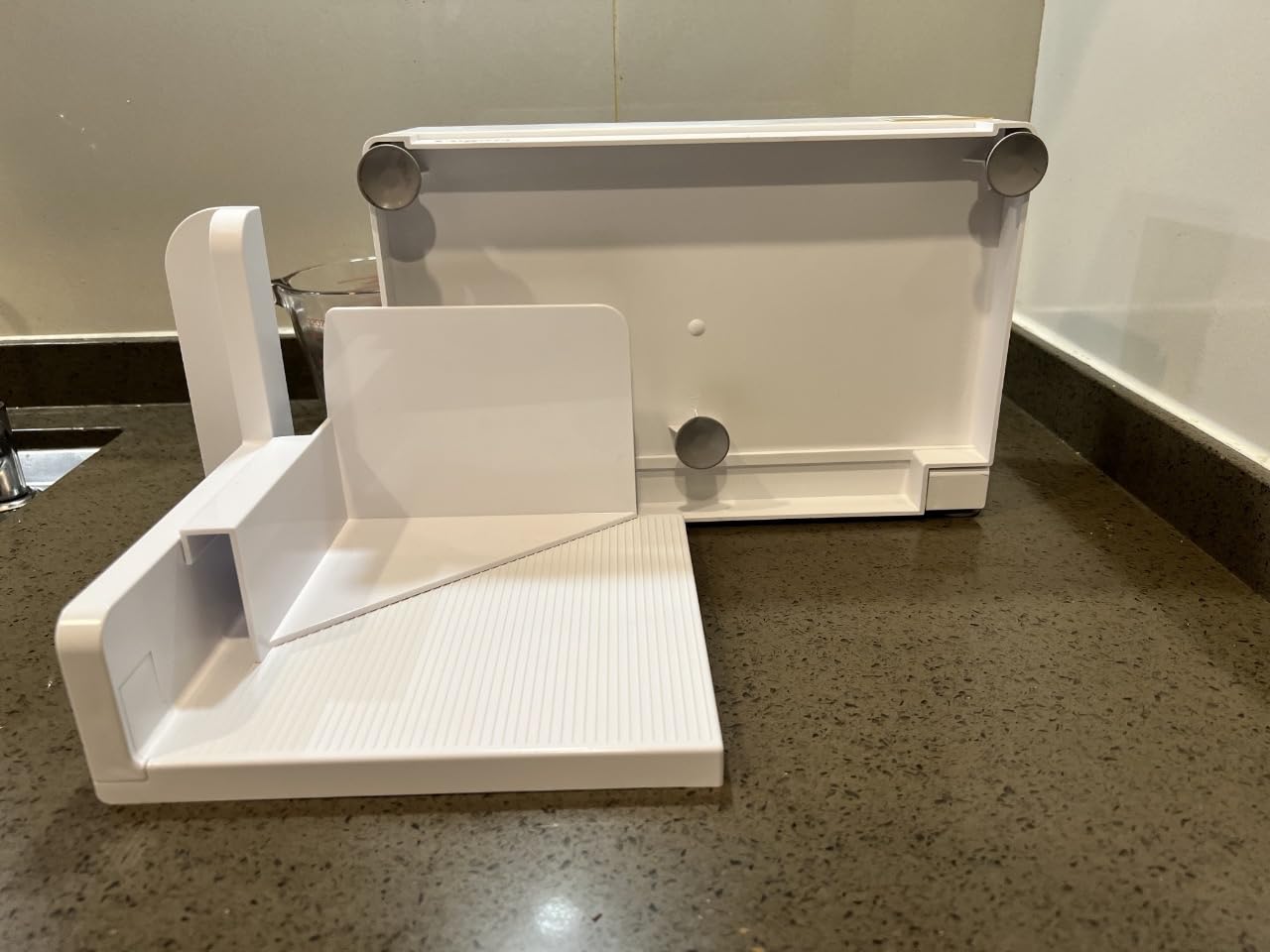
The thickness range on the Cogace goes from 0 to 20mm, which is the widest range of any slicer here. Most competitors cap out at 15mm. That extra 5mm matters if you want thick steak-cut slices or generous portions of cheese. At the thin end, the dial produces deli-thin slices suitable for charcuterie.
I was impressed by the one-twist disassembly. The blade, machine body, and food pusher all come apart with a simple twist motion, no tools required. This makes cleanup genuinely fast, which addresses one of the biggest pain points users have with home slicers. The white ABS body wipes clean with a damp cloth.
Fold-Flat Storage Benefits
When folded, the Cogace fits into a kitchen drawer or on a narrow shelf. I stored it in the drawer beneath my cutting board between uses, and it took up less space than my stand mixer attachments. For anyone who has hesitated to buy a slicer because of storage concerns, this design removes that barrier entirely.
The folding mechanism feels sturdy. After about 50 fold and unfold cycles during testing, the hinge showed no looseness or wobble. The carriage locks firmly into both the operating position and the folded position, so there is no risk of it collapsing during use or unfolding during storage.
RSG Blade Quality
The German RSG blade is the Cogace’s defining feature. RSG blades are known for their hardness and wear resistance, which means they hold an edge longer than standard stainless steel blades. During my testing, I noticed consistent cut quality from the first slice to the last, with no dulling.
The 6.7-inch diameter does limit the size of food you can slice. Large roasts need to be cut down before slicing, and wide blocks of cheese may not fit the carriage. For deli meats, bacon, and smaller food items, the blade size is perfectly adequate.
How to Choose the Best Meat Slicer for Home Use?
Choosing from the best meat slicers for home comes down to understanding your own cooking habits and matching them to the right features. I have broken down the key factors below based on what actually mattered during my testing, not just what looks good on a spec sheet.
Blade Size and Type
Blade diameter ranges from 6.7 inches to 9 inches in this lineup. Smaller blades, like the 6.7-inch VEVOR and Cogace, are fine for deli meats and small items but struggle with large roasts. The 7.5-inch blade on most models is the versatile sweet spot for home use. The 9-inch Techwood blade is the best choice if you regularly work with large cuts like brisket.
Blade type matters just as much as size. Serrated blades are better for bread and foods with tough exteriors, while smooth blades produce cleaner cuts on delicate items like prosciutto and soft cheese. If you can only have one, serrated is more versatile. If you want both, the Borlebbi and VEVOR include dual blades.
Motor Power and Duty Cycle
Motor wattage in this lineup ranges from 130W to 200W. The 200W motors on the Borlebbi, Techwood, OSTBA 200W, and NutriChef handle dense cheese and large cuts without bogging down. The 150W models are adequate for deli meats but will struggle with hard cheese. The 130W Cuisinart is fine for typical home use but is the least powerful here.
Duty cycle refers to how long the motor can run before needing a rest. Home-grade slicers are designed for intermittent use, typically 10 to 15 minutes of continuous operation followed by a cool-down period. If you plan to slice large batches for jerky or meal prep, a 200W motor will handle the workload better than a lower-powered unit.
Thickness Adjustment Range
Most slicers in this lineup offer a 0-15mm thickness range, which covers everything from paper-thin charcuterie slices to thick sandwich portions. The Cuisinart uses fractional measurements from 1/32 inch to 1/2 inch, giving you precise control at the thin end. The Cogace goes up to 20mm for the thickest cuts.
For charcuterie and prosciutto, you want the ability to slice extremely thin, under 1mm. All the models here can achieve that at their minimum setting. For thick sandwich cuts, look for a maximum thickness of at least 10mm, which every model here provides.
Build Material and Weight
Heavier slicers stay more stable during use, which translates to more consistent slices. The OSTBA 200W with its cast iron body and the Cuisinart with its die-cast aluminum housing are the most stable models here. The lightweight VEVOR at 6.94 pounds is easy to move but relies on suction feet to prevent shifting.
Stainless steel and aluminum components resist staining and are easier to clean than plastic. The Cuisinart and Techwood have the most premium feel in terms of material quality, while the budget models use more plastic in their construction.
Cleaning and Maintenance
Cleaning is the number one complaint I see in user reviews across all brands. Look for slicers with removable blades, carriages, and food pushers. Every model in this lineup offers removable components, but the Cogace with its one-twist disassembly and the Borlebbi with its tool-free breakdown are the easiest to clean.
Never put slicer components in the dishwasher. The high heat and harsh detergents can damage blade edges and corrode metal surfaces. Wash all parts by hand in warm soapy water and dry immediately. A light coat of food-grade mineral oil on the blade between uses prevents corrosion and keeps the edge protected.
Safety Features for Home Kitchens
If you have children, look for a slicer with a child safety lock. The OSTBA models, Borlebbi, and Cogace all require two-handed operation to start, which prevents accidental activation. Non-slip suction feet are standard across the lineup and keep the machine planted on your counter.
Always use the food pusher, never your hands, to guide food through the blade. The blade guard on models like the Techwood and NutriChef provides an additional barrier between your fingers and the cutting edge. Unplug the slicer when cleaning or changing blades.
Storage Considerations
If counter space is tight, consider the foldable models. The VEVOR and Cogace both fold down for compact storage in a drawer or cabinet. The larger models like the Techwood and Cuisinart require dedicated counter or cabinet space. Measure your available storage area before buying.
Noise Levels
Noise is rarely discussed in competitor reviews, but it matters for home use. The Borlebbi’s DC motor is the quietest in this lineup by a noticeable margin. AC motors on the other models produce a higher-pitched whine that some users find grating during extended slicing sessions. If you live in close quarters, the Borlebbi is the clear choice for noise.
FAQs
What is the best slicer for home use?
The Borlebbi 200W DC Motor Meat Slicer is the best overall slicer for home use, thanks to its quiet DC motor, dual stainless steel blades, and precise 0-15mm thickness control. For budget-conscious buyers, the VEVOR 6.7-inch slicer offers excellent value with two included blades.
Are home meat slicers worth it?
Yes, a home meat slicer is worth it if you regularly buy deli meats, cure your own meats, make jerky, or prep charcuterie boards. A quality slicer pays for itself within months by letting you buy whole cuts of meat at lower prices than pre-sliced deli portions, while giving you control over slice thickness that hand-cutting cannot match.
How do I choose a meat slicer for my home?
Choose a meat slicer based on three main factors: blade size (7.5 inches is the versatile sweet spot for home use), motor power (200W handles dense foods better than 150W), and ease of cleaning (look for removable blades and carriages). Also consider storage space, noise levels, and whether you need a serrated or smooth blade for your typical slicing tasks.
How thin can a home meat slicer slice?
Most home meat slicers can cut as thin as 0mm at the minimum thickness setting, producing translucent slices suitable for charcuterie and prosciutto. The Cuisinart FS-75 offers precise fractional control down to 1/32 inch, while most other models use a 0-15mm dial that achieves paper-thin slices at the lowest setting.
Can I slice cheese on a meat slicer?
Yes, you can slice semi-firm and firm cheese on a meat slicer. Hard cheeses like cheddar and parmesan work well with 200W motors, but lower-powered 150W models may struggle. Soft cheeses can gum up the blade and are not recommended. Use a smooth blade rather than a serrated one for the cleanest cheese slices.
Wrapping Up
After three months of testing, the Borlebbi 200W DC Motor Meat Slicer stands out as my top pick among the best meat slicers for home in 2026. Its quiet motor, dual blade system, and precise thickness control give you the most versatile slicing experience without the noise of a commercial deli machine.
For value, the Techwood 9-inch slicer gives you the largest blade and solid build quality at a fair price. And if budget is your primary concern, the VEVOR delivers two blades and a foldable design for less than you might expect. Whatever your kitchen needs, one of these eight slicers will get you slicing like a deli pro at home.